Evaluating Inflectional Complexity Crosslinguistically:
a Processing Perspective
Claudia Marzi
1, Marcello Ferro
1, Ouafae Nahli
1, Patrizia Belik
2, Stavros Bompolas
3, Vito Pirrelli
11Institute for Computational Linguistics-CNR,2Universitat Politècnica de Valencia,3University of Patras
[email protected], [email protected] {claudia.marzi, marcello.ferro, ouafae.nahli, vito.pirrelli}@ilc.cnr.it
Abstract
The paper provides a cognitively motivated method for evaluating the inflectional complexity of a language, based on a sample of "raw" inflected word forms processed and learned by a recurrent self-organising neural network with fixed parameter setting. Training items contain no information about either morphological content or structure. This makes the proposed method independent of both meta-linguistic issues (e.g. format and expressive power of descriptive rules, manual or automated segmentation of input forms, number of inflectional classes etc.) and language-specific typological aspects (e.g. word-based, stem-based or template-based morphology). Results are illustrated by contrasting Arabic, English, German, Greek, Italian and Spanish.
Keywords:paradigm-based morphology, inflectional complexity, prediction-based processing, recurrent self-organising networks.
1.
Introduction
There is little doubt that some languages are inflectionally more complex than others. Everybody would agree with the intuitive statement that the English conjugation system is simpler than the German system, and that the latter is, in turn, simpler than the verb system of Modern Standard Arabic. However, the naïve view is faced with two apparent paradoxes. When linguists try to pinpoint the source of this complexity, the task is far more elusive than expected, and goes well beyond a purely descriptive notion of diversity in the battery of realisational means (e.g. number of differ-ent affixes, number of cells in the corresponding paradigms, amount of stem allormophy etc.) provided by each system. Besides, there seems to be a poor correlation between our intuitive notion of morphological complexity and actual ev-idence of the pace of acquisition of more or less complex inflectional systems in child language. In some cases, ap-parently simpler inflectional markers may take more time to be acquired than formally more complex and articulated ones. What looks like a prohibitively difficult learning task in the light of the complexity and uncertainty of the infer-ence steps required for mastering it, may turn out to be rel-atively unproblematic for human speakers. In the present paper we entertain a usage-oriented, cognitively motivated approach to issues of morphological complexity, based on a neurobiologically inspired model of word processing and learning, and explore its theoretical and computational im-plications.
2.
Background
Assessing and understanding the comparative complex-ity of the inflectional system of a language relative to a functionally-equivalent system of another language re-mains an open question, which has animated much of the contemporary debate on the nature of word knowledge and its connection with issues of word usage (Ackerman and Malouf, 2013; Bane, 2008; Bearman et al., 2015; Juola, 1998; Moscoso del Prado Martín et al., 2004). In a crosslinguistic perspective, the way
morphosyntac-tic features are contextually realised through processes of word inflection probably represents the widest dimension of grammatical crosslinguistic variation, somewhat belit-tling universal invariances along other dimensions (Evans and Levinson, 2009).
pre-dicted and inferred on the basis of known forms, thereby making it easier for a human speaker to process, retain and access them. Not only do implicative relations shed light on the way children come to master the inflectional tem of their mother tongue, but they also constrain sys-tems of word shapes, providing a limit on the range of E-complexity that languages can afford.
A number of information theoretic approaches have been proposed to model this view in terms of Kolmogorov com-plexity (Kolmogorov, 1965) and Shannon entropy (Shan-non, 1948). The idea behind Kolmogorov complexity is to measure a dataset of inflected forms as the shortest possible grammar needed to describe them. This however leads to a definition of morphological complexity heavily dependent on the grammar formalism adopted (Bane, 2008; Walther and Sagot, 2011). Ackerman and Malouf (2013) use Shan-non’s information entropy to quantify prediction of an in-flected form as a paradigm-based change in the speaker’s uncertainty. They conjecture that inflectional systems tend to minimise the average conditional entropy of predicting each form in a paradigm on the basis of any other form of the same paradigm (Low Conditional Entropy Conjecture or LCEC). This is measured by looking at the distribution of inflectional markers across inflection classes in the mor-phological system of a language. Although LCEC proves to be able to capture a substantial part of the inferential complexity within paradigms, it presupposes a segmenta-tion of inflected forms into stems and affixes, while ignor-ing implicative relations holdignor-ing between stem allomorphs. Use of principal parts can remedy this in a principled way (Finkel and Stump, 2007, among others). However, while entropy measures can provide extremely valuable insights into the organisation of static, synchronic paradigms, there are crucial complementary questions about how such pat-terns are processed and learned which remain unaddressed. In what follows, we will focus on these important issues from a neuro-computational perspective. In particular, we are interested in evaluating the net effect of the complexity of an inflectional system on the processing behaviour of a recurrent neural network, excluding the role of word token frequency effects on prediction-driven processing (Picker-ing and Garrod, 2013). To factor out frequency effects, we ran simulations on uniformly distributed inflectional data. Our work can hence be understood as a purely morpholog-ical evaluation of complexity, based on lexmorpholog-ical rather than corpus data. Since uniform distributions increase the en-tropy of a system, our results define some sort of upper bounds for inflectional complexity: if all factors (including frequency) are taken into account, the effects we observe here will likely be more prone to potentially confound-ing factors. This is in the spirit of information-theoretic work on paradigm-based morphology, as well as ‘discrimi-native learning’ research in animal behaviour and language learning (Rescorla and Wagner, 1972; Ramscar and Yarlett, 2007; Ramscar and Dye, 2011), and justifies our choice of a specific type of recurrent neural network, namely a Tem-poral Self-Organising Map (Ferro et al., 2011; Marzi and Pirrelli, 2015; Pirrelli et al., 2015; Marzi et al., 2016) as a workbench for simulating pardigm-based effects. Ulti-mately, it is intended to bridge the gap between an
algorith-mic/mathematical understanding of processing-based mor-phological complexity (Balling and Baayen, 2008; Balling and Baayen, 2012), and the neurobiological (or implemen-tational) level of Marr’s hierarchy (Marr, 1982).
3.
Method and data
According to Dressler and colleagues (Bittner et al., 2003), European languages can be arranged along an inflectional complexity continuum, ranging from a more inflecting-fusional type (left) to a more isolating type (right):
Lithuanian→Greek→Russian→Croatian→Italian→ Spanish→German→Dutch→French→English.
Somewhat paradoxically, developmental evidence provides an indication that inflectional contrasts in prototypically in-flecting verb systems are reported to be acquired at an ear-lier stage than inflectional contrasts in more isolating verb systems.1
Here, we would like to investigate the related question about how degrees of inflectional complexity/regularity af-fect word processing strategies. For this purpose, we analyse the performance of recurrent self-organising neu-ral networks learning a few languages in the typological continuum above: namely, English, German, Greek, Ital-ian and Spanish. To broaden our typological data, Stan-dard Modern Arabic was added to the range of tested languages. For each language we sampled the 50 top-frequency verb paradigms found in a few reference re-sources: CELEX (Baayen et al., 1995) for German and English; the Paisà Corpus (Lyding et al., 2014) for Ital-ian; the European Spanish Subcorpus of the Spanish Ten-Ten Corpus (www.sketchengine.co.uk); the SUBTLEX-GR corpus (Dimitropoulou et al., 2010) for Modern Greek; the Penn Arabic Treebank (Maamouri et al., 2004). To con-trol paradigm implicative relations, we selected a com-parable set of 15 paradigm cells (14 cells for Arabic).2
The sample contains a shared set of 6 present and 6 past tense forms for English, German, Greek, Italian and Span-ish. Infinitive, gerund/present participle and past participle forms were added for English, German, Italian and Span-ish, whereas 3 singular forms of the simple future were included for Modern Greek. The Arabic set contains 7 imperfective and 7 perfective forms, including 1S, 2MS, 3MS, 3FS, 1P, 2MP, 3MP cells. Only inflected “raw” forms from the selected cells were included for training a recur-rent neural network, with no additional morphological in-formation. Each language-specific dataset is administered to a Temporal Self-Organising Map (hereafterTSOM,see section 3.2. for more details) for 100 epochs. In one epoch, all word forms are randomly input to the map five times, and each training session was repetated five times with re-sults averaged over repetitions to control random
variabil-1For example, Noccetti (2003) reports that the transition from
pre- to proto-morphology in Italian verb acquisition has an early onset at Brown’s stage II, with mean length of utterance 2 (Brown, 1973), in contrast with the comparative late emergence of the third-person singular marker -sin the acquisition of the English present tense.
2The full set of data, for each language, is available at
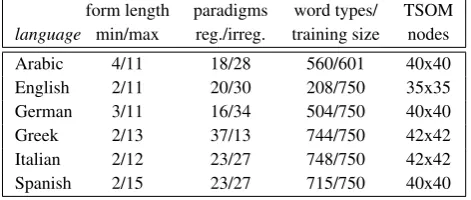
ity. TSOM parameters are identically initialised across the 6 languages, with the only exception of available memory nodes (Table 1).3
3.1.
The data
The selected paradigm cells for the target languages offer evidence of graded levels of morphological (ir-)regularities. Greek, Italian, Spanish and German present highly inflect-ing conjugation systems, with extensive stem allomorphy, exhibiting varying degrees of (ir)regularity. Inflecting pro-cesses include prefixation, suffixation, vowel alternation, infixation and suppletion. Arabic stem formation is based on the interspersion of discontinuous consonantal roots and variable vowel patterns. English offers the by far simplest inflectional system, with extensive syncretism and a rather dichotomous subdivision of paradigms between regular and irregular ones.
For all test languages except Modern Greek, word forms are orthographically transcribed, and administered to the network one symbol at a time as raw letter strings (start-ing with the start-of-word symbol ’#’ and ending with the end-of-word symbol ’$’), with no information about their morphological structure. To account for the com-plex interaction between morphologically-conditioned and phonologically-conditioned stem allomorphy in Greek con-jugation (Ralli, 2005; Ralli, 2006), Greek word forms are transcribed phonologically, and input one segment at a time. Once more, no information about morphological structure is input. To assess the network sensitivity to mor-phological structure and the processing behaviour of the map across morpheme boundaries (see section 4.), after training, word forms in all test languages were segmented morphologically according to a prefix-stem-suffix schema: e.g. Greeke-krin-a‘I judged’, Germange-dach-t‘thought’ (past participle), Arabic ya-ktub-u ‘he writes’. Stem al-lomorphs within a single paradigm (whether morphologi-cally/phonologically predictable or not) are segmented as whole units, with no explicit indication of either the root or the alternating pattern: e.g. Arabic katab-a‘he wrote’ vs.ya-ktub-u‘he writes’. Only purely suffixal stem forma-tion is segmented: e.g. GreekAGApi-s-A ‘I loved’, Italian
perd-ut-o‘lost’ (past participle).
3.2.
Recurrent self-organising neural networks
TSOMs are recurrent self-organising networks consisting of two-dimensional grids of artificial memory/processing nodes that learn to dynamically memorise input strings as chains of maximally-responding processing nodes (Best Matching Units, or BMUs), whose level of sensitivity to in-put symbols in context is a continuous function of their dis-tributional regularities in training (Ferro et al., 2011; Marzi and Pirrelli, 2015; Pirrelli et al., 2015; Marzi et al., 2016). In a TSOM, each processing node has two layers of synap-tic connectivity: an input layer, connecting each node to3
For the sake of data comparability, the number of memory nodes for each language was decided empirically to control for cross-linguistic differences in cardinality and length of word types (see Table 1). For all trained languages, the percentage of used nodes among all available nodes ranges between 31% and 35%.
form length paradigms word types/ TSOM
language min/max reg./irreg. training size nodes Arabic 4/11 18/28 560/601 40x40 English 2/11 20/30 208/750 35x35 German 3/11 16/34 504/750 40x40 Greek 2/13 37/13 744/750 42x42 Italian 2/12 23/27 748/750 42x42 Spanish 2/15 23/27 715/750 40x40
Table 1: Language training sets. Form length is measured by the number of orthographic/phonetic symbols. In the Italian sample, we encoded the orthographic accent as a separate character (e.g.è=e’). Differences between word types and cardinality of the training set are due to syn-cretism (particularly extensive in English). Paradigm de-fectiveness explains the smaller cardinality of the Arabic training set.
the current input stimulus (i.e. orthographic or phonolog-ical symbols), and a (re-entrant) temporal layer, connect-ing each node to all other nodes. Every time a symbol is presented to the input layer, activation propagates to all map nodes through input and temporal connections, and the most highly activated node (BMU) is calculated (see Figure 1). Given the BMU at timet, the temporal layer en-codes the expectation of the current BMU for the node to be activated at timet+1. The strength of the connection be-tween consecutively activated BMUs is trained through the following principles of discriminative learning: given the input bigramab, the connection strength between the BMU that get mostly activated foraat timetand the BMU forb
at timet+1will:
(i) increase ifaoften precedesbin training (entrenchment), (ii) decrease ifbis often preceded by a symbol other thana
(competition).
x
1
x
2
...
x
j
...
x
D
#
p
p
...
o
...
...
$
w
1
w
2
...
pop
...
...
w
L
input layer
input connections
map nodes
temporal connections
IAP connections
symbol level word level
Figure 1: Functional architecture of a Temporal Self-Organising Map (TSOM). Each input word form is pre-sented by a unique time-series of symbols, which are ad-ministered one at a time.
on higly redundant input data such as verb paradigms, spe-cialisation and blending may interact. By inputting all verb forms with a uniform token distribution, we factor out the effect of frequency and focus our analysis on the effect of formal redundancy only. Thus, due to the prediction-driven bias of the temporal layer of re-entrant connections, strong expectations over upcoming input symbols account for suc-cessful serial word processing, with processing accuracy being a function of how confident the TSOM is about the position of the current symbol in the input string.
These dynamics make it possible to test the behaviour of a TSOM on specific lexical tasks: word recall andserial word processing. For each time series of input symbols (i.e. each word form), the processing response of the map is represented by the synchronic activation pattern of all the BMUs that most highly get activated for that input se-quence. Thus, the task ofword recalltests how accurately a map can retrieve the input word from its synchronic activa-tion pattern, namely how accurately the activaactiva-tion nodes of the map can encode information about the timing of the in-put symbols that make up the word. Accuracy in recall ver-ifies that, for each input form, activation propagation (i.e. sequential activation) of nodes within each synchronic pat-tern correctly activates the BMUs associated with the sym-bols of each word. Scores are given in Table 2, showing very high accuracy and remarkably cross-linguistic simi-larity.
Conversely, serial word processing can be monitored by evaluating the ability of a map to predict an incrementally presented input word. Proceduraly, by presenting one sym-bol at a time on the input layer, a TSOM is prompted to complete the current input string by anticipating the upcom-ing BMU to be activated. Anticipation/prediction scores across input words are calculated by incrementally assign-ing each correctly anticipated symbol in the input form a 1-point score, i.e. the anticipation score of the preceding symbol incremented by 1. Otherwise, for unpredicted sym-bols the score is 0. The more input symsym-bols are anticipated,
language recall % sd % Arabic 99.93 0.16
English 99.62 0.86
German 99.76 0.18
Greek 99.84 0.06
Italian 99.79 0.15
Spanish 99.94 0.13
Table 2: For each language, percentage values of correctly recalled word types and standard deviations are given, av-eraged over 5 map instances.
0.0 0.5 1.0 1.5 2.0
−10 −5 0 5
distance to morpheme boundary
PREDICTION
Arabic English German Greek Italian Spanish
Figure 2: Marginal plot of interaction effects between lan-guage and distance to morpheme boundary, in an LMER model fitting the number of symbols predicted by TOMs. Fixed effects: languages, distance to morpheme boundary. Random effects: TSOM instances, paradigms, word forms.
the easier the prediction of that word. Results will be given and discuss in the ensuing section (4.).
4.
Results and discussion
All results in this section are analysed with linear models for mixed effects (LMERs). For all models/languages, we treated TSOM instances, verb paradigms and word forms as random effects. In particular, we show how inflectional systems of different complexity (independent variables) af-fect TSOM processing, by focusing on symbol prediction rate as a dependent variable.
Figure 2 plots, for each language, the rate of symbol predic-tion in serial word processing. It should be appreciated that Arabic, German, Italian and Spanish exhibit remarkably similar trends, with not significantly different slopes (p-values >.05). Only Greek and English present significantly different slopes (p-values <.001), with Greek forms being the hardest to process (lower slope), and English forms the easiest ones (higher slope).
0 1 2
−10 −5 0 5
distance to morpheme boundary
PREDICTION
I R
Figure 3: Marginal plot of interaction effects between cate-gorical (ir-)regularity and distance to morpheme boundary, in an LMER model fitting the number of symbols predicted by TOMs. Fixed effects: irregulars (I) vs. regulars (R), dis-tance to morpheme boundary. Random effects: languages, TSOM instances, paradigms, word forms.
<.001) than forms in irregular ones, as shown by the marginal plot in Figure 3.
To investigate in more detail the impact of inflectional com-plexity on processing, we fitted an LMER of symbol predic-tion for each language, with classes of morphological regu-larity (regulars vs. irregulars) and morphological structure (stem vs. suffix) as fixed effects (Figure 4).
The marginal plots in Figure 4 better show a clear serial processing effect of the distance of an input symbol to the stem-ending boundary, over and above the length of the input string. Unsurprisingly, Italian and Spanish show a very similar behaviour, with irregular forms exhibiting fu-sional effects that blur the boundary between stem and in-flectional endings, and comparable (but not identical) num-ber of stem allomorphs (Boyé and Cabredo Hofherr, 2006; Pirrelli, 2000). Remarkably, both German and Greek ex-hibit systematic (albeit not always predictable) processes of stem formation, followed by a fairly homogenous pool of inflectional endings. As a result, in both languages, the base stem (or present stem) is often followed by a highly embedded and unpredictable sequence of symbols which account for the negative slopes in the corresponding seg-ments. In Arabic imperfective forms, prefixation is used to convey person features. This makes selection of inflec-tional endings fairly predictable, given the stem. Finally, in our pool of languages, English offers the by far simplest inflectional system, with extensive syncretism and a rather dichotomous subdivision of paradigms between regular and irregular ones.
Slopes are also modulated by degrees of regular-ity/transparency of the stem. Discontinuous patterns of morphological structure are often found in irregu-lar paradigms of concatenative languages (e.g. English
drink/drunk, German finden/fanden), and are systemati-cally attested in non-concatenative morphologies (e.g. Ara-bickataba/yaktubu). It is well known in the literature on
se-−6 −4 −2 0 2 4
distance to morpheme boundary
PREDICTION
distance to morpheme boundary
Spanish
Irregulars: stem Regulars: stem Irregulars: suffix Regulars: suffix
Figure 4: For each language, marginal plots of interac-tion effects between morphological (ir-)regularity and dis-tance to morpheme boundary, in LMER models fitting the number of symbols predicted by TOMs for stem and suf-fix. Fixed effects: regularity (dashed lines) vs. irregular-ity (solid lines), distance to morpheme boundary, stem and suffix as separate patterns, suffix length. Random effects: TSOM instances, paradigms, word forms.
rial alignment that discontinuous patterns are more difficult to be processed and tracked down (Hahn and Bailey, 2005). In the present context, stem allomorphs are less predictable since their "uniqueness point", i.e. the point at which they can be distinguished from all neighbouring allomorphs, are normally delayed, slowing down processing (Balling and Baayen, 2012). Other things being equal,4 the order of
magnitude of this competing effect is a function of the num-ber of stem allomorphs: the more they are, the more confus-able the input stem is. Conversely, in regular paradigms the same stem shows up systematically in all cells. Hence the stem suffers from no intra-paradigmatic competition. These factors provide, on average, a net processing advantage of stems in regular paradigms, as confirmed by the significant difference in prediction rate between stems of regular vs. irregular paradigms in all languages (Figure 4). However, the clear advantage in stem processing is somewhat com-pensated by the difference in the prediction rate on suffixes. In German, Greek, Italian and Spanish suffixes in irregulars are predicted significantly more easily than suffixes in regu-lar forms, as shown by the steeper segments in the positive
4The effect is modulated by other factors we are not
xrange of Figure 4. Besides, for all languages, there is a deeper drop in prediction rate at the stem-suffix bound-ary (forx = 0 as the first symbol of the suffix) in regu-lar forms. In fact, stem allomorphs typically select only a subset of paradigm cells. Hence they can be followed by fewer inflectional endings than regular stems are. This re-duces processing uncertainty, by constraining the range of possible continuations at the stem-suffix boundary of irreg-ularly inflected forms. As a result, irregulars tend to blur the TSOM sensitivity to the verb morphological structure, favouring a somewhat more holistic processing strategy. Results and statistical significance are confirmed when we consider a more fine-grained meausure for inflectional complexity based on a gradient of morphological regular-ity, which takes into account the number of stem alternants of a given paradigm.5 It represents a graded - and contin-uous - meausure of paradigmatic (ir-)regularity that con-siders, for each inflected form, the number of stem-sharing forms (or stem family size), instead of a dichotomous and formal classification of paradigms (regulars vs. irregulars). Thus, given the number of inflected form-types for each paradigms, the average stem family size correlates better with the non-categorical idea of inflectional complexity.
5.
Concluding remarks
Our evidence is in line with Low Conditional Entropy Con-jecture (Ackerman and Malouf, 2013). The processing cost of considerably different inflectional systems appears to os-cillate within a fairly limited range of variation, whose up-per bound and lower bound are marked, in our language sample, by Modern Greek and English respectively. All other conjugations present no statistically significant dif-ferences in the processing overhead they require, in spite of their typological diversity, which is nonetheless reflected by the different processing profiles exhibited by sublexical constituents in the different languages.
In a functional perspective, this evidence can be interpreted as the result of a balancing act between two potentially competing communicative requirements: (i) a recognition-driven tendency for a maximally contrastive system; and (ii) a production-driven bias for a maximally generalisable inflection system, where, for each paradigm, all forms in the paradigm can possibly be deduced from any one of its forms.
This interpretation is also compatible with another clear pattern shown by our data. In each of our sample lan-guages, the difference between the processing cost of forms in irregular paradigms compared with the processing cost of forms in irregular paradigms shows an interesting structure-sensitive profile. The higher processing cost of irregular stems is compensated by a lower cost in processing the in-flectional endings selected by irregular stems. Once more, these structural effects tend to reduce processing costs at the level of the whole word, making the inflectional sys-tem as functional as possible from an information theoretic
5
This graded notion takes into accout exceptional alternating stems in otherwise regular paradigms (e.g. Italianaprire/aperto
and Spanish abrir/abierto, “open” infinitive/”opened” past ticiple). At the same time, it captures the difference between par-tially irregular paradigms and radically idiosynchratic ones.
perspective. In recognising that scale effects play an im-portant role in the processing behaviour of our model at the word level, and that constrains on word processing are likely to obtain universally, we also highlight the funda-mental communicative role of words as optimal-sized units for describing general functional tendencies in language, and for studying language as a complex information sys-tem.
Inflectional complexity is multifactorial and dynamic. Its variability can be observed and measured on many counts: number and types of stem allomorphs, number and types of inflectional affixes, transparency/compositionality effects, stem-stem predictability, stem-affix predictabil-ity, affix-affix predictabilpredictabil-ity, intra-paradigmatic and inter-paradigmatic frequency distributions etc. In this paper, we investigated inflectional complexity by controlling a num-ber of interacting factors through language-specific train-ing regimes, on which we ran a psycho-ltrain-inguistically plau-sible computer model of inflection learning. In this way, we could understand more of factor interaction through a quantitative analysis of the way the performance of our sys-tem is affected across different training regimes. Method-ologically, it allows for much more flexible and controlled test/analysis protocols than those commonly used with hu-man subjects in experimental psycholinguistics.
In addition, understanding more of the real cognitive hur-dles a human learner has to face in the process of effec-tively acquiring an inflectional system of average complex-ity may also shed some light on optimal practices for lan-guage teaching.
6.
Bibliographical References
Ackerman, F. and Malouf, R. (2013). Morphological orga-nization: The low conditional entropy conjecture. Lan-guage, 89(3):429–464.
Baayen, H. R., Piepenbrock, P., and Gulikers, L., (1995).
The CELEX Lexical Database (CD-ROM). Linguistic Data Consortium, University of Pennsylvania, Philadel-phia, PA.
Balling, L. W. and Baayen, R. H. (2008). Morphological effects in auditory word recognition: Evidence from dan-ish. Language and Cognitive processes, 23(7-8):1159– 1190.
Balling, L. W. and Baayen, R. H. (2012). Probability and surprisal in auditory comprehension of morphologically complex words. Cognition, 125(1):80–106.
Bane, M. (2008). Quantifying and measuring morpholog-ical complexity. InProceedings of the 26th West Coast Conference on Formal Linguistics, pages 69–76. Matthew Bearman, et al., editors. (2015). Understanding
and Measuring Morphological Complexity. Oxford Uni-versity Press.
Bickel, B. and Nichols, J. (2005). Inflectional synthesis of the verb. In David Gil Martin Haspelmath, Matthew S. Dryer et al., editors, The World Atlas of Language Structures, pages 94–97. Oxford University Press. Dagmar Bittner, et al., editors. (2003). Development of
Blevins, J. P. (2003). Stems and paradigms. Language, 79(2):737–767.
Blevins, J. P. (2016). Word and Paradigm Morphology. Oxford University Press, Oxford.
Boyé, G. and Cabredo Hofherr, P. (2006). The structure of allomorphy in spanish verb inflection. Cuadernos de Lingüística, 13:9–24.
Brown, R. (1973). A first language: the early stages. George Allen I& Unwin.
Burzio, L. (1998). Multiple correspondence. Lingua, 104:79–109.
Bybee, J. and McClelland, J. L. (2005). Alternatives to the combinatorial paradigm of linguistic theory based on domain general principles of human cognition.The Lin-guistic Review, 22(2-4):381–410.
Bybee, J. (1995). Regular morphology and the lexicon.
Language and Cognitive Processes, 10(5):425–455. Dimitropoulou, M., Duñabeitia, J. A., Avilés, A., Corral, J.,
and Carreiras, M. (2010). Subtitle-based word frequen-cies as the best estimate of reading behavior: the case of greek.Frontiers in Psychology, 1(218):1–12.
Evans, N. and Levinson, S. C. (2009). The myth of lan-guage universals: Lanlan-guage diversity and its importance for cognitive science. Behavioral and Brain Sciences, (32):429–92.
Ferro, M., Marzi, C., and Pirrelli, V. (2011). A self-organizing model of word storage and processing: impli-cations for morphology learning. Lingue e Linguaggio, 10(2):209–226.
Finkel, R. and Stump, G. (2007). Principal parts and mor-phological typology.Morphology, 17:39–75.
Hahn, U. and Bailey, T. M. (2005). What makes words sound similar? Cognition, 97:227–267.
Juola, P. (1998). Measuring linguistic complexity: The morphological tier. Journal of Quantitative Linguistics, 3(5):206–213.
Kolmogorov, A. N. (1965). Three approaches to the quan-titative definition of information. Problems of informa-tion transmission, 1(1):1–7.
Lyding, V., Stemle, E., Borghetti, C., Brunello, M., Castag-noli, S., Dell’ Orletta, F., Dittmann, H., Lenci, A., and Pirrelli, V. (2014). The paisá corpus of italian web texts. Proceedings of the 9th Web as Corpus Workshop (WaC-9)@ EACL 2014, pages 36–43. Association for Compu-tational Linguistics.
Maamouri, M., Bies, A., Buckwalter, T., and Mekki, W. (2004). The penn arabic treebank: Building a large-scale annotated arabic corpus. In NEMLAR conference on Arabic language resources and tools, volume 27, pages 466–467.
Marr, D. (1982). Vision. A Computational Investigation into the Human Representation and Processing of Visual Information. Freeman and Company.
Marzi, C. and Pirrelli, V. (2015). A neuro-computational approach to understanding the mental lexicon. Journal of Cognitive Science, 16(4):493–535.
Marzi, C., Ferro, M., and Pirrelli, V. (2014). Morpholog-ical structure through lexMorpholog-ical parsability. Lingue e Lin-guaggio, 13(2):263–290.
Marzi, C., Ferro, M., Cardillo, F. A., and Pirrelli, V. (2016). Effects of frequency and regularity in an inte-grative model of word storage and processing. Italian Journal of Linguistics, 28(1):79–114.
Matthews, P. H. (1991). Morphology. Cambridge Univer-sity Press, Cambridge.
McWorther, J. (2001). The world’s simplest grammars are creole grammars.Linguistic Typology, (5):125–166. Moscoso del Prado Martín, F., Kosti´c, A., and Baayen.,
R. H. (2004). Putting the bits together: An informa-tion theoretical perspective on morphological process-ing.Cognition, 94(1):1–18.
Noccetti, S. (2003). Acquisition of verb morphology in italian: A case study. In Dagmar Bittner, et al., edi-tors, Development of Verb Inflection in First Language Acquisition: a cross-linguistic perspective, pages 351– 378. Mouton de Gruyter, Berlin.
Pickering, M. J. and Garrod, S. (2013). An integrated the-ory of language production and comprehension. Behav-ioral and Brain Sciences, 36:329–392.
Pirrelli, V. and Battista, M. (2000). The paradigmatic di-mension of stem allomorphy in italian verb inflection.
Italian Journal of Linguistics, 12(2):307–380.
Pirrelli, V., Ferro, M., and Marzi, C. (2015). Com-putational complexity of abstractive morphology. In Matthew Baerman, et al., editors, Understanding and Measuring Morphological Complexity, pages 141–166. Oxford University Press, Oxford.
Pirrelli, V. (2000). Paradigmi in morfologia. Un approc-cio interdisciplinare alla flessione verbale dell’italiano. Istituti Editoriali e Poligrafici Internazionali, Pisa. Ralli, A. (2005). Morfologia [Morphology]. Patakis,
Athens.
Ralli, A., (2006). On the role of allomorphy in inflectional morphology: evidence from dialectal variation, pages 123–152. Polimetrica, Monza.
Ramscar, M. and Dye, M. (2011). Learning language from the input: Why innate constraints can’t explain noun compounding.Cognitive Psychology, 62(1):1–40. Ramscar, M. and Yarlett, D. (2007). Linguistic
self-correction in the absence of feedback: A new approach to the logical problem of language acquisition. Cognitive Science, 31(6):927–960.
Rescorla, R. A. and Wagner, A. R. (1972). A theory of pavlovian conditioning: variations in the effectiveness of reinforcement and non-reinforcement. In Abraham H Black et al., editors,Classical conditioning II: Current research and theory, pages 64–99. Appleton-Century-Crofts, New York.
Shannon, C. E. (1948). A mathematical theory of commu-nication.Bell System Technical Journal, 27:379–423. Shosted, R. (2006). Correlating complexity: a typological
approach.Linguistic Typology, (10):1–40.
Walther, G. and Sagot, B. (2011). Modélisation et implé-mentation de phénomènes flexionnels non-canoniques.