On the Use of Term Associations in Automatic Information Retrieval Gerard
Salton*
Abstract
It has been recognized that single words extracted from natural language texts are not always useful for the representation of information content. Associated or related terms, and complex content identifiers derived from thesauruses and knowledge bases, or constructed by automatic word grouping techniques, have therefore been proposed for text identification purposes.
The area of associative content analysis and information retrieval is reviewed in this study. The available experimental evidence shows that none of the existing or proposed methodologies are guaranteed to improve retrieval performance in a replicable manner for document collections in different subject areas. The associative techniques are most valu- able for restricted environments covering narrow subject areas, or in iterative search situa- tions where user inputs are available to refine previously available query formulations and search output.
I. Introduction
Computers were first used for the process- ing of natural language texts over 30 years ago. From the beginning it has been recognized that the individual words contained in the texts of written documents could be used in part to pro- vide a representation of document content. At the same time it was generally accepted that certain words, or word sets, would not produce meaningful content identifiers. In particular,
some quite broad words, such as the term "com- puter" used to identify computer science litera- ture, would be useless for distinguishing one document from another. Other very specific terms would be so rare that no single item in a collection might reasonably be described by such a very rare term.
To improve the operations of text process- ing systems, it has been suggested that the ori- ginal document vocabulary be expanded by adding related or associated terms not originally present in the available text samples. Two main types of vocabulary relationships can be recog- nized in this connection, known respectively as
and ~ relations. [I] The paradigmetric relations cover term associa- tions, such as synonyms and hierarchical inclu- sion, that always exist between particular terms regardless of the context in which these terms are used. For example, a paradigmatic relation exists between the name of a country (say, France) and the capital city (Paris). Syntag.- matie relations, on the other hand, are rela- tions which are not valid outside some specified context. For example, a cause-effect relation may be detected in certain circumstances between "poison" and "death H.
Department of Computer Science, Cornell Univer- sity, Ithaca, NY 14853.
This study was supported in part by the National Science Foundation under grants IST 83-16166 and IST 85-44189,
380
The paradigmatic relations may be identi- fied by using precoustructed dictionaries, or thesauruses, containing schedules or groupings of related terms or concepts. The syntagmatic relations, on the other hand, must be derived by analyzing particular text samples and extracting the term relationships specified in these texts. Various methods are outlined in the next section for utilizing paradigmatic and syntag- matic term associations in text processing sys- tems, and the effectiveness of the methods is assessed using available experimental output.
2. Associative Text Processing Methods A) Thesaurus Operations
A thesaurus is a word grouping device which provides a hierarchical and/or a clustered arrangement of the vocabulary for certain sub- ject areas. Thesauruses are used in text pro- cessing for three main purposes [2]:
a) as authority lists where the thesaurus nor- malizes the indexing vocabulary by distin- guishing terms that are allowed as content identifiers from the remainder of the voca- bulary;
b) as grouping devices where the vocabulary is broken down into classes of related, or synonymous terms, as in the traditional RogetWs thesaurus;
When a thesaurus is available for a partic- ular subject area, each term found in a document can be used as an entry point into the thesaurus, and additional (synonymous or hierarchically related) terms included in the same thesaurus class as the original can be sup- plied. Such a thesaurus operation normalizes the vocabulary and provides additional opportun- ities for matches between query and document vocabularies. The vocabulary expansion tends to enhance the search recall (the proportion of relevant materials actually retrieved as a result of a search process).
When the subject area is narrowly cir- cumscribed and knowledgeable subject experts are available, useful thesaurus arrangements can he manually constructed by human experts that may provide substantial enhancements in retrieval effectiveness. Table 1 shows the average search precision (the proportion of retrieved materials actually relevant) obtained at certain fixed recall points for a collection of 400 documents in engineering used with 17 search requests. In that case, the performance of a manually con- structed thesaurus (the Harris Three thesaurus) is compared with a content analysis system based on weighted word stems extracted from document and query texts. The output of Table 1 shows that at the high recall end of performance range, the thesaurus provides much better zetrieval output than the word stem process. [3]
Average Search Precision Recall ] Weighted Word Harris Three
Stems Thesaurus
-- i
. i I .9563
• 3 l . 7 9 8 6
• 5 l . 6 3 7 1
• 7 l . 4 8 7 7
• 9 I . 3 4 2 6
.9735 + 2% .8245 + 3% .7146 +11% .6012 +19% .4973 +31%
+13%
Sample Thesaurus Performance (IRE Collection, 400 documents, 17 queries)
Table 1
While the use of thesauruses is widely advocated as a means for normalizing the vocabu- lary of document texts, no consensus exists about the best way of constructing a useful thesaurus. It was hoped early on, that thesaurses could be built automatically by studying the occurrence characteristics of the terms in the documents, and grouping into common thesaurus classes those terms that co-occur suf- ficiently often in the text of the documents: [4]
"the statistical material that may be required in the manual compilation of dic- tionaries and thesauruses may be derived from the original texts in any desired form and degree of detail."
Later is was recognized that thesauruses con- structed by using the occurrence characteristics
of the vocabulary in the documents of" a collec- tion do not in fact provide generally valid paradigmatic temn relations, but identify instead locally valid syntagmatic relations derivable from the particular document environ- ment. [5] To utilize the conventional paradig- matic te~l relations existing in particular sub- ject areas, the vocabulary arrangements must effectively be constructed by subject experts using largely ad-hoc procedures made up for each particular occasion. The thesaurus method is therefore not generally usable in operational environments.
B) Automatic Term Associations
While generally valid thesauruses are dif- ficult to build, locally valid f ~ K m ~ d i ~ a I L i g / l can be generated automatically by making use of similarity measurements between pairs of te~mls based, for example, on the number of docu- ments in which the terms co-occur in the docu- ments of a collection° The number of common sentences in which a pair of words can be found may also be taken into account, as well as some measure of proximity between the words in the various texts. Using similarity measurements between word pairs, term association maps can be constructed, and these may be displayed and used by the search personnel to formulate useful query statements, and to obtain expanded docu- ment representations. [6,7]
Documenl Dz
vectors D3
Or
( a )
]erms osslgne0 to documents
r 2 r~ r~ % To r7 ....
3 0 0 2 0 6 i
0 0 I 3 2 o 2
o 2 3 0 4 O O
i 2 i O 3 I O
Term-Document Matrix Showing Frequency of Terms A~;signed to Documents
(b)
T 2
r D
D, " 2 3
6 3
r,
I 4
Term-Document Graph for Matrix of Fig. l(a)
Accelerotion
Nozzle, Propulsion
Chomber Ejeclion
Fluid
( c ) Term Association Map
Term-Document Matrix and Graph and Corresponding Association Map (from [8] p.51)
Fig. 1
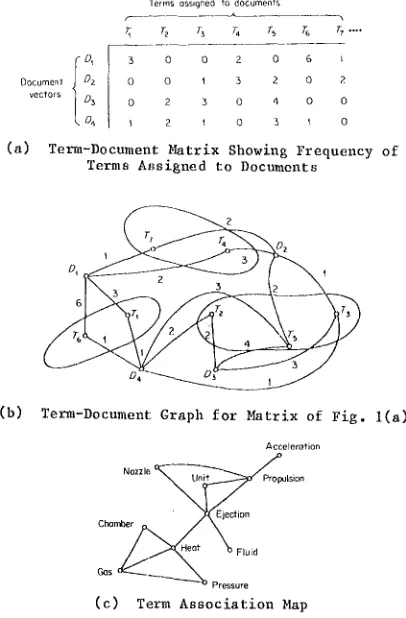
[image:2.612.336.539.387.696.2]A sample assignment of terms to documents is Shown in the m a t r i x of Fig. l(a). Fig. l(b) shows the corresponding document-term graph where a line between term T. and document D. represents the c o r r e s p o n d i n ~ term assignmen~ appears in Fig. l(b). Given the assignment of Figs. l(a) and (b). term associations may be derived by grouping sets of terms appearing in
t e r m 4 J 4
similar contexts. For example, and T_ may be grouped because these te appea~ jointly in documents D I and D2; similarity terms T 1 and T 6 appear in aocuments D 1 and D 4. The grouping operations may be used to obtain a term association map of the kind shown in Fig. l(c), where associated temDs are joined by lines on the map.
The operations of a typical associativ~ system are illustrated in Fig. 2. [7] The original query words are listed on the left-hand side of Fig. 2, and the derived asso- ciated terms are shown on the right. The value of a given associated term--for example, "Inter u national Organizations"-- is computed as the sum of the term association values between the given term and all origilml query tez~s (0.5 for ~IUnited Nations" plus 0.4 for "Pan American Union" in the example of Fig. 2). Finally the retrieval value of a document is computed as the sum of the common term association values for all matching terms that are present in both queries and documents. Many variations are pos- sible of the basic scheme illustrated in Fig. 2; in each case, the hope is that valid term asso- ciations would make it possible to achieve a greater degree of congruence between document representations and query formulations.
UNITED NATIONS (1.5)
~
INT. ORGAniZATIONS (0.9)nl 5" ~ / / ~ I N T , ~ ~ / COOPERATION <0.E) 0.5
UNITED
NATIONS~I 3 INT, RELATIONS (0.9)
0 . 5
0.5 LEAGNE OF NATIONS (0.5)
0.5
0.4 NT. LAW (0.3)
0.3
pAN. AM. UNION~[ PEACE (0.7)
0 . 2 1
AN AM UNION (1.5)
Document 1 :
Document 2 :
UNITED NATIONS 1.5 LEAGUE OF NATIONS 0.5 PAN. AM. UNION 1.5 INT. COOPERATION 0.8
4.3
UNITED NATIONS 1.5 PAN. AM. ONION 1.5
INT. LAW 0.3
3.3
382
Associative Retrieval Example (from Giuliano [6])
Fig. 2
In practice, it is found that the use of term associations can improve the search recall by providing new matches between the term assigned to queries and documents that were not available in the original query and document. In addition, the search precision can also be enhanced by reinforcing the strength of already existing term matches. [5] Unfortunately, the experimental evidence indicates that only about 20 percent of automatically derived associations between pairs of terms are semantically s i g n i f i - cant; the associative indexing process does not therefore provide guaranteed advantages in retrieval effectiveness.
Table 2 shows a typical evaluation output for a collection of 400 documents in engineering used with 17 search requests. The output of Table 2 shows that the automatic term associa- tions provide an increase in average search pre- cision only at the high recall end of the per- formance range. Overall, the average search precision decreases by 13 percent for the col- lection used in Table 2. [8, p. 130]
Average Search Precision Recall Weighted Word
Stems
• i °9563
• 3 .7986
• 5 .6371
.7 °4877
,9 .3426
Automatic Term Associations
.7385 -23% .5844 -27% • 5187 -19% • 4452 - 9% .3794 +11%
-13%
Sample Associative Indexing Performance (IRE Collection, 400 documents, 17 queries)
Table 2
More recently other vocabulary expansion experiments have been conducted using associated terms derived by statistical term co-occurrence criteria. [9-10] Once again, the evaluation results were disappointing: [10]
hOur results on query expansion using the NPL data are disappointing. We have not been able to achieve any significant improvements over nonexpansion. We have repeated previous experiments in which the query was expanded, and the resulting set of search terms then weighted... Once again the results have been conflicting..,"
C) Term Phrase Generation
The vocabulary expansion methods described up to now are designed principally to improve search recall. Search precision may be enhanced by using narrow indexing vocabularies consisting largely of JL&I~B p ~ replacing the normally used single terms. Thus "computer science" or "computer programming" could replace a broader term such as 'tcaleu1~tor" or "computer". The recognition and aesig u ent of term phrases poses much the same p r o b e m s as the previously described generation of term associations and the expansion of indexing vocabularies. In par- ticular, an accurate determination of useful te~,l phrases, and the rejection of extraneous phrases, must he based on syntactic analyses of query and document texts suppl~nented by semen= tic components valid for the subject areas under consideration. Unfortunately, complete linguis- tic analyses of topic areas of reasonable scope are unavailable for reasons of efficiency as well as effectiveness. In practice, it is then necessary to fall back on simpler phrase genera- tion methods in which phrases are identified as sequences of co-occurring terms with appropriate statistical and/or syntactic properties. In such simple phrase generation environments qual- ity control is, however, difficult to achieve.
The following phrase generation methods are of main interest:
a)
statistical methods where each phrase ] ~ (the main phrase component) bas a stated minimal occurrence frequency in the texts under consideration, and each phraseexhibits another stated minimal occurrence frequency, and the distance in number of intervening words between phrase heads and phrase components is limited to a stated number of words;
b) a simple syntactic pattern matching method where a dictionary search method is used to assign syntactic indicators to the text elements, and phrases are then recognized as sequences of words exhibiting certain previously established patterns of syntac- tic indications (e.g. adjective-noun-noun, or preposition-adjective-noun); [11-12]
c) a more complete syntactic analysis method supplemented if possible by appropriate semantic restrictions to control the variety of permitted syntactic phrase con- structions for the available texts. [13,14] When statistical phrase generation methods are used, a large number of useful phrases can in fact be identified, together unfortunately with a large number of improper phrases that are difficult to reject on formal grounds. For example, given a query text such as
"h~nophilia and christmas disease, espe- cially in regard to the specific complica- tion of pseudotumor formation (occurrence, pathogenesis, treatment, prognosis)'
it is easy to produce correct phrase combina- tions such as "christmas disease" and "pseudotu- mor formation". At the same time the statist:i- cal phrase formation process produces inap- propriate patterns such as "formation occurrence '~ and "complication formation"° [15] Overall a statistical phrase formation process will be of questionable usefulness.
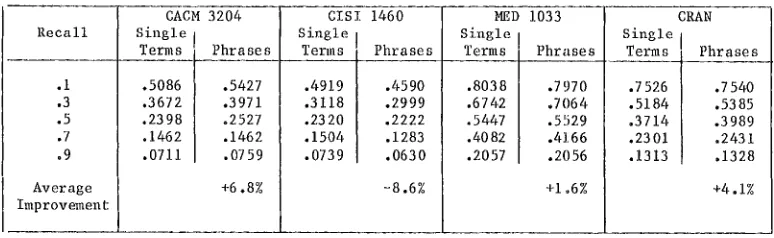
Table 3 shows a comparison of the average search precision results for certain fixed recall values between a standard single term indexing system, and a system where the single terms are supplemented by statistically deter- mined phrase combinations. The output of Table 3 for four different document collections in computer science (CACM), documentation (CISI)~ medicine (MED) and aeronautics (CRAN) shows that the phrase process affords modest average i~provements for three collections out of four. [15] However, the improvement is not guaranteed, and is in any case limited to a few percentage points in the average precision.
The evaluation results available for tile syntax-based methods are not much more encourag- ing. [16] The basic syntactic analysis approach must be able to cope with ordinary word ambiguities (Imllp base, army base, baseball base), the recognition of distinct syntactic constructs with identical meanings, discourse problems exceeding sentence boundaries such as pronoun referents from one sentence to another,
Recall
.I .3 .5 .7 .9 Average Improvement
CACM 3204 Single I
Terms_] Phrases .5086 I .5427 .3672 I .3971 .2398 ] .2527 .1462 .1462 .0711 .0759 +6.8%
CISI 1460 Single
_ Ten,}s Phrases .4919 .4590 .3118 .2999 .2320 .2222 .1504 .1283 .0739 .0630 -8.6%
MED 1033 Single
Terms Phrases .8038 .7970 .6742 °7064 .5447 .5529 .4082 .4166 .2057 .2056 +1,6%
CRAN Single
Term~ Phrases .7526 .7540 .5184 .5385 .3714 .3989 .2301 .2431 .1313 .1328 +4.1%
Comparison of Single Term Indexing with Statistical Phrase Indexing for Four S~iple Document Collections
T a b l e 3
[image:4.612.129.516.568.687.2]and the difficulties of interpreting many com- plex meaning units in ordinary texts. An illus- tration of the latter kind is furnished by the phrase "high frequency transistor oscillator", where it is important to avoid the interpreta- tion "high frequency transistor" while admitting "transistor oscillator" and "high frequency oscillator". A sophisticated syntactic analysis system with substantial semantic components was unable in that case to reject the extraneous interpretations "frequency transistor oscilla- tors which are high (tall)" and "frequency oscillators using high (tall) transistors". [17] In addition to the problems inherent in the language analysis component of a phrase indexing system, a useful text processing component must also deal with phrase classification, that is the recognition of syntactically distinct pat- terns that are semantically identical ("computer programs", "instruction sets for computers", "programs for calculating machines"). The phrase classification problem itself raises com- plex problems that are not close to solution. [18]
In summary, the use of complex identifying units and term associations in automatic text processing environments is currently hampered by difficulties of a fundamental nature. The basic theories needed to construct useful term group- ing schedules and thesauruses valid for particu- lar subject areas are not sufficiently developed. As a result, the effectiveness of associative retrieval techniques based on term grouping and vocabulary expansion leaves some- thing to be desired. The same is true of the syntactic and semantic language analysis theories used to generate a large proportion of the applicable complex content descriptions and phrases, and to reject the majority of extrane- ous term combinations.
The question arises whether any retrieval situations exists in which it is useful to go beyond the basic single term text analysis methodology, consisting of the extraction of single terms from natural language query and document texts. This question is examined in the remaining section of this note.
3. The Usefulness of Complex Text Processing Three particular text processing situations can be identified where term association tech-
nlques have proved to be useful. The first one is the well-known ~ ~ process where initial search operations are conducted with preliminary query formulations obtained from the user population. Following the retrieval of certain stored text items, the user is asked to respond by furnishing relevance assessments for some of the previously retrieved items; these relevance assessments are then used by the system to construct new, improved query formulations which may furnish additional, hope- fully improved, retrieval output. In particu- lar, the query statements are altered by adding terms extracted from previously retrieved items that were identified as relevant to the user's purposes, while at the same time removing query terms included in previously retrieved items designated as nonrelevant.
The relevance feedback methodology represents an associative retrieval technique, since new query terms are obtained from certain designated documents that hopefully are related to the originally available formulations. Relevance feedback techniques have been used with vector queries formulated as sets of search terms [9, 19-20], and more recently with Boolean queries. [21] The effectiveness of the feedback procedure has never been questioned.
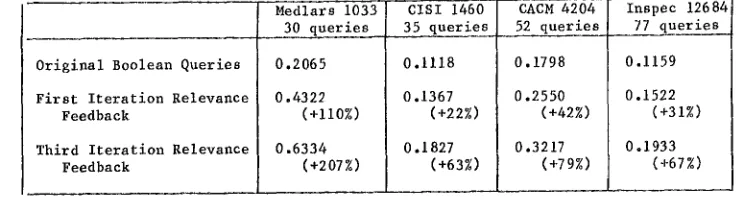
Table 4 shows typical evaluation output for four different document collections in terms of average search precision at ten recall points (from a recall of 0.I to a recall of 1.0 in steps of 0.I) averaged over the stated number of user queries. The output of Table 4 applies to Boolean queries with binary weighted terms. [21] The improvements in retrieval precision due to the user feedback process ranges from 22% to 110% for a single search iteration. When the feedback process is repeated three timesj the improvement in search precision increases to 63% to 207%, Evidently, the user relevance informa- tion which applies to particular queries at par- ticular times makes it possible to find a suffi- cient number of interesting term associations to substantially improve the retrieval output.
A second possibility for generating improved retrieval output consists in limiting the analysis effort to the ~ ~ 1 9 ~ / ~ instead of the document texts. In a recent study, term phrases were first extracted from natural language query texts using a sim- ple, manually controlled, syntactic analysis process. These query phrases were then recog- nized in document texts bY a rough pattern
Original Boolean Queries First Iteration Relevance
Feedback
Third Iteration Relevance Feedback
Medlars 1033 ClSI 1460 CACM 4204 Inspec 12684 30 queries 35 queries 52 queries 77 queries
0.1798 0.1159 0.2065
0.4322
(+11o%)
0,6334 (+207%)
0.1118 0.1367
(+22%)
0.1827 (+63%)
0.2550 (+42%) 0.3217
(+79%)
0.1522 (+31%)
0.1933 (+67%)
Average Search Precision at i0 Recall Points for One Iteration and Throe Iterations of Relevance Feedback (4 document collections)
[image:5.612.108.477.602.704.2]matching procedure distinguishing pairs and tri- ples of terms occurring in the same phrases of documents, and pairs and triples of terms occur- ring in the same sentences of documents. [22] Whenever a phrase match is obtained between a query phrase and a document text, the retrieval weight of the document is appropriately increased.
An evaluation of such a manually controlled syntactic phrase recognition system based on query statement analysis reveals that substan- tial improvements in retrieval effectiveness are obtainable for the phrase assignments, compared with the single term alternatives. Table 5 shows average search precision values at five recall levels for 25 user queries used with the CACM collection in computer science. [22] On average the query analysis system raises the search precision by 32 percent.
0.1 0.3 0.5 0.7 0.9
Average Search Precision Weighted Weighted Single Single Terms Terms and Phrases
0.555 0.625
0.271 0.355
0.211 0.265
0. 064 0 • 085
0.038 0.060
+13% +31% +26% +33% +58%
+32%
Average Search Precision for Query Statement Phrase Analysis
(CACM Collection, 25 Queries)
Table 5
The special processing described up to now is user related in the sense that user query formulations and user relevance assessments are utilized to improve the retrieval procedures. The last possibility for the use of complex information descriptions consists in incorporat- ing stored J g R O _ ~ renresentations covering particular subject areas to enhance the descrip- tions of document and query content. [23-25] Various theories of knowledge representation are current, including for example, models based on the use of frames representing events and descriptions of interest in a given subject.
Frames designating particular entities may be represented by tabular structures, with open Hslots" filled with attributes of the entities, or values of attributes. Relationships between frames are expressed by using attributed that are themselves represented by other frames, and by adding links between frames. Frame opera- tions can also be introduced to manipulate the knowledge structure when new facts or entities become known, or when changes occur in item relationships, There is some evidence that when the knowledge base needed to analyze the avail- able texts is narrowly circumscribed and limited in scope, useful frame structures can in fact be intellectually prepared to enhance the retrieval operations. [26]
However, when the needed topic area is not of strictly limited scope, the construction of useful knowledge bases is much less straightfor- ward and the knowledge-based processing tech- niques become of limited effectiveness. It has been suggested that: in these circumstances, the system user himself might help in building the knowledge structures. [27] While this remains a possibility, it is hard to imagine that untrained users can lay out the subject knowledge of interest in particular areas and specify concept relationships such as synonyms, generalizations, instantiations, and cross- references with sufficient accuracy. In any case, no examples exist at the present time where user constructed knowledge bases have proved generally valid for different collections in particular subject areas. In fact, the situation appears much the same as it was thirty years ago: it seems quite easy to build locally valid t e ~ association systems by ad-hoc means; these tools fail however in somewhat different environments, and do not furnish reliable means for improving text processing systems in gen- eral.
For the foreseeable future, text processing systems using complex information identifica- tions and term associations must therefore be limited to narrowly restricted topic areas, or must alternatively be based on simple user inputs, such as ~ocument relevance data, t:hat can be furnished by untrained users without undue hardship.
References
[ i ]
[ 2]
[ 3]
[ 4]
[ 5]
[ 6]
[ 73
[ 83
J.Co Gardin, Syntol, in Systems for the Intellectual Organization of Information, S. Artandi, editor, Vol. 2, Rutgers Univer- sity, New Brunswick, NJ, 1965.
M.E. Stevens, Automatic Indexing: A State
of the Art Report, NBS Monograph 9], National Bureau of Standards, Washington, DC, 1965.
G. Salton and M.E. Lesk, Computer Evalua- tion of Indexing and Text Processing, Jour- nal of the ACM, 15:1, January 1968, 8-36.
H.P Luhn, Auto-Encoding of Documents for Information Retrieval Systems ~, M. Boaz, editor, Modern Trends in Documentation, 1959, 45-58.
M.E. Lesk, Word-Word Associations in Docu- ment Retrieval Systems, American Documenta- tion, 20:1, January 1969, 27-38.
L.B. Doyle, Semantic Road Maps for Litera- ture Searchers, Journal of the ACM, 8°
1961, 553-578.
V.E. Giulianoj Automatic Message Retrieval by Associative Techniques, in Joint Man- Computer Languages, Mitre Corporation Report SS-10, Bedford, MA, 1962, 1-44.
G. Salton, Automatic Information Organiza- tion and Retrieval, McGraw Hill Book Com- pany, New York, 1968.
[ 9]
[10]
[11]
[12]
[13]
[14]
[15]
[16]
[ 17]
[18]
[19]
[20]
[21]
[22]
3 8 6
D.J. Harper and C.J van Rijsbergen, An Evaluation of Feedback in Document Retrieval using Cooceurrence Data, Jl. of Documentation, 34:3, September 1978, 189- 216.
S.E. Roberts,n, C.J. van Rijsbergen, and M.F. Porter, Probabilistic Models of Index- ing and Searching, in Information Retrieval Research, R.N. Oddy, S.E. Roberts,n, C.J. van Rijsbergen, and P.W. Williams, editors, Butterworths, London, 1981, 35-56.
M. Dillon and A.S. Gray, FASIT: A Fully Automatic Syntactically Based Indexing Sys- tem, Journal of the ASIS, 34, 1983, 99-108. G. Salt,n, Automatic Phrase Matching, in Readings in Automatic Language Processing, DoG. Hays, editor, Am. Elsevier Publishing Co.B New York, 1966.
R. Grishman, Natural Language Processing, Journal of the ASIS, 35, 1984, 291-296. P.J. Hayes and J.G. Carbonell, A Tutorial on Techniques and Applications for Natural Language Processing, Technical Report CMU- CS-83-158, Carnegie-Mellon University, Pittsburgh, PA, 1983.
J.L. Fagan, Automatic Phrase Indexing for Text Passage Retrieval and Printed Subject Indexes, Technical Report, Department of Computer Science, Cornell University, Ithaca, NY, May 1985.
G. Salt,n, The Smart Retrieval System - Experiments in Automatic Document Process- ing, G. Salt,n, editor, Prentice Hall Inc., Englewood, Cliffs, NJ, 1971, 207-208. K. Sparck Jones and J.l. Tait, Automatic Search Tel~ Variant Generation, Journal of Documentation, 40:1, March 1984, 50-66. C.D. Paice and V. Aragon-Ramirez, The Cal- culation of Similarities between Multi-word Strings using a Thesaurus, Proc. RIAO-85 Conference, Grenoble, France, 1985, 293- 319.
J.J. Rocchio, Jr., Relevance Feedback in Information Retrieval, in The Smart System Experiments in Automatic Document Pro- cessing, Prentice Hall, Inc., Englewood Cliffs, NJ, 1971, Chapter 14.
E. Ide, New Experiments in Relevance Feed- back, in The Smart S y s t e m - Experiments in Automatic Document Processing, G. Salt,n, editor, Prentice Hall Inc., Englewood Cliffs, NJ, 1971, Chapter 16.
G. Salt,n, E.A. Fox and E. Voorhees, Advanced Feedback Methods in Information Retrieval, Journal of the ASIS, 36:3, 1985, 200-210.
A.F. Smeaton, Incorporating Syntactic Information into a Document Retrieval Stra- tegy: An Investigation, Technical Report, Department of Computer Science, University College, Dublin, Ireland, 1986.
[23]
[24]
[25]
[26]
[273
M. Minsky, A Framework for Representing Knowledge, P.H. Winston, editor, The Psychology of Computer Vision, McGraw Hill Book Co., NY, 1975, 211-277.
R.C. Schank and R.P. Abels,n, Scripts, Plans, Goals and Understanding, Lawrence Erlbaum Associates, Hillsdale, NJ, 1977. R.J. Brachman and B.C. Smith, Special Issue on Knowledge Representation, SIGART Newsletter, No. 70, February 1980.
M.K. diBenigno, G.R. Cross and C.G. deBes- sonet, COREL - A Conceptual Retrieval Sys- tem, Technical Report, Louisiana State University, Baton Rouge, LA, 1986.