Identifying Sections in Scientific Abstracts using Conditional Random Fields
Kenji Hirohata† [email protected]
Naoaki Okazaki† [email protected]
Sophia Ananiadou‡
†
Graduate School of Information Science and Technology,
University of Tokyo 7-3-1 Hongo, Bunkyo-ku,
Tokyo 113-8656, Japan
Mitsuru Ishizuka† [email protected]
‡
School of Computer Science, University of Manchester
National Centre for Text Mining (NaCTeM) Manchester Interdisciplinary Biocentre, 131 Princess Street, Manchester M1 7DN, UK
Abstract
OBJECTIVE: The prior knowledge about the rhetorical structure of scientific abstracts is useful for various text-mining tasks such as information extraction, information re-trieval, and automatic summarization. This paper presents a novel approach to cate-gorize sentences in scientific abstracts into four sections, objective, methods, results, and conclusions. METHOD: Formalizing the categorization task as a sequential label-ing problem, we employ Conditional Ran-dom Fields (CRFs) to annotate section la-bels into abstract sentences. The train-ing corpus is acquired automatically from Medline abstracts. RESULTS: The pro-posed method outperformed the previous approaches, achieving 95.5% per-sentence accuracy and 68.8% per-abstract accuracy. CONCLUSION: The experimental results showed that CRFs could model the rhetor-ical structure of abstracts more suitably.
1 Introduction
Scientific abstracts are prone to share a similar rhetorical structure. For example, an abstract usu-ally begins with the description of background in-formation, and is followed by the target problem, solution to the problem, evaluation of the solution, and conclusion of the paper. Previous studies ob-served the typical move of rhetorical roles in sci-entific abstracts: problem,solution,evaluation, and
conclusion (Graetz, 1985; Salanger-Meyer, 1990;
Swales, 1990; Or˘asan, 2001). The American Na-tional Standard Institute (ANSI) recommends au-thors and editors of abstracts to state the purpose,
methods, results, and conclusions presented in the documents (ANSI, 1979).
The prior knowledge about the rhetorical structure of abstracts is useful to improve the performance of various text-mining tasks. Marcu (1999) proposed an extraction method for summarization that cap-tured the flow of text, based on Rhetorical Struc-ture Theory (RST). Some extraction methods make use of cue phrases (e.g., “in conclusion”, “our in-vestigation has shown that ...”), which suggest that the rhetorical role of sentences is to identify im-portant sentences (Edmundson, 1969; Paice, 1981). We can survey the problems, purposes, motivations, and previous approaches of a research field by read-ing texts in background sections of scientific papers. Tbahriti (2006) improved the performance of their information retrieval engine, giving more weight to sentences referring topurposeandconclusion.
per-OBJECTIVE: This study assessed the role of adrenergic signal transmission in the control of renal erythropoietin (EPO) pro-duction in humans. METHODS: Forty-six healthy male volunteers underwent a hemorrhage of 750 ml. After phlebotomy, they received (intravenously for 6 hours in a parallel, randomized, placebo-controlled and single-blind design) either placebo (0.9% sodium chloride), or the beta 2-adrenergic receptor agonist fenoterol (1.5 microgram/min), or the beta 1-adrenergic receptor ago-nist dobutamine (5 micrograms/kg/min), or the nonselective beta-adrenergic receptor antagoago-nist propranolol (loading dose of 0.14 mg/kg over 20 minutes, followed by 0.63 micrograms/kg/min).RESULTS: The AUCEPO(0-48 hr)fenoterol was 37% higher (p ¡ 0.03) than AUCEPO(0-48 hr)placebo, whereas AUCEPO(0-48 hr)dobutamine and AUCEPO(0-48 hr)propranolol were comparable with placebo. Creatinine clearance was significantly increased during dobutamine treatment. Urinary cyclic adenosine monophos-phate excretion was increased only by fenoterol treatment, whereas serum potassium levels were decreased. Plasma renin activity was significantly increased during dobutamine and fenoterol infusion. CONCLUSIONS: This study shows in a model of con-trolled, physiologic stimulation of renal erythropoietin production that the beta 2-adrenergic receptor agonist fenoterol but not the beta 1-adrenergic receptor agonist dobutamine is able to increase erythropoietin levels in humans. The result can be interpreted as a hint that signals for the control of erythropoietin production may be mediated by beta 2-adrenergic receptors rather than by beta 1-adrenergic receptors. It appears to be unlikely that an increase of renin concentrations or glomerular filtration rate is causally linked to the control of erythropoietin production in this experimental setting.
Figure 1: An abstract with section labels indicated by boldface type (Gleiter et al., 1997).
sentence accuracy and 68.8% per-abstract accuracy. This paper is organized as follows. Section 2 describes previous approaches to this task. For-malizing the task as a sequential-labeling problem, Section 3 designs a sentence classifier using CRFs. Training corpora for the classifier are acquired au-tomatically from the Medline abstracts. Section 4 reports considerable improvements in the proposed method over the baseline method using Support Vec-tor Machine (SVM) (Cortes and Vapnik, 1995). We conclude this paper in Section 5.
2 Related Work
The previous studies regarded the task of identify-ing section names as a text-classification problem that determines a label (section name) for each sen-tence. Various classifiers for text categorization, Na¨ıve Bayesian Model (NBM) (Teufel and Moens, 2002; Ruch et al., 2007), Hidden Markov Model (HMM) (Wu et al., 2006; Lin et al., 2006), and Sup-port Vector Machines (SVM) (McKnight and Arini-vasan, 2003; Shimbo et al., 2003; Ito et al., 2004; Yamamoto and Takagi, 2005) were applied.
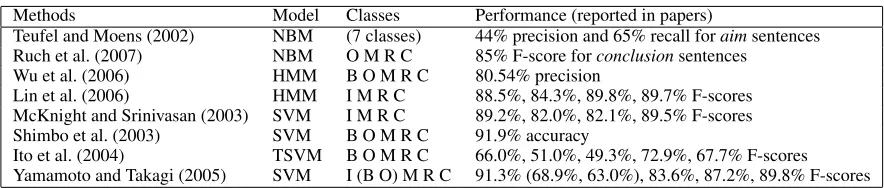
Table 1 summarizes these approaches and perfor-mances. All studies target scientific abstracts except for Teufel and Moens (2002) who target scientific full papers. Field classes show the set of section names that each study assumes: background (B), objective/aim/purpose (O), method (M), result (R), conclusion (C), and introduction (I) that combines the background and objective. Although we should not compare directly the performances of these stud-ies, which use a different set of classification labels
and evaluation corpora, SVM classifiers appear to yield better results for this task. The rest of this sec-tion elaborates on the previous studies with SVMs.
Shimbo et al. (2003) presented an advanced text retrieval system for Medline that can focus on a specific section in abstracts specified by a user. The system classifies sentences in each Medline ab-stract into four sections,objective, method, results, and conclusion. Each sentence is represented by words, word bigrams, and contextual information of the sentence (e.g., class of the previous sentence, relative location of the current sentence). They reported 91.9% accuracy (per-sentence basis) and 51.2% accuracy (per-abstract basis1) for the clas-sification with the best feature set for quadratic SVM. Ito et al. (2004) extended the work with a semi-supervised learning technique using transduc-tive SVM (TSVM).
Yamamoto and Takagi (2005) developed a sys-tem to classify abstract sentences into five sections,
background, purpose, method, result, and conclu-sion. They trained a linear-SVM classifier with fea-tures such as unigram, subject-verb, verb tense, rel-ative sentence location, and sentence score (average TF*IDF score of constituent words). Their method achieved 68.9%, 63.0%, 83.6%, 87.2%, 89.8% F-scores for classifyingbackground,purpose,method,
result, andconclusionsentences respectively. They also reported the classification performance of intro-ductionsentences, which combinesbackgroundand
purposesentences, with 91.3% F-score.
1
Methods Model Classes Performance (reported in papers)
Teufel and Moens (2002) NBM (7 classes) 44% precision and 65% recall foraimsentences Ruch et al. (2007) NBM O M R C 85% F-score forconclusionsentences
Wu et al. (2006) HMM B O M R C 80.54% precision
Lin et al. (2006) HMM I M R C 88.5%, 84.3%, 89.8%, 89.7% F-scores McKnight and Srinivasan (2003) SVM I M R C 89.2%, 82.0%, 82.1%, 89.5% F-scores Shimbo et al. (2003) SVM B O M R C 91.9% accuracy
[image:3.612.84.526.69.163.2]Ito et al. (2004) TSVM B O M R C 66.0%, 51.0%, 49.3%, 72.9%, 67.7% F-scores Yamamoto and Takagi (2005) SVM I (B O) M R C 91.3% (68.9%, 63.0%), 83.6%, 87.2%, 89.8% F-scores
Table 1: Approaches and performances of previous studies on section identification
3 Proposed method
3.1 Section identification as a sequence labeling problem
The previous work saw the task of labeling as a text categorization that determines the class labelyi for
each sentencexi. Even though some work includes
features of the surrounding sentences for xi, e.g.
“class label of xi−1 sentence,” “class label ofxi+1
sentence,” and “unigram inxi−1sentence,” the
clas-sifier determines the class labelyifor each sentence
xi independently. It has been an assumption for text
classification tasks to decide a class label indepen-dently of other class labels.
However, as described in Section 1, scientific ab-stracts have typical moves of rhetorical roles: it would be very peculiar if result sentences appear-ing before method sentences were described in an abstract. Moreover, we would like to model the structure of abstract sentences rather than model-ing just the section label for each sentence. Thus, the task is more suitably formalized as a sequence labeling problem: given an abstract with sentences x= (x1, ..., xn), determine the optimal sequence of
section names y = (y1, ..., yn) of all possible
se-quences.
Conditional Random Fields (CRFs) have been successfully applied to various NLP tasks includ-ing part-of-speech tagginclud-ing (Lafferty et al., 2001) and shallow parsing (Sha and Pereira, 2003). CRFs de-fine a conditional probability distributionp(y|x)for output and input sequences,yandx,
p(y|x) = 1
Zλ(x)
exp{λ·F(y,x)}. (1)
Therein: functionF(y,x) denotes a global feature
vector for input sequencexand output sequencey,
F(y,x) =X
i
f(y,x, i), (2)
iranges over the input sequence, functionf(y,x, i)
is a feature vector for input sequencexand output sequenceyat positioni(based on state features and transition features),λis a vector where an element λk represents the weight of feature Fk(y,x), and
Zλ(x)is a normalization factor,
Zλ(x) =
X
y
exp{λ·F(y,x)}. (3)
The optimal output sequence yˆ for an input se-quencex,
ˆ
y= argmax
y p(y
|x), (4)
is obtained efficiently by the Viterbi algorithm. The optimal set of parametersλis determined efficiently by the Generalized Iterative Scaling (GIS) (Darroch and Ratcliff, 1972) or Limited-memory Broyden-Fletcher-Goldfarb-Shanno (L-BFGS) (Nocedal and Wright, 1999) method.
3.2 Features
We design three kinds of features to represent each abstract sentence for CRFs. The contributions of these features will be evaluated later in Section 4.
Rank OBJECTIVE METHOD RESULTS CONCLUSIONS 1 # to be measure % ) suggest that
2 be to be perform ( p may be
[image:4.612.143.467.69.154.2]3 to determine n = p< # these 4 study be be compare ) . should be 5 this study be determine % . these result
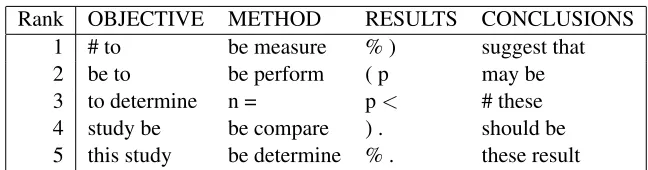
Table 2: Bigram features with highχ2values (‘#’ stands for a beginning of a sentence).
domain. We measure the co-occurrence strength (χ2 value) between each feature and section label. If a feature appears selectively in a specific section, the χ2value is expected to be high. Thus, we extract the top 200,000 features2that have highχ2values to re-duce the total number of features. Table 3.2 shows examples of the top five bigrams that have highχ2 values.
Relative sentence location An abstract is likely to stateobjectiveof the study at the beginning and its
conclusion at the end. The position of a sentence may be a good clue for determining its section la-bel. Thus, we design five binary features to indicate relative position of sentences in five scales.
Features from previous/next w sentences This reproduces features from previous and followingw sentences to the current sentence (w = {0,1,2}), so that a classifier can make use of the content of the surrounding sentences. Duplicated features have prefixes (e.g. PREV_ and NEXT_) to distinguish their origins.
3.3 Section labels
It would require much effort and time to prepare a large amount of abstracts annotated with section la-bels. Fortunately, some Medline abstracts have sec-tion labels stated explicitly by its authors. We ex-amined section labels in 7,811,582 abstracts in the whole Medline3, using the regular-expression pat-tern:
ˆ[A-Z]+([ ][A-Z]+){0,3}:[ ]
A sentence is qualified to have a section name if it begins with up to 4 uppercase token(s) followed by
2
We chose the number of features based on exploratory ex-periments.
3
The Medline database was up-to-date on March 2006.
a colon ‘:’. This pattern identified 683,207 (ca. 9%) abstracts with structured sections.
Table 3 shows typical moves of sections in Med-line abstracts. The majority of sequences in this table consists of four sections compatible with the ANSI standard,purpose,methods,results, and con-clusions. Moreover, the most frequent sequence is “OBJECTIVE → METHOD(S) → RESULTS
→ CONCLUSION(S),” supposing that AIM and PURPOSE are equivalent to OBJECTIVE. Hence, this study assumes four sections, OBJECTIVE, METHOD, RESULTS, and CONCLUSIONS.
Meanwhile, it is common for NP chunking tasks to represent a chunk (e.g., NP) with two labels, the begin (e.g., B-NP) and inside (e.g., I-NP) of a chunk (Ramshaw and Marcus, 1995). Although none of the previous studies employed this repre-sentation, attaching B- and I- prefixes to section la-bels may improve a classifier by associating clue phrases (e.g., “to determine”) with the starts of sec-tions (e.g., B-OBJECTIVE). We will compare clas-sification performances on two sets of label repre-sentations: namely, we will compare four section labels and eight labels with BI prefixes attached to section names.
4 Evaluation
4.1 Experiment
Rank # abstracts (%) Section sequence
1 111,617 (17.6) OBJECTIVE→METHOD(S)→RESULT(S)→CONCLUSION(S) 2 107,124 (16.9) BACKGROUND(S)→METHOD(S)→RESULT(S)→CONCLUSION(S) 3 40,083 (6.3) PURPOSE→METHOD(S)→RESULT(S)→CONCLUSION(S)
4 20,519 (3.2) PURPOSE→MATERIAL AND METHOD(S)→RESULT(S)→CONCLUSION(S) 5 16,705 (2.6) AIM(S)→METHOD(S)→RESULT(S)→CONCLUSION(S)
6 16,400 (2.6) BACKGROUND→OBJECTIVE→METHOD(S)→RESULT(S)→CONCLUSION(S) 7 12,227 (1.9) OBJECTIVE→STUDY DESIGN→RESULT(S)→CONCLUSION(S)
8 11,483 (1.8) BACKGROUND→METHOD(S) AND RESULT(S)→CONCLUSION(S)
9 8,866 (1.4) OBJECTIVE→MATERIAL AND METHOD(S)→RESULT(S)→CONCLUSION(S) 10 8,537 (1.3) PURPOSE→PATIENT AND METHOD(S)→RESULT(S)→CONCLUSION(S)
.. ... ... ...
[image:5.612.67.540.73.408.2]Total 683,207 (100.0)
Table 3: Typical sequences of sections in Medline abstracts
Representative Equivalent section labels
OBJECTIVE AIM, AIM OF THE STUDY, AIMS, BACKGROUND/AIMS, BACKGROUND/PURPOSE, BACK-GROUND, BACKGROUND AND AIMS, BACKGROUND AND OBJECTIVE, BACKGROUND AND OBJECTIVES, BACKGROUND AND PURPOSE, CONTEXT, INTRODUCTION, OBJECT, OBJEC-TIVE, OBJECTIVES, PROBLEM, PURPOSE, STUDY OBJECOBJEC-TIVE, STUDY OBJECTIVES, SUM-MARY OF BACKGROUND DATA
METHOD ANIMALS, DESIGN, DESIGN AND METHODS, DESIGN AND SETTING, EXPERIMENTAL DE-SIGN,INTERVENTION, INTERVENTION(S), INTERVENTIONS, MATERIAL AND METHODS, MA-TERIALS AND METHODS, MEASUREMENTS, METHOD, METHODOLOGY, METHODS, METH-ODS AND MATERIALS, PARTICIPANTS, PATIENT(S), PATIENTS, PATIENTS AND METHMETH-ODS, PROCEDURE, RESEARCH DESIGN AND METHODS, SETTING, STUDY DESIGN, STUDY DESIGN AND METHODS, SUBJECTS, SUBJECTS AND METHODS
RESULTS FINDINGS, MAIN RESULTS, RESULT, RESULT(S), RESULTS
CONCLUSIONS CONCLUSION, CONCLUSION(S), CONCLUSIONS, CONCLUSIONS AND CLINICAL RELE-VANCE, DISCUSSION, IMPLICATIONS, INTERPRETATION, INTERPRETATION AND CONCLU-SIONS
Table 4: Representative section names and their expanded sections
In contrast, the ‘expanded’ corpus includes sen-tences in equivalent sections: AIM and PURPOSE sentences are mapped to the OBJECTIVE. Table 4 shows the sets of equivalent sections for representa-tive sections. We created this mapping table man-ually by analyzing the top 100 frequent section la-bels found in the Medline. The ‘expanded’ corpus is close to the real situation in which the proposed method annotates unstructured abstracts.
We utilized FlexCRFs4 implementation to build a classifier with linear-chain CRFs. As a baseline method, we also prepared an SVM classifier5 with the same features.
4
Flexible Conditional Random Field Toolkit (FlexCRFs): http://flexcrfs.sourceforge.net/
5
We used SVMlightimplementation with the linear kernel, which achieved the best accuracy through this experiment: http://svmlight.joachims.org/
20 30 40 50 60 70 80
1000 10000 100000
Per-abstract accuracy
(%)
Number of abstracts for training CRF
SVM
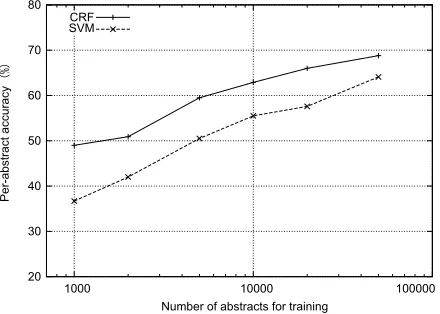
Figure 2: Training curve
4.2 Results
[image:5.612.314.534.444.601.2]Section labels With B- and I- prefixes Without B- and I- prefixes
Features CRF SVM CRF SVM
[image:6.612.110.499.71.171.2]n-gram 88.7 (42.4) 81.5 (19.1) 85.7 (33.0) 83.3 (23.4) n-gram + position 93.4 (59.7) 88.2 (35.5) 92.4 (55.4) 89.6 (39.4) n-gram + surrounding (w= 1) 93.3 (60.4) 89.9 (42.2) 92.1 (52.8) 90.0 (42.0) n-gram + surrounding (w= 2) 93.7 (61.1) 91.8 (49.4) 92.8 (54.3) 91.8 (47.0) Full 94.3 (62.9) 93.3 (55.5) 93.3 (56.1) 92.9 (52.2)
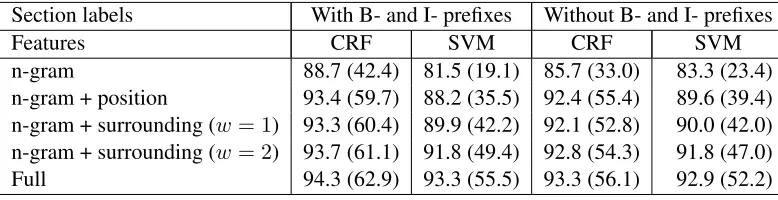
Table 5: Classification performance (accuracy) on ‘pure’ corpus (n= 10,000)
Section labels With B- and I- prefixes Without B- and I- prefixes
Features CRF SVM CRF SVM
n-gram 87.7 (35.6) 78.5 (14.5) 81.9 (21.0) 80.0 (16.2) n-gram + position 92.6 (54.3) 87.1 (31.2) 91.4 (48.7) 88.1 (31.2) n-gram + surrounding (w= 1) 92.3 (52.0) 88.5 (37.6) 89.9 (44.0) 88.4 (37.1) n-gram + surrounding (w= 2) 92.4 (52.5) 90.1 (41.1) 91.2 (46.6) 90.4 (41.6) Full 93.0 (55.0) 92.0 (47.3) 92.5 (50.9) 91.7 (44.0)
Table 6: Classification performance (accuracy) on ‘expanded’ corpus (n= 10,000)
measured the classification accuracy of sentences (per-sentence accuracy) and abstracts (per-abstract accuracy). In per-abstract accuracy, an abstract is considered correct if all constituent sentences are correctly labeled.
Trained with n = 50,000 abstracts from ‘pure’ corpus, the proposed method achieved 95.5% per-sentence accuracy and 68.8% per-abstract accuracy. The F-score for each section label was 98.7% (O), 95.8% (M), 95.0% (R), and 94.2% (C). The pro-posed method performed this task better than the previous studies by a great margin. Figure 2 shows the training curve for the ‘pure’ corpus with all fea-tures presented in this paper. CRF and SVM meth-ods performed better with more abstracts used for training. This training curve demonstrated that, with less than half the number of training corpus, the pro-posed method could achieve the same accuracy as the baseline method.
Tables 5 and 6 report the performance of the proposed and baseline methods on ‘pure’ and ‘ex-panded’ corpora respectively (n = 10,000). These tables show sentence accuracy followed by per-abstract accuracy in parentheses with different con-figurations of features (row) and label representa-tions (column). For example, the proposed method obtained 94.3% per-sentence accuracy and 62.9% per-abstract accuracy with 10,000 training abstracts
from ‘pure’ corpus, all features, and BI prefixes for class labels.
The proposed method outperformed the baseline method in all experimental configurations. This suggests that CRFs are more suitable for modeling moves of rhetorical roles in scientific abstracts. It is noteworthy that the CRF classifier gained higher per-abstract accuracy than the SVM. For example, both the CRF classifier with features from surround-ing sentences (w= 1), and SVM classifier with full features, obtained 93.3% per-sentence accuracy in Table 5. Nevertheless, the per-abstract accuracies of the former and latter were 60.4% and 55.5% respec-tively: the CRF classifier had roughly 5% advantage on per-abstract accuracy over SVM. This analysis reflects the capability of CRFs to determine the op-timal sequence of section names.
5 Conclusion
This paper presented a novel approach to identifying rhetorical roles in scientific abstracts using CRFs. The proposed method achieved more successful re-sults than any other previous reports. The CRF clas-sifier had roughly 5% advantage on per-abstract ac-curacy over SVM. The BI representation of section names also boosted the classification accuracy by 5%. In total, the proposed method gained more than 10% improvement on per-abstract accuracy.
We have evaluated the proposed method only on medical literatures. In addition to improving the classification performance, a future direction for this study would be to examine the adaptability of the proposed method to include other types of texts. We are planning to construct a summarization system using the proposed method.
References
ANSI. 1979. American national standard for writing abstracts. Z39.14-1979, American National Standards Institute (ANSI).
Corinna Cortes and Vladimir Vapnik. 1995. Support-vector networks. Machine Learning, 20(3):273–297.
John N. Darroch and Douglas Ratcliff. 1972. General-ized iterative scaling for log-linear models. The An-nals of Mathematical Statistics, 43(5):1470–1480.
Harold P. Edmundson. 1969. New methods in automatic extracting. Journal of the Association for Computing Machinery, 16(2):264–285.
Christoph H. Gleiter, Tilmann Becker, Katharina H. Schreeb, Stefan Freudenthaler, and Ursula Gundert-Remy. 1997. Fenoterol but not dobutamine increases erythropoietin production in humans. Clinical Phar-macology & Therapeutics, 61(6):669–676.
Naomi Graetz. 1985. Teaching EFL students to extract structural information from abstracts. In Jan M. Ulijn and Anthony K. Pugh, editors, Reading for Profes-sional Purposed: Methods and Materials in Teaching Languages, pages 123–135. Acco, Leuven, Belgium.
Takahiko Ito, Masashi Simbo, Takahiro Yamasaki, and Yuji Matsumoto. 2004. Semi-supervised sentence classification for medline documents. In IPSJ SIG Technical Report, volume 2004-ICS-138, pages 141– 146.
John Lafferty, Andrew McCallum, and Fernando Pereira. 2001. Conditional random fields: Probabilistic mod-els for segmenting and labeling sequence data. In Pro-ceedings of the 18th International Conference on Ma-chine Learning (ICML-2001), pages 282–289.
Jimmy Lin, Damianos Karakos, Dina Demner-Fushman, and Sanjeev Khudanpur. 2006. Generative con-tent models for structural analysis of medical ab-stracts. In Proceedings of the HLT/NAACL 2006 Workshop on Biomedical Natural Language Process-ing (BioNLP’06), pages 65–72, New York City, USA.
Daniel Marcu. 1999. Discourse trees are good indicators of importance in text. In Inderjeet Mani and Mark T. Maybury, editors,Advances in Automatic Text Summa-rization. MIT Press.
Larry McKnight and Padmini Arinivasan. 2003. Cate-gorization of sentence types in medical abstracts. In AMIA 2003 Symposium Proceedings, pages 440–444.
Jorge Nocedal and Stephen J. Wright. 1999. Numerical Optimization. Springer-Verlag, New York, USA.
Constantin Or˘asan. 2001. Patterns in scientific abstracts. In Proceedings of Corpus Linguistics 2001 Confer-ence, pages 433 – 443, Lancaster University, Lan-caster, UK.
Chris D. Paice. 1981. The automatic generation of litera-ture abstracts: an approach based on the identification of self-indicating phrases. InSIGIR ’80: Proceedings of the 3rd annual ACM conference on Research and development in information retrieval, pages 172–191, Kent, UK. Butterworth & Co.
Lance A. Ramshaw and Mitchell P. Marcus. 1995. Text chunking using transformation-based learning. In Pro-ceedings of the ACL 3rd Workshop on Very Large Cor-pora, pages 82–94.
Patrick Ruch, Celia Boyer, Christine Chichester, Imad Tbahriti, Antoine Geissb¨uhler, Paul Fabry, Julien Gob-eill, Violaine Pillet, Dietrich Rebholz-Schuhmann, Christian Lovis, and Anne-Lise Veuthey. 2007. Using argumentation to extract key sentences from biomedi-cal abstracts. International Journal of Medical Infor-matics, 76(2–3):195–200.
Franc¸oise Salanger-Meyer. 1990. Discoursal flaws in medical english abstracts: A genre analysis per research- and text-type. Text, 10(4):365–384.
Masashi Shimbo, Takahiro Yamasaki, and Yuji Mat-sumoto. 2003. Using sectioning information for text retrieval: a case study with the medline abstracts. In Proceedings of Second International Workshop on Ac-tive Mining (AM’03), pages 32–41.
John M. Swales, 1990. Genre Analysis: English in aca-demic and research settings, chapter 6. Cambridge University Press, UK.
Imad Tbahriti, Christine Chichester, Fr´ed´erique Lisacek, and Patrick Ruch. 2006. Using argumentation to re-trieve articles with similar citations: An inquiry into improving related articles search in the medline digital library. International Journal OF Medical Informat-ics, 75(6):488–495.
Simone Teufel and Marc Moens. 2002. Summa-rizing scientific articles: experiments with relevance and rhetorical status. Computational Linguistics, 28(4):409–445.
Yoshimasa Tsuruoka and Jun’ichi Tsujii. 2005. Bidi-rectional inference with the easiest-first strategy for tagging sequence data. In Proceedings of Human Language Technology Conference and Conference on Empirical Methods in Natural Language Processing, pages 467–474, Vancouver, British Columbia, Canada.
Jien-Chen Wu, Yu-Chia Chang, Hsien-Chin Liou, and Jason S. Chang. 2006. Computational analysis of move structures in academic abstracts. In Proceed-ings of the COLING/ACL on Interactive presentation sessions, pages 41–44, Sydney, Australia.