A Semantic-Specific Model for Chinese Named Entity Translation
Yufeng Chen
and
Chengqing Zong
National Laboratory of Pattern Recognition
Institute of Automation, Chinese Academy of Sciences
Beijing, China, 100190
{chenyf,cqzong}@nlpr.ia.ac.cn
Abstract
We observe that (1) it is difficult to combine transliteration and meaning translation when transforming named entities (NE); and (2) there are different translation variations in NE translation, due to different semantic informa-tion. From this basis, we propose a novel se-mantic-specific NE translation model, which automatically incorporates the global context from corpus in order to capture substantial semantic information. The presented approach is inspired by example-based translation and realized by log-linear models, integrating mo-nolingual context similarity model, bilingual context similarity model, and mixed language model. The experiments show that the seman-tic-specific model has substantially and con-sistently outperformed the baselines and re-lated NE translation systems.
1
Introduction
Named entity (NE) translation, which transforms a name entity from source language to target lan-guage, plays a very important role in trans-lingual language processing tasks, such as ma-chine translation and cross-lingual information retrieval.
Generally, NE translation1
(1) The combination of transliteration and meaning translation. Either transliteration or meaning translation is only a subtask of NE translation. There has been less work devoted to includes translitera-tion and meaning translatranslitera-tion. Recently, many researches have been devoted to NE translitera-tion (most person names) or NE meaning transla-tion (organizatransla-tion names) individually. However, there are still two main challenges in statistical Chinese-English (C2E) NE translation.
1 NE translation referred to in this paper denotes bilingual
NE transformation (either transliteration or meaning transla-tion), and meaning translation is proposed as distinct from transliteration.
the combination of transliteration and meaning translation for translating NEs.
(2) The selection of NE translation variations. Segments in different NEs could be translated differently due to NEs’ origins and enrich lan-guage phenomenon (Huang et al., 2005). As shown in Table 1, the same Chinese character “金” is translated into different English varia-tions (highlighted in aligned parts).
Transliteration variations
金炳华——Jin Binghua
金成勋 ——Kim Sung-Hoon
何塞华金布伦纳—— Jose Joaquin Brunner
若阿金·希潘德—— Joaquim Chipande
马丁路德金—— Martin Luther King
金丸信——Kanemaru Shin
米斯金—— Miskine
麦金托什—— Aaron Mcintosh
文森特·伯金 —— Vincent Burgen
埃尔金·杰拉辛—— Ergin Celasin
阿利亚夫金—— Alyavdin
卡列伊金—— Kaleikin
……
Meaning translation variations
阿斯特基金—— Astor Fund
北京冶金学院—— Beijing Institute of Metallurgy
……
Table 1.C2E Translation variations of a charac-ter “金” in different instances
Furthermore, we randomly extract 100 Chi-nese characters from the person names of LDC2005T34 corpus, and find out all the charac-ters have more than one translation variations. And each character has about average 7.8 trans-lation variations. Also, (Li et al., 2004) have in-dicated that there is much confusion in C2E
transliteration and Chinese NEs have much lower perplexity than English NEs.
According to the above two problems, we find that a crucial problem of C2E NE translation is selecting a correct syllable/word at each step,
unlike traditional Statistical machine translation (SMT), which mainly focuses on (word, phrase or syntax) alignment and reordering. The selec-tion in NE translaselec-tion is much related to its se-mantic information, including NE types, origins, collocations of included Chinese characters, and position-sensitive etc. We want the translation model could automatically learn the semantic information. However, this semantic information for translation is various and difficult to classify.
Given an input “卡科夫金(Kakovkin)”, how to identify the translation of “金”? Only selecting high probable translation across the training set is not reliable in this case. After simply compar-ing “卡科夫金” with the instances in Table 1, we find that the input is much relevant to “卡列伊金
(kin)”, since both of them include “金” at the end position, and their contexts are much related (they share a common Chinese character usage mainly due to the same origin (Russia), such as “卡”, “列”, and “夫” etc., according to clues supplied by global context). If we only considers the left/right context of “金”, “卡科夫金” would have been related to “阿利亚夫金(din)” wrong-ly. From this view, this strongly suggests using a global context as the knowledge base for the fi-nal translation decision.
Therefore, we propose a semantic-specific NE translation model, which makes use of those re-lated instances in the training data (defined as
global context), to capture semantic information. The main idea is: for each input Chinese NE segment, it is assumed that its correct translation exists somewhere in the instances of the training set. What we need to do is to find out the correct answers based on semantic clues. It is achieved by selecting relevant instances, of which the se-mantic information is much relevant with the input. In other word, we choose those relevant instances from corpus to imitate translation. Here, semantic information is not directly learned, but is used as a bridge to measure the relevance or similarity between the input and those instances.
The proposed semantic-specific model has two advantages. Firstly, traditional translation ap-proaches only exploit a general model to trans-form a source name into the target name with the same rules or distributions. Whereas our model could capture the transformation differences by measuring semantic similarity among different instances (global context). Secondly, we do not need define exact semantic labels for translation, such as various origins or NE types.
2
Framework
Formally, given a source (Chinese) name 1,..., k,... K
C=c c c , which consists of K Chinese segments, we want to find its target (English) translation E=e1,... ,...ek eKof the highest proba-bility. Here, it is assumed that an NE is literally translated, without insertion or deletion during the transformation. Within a probabilistic framework, a translation system produces the optimum target name, E*, which yields the high-est posterior probability given the source Chinese name.
*
arg max ( | )
E
E
E = ∈Φ P E C (1)
where ΦE is the set of all possible translations for the Chinese name. In order to incorporate enrich language phenomenon of NEs (i.e. origins or other semantic information that affect NE translation) for capturing more exact translation,
( | )
P E C is rewritten as:
( | ) ( , | )
max ( , | )
S
S
P E C P E S C
P E S C
= ≅
∑
(2)where S is the semantic-specific information for
C and E. Inspired by example-based machine translation model (Nagao, 1984; Sato and Nagao, 1990), we assume that certain mappings in the training set are identical with the transformation of the input NE. Thus we materialize the seman-tic information as a set of C2E mappings coming from the training set 1K 1,..., ,...
k K
S=s =s s s . A
mapping sk is defined as a segment 2 [sc sek, k]
pair , where sck is similar to the input NE segment ck on the source side, while sek is the corresponding transformation of sckon the target side. Such as [金, Jin], [金, din], or [基金, Fund]. Therefore,
1 1 1
[ k, k]K {[ , ],...,[ k, k],...,[ K, K]}.
S= sc se = sc se sc se sc se
For example, given an input NE “日本松山芭蕾 舞团 (Japanese Matsuyama Ballet Troupe)”, one of its mapping sets would be {[日本, Japa-nese],[松 山, Matsuyama],[芭 蕾 舞 团, Ballet Troupe]}, or {[日本, Japanese],[松, Matsu], [山, yama],[芭蕾, Ballet], [舞团, Troupe]} and so on. Therefore, the semantic-specific translation model incorporates semantic information by finding out the most likely mappings coming
2 The source side of one mapping could be a character, a
from the training set to capture the semantic structure. If the mappings are known, the transla-tion is achieved. Thus the semantic-specific model is further derived as:
1 1 1 target segments se1Kacross global context given
the input and the source segments sc1K. Finally, ( )
P E is the probability to connect the target segments as the final translationE.Therefore, in our semantic-specific model, the traditional NE translation problem is transferred as searching the most probable (higher semantic similarity) mappings from the training data and then con-structing the final translation.
In the proposed model (Eq (3)), those features are equally weighted. However, they should be weighted differently according to their contribu-tions. Considering the advantages of the maxi-mum entropy model (Berger et al., 1996) to inte-grate different kinds of features, we use this framework to model the probability ( , | )P E S C . Suppose that we have a set of M feature func-tions h C E Sm( , , ), m 1,...= M . For each feature function, there exists a model parame-terλm, m 1,...= M .The decision rule is used to choose the most probable target NE (Och and Ney, 2002): we discuss these three features in detail.
3
Feature Functions
3.1 Monolingual Similarity Model
The First feature P sc( 1K| )C segments the source into several related segments assumed indepen-dence. frequency of sck . However, this measurement usually produces short and high frequent seg-ments, which is not really suitable for NE trans-lation with multiple variations.
To better estimate the distribution (P sck|ck), this paper proposes a much more generic model called monolingual similarity model, which cap-tures phonetic characteristics and corpus statis-tics, and also removes the bias of choosing short-er segment.
Here we first adopt a local similarity func-tionsim sc cl( k, k)to measure the relationship of the input Chinese segment ckand a possible Chi-nese segment sck. It is measured on literal level (shallow level based on Chinese character and phonetic similarity).
If all the characters of the two segments are identical (sck =ck), their similarity is assigned as a high score 1.0. However, many phonetically similar segments are usually translated into a same syllable, such as “肯” and “坎” could align to a same syllable “cam”. So we use NE align-ment result to evaluate the phonetic similarity of two segments by 1 iI1P e sc( |i k) P e c( |i k)
I
∑
= × ,where eidenotes the same syllables they aligned in the training set.
On the other hand, a global concept, which is borrowed from tf×idf scheme in information re-trieval (Chen et al., 2003), is used in Eq (7). Term frequency (tf) of a Chinese segment
( k)
tf sc denotes the number of occurrences of
k
Therefore, Eq (7) prefers Chinese segments that occur frequently, but rarely have different English transformations. Besides, since a longer segment has less disambiguation of its translation variations, we also favor longer Chinese seg-ments, so that the length of a Chinese segment, i.e., |sck|, is also considered.
3.2 Bilingual Similarity Model
The second feature is formulated as follows:
2( , , ) ( 1 | 1 , 1 ) 1 ( | , )
K K K K
k k k k
h C E S =P se sc c ≈
∏
= P se sc c (8) The probability (P sek|sc ck, k) identifies the tar-get segment sek, of which the semantic informa-tion is consistent with the input ck. This distribu-tion estimates the bilingual similarity of sek andk
c , thus is formulated as follows:
( | , )
( , ) ( , )
k
k k k
s k k k k sc KNN
P se sc c
sim sc c y sc se ∈
≅
∑
(9)Here, we borrow the idea of KNN (K Nearest Neighbor) algorithm. Translation variations for each ck could be seen as different categories. To classify ck into a correct translation, we could find the instance sck in the training set that is most semantically similar to ck, and then assign the translation (category) sek of this nearest neighbor to ck . Since there would be
( 1)
K K> nearest neighbors for ck, we generalize the nearest neighbor to K nearest instances of ck. If the translation of sck in the instance issek, (y sc sek, k) 1= , otherwise (y sc sek, k)=0.
On the other hand, sim sc cs( k, k)measures the semantic consistency between sckand ck, which ensures the two have the same translation. Note that sim sc cs( k, k)is different fromsim sc cl( k, k), which only measures the literal similarity based on characters or syllables as shown in Eq (7). Because it is difficult to measure the semantic similarity of two segments directly, we quantify their similarity in terms of their specific contexts. The context of ckis the input NE C, while the context of sck is an instance SC that includes
k
sc in the training set. For example: given an
input NE “日本松山芭蕾舞团” that acts as a
context, we want to find the translation of a seg-ment “松”, the segment “松” in the training data have different global contexts, such as “斯文松
(Svensson)”, “亚松森 (Asuncion)”, and “赤松 广隆 (Akamatsu Hirotaka)” and so on.
To address this problem, we adopt a vector space model that describes the context of ckand
k
sc . Some notions are defined here. A term set
1 1
{
n,...,
, ,..., }
nT
=
t
−t
−t
t
is an orderly character set of the context of ck, where [−n n, ]is a Cha-racter-based n-range context window for ck . This term set not only represents the character set of the context, but also presents the position in-formation of the context. The similar action is applied to SC (the context of sck ). Therefore, the context of ck (the input Chinese NE) and each instance that includes sckwould be trans-formed into vectors. For example, given a seg-ment “松” in the input NE “日本松山芭蕾舞团”,its term vector is {/s, 日,本,山,芭,蕾}
when n=3 , “/s” denotes the start position. While “松” in the instance “赤松广隆”, its vec-tor is {/, /s, 赤, 广, 隆, /e}, where “/” denotes a valid character and “/e” represents the end posi-tion.
We don’t use Boolean weighting or tf/idf con-ceptions as traditional information retrieval (IR) to calculate the terms’ weight, due to the sparse data problem. The mutual information is adopted to calculate the weight of t, which expresses the relevance between the context of ck and the con-text of sck.
( , )
( , ) log
( ) ( )
C SC weigh C SC
C SC
p t t
t MI t t
p t p t
= =
× (10)
After transferring the contexts into general vectors, the similarity of two vectors is measured by computing the cosine value of the angle be-tween them. This measure, called cosine-similarity measure, has been widely used in in-formation retrieval tasks (Baeza-Yates and Ri-beiro-Neto, 1999), and is thus utilized here.
( , ) C SC
s k k
C SC V V sim sc c
V V
= ×
(11)
The numerator is the inner product of two vec-tors. The denominator is product of the length of
C
V and the length of VSC. If an instance SC (in-cluding the segmentsck) is much related to the input NE C(including the segment ck), this case suggests that the semantic similarity between ck
acts as a bridge to realize the transformation from ck to sek.
3.3 Mixed Language Model
The probability ( )P E in Eq (3) encodes the popularity distribution of an English NE E, i.e. English language model. As mentioned above, there are two transformation styles for NEs: transliteration and meaning translation. Hence the glue rules for the final result are different. Transliteration is syllable-connecting without space on the English side, such as “Matsu (松)” and “yama (山)” are connected as “Matsuyama (松山)”, its language model can be defined as a
syllable-based n-gram model , 1
, , 1
1 1
( ) K J ( | k j )
LM tl k j k j k j n
P E =
∏ ∏
= = P e e − +− (supposethere are j letters in the ksegment). In contrast, the output of meaning translation is chained word by word with spaces, for example, “Wuyi (武夷)” and “Mountain (山)” are connected as “Wuyi Mountain”, of which the language model is presented as a general word-based n-gram model PLM(Ets)=
∏
kK=1P e( k |ek nk− +−11) . For some NEs (most organization names), transliteration and meaning translation coexist. Hence we de-note Etlas the included transliteration part, whilets
E as the meaning-translation part. Intuitively, the whole language model is estimated as fol-lows.
3( , , ) ( ) LM( tl) LM( ts) h C E S =P E =P E ×P E (12) Moreover, the language models PLM(Etl) and
( )
LM ts
P E could be further normalized for remov-ing the bias induced by different word/syllable lengths.
4
Training and Search
Without Chinese word segmentation, we have to calculate every possible mapping to determine the most probable one in a large corpus, which will make the search space significantly huge. Therefore, we only measure those instances that including at least one character of the input NE. And the candidates, of which the feature values are below a threshold, are discarded.
4.1 ME Parameter Training
The weighting coefficients for the three features in Eq (3) can be learned from the development set via Maximum Entropy (ME) training.
One way to get the associated weighting coef-ficients for those log-probability-factors adopted in the model is to regard each of them as real-valued features, and then use ME framework to find their corresponding lambda values, which are just the weighting coefficients that we look for. Following (Och et al. 2002; Liu et al. 2005), we use the GIS (Generalized Iterative Scaling) algorithm (Darroch and Ratcliff, 1972) to train the model parameters λ λ1,... M of the log-linear models according to Eq (4). In practice, YAS-MET3
1,... M
λ λ
package is adopted here to train the model parameters . In our case, M=3 .
4.2 Search
We use a greedy search algorithm to search the translation with highest probability in the space of all possible mappings. A state in this space is a partial mapping. A transition is defined as the addition of a single mapping to the current state. Our start state is the empty translation result, where there is no selected mapping. A terminal state is a state in which no more mappings can be added to increase the probability of the current alignment. Our task is to find the terminal state with the highest probability.
We can compute gain, a heuristic function, to figure out a probability when adding a new map-ping, which is defined as follows:
1
1
exp[ ( , , )]
( , )
exp[ ( , , )]
M
m m k
m
k M
m m m
h C E S s gain S s
h C E S
λ λ
= =
=
∑
∑
(13)
where Sskmeans a single mapping sk is add-ed to S . Since we have assumed that NE is lit-erally translated in our model, there is a restric-tion: no overlap is allowed between the mapping
k
s and the mapping set S.
The greedy search algorithm for general log-linear models is formally described as follows: Input: C and aligned training set
Output: E , S 1. Start with S=φ;
2. Do for each sk and skS= ∅: Computegain S s( , k);
3. Terminate if ∀s gain S sk, ( , k) 1≤ or sc1K
cov-ers all segments in C;
4. Add skwith the maximal gain S s( , k)to S; 5. Go to 2.
3
The above search algorithm generates the final translation result by adding one mapping for each time.
5
Experiments
The training-set, testing-set, and development-set all come from Chinese-English Named Entity List v1.0 (LDC2005T34). The training-set con-sists of 218,172 proofread bilingual entries: 73,052 person name pairs, 76,460 location name pairs and 68,660 organization name pairs. Be-sides, 300 person names, 300 organization names, and 300 names of various NE types (including person names, location names and organization names) are used as three testing-sets respectively. Development-set includes 500 randomly selected name pairs of various NE types. There is no overlap between the training set, the develop-ment set and the open test sets.
Note that in the training set, the included transliterated parts and the meaning translated parts, which have been manually labeled, are trained separately. 218,172 NE pairs are split into 185,339 transliterated pairs (TL-training set) and 62,453 meaning translated pairs (TS-training set) (since transliteration and meaning translation would occur in one NE pair, so 185,339+62.453>218,172).
In the TL-training set, the Chinese name of an NE pair is transformed into a character-based sequence and its aligned English name is split into syllables, of which the split rules are de-scribed in (Jiang et al., 2007). Afterwards, GI-ZA++4
First, we will show the experimental results when setting different parameters for the seman-tic similarity model, which is done on the devel-opment set with equal feature weightings. We set
tool is invoked to align characters to syl-lables. On the other hand, for TS-training set, the Chinese part of an NE is also treated as a charac-ter-based sequence, while the English part is re-garded as a word-based sequence. The alignment between Chinese characters and English words are achieved by GIZA++ toolkit as well.
We use the recall of top-N hypotheses (Yang et al, 2008) as the evaluation metrics, and also adopt the Mean Reciprocal Rank (MRR) metric (Kantor and Voorhees, 2000), a measure that is commonly used in information retrieval, assum-ing there is precisely one correct answer. Each NE translation generates at most top-50 hypo-theses for each input when computing MRR.
4
http://www.fjoch.com/GIZA++.html
different ranges of the context window (the pa-rametern) to find which range could get the best performance. Figure 1 illustrates the effect of the range parameter n for the final translation result (by MRR metric). From Figure 1, we could find that when n=3, the proposed model gets the best performance (MRR value=0.498). Therefore, n=3 is chosen for further study.
1 2 3 4 5 6
Figure 1. Effects of different context ranges (n) on translation results (by MRR metric)
Because the proposed three features cannot be used separately, we do not compare their indi-vidual effectiveness. Those normalized weight-ing coefficients (i.e., normalized lambda-values) obtained from YASMET package is 0.248, 0.565 and 0.187 (we all use 3-gram in the mixed lan-guage model). It is not surprising to find that
2
λ (corresponding to the bilingual similarity fea-ture) receives the highest value. This clearly in-dicates that the bilingual similarity model plays a critical role in our semantic-specific translation model.
5.1 Semantic-Specific Model Vs. Baselines
We adopt a traditional statistical translation model (a phrase-based machine translation mod-el, Moses5
Setting
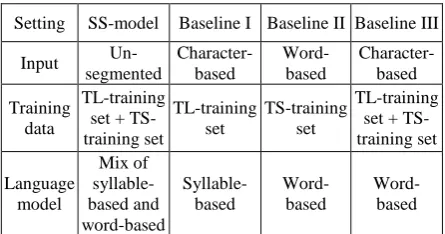
decoder) to process transliteration, meaning translation, and their combination as three baselines respectively. All of the baselines generate Top-50 candidates for each input. Table 2 shows their different settings comparing the proposed semantic-specific (SS) model.
SS-model Baseline I Baseline II Baseline III
Input
Un-Table 2. The experiment configurations of base-lines
5
Note that baseline III combines transliteration and meaning translation only by training TL training set and TS training set individually, and then directly integrating generated syllable-based alignment and word-based alignment into a whole translation table.
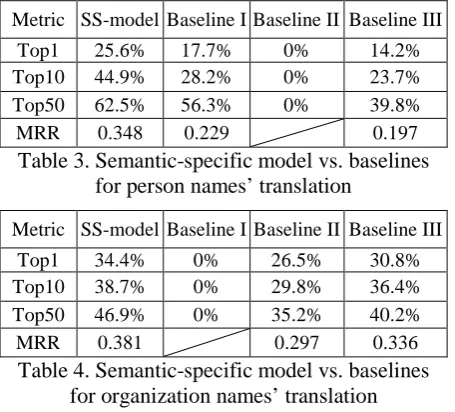
Firstly, Table 3 compares the semantic-specific model (SS-model) with three baselines for the translation of person names. From Table 3, we find that the proposed model raises the re-call of top-50 6.2% over Baseline I. It proves that our proposed model is effective for the translite-ration of person names, and outperforms the tra-ditional transliteration model. Baseline II can not output result due to its used TS-training set is out of the range of transliterating. It is interesting that the performance of baseline III even deteri-orates after combing TS and TL training sets. One explanation might be that the language model of baseline III is only trained on word lev-el, so that there is a severe data sparse problem.
Metric SS-model Baseline I Baseline II Baseline III
Top1 25.6% 17.7% 0% 14.2% Top10 44.9% 28.2% 0% 23.7% Top50 62.5% 56.3% 0% 39.8%
MRR 0.348 0.229 0.197
Table 3. Semantic-specific model vs. baselines for person names’ translation
Metric SS-model Baseline I Baseline II Baseline III
Top1 34.4% 0% 26.5% 30.8% Top10 38.7% 0% 29.8% 36.4% Top50 46.9% 0% 35.2% 40.2%
MRR 0.381 0.297 0.336
Table 4. Semantic-specific model vs. baselines for organization names’ translation
Secondly, the comparison between SS-model and three baselines for translating organization names are shown in Table 4. Baseline III outper-forms baseline II for combining both TL-training set and TS-training set. Also SS-model has sub-stantially raised the Top-N recall and MRR value over the baselines. Intuitively, we might expect that SS model could play a greater advantage on translating organization names, because organi-zation names usually combine transliteration and meaning translation. However, comparing Table 3 with Table 4, the performance gaps between SS-model and baselines for organization names is smaller than that for person names. After checking those errors, this phenomenon is prob-ably due to the word reordering problem, which
usually occurs in the translation of organization names, but has not been considered by SS-model. Further study would be required for this problem.
Thirdly, we measure the overall effect of model in Table 5. Evidently, the proposed SS-model yields significantly better results than the three baselines at all aspects. It is not surprising to find that the proposed SS-model is effective in translating various NEs of different NE types.
Metric SS-model Baseline I Baseline II Baseline III
Top1 30.7% 9.5% 11.8% 22.4% Top10 36.2% 14.2% 16.7% 30.8% Top50 55.3% 23.5% 32.8% 42.3% MRR 0.337 0.139 0.142 0.256
Table 5. Semantic-specific model vs. baselines for various names’ translation
5.2 Semantic-Specific Model Vs. Joint Transliteration Model
Actually, the proposed semantic-specific model captures semantic information by incorporating the global context information in the corpus, which is similar to the joint transliteration model proposed by (Li et al., 2004). However, the joint model only utilized the local context of the input (joint n-gram model of transliteration pairs)
1 1 1
( | ) K ( , k| , kk n ),
k
P E C =
∏
= P <e c> <e c> −− + whereas our model measures the similarity of the global context amongst corpus. Table 6 gives the com-parison of the joint model and SS-model for per-son names’ transliteration. Here previous used training-set I and 300 person names are adopted for training and testing here. Also we use 3-gram in both of the two models. As shown in Table 6, even though the performance gap of Top1 (+0.8%) is not much obvious, the performance gap gets larger when the top-N hypotheses in-crease. This evidently proves the superiority of the proposed model on selecting the correct translation variation from global context.System Top1 Top10 Top50 MRR
Joint model 24.8% 40.2% 54.2% 0.319
SS-model 25.6 % (+0.8%)
43.9% (+3.7%)
61.4%
(+7.2%) 0.348
Table 6. Semantic-specific model vs. joint model for person names’ translation
5.3 Semantic-Specific Model Vs. Origin-Based Model
information. Thus we compare it with a well-known semantic transliteration model (Li et al., 2007), which only deals with transliteration. Li’s semantic transliteration model, called origin-based model here, firstly identifies the NE’s ori-gin O by O=arg maxOP O C( | ), and then uses its corresponding trained model, which is trained on instances all from origin O. The training and decoding process also use the Moses decoder.
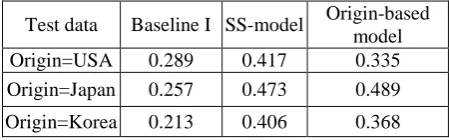
In this experiment, we adopt training-set II, which includes 7,021 person names from USA, Japan and Korea (International whoswho corpus in LDC2005T34). And then we randomly select 100 person names from USA, Japan and Korea respectively (also in whoswho corpus) as our test data. Also, there is no overlap between the train-ing set II and those test data. Here, baseline I is also the transliteration model, but trained on training set II, and we use the MRR criterion as well.
Test data Baseline I SS-model Origin-based model Origin=USA 0.289 0.417 0.335 Origin=Japan 0.257 0.473 0.489
Origin=Korea 0.213 0.406 0.368
Table 7. Semantic-specific model vs. origin-based model for person names’ translation
Considering Table 7, though there is a slight drop comparing our model with origin-based model for the Japanese person names, the trans-lation improvements on the person names of the other two origins show the superiority of our se-mantic-specific translation model. Actually, there would be much more origins to classify. For in-stance, there are more than 100 origins in
whoswho data; it is tedious to train a large num-ber of models in practice. And the origin labeled data for person names is hard to acquire. By us-ing semantic-specific model, we could directly cluster instances of similar origin, and generate final translation result for origin consistency. The experiments prove that the SS-model is effective on capturing NE origin information to assist NE translation, and it could further accommodate more different semantic information.
6
Related Work
There are two strategies for NE translation. One is to extract NE translation pairs from the Web or from parallel/comparable corpora. This is essen-tially the same as constructing NE-pair dictio-nary (lee et al., 2006; Jiang et al., 2009), which is
usually not a real-time translation model and is limited by the coverage of the used corpus and the Web resource.
The other is to directly translate an NE phonet-ically or according to its meaning. For translite-ration, several transliteration approaches have been applied to various language pairs (Knight and Graehl, 1998; Tsuji 2002; Li et al. 2004; Oh and Choi, 2005; Pervouchine et al., 2009; Durra-ni et al., 2010). In contrast, for NE meaDurra-ning translation, (Zhang et al., 2005; Chen and Zong, 2008; Yang et al., 2009) have proposed different statistical translation models only for organiza-tion names.
So far, semantic transliteration has been pro-posed for learning language origin and gender information of person names (Li et al., 2007). However, semantic information is various for NE translation. It is complicated to define different semantic types, and is tedious to train a large number of models used for different semantic information. Moreover, a semantically labeled training corpus is hard to acquire. Hence this pa-per does not directly learn NE semantic informa-tion, but measures the semantic similarity be-tween the input and global context to capture exact NE translation.
7
Conclusion
In this paper, we present a novel semantic-specific model which could adaptively learn se-mantic information via instance-based similarity measurement from global context. Accordingly, this model combines transliteration and meaning translation, and automatically selects most prob-able translation candidates on the basis of the NE semantic-specific information. In summary, our experiments show that the semantic-specific model is much more effective than the traditional statistical model for named entity translation, which achieves a remarkable 31.6% relative im-provement in MRR (Table 5). Furthermore, the proposed model yields a comparable result with the joint transliteration model (also using context) and the origin-based model, which shows its ad-vantage on capturing semantic information from global context, such as origin information.
Acknowledgments
The research work has been funded by the Natu-ral Science Foundation of China under Grant No. 6097 5053 and 61003160 and also supported by the External Cooperation Program of the Chinese Academy of Sciences. The authors also extend sincere thanks to Prof. Keh-Yih Su for his keen in-sights and suggestions on our work.
References
R. Baeza-Yates and B. RiBeiro-Neto. 1999. Modern Information Retrieval. ISBN 0-201-39829-X.
Adam L. Berger, Stephen A. Della Pietra and Vincent J. Della Pietra. 1996. A Maximum Entropy Approach to Natural Language Processing. Com-putational Linguistics, 22(1):39-72, March.
Hsin-His Chen, Changhua Yang and Ying Lin. 2003. Learning Formulation and Transformation Rules for Multilingual Named Entities. In Proceedings of ACL 2003 Workshop on Multilingual and Mixed-language Named Entity Recognition, pages 1-8.
Yufeng Chen, Chengqing Zong. 2008. A Structure-based Model for Chinese Organization Name Translation. ACM Transactions on Asian Language Information Processing, 7(1): 1-30, February 2008.
J. N. Darroch and D. Ratcliff. 1972. Generalized itera-tive scaling for log-linear models. Annuals of Ma-thematical Statistics, 43: 1470-1480.
Nadir Durrani, Hassan Sajjad, Alexander Fraser, and Helmut Schmid. 2010. Hindi-to-Urdu Machine Translation Through Transliteration. In Proceed-ings of the 48th Annual Meeting of the Association for Computational Linguistics, pages 465–474.
Fei Huang. 2005. Cluster-Specific Name Translitera-tion. In Proceedings of the HLT-EMNLP 2005, Vancouver, BC, Canada.
Long Jiang, Ming Zhou, Lee-Feng Chien, and Cheng Niu. 2007. Named Entity Translation with Web Mining and Transliteration. In Proceedings of IJ-CAI-2007.
Long Jiang, Shiquan Yang, Ming Zhou, Xiaohua Liu, and Qingsheng Zhu. 2009. Mining Bilingual Data from the Web with Adaptively Learnt Patterns. In
Proc. of ACL-2009 and the 4th IJCNLP of the AFNLP, pages 870-878.
Paul B. Kantor and Ellen M. Voorhees, 2000, The TREC-5 Confusion Track: Comparing Retrieval Methods for Scanned Text. Informational Retrieval, 2, pp. 165-176.
Kevin Knight and Jonathan Graehl. 1998. Machine Transliteration. Computational Linguistics, 24(4).
Chun-Jen Lee, Jason S. Chang and Jyh-Shing R. Jang. 2006. Alignment of Bilingual Named Entities in Parallel Corpora Using Statistical Models and Mul-tiple Knowledge Sources. ACM Transactions on Asian Language Information Processing (TALIP), 5(2): 121-145.
Haizhou Li, Min Zhang and Jian Su. 2004. A Joint Source Channel Model for Machine Transliteral-tion. In Proceedings of 42nd ACL, pages 159-166.
Haizhou Li, Khe Chai Sim, Jin-shea Kuo, and Ming-hui Dong. 2007. Semantic Transliteration of Per-sonal Names, In Proceedings of 45th ACL, pages 120-127.
Yang Liu, Qun Liu and Shouxun Lin. Log-linear Models for Word Alignment. 2005. In Proceedings of the 43rd Annual meeting of the ACL, pages 459-466.
M. Nagao. 1984. A Framework of a Mechanical Translation between Japanese and English by Analogy Principle, In Artificial and Human Intelli-gence, pages 173-180. NATO publications.
Franz Josef Och and Hermann Ney. 2002. Discri-minative Training and Maximum Entropy Models for Statistical Machine Translation. In Proceedings of the 40th Annual Meeting of the ACL, pages 295-302.
J.-H. Oh and Choi, K.-S. 2005. An ensemble of gra-pheme and phoneme for machine transliteration. In
Proceedings of IJCNLP, pages 450–461.
Vladimir Pervouchine, Haizhou Li and Bo Lin. 2009. Transliteration Alignment. In Proceedings of ACL-09, pages 136-144.
S. Sato and M. Nagao. 1990. Toward Memory-Based Translation. In Proceedings of COLING 1990, Vol.3. pages 247-252.
K. Tsuji. 2002. Automatic extraction of translational Japanese-KATAKANA and English word pairs from bilingual corpora. Int. J. Comput. Process Oriental Lang. 15(3): 261-279.
Fan Yang, Jun Zhao, Bo Zou, Kang Liu, Feifan Liu. 2008. Chinese-English Backward Transliteration Assisted with Mining Monolingual Web Pages, In
Proceeding of the 46th Annual Meeting of the As-sociation for Computational Linguistics, pages 541-549, Columbus, OH.
Fan Yang, Jun Zhao, Kang Liu. 2009. A Chinese-English Organization Name Translation System Using Heuristic Web Mining and Asymmetric Alignment. In Proceedings of the 47th Annual Meeting of the ACL, Singapore. August 2 -7.