The Importance of Lexicalized Syntax Models
for Natural Language Generation Tasks
Hal Daum´e III, Kevin Knight, Irene Langkilde-Geary, Daniel Marcu and Kenji Yamada
Information Sciences Institute Computer Science Department University of Southern California
4676 Admiralty Way, Suite 1001 Marina del Rey, CA 90292
hdaume,knight,ilangkil,marcu,kyamada @isi.edu
Abstract
The parsing community has long recog-nized the importance of lexicalized mod-els of syntax. By contrast, these modmod-els do not appear to have had an impact on the statistical NLG community. To prove their importance in NLG, we show that a lexicalized model of syntax improves the performance of a statistical text compres-sion system, and show results that suggest it would also improve the performances of an MT application and a pure natural lan-guage generation system.
1 Introduction
We distinguish between three types of language models:
-gram language models look only at word se-quences to gauge the quality of a sentence.
Non-lexicalized syntax models consider only syntactic structure down to the level of word tags in assessing the grammaticality of a sen-tence. A PCFG is an example of such a model.
Lexicalized syntax models take into account both sentence syntax and lexical values when determining the quality of a sentence.
The parsing community has long recognized the importance of lexicalized models of syntax for building robust natural language applications. For example, Charniak (1997) showed that by us-ing a lexicalized syntax model instead of a non-lexicalized PCFG syntax model trained on Penn
Treebank data, one can increase the performance of
a syntactic parser from labeled recall and
precision to . More sophisticated lexicalized
models of syntax (Collins, 1997; Charniak, 2000) have increased the performance of syntactic parsers
to labeled recall and precision. Lexicalized
models of syntax have been also proven useful in speech recognition (Chelba and Jelinek, 1998) and language modeling (Charniak, 2001; Roark, 2001).
By contrast, lexicalized models of syntax do not appear to have had an impact on the statistical NLG community. Langkilde and Knight (1998), for
ex-ample, use an
-gram model to select between dif-ferent lexical renderings of a meaning representa-tion. Knight and Marcu (2000) use a combination of bigram and context free probabilities to select be-tween sentence compressions. To our knowledge, the only NLG work that resonates with the work in parsing, speech recognition, and language modeling is that of Bangalore and Rambow (2000), who show that a statistical generation system that uses a lexi-calized hierarchical model of syntax outperforms a system that uses a random model.
genera-tion system.1
In each experiment, we assess the impact that a lexicalized model of syntax may have on improving the quality of existing systems using an off-the-shelf component: the parser built by Charniak (2000).
Our use of Charniak’s parser provides for a loose coupling of a lexicalized model of syntax with a gen-eration system, which is far from ideal. Neverthe-less, these experiments provide evidence that lex-icalized models of syntax can improve the quality of the outputs of statistics-based generators. Our results motivate work aimed at building generation systems that choose between possible renderings of the same meaning using not only n-gram proba-bilistic models, but lexicalized models of syntax, such as those proposed by Collins (1997) and Char-niak (2000).
2 Statistical Summarization
2.1 Document Compression
To assess the impact that lexicalized models of syn-tax may have on the task of summary generation, we used a noisy-channel document compression system (Daum´e III and Marcu, 2002), which generalizes the sentence compression system developed by Knight and Marcu (2000) to the document level.
In Daum´e and Marcu’s system, possible docu-ment compressions are packed into a shared-forest structure which contains explicit channel-model probability scores. These channel probabilities are based on discourse PCFG probabilities and syntac-tic PCFG probabilities, as well as compression prob-abilities. None of these probabilities are lexicalized. We then use a generic forest ranker which com-bines these channel probabilities with bigram-based source model probabilities (Langkilde, 2000) to ex-tract the top scoring compression. The only point at which lexicalization enters the model is in the bigram-based source model. This leads to the gen-eration of many poor syntactic structures. For in-stance, the model does not know the difference be-tween transitive and intransitive verbs, and therefore will often “compress off” the objects of transitive verbs.
1
We are grateful to Eugene Charniak for suggesting these experiments to us.
After the system was constructed, we evaluated its
performance on documents chosen from the Wall
Street Journal portion of the Penn Treebank, each
containing between and words
2. We also
eval-uated it on documents selected from the Mitre
cor-pus (Hirschman et al., 1999), each document
con-taining between and words. We used two
cor-pora to see whether the system’s performance varied with text genre. In the evaluations, the system out-performed a baseline system presented by Knight & Marcu (2000), applied iteratively. However, it still made many errors which would not have been made, had it had a good grasp of English grammar. We per-formed an exhaustive error analysis on the system to see where it could be improved.
2.2 Error Analysis
After analyzing the errors the system made, we clas-sified them into ten classes, each listed in Table 1 with an example of the error and an example of this error fixed.
We then tabulated the frequency with which these error occurred in the summaries produced by the system. They are shown in Table 2.
Three of these error classes can be
consid-ered grammaticality errors: DET, MOD, COMP,
NOVERBand NUM. These three alone account for
errors out of a total of errors. It seemed
that the integration of a lexicalized model of syn-tax into the source model would easily remove all of these problems. Since the document compression
system was able to output an
-best list of possible compressions, we were able to rerank this list using Charniak’s parser.
2.3 Syntax-Based Reranking
To do this reranking, we modified Charniak’s (2000) parser so that instead of outputting the optimal parse tree for a given sentence, it outputs its non-normalized maximum entropy score. We then ran the modified parser on the 1000 best compressions according to the bigram model, normalized the prob-abilities by length and chose the single best com-pression.
2
Grammatical Errors
DET - A noun or noun phrase is missing a determiner. Erroneous “El Paso owns and operates refinery.”
Fixed “El Paso owns and operates a refinery.”
COMP - The complement of a verb or noun is missing, rendering the output ungrammatical. Erroneous “Banco Exterior was run by politicians who lacked the skills or the will.”
Fixed “Banco Exterior was run by politicians who lacked the skills or the will to do .”
NUM - Often if the original document contains a percentage (for instance “5%”), the number will be dropped without the percent-age sign.
Erroneous “The rate is %.”. Fixed “The rate is 5%.”.
NOVERB - Sentence lacking a verb. Erroneous “Stewart, the builder.”
Fixed “It is named for Stewart, the builder.”
Discourse/Coherence-specific Errors
ANTE - The antecedent of an anaphor has been dropped, resulting in incoherence. Erroneous “Terms are subject to change, the company said.”
Fixed “Terms are subject to change, Banko Exterior said.”
CUE+ - Uninterpretable cue-word. For instance, if and form a discourse constituent and is contrasting and begins with “But”, but is dropped, so should be “But.”
Erroneous “But the proposed transaction calls for an exchange of the debt ” Fixed “The proposed transaction calls for an exchange of the debt ”
CUE- - A cue word or phrase is missing, rendering the output incoherent.
Erroneous “The President of the United States urged the armed forces to advance. His commanders did not have the initiative.”
Fixed “President of the United States urged the armed forces to advance. When he did, his commanders did not have the initiative.”
Summarization-specific Errors
MOD - A nominal modifier which should not have been dropped has been and significant meaning is lost. Erroneous “Tons will fill damp barns across the land.”
Fixed “Tons of vegetables will fill damp barns across the land.”
MISS - The compression misses important information.
EXTRA - The compression contains unimportant information.
Table 1: Types of errors in the texts generated by the model.
This is far from an ideal language model. For in-stance, there is no guarantee that the structure the parser will derive for the sentence will be the same structure the compression model generated. Further-more, since the parser assumes only one input sen-tence, the scores produced by the best parse for two different sentences may not be comparable.
2.4 Evaluation
After reranking, we performed the same error anal-ysis as before. The results for the new error analanal-ysis are summarized in Table 3.
We can see from the delta row in Table 3 (negative
numbers are good), that we removed most grammat-icality errors. We saw modest improvement with re-spect to the dropping of important modifiers; this is to be expected, though, since the syntax model has no idea of “importance.” The same argument ex-plains the minimal change in the missing antecedent problems. We removed all instances of extra infor-mation but added seven additional counts of missing information.
nec-Grammaticality Discourse Summarization DET MOD COMP NUM NOVERB ANTE CUE+ CUE- MISS EXTRA
wsj 0607 ! !
wsj 0616 ! ! ! !
wsj 0632 !
wsj 0654 ! ! !
wsj 0655 !
wsj 0667 ! " !
wsj 0689 ! ! ! !
wsj 1126 " ! !
wsj 1146 !
wsj 1189 ! " !
wsj 1307 ! ! " !
wsj 1331 !
wsj 1346 " !
wsj 1376 ! ! !
wsj 1380 ! !
wsj 2386 ! ! !
rm5-10 ! ! !
rm5-22 ! ! "
rm5-27 ! !
rm5-6 ! !
rm5-9
Count !# !$! !% ! " & " " ' %
Table 2: Tabulation of the errors in the texts generated by the model.
Grammaticality Discourse Summarization
DET MOD COMP NUM NOVERB ANTE CUE+ CUE- MISS EXTRA
wsj 0607
wsj 0616 ! !
wsj 0632 ! !
wsj 0654 !
wsj 0655 ! ! !
wsj 0667 !
wsj 0689 " ! !
wsj 1126 !
wsj 1146 !
wsj 1189
wsj 1307 !
wsj 1331 ! !
wsj 1346 !
wsj 1376 ! !
wsj 1380 ! !
wsj 2386 !
rm5-10 ! !
rm5-22 ! !
rm5-27 ! "
rm5-6
rm5-9 ! !
Count ! ' ( ! # ( # # !)& #
Delta *,+ *,% *,+ # *-" *.! *-" *-" /.0 *,%
Table 3: Tabulation of the errors in the texts generated by the model with syntax-based rescoring.
essary, which reduces the amount of information which can be packed into a summary of comparable length. Here, by removing most of the grammatical-ity errors, we caused the system to drop some of the important information.
To determine whether the changes in the system
are noticeable to a user, we carried out a
subjec-tive evaluation. We presented human judges with
the outputs generated by the original text compres-sion system, the results after rescoring, and human-generated compressions. These judges were asked
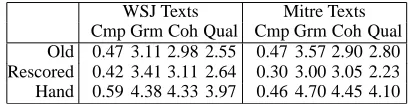
WSJ Texts Mitre Texts Cmp Grm Coh Qual Cmp Grm Coh Qual Old 0.47 3.11 2.98 2.55 0.47 3.57 2.90 2.80 Rescored 0.42 3.41 3.11 2.64 0.30 3.00 3.05 2.23 Hand 0.59 4.38 4.33 3.97 0.46 4.70 4.45 4.10
Table 4: Evaluation Results
best) on metrics of compression rate (Cmp), Gram-maticality (Grm), Coherence (Coh) and Compres-sion Quality (Qual). The results of this evaluation are summarized in Table 4.
In the Wall Street Journal data, there was a mod-erate improvement in grammaticality, coherence and quality, as error analysis suggested. In the Mitre data, grammaticality and quality went down signif-icantly, while coherence remained steady. This can be attributed to two factors. First, there were few errors in the Mitre data to start with and thus less room for improvement; Second, the Mitre data is out of domain for both the document compression sys-tem and for the parser, which leads to less reliable statistics.
3 Machine Translation
For our machine translation experiments, we use the statistical MT system of Yamada and Knight (2001). This system produces English translations of foreign language sentences by exploiting three components:
A Translation model (TM). For any given pair
1
English parse tree 2 , foreign language string
354
, this model returns a probability687
3.9 2: .
A Language model (LM). For any English tree
2 , this model returns a probability687;2<:.
A Search algorithm. Given a foreign language sentence
3
, this algorithm searches for the
En-glish tree e that maximizes 687;2
9=3
:?>@687A2<:CB 687
3D9 2<:.
Yamada and Knight (2001; 2002) describe the
TM and the search algorithm, respectively. The
search algorithm takes a foreign language sentence and produces a vast number of candidate English trees, packed into a forest structure, as in sum-marization (see Section 2), then searches for the highest-scoring tree. The current algorithm uses a trigram LM, ignoring the internal structure of the
candidate trees. Therefore, the system does not nec-essarily produce syntactically correct translations.
To see the effect of a lexicalized syntax language model, we performed what automatic speech recog-nition (ASR) researchers call “a cheating experi-ment”. For a given acoustic signal, ASR researchers know both the correct target transcription, A, (which was done by hand) and the current automatic system transcription, B. The probabilistic score for B will be greater than that for A. However, a new knowledge source may provide additional scores that cause A to be reranked higher. This is cheating for two reasons: (1) it does not include a search algorithm that inte-grates the new knowledge source, and (2) there may be an incorrect string C that scores higher than both A and B under reranking.
This kind of experiment is not regularly done in machine translation because there is no single cor-rect translation A. Using a human translation as a target A does not work, because human translations are often non-literal and current statistical models do not recognize them as good translations. To rem-edy this, we manually created a set of target trans-lations, which we called “hope” translations. These are good translations that we believe to be within reach of the system: we can reasonably hope that the system would prefer them.
In our experiment, we score both hope sentences, A, and current system translations, B, over a num-ber of examples, using combinations of these knowl-edge sources:
T: translation model
R: word-trigram language model
C: score from Charniak’s parser
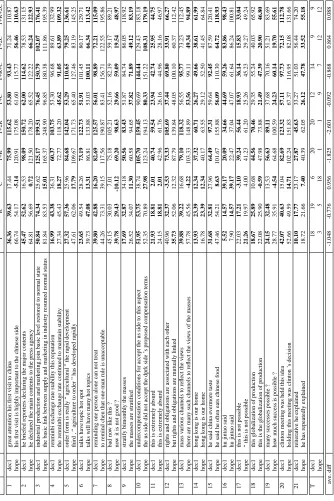
Table 5 shows the results. A sentence marked “dec1” is a decoder output (Sentence B) and “hope” is a hope sentence (Sentence A); lower scores are better. The last row shows the average difference of the score (a positive difference means that the sys-tem prefers “hope” sentences over current syssys-tem outputs). Just above the last row is the number of
sentences which ranked better.3
3
The score from Charniak’s parser (C) is a
(H37 :ADJUNCT "earlier"
:LOGICAL-SUBJECT (H5 / "company") / "announce"
:ADJUNCT (H34 :ADJUNCT "its" / "plan"))
Figure 1: An underspecified input for the sentence, ”Earlier the company announced its plans.”
As expected, our current system (T+R) almost never ranks the hope sentence higher than the system sentence. If we replace the trigram model with Char-niak’s parser (T+C), the hope sentence is ranked higher than the originally preferred sentences in 9 cases. These results are slightly better than rerank-ing with the parser (T+R+C). Best results are ob-tained by assigning a higher weight to the parser score relative to the translation model (T+2C): here, the hope sentence comes out on top in 12 cases.
4 Natural Language Generation
From the sentences in section 23 of the Penn Treebank, inputs to the HALogen generator sys-tem were automatically derived and then
re-generated(Langkilde-Geary, 2002). The inputs
derived were feature-value dependency structures, where the features represent syntactic relationships between values, and the values were either words in root form or a nested feature-value structure. The inputs were underspecified with respect to proper-ties such as part-of-speech category, tense, voice, and number, as well as constituent order and some closed-class words like auxiliary verbs and deter-miners. Underspecification tests the ability of a lan-guage model to pick the best solution from among a set of choices.
HALogen overgenerates possible expressions for an input, in part because of enumerating possible choices for underspecified details. It then ranks
po-tential outputs using an
-gram model. Both bigram and trigram models were available, but because the trigram model takes two orders of magnitude more time to use (roughly 40 minutes per sentence, ver-sus 1 minute per sentence for the bigram model), the sentences were generated using the bigram model.
sentences. For “dec1” sentences, we use the parse tree returned from the decoder to calculate it. For “hope” sentences, we use a parse tree generated from Collins parser (1997) to calculate it. Thus, there may be different T scores for the same sentence.
One hundred sentences were randomly chosen from among the successfully generated outputs. Each was paired with its original Treebank sentence, and then trigram and Charniak-parser scores were calculated for all the sentences. About 3% of the sentence pairs were exact matches. Sentences within pairs had very similar lengths in all cases. The average sentence length was 24 tokens. The original Treebank sen-tence serves as a gold standard for the generator.
Trigram scores for original Treebank sentences scored better than the output of the generator sys-tem 71% of the time. In comparison, Charniak-parse scores preferred the original Treebank sen-tences 83% of the time. This indicates that the gen-erator system would benefit even more from a statis-tical model of syntax than from trigrams.
5 Conclusion
In statistical summarization, we have shown that having a lexicalized syntax model reduces the fre-quency of grammatical errors through both a
care-ful error analysis and a human evaluation. We
furthermore show that a lexicalized syntax model might assist in the selection of good translations in a syntax-based machine translation system. Finally, we present results that indicate the importance of lexicalized models of syntax in the HALogen nat-ural language generation system (Langkilde-Geary, 2002).
It seems from these results that the integration of such a language model in these tasks and in statistical natural language generation systems will
prove to be fruitful. Most importantly, all three
of these systems use the same forest ranking algo-rithm/component. Thus, if this one component were extended to use a lexicalized model of syntax in
place of the current
-gram scoring method, the per-formance of all three system would undoubtedly im-prove significantly.
Acknowledgements
References
S. Bangalore and O. Rambow. 2000. Exploiting a proba-bilistic hierarchical model for generation. In Proceed-ings of the International Conference on Computational Linguistics (COLING 2000), Hong Kong, China.
Eugene Charniak. 1997. Statistical parsing with a context-free grammar and word statistics. In Proceed-ings of the Fourteenth National Conference on Arti-ficial Intelligence (AAAI’97), pages 598–603, Provi-dence, Rhode Island, July 27–31.
Eugene Charniak. 2000. A maximum-entropy-inspired parser. In Proceedings of the First Annual Meeting of the North American Chapter of the Association for Computational Linguistics NAACL–2000, pages 132– 139, Seattle, Washington, April 29 – May 3.
Eugene Charniak. 2001. Immediate-head parsing for language models. In Proceedings of the 39th Annual Meeting of the Association for Computational Linguis-tics.
Ciprian Chelba and Frederick Jelinek. 1998. Exploiting syntactic structure for language modeling. In Chris-tian Boitet and Pete Whitelock, editors, Proceedings of the Thirty-Sixth Annual Meeting of the Associa-tion for ComputaAssocia-tional Linguistics and Seventeenth International Conference on Computational Linguis-tics, pages 225–231, San Francisco, California. Mor-gan Kaufmann Publishers.
Michael Collins. 1997. Three generative, lexicalized models for statistical parsing. In Proceedings of the 35th Annual Meeting of the Association for Compu-tational Linguistics (ACL–97), pages 16–23, Madrid, Spain, July 7-12.
Hal Daum´e III and Daniel Marcu. 2002. A noisy-channel model for document compression. In Proceedings of the Conference of the Association of Computational Linguistics (ACL 2002).
L. Hirschman, M. Light, E. Breck, and J. Burger. 1999. Deep read: A reading comprehension system. In Pro-ceedings of the 37th Annual Meeting of the Association for Computational Linguistics.
Kevin Knight and Daniel Marcu. 2000. Statistics-based summarization — step one: Sentence compression. In The 17th National Conference on Artificial Intelli-gence (AAAI–2000), pages 703–710, Austin, TX, July 30th – August 3rd.
Irene Langkilde and Kevin Knight. 1998. Generation that exploits corpus-based statistical knowledge. In Proceedings of the 36th Annual Meeting of the Asso-ciation for Computational Linguistics and of the 17th International Conference on Computational Linguis-tics (COLING/ACL’98), Montreal, Canada, August.
Irene Langkilde-Geary. 2002. An empirical verifica-tion of coverage and correctness for a general-purpose sentence generator. In Proceedings of the 2nd Inter-national Conference on Natural Language Generation (INLG 2002)., Arden House, NJ, July.
Irene Langkilde. 2000. Forest-based statistical sentence generation. In Proceedings of the 1st Annual Meeting of the North American Chapter of the Association for Computational Linguistics, Seattle, Washington, April 30–May 3.
Brian Roark. 2001. Probabilistic top-down parsing and language modelling. In Computational Linguistics 27(2), pages 249–276.
K. Yamada and K. Knight. 2001. A syntax-based statis-tical translation model. In Proceedings of the Confer-ence of the Association of Computational Linguistics (ACL 2001).