997
Encoding Sentiment Information into Word Vectors for Sentiment
Analysis
Zhe Ye♠ Fang Li♠ Timothy Baldwin♥
♠Department of Computer Science and Engineering, Shanghai Jiao Tong University, Shanghai, 200240, China
♥School of Computing and Information Systems, The University of Melbourne, Victoria, 3010, Australia
{yezhejack, fli}@sjtu.edu.cn, [email protected]
Abstract
General-purpose pre-trained word embeddings have become a mainstay of natural language pro-cessing, and more recently, methods have been proposed to encode external knowledge into word embeddings to benefit specific downstream tasks. The goal of this paper is to encode sentiment knowledge into pre-trained word vectors to improve the performance of sentiment analysis. Our proposed method is based on a convolutional neural network and an external sentiment lexicon. Experiments on four popular sentiment analysis datasets show that this method improves the accuracy of sentiment analysis compared to a number of benchmark methods.
1 Introduction
Sentiment analysis plays an important role in many real-world applications. The objective of sentiment classification is to classify a sentence, message or document according to sentiment, often in the form of ordinal regression (e.g. positive vs. neutral vs. negative). In recent years, deep neural networks, such as convolutional neural networks (“CNNs”), have been widely used for sentiment classification. A simple CNN trained over pre-trained word vectors has been shown to achieve highly competitive results (Kim, 2014). Learning task-specific vectors through fine-tuning may offer further gains in performance, and this is the primary focus of this paper.
Separately, there has been recent work on methods for learning word embeddings based not just on textual contexts, but also external knowledge bases (Wieting et al., 2015; Yu and Dredze, 2014; Xu et al., 2014; Bian et al., 2014; Faruqui et al., 2015; Mrkˇsi´c et al., 2016; Mrkˇsi´c et al., 2017; Vuli´c et al., 2017). This has also been applied to sentiment classification (Rouvier and Favre, 2016; Yu et al., 2017), with empirical results indicating that explicitly embedding sentiment resources can improve the performance of sentiment analysis.
Existing methods for encoding external knowledge into word vectors are generally trained indepen-dently of the downstream task. In order to leverage sentiment lexicons for sentiment analysis, we propose a novel method to combine a feedforward neural network (denoted “SentiNet”) with a CNN classifier to encode sentiment knowledge into word vectors during training. The method tunes word vectors through the CNN and SentiNet, based on independent information from supervised training data and sentiment lexicons. Our hypothesis is that joint training of sentiment-targeted word embeddings should improve the overall accuracy of the resulting sentiment analyzer. We conduct several experiments to verify this hypothesis, and compare our method with competitor methods that use antonymy/synonymy lexicons and paraphrase databases.
The major contributions of this paper are as follows: (1) the sentiment lexicon is encoded into word vectors by a feedforward neural network instead of an objective function based on a fixed metric such as cosine similarity or Euclidean distance, and in doing so are able to dynamically learn how to encode the lexicon; (2) word vectors are fine-tuned based on supervised training data and the sentiment lexicon during the training of the CNN sentiment classifier; and (3) we achieve state-of-the-art accuracy over a range of benchmark sentiment analysis datasets.
2 Related Work
2.1 Encoding External Knowledge into Word Vectors
Existing approaches to leveraging external knowledge for word embedding learning for natural language processing fall into two categories: (1) encoding external knowledge during the word vector learning stage; and (2) encoding external knowledge into pre-trained word vectors. Both styles of approach make use of similar linguistic resources such as WordNet (Miller, 1995), FrameNet (Baker et al., 1998), the Paraphrase Database (“PPDB”: Ganitkevitch et al. (2013)), or BabelNet (Navigli and Ponzetto, 2012).
Methods in the first category usually change the objective function of the language model or add reg-ularization terms into the original objective function. Yu and Dredze (2014) combine CBOW (Mikolov et al., 2013) with word relations extracted from WordNet and PPDB. Xu et al. (2014) regard relational knowledge and categorical knowledge as learning regularizers, and combine them with the skip-gram objective function. Bian et al. (2014) also combine the objective function of CBOW with external syn-tactic and semantic knowledge to improve word vectors for extrinsic tasks. These methods all need large unlabeled corpora to learn word vectors from scratch.
In contrast, methods in the second category are lightweight because they adapt pre-trained word vec-tors via post-processing. This means these methods are compatible with different kinds of word vecvec-tors. Wieting et al. (2015) learn PARAGRAM word vectors by fine-tuning over paraphrase data from PPDB. The resultant embeddings outperform the baseline skip-gram embeddings over an extrinsic sentiment analysis task for low-dimensionality word embeddings. Faruqui et al. (2015) use synonym relations extracted from WordNet and other resources to construct an undirected graph. They then retrofit the undirected graph to pre-trained word vectors to obtain new word vectors, under the constraint that the resulting vectors should be close to the vectors of their neighbours in the semantic graph. Antonyms are generally close in vector space, presenting a problem when learning general-purpose word vectors (as in most scenarios, it is undesirable for antonyms to be closely related) (Mnih and Hinton, 2008; Col-lobert et al., 2011; Mikolov et al., 2013; Levy and Goldberg, 2014; Pennington et al., 2014). In order to solve this problem, antonym lexicons have been used to fine-tune pre-trained word vectors. Mrkˇsi´c et al. (2016) present a method called counter-fitting to inject antonymy and synonymy constraints into word vectors trained with GloVe (Pennington et al., 2014) and PARAGRAM (Wieting et al., 2015). The adapted word vectors trained with PARAGRAM achieve the second-highest SimLex-999 (Hill et al., 2015) score. Mrkˇsi´c et al. (2017) extend this previous work using negative sampling, to force synonym pairs to be closer to each other than to their negative examples, and forcing antonyms pairs to be further away from each other than from their negative examples.
Encoding external knowledge into word vectors has shown to be effective for improving pre-trained word vectors for intrinsic evaluation such as WordSim-353 (Finkelstein et al., 2002) and SimLex-999. It has also shown to be effective for improving extrinsic tasks such as dialogue state tracking (Mrkˇsi´c et al., 2016; Mrkˇsi´c et al., 2017; Vuli´c et al., 2017), sentiment analysis (Faruqui et al., 2015; Wieting et al., 2015; Yu et al., 2017), document classification (Kiela et al., 2015), and word sense disambiguation (Rothe and Sch¨utze, 2015).
The above two kinds of methods both encode external knowledge into word vector space before ap-plying word vectors in downstream tasks. Our method encodes a sentiment lexicon into word vectors when fine-tuning the word vectors in a downstream task.
2.2 Adapting Word Vectors for Sentiment Analysis
a combined word representation for sentiment analysis. Severyn and Moschitti (2015) refine pre-trained word vectors through a CNN based on distant-supervised data. Zhou et al. (2016) introduced three kinds of word vectors as features into their sentiment classifier. One is general purpose, and the the other two are trained by leveraging sentiment information. However, their feature selection experiments indicate that the task-specific trained word vectors do not improve the performance of their system substantially. Ren et al. (2016) use a recursive autoencoder to learn topic-enhanced word vectors, based on the assump-tion that the same word can vary in sentiment according to topic. Rouvier and Favre (2016) proposed three kinds of word embeddings — lexical embeddings, part-of-speech embeddings, and sentiment em-beddings — in order to train three CNN-based sentiment classifiers. The three classifiers are combined into a fusion model to make the final prediction.
Other methods regard sentiment information as a kind of external knowledge. They encode sentiment information into word vectors by using customized objective functions or introducing regularization terms into objective function of the language model. Yu et al. (2017) utilize a sentiment lexicon to re-rank the nearest neighbors in order to capture sentiment information. The refinement model is based on an objective function which calculates the distance among vectors, in order to adapt word vectors for sentiment analysis. Tang et al. (2016) build on their earlier method (Tang et al., 2014) for Twitter sentiment classification, by leveraging a sentiment lexicon instead of large volumes of distant-supervised Twitter data. Our method also leverages a sentiment lexicon to encode sentiment information into word vectors. The difference between our method and the methods proposed by Yu et al. (2017) and Tang et al. (2014) is that our method applies to word vectors directly via the word embedding layer of the neural network in the context of training a sentiment analyzer, rather than over pre-trained word vectors without explicit task-based training. Our method uses a feedforward neural network to encode sentiment information, as distinct from prior work, which has used cosine similarity or Euclidean distance in the objective function to model word embedding (dis)similarity.
3 Methods
Sentiment lexicons are considered to be a critical component of sentiment analysis. Such external knowl-edge resources — such as SentiWordNet (Baccianella et al., 2010) and the extended version of Affective Norms of English Words (E-ANEW: Warriner et al. (2013)) — are often used to provide more accurate information about the polarity of a word. Encoding sentiment knowledge into word vectors has been proven to be an effective way to enhance the performance of sentiment analysis.
3.1 Encoding Method
A high-level overview of methods for encoding external knowledge into word vectors for CNN classifiers is presented in Figure 1. Word vectors are used to initialize word embeddings in a CNN classifier. The parameters of the CNN and components for fine-tuning the word embeddings are learned based on supervised training data. The differences in approaches to encoding external knowledge into word vectors are indicated with dotted rectangles in Figure 1. There are three rectangles, representing the two categories of existing approaches described in Section 2.1, and our proposed method: (a) the first class of approach, where word vectors are trained based on external knowledge and unsupervised corpora from scratch; (b) the second class of approach, where pre-trained word vectors are fine-tuned based on external knowledge, and the fine-tuned word vectors are then used to initialize the word embeddings for a CNN classifier; and (c) our method, where we combine external knowledge with pre-trained word vectors during joint parameter training. The parameters of the “Embedding” component are therefore trained not only based on supervised training data, but also based on external knowledge.
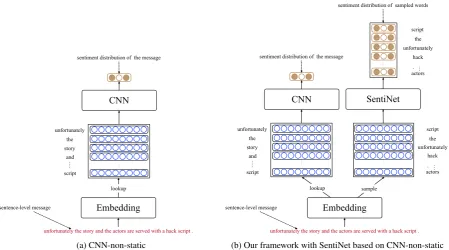
Figure 2(a) illustrates the architecture of the CNN classifier proposed by Kim (2014). The input to the Embedding component is a document.1 The Embedding component of the model outputs a real-valued matrix consisting of the word vectors representing the document. The CNN takes the matrix as input and predicts the sentiment class distribution of the document.
word vectors Embedding CNN initialized CNN classifier parameter training supervised training data Embedding CNN trained CNN classifier parameter training external knowledge external knowledge unsupervised corpora external knowledge (a) The first existing method (b) The second existing method (c) Our method word vectors training
Figure 1: High-level overview of existing methods and our method of encoding external knowledge into word vectors.
Embedding
sentence-level message
unfortunately the story and the actors are served with a hack script .
CNN
sentiment distribution of the message
lookup unfortunately the story and script …. …. (a) CNN-non-static Embedding sentence-level message
unfortunately the story and the actors are served with a hack script .
SentiNet CNN
sentiment distribution of sampled words
sentiment distribution of the message
the lookup sample script the unfortunately hack actors unfortunately the story and script …. …. … . …. script unfortunately hack actors … . ….
[image:4.595.74.524.353.603.2](b) Our framework with SentiNet based on CNN-non-static
Figure 2: The framework of CNN-non-static (Kim, 2014) vs. our method for encoding a sentiment lexicon into word vectors by SentiNet.
[image:4.595.298.518.355.586.2]distribution of the document. The loss function of the CNN is:
LCNN =CE(fhm(W),fgm(W)), (1)
whereCE(·)is a scalar value representing the categorical cross-entropy between the prediction and the gold-standard sentiment distribution. The parameters of the CNN will be updated according toLCNN. M words are sampled from[w1, w2, . . . , wN], denoted as [ws1, ws2, . . . , wsM]wheresk ∈ [1, N]and k∈[1, M]. The word vectors of the sampled words are denoted as[ws1,ws2, . . . ,wsM]. SentiNet uses
the sampled word vectors to predict the word-level sentiment distribution based on SentiWordNet. Let
fhw(wsk)andf g
w(wsk)be the prediction and gold-standard sentiment distribution of the wordwsk. The
loss function for SentiNet is:
LSentiNet= M
X
k=1
CE(fhw(wsk),f g
w(wsk)). (2)
The parameters of SentiNet are updated according to LSentiNet, and the parameters of Embedding are updated according to the combined lossL:
L=LCNN+LSentiNet (3)
Instead of encoding external knowledge into word vectors and training the CNN sentiment classifier separately, the word vectors in our method are fine-tuned with not only the CNN, but also with Sen-tiNet, where SentiNet is regarded as an indicator of word-level sentiment information. If the training of SentiNet converges, the word vectors are considered to have sentiment information.
3.2 SentiNet
Our SentiNet method uses a feedforward neural network with one hidden layer, distinct from previous work which has tended to use an objective function based on cosine similarity or Euclidean distance to capture word embedding similarity. SentiNet takes a word vectorwskas input, and outputs the sentiment
distribution of the word, denoted asfhw(wsk). The calculation of the sentiment distribution of the word
is based on:
fhw(wsk) = softmax(θ2(σ(θ1wsk+b1)) +b2), (4)
whereθ1,θ2,b1andb2are trainable parameters, andσ is the sigmoid function. The reason for using a feedforward neural network is that it has the same structure as standard word embedding training models such as CBOW, skip-gram and C&W (see Section 2.1).2
4 Experiments
4.1 Experimental Setup
Experiments are conducted over four popular, publicly-available sentence-level sentiment classification datasets:
• SemEval2016: The dataset of the SemEval-2016 Message Polarity Classification task. The goal
is to classify a given Twitter message according to positive, negative or neutral sentiment (Nakov et al., 2016).
• SemEval2017: The dataset of the SemEval-2017 Message Polarity Classification task. The task
formulation is exactly the same asSemEval2016and the same training data is used, with new test data (Rosenthal et al., 2017).
2When training SentiNet with a mini-batch sentences, the words of the mini-batch are classified into positive, neutral and
Train Dev Test
Positive Neutral Negative Positive Neutral Negative Positive Neutral Negative
SemEval2016 9169 8098 4115 — — — 7059 10342 3231
SemEval2017 19902 22591 7840 — — — 2375 5937 3972
MR 5331 — 5331 — — — — — —
SST-2 3610 — 3310 444 — 428 909 — 912
Table 1: Statistical breakdown of the four sentiment classification datasets used in this research.
• MR: Single-sentence movie reviews, labeled as having positive or negative sentiment (Pang and Lee, 2005).
• SST-2: A relabelled version of MR, where the overall review is labeled as having positive or
nega-tive sentiment (Socher et al., 2013).
Statistics for the four datasets are shown in Table 1. SemEval2016,SemEval2017andSST-2have standard training–test splits.MRdoes not have such a standard split, so we use 10-fold cross validation, consistent with other work on the dataset. We hold out 10% of the training data for SemEval2016,
SemEval2017andMRfor development purposes (e.g. for early stopping), whereasSST-2has a
stan-dard development partition. Consistent with stanstan-dard practice for the respectivce datasets, we evaluate
SemEval2016andSemEval2017based on macro-averaged F-score (“F1”), andMRandSST-2based
on classification accuracy.
The CNN sentiment classifier is based on the model proposed by Kim (2014). The differences are that: (1) the penultimate layer of our model is not regularized; and (2) we use the Adam optimizer (Kingma and Ba, 2014), whereas Adadelta (Zeiler, 2012) was used in the original. Hyperparameter tuning was per-formed over theSemEval2016development data, based on which we use rectified linear units (ReLU), and a dropout rate of 0.5 on the penultimate layer. Three filter window sizes of 3, 4 and 5 are used, each of which contains 100 feature maps. These values are consistent with the hyperparameter settings of Kim (2014).3
4.2 Training Variations
We propose three settings for learning the parameters of Embedding, CNN and SentiNet. Learning all parameters together will lead to co-adaption of the parameters, degrading performance. The number of epochs is set to 100. We use the test result of the epoch with highest performance in dev data. The procedure for training the sentiment classifier is divided into two stages, each made up of 50 epochs. There are three variations according to the training time of Embedding and CNN, named BEFORE, DURING and AFTER, which are optionally integrated with the training of SentiNet:
• BEFORE: The parameters of Embedding are updated in the first stage (the first 50 epochs), and the parameters of CNN are updated in the second stage (the second 50 epochs).
• BEFORE+SentiNet: The parameters of Embedding and SentiNet are updated in the first stage, and the parameters of CNN are updated in the second stage.
• DURING: The parameters of Embedding and CNN are updated synchronously across both stages.
• DURING+SentiNet: The parameters of Embedding, SentiNet and CNN are updated synchronously across both stages.
• AFTER: The parameters of Embedding are updated in the second stage and the parameters of CNN are updated in the first stage.
• AFTER+SentiNet: The parameters of Embedding are updated in the second stage. The parameters of CNN and SentiNet are updated in the first stage.
SemEval2016 SemEval2017 MR SST-2
Baseline (CNN + Embedding) 0.606 0.640 0.782 0.825
BEFORE 0.607 0.640 0.786 0.831
BEFORE+SentiNet 0.609 0.636 0.788 0.834
DURING 0.608 0.646 0.789 0.825
DURING+SentiNet 0.610 0.637 0.794 0.840
AFTER 0.614 0.650 0.787 0.834
AFTER+SentiNet 0.616 0.651 0.794 0.837
Table 2: Results of three variations with and without SentiNet. The evaluation metric in the second and third columns is Macro-averaged F-score, while the measurement in the fourth and fifth columns is accuracy. Above-baseline results are indicated inbold, and the best result over each dataset is underlined.
4.3 Results
Baseline system: The baseline system consists of Embedding and CNN. The parameters of Embedding are static during training.
Experimental results on the four sentiment classification datasets are reported in Table 2.4 BE-FORE+SentiNet performs better than BEFORE on SemEval2016, MR and SST-2 datasets. DUR-ING+SentiNet performs better than DURING on SemEval2016, MR and SST-2 datasets. AF-TER+SentiNet performs better than AFTER over all four datasets. These results show that SentiNet improves the performance of the CNN sentiment classifier. AFTER+SentiNet achieves the best perfor-mance onSemEval2016andSemEval2017, while DURING+SentiNet achieves the best performance
onMRandSST-2. AFTER+SentiNet performs better than DURING+SentiNet, as fine-tuning
Embed-ding after CNN and SentiNet can avoid the co-adaption of parameters. BEFORE+SentiNet is the worst because CNN has not been trained when Embedding is tuned, meaning Embedding does not benefit from the task-specific supervised training data.
4.4 Comparison with Other Methods
Experimental setup: We compare our method with three existing methods for encoding external knowl-edge resources into word embeddings: (1) attract-repel (Mrkˇsi´c et al., 2017); (2) PARAGRAM (Wieting et al., 2015); and (3) counter-fitting (Mrkˇsi´c et al., 2016). We experiment with word embeddings gener-ated by these three methods to initialize Embedding in our model. These embeddings encode different external knowledges. Embedding and CNN are jointly trained over the supervised training data. For our proposed method, we compare against AFTER+SentiNet and DURING+SentiNet, based on the results from Section 4.3.
The benchmark methods we compare our method against are as follows:
• word2vec: The 300 dimensional pre-trained word vectors based on Google News data, and dis-tributed by Google.5
• attract-repel-pos-neg: The attract-repel6method of Mrkˇsi´c et al. (2017), which is used to encode the sentiment lexicon into word2vec word embeddings. The sentiment lexicon is the same as the one used in our method.
• attract-repel-ant-syn: The attract-repel method of Mrkˇsi´c et al. (2017) applied to word2vec word embeddings, based on antonym/synonym lexicons.
4
Based on McNemar’s test, the difference between AFTER-SentiNet and AFTER is significant for SemEval2016 (p <0.05) and SST-2 (p <0.01), but not SemEval2017 or MR (p >0.05).
5
https://code.google.com/archive/p/word2vec/
SemEval2016 SemEval2017 MR SST-2
word2vec (Mikolov et al., 2013) 0.608 0.647 0.792 0.837 attract-repel-pos-neg (Mrkˇsi´c et al., 2017) 0.608 0.641 0.792 0.836 attract-repel-ant-syn (Mrkˇsi´c et al., 2017) 0.608 0.626 0.785 0.817 PARAGRAM (Wieting et al., 2015) 0.599 0.632 0.781 0.839 counter-fitting (Mrkˇsi´c et al., 2016) 0.603 0.627 0.780 0.838
DURING+SentiNet 0.601 0.641 0.790 0.842
AFTER+SentiNet 0.613 0.648 0.796 0.844
SwissCheese (Deriu et al., 2016) 0.633 — — —
SENSEI-LIF (Rouvier and Favre, 2016) 0.630 — — —
UNIMELB (Xu et al., 2016) 0.617 — — —
BB twtr (Cliche, 2017) — 0.685 — —
CNN-non-static (Kim, 2014) — 0.685 — —
[image:8.595.82.518.64.276.2]Re(word2vec) (Yu et al., 2017) — — — 0.879
Table 3: Experiment results of word vectors on the four Sentiment Classification Datasets. The measure-ment of the second and third columns is Macro F1. The measuremeasure-ment of the fourth and fifth columns is Accuracy.
• PARAGRAM: The word vectors of PARAGRAM, generated by encoding PPDB into word2vec word embeddings, based on the pre-trained PARAGRAM word embedding set.7
• counter-fitting: The word vectors of counter-fitting, generated by encoding an antonym/synonym lexicon into PARAGRAM word vectors, based on the pre-trained word embedding set.8
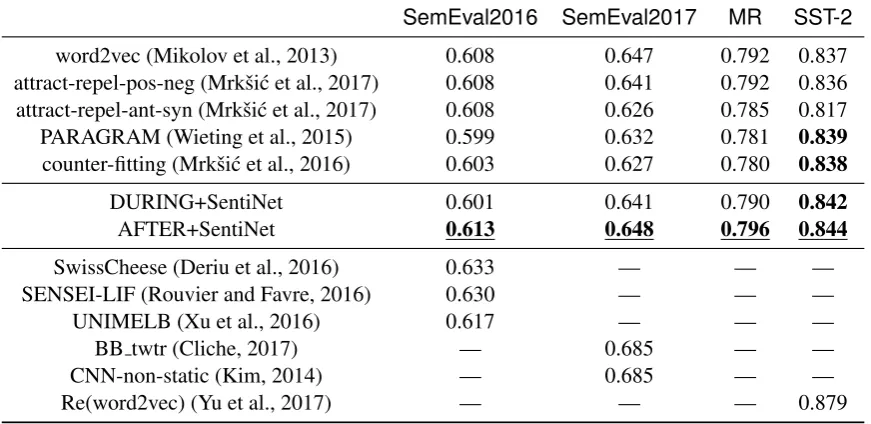
Experimental Analysis: The results of the experiment are shown in Table 3. DURING+SentiNet and AFTER+SentiNet are the results of our method, run on the same sentiment lexicons as other methods.9
AFTER+SentiNet performs better than the other methods over all four datasets. The reason is that our word vectors encode not only sentiment information through SentiNet, but also propagate supervision signal from the sentiment analysis task. Comparing the same method with different external knowledge sources, the sentiment lexicon has greater utility than the antonym/synonym lexicon for sentiment classi-fication. Counter-fitting and PARAGRAM outperform word2vec only onSST-2, and not the other three datasets.
The last 6 lines in Table 3 detail state-of-the-art results for the four datasets. SwissCheese (Deriu et al., 2016) leverages large amounts of distant-supervised data to train an ensemble of CNNs. SENSEI-LIF (Rouvier and Favre, 2016) trains three kinds of word embeddings: lexical embeddings, part-of-speech embeddings and sentiment embeddings, in order to train three CNN sentiment classifiers. The three classifiers are combined into a fusion model to make the final prediction. UNIMELB (Xu et al., 2016) consists of a soft-voting ensemble of a language model adapted to classification, a CNN, and a long-short term memory network (LSTM). BB twtr (Cliche, 2017) also uses a large amount of unlabelled data to pre-train word vectors. It also ensembles CNNs and LSTMs to boost performance. All of these methods are based on ensembling classifiers to improve results, while our method uses a single classifier. Additionally, our CNN model is tuned based on the development data ofSemEval2016, and not tuned to the respective datasets. In that sense, the results are highly encouraging, and there is every expectation that ensemble methods would benefit from the incorporation of the outputs of our model.
7
https://github.com/nmrksic/counter-fitting/blob/master/word_vectors/paragram.txt. zip
8https://github.com/nmrksic/counter-fitting/blob/master/word_vectors/
counter-fitted-vectors.txt.zip
9In Table 2, the whole vocabulary of pre-trained word2vec is used, whereas in Table 3, we use the intersection of the
5 Conclusion
In this paper, we have proposed a novel method for encoding a sentiment lexicon into word embed-dings for sentiment analysis, based on a method we call SentiNet. SentiNet uses a feedforward neural network to lexically encode sentiment information, instead of using an objective function based on co-sine similarity or Euclidean distance. Three variations — BEFORE+SentiNet, DURING+SentiNet and AFTER+SentiNet — were proposed to combine SentiNet with Embedding and CNN. Experiments on sentiment classification datasets show that DURING+SentiNet and AFTER+SentiNet are the most ef-fective ways of combining the training of SentiNet with the training of Embedding and the CNN. Our method can combine sentiment information from the training data and the sentiment lexicon to fine-tune word vectors for sentiment classification. For sentiment classification, we have shown sentiment lexicons to have greater utility than antonym/synonym lexicons and paraphrase databases.
In future work, we plan to experiment with encoding other external lexical knowledge beyond senti-ment lexicons, and to explore frameworks for encoding external knowledge into deep neural networks.
6 Acknowledgments
This work was supported in part by the National Natural Science Foundation of China (Grant No. 61673266).
References
Stefano Baccianella, Andrea Esuli, and Fabrizio Sebastiani. 2010. SentiWordNet 3.0: An enhanced lexical re-source for sentiment analysis and opinion mining. InProceedings of the International Conference on Language Resources and Evaluation (LREC 2010), Valletta, Malta.
Collin F. Baker, Charles J. Fillmore, and John B. Lowe. 1998. The Berkeley FrameNet Project. InProceedings of the 36th Annual Meeting of the Association for Computational Linguistics and 17th International Conference on Computational Linguistics (COLING-ACL 1998), pages 86–90, Montr´eal, Canada.
Jiang Bian, Bin Gao, and Tie-Yan Liu. 2014. Knowledge-powered deep learning for word embedding. In Proceed-ings of the 2014 European Conference on Machine Learning and Knowledge Discovery in Databases (ECML-PKDD 2014), pages 132–148, Nancy, France.
Mathieu Cliche. 2017. Bb twtr at SemEval-2017 task 4: Twitter sentiment analysis with CNNs and LSTMs. InProceedings of the 11th International Workshop on Semantic Evaluation, (SemEval 2017), pages 573–580, Vancouver, Canada.
Ronan Collobert, Jason Weston, L´eon Bottou, Michael Karlen, Koray Kavukcuoglu, and Pavel P. Kuksa. 2011. Natural language processing (almost) from scratch. Journal of Machine Learning Research, 12:2493–2537.
Jan Deriu, Maurice Gonzenbach, Fatih Uzdilli, Aur´elien Lucchi, Valeria De Luca, and Martin Jaggi. 2016. Swiss-Cheese at SemEval-2016 task 4: Sentiment classification using an ensemble of convolutional neural networks with distant supervision. InProceedings of the 10th International Workshop on Semantic Evaluation, (SemEval 2016), pages 1124–1128, San Diego, USA.
C´ıcero Nogueira dos Santos and Maira Gatti. 2014. Deep convolutional neural networks for sentiment analysis of short texts. InProceedings of the 25th International Conference on Computational Linguistics (COLING 2014), pages 69–78, Dublin, Ireland.
Manaal Faruqui, Jesse Dodge, Sujay Kumar Jauhar, Chris Dyer, Eduard H. Hovy, and Noah A. Smith. 2015. Retrofitting word vectors to semantic lexicons. InProceedings of the 2015 Conference of the North American Chapter of the Association for Computational Linguistics: Human Language Technologies (NAACL HLT 2015), pages 1606–1615, Denver, USA.
Lev Finkelstein, Evgeniy Gabrilovich, Yossi Matias, Ehud Rivlin, Zach Solan, Gadi Wolfman, and Eytan Ruppin. 2002. Placing search in context: the concept revisited. ACM Trans. Inf. Syst., 20(1):116–131.
Juri Ganitkevitch, Benjamin Van Durme, and Chris Callison-Burch. 2013. PPDB: the paraphrase database. In
Felix Hill, Roi Reichart, and Anna Korhonen. 2015. Simlex-999: Evaluating semantic models with (genuine) similarity estimation. Computational Linguistics, 41(4):665–695.
Douwe Kiela, Felix Hill, and Stephen Clark. 2015. Specializing word embeddings for similarity or relatedness. InProceedings of the 2015 Conference on Empirical Methods in Natural Language Processing (EMNLP 2015), pages 2044–2048, Lisbon, Portugal.
Yoon Kim. 2014. Convolutional neural networks for sentence classification. InProceedings of the 2014 Confer-ence on Empirical Methods in Natural Language Processing (EMNLP 2014), pages 1746–1751, Doha, Qatar.
Diederik P. Kingma and Jimmy Ba. 2014. Adam: A method for stochastic optimization.CoRR, abs/1412.6980.
Omer Levy and Yoav Goldberg. 2014. Dependency-based word embeddings. InProceedings of the 52nd Annual Meeting of the Association for Computational Linguistics (ACL 2014), Volume 2: Short Papers, pages 302–308, Baltimore, USA.
Andrew L. Maas, Raymond E. Daly, Peter T. Pham, Dan Huang, Andrew Y. Ng, and Christopher Potts. 2011. Learning word vectors for sentiment analysis. InProceedings of the 49th Annual Meeting of the Association for Computational Linguistics: Human Language Technologies (ACL 2011), pages 142–150, Portland, USA.
Tomas Mikolov, Ilya Sutskever, Kai Chen, Gregory S. Corrado, and Jeffrey Dean. 2013. Distributed represen-tations of words and phrases and their compositionality. In Proceedings of the 27th Annual Conference on Advances in Neural Information Processing Systems (NIPS 2013), pages 3111–3119, Lake Tahoe, USA.
George A. Miller. 1995. WordNet: A lexical database for English. Commun. ACM, 38(11):39–41.
Andriy Mnih and Geoffrey E. Hinton. 2008. A scalable hierarchical distributed language model. InProceedings of the Twenty-Second Annual Conference on Neural Information Processing Systems (NIPS 2008), pages 1081– 1088, Vancouver, Canada.
Nikola Mrkˇsi´c, S´eaghdha ´O S´eaghdha, Blaise Thomson, Milica Gaˇsi´c, Lina Rojas-Barahona, Pei-Hao Su, David Vandyke, Tsung-Hsien Wen, and Steve Young. 2016. Counter-fitting word vectors to linguistic constraints. In Proceedings of the 2016 Conference of the North American Chapter of the Association for Computational Linguistics: Human Language Technologies (NAACL HLT 2016), pages 142–148, San Diego, USA.
Nikola Mrkˇsi´c, Ivan Vuli´c, Diarmuid ´O S´eaghdha, Ira Leviant, Roi Reichart, Milica Gai, Anna Korhonen, and Steve Young. 2017. Semantic specialization of distributional word vector spaces using monolingual and cross-lingual constraints.Transactions of the Association for Computational Linguistics, 5:309–324.
Preslav Nakov, Alan Ritter, Sara Rosenthal, Fabrizio Sebastiani, and Veselin Stoyanov. 2016. SemEval-2016 task 4: Sentiment analysis in Twitter. InProceedings of the 10th International Workshop on Semantic Evaluation, (SemEval 2016), pages 1–18, San Diego, USA.
Roberto Navigli and Simone Paolo Ponzetto. 2012. BabelNet: The automatic construction, evaluation and appli-cation of a wide-coverage multilingual semantic network. Artif. Intell., 193:217–250.
Bo Pang and Lillian Lee. 2005. Seeing stars: Exploiting class relationships for sentiment categorization with respect to rating scales. In Proceedings of the 43rd Annual Meeting of the Association for Computational Linguistics (ACL 2005), pages 115–124, Ann Arbor, USA.
Jeffrey Pennington, Richard Socher, and Christopher D. Manning. 2014. GloVe: Global vectors for word rep-resentation. In Proceedings of the 2014 Conference on Empirical Methods in Natural Language Processing (EMNLP 2014), pages 1532–1543, Doha, Qatar.
Yafeng Ren, Ruimin Wang, and Donghong Ji. 2016. A topic-enhanced word embedding for Twitter sentiment classification. Inf. Sci., 369:188–198.
Sara Rosenthal, Noura Farra, and Preslav Nakov. 2017. SemEval-2017 task 4: Sentiment analysis in Twitter. InProceedings of the 11th International Workshop on Semantic Evaluation, (SemEval 2017), pages 502–518, Vancouver, Canada.
Mickael Rouvier and Benoˆıt Favre. 2016. SENSEI-LIF at SemEval-2016 task 4: Polarity embedding fusion for robust sentiment analysis. In Proceedings of the 10th International Workshop on Semantic Evaluation, (SemEval 2016), pages 202–208, San Diego, USA.
Aliaksei Severyn and Alessandro Moschitti. 2015. Twitter sentiment analysis with deep convolutional neural networks. InProceedings of the 38th International ACM SIGIR Conference on Research and Development in Information Retrieval (SIGIR 2015), pages 959–962, Santiago, Chile.
Richard Socher, Alex Perelygin, Jean Wu, Jason Chuang, Christopher D. Manning, Andrew Ng, and Christopher Potts. 2013. Recursive deep models for semantic compositionality over a sentiment treebank. InProceedings of the 2013 Conference on Empirical Methods in Natural Language Processing, pages 1631–1642, Seattle, USA.
Duyu Tang, Furu Wei, Nan Yang, Ming Zhou, Ting Liu, and Bing Qin. 2014. Learning sentiment-specific word embedding for twitter sentiment classification. InProceedings of the 52nd Annual Meeting of the Association for Computational Linguistics, ACL 2014, June 22-27, 2014, Baltimore, MD, USA, Volume 1: Long Papers, pages 1555–1565.
Duyu Tang, Furu Wei, Bing Qin, Nan Yang, Ting Liu, and Ming Zhou. 2016. Sentiment embeddings with applications to sentiment analysis. IEEE Trans. Knowl. Data Eng., 28(2):496–509.
Ivan Vuli´c, Nikola Mrkˇsi´c, Roi Reichart, Diarmuid ´O S´eaghdha, Steve J. Young, and Anna Korhonen. 2017. Morph-fitting: Fine-tuning word vector spaces with simple language-specific rules. InProceedings of the 55th Annual Meeting of the Association for Computational Linguistics (ACL 2017), pages 56–68, Vancouver, Canada.
Amy Beth Warriner, Victor Kuperman, and Marc Brysbaert. 2013. Norms of valence, arousal, and dominance for 13,915 English lemmas. Behavior Research Methods, 45(4):1191–1207.
John Wieting, Mohit Bansal, Kevin Gimpel, and Karen Livescu. 2015. From paraphrase database to compositional paraphrase model and back. Transactions of the Association for Computational Linguistics, 3:345–358.
Chang Xu, Yalong Bai, Jiang Bian, Bin Gao, Gang Wang, Xiaoguang Liu, and Tie-Yan Liu. 2014. RC-NET: A general framework for incorporating knowledge into word representations. InProceedings of the 23rd ACM International Conference on Conference on Information and Knowledge Management (CIKM 2014), pages 1219–1228, Shanghai, China.
Steven Xu, Huizhi Liang, and Timothy Baldwin. 2016. UNIMELB at SemEval-2016 tasks 4a and 4b: An en-semble of neural networks and a word2vec based model for sentiment classification. InProceedings of the 10th International Workshop on Semantic Evaluation, (SemEval 2016), pages 183–189, San Diego, USA.
Mo Yu and Mark Dredze. 2014. Improving lexical embeddings with semantic knowledge. InProceedings of the 52nd Annual Meeting of the Association for Computational Linguistics (ACL 2014), Volume 2: Short Papers, pages 545–550, Baltimore, USA.
Liang-Chih Yu, Jin Wang, K. Robert Lai, and Xue-Jie Zhang. 2017. Refining word embeddings for sentiment anal-ysis. InProceedings of the 2017 Conference on Empirical Methods in Natural Language Processing (EMNLP 2017), pages 534–539, Copenhagen, Denmark.
Matthew D. Zeiler. 2012. ADADELTA: An adaptive learning rate method.CoRR, abs/1212.5701.