O R I G I N A L R E S E A R C H
Comparison of subcutaneous dexmedetomidine
versus clonidine as an adjuvant to spinal
anesthesia: a randomized double blind control
trial
This article was published in the following Dove Press journal: Local and Regional Anesthesia
Divya B Srinivas1
Geetha Lakshminarasimhaiah2
1Department of Anaesthesiology, Sakra
World Hospital, Bangalore, 560103, India;
2Department of Anaesthesiology, M.S.
Ramaiah Medical College and Hospitals, Bengaluru, 560054, India
Background: Alpha-2 adrenergic agonists like clonidine and dexmedetomidine prolong the duration of postoperative analgesia and improve the quality of subarachnoid block (SAB) when used as adjuvant in various routes. However, addition of these drugs by IVor intrathecal routes are known to cause hemodynamic instability. The subcutaneous (SC) route provides similar efficacy as IV administration with less hemodynamic instability and prolonged effect.
Aims: To compare the efficacy of clonidine and dexmedetomidine as adjuvants to SAB when used subcutaneously.
Materials and methods:A total of 90 patients were randomized into one of the three groups: Group P received 1 ml of Normal saline SC, Group D received 0.5 mcg/kg of dexmeditomedine SC and Group C received 1 mcg/kg of clonidine SC respectively after SAB with 3ml of 0.5% hyperbaric bupivacaine (15 mg). Time of onset of sensory and motor block, intraoperative hemodynamics, postoperative VAS scores, Richmond agitation sedation scale, duration of post-operative analgesia and mean paracetamol requirement in 24 hours were recorded.
Results:Mean duration of postoperative analgesia was prolonged in group D (838.10±348.22 minutes) and group C (816.67±230.48 minutes) when compared to group P (332.10±110.91 minutes). Total paracetamol consumption was less in group D (1400.00±770.13 mg) and group C (1600.00±674.66 mg), whereas it was 1900.00±758.86 mg in group P. Hemodynamic para-meters, maximum sensory level attained, and time to attain maximum sensory levels were comparable among the two groups.
Conclusion:Both subcutaneous clonidine and dexmedetomidine prolonged the duration of post-operative analgesia and reduced analgesic requirements when used as adjuvants to SAB with stable hemodynamics, hence both of these drugs can be used effectively as adjuvants to SAB. Keywords:subarachnoid block, dexmedetomidine, clonidine, postoperative analgesia
Introduction
Subarachnoid block (SAB) is a widely used regional anesthetic technique, which is a quick and effective form of regional anesthesia with predictable and reliable therapeutic benefits, and has been the technique of choice for infra-umbilical surgeries unless contraindicated.1,2Despite these positive attributes, a major limita-tion of SAB is its limited duralimita-tion of aclimita-tion. Intrathecal local anesthetics used for SAB is appropriate for surgeries lasting for 2–2.5 hours.2Several techniques, drug regimens and additives like opioids, Alpha 2 adreno-receptor agonists have been Correspondence: Geetha
Lakshminarasimhaiah
Department of Anaesthesiology, M.S. Ramaiah Medical College and Hospitals, Bengaluru 560054, India
Tel +961 189 7899
Email [email protected]
Local and Regional Anesthesia
Dove
press
open access to scientific and medical research
Open Access Full Text Article
Local and Regional Anesthesia downloaded from https://www.dovepress.com/ by 118.70.13.36 on 24-Aug-2020
used to eliminate anxiety, improve the quality of block and to prolong the duration of post-operative analgesia during SAB.1,2
Alpha 2 adrenergic agonists have both analgesic and sedative properties when used as adjuvants to SAB. They act at spinal and supra spinal levels of the central nervous system (CNS) to modulate pain relief .3
Clonidine, a selective Alpha 2 adrenergic agonist has been shown to result in the prolongation of sensory and motor blockade, with reduction in the amount of local anesthetic (LA) require to produce post-operative analgesia.4Clonidine has been effectively used as an intrathecal adjuvant to SAB with proven benefits like prolongation of duration of post-operative analgesia and improvement in the quality of SAB in many studies.5It has also shown to have peripheral analgesic action after administration by epidural, intra venous route, wound infiltration, and topical application in various clinical studies.6
Dexmedetomidine is a highly selective Alpha 2 adrener-gic agonist; with Alpha 2/Alpha 1 selectivity ratio which is 8 to 10 times higher than clonidine, along with sympatholytic, sedative, amnestic, anxiolytic and analgesic properties.1,7It has been shown to prolong duration of postoperative analge-sia when used as an adjuvant to SAB by various routes.
Both clonidine and dexmedetomidine have been used in various routes such as oral, intrathecal, epidural, intravenous (IV), wound infiltration, intranasal routes and have been showed to prolong the duration of postoperative analgesia after SAB.3
It is a proven fact that after IVadministration of drugs with a short half-life, there occurs a rapid peak in the plasma con-centration, which falls rapidly resulting in short duration of action. Hence these drugs need to be administered as a continuous infusion to maintain a steady plasma concentration.8
Subcutaneous (SC) injections have been extensively used as a route of administration for drugs with short dura-tion of acdura-tion, due to ease of administradura-tion, constant rate of drug absorption, better patient acceptance and better hemo-dynamic profile when compared to the IV route.8
Both clonidine and dexmedetomidine have been used as additives to bupivacaine local infiltration in various clinical studies.9,10Dexmedetomidine has also been used as subcuta-neous infusion in intensive care unit (ICU) settings for sedation11and as adjuvants to local anesthetics in peripheral nerve blocks.12However there are no studies performed using alpha2 agonists by the SC route to prolong the duration of post-operative analgesia in patients undergoing surgery under SAB.
Hence this randomized controlled trial was conducted to com-pare the efficacy of subcutaneous clonidine and dexmedetomi-dine as adjuvants to bupivacaine to prolong the duration of postoperative analgesia in patients undergoing surgeries under SAB. The secondary objectives were to assess the intraopera-tive hemodynamic variability, intra-operaintraopera-tive Ramsay agita-tion sedaagita-tion score (RASS) postoperative Visual analog scale (VAS) score and total analgesic requirement in 24 hours between the two groups.
Methodology
This prospective randomized double blind control study was conducted at Ramaiah Medical College and Hospitals, Bangalore. After obtaining institutional ethical committee clearance, 90 American Society of Anesthesiologist’s Physical Status (ASA PS) I and II patients in the age group of 20–70 years scheduled to undergo elective infra-umbilical surgeries like wound debridement, ureteroscopic stenting, transurethral resection of prostate, abdominal tubectomy, and split skin grafting under subarachnoid block were recruited for the study. Sample size of 90 patients (30 patients in each group), was derived based on a previous study conducted by Reddy et al1assuming a mean difference of 40 minutes, an alpha error of 5% with a power of 90%. Patients with altered coagulation profile or bleeding diathesis, obstructive sleep apnea, pre-existing neurological deficits, surgeries in prone position, Known allergy to any of the drugs used in the study and cardiac diseases were excluded from the study.
On the previous day to surgery, after thorough pre-anesthetic evaluation of patients, written informed consent was obtained and they were premedicated with pantoprazole 40 mg and ondensetron 4 mg on the previous night. On the day of surgery, after confirming the nil per oral status patients were shifted to the operation theater, where 18 gauge IV cannula was secured and crystalloid infusion was started at a rate of 10 ml/ kg body weight. All standard ASA monitors like 5 lead elec-trocardiogram (ECG), pulse oximetry, non-invasive blood pressure monitoring (NIBP), and temperature were connected and baseline vital parameters were noted.
Under strict aseptic precautions SAB was performed in a sitting position after skin infiltration with 2% lignocaine in the L3-L4 space. SAB was done using 25G Quinke spinal needle with 15 mg 0.5% Hyperbaric bupivacaine (3 ml).
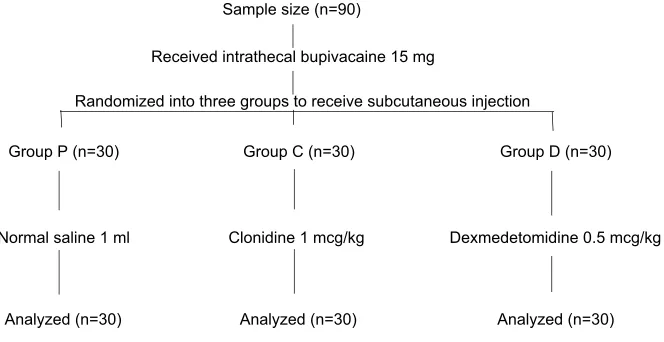
Patients were randomly allocated to groups based on computer generated random number table into three groups for subcutaneous injection (Figure 1). Group C received 1 mcg/kg of clonidine diluted to 1 ml with normal saline.
Local and Regional Anesthesia downloaded from https://www.dovepress.com/ by 118.70.13.36 on 24-Aug-2020
Group D received 0.5 mcg/kg of dexmedetomidine diluted to 1 ml with NS and Group P received 1 ml of NS. This was a randomized double blind control study.
This subcutaneous drug was prepared and injected in the forearm by a second anesthesiologist who was not involved in the study using 26 gauge ½ inch hypodermic needle immedi-ately following SAB. The primary anesthesiologist was una-ware of the drug which was injected subcutaneously. The study data was collected and analyzed by another anesthesiol-ogist who was not aware of the study drug injected.
All patients received supplemental oxygen via face mask at 5 liters per minute. Time of injection of the study drug was noted and vital signs were recorded at this point (0 min). After ensuring adequate sensory and motor blockade the surgeons were asked to proceed with the surgery.
Time of onset of maximum sensory block, time to achieve a modified bromage scale of 3 and maximum height achieved were recorded. Heart rate (HR), systolic blood pressure (SBP), diastolic blood pressure (DBP), mean arterial blood pressure (MAP), and Spo2, were recorded once every 5 minutes for the first 15 minutes and once every 15 minutes thereafter through-out the procedure.
Side effects like nausea and vomiting, hypotension (fall in MAP by more than 20% from baseline) and bradycardia (HR less than 50 beats per minute or decrease more than 20% from baseline) were noted and treated with Ondensatron 4 mg IV, Ephedrine 6 mg boluses and atropine 0.6 mg IV respectively. After the surgery, patients were monitored in the Post anesthesia care unit (PACU) for vitals like
HR, BP, RR and SpO2 every 15 minutes. The VAS (Visual Analogue Scale) score was used to assess pain at 0, 4, 8, 12, 16, 20, 24 hours postoperatively. Inj Paracetamol 1 gm IV was given asfirst rescue analgesic on patients request or if VAS>4 and repeated thereafter on patients request. Time for request of
first rescue analgesic and total analgesic requirement in 24 hours was recorded.
Statistical analysis
Descriptive and inferential statistical analysis were carried out in the present study. Results on continuous measurements are presented as Mean±SD (Min-Max) and results on categorical measurements are presented in Number (%). Significance is assessed at 5% level of significance. The following assump-tions on data were made 1) Dependent variables should be normally distributed; and 2) Samples drawn from the popula-tion should be random, cases of the samples should be independent
Statistical analysis was performed using Analysis of var-iance (ANOVA) tofind the significance of study parameters between three or more groups of patients. Post-hoc Tukey (two-tailed, independent) was used tofind the significance of study parameters on a continuous scale between two groups (Inter-group analysis) on metric parameters. Chi-square or Fisher Exact test was used to find the significance of the study parameters on a categorical scale between two or more groups, nonparametric setting for qualitative data analysis. The Fisher exact test was used when cell samples were very small. SPSS 18.0 was used for the analysis of the data (IBM Corporation, Armonk, NY, USA).
Ethics statement
We confirm that this study was approved by Ramaiah Medical College and Hospitals Ethics Committee, Bengaluru 560054. This study was conducted in accordance with the Declaration of Helsinki throughout the project.
Results
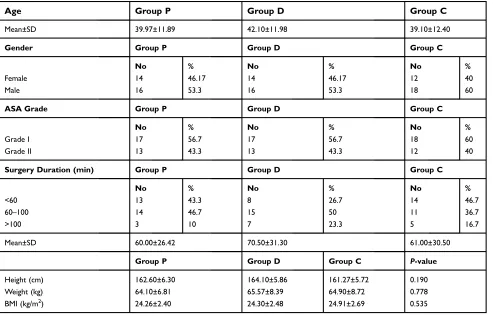
All demographic variables like age, gender, BMI, ASA physical status, duration of surgery were identical among
Sample size (n=90)
Received intrathecal bupivacaine 15 mg
Randomized into three groups to receive subcutaneous injection
Group P (n=30) Group C (n=30) Group D (n=30)
Normal saline 1 ml Clonidine 1 mcg/kg Dexmedetomidine 0.5 mcg/kg
Analyzed (n=30) Analyzed (n=30) Analyzed (n=30)
Figure 1Flow chart of the study.
Local and Regional Anesthesia downloaded from https://www.dovepress.com/ by 118.70.13.36 on 24-Aug-2020
all the three groups (Table 1). We did not find any statis-tical significance in the maximum sensory level reached between the groups although group D achieved higher sensory level (Table 2) compared to the other two groups. The results of the study showed a statistically signifi -cant difference in the post-operative VAS score, the time tofirst request of post-operative analgesia and mean para-cetamol consumption among the three groups.
Postoperative VAS scores (Table 3) were significantly higher in group P for first 12 hours postoperatively when compared to group D and group C. Patients in group D had lower VAS scores throughout the 24-hour period, the lowest value being at 4 hours (2.47±0.90) and in group C it was 2.67 ±0.55 which had high statistical significance. P-value was<0.05 up to 12 hours post operatively between group P and group D and also between group P and group C. However there was no statistical significant difference between group D and group P.
The mean duration of postoperative analgesia, defined by the time for use of first rescue analgesic (Figure 2) was 332±110.91 minutes in group P, 838.10±348.22 minutes in group D and 816.67±230.48 minutes in group C. This difference was statistically significant with a P-value<0.001.
The mean paracetamol consumption (Figure 3) in group P was 1900±758.86 mg, group D 1400±770.13 mg and patients in group C 1600±674.66 mg. The results suggest that patients in groupPrequired higher doses of paracetamol for Table 1Comparison of demographic variables
Age Group P Group D Group C
Mean±SD 39.97±11.89 42.10±11.98 39.10±12.40
Gender Group P Group D Group C
No % No % No %
Female 14 46.17 14 46.17 12 40
Male 16 53.3 16 53.3 18 60
ASA Grade Group P Group D Group C
No % No % No %
Grade I 17 56.7 17 56.7 18 60
Grade II 13 43.3 13 43.3 12 40
Surgery Duration (min) Group P Group D Group C
No % No % No %
<60 13 43.3 8 26.7 14 46.7
60–100 14 46.7 15 50 11 36.7
>100 3 10 7 23.3 5 16.7
Mean±SD 60.00±26.42 70.50±31.30 61.00±30.50
Group P Group D Group C P-value
Height (cm) 162.60±6.30 164.10±5.86 161.27±5.72 0.190
Weight (kg) 64.10±6.81 65.57±8.39 64.90±8.72 0.778
BMI (kg/m2) 24.26±2.40 24.30±2.48 24.91±2.69 0.535
Notes:Group C,received 1 mcg/kg of clonidine diluted to 1 ml with normal saline; Group D received 0.5 mcg/kg of dexmedetomidine diluted to 1 ml with NS and Group P (placebo) received 1 ml of NS.
Table 2Maximum sensory level attained
Group P Group D Group C
Max sen-sory level
No % No % No % P-value
T6 8 26.7 9 30 6 20 0.267
T8 9 30 14 46.7 8 26.7
T10 10 33.3 7 23.3 13 43.3
T12 3 10 0 0 3 10
Notes:Group C,received 1 mcg/kg of clonidine diluted to 1 ml with normal saline; Group D received 0.5 mcg/kg of dexmedetomidine diluted to 1 ml with NS and Group P (placebo) received 1 ml of NS.
Local and Regional Anesthesia downloaded from https://www.dovepress.com/ by 118.70.13.36 on 24-Aug-2020
postoperative analgesia when compared to group D and group C and this difference was statistically significant with aP-value of 0.034.
Time to achieve Bromage scale 3 in group C was 3.43±1.30 minutes, in group D 4.03±2.53 minutes and group P, 4.30±2.07 minutes, with aP-value of <0.05 and
0 10 20 30 40 50 60 70 80 90
Group P Group D Group C
Percentage
Time of RES anal (min)
<500 min
500-1000 min
>1000 min
Figure 2Time forfirst rescue analgesia.
Notes:Group C, received 1 mcg/kg of clonidine diluted to 1 ml with normal saline; Group D received 0.5 mcg/kg of dexmedetomidine diluted to 1 ml with NS and Group P (placebo) received 1 ml of NS.
Abbreviation:RES, rescue.
0 500 1000 1500 2000 2500 3000
Group P Group D Group C
Total PCT (mg)
Figure 3Comparison of mean PCT consumption.
Notes:Group C,received 1 mcg/kg of clonidine diluted to 1 ml with normal saline; Group D received 0.5 mcg/kg of dexmedetomidine diluted to 1 ml with NS and Group P (placebo) received 1 ml of NS.
Abbreviation:PCT-Paracetamol . Table 3Postoperative VAS score
Post op VAS Results Group WiseP-value
Group P Group D Group C Group P-D Group P-C Group D-C
0 hrs 0.00±0.00 0.00±0.00 0.00±0.00 - -
-4 hrs 3.77±1.25 2.47±0.90 2.67±0.55 <0.001** <0.001** 0.691
8 hrs 3.37±0.72 2.80±0.76 3.00±0.95 0.023* 0.195 0.610
12 hrs 3.97±1.22 3.10±0.80 3.27±1.14 0.007** 0.035* 0.819
16 hrs 3.67±0.88 3.60±1.13 3.43±0.97 0.964 0.640 0.796
20 hrs 3.33±0.88 3.67±1.18 3.60±1.04 0.434 0.585 0.967
24 hrs 3.43±0.73 3.40±0.77 3.30±0.75 0.984 0.771 0.863
Notes:Group C, received 1 mcg/kg of clonidine diluted to 1 ml with normal saline; Group D received 0.5 mcg/kg of dexmedetomidine diluted to 1 ml with NS and Group P (placebo) received 1 ml of NS. *P≤0.05; **P≤0.01
Local and Regional Anesthesia downloaded from https://www.dovepress.com/ by 118.70.13.36 on 24-Aug-2020
mean time to attain the highest sensory level of T6 was 5.57±2.31 minutes in group P, 5.70±2.72 minutes in group D and 5.37±2.33 minutes in group C. Other para-meters like time to achieve maximum sensory level, and Bromage scale, and hemodynamic parameters were identical among the three study groups.
It is seen that the Heart rate and MAP (Figures 4 and 5) were comparable among the three groups at all times except at 75 and 90 minutes during which patients who received dexmedetomidine had a lower MAP in comparison to the other two groups and this difference was statistically significant.
Discussion
In our study, the primary objective was to assess the mean duration of postoperative analgesia, which was 332.±110.91 minutes in group P, 838.10±348.22 minutes in group D and 816.67±230.48 minutes in group C. The results were comparable to that of a study conducted by Reddy et al1 to compare the efficacy of IV dexmedeto-midine and clonidine premedication during SAB which prolonged the duration of postoperative analgesia to 243.35±56.82 minutes and 190.93±43.38 minutes. Harsoor et al2 also obtained similar results in their study, where they compared IV dexmedetomidine
0 20 40 60 80 100 120
MAP(mm Hg)
Results
Group P
Group D
Group C
Figure 5MAP comparison among three groups.
Notes:Group C,received 1 mcg/kg of clonidine diluted to 1 ml with normal saline; Group D received 0.5 mcg/kg of dexmedetomidine diluted to 1 ml with NS and Group P (placebo) received 1 ml of NS.
Abbreviation:MAP, mean arterial pressure. 0 20 40 60 80 100 120
Heart rate (bpm)
Results
Group P
Group D
Group C
Figure 4Comparison of intraoperative heart rate.
Notes:Group C,received 1 mcg/kg of clonidine diluted to 1 ml with normal saline; Group D received 0.5 mcg/kg of dexmedetomidine diluted to 1 ml with NS and Group P (placebo) received 1 ml of NS.
Local and Regional Anesthesia downloaded from https://www.dovepress.com/ by 118.70.13.36 on 24-Aug-2020
infusion and placebo for patients undergoing surgery under bupivacaine spinal anesthesia. Supplementation of IV dexmedetomidine infusion along with SAB pro-longed the duration of postoperative analgesia in group D to 222.8±123.4 minutes, where as it was 138.36 ±21.62 minutes in group C.
Patients who received SC dexmedetomidine or clonidine as adjuvants to SAB required significantly less analgesia in the postoperative period in contrast to patients who received SAB alone. Agarwal et al3compared IV dexmedetomidine infusion versus IV clonidine infusion as adjuvant to SAB. They found that patients who received either of the two drugs intraopera-tively required significantly lower doses of rescue analgesic agents in the postoperative period when compared to the con-trol group.
The hemodynamics in any of the patients HR, SBP, DBP, and MAP among patients receiving either dexme-detomidine or clonidine was comparable to the placebo group without incidence of significant bradycardia and hypotension.
We did not find any improvement in the onset times of sensory and motor blockade with the use of SC alpha 2 agonists, in contrast to previous studies which used IV alpha 2 agonists. This could be because the slower rate of absorption of subcutaneously administered drugs, which results in a slow rise in plasma concentration of the drug in contrast to the IV route thereby resulting in much less hemodynamic instability and prolonged duration of analgesia could be attributed to the longer half life of subcutaneously administered drugs. However the study has a few limitations in that it was per-formed in a small group and the regression time of sensory and motor block was not assessed. Comparison of the IV and SC routes of a single drug (either dexmedetomidine or clonidine) gave a better idea about the pharmacodynamics and pharma-cokinetics of the drugs.
Conclusion
Both dexmedetomidine and clonidine can be used safely and effectively bythe SCroute as adjuvants to SAB, to pro-long the duration of analgesia. When used by the SC route, these adjuvants provide much more stable hemodynamic parameters than IV administration. However, among the two drugs, dexmedetomidine would provide a longer dura-tion of analgesia along with intraoperative sedadura-tion than clonidine. This being the first study using subcutaneous
alpha 2 agonists as adjuvants for prolongation of duration of postoperative analgesia, the results of the study cannot be generalized. Further studies with larger sample sizes would be required to prove the efficacy of SC alpha 2 agonists as adjuvants to SAB. The future studies with additional ana-lysis of regression time of sensory and motor block follow-ing SC use of these agents are advisable.
Disclosure
The authors report no conflicts of interest in this work.
References
1. Reddy VS, Shaik NA, Donthu B, Sannala VKR, Jangam V. Intravenous dexmedetomidine versus clonidine for prolongation of bupivacaine spinal anesthesia and analgesia: a randomized double-blind study.
J Anaesthesiol Clin Pharmacol. 2013;29:342–347. doi:10.4103/0970-9185.117101
2. Harsoor S, Rani D, Yalamuru B, Sudheesh K, Nethra SS. Effect of supplementation of low dose intravenous dexmedetomidine on char-acteristics of spinal anaesthesia with hyperbaric bupivacaine.Indian J Anaesth. 2013;57:265–269. doi:10.4103/0019-5049.115616 3. Agrawal A, Agrawal S, Payal YS. Comparison of block
character-istics of spinal anesthesia following intravenous dexmedetomidine and clonidine. J Anaesthesiol Clin Pharmacol. 2016;32:339–343. doi:10.4103/0970-9185.188830
4. Dinesh CN, Tej NS, Yatish B, Pujari VS, Kumar RM, Mohan CV. Effects of intravenous dexmedetomidine on hyperbaric bupivacaine spinal anesthesia: a randomized study. Saudi J Anaesth. 2014;8:202–208. doi:10.4103/1658-354X.130719
5. Mahendru V, Tewari A, Katyal S, Grewal A, Singh MR, Katyal R. A comparison of intrathecal dexmedetomidine, clonidine and fenta-nyl as adjuvants to hyperbaric bupivacaine for lower limb surgery: a double blind controlled study. J Anaesthesiol Clin Pharmacol. 2013;29:496–502. doi:10.4103/0970-9185.119151
6. Bharti N, Dontukurthy S, Bala I, Singh G. Postoperative analgesic effect of intravenous (i.v) clonidine compared with clonidine admin-istration in wound infiltration for open cholecystectomy. Br J Anaesth. 2013;111:656–661. doi:10.1093/bja/aet130
7. Afonso J, Reis F. Dexmedetomidine: current role in anesthesia and intensive care.Rev Bras Anesthesiol. 2012;62:118–133. doi:10.1016/ S0034-7094(12)70110-1
8. McLennan DN, Porter CJH, Charman SA. Subcutaneous drug deliv-ery and the role of the lymphatics.Drug Disco Today Technol. 2005;2 (1):89–96. Spring. DOI:10.1016/j.ddtec.2005.05.006
9. Nataraj MS, Mohan Kumar RM. Effect of clonidine as an adjuvant for wound infiltration following caesarean section.J Obstet Anesth Crit Care. 2017;7:33–36. doi:10.4103/2249-4472.207389
10. Singh S, Prasad C. Post-operative analgesic effect of dexmedetomidine administration in wound infiltration for abdominal hysterectomy: a randomized control study. Indian J Anaesth. 2017;61:52–56. doi:10.4103/ija.IJA_676_16
11. Gertler R, Brown HC, Mitchell DH, Silvius EN. Dexmedetomdine: a novel sedativeanalgesia agent.BUMC Proceedings. 2001;14:13–21. 12. Swami S, Keniya VM, Ladi SD, Rao R. Comparison of dexmedeto-midine and clonidine (alpha2 agoinst drugs) as an adjuvant to local anaesthesia in supraclavicular brachial plexus block: a randomized double-blind prospective study.Indian J Anaesth. 2012;56:243–249. doi:10.4103/0019-5049.98767
Local and Regional Anesthesia downloaded from https://www.dovepress.com/ by 118.70.13.36 on 24-Aug-2020
Local and Regional Anesthesia
Dove
press
Publish your work in this journal
Local and Regional Anesthesia is an international, peer-reviewed, open access journal publishing on the development, pharmacology, delivery and targeting and clinical use of local and regional anes-thetics and analgesics. The journal welcomes submitted papers covering original research, basic science, clinical studies, reviews &
evaluations, guidelines, expert opinion and commentary, case reports and extended reports. The manuscript management system is comple-tely online and includes a very quick and fair peer-review system, which is all easy to use. Visit http://www.dovepress.com/testimonials. php to read real quotes from published authors.
Submit your manuscript here:https://www.dovepress.com/local-and-regional-anesthesia-journal
Local and Regional Anesthesia downloaded from https://www.dovepress.com/ by 118.70.13.36 on 24-Aug-2020