Towards the rapid network-wide
deployment of new application specific
network protocols, using application
level active networking.
Atanu Ghosh
A dissertation submitted in partial fulfillment
of the requirements for the degree of
Doctor of Philosophy
of the
University of London.
Department of Computer Science
University College London
ProQuest Number: U643293
All rights reserved
INFORMATION TO ALL USERS
The quality of this reproduction is dependent upon the quality of the copy submitted.
In the unlikely event that the author did not send a complete manuscript and there are missing pages, these will be noted. Also, if material had to be removed,
a note will indicate the deletion.
uest.
ProQuest U643293
Published by ProQuest LLC(2015). Copyright of the Dissertation is held by the Author.
All rights reserved.
This work is protected against unauthorized copying under Title 17, United States Code. Microform Edition © ProQuest LLC.
ProQuest LLC
789 East Eisenhower Parkway P.O. Box 1346
“Sometimes a scream is better than a thesis.”
Acknowledgements
I am indebted to my supervisors Jon Crowcroft and Michael Fry. Jon for his patience,
incredible enthusiasm and encouragement. Michael for the work that we did together.
Mark Handley for allowing me more time than either of us had expected. Nermeen
Abstract
In this thesis I try to show that traditional transport protocols (such as TCP) poorly
match the requirements of today’s applications.
Firstly, I develop two new user level protocols using Application Layer Framing
(ALF) [20] concepts in order to test this hypothesis. A simple remote login program and
a protocol to deliver mailing lists using multicast. In both cases I am able to show that
application level protocols utilise less network resources than their traditional counter
parts as well as providing improved responsiveness to the user.
The development and deployment of new protocols is both difficult and time con
suming. I consider a new mechanism for the deployment of protocols. Rather than
attempting to deploy them in the end systems, new protocols entities are dynamically
deployed into the network. These protocol entities are called proxylets and are written
in the programming language Java. A whole i n f r a s t r u c t u r e , [34], has been
built to allow the deployment of proxylets. A number of diverse applications are then
built around proxylets to show benefits which can be derived from such a scheme. In
order to make the funnelWeb infrastructure useful, when globally deployed, a routing
Contents
1 Introduction 19
1.1 Chapter o u t l i n e ...22
1.2 Discussion... 23
1.3 Experimental R e s u lts ... 25
2 Simple login {slogin) 29 2.1 Introduction... 29
2.2 Slogin Protocol Overview ...32
2.3 Slogin Protocol Requirements ... 33
2.4 The Slogin P ro to co l... 34
2.4.1 Packet Format ...34
2.4.2 D a ta ...36
2.4.3 The Slogin Protocol... 37
2.5 Implementation Issues ... 38
2.5.1 Control p ac k ets...38
2.5.2 R etransm ission...40
2.5.3 Bind and connect problems with U D P ... 40
2.5.5 T e s t i n g ...43
2.5.6 S ecu rity ... 43
2.6 Experim ents... 46
2.7 Results...47
2.8 Enhancements... 47
2.9 Discussion... 48
2.10 C onclusions... 49
3 MMD: Multicast Mail Delivery 51 3.1 Introduction... 51
3.2 Design B a s ic s ... 54
3.3 The S tru c tu re ... 55
3.4 The Protocol... 56
3.4.1 Status m e s s a g e ...57
3.4.2 NACK m essage...57
3.4.3 Data m essag e... 58
3.4.4 Retransmission Scheme ...59
3.5 Related W o r k ... 63
3.6 D iscussion...63
3.7 C onclusions...64
4 JavaRadio: an application level active network 67 4.1 Introduction... 67
4.2 Proposal for Mobile Protocol S ta c k s ... 68
Contents 11
4.2.2 Significance...70
4.3 Experiment D escription... 71
4.4 Component O verview ...73
4.4.1 YAAT - Yet Another Audio T o o l...73
4.4.2 Proxy S e r v e r ...75
4.4.3 Control In te rfa c e ... 76
4.4.4 Protocol S e rv e r...76
4.5 Implementation Issues ... 77
4.5.1 Portability... 77
4.5.2 Stability...77
4.5.3 T h re a d s... 78
4.5.4 Header P ro c e s s in g ... 78
4.6 Experimental Outcom es... 81
4.6.1 Local Area Experim ent... 82
4.6.2 Wide Area E xperim ent... 82
4.6.3 Multicast Reception ... 84
4.7 Related W o r k ... 84
4.8 Discussions and C onclusions... 85
5 Application Level Active Networking 89 5.1 Introduction... 89
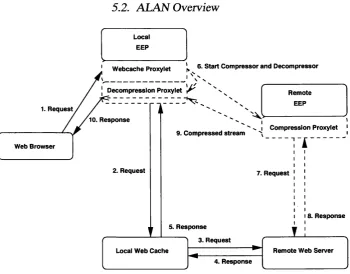
5.2 ALAN O v e rv ie w ...92
5.2.1 Basic A L A N ... 92
5.2.2 ALAN E n h a n c e m e n ts... 95
5.3.1 Design ... 97
5.3.2 Implem entation...98
5.3.3 Lessons learned from d ep lo y m en t... 100
5.3.4 Future d ire c tio n s ...101
5.4 Execution Environment for Proxy/cr5 E E P s...102
5.4.1 D e s i g n ...102
5.4.2 Implementation I s s u e s ... 104
5.4.3 Lessons learned from d ep lo y m en t...105
5.5 Controlling Proxy The graphical user in te rfa c e s...106
5.6 System Proxylets ...107
5.6.1 R o u tin g ...108
5.6.2 Error H a n d lin g ... 109
5.7 Performance Measurements... 110
5.7.1 EEP L ocation... 110
5.7.2 Proxylet Load T im e...110
5.7.3 Execution T im e ... I l l 5.8 Charging ...113
5.9 Related W o r k ... 114
5.10 D eploym ent... 115
5.11 Proxylets ... 116
Contents 13
6 An Architecture for Application Layer Routing 119
6.1 Introduction...119
6.2 Application Layer Active N e tw o rk in g ...121
6.2.1 WWW cache p r o x y l e t... 121
6.2.2 T C P b rid g e ... 122
6.2.3 VOIP gateway ... 123
6.2.4 M u ltic a s t...124
6.3 Application Layer Routing A rc h ite c tu re...124
6.4 D isco v ery ...127
6.4.1 Discovery p h a s e ... 127
6.5 Routing e x c h a n g e s ... 132
6.5.1 Connectivity m e s h ... 133
6.5.2 Snooping for network s ta te ...134
6.5.3 Self Organising Application-level Routing - S O A R ...134
6.6 Related W o r k ...138
7 Conclusion 141 7.1 Future W o rk ... 146
A Glossary 149 B Flakeway 155 B .l Im plem entation...158
B.2 C onclusions... 161
C.l Application modifications... 163
C.1.1 Netscape - multiple s t r e a m s ... 164
C .l.2 HTTP - single c o n n e c tio n ... 164
C.2 Implementation modifications ... 165
C.2.1 Transaction TCP T / T C P ...165
C.2.2 Large W indow s...165
C.2.3 Selective Acknowledgement - S A C K ...165
C.2.4 Congestion C o ntrol... 166
C.2.5 Unreliable D elivery... 166
List of Figures
2.1 5/ogm packet format ... 34
3.1 The Structure of M M D ...55
4.1 F ra m e w o rk ...73
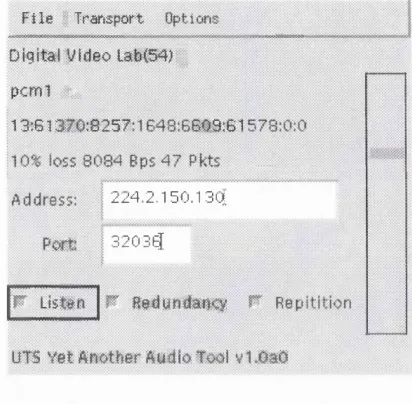
4.2 Yet Another Audio T ool... 74
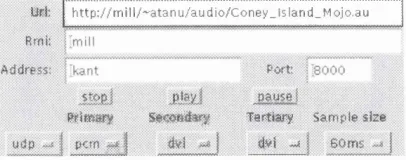
4.3 Control I n te r f a c e ...76
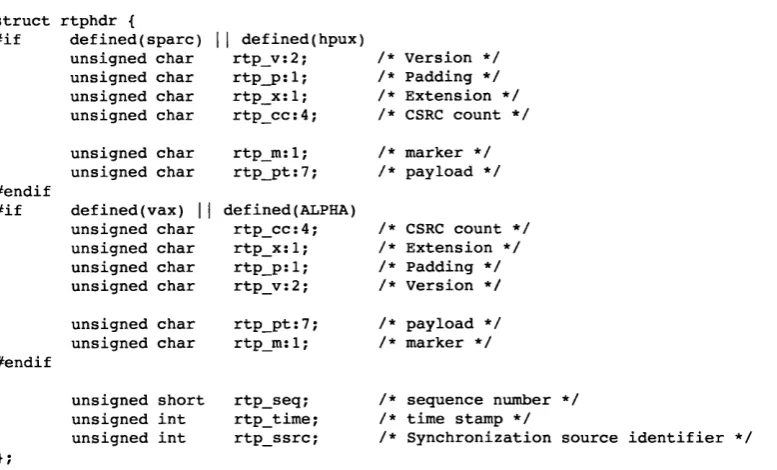
4.4 RTF h e a d e r ... 79
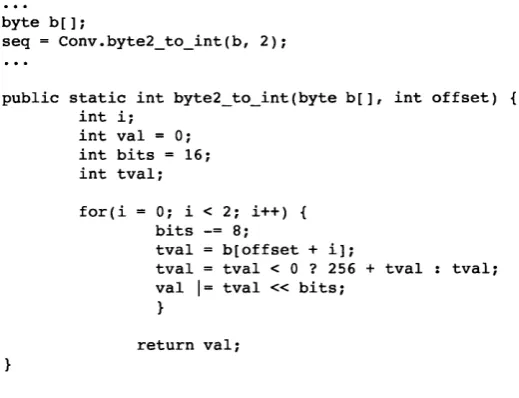
4.5 Header Processing in C ... 79
4.6 Header Processing in Java ...80
5.1 Text Com pression... 93
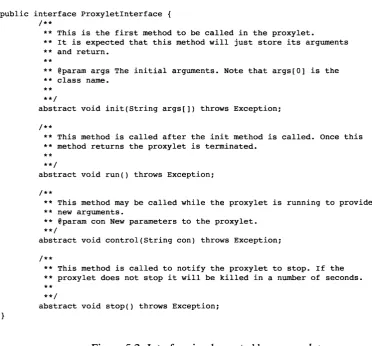
5.2 Interface implemented by a p r o x y l e t...99
6.1 Text Com pression...122
B .l Possible a c tio n s ...156
B.2 Example Packet count ta b le ...157
B.3 Example Time sequence table ... 157
B.4 Ping Trace. UCL - INRIA ...158
B.6 Network c o n fig u ra tio n ...160
D .l r c 4 .h ... 169
List of Tables
2.1 slogin state transitions...39
5.1 Compression T im e s ... 112
Chapter 1
Introduction
We are stifled in the process of developing new more efficient network protocols due to
the increasing difficulty in deployment.
In the statement above and in the title “network-wide protocols”, the protocols are
not end-to-end transport or network protocols in the traditional sense. They are proto
cols which are specific to an application built, for example, on top of a connectionless
transport protocol such as the User Datagram Protocol (UDP) [70]. These are protocols
which are implemented by applications as opposed to protocols such as Transmission
Control Protocol (TCP) [72] which are traditionally provided by the host operating
system.
We argue that many networking applications are ill suited to using traditional
transport protocols such as TCP. In Appendix C is a representative list of either changes
that have been made to TCP or workarounds when using TCP. We suggest that it is more
efficient to implement protocols that map directly onto an application’s requirements.
If high performance in terms of raw throughput is not a requirement, then a mech
anism for speeding up the testing and deployment of an application specific protocol is
than the traditional approach of building it into the operating system. This is called Ap
plication Layer Framing (ALF) [20]. It is typically faster to send out a new application
than to ship a new operating system.
If the hypothesis that building application specific protocols has value, then the
next problem is: How are these application specific protocols developed and deployed?
New protocols are often shunned for a number of reasons. The main difficulty is time:
the time to implement, the time to test, the time to deploy. It is rare for software to
be shipped without anomalies or bugs. Network protocols often go through a “bake
off” [73] process where different implementors can test their implementations against
each other. Specifications especially in protocol areas can be difficult to follow and
implement “correctly”. Therfore, there is also the time to redeploy.
Hence ease of deployment of new protocols is a key component of their being
adopted. My work focuses on this issue of deployment. By building two protocols
using UDP as the transport no operating system modifications should be required. Al
though some bugs in implementations of UDP were found, protocols built entirely in
user space are generally faster to deploy than protocols requiring operating system im
plementations and deployments.
To help simplify the creation of user space protocols an initial examination was
made to specify building blocks which could be used [32]. As part of this examination
two application specific protocols were built using Application Layer Framing (ALF)
[20] concepts.
Rather than focus on the implementation of the protocols it became apparent that
deployment was the key. What if only a single implementation could be used by all
de-21
ployment could be met.
Using Java [9], a relatively new programming language at the time, some ex
periments were performed to create protocol stacks which could then be dynamically
downloaded, on demand, into end systems by applications.
These experiments were successful in terms of performance, however, specifying a
general API from application to protocol stack was not a simple process. The separation
of the application from the protocol stack proved to be difficult.
Instead of attempting to download code into an end system to aid in the deploy
ment of a protocol a whole protocol entity was downloaded into the network. In the
experiments that were performed the end system stacks were not modified in any sig
nificant way. This led to the development of Application Level Active Networking
(ALAN).
Thus the rapid deployment of protocols was achieved by loading dynamic code
into the “network”. This is not loading code into routers as advocated by the active
network community [83]. In the active networking model this code can then manipulate
packets travelling through these routers and these manipulations can be considered to
be transparent to the end systems.
In the case of ALAN programs named proxylets are loaded into nodes on a net
work. These nodes are not routers. In an optimal situation they would be placed in the
core of the network. Normally the proxylets would be explicitly placed into the path of
a flow. This too is at variance with the usual active networking ideas, in which packets
1.1 Chapter outline
The initial work in this thesis, Chapters 2 and 3 were done as part of larger project,
the Hipparch [5] project. Other project members were considering another aspect of
the problem, automated protocol composition [23]. My initial work consisted of hand
building integral applications and protocols. This was done to both verify that there
was a benefit from this approach as well as trying to determine what could be learnt
and extracted to form building blocks of future ALF applications. We consider two
classic network applications. Chapter 2 describes an ALF based remote login protocol
called slogin. As an enhancement over the applications telnet and rlogin available at the
time, slogin also supported encryption. In Chapter 3 MMD describes a Multicast Mail
Delivery protocol which was developed for the delivery of mailing lists. Both pieces
of work develop protocols which are tightly matched to the applications requirements.
These protocols are more efficient in terms of packet exchange than their TCP equiva
lents. Unfortunately there is the added complexity of having to design, verify and test
these protocols
The JavaRadio Chapter, Chapter 4, describes a mechanism in which the protocol
stack itself can be dynamically loaded by an application. It was also an experiment to
discover if the then relatively new Java programming language could be used for real
time processing. The work in this Chapter was presented at the Hipparch Workshop in
1997 in Uppsala, Sweden [35].
Chapter 5 on Application Level Active Networking describes an infrastructure
called funnelWeb [34], which was designed and built to test some of the ideas presented.
The work in this Chapter appeared in the Journal of Computer Networks [36].
1.2. Discussion 23
Layer Active Networking - Application Layer Routing. This work was presented at the
the International Workshop on Active Networking in 2000 in Tokyo, Japan.
The last Chapter, Chapter 7, is the conclusion.
1.2 Discussion
The two main applications are: slogin (a simple login program) and MMD a multicast
mail delivery program, which used a reliable multicast protocol to deliver mail to email
list. An infrastructure (Appendix B) was also built to test the slogin program.
We were able to show with the slogin and MMD programs that there is indeed
a benefit to be derived from fitting an applications requirements directly to its own
associated protocol.
It may be considered that this approach is limited as there is a lot of extra effort
involved in building a protocol for each application as opposed to just using TCP or
equivalent. In order to aid in the building of such applications we suggested some
possible building blocks [32].
At this point rather than build a toolkit to construct ALF style applications, I be
came more interested in the proposition that very few people would ever need to design
an ALF based protocol. Consider an application such a ftp. How many people have
actually written an ftp client or daemon? Consider the most widely used protocol on
the Internet, currently HTTP [25]. The W3C consortium actually provide a library to
implement this protocol.
The next step was to consider building protocol libraries which could be used by
applications. The challenges were to develop a generic API for an arbitrary set of
protocol API is a tricky process if out of order delivery is required.
The traditional approach to a protocol library may have been to design an API and
implement a number of protocols. In the protocol library idea I wanted to address the
ubiquitous version mismatch problem with protocol stacks.
Hence, the idea of a dynamic protocol stack was conceived. In order to address
the protocol mismatch problem, why not dynamically load a protocol stack into an
application at runtime? This solves many problems; only one implementation of a
protocol, perhaps available from the appropriate standards body. There is an issue:
how is the protocol stack made processor independent?
At this time a new programming language, Java, was becoming popular. A pos
sible solution seemed to be use Java as it could be compiled into processor neutral
byte codes. There was some concern at the time that since Java was an interpreted and
garbage collected language it could not meet the performance requirements of a large
set of applications.
However, Java had a lot to offer in terms of code portability. The holy grail of
a single portable implementation of a protocol with no version incompatibility issues
was too tantalising to be ignored. Though there was still the issue of performance.
In order to investigate the performance characteristics of using Java with a realistic
application, an audio playout tool was written (Chapter 4). In order to test the RTF
compliant playout tool an audio encoder was also written. It turned out that for a real
time application such as audio playout Java met the performance criteria.
The next step should have been to define an API for protocol stacks. However,
it became apparent that it would be more beneficial to start placing the code in the
1.3. Experimental Results 25
have been written is this area [35], [31], [36], and [33].
Having built an ALAN infrastructure it was possible to see that there were benefits
in such a scheme. However, a significant limitation in the system is that it is a require
ment to know beforehand the location of EEP’s (Execution Environment for Proxy lets,
the nodes on which the active code executes). Having to know the location of EEP’s
before running code is not a solution which scales. Therefore some initial work was
done in the area of Application Layer Routing (ALR) [33]. A two stage scheme was
designed and implemented that addressed the issues of discovery and routing.
The original idea was to build tailored application specific protocols. In order to
pursue this goal the final outcome was a mechanism to place code into the network to
aid the performance and deployment of applications.
1.3 Experimental Results
One major problem with the work presented is being able to demonstrate that ALE
and ALAN provide any benefit over traditional networking paradigms. One way of
demonstrating benefit is to measure an existing system and then compare against the
new proposed system.
In the slogin work (chapter 2) it is possible to reason that less resources are used for
an slogin session over an equivalent rlogin session. In order to test the slogin protocol
and to compare it against the rlogin protocol a testing harness was built. The testing
harness, flakeway, is described in Appendix B. Flakeway was introduced into the path
of a connection and its purpose was to delay or drop packets. Reordering could also be
achieved; reordering is a subset of delay. A novel feature of flakeway was that it does
manipulated (in terms of delay or being dropped) by being compared against a table
which determines how a packet is modified. This gives deterministic behaviour across
test runs. If the input packets are identical across test runs the results are identical. The
tables used to drive flakeway were derived from actual packet traces. The reasoning
is that the only time any major variance will be seen in the performance of slogin
against rlogin, will be when there is some level of loss and some transmission delay.
There will be no perceptible difference in performance on a LAN with no loss or delay.
Therefore in order to test slogin against traditional applications such as rlogin a wide
area test needs to be performed. The conditions in the global Internet are continually
changing. It would not really prove anything if we were to say that at a particular time
slogin performed “better” than rlogin in a wide area test. In order to be able to generate
repeatable tests flakeway was built. The tables for driving flakeway were derived by
running pings to sites in remote countries. The delay, reordering and losses were then
used to driwe flakeway. Various factors such as variable packet sizes and extra load were
not taken into account. Flakeway turned out to be an extremely useful tool for testing
the slogin protocol as it was being developed. For example, the connection setup phase
could be fairly exhaustively tested be delaying or dropping the initial packets on a
connection. Unfortunately, it is not possible to justify that slogin performed better than
rlogin by just performing test runs th ro n g flakeway.
A similar problem exists with the MMD work (chapter 3). It is difficult to show
experimentally that this scheme is superior to the standard distribution schemes.
In both the slogin and the MMD case it is shown that protocols can be designed and
deployed using ALF principles that are better mapped to the applications requirements.
1.3. Experimental Results 21
Application Layer Routing (ALR) (Chapters 5 and 6) also exhibit this property that it
is difficult to prove they are an improvement over current networking technologies.
I have not been able to prove that application specific protocols are the best or only
way to deploy new applications. I have been able to demonstrate that there are benefits
from building application specific protocols. I have also been able to demonstrate that
it is possible to deploy new protocols by placing them dynamically into the network
Chapter 2
Simple login
{slogin)
2.1 Introduction
TCP is a general purpose communication protocol that attempts to satisfy the require
ments of a diverse set of applications. It is a stream based protocol that transfers streams
of octets. The reliable transmission of data provided by TCP simplifies application
writing, which is why TCP is traditionally used by most Internet applications requiring
reliable delivery. An example of such application is remote login where the two pop
ular programs in use on the Internet: telnet [74] and rlogin [45] are both TCP based.
This is despite the fact that a stream based protocol does not usually map easily onto
the packet based nature of an application such as remote login. This usually results
in failing to provide the correct trade off between delay and throughput that meets the
application needs.
In a remote login application, one end of the connection transmits text typed by
the user while the other end of the connection generates output based on the typed text
as well as possibly echoing back what it has received.
definitely lower than that supported by most networks today. Hence low latency rather
than a high data throughput is the main requirement of a remote login application.
However, there are occasions when a word processing application may need to send
several kilobytes of data to update the display.
In an attempt to reduce the number of packets exchanged and hence keep the load
on the network to a minimum, TCP implementations use two mechanisms: delayed
ACK and the Nagle algorithm [12, 63] ^ The goal is to reduce the number of packets
exchanged by increasing the amount of information carried in each packet. Effectively
this is achieved by delaying the transmission of packets to allow more information to
be carried in each packet.
For a long delay path, using TCP decreases the responsiveness of the remote login
connection. This is a well known side affect of the delayed ACK and the Nagle algo
rithm. The delayed ACK typically does not increase the latency. However, in situations
where no data needs to be sent back, the delayed ACK will cause latency.
On the other hand, the Nagle algorithm typically means that at least two RTT times
will pass before the echo of a command is received. The Nagle algorithm is simple and
elegant. On packet transmission if there is no data in the transmit queue then the data
is sent immediately. However, if there is data in the transmit queue then the new data is
queued until the arrival of the ACK for the outstanding data or the retransmission timer
expires. So a delay is imposed on the transmit queue to allow time for more data to
build up in the transmit queue. When the ACK arrives or the retransmit timer expires,
all queued data can be sent in one packet.
One of the examples from the Nagle request for comments (RFC [63]) is a link
2.1. In traduction 31
with a round trip time of 5 seconds. The user generates 24 characters with an inter
character gap of 200ms. The first character will be sent immediately while the other 23
characters will be queued awaiting the ACK for the first character. Taping 23 characters
will take 4.6 seconds which is less than the 5 second round trip time. When the ACK
for the first character arrives all 23 characters will be sent in the same packet. The
number of packets sent has been reduced to a minimum of 2 packets, considering the
no loss situation where no packets have been lost, as opposed to 24 data packets. The
time to get the ACK in the Nagle case will be at least 10 seconds. If each character
is sent in its own packet the time to get an ACK will be 24*.200 + 5 = 9.8 seconds.
So in this example using the Nagle algorithm saves the sending of 22 data packets and
only costs an extra 200ms. For the user in the Nagle case it will take 5 seconds for
the first character to be echoed and 10 seconds after the first character being typed (or
9.8 seconds after the second character being typed) for the rest of the characters to be
echoed. In the non Nagle case, assuming no loss, the echo will appear after one RTT
delay, which is much more acceptable to the user. However, sending only one data byte
per packet is extremely inefficient in terms of link usage. With a 20 byte IP header and
a 20 byte TCP header, a 41 byte packet containing only one byte of data is inefficient
in terms of link utilisation. Under heavy network congestion, many small data packets
will increase the congestion.
Slogin is a program that has its communications stack built with consideration
of the requirements of the application. Slogin was built to show that a hand crafted
protocol could be made more responsive than TCP and still does not cost too much
more than TCP in terms of link utilisation. Encryption is a value added feature of
The building of slogin also facilitated the identification of the tools needed for
building specially tailored protocols for specific applications. One of the intended
outcomes from this work was to ultimately generate a set of building blocks. These
building blocks could then be used to build the next generation of application specific
protocols. This direction was ultimately not pursued. Although a paper attempting
to define useful building blocks was written in 1996: “Some Lessons Learned from
Various ALF and ILP Applications” [32].
2.2
Slogin Protocol Overview
The slogin program is relatively simple. It uses its own packet format on top of UDP.
The packet format contains header fields that allow the building of a reliable proto
col. Various ideas from TCP implementations are used such as delayed ACKs and the
mechanism for calculating the RTT. The slogin program generates more packets than
an equivalent remote login program using TCP because the Nagle algorithm is not used.
The Nagle algorithm in TCP is not just for remote login applications but also for any
application that generates a few bytes at a time that can be amortised into larger packets.
The Nagle algorithm is inappropriate for remote login sessions over long delay paths.
In order to keep the response time to a minimum, the slogin protocol sends packets
the moment characters are generated by the user. This increases the number of packets
generated, however, in defence of this strategy, a single user typing a character every
200ms can only generate 5 characters per second resulting in 5 packets per second. An
important aspect of the slogin protocol is that each packet carries all of the data that
has not yet been acknowledged. Hence any packet loss will not necessarily result in
2.3. Slogin Protocol Requirements 33
TCP implementation can not make the decision to carry all data that has not yet been
acknowledged in its packets because as a general purpose protocol it does not know the
shape of the traffic generated by the application. On the other hand a specially tailored
protocol can take full advantage of such knowledge. While the TCP protocol requires
20 bytes, assuming no options, the slogin protocol uses 7 bytes (currently more are
used for ease of implementation) plus 8 bytes of UDP header to give a total of 15 bytes;
a saving of 5 bytes per packet. The comparative header sizes are not given to imply
that slogin is better then TCP because it uses fewer bytes. It just illustrates that an
equivalent number of bytes is used.
2.3
Slogin Protocol Requirements
The goal of slogin is to develop a UDP-based transport protocol that is optimised for
remote login applications over long delay links. A second requirement is the use of
encryption for security purposes. A number of goals are identified for the protocol.
1. Most importantly, from the user point of view, the protocol needs to be more
responsive than the traditional programs such as rlogin or telnet.
2. It is also important that the number of bytes exchanged using slogin is not sig
nificantly more than the number of bytes exchanged when using TCP based pro
grams.
3. It is also a goal to achieve better interrupt and expediated data processing. The
rlogin program uses TCP’s urgent pointer (URG) to perform expedited data pro
cessing. One significant drawback of this approach is that the URG pointer is
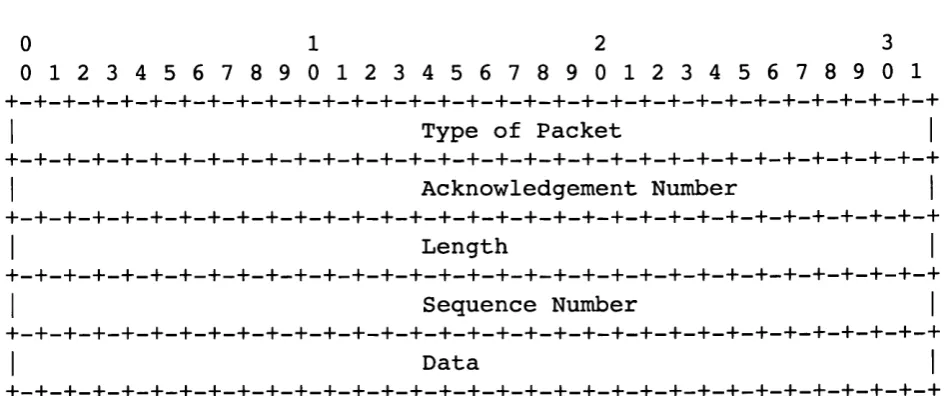
0 1 2 3 0 1 2 3 4 5 6 7 8 9 0 1 2 3 4 5 6 7 8 9 0 1 2 3 4 5 6 7 8 9 0 1
+ — + — " h — + — + — *1"— + — "H
I
Typeo f
Packet |— + — + — " H — "I" — + — + — + — " I " — " h — t — t — 4 " — + — t — t — "H
I
Acknowledgement Number |+ —+ — + —+ — 4- —+ — + — + — 4" —+ ~ + —4" —"h—4"—4"—t —4"—4" — +
I
Length |4- —4* —4~ —4~ —4~ —4~ —4~ —4" —4" —4" —4" —4" —4" —4" —4" —4" —4" —4" —4" —4" —4" —4" —4* —4" —4" —4" —4" —4" — 4" —4" —4" —4" —4"
I Sequence Number |
4" —4" —4" —4" —4" —4" —4" —4" —4" —4" —4" —4" —4" —4" —4" —4" —4" —4" —4" —4" —4" —4" —4" —4" —4" —4" —4" —4" - -4" —4" —4" —4" —4"
I
DataI
4" —4" —4" —4" —4" —4" —4" —4" —4" —4“ —4" —4" —4" — 4* —4" —4" —4* —4" —4" —4" —4" —4" —4" — 4" —4* —4" —4" —4" —4“ —4* —4" —4* —4"
Figure 2,1: slogin packet format
marked as being urgent. Depending on the TCP implementation the urgent byte
is not necessarily delivered before any other data.
2.4
The Slogin Protocol
2.4.1 Packet Format
The packet format is rather simple. It is made up of four fields followed by an optional
payload (Figure 2.1).
Figure 2.1 shows the slogin packet format. The packet header is much larger than
it needs to be. Each field is kept as a four byte quantity for ease of implementation. The
type field can be reduced to three bits as there are only six packet types. The length
field can also be removed as UDF gives the length of the packet. So all in all the header
can be reduced by slightly more than 5 bytes. Each packet contains the same fixed
size header for simple parsing independent of the packet type. Though controversial,
there is no version field in the packet format. Slogin utilizes the simple expedient of
2.4. The Slogin Protocol 35
check of a version number field. Such decision forces any slogin version to always use
a fixed UDP port. However, there is no requirement to check version fields nor support
backward compatibility. There is no interoperability concern.
A number of fields that are usually present in transport protocols are missing in
slogin. There is no ID field to associate packets with sessions. Instead, the host and
port fields contained in the UDP header are used for that purpose.
Slogin packets have no additional checksum apart from the checksum provided
by UDP. However, a checkbyte is placed at the end of the payload to aid with the
authentication of packets. As both TCP and UDP use the same checksum algorithm,
both slogin and rlogin packets have the same protection against data corruption. The
additional checkbyte in the slogin packets provides extra protection despite its main
purpose being authentication rather than protection.
The packet format has the following fields:
Packet types
There are 7 packet types in slogin:
1. CR - Connection Request - Value 0
A connection request packet.
2. CC - Connection Confirmation - Value 1
A connection confirmation packet.
3. DATA - Data Packet - Value 2
4. CONTROL - Control Packet - Value 3
A control packet.
This packet type conveys out of band information such as interrupt characters,
terminal size , flow control information and terminal type.
The current implementation does not support this packet type.
5. DR - Disconnect Request - Value 4
A disconnect request packet.
6. DC - Disconnect Confirm - Value 5
A disconnect confirmation packet.
7. RESET - Reset - Value 6
A reset packet.
Acknowledgement Number
This field acknowledges the last byte received from the peer.
Length
This field specifies the length of the packet. It is a redundant field as the UDP API
provides the same information.
Sequence Number
This is the sequence number of the first byte of data contained in the packet.
2.4.2 Data
The payload is encrypted by the RC4 stream cipher. There is also an additional check
2.4. The Slogin Protocol 37
2.4.3 The
Slogin
Protocol
An slogin session can be in one of four states: IDLE, CONNECTING, CONNECTED
and DISCONNECTING.
The simplest way to describe the protocol is to examine the connection setup pro
cess and the connection tear down process as we step through the protocol states on the
server side of the connection.
Connection Setup
The server side of the connection starts in an IDLE state awaiting a Connection Request
(CR) packet. The client side sends a CR packet and moves to the CONNECTING state.
On receipt of the CR packet, the server sends a Connection Confirmation (CC) packet
to the client and moves to the CONNECTED state. Once the client receives the CC
packet, it also moves to the CONNECTED state.
Any of the packets can be lost in this interchange. It is up to the client to retrans
mit CR packets until either a timeout period expires or a CC packet is received. On
the server side no timers will be started once the CR packet has been received and the
server has moved to the CONNECTED state. This is consistent with the data trans
mission part of the protocol that does not use keep alive timers when no data is left
to be acknowledged. This design makes the initiator of the connection responsible for
driving the state transitions of its peer and reduces the number of packets exchanged.
However, there is a flaw associated with this design. If a CR packet is sent to the server
after which the client dies, there is no way to remove the state of the connection held
by the server. In practice this situation rarely arises and when it does the amount of
memory used to hold the protocol control block is small. More importantly, this de
attack used against TCP servers such as WWW servers.
Connection Teardown
A connection teardown can be initiated by either side of the connection. The initiator
of the teardown sends a Disconnect Request (DR) packet to the peer and moves to
the DISCONNECTING state. On reception of the DR, the peer sends a Disconnect
Confirmation (DC) packet to the initiator and moves to the idle state. As soon as the
initiator receives the DC packet, it also moves to the IDLE state.
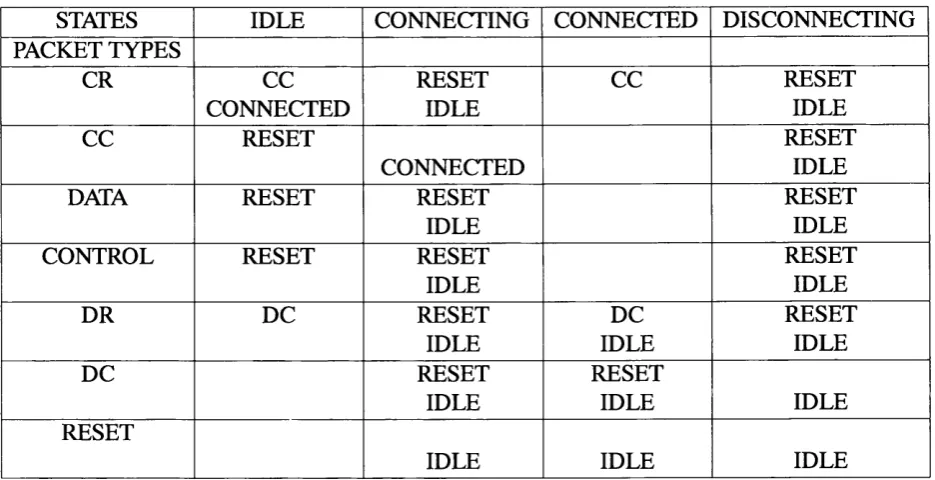
State Transitions
Table 2.1 shows the state transitions of the slogin protocol. The first column lists all
the protocol packet types while the first row lists all the protocol states. Each table
entry shows the protocol response to receiving a particular packet at a particular state.
Each response entry consists of two rows. The first row shows the packet to be sent in
response, if any. The second row shows the next state transition, if any.
For example, if an endpoint receives a DR packet while in the CONNECTED state,
it will send a DC packet and move to the IDLE state. If it receives any subsequent DC
packets while still in the IDLE state, it will continue sending DC packets but it will stay
in the IDLE state.
2.5
Implementation Issues
2.5.1 Control packets
As Stated before, the rlogin program uses TCP’s urgent pointer (URG) to perform ex
pedited data processing. Depending on the TCP implementation the urgent byte might
Con-2.5. Implementation Issues 39
STATES IDLE CONNECTING CONNECTED DISCONNECTING PACKET TYPES CR CC CONNECTED RESET IDLE CC RESET IDLE CC RESET CONNECTED RESET IDLE
DATA RESET RESET
IDLE
RESET IDLE
CONTROL RESET RESET
IDLE
RESET IDLE
DR DC RESET
IDLE DC IDLE RESET IDLE DC RESET IDLE RESET IDLE IDLE RESET
IDLE IDLE IDLE
Table 2.1: slogin state transitions
trol Packets to deal with expediated data processing. Control Packets will carry special
data and information that needs immediate delivery to the other end of the connection.
Interrupt and flow control characters as well as information related to changes in the
size of the user’s xterm will be typically transmitted using Control Packets. However,
the slogin usage of a send and wait protocol instead of a windowing protocol resolved
the issue of expediated data processing without the need to implement Control Packets.
An interrupt character is typically used to stop the current transaction. If an application
is generating a lot of output in response to a user’s command, it is necessary to stop the
transmission of the remaining output upon the receipt of the interrup character. Typi
cally in the TCP situation large amounts of data will be transmitted before the interrupt
is processed. In the slogin case at most one network buffer will be sent after the inter
rupt character is sent. This is an interesting side effect of using a send and wait protocol
2.5.2 Retransmission
Slogin uses packet retransmission to deal with packet loss. Whenever a packet is sent,
the sender expects to receive an acknowledgement from its peer. If an acknowledge
ment does not arrive then either the original packet or its acknowledgement has been
lost. To break the deadlock due to packet loss, the sender sets a timer once a packet
has been sent. If the timer expires before an acknowledgement has been received, the
packet will be retransmitted. To deal with the case when the peer disappears for what
ever reason, a packet can be retransmitted for a specific number of times after which
the connection will be closed.
To implement the above mechanism three parameters need to be specified:
• The value of the initial retransmission timer. This time is selected based on the
round trip time. The exponentially weighted moving average (EWMA) from
TCP is used.
• The value of the subsequesnt retransmission timers. These timers are exponen
tially backed off.
• The maximum number of retransmissions. This value is set to 11. A packet will
be retransmitted 11 times after which the connection will be closed.
2.5.3 Bind and connect problems with UDP
A TCP connection is uniquely defined by a pair of identifiers each identifying one end
of the connection. Each identifier contains a 4 octets IPv4 address and a 2 octets port
number. Well known TCP services are available on well known ports. For example
telnet uses TCP port 513. All telnet connections use port number of 513 at the server
2,5. Implementation Issues 41
to deliver packets to the correct process. In many systems the way this is implemented
is to a have a process control block (PCB) with addresses (local and remote) as well
as ports (local and remote). When a packet arrives at a host it is compared against
the PCB’s. It is delivered to the process which best matches the PCB entries. Both
TCP and UDP packets contain source and destination addresses as well as source and
destination ports.
Initially when a telnet server is waiting for a connection the local port number is
bound to port 513 and the remote port number is unbound. There is no connection yet.
As soon as a connection is created the remote port is bound to the port number the
remote packet originated from.
In the TCP case this works well. Hence slogin used a similar method. The slogin
server would wait on a well known port. The client would then ask the system for
an currently unused port. The UDP packet would be sent to the server with a random
source port and the known destination port. The packet would be delivered to the
process which was listening on the slogin port. If the incoming packet was a connection
request then the server process would start a new process. The new process would have
a copy of the networking socket. The new process would then set the remote port value
on its PCB using the connect(2) system call. Now both the parent and the child would
have a PCB with the same local port. In the server case the remote port would be
unbound. Thus all packets which are not bound to the child process will be sent to
the parent. By the same token all packets for the child process will be delivered to it.
Thus the operating system would be responsible for correctly demultiplexing incoming
packets. Unfortunately on the Sun running (Solaris 2.5.1) under which I was writing
itself was that the first connection worked fine. If a second connection was attempted
then no more packets were delivered to any of the applications. This seemed extremely
surprising. One would have thought that other UDP based programs might use the
same mechanism as was attempted in slogin. On checking the source for the Trivial
File Transfer Protocol daemon(tftpd). A widely used UDP based file transfer program.
It transpired that tftpd gets around this problem by sending the response packet from
a different local port than the advertised port. Once the response is received by the
client all packets are sent to the new port on the server. A similar scheme was therefore
incorporated into slogin. An irritating feature of this scheme is that for every connection
request a new process is created, even if the connection requests are coming from the
same client.
2.5.4 User Privileges
The slogin program was developed on a Sun running Solaris 2.5.1. In order to test
slogin on wide area links an account at INRIA ,in the South of France, was used. This
account has no root privileges. It was therefore necessary to try and get the slogin
server (slogind) running with only user privileges.
As soon as slogin manages a connection setup, including the Diffie-Hellman ex
change, the server slogind runs the standard Unix login program to perform authenti
cation.
Starting the login program turned out to be extremely problematic. The login
program requires to be started from the lowest level shell. On UNIX systems a file
“utmp” is used to hold login records. In order to start the login program the “utmp”
file needs an appropriate entry. Trying to write the “utmp” entry as a non root process
2.5. Implementation Issues 43
“utmp” entry was not cleared on logout as the system will eventually perform this task.
This causes a problem, for attempts to log in immediately after logout, the “utmp” entry
isn’t cleared the same pseudo terminal is allocated and it is not possible to log in. The
second login attempts seems to clear the entry and it is possible to log in.
2.5.5 Testing
The slogin protocol was tested initially on a local area network. For realistic wide area
tests an account at INRIA was used as described above.
Also a system was built to emulate wide area lossy links. This system flakeway
is described in Appendix B. Flakeway was table driven and hence deterministic. This
allowed for repeatable tests to test the slogin protocol, using hand crafted data sets. Test
data sets were also derived from ping traces between UCL and INRIA. It was initially
hoped, to perform systematic tests of slogin against rlogin, to demonstrate the benefit
of one scheme over the other. It was not clear that such tests would actually help in
proving one scheme was better than another. Therefore the flakeway was only used for
testing.
2.5.6 Security
At the time that the slogin work was done; 1994, there were no generally available
remote login programs that attempted to cryptographically protect either passwords or
session data. Since that time “SSH” [94] a secure login program has become widely
available and is heavily used.
Any program being developed to support remote logins, really needed to support
security. Adding security in the form of encryption also allowed for testing of ideas in
A major win with slogin is that as the protocol and application are so tightly cou
pled the connection setup exchanges can also carry pertinent data. Carried with the con
nection setup messages were Diffie-Hellman [22] setup information. Diffie-Hellman
allows two parties that do not share a common secret to generate a common secret. It
relies on the difficulty of factoring large numbers. In the slogin case the connection and
Diffie-Hellman exchange can be taking place in the same packets. If TCP was used
first a three way hand shake would need to take place, followed by the Diffie-Hellman
exchange. More packets are exchanged than is necessary. Which is wasteful of band
width and time. Some transport protocols do allow data to be carried in the connection
setup packets.
Once a secret key has been generated then the stream encryption protocol RC4 is
used. RC4 is easy to implement and has no known attacks [78]. Once seeded by the key
generated by the Diffie-Hellman exchange. RC4 generates a byte stream. This stream is
exclusive or’d with the data stream. At the receiver the same RC4 stream is generated
and the received data stream is again exclusive or’d with the incoming stream. This
allows the recovery of the transmitted data. As well as being simple to implement it is
also computationally cheap; this can be observed from the implementation in Appendix
D. Another advantage of RC4 is that being stream based, unlike block solutions it is
not necessary to pad transmitted packet to a block boundary, hence not necessitating
the transport of extra padding bytes in the data payload.
The Diffie-Hellman key exchange uses a prime modulus of 1024 bits. The (prime
-1 ) / 2 is also prime. This is supposed to make the exchange more secure. I generated
the prime myself which may have been a mistake. Its been tested against all primes less
2.5. Implementation Issues 45
from the exchange.
The stream cipher RC4 can accept up to 2048 bit key. So the 1024 bit key is
repeated to give a 2048 bit key. In order to have a different encryption key in each
direction the key is byte swapped for the reverse path. Hopefully this doesn’t open a
hole in the encryption.
The GNU multiple precision library was used to manipulate these large numbers.
The security in slogin is only there to encrypt the traffic. It does not perform any
authentication. Authentication is performed by the standard login process. However,
as all traffic is encrypted the password will not be available to the world. The Diffie-
Hellman algorithm is susceptible to man in the middle attacks.
Checksum - Authentication
It is essential that all incoming packets are authenticated, otherwise bogus packets could
be fed into the session. A nonce is added to the end of each packet before encryption.
The nonce is a trivial checksum that is run across the data portion of the packet.
The checksum algorithm consists of summing all the bytes in the data field and
then storing the low order byte at the end of the packet. This scheme is used for au
thentication, not for protecting the data. Before the payload is encrypted the checksum
byte is placed at the end of the payload. When a packet is received it is decrypted and
the checksum algorithm is run. Only if the computed checksum byte and the checksum
byte in the packet match is the payload accepted. There is a very high likelihood that
2.6 Experiments
On November 27 1994 the slogin and slogind programs existed. Experiments were per
formed between UCL in London and INRIA at Sophia Antipolis. The typical roundtrip
time was around 200ms with 17 hops.
The original idea had been to build an asymmetric protocol, at the client side all
data which had not been acknowledged would be sent in all packets, this seemed to be a
fairly reasonable approach as at the client end, the input is from the keyboard. In order
to simplify the implementation, the first cut was to build a symmetric protocol: unac
knowledged data from the server was also repeated. With a terminal size of 24x80 this
could mean 1920 bytes in a screen refresh, generated perhaps by an editor. However,
experiments showed that the arbitrary packet size of 1024 which was chosen sometimes
meant that a screen of data would require two packets. Host MTU discovery, would be
extremely useful, to allow the application to transmit the largest possible packet size
for a path.
In order to simplify the buffering of data both from the keyboard and the remote
shell once 1024 bytes of data is in the transmit buffer the program no longer reads
from the input keyboard/shell. This has the side effect of there only ever being one
packets worth of data buffered. So if a keyboard interrupt is used to stop a flow, only
one packet’s worth of data is ever in the system. When a lot of data is being generated
from the server end of the connection, for example displaying a very large file (e.g. cat
2.7. Results 47
2.7 Results
On a long delay link with a small amount of packet loss the slogin program feels more
responsive than rlogin. This is due to not having to wait for one round trip time when a
packet is lost. It would be interesting to modify a TCP implementation to also send all
buffered bytes when the number of bytes is small.
The XON/XOFF flow control and interrupt processing work very well even with
out special support, this is due to only ever buffering one packets worth of data.
As mentioned above when a lot of data is being sent the current implementa
tion becomes a send and wait protocol. This means that currently slogin has a lower
throughput than rlogin. However, the author believes that apart from performing tests,
generating a lot of data which cannot possibly be read is not useful, so limiting the rate
is not a bad property of the current implementation.
2.8 Enhancements
Passing the user name display variable and term variable would be useful The rlogin
protocol also tracks window size changes. There is support for a separate control chan
nel in slogin which has never been implemented. This control channel could be used
for window updates.
The environment variables could just be tacked onto the end of the key in the key
exchange. They could actually be placed in the packet as environment variables and
2.9 Discussion
TCP is badly matched to the requirements of a rlogin application. In most cases the
application writer has information about the characteristics of his application that can
be exploited. A classic example of this problem is rlogin, the echoing in rlogin is
performed by the remote end, when it was discovered that for every character that was
typed first an ack was sent back then the echo, TCP implementations were modified
to delay for 200ms to delay the sending of the ack so that it could be carried with the
echo.
We can make many observations about a typical rlogin session: a user does not
type fast, so until an acknowledgement is received up to some threshold all characters
typed can be repeated. On long delay paths this should give the best response under
conditions of loss. Consider the case of a character typed by the user. The single packet
carrying this character is lost. Then another character is typed. In the TCP case due to
the Nagle delay typically 0.5 seconds will pass until the two characters are transmitted.
In the slogin case the second character will be sent immediately with the first. If the
TCP has Nagle disabled it will still take one more round trip time for the character to
be delivered.
A user can not necessarily read very fast: data rate of the reverse channel could be
kept to a fairly low settable rate. In fact as the protocol was implemented as a send and
wait protocol there was always a RTT of delay. This provided a useful side effect of
not requiring any special interrupt character or X-ON/X-OFF flow control processing.
2.10. Conclusions 49
2.10 Conclusions
Slogin provides a number of benefits over rlogin and telnet. It provides security at no
significant overhead. This is also true of SSH.
Slogin provides better responsiveness on long delay links with any loss.
TCP is a good general reliable protocol, but it does not match the requirements, of
even a simple application; such as remote login.
The actual slogin implementation was different to the original specification. The
original specification was to have used windowing; the initial implementation used send
and wait. This turned out to be perfectly acceptable. A benefit of this decision was,
the control channel, which had also been specified, did not have to be implemented.
The control channel was among other things supposed to carry interrupt characters. An
expedited channel which could overtake the data channel. With send and wait there
was never more than one packet of data which needed to be interrupted.
The control channel was also to have carried window size change information,
amongst other things. Implementing this feature would not have provided any signifi
cant advantage.
It was harder to specify, implement and debug the slogin protocol than writing say
rlogin. The author has written a rlogin for a commercial UNIX vendor, so can validly
make this comparison.
The increased implementation complexity of this approach, would be an obstacle
to its adoption. An avenue that was consider was the provision of building blocks to fa
cilitate the construction of application level protocols (ALPs) such as slogin [32]. This
direction was not pursued. The work in this chapter was done as part of the Hipparch
[23], in order to solve the complexity of designing and implementing protocols.
In this chapter one application has been considered. In the next chapter we con
Chapter 3
MMD: Multicast Mail Delivery
3.1 Introduction
The work presented in this chapter is joint work with Zheng Wang and Jon Crowcroft.
The work was done at the end of 1995, which is why some design decisions may not be
as appropriate today as they were then. These decisions are discussed in section 3.4.4.
In this chapter we consider mailing lists as another application that could benefit
from application level protocols (ALPs). This application is very different to the slogin
application. It is again, however a very heavily used application.
As mailing lists grow large, current centralised distribution becomes increasingly
unmanageable. In this chapter we present an alternative mailing list delivery system
MMD. MMD delivers message to list members by multicast and achieves reliabil
ity with a lightweight retransmission scheme based on expanding ring local repair
ing. MMD can co-exist with conventional mailing list delivery and requires minimum
changes to the systems.
Mailing lists are among the most useful applications on the Internet. It is impos
Internet. As of June 2nd 1996, www.lisxt.com, a mailing list directory had a database
of 37,416 lists.
Standard mailing list operation is fairly simple, a mailing list is set up at a site by
allocating an electronic mail address, for example [email protected]. All electronic
mail sent to this address is then fanned out to all members of the list at the main list
exploder.
There are a number of problems associated with this conventional mailing list
operation [89]. First of all, the administration of large mailing lists can be a very
time consuming activity. The simplest part of maintenance may just be dealing with
subscribe/unsubscribe messages. Although mailing list software typically can handle
automatic subscription and unsubscription [81], people often fail to change their mail
addresses in the lists when they change organisations. A major problem reported by
maintainers of large mailing lists is delivery failure. When a mail transfer agent [75]
fails to deliver mail to a recipient of a mailing list, a mail message is often generated
by the mailer and sent back to the list maintainer with an error report. There can be
many reasons for delivery to fail, for example, the hostname cannot be found in the
DNS [60], the mailbox may no longer exist, the machine that the mailbox resides on
has been unavailable for prolonged periods etc ... Some of the problems may be the
kind of transient errors that occur in networking or they may be more permanent like
a recipient has changed organisations and no mail forwarding is enabled to the new
organisations. Whether the error is transient or permanent, time is spent by list main
tainers processing the delivery reports. For example. Information Sciences Institute
(ISI), which maintains mailing lists for Internet research groups, the IETF and other In
3.1. Introduction 53
deletions, and about 300 error messages a month due to mail delivery problems during
1991 [89]. The members on most ISFs mailing lists have increased substantially since.
Since every message has to be replicated at the mail server where the mailing list
resides, a large and active mailing list may place significant workload on the mail server
and also outgoing traffic for the list maintainer’s site. The majority of the mailing lists
on the Internet are operated as a free service to a particular community or interest group,
so it is desirable to reduce the burden to the list maintainer’s site as much as possible.
When the number of members in a list reaches a few thousand, such centralised
distribution becomes increasingly unmanageable. In this chapter, we present a dis
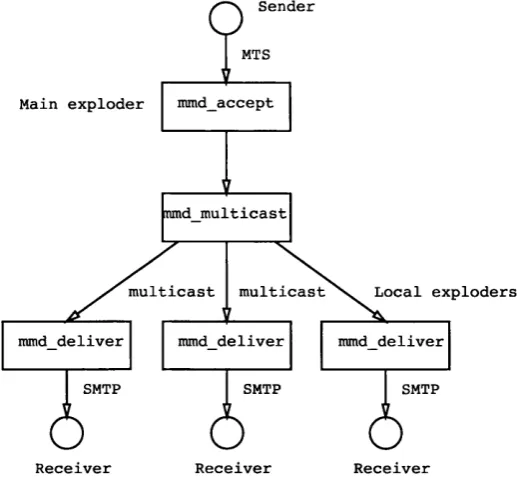
tributed approach based on multicast, called multicast mail delivery (MMD). In MMD,
mailing list distribution utilises the multicast capacity of the underlying networks
(MB0NE)[17j. Messages from the main exploder are multicast out and each site inter
ested in a particular list has a local exploder which listens at the multicast address and
distributes to local members of the list.
With this approach, the entire mailing list operation is fully distributed.
The administrative load on the main exploders is drastically reduced. Subscrib
ing/unsubscribing is a local matter so there will no longer be the large turn-a-round time
often encountered with some mailing lists. Any errors generated are handled locally
and hence easier to solve. As the replication is done with multicast, the traffic load on
the main exploders is no longer an issue. With local retransmission mechanisms, main
exploders only need multicast a message once, or at most a small number of times
when local repairing fails. Thus, MMD can deliver mailing lists more efficiently in
terms of network bandwidth and speed of delivery. With MMD, there is the additional
is inevitable as a result of the distributed approach. However, the setup process could
be automated.
3.2 Design Basics
MMD was developed as an alternative to conventional mailing list delivery. Its aim is
to relieve the administrative burdens on list managers, and to reduce traffic and delay in
message distribution. The core of MMD is a multicast based distribution system with a
lightweight retransmission scheme based on expanding ring local repairing. The design
of MMD adheres to the following basic principles:
1. Co-existence with conventional mailing list delivery. Given the large installed
base of conventional mailing lists, any systems incompatible with the conven
tional one will not work in practice. The use of MMD and conventional mail
delivery must not be mutually exclusive. For any list, users who do not have ac
cess to networks with multicast capacity can continue to use conventional mailing
list delivery.
2. Minimum modifications to current systems. MMD was designed to replace only
the replication part of the mailing list delivery. There has deliberately been no
attempt made to replace current mailing list maintenance software. Subscribing,
unsubscribing, mailing to a list and receiving mail are handled through existing
infrastructure. By doing so, MMD requires minimum changes to the current
systems.
3. Handling of multiple lists. MMD was designed to handle multiple mailing lists