376 | P a g e
Compatibility of Metals And Elastomers in Biodiesel: A Review |
Compatibility of Metals and
Elastomers in Biodiesel: A review
Mayank Bhardwaja, Parul Guptab, Neeraj Kumarc
a
M.Tech Scholar , Moradabad Institute of Technology, India
b
Associate Prof. Mechanical Engineering Deptt., Moradabad Institute of Technology,India
c
Asst. Prof. Mechanical Engineering Deptt., Moradabad Institute of Technology, India
Abstract:
Recently biodiesel as an alternative fuel is getting more significance to replace diesel fuel partially and help reduce environmental pollution. However, corrosion of automotive materials in biodiesel is a major concern as this can reduce of engine life. This paper reviews the effects of corrosion on the engine parts that come in contact with biodiesel and its diesel blends. In metals copper, brass, bronze shows high level of corrosion in biodiesel and biodiesel blends on the other side aluminium shows low corrosion. Stainless steel has high resistance to corrosion as compare to copper, aluminium and copper alloys in
biodiesel. Common methods adopted for
measurement of corrosion include weight loss through Static emersion tests and electrochemical
techniques by electrochemical impedance
spectroscopy or on Potentiostat/Galvanostat. Biodiesel composed of saturated and unsaturated alkyl ester fatty acids when exposed to air, heat, light
and metallic contaminants can cause auto oxidation. The process ultimately leads to the formation of corrosive acids and deposits that cause a slow degradation of metal and elastomers. Elastomers such as nitrile rubber (NBR), EPDM, PVC, fluoro-viton, silicon rubber also show degradation nature in biodiesel. Static immersion test carried out to find out the degradation of elastomers in biodiesel for a particular time and temperature. The level of degradation has been finding out by measuring property change in elastomers at the end of test. A massive change was found in tensile strength, volume swell, hardness, compression set, weight change and elongation of elastomers at the completion of static immersion test. Results showed that the extent of degradation was higher for PVC, silicon rubber, EPDM and NBR while fluoro-viton exhibited good resistance to degradation and was least attacked.
Key Words: Corrosion, Static immersion, Stainless steel, Aluminium, Copper, Mild Steel, Bronze, biodiesel, Wear, Elastomers.
Introduction:
As a result of increasing environmental concern and diminishing petroleum reserves, there is a growing trend to substitute biodiesel for conventional diesel fuel. As an alternative fuel, though biodiesel have some technical advantages over diesel fuel, the former appears to be more corrosive than diesel. The corrosive nature of biodiesel can be more aggravated if
Free water and free fatty acid are present in it. As compared to diesel, biodiesel is more prone to absorb water which tends to condense on metal surface and may cause enhanced
377 | P a g e
Compatibility of Metals And Elastomers in Biodiesel: A Review | cetane number and absence of sulfur and
aromatics.
Among the disadvantages is its low fuel density in comparison to mineral diesel, which requires a higher amount of fuel to achieve the same power to drive the engine [1]. Until now, CI engines were suited only for a low-ratio blend of biodiesel with diesel because of corrosion. Corrosion is the disintegration of a material as it reacts with other materials with which it comes into contact. According to Nernst’s theory, all metals have a tendency to pass into solution. However, the extent of corrosion varies for metal ions depending on its oxidation potential and various prevailing conditions (temperature, water content, etc.) in the fuel. Metal ions, when present in fuel, can cause corrosion [2].
Kaul et al. [3] investigated the corrosiveness of different biodiesel (i.e. Jatropha curcas, Karanja, Mahua and Salvadora) as compared to that of diesel fuel. They found that biodiesel from Jatropha curcas and Salvadora were more aggressive for both ferrous and non-ferrous metal. Geller et al. [4] have reported that as compared to ferrous alloys, copper alloys are more prone to be attracted by corrosion into fat based biodiesel. In an another study, pitting corrosion was found on the bronze sintered filters integrated oil nozzle after 10 h operation with biodiesel at 70 °C [5].
Hence, recently, corrosion aspect of biodiesel as fuel has been tested by researchers for its viability in CI engines. Biodiesel is generally prepared from acid or alkali catalysts that are either homogeneous or heterogeneous [6]. Homogeneous acid catalysts, such as sulfuric acid, which are generally used for acid esterification, and impart corrosive nature to biodiesel fuel [7]. This is generally overcome by using solid acid catalysts which are easily separated from biodiesel and hence do not make the fuel corrosive [8–10]. Biodiesel also ought to be of high purity for its compatibility in CI engines. Therefore, incomplete conversion or inadequate purification (by water washing or other means) may result in impurities such as glycerol, free fatty acids, alcohol, and catalyst,
causing deposits in the engine, corrosion, and ultimately failure of the fuel [11].
Biodiesel has a good lubricity and hence, it has a higher tendency as compared to mineral diesel to dissolve the metallic parts in the fuel. Thus, the study of corrosion with biodiesel as fuel and search for corrosion inhibitors becomes an important aspect for the enhanced endurance of biodiesel as a fuel in the compression ignition engine. An excellent review on the compatibility of automotive materials in biodiesel has been done by Haseeb et al. [12].
Diesel engine components are made from a variety of metals, non-metals, and elastomers. The main parts of the engine/vehicle that come in contact with fuel are fuel tank, fuel feed pump, fuel lines, fuel filter, fuel pump, fuel injector cylinder, piston assembly, and exhaust system. These engine/vehicle parts are made of metallic (i.e., steel, stainless steel, copper, aluminum, copper-based alloy, aluminum-based alloy, iron-based alloy, gray-cast iron, special cast iron, cast aluminum, forged aluminum, sand-cast aluminum, die-cast aluminum, and aluminum fiber) and non-metallic materials (i.e., elastomer, plastics, paint, coating, cork, rubber, ceramic fiber, and even paper). The fuel comes in contact with the various engine parts and its accessories at varying temperature, velocity, load, sliding, and physical state. It has been found that either the impurities in biodiesel or the deterioration of biodiesel through oxidation enhances the corrosiveness of the fuel.
Production of Biodiesel:
Biodiesel can be produced from straight vegetable oil, animal oil/fats and waste cooking oil. The process used to convert these oils to biodiesel is called transesterification
.
378 | P a g e
Compatibility of Metals And Elastomers in Biodiesel: A Review |
Fig.1.Transesterification reaction ( from Ref. [12])
R1, R2, and R3 represent the hydrocarbon chains (more than 10 carbon atoms) of the fatty acid of the triglyceride. Glycerides make the oil
thick and sticky with higher viscosity. In order to reduce the viscosity to make the fuel usable in a diesel engine, pure oil is converted from natural oil triglyceride into three mono-alkyl
esters (three separated long chain carbon molecules) by transesterification as shown in Fig. 1. Glycerol is removed as by-product and esters are known as biodiesel. These esters have several acronyms to describe the short chain biodiesel fuels as SME (soyabean oil methyl ester), RME (rapeseed methyl ester), FAME (fatty acid methyl ester, encompasses oils from many sources: all types of vegetable oils and animal fats), POME (palm oil methyl ester) etc. The total ester content is a measure of the completeness of the transesterification reaction [13]. The content of esters for different types of biodiesel depends on the type of feedstock used to produce biodiesel. Fuel properties such as cetane number (CN), viscosity, cloud and pour points, degree of saturation depend on the verities and amounts of esters. The presence of impurities remaining after processing also affects the fuel properties. Therefore, properties of biodiesel are generally affected by the choice of feedstock and by degree
of refinement. For biodiesel, as an alternative to diesel fuel, a higher CN is desirable whereas higher viscosity and higher cloud and pour points are undesirable.
The fatty acid profile of biodiesel is identical to that of its parent oil or fat [14]. Biodiesels obtained from different sources contain different types and amounts of unsaturated and saturated fatty acids. Unsaturated fatty acids with double bonds in their structures are more susceptible to oxidation. Fig. 2 shows the bar diagram of total amount of saturated and mono- and poly-unsaturated fatty acids in different types of biodiesel. It is seen that biodiesel from coconut oil, palm oil and tallow contain more saturated acids whereas biodiesel from soybean, sunflower, rapeseed, calona etc. contain more unsaturated fatty acids. Thus coconut or palm oil based biodiesel is expected to be less prone to oxidation than biodiesel from soybean or rapeseed.
Penut Rapseed Calona Coconut Palm Soyabeen Sunflower Tallow
Saturated 19.1 6.2 7.3 85.4 50.4 16.7 13.4 46.3
Mono saturated 48.4 22.3 59.4 9.1 37 21.4 21.7 47.8
Poly Saturated 32.7 74 31.7 2.6 9.5 61.7 67.8 2.85
Fig.2. Saturated,mono- and poly-unsaturated fatty acid contents for different biodiesel. ( from Ref. [15,16,17]).
0 20 40 60 80 100 120
Penut Rapseed Calona Coconut Palm Soyabeen Sunflower Tallow
379 | P a g e
Compatibility of Metals And Elastomers in Biodiesel: A Review |
Engine component materials that
comes
in
contact
with
fuel
in
automobiles:
In diesel engine fuel system, fuel passes through three subsystems: fuel feed, combustion and exhaust sub-system. Basic components of these sub-systems are shown in Fig. 3.
The fuel feed sub-system helps to draw fuel from the tank and to deliver it to the injectors of various cylinders. It consists of diesel tank, preliminary fuel filter, feed pump, filter, an injector pump, injectors and connecting lines. From tank, fuel feed pump delivers fuel to the injection pump through filter. The injection pump feeds high-pressure lines to the fuel nozzles for injection into the cylinders
[18]. In in-line pumps and injectors, there is less reliance on the fuel for lubrication, however there are some sliding components at where fuel itself provides lubricity (e.g. plunger and barrel). In combustion zone, fuel is burnt once it is injected. This sub-system consists of cylinder block, cylinder liner, cylinder head, inlet valve, exhaust valve, piston, piston rings, piston pin and connecting rod. The piston compresses the air and raises its temperature above 500˚C. The diameter of the piston is slightly smaller then
cylinder which allows the piston to slide up and down in the cylinder. To prevent the gap between piston and cylinder wall, piston rings are installed around the piston. The rings are split at single point. Engine exhaust system consists of mainly exhaust manifold, catalytic converter and muffler. After combustion the exhaust gas flows through the catalytic converter and the muffler. The catalytic converter converts most of the pollutant in the exhaust gas to harmless substances. The muffler reduces exhaust noise. During the flow of fuel in different sub-systems, fuel comes in contract with a wide verity of metallic and non-metallic materials. Different types of materials commonly used in diesel engine fuel system. Metallic materials include ferrous like steel, cast irons and non-ferrous like aluminum alloys and copper alloys. Elastomer, plastics, paints, paper etc. are the most common nonmetallic materials. Fuel comes in contact with these materials under different temperature, velocity, and load as well as in different sliding and physical state and thereby causes corrosion, wear, and degradation of metals.
380 | P a g e
Compatibility of Metals And Elastomers in Biodiesel: A Review |
Metal and alloys corrosion in biodiesel:
Currently, the level of corrosion in biodiesel fuel is specified by the ‘copper strip corrosion test’ and determined by ASTM D 93 specifications [19]. A polished copper strip is immersed in a specified volume of biodiesel for a specific time and temperature. The copper strip is then removed and washed. The color of the strip is then assessed as per the ASTM standard [20]. However, the ‘copper strip corrosion test’ provides limited information with respect to corrosiveness as it measures the level of corrosion that will occur when copper is present as metal. Corrosion in engine parts that are made of metals, alloys, and elastomers on contact with biodiesel occur due to the chemical composition of biodiesel that is comprised of unsaturated molecules that easily undergo oxidation. Factors that influence the performance and engine durability of a CI engine run on B0 (100% pure or ‘neat’ diesel) or a biodiesel blend are presence of oxygen in the functional groups (moieties), free fatty acids, degree of unsaturation, and hygroscopic nature (ability to attract and hold water) of the biodiesel [21]. The level of corrosion also depends on the type of alloy in contact with biodiesel fuel. In general, copper alloys have been found to be more corrosive than the ferrous alloys [21]. Apart from biodiesel, corrosion also occurs in engines operating on ethanol. Agarwal [22] reported corrosion in engine carburetors exposed to ethanol by three ways: general corrosion, dry corrosion, and wet corrosion. General corrosion results from ionic impurities such as chloride ions and acetic acid. Dry corrosion results from polarity of the molecule. Wet corrosion arises due to azeotropic water and oxidizes various metals [22]. In biodiesel-run engines, a high chrome stainless steel has been used to make oil nozzles and was found to be resistant to corrosion when exposed to biodiesel. The oil burner filter components made of copper and copper alloys were found to corrode in biodiesel, resulting in the fuel being
contaminated with copper ions. The copper content increased from 0.1 to 21 ppm after 2 h contact with the fuel when analyzed on Inductively Coupled Plasma (ICP). Corrosion was observed on the bronze filter incorporated in the oil nozzle after 10 h operation using biodiesel at 70 ◦C. Pitting corrosion was also observed after several hours of operation with biodiesel fuel [23].
381 | P a g e COMPATIBILITY OF METALS AND ELASTOMERS IN BIODIESEL: A REVIEW | days was quite low (around 10-5 g) and only
slightly higher in biodiesel. The Fourier Transform Infra Red (FTIR) Spectroscopy spectra revealed the formation of secondary products due to degradation of the fuel. The C═ O peak was broadened and hydroxyl peaks sharpened with time (Fig. 4). Degradation of fuel was also observed in diesel, which has been attributed to its sulfur content, resulting in the formation of iron sulfide. In the HDPE strip exposed to biodiesel and diesel, a gain in weight and discoloration was observed. The gain in weight occurred during the first 75 days and then remained constant.
Fig. 4. FT-IR spectra of fluids before and after immersion tests. (a) Diesel; (b) soybean; (c) sunflower [27].
382 | P a g e COMPATIBILITY OF METALS AND ELASTOMERS IN BIODIESEL: A REVIEW | Elemental analysis of the metal samples also
revealed presence of oxygen on their surfaces, which increased at higher temperature, indicating oxidation of the metal surface. X-ray
diffraction (XRD) analysis revealed two phases in diesel exposed metal: Fe(OH)3 and Fe2O3 In
the biodiesel-exposed metal, a new, third, Fe2O2CO3 phase was observed in addition to
Fe(OH)3 and Fe2O3. The formation of the Fe2O2CO3 phase has been attributed to
absorption of water, oxygen, and carbon dioxide from the atmosphere.
Fig. 5. Corrosion rate of mild steel after exposure to
diesel (B0), B50, and B100 for 1200 h at 27, 50, and 80 ◦C [35].
Corrosion of metals can also trigger/catalyze other undesirable reactions leading the instability and degradation of biodiesel. ASTM D130 is currently used to measure the corrosion of biodiesel by copper strip tarnish test. During the test, copper strips are immersed into the sample being evaluated. At the end of the exposure period, the strips are compared to standardized reference strips and rated on a scale of slight tarnish 1A, B to heavy tarnish 4A–C [36]. Some test results available in the literature are summarized in Table 1. In most cases, such tests in biodiesel indicate 1A which represents marginal corrosion. It is thus seen that the results cannot distinguish between different types of biodiesel as well as different concentration of biodiesel in blends. Similarly, TAN value is
another parameter measured by titration to indicate the total acid number. For biodiesel, the standard calls for a maximum acid number of 0.80 mg KOH/g [36]. The acid number is directly related to the free fatty acid content. Higher the free fatty acid content and is considered as a measure of corrosiveness of biodiesel. For biodiesel, total acid content increases as it is oxidized specially while in service. Besides, the acid number can become a serious issue when feed stocks with high free fatty acids are used to produce biodiesel. It has been suggested that both of these indicators are not reliable indicators of the corrosiveness of biodiesel [37,38]. The corrosive nature of biodiesel can also stem from impurities like water, methanol, free glycerol, free fatty acid, catalyst (Na and K) remaining after processing and also from the reversibility of the chemical reaction which produces the esters. Under certain conditions absorbed water can convert some of the esters back to fatty acid plus methanol. These acids can then react with metals and causes [37].
383 | P a g e COMPATIBILITY OF METALS AND ELASTOMERS IN BIODIESEL: A REVIEW | observed that pitting corrosion occurred on
bronze when the nozzle operated at 70˚C for several hours. Corrosive nature of biodiesel seems to be attributed to its free fatty acid
components and impurities remaining after processing. In addition, biodiesel is hygroscopic in nature and can absorb moisture from air and thereby can increase the water content [47]
Table 1
Copper strip corrosion test result
Fuel Experimental
result
Test Method Reference
B0 (Diesel) 1A ASTM D 130 Kanneth Proc [41]
B20 (methyl soyate) 1A ASTM D 6751 Mazzoleni et al.[42] B20 (soyabeen oil) 1A ASTM D 130(IP 154) Terry [44]
B100 (rapseed oil ) 1A EN ISO 2160 Dinkov et al.[45] B100 (ethyl soyate) 1A ASTM D 130 Clark et al.[46]
B100 (cotton seed oil) 1A ASTM D 130 Rashid et
al.[43]
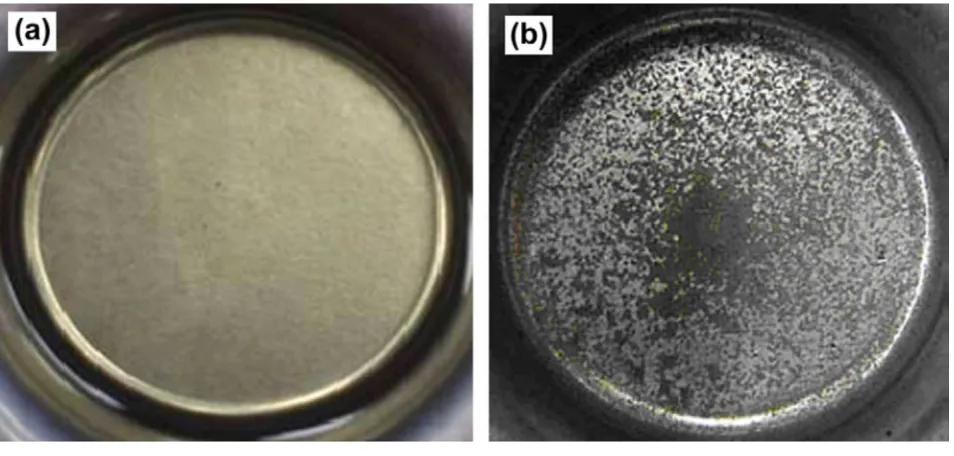
384 | P a g e COMPATIBILITY OF METALS AND ELASTOMERS IN BIODIESEL: A REVIEW | Fig.6 Appearance of terne cup after immersion in (a) diesel and (b) B5 for 500 h [37]
In addition to the scientific literature, reports on materials compatibility issues are also available which are mainly produced by industrial stakeholders and government agencies. In one such report it has been suggested [47] that copper, brass, bronze, lead, tin and zinc are corroded by biodiesel. These elements accelerate oxidation of biodiesel and hence should be avoided in fuel system. Stainless steel, carbon steel and aluminum, on the other hand, have been suggested to be used in biodiesel.
Ballote et al. [48] used electrochemical techniques to determine the effect of corrosion in biodiesel samples exposed to aluminum during different stages of washing. The corrosion process occurred in the same manner as if aluminum was exposed to aqueous or ethanol alkaline solution. The electrochemical
measurements were done by
Potentiostat/Galvanostat in a 3 electrode cell. During the initial wash, the open circuit potential (Eocp) showed a high negative value (−600 mV), which might have occurred due to reaction of aluminum with biodiesel. Repeated washing of biodiesel by water resulted in a positive of Eocp value, which was attributed to the use of potassium hydroxide or sodium hydroxide as homogeneous catalyst which forms Al(OH)3 as a passive layer. The corrosion potential (Ecorr) was negative (below −500 mV) through six washing cycles, but increased to −50 mV after the seventh wash cycle. The corrosion current density also decreased with the number of wash cycles (from 10 nA/cm2 to 0.10 nA/cm2). Kaul et al. [3] did a static immersion test (SIT) on the diesel piston liner and piston metal that came into contact with the biodiesel fuel. The SIT was conducted for 300 days at room temperature, which varied between 15 and 40 ◦C, and corrosion rate (mpy) and penetration (mdd) were determined. Weight losses resulting from corrosion in the piston liner exposed to Salvadora, Jatropha, Karanja, and Mahua biodiesel were 6.1, 3.6, 0.3, and 0.3 mg,
respectively. A high weight loss of 2.1 mg was also observed in piston metal exposed to Salvadora biodiesel, followed decreasingly by Jatropha biodiesel (0.2 mg), then Karanja and Mahua biodiesel (0.1 mg). Corrosion rate and penetration were high in Salvadora and Jatropha biodiesel. An increase in Total Acid Number due to oxidation of the fuel was observed with Jatropha, Karanja, and Mahua, which led to increased corrosion. With Salvadora, however, the increase in corrosion was attributed to presence of a high concentration (1600 ppm) of sulfur. Although they reported that the extent of corrosion was within the permissible limits and no gum formation was observed.
Based on the studies done so far, it can be said that biodiesel is more corrosive than diesel. The corrosiveness of biodiesel increases with the concentration of biodiesel in the blend. Copper alloys are more susceptible to corrosion than ferrous alloys and aluminum alloys. Lead alloys on terne steel sheet are also affected by biodiesel. The presence of impurities and water increases the corrosion tendency of biodiesel. There are concerns that the currently used indicators of corrosiveness of biodiesel e.g. copper strip corrosion and TAN value that are prescribed by different standards are not effective enough. Clearly at present, there is a serious lack of scientific data on corrosion of automotive metals and alloys in biodiesel based on which confident decisions could be made. Corrosive nature of biodiesel under wide spectrum of compositional, environmental and operating variables should be investigated.
Degradation of Elastomers in biodiesel:
385 | P a g e COMPATIBILITY OF METALS AND ELASTOMERS IN BIODIESEL: A REVIEW | arises from the fact that petrodiesel and biodiesel
have much different chemical structures and consequent different effects on elastomers. Besides, biodiesel is susceptible to oxidation upon exposure to air as well as storage conditions and the amount of unsaturation of fatty acids. Being oxidized, it produces hydroperoxides at the unsaturated points of the fatty acids and these hydroperoxides later decompose to aldehydes, ketones, shorter chain carboxylic acids [49]. Esters, the main components of biodiesel, can also be easily hydrolyzed in the presence of water to form carboxylic acids. All these products including the chemical composition of biodiesel affect the swelling characteristic of elastomer depending not only on its composition but also on the formulation of the compound [50]. For diesel engine, usually hoses are produced from rubber modified polyolefin whereas gaskets are produced from gasket paper, non-asbestos, rubber, ethylene–propylene–diene monomer (EPDM), nitrile, Buna, neoprene, flexible graphite, viton, silicone, metal, mica, felt or plastic polymer, like Teflon, (PTFE), ethylene polymer etc. The common seal materials are polyurethane, nitrile rubber, Buna-N, EPDM, silicon rubber, virgin polytetrafluoroethylene (PTFE), aluminum etc. Many of these materials used in diesel engine are not compatible with biodiesel. Trakarnpruk and Porntangjitlikit [51] carried out immersion tests with six types of elastomers like nitrile rubber (NBR), hydrogenated nitrile butadiene rubber (HNBR), NBR/PVC, acrylic rubber, co-polymer fluoroelastomer (FKM), and terpolymer FKM in B10 (palm biodiesel) for upto 1008 h at 100 ˚C. They showed that mass and volume increased with respect to time for all test samples except NBR and NBR/ PVC. Only for these two (NBR and NBR/PVC) mass and volume were decreased with time.
Materials compatibility may also vary depending on feedstock of biodiesel. Frame and McCormick [52] investigated the degradation characteristics of elastomers like peroxide-cured nitrile rubber (N1059), nitrile rubber (N674), high aceto-nitrile content rubber (N0497), fluorocarbon filled with
carbon black (V747) and fluorocarbon without carbon black (V884) in diesel, diesel blend with 15% ethanol and 20% soy-derived biodiesel. They observed that these elastomers were fully compatible with B20 and diesel but not in 15% ethanol blend.
386 | P a g e COMPATIBILITY OF METALS AND ELASTOMERS IN BIODIESEL: A REVIEW | observed in fluoro-viton. Analysis by FTIR
spectrometry showed presence of carbon–carbon double bonds that may have resulted from reaction between the methylene or vinyl groups of nitrile rubber. The degradation of nitrile rubber and polychloroprene in biodiesel has been attributed to the carboxylic polar groups present in biodiesel
In order to investigate the oxidation effect, Terry [54] conducted experiments with different types of elastomers like sulfur cured acrylonitrile butadiene nitrile rubber (NO674-70), peroxide cured acrylonitrile butadiene nitrile rubber (NB104-75), hydrogenated nitrile polymer (KB162-80), fluorocarbon polymer with 67% fluorine content (VB153-75), fluorocarbon polymer with 66% fluorine content (V1164-75) in different types of feedstock blends like rapeseed methyl ester (B5, B20) and soybean methyl ester (B5, B20, oxidized B5, oxidized B20). He found that NB104- 75, NO674-70 and KB162-80 showed higher volume swell and little decrease in hardness in B20 oxidized SME. Dimensional changes were higher in oxidized B5 and B20. These results most likely proved that oxidized products caused comparatively more degradation of elastomers. Tensile strength was decreased for each elastomer only little in all the fuels.
According to Baranescu [55] most of the elastomers used with conventional diesel swell by absorption of aromatic compounds. It is also reported in his study that biodiesel may leach aromatics as well as additives designed to prevent hardening and cracking.
Haseeb et al. [56] tested the physical properties of various elastomers on their exposure to diesel and biodiesel (prepared from palm oil). The elastomers tested were ethylene propylene diene monomer (EPDM), silicone rubber (SR), polychloroprene (CR), polytetrafluroethylene (PTFE), and nitrile rubber (NBR). A SIT was carried out for B0, B10, B20, and B50 biodiesel at 25 ◦C for 1000 h. The physical properties of weight/volume loss, hardness, and tensile strength were determined after every 250 h of immersion. While biodiesel blends were found to
cause high swelling in CR and NBR elastomers, the EPDM and SR elastomers swelled more in diesel than in biodiesel. PTFE elastomer showed slight loss in weight and volume, whereas other elastomers showed considerable gain in weight due to swelling. The reason attributed for high swelling in CR and NBR elastomers was the polar nature of the elastomers that dissolved in the biodiesel with its polar ester group. Exposure to metals may have caused oxidation of the fuel, which enhanced its polarity and further degraded the elastomers. When exposed to biodiesel, elastomers are affected in two ways: first by absorption of liquid by elastomers and second, by dissolution of soluble components from the elastomers in the liquid medium. Swelling was the result of high absorption amount by elastomers in comparison to their dissolution in the fuel. The tensile strength of biodiesel decreased to a large extent in the case of EPDM and CR. A minor decrease in tensile strength was observed in SR, PTFE and NBR elastomers. Among all of the elastomers, PTFE showed high compatibility with biodiesel that was attributed to absence in its polarity, although it also underwent reduction in its constituents. Swelling of the elastomers in biodiesel fuel can be retarded by adding cross-linking agents in the elastomers. Peroxides are commonly added as cross-linking agents [57].
387 | P a g e COMPATIBILITY OF METALS AND ELASTOMERS IN BIODIESEL: A REVIEW | aspects of compatibility with elastomers are a
topic for future research.
Fig. 7. Changes in: (a) weight and (b) volume of different elastomers after immersion at room temperature for
500 h [53].
Conclusion:
Biodiesel has chemical characteristics that are distinct from that of petroleum diesel. It is therefore expected that they will interact with materials differently. Compositional differences of biodiesel derived from different feed stocks complicate the situation. In automobile fuel systems, numerous materials come in contact with fuel. These can be mainly grouped into ferrous alloys, non-ferrous alloys and elastomers. Among these groups of materials, elastomers undergo degradation to a greater extent in biodiesel. Common elastomers like natural rubber, nitrile, chloroprene/neoprene etc. are not suitable for use in biodiesel. Fluorocarbons have shown good resistance and are recommended for used in biodiesel. Exact mechanisms of degradation of elastomers in biodiesel and the effects of different biodiesel constituents require systematic investigations. Between the other two groups of materials, viz. ferrous alloys and non-ferrous alloys, the former are more resistant to attack in biodiesel. Among non-ferrous alloys, copper alloys and lead alloys are the most vulnerable which appear to be followed by aluminum.
Metallic components in automobiles can undergo corrosive, tribological or both forms (tribo-corrosion) of attacks depending on their functionality. Corrosion studies done so far
suggest that biodiesel is more corrosive than diesel. However, there is no conclusive evidence as to whether the extent of corrosion encountered in biodiesel is within limits acceptable for automotive components. The corrosiveness of biodiesel increases with the concentration of biodiesel in the blend and the extent of oxidation. Copper alloys are more susceptible to corrosion than ferrous alloys and aluminum alloys. Lead alloy coating on terne steel sheet which is used for automotive fuel tanks is severely affected by biodiesel. The presence of impurities and water increases the corrosion tendency of biodiesel. There are concerns that the currently used indicators of corrosiveness of biodiesel e.g. copper strip corrosion and TAN value that are prescribed by different standards are not effective enough. Corrosive nature of biodiesel under wide spectrum of compositional, environmental and operating variables should be investigated.
388 | P a g e COMPATIBILITY OF METALS AND ELASTOMERS IN BIODIESEL: A REVIEW | static engine as well as on-road tests. Most of
these studies mainly evaluated engine component wear in biodiesel in terms of the contents of different elements in lubricants. In general, these studies show low or similar wear for many elements in biodiesel compared with diesel. Fe, the main constituents of the most critical components in automobiles, shows less or similar wear, except for one study which involved higher blend (100%). On the other hand, Cu shows higher wear in many cases. Pb and Al follow copper in terms of decreasing trend in the number of studies where higher wear was reported for these metals. The lubricant analysis technique for wear evaluation provides only overall indication of the extent of wear. It does not furnish
information on the extent of damage of individual components which is important in the prediction of component life. Such information can be obtained by examining the individual wear components in an engine. A handful of studies involving such engine teardown investigations did not find excessive in lower blends (6B20) of biodiesel as compared with diesel. However, higher wear was reported for piston rings in 100% biodiesel. Corrosion of metallic parts and elastomers takes a long duration. Current studies done on metal samples commonly used in CI engines have been done for a limited period of time (1000 h or 300 days). Further testing carried out for longer durations is needed to
provide a better understanding of corrosion for application. A few inhibitors (ethylenediamine, tert-butylamine, and n-butylamine) have been found to be effective in the formation of a stable metal oxide as protective layer and thus retarding corrosion in biodiesel. An antioxidant,
tert-butylhydroquinone, was also found to retard the corrosion of copper coupon in biodiesel along with enhancing the oxidation stability of the fuel. Further studies on the effectiveness of inhibitors added to biodiesel are needed.
References:
1. Jung H, Kittelson DB, Zachariah MR. Characteristics of SME biodiesel-fueled diesel particle emissions and the kinetics of oxidation. Environ Sci Technol 2006;40:4949–55.
2. Prado AGS, Pescara IC, Evangelista SM, Holanda MS, Andrade RD, Suareza PAZ, et al. Adsorption and preconcentration of divalent metal ions in fossil fuels andbiofuels: Gasoline, diesel, biodiesel, diesel-like and ethanol by using chitosan microspheres and thermodynamic approach. Talanta 2011;84:759–65
3. S. Kaul, R.C. Saxena, A. Kumar, M.S. Negi, A.K. Bhatnagar, Corrosion behavior of biodiesel from seed oils of Indian origin on diesel engine parts, Fuel Process.Technol. 88 (2007) 303–307.
4. D.P. Geller, T.T. Adams, J.W. Goodrum, J. Pendergrass, Storage stability of poultry fat and diesel fuel mixtures: specific gravity and viscosity, Fuel 87 (2008) 92–102.
5. M. Sgroi, G. Bollito, G. Saracco, S. Specchia, BIOFEAT: biodiesel fuel processor for a vehicle fuel cell auxiliary power unit — study of the feed system, J. Power Sources 149 (2005) 8–14.
6. Sharma YC, Singh B, Upadhyay SN. Advancements in development and characterization of biodiesel: a review. Fuel 2008;87:2355–73.
7. Yuan H, Yang BL, Zhu GL. Synthesis of biodiesel using microwave absorption catalysts. Energy Fuels 2009;23:548–52. 8. Busca G. Bases and basic materials in
389 | P a g e COMPATIBILITY OF METALS AND ELASTOMERS IN BIODIESEL: A REVIEW | Liquid versus solid basicity. Chem Rev
2010;110:2217–49.
9. Satyarthi JK, Srinivas D, Ratnasamy P. Influence of surface hydrophobicity on the esterification of fatty acids over solid catalysts. Energy Fuels 2010;24:2154– 61.
10. Sharma YC, Singh B, Korstad J. Advancements in solid acid catalysts for ecofriendly and economically viable synthesis of biodiesel. Biofuel Bioprod Bior 2011;5:69–92.
11. Nagy M, Foston M, Ragauskas AJ. Rapid quantitative analytical tool for characterizing the preparation of
biodiesel. J Phys Chem A
2010;114:3883–7.
12. Haseeb ASMA, Fazal MA, Jahirul MI, Masjuki HH. Compatibility of automotive materials in biodiesel: a review. Fuel 2011;90:922–31.
13. Fernando S, Karra P, Hernande R, Kumar SJ. Effect of incompletely converted soybean oil on biodiesel quality. Energy 2007;32:844–51.
14. Lebedevas S, Vaicekauskas A. Research into the application of biodiesel in the transport sector of Lithuania. Transport 2006(2):80–7.
15. Kajdas C, Majzner M. The influence of fatty acids and fatty acids mixtures on the lubricity of low-sulfur diesel fuels. SAE Technical Paper No. 2001-01-1929. 16. Goering CE, Schwab AW, Daugherty
MJ, Pryde EH, Heakin AJ. Fuel properties of eleven oils. Trans ASAE 1982;25:1472–83.
17. Anjana S, Ram P. Triglycerides-based diesel fuels. Renew Sustain Energy Rev 2000;4:111
18. Challen B, Baranescu R. Diesel engine reference book. 2nd ed. Woburn:
Butterworth-Heinemann; 1999.
19. Fernando S, Karra P, Hernandez R, Jha SK. Effect of incompletely converted soybean oil on biodiesel quality. Energy 2007;32:844–51.
20. Standard test method for corrosiveness to copper from petroleum products by copper strip test. ASTM D130-04. Assessed on May 14, 2008.
21. Fazal MA, Haseeb ASMA, Masjuki HH. Biodiesel feasibility study: an evaluation of material compatibility; performance; emission and engine durability. Renew Sustain Energy Rev 2011;15:1314–24.
22. Agarwal AK. Biofuels (alcohols and biodiesel) applications as fuels for internal combustion engines. Prog Energy Combust 2007;33:233–71. 23.Sgroi M, Bollito G, Saracco G, Specchia
S. BIOFEAT: Biodiesel fuel processor for a vehicle fuel cell auxiliary power unit Study of the feed system. J Power Sources 2005;149:8–14.
24. Geller DP, Adams TT, Goodrum JW, Pendergrass J. Storage stability of poultry fat and diesel fuel mixtures: specific gravity and viscosity. Fuel 2008;87:92– 102.
25. Cao P, Tremblay AY, Dube MA, Morse K. Effect of membrane pore size on the performance of a membranereactor for biodiesel production. Ind Eng Chem Res 2007;46:52–8.
26.Prieto LEG, Sorichetti PA, Romano SD. Electric properties of biodiesel in the range from 20 Hz to 20 MHz. Comparison with diesel fossil fuel. Int J Hydrogen Energy 2008;33:3531–7. 27. Maru MM, Lucchese MM, Legnani C,
Quirino WG, Balbo A, Aranha IB, et al. Biodiesel compatibility with carbon steel and HDPE parts. Fuel Process Technol 2009;90:1175–82.
390 | P a g e COMPATIBILITY OF METALS AND ELASTOMERS IN BIODIESEL: A REVIEW | 29. Proc K, McCromick RL, Chandler K,
Buchholz B, Operating experience and teardown analysis for engines operated on biodiesel blends (B20), NREL/CP- 540-38509, SAE technical paper no. 2005-01-3641. In: Fazal MA, Haseeb ASMA, Masjuki HH, Comparative corrosive characteristics of petroleum diesel and palm biodiesel for automotive materials. Fuel Process Technol 2010;91:1308–15.
30.Avner SH. Introduction to physical metallurgy. 2nd ed. New York: McGraw-Hill; 1974. In: Fazal MA, Haseeb ASMA, Masjuki HH, Comparative corrosive characteristics of petroleum diesel and palm biodiesel for automotive materials. Fuel Process Technol 2010;91:1308–15. 31. Fazal MA, Haseeb ASMA, Masjuki HH.
Comparative corrosive characteristics of petroleum diesel and palm biodiesel for automotive materials. Fuel Process Technol 2010;91:1308–15.
32. Haseeb ASMA, Masjuki HH, Ann LJ, Fazal MA. Corrosion characteristics of copper and leaded bronze in palm biodiesel. Fuel Process Technol 2010;91:329–34.
33. Wood RJK, Hutton SP, Schiffrin DJ. Mass transfer effects of non-cavitating seawater on the corrosion of Cu and 70Cu–30Ni. Corros Sci 1990;30, 1177– 1181, 1183–1201. In: Fazal MA, Haseeb ASMA, Masjuki HH, Comparative corrosive characteristics of petroleum diesel and palm biodiesel for automotive materials. Fuel Process Technol 2010;91:1308–15.
34. Keera ST, Elham EA, Taman AR. Corrosion of copper metal in distillation process. Anti Corros Method Mater 1998;45:252–5. In: Fazal MA, Haseeb ASMA, Masjuki HH, Comparative corrosive characteristics of petroleum diesel and palm biodiesel for automotive materials. Fuel Process Technol 2010;91:1308–15.
35. Fazal MA, Haseeb ASMA, Masjuki HH. Effect of temperature on the corrosion behavior of mild steel upon exposure to palm biodiesel. Energy 2011;36:3328– 34.
36.ASTM International (ASTM, 1994f, ASTM, 1994j). Standard specification for biodiesel fuel blend stock (B100) for distillate fuels; 2002.
37.Tsuchiya T, Shiotani H, Goto S, Sugiyama G, Maeda A. Japanese standards for diesel fuel containing 5% FAME blended diesel fuels and its impact on corrosion. SAE Technical Paper No. 2006-01-3303.
38.Geller DP, Adams TT, Goodrum JW, Pendergrass J. Storage stability of poultry fat and diesel fuel mixtures: specific gravity and viscosity. Fuel 2008;87:92– 102.
39.Haseeb ASMA, Masjuki HH, Ann LJ, Fazal MA. Corrosion characteristics of copper and leaded bronze in palm biodiesel. Fuel Process Technol 2010;91:329–34.
40.Sgroi M, Bollito G, Saracco G, Specchia S. BIOFEAT: biodiesel fuel processor for a vehicle fuel cell auxiliary power unit – study of the feed system. J Power Sources 2005;149:8–14.
41. Fazal MA, Haseeb ASMA, Masjuki HH. Comparative corrosive characteristics of petroleum diesel and palm biodiesel for automotive materials. Fuel Process Technol 2010;91:1308–15.
42.Kenneth Proc, Barnitt R, Hayes RR, Ratcliff M, McCormick RL, Lou Ha, et al. 100,000-Mile Evaluation of Transit Buses Operated on Biodiesel Blends (B20). SAE Technical Paper No. 2006-01-3253.
391 | P a g e COMPATIBILITY OF METALS AND ELASTOMERS IN BIODIESEL: A REVIEW | 44. Rashid U, Anwar F, Knothe G.
Evaluation of biodiesel obtained from cottonseed oil. Fuel Process Technol 2009;90:1157–63.
45.Haseeb ASMA, Masjuki HH, Ann LJ, Fazal MA. Corrosion characteristics ofcopper and leaded bronze in palm biodiesel. Fuel Process Technol 2010;91:329–34.
46. Sgroi M, Bollito G, Saracco G, Specchia S. BIOFEAT: biodiesel fuel processor for a vehicle fuel cell auxiliary power unit – study of the feed system. J Power Sources 2005;149:8–14.
47. Biodiesel handling and guidelines. 3rd ed. US Department of Energy, DOE/GO-102006-2356; 2006.
48.Ballote LD, Sansores JFL, Lopez LM, Mesias LFG. Corrosion behavior of aluminum exposed to a biodiesel. Electrochem Commun 2009;11:41–4. 49.Knothe G, Steidley KR. Lubricity of
components of biodiesel and petrodiesel. The origin of biodiesel lubricity. Energy Fuels 2005;19:1192–200.
50.Thomas EW, Fuller RE, Terauchi K. Fluoroelastomer compatibility with biodiesel fuels. SAE Technical Paper No. 2007-01-4061.
51. Trakarnpruk W, Porntangjitlikit S. Palm oil biodiesel synthesized with potassium loaded calcined hydrotalcite and effect of biodiesel blend on elastomer properties. Renewable Energy 2008;33:1558–63.
52. Frame E, McCormick RL. Elastomer compatibility testing of renewable diesel fuels. Technical Report NREL/TP: 2005; 540-38834.
53. Haseeb ASMA, Masjuki HH, Siang CT, Fazal MA. Compatibility of elastomers in palm biodiesel. Renewable Energy 2010;35:2356–61.
54.Terry B. Impact of biodiesel on fuel system component durability FTC 2005.01 September 2005. NREL/TP-540-39130.
55. Baranescu R. Biodiesel research engine warranty policy. Presented at commercialization of biodiesel: establishment of engine warranties. University of Idaho National Center for Advanced Transportation Technology; 1994. p. 102–6.
56. Haseeb ASMA, Jun TS, Fazal MA, Masjuki HH. Degradation of physical properties of different elastomers upon exposure to palm biodiesel. Energy 2011;36:1814–9.
57. Duin van M, Orza RA, Peters R, Chechik V. Mechanism of peroxide crosslinking of EPDM rubber. Macromol Symp 2010;291–292:66–74. In: Haseeb ASMA, Jun TS, Fazal MA, Masjuki HH, Degradation of physical properties of different elastomers upon exposure to palm biodiesel. Energy 2011;36:1814–9.
![Fig. 5. Corrosion rate of mild steel after exposure to diesel (B0), B50, and B100 for 1200 h at 27, 50, and 80 ◦C [35]](https://thumb-us.123doks.com/thumbv2/123dok_us/7834121.1298183/7.595.63.288.288.462/fig-corrosion-rate-mild-steel-exposure-diesel-b.webp)