JOURNK OF
MNGE
NNWGEMENT
Published bimonthly-January, March, May, July, September, November-by the Society for Range Management 2120 South Birch Street Denver, Colorado 80222
TABLE OF CONTENTS_ Vol. 28. No. 1. Januarv 1975 Copyright @ 1975 by the
Society for Range Management
ARTICLES Managing Editor
DAVID A. SMITH
2120 South Birch Street Denver, Colo. 80222 Editor
ELBERT H. REID
4
11
18
22
624 South Shields Street
Fort Collins, Colo. 80521 27
Book Review Editor
DONALD N. HYDER 32
Agricultural Research Service Colorado State University
Fort Collins, Colo. 80521 37
Copy Editor
PATRICIA G. SMITH 43
2120 South Birch Street Denver, Colo. 80222 Editorial Board 1972-74
48
52
LOWELL K. HALLS, Nacogdoches, Tex. ROBERT L. ROSS, Bozeman, Mont. GERALD W. TOMANEK, Hays, Kan. HENRY A. WRIGHT, Lubbock, Tex.
56
1973-75 61
DWIGHT R. CABLE, Tucson, Ariz. JOHN P. WORKMAN, Logan, Utah RUSSELL J. LORENZ, Mandan, N.D. LEWIS L. YAR LETT, Gainesville, Fla.
65
1974-76
PHILLIP L. SIMS, Fort Collins, Colo. REX D. PIEPER, Las Cruces, N. Mex. MINORU HIRONAKA, Moscow, Ida. MARK R. KILCHER, Swift Current, Sask.
INDIVIDUAL SUBSCRIPTION is by membershrp In the Society for Range Management. c
LIBRARY or other INSTITUTIONAL SUBSCRIP TIONS, on a calendar year basis, are $22.00 postpaId to all countries. Payments from outslde the Unlted States should be remltted In US dollars by lnternatlonal money order or draft on a New York bank.
.
CHANGE OF ADDRESS notices should be sent to the Managing Editor, 2120 S. Birch St., Denver, CO 80222, no later than the first day of the month of issue. Copies lost due to a change of address cannot be replaced unless adequate notice is given. To assure uninterrupted ser- vice, provide your local postmaster with a Change of Address Order (POD Form 3575). indicating thereon to guarantee forwarding postage for second-class mail. BUSINESS CORRESPONDENCE, concernrng subscrip- tions, advertising, reprints, back issues, and related matters, should be addressed to the Managing Editor, 2120 S. Birch St., Denver, CO 80222.
TECHNICAL NOTES
70 Legume Response Unrelated to Fuel Moisture at Time of Burning by T. J. Harshbarger, C. J. Perkins, and R. E. Martin
71 Herbage Disappearance and Grazing Capacity Determinations of Southern Pine Bluestem Range by H. A. Pearson
73’ Approximate Annual Water Budgets of Two Chained Pinyon-Juniper Sites by _. Gerald F. Gifford
VIEWPOINT
75 Some Economic Aspects of Western Rangeland Management and Conservation by Mont H. Saunderson
77 Land Use, Ethics, and Property Rights-a Western View from the East by William R. Burch, Jr.
BOOK REVIEWS
80 Psychrometry in Water Relations Research (Edited by Ray W. Brown and Bruce P. Van Haveren); Range Resources of the Southeastern United States (Edited by Robert S. Campbell and Wesley Keller).
EDITORIAL CORRESPONDENCE, concerning manu- scripts or other editorial matters, should be addressed to the Editor, 624 S. Shields St., Fort Collins, CO 80521.
INSTRUCTIONS FOR AUTHORS appear each year in the March issue; copies of these instructions are available from the editor.
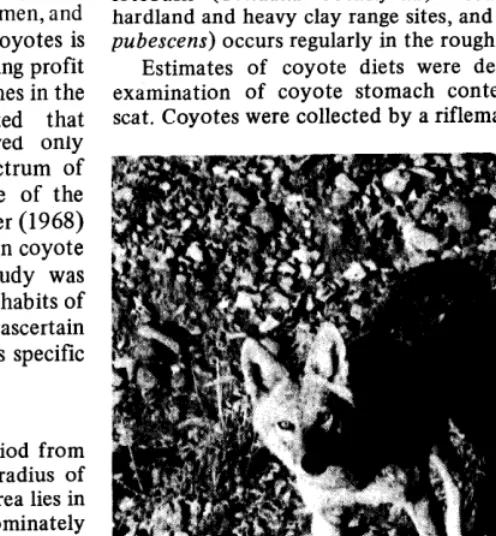
COVER: Coyote! (Photo by Carl L. Wambolt. See first four articles in this journal on predator- livestock relationships.)
SECOND CLASS POSTAGE paid at Denver, Colorado.
The Predator-Control Scene as of 1974 by Frederic H. Wagner
Eagles and Sheep: A Viewpoint by Eric G. Bolen
Perspectives on Predator Management by, Joan Johnson and F. R. Gartner
Foodniche of Coyotes in the Rolling Plains of Texas by Wyman P. Meinzer, Darrell N. Ueckert, and Jerran T. Flinders
Sheep-raising in the 17 Western States: Populations, Distribution, and Trends by Erwin W. Pearson
Presettlement Vegetation in the Sagebrush-Grass Area of the Intermountain West by Thomas R. Vale
Waterfowl Production in Relation to Rest-Rotation Grazing by Frank M. Gjersing
Diet Overlap of Deer, Elk, and Cattle in Southern Colorado by R.
M.
Hansen and L. D. ReidSteer Diets in Southeastern Colorado by Reldon F. Beck
Diet and Performance of Sheep on Rangeland in Semiarid Argentina by J. P. Bishop, J. A. Froseth, H. N. Verettoni, and C. H. Noller
Ecological Effects and Fate of N Following Massive N Fertilization of Mixed- Grass Plains by W. H. Houston and D. N. Hyder
Salt and Specific Ion Effects on Germination of Four Grasses by J. Ryan, S. Miyamoto, and J. L. Stroehlein
The Predator-Control
Scene as of I974
FREDERIC H. WAGNER
Highlight: Mounting public pressures against predator control, especially with to.uican ts, plus the information compiled b-v the Cain Committee led to the Executive Order banning the use of toxicants on federal land and by federal control agents. Reaction of the livestock industry has been to ask that control be moved into the state governments and to seek release of M-44 cyanide guns through an experiment clause in the Environmental Protection Agency order withdrawing toxicant registration. An accelerated research program under the aegis of a number of agencies is providing a ,great deal of illformation, but needed programs are falling
between the cracks because of the lack of integrated analysis and attack o r1 the o Vera11 predator problem. A multidisciplinary, federal predator commission is proposed
which would have responsibility for anal_vzing the problem in concert, providing critical advice on proposed programs and available information, communicating rrpith all interested parties, and advocating policy.
_
The author is associate dean, College of Natural Resources, Utah State University, Logan.
I base been asked to write a “philosophical” article on the predator-control situation as of 1974. I propose to do this by giving a brief, retrospective summary of the events leading up to the Executive ban against the use of toxicants in February, 1972, some consideration o.f the sequence of events which followed the ban, a closer look at the scene as I interpret it today, and a suggestion for one course of action that might be helpful. Perhaps the fact that I am somewhat suspect to cnnserllationists and sheepmen alike attests to mv objectivity for doins this task.
The Situation Prior to the Executive Order
Prior to February, 1972, the predator-control situation in the West was in an uneasy equilibrium. No one was satisfied
with it. Stockmen were sustaining losses-more than they
thought reasonable-and were not sanguine about the job
being done by the Division of Wildlife Services (DWS).
Conservation groups were restive about the widespread use of toxicants and possible hazards to the biota. DWS was caught
squarely in the middle, attempting to compromise between
opposing demands, operating in areas where solid, factual
information was wanting, and pleasing no one.
My own opinion is that the Division was doing a better job than most of its critics gave it credit for. It had installed a professionally trained, wildlife biologist as its director in the
1960’s, had developed a set of uniform, nationwide operational guidelines, and had kept a surprisingly good series of records on its operations. There were, of course, violations. It did have a control mind-set bred of the fact that its field men had traditionally been hired to catch and kill predators.
But one could see changes in philosophy as new men were
employed and in response to rising pressures from
fast-growing, environmentally concerned facets of society.
Violations were disciplined. With its administration located in
Washington it was to some degree buffered from the
grass-roots political pressures to which its field men in the West were subjected. And predator control was largely in the
hands of public servants whose activities were under the
control of agency administrators, and whose practices, and to some degree, effects were recorded and accountable.
But the balance of forces was changing. The rise of
environmental awareness, and the public awakening to the
wonders of, and its ownership in, our natural resources
focused increasing pressures on predator control. The
equilibrium was destined to shift.
The Cain Committee was appointed in early 1971. Five
wildlife ecologists, one plant ecologist (and former Assistant Secretary of the Interior), and one political scientist were
given a few short months to evaluate a set of complex
ecological and economic questions on which there had been
little research, and to make recommendations for change. One of the most significant questions which the Committee deliberated was the effectiveness of toxicants. I reviewed most of the evidence available to us at that time on pages 36-58 of the report (Cain et al., 1972) and elsewhere (Wagner, 1972).
That evidence, all originally recorded incidentally to the
question at hand, came almost entirely from DWS records and the statistics of U.S. Department of Agriculture’s Statistical Reporting Service (SRS). There were few data from research
carefully designed to shed light on the effectiveness of
toxicants in reducing coyote populations and sheep losses, and the side effects in the environment.
The information that we were able to compile was
equivocal. The indications, in my view, did point rather
strongly to coyote population reductions that were
proportionate to the amount of 1080 used (Cain et al.,
197 2 : 42-44; Wagner, 1972:21-25). With the coyote
population indices available, reductions seemed rather strongly indicated in such northern Intermountain states as Montana, Wyoming, and Idaho; but undetectable in such southern states as Texas, New Mexico, and perhaps Arizona.
But a number of results feared by many observers have
developed, or are in the process of developing. The stockmen
Any justification for predator population reduction must
lie in its reduction of sheep losses, and evidence on that point was conflicting in late 197 1. Available indices based on DWS records suggested reduction in sheep losses during the era of toxicant use; but indices based on the more extensive, and statistically designed, Statistical Reporting Service surveys
suggested no reduction in post-docking losses during the
toxicant era (Cain et al., 1972:47-53; Wagner, 1972:32-37).
If there is one lesson that comes through strongly in the tortured history of predator control-and all resource management, for that matter-it is that the day of single-value management is gone. Predatory animals are game species to the growing clan of varmint hunters. To hikers, campers, back-packers, and numerous groups of nature lovers, they are as much a part of the variety and beauty of the American outdoors as pine trees, lakes, red squirrels, and deer.
Evidence of side effects on nontarget species was also
inconclusive. There is no question that individual carnivorous animals other than coyotes have been killed by toxicants. But it has not been established that the population levels of these species have been detrimentally affected. In fact, a number of
the common, mammalian carnivorous species may actually
have increased following toxicant-induced coyote reduction
(Robinson, 1961; Linhart and Robinson, 1972; Cain et al.,
1972:55-56; Wagner, 1972:38-41). We do not know about the
effects on raptor numbers, on the larger carnivores, and on smaller, rare-and-endangered species.
understandably felt they were treated unfairly, if not
betrayed. They have been quoted in the media as saying that Secretary Morton promised them that they would be shown the Cain Report before its release, and they were not. Whether or not they received such a promise, they clearly were not represented on the Committee, were not invited to participate in the deliberations leading up to the recommendations of the Committee (although some did testify under invitation before the Committee meetings in Denver and Logan). And they were
not apprised of the Committee’s recommendations, or
rationale for those recommendations, prior to release of the report.
Public pressures were sufficient that some change in
poisoning practices virtually had to take place. If it were true that coyote poisoning did not materially reduce sheep losses,
as the SRS data suggested, there was then no reason to
continue it. Yet these data were of unknown accuracy, and
contradicted by the DWS records. In my view precipitate
change was not indicated, and I advocated experimental
reduction in trial areas to observe the effects, along with some form of insurance or some other compensation for losses (Cain
et al., 1972:62; Wagner, 1972:55-56). Other members of the
Committee saw the evidence, and assessed the public
Hindsight vision is, of course, always 20:20. But in
retrospect it would seem proper to have brought stockmen
into the deliberations which affected them so profoundly.
That they were not brought in has placed them in a
near-martyr posture, and this in turn contributes to some of the current developments, two of which merit emphasis here.
The Move to the States
One of the early actions taken by Western stockmcn, or
their representatives in the various state departments of
agriculture, after the Executive Order was to press the
Department of the Interior to turn predator control over to
the states. The rationale was obvious. The stockmen
recognized very well that the growing pressures against
restiveness, differently than I and recommended immediate
cessation of toxicant use in the Committee Report. That
report was duly filed in fall 197 1.
Developments since the Executive Order
For reasons given above, and others to be outlined below, I
felt that the February, 1972, Executive Order banning
toxicant use was somewhat abrupt. 1 favored a phased,
experimental withdrawal. But more than one official in the Executive Branch has told me that government does not move in such rational, orderly fashion. The system needs to be jolted before it responds. In effect, the political mule needs to be hit over the head with a 2-by-4 in order to get its attention.
There must be something to this view, because massive
funding has become available for predator research. To its very definite credit, the Department of the Interior reprogrammed
funds internally to free support for an expanded predator
research program. And several bills appropriated additional research funds for the Department of the Interior, Agricultural Research Service, Economic Research Service, Enviromnental Protection Agency, and other federal agencies. At the same time, a number of states made funds available. A welter of predator projects have sprung up during the 2 years following the ban.
predator control were substantially generated by Easterners who, they felt, did not understand and/or did not sympathize with their problems. As long as control was in the hands of the
federal government, this large voting block could exert
pressures against control. If toxicants were banned today,
shooting, denning, and trapping-the only remaining control
measures-might go tomorrow. If control were in state hands, it would be separated from Eastern political pressures, and closer to home where people were more sympathetic with the
plight of the livestock industry and perhaps less
environmentally concerned.
The states have not needed to beckon very hard because they have been finding a more-than-willing Department of the Interior. Explicitly, the Department is moving to turn control over to the states because predators are resident wildlife. But
implicitly, the Department is probably anxious to get the
predator-control monkey off its back.
In principle, the move to the states is quite proper. By tradition. and statute in the United States, ownership and responsibility for management of wildlife resident within the states have been vested in the people of the states and their state governments, even when that wildlife resides on federal land. That Western predator control should have been in the hands of a federal agency all of these years is largely a matter of tradition dating back to the World War I years and the existence of large acreages of federal land in the West.
In practice, however, many observers fear the direction the
stateward move is taking. The stockmen are asking that
control be taken over by the state departments of agriculture.
Their reasoning, quite understandably, is that these
departments have the same value systems as they, and would
carry out predator control with the singleness of purpose
which they desire.
Since the impression has spread that the industry was not treated with sufficient consideration and respect in the course of the Cain Committee study and subsequent Executive Order, it has incurred the sympathies of the Western-state executive
branches. There is, accordingly, rather strong inclination
among many of these branches to place control in the state agriculture departments. Such a move has already been made
in Colorado. And a bill now in the hopper in the Utah
legislature proposes that predator control be placed in the hands of a new commission, most of whose members are either industry representatives or employees of agriculture-related agencies.
Many observers are voicing concern that these moves violate the spirit, if not the letter, of the traditional American legalities surrounding wildlife resources. By statute, wildlife is the property of all the people, and therefore should properly be managed by agencies which are responsive to a plurality of values of all the people.
If there is one lesson that comes thro,ugh strongly in the
tortured history of predator control-and all resource
management, for that matter-it is that the day of single-value management is gone. Predatory animals are game species to the
growing clan of varmint hunters. To hikers, campers,
back-packers, and numerous groups of nature lovers, they are as much a part of the variety and beauty of the American outdoors as pine trees, lakes, red squirrels, and deer.
Traditionally, the responsibility for wildlife management has been vested in the hands of the divisions or departments of fish and game, or wildlife resources. Livestock predatory loss is
but one of numerous kinds of wildlife damage. There are
innumerable precedents in which the state wildlife
departments have assumed the responsibility for controlling
such damage. In most states, these agencies remove the
offending animals when deer or elk raid orchards or alfalfa fields; when beaver drop trees on dwellings or flood roads;
when pheasants pull newly sprouted corn or raid tomato
fields.
It remains to be seen how the move to the states will settle out. The final result will probably vary from state to state.
The M-44 Experiments
Following issuance of the Executive Order, the
Environmental Protection Agency suspended and cancelled all
registrations of cyanide, s t rychnine, and sodium
monofluoroacetate (1080) for predator-conirol purposes.
However, the Pesticide Act contained a proviso which stated that these substances could be released under special cases for experimental purposes.
As concerns grew among stockmen that the toxicant ban
would promote coyote population increases, pressures were
brought to bear on the Environmental Protection Agency to
develop “experiments” in toxicant use. To date there has been
no predisposition to release 1080, but the door has been
opened to the experimental release of the M-44 cyanide gun, the newer, spring-ejected version of the old cartridge-ejected “coyote getter.” The first state for which such an experiment was designed was Texas. Montana followed suit next, and a
number of Western states have expressed interest in
participating.
I am personally in favor of such experiments properly
designed and carried out. We need to evaluate the effectiveness of specific control measures, including toxicants, and I see no
way of doing so except to set up carefully controlled
experiments, one by one, with each control measure to be
evaluated. The M-44 is probably the most specific
coyote-control technique available except for denning and
shooting. Its effectiveness needs to be assessed.
But one cannot help but be concerned about two aspects of
the move toward M-44 “experiments” in the Western states.
One is the evident, widespread assumption among individuals of the livestock industry that M-44 use will reduce their losses. This, like the bounty matter, is another manifestation of the
wide communications gap which exists between stockmen,
wildlife biologists, predator-control agents, and individuals in government. It is my contention that this gap underlies much of the chaotic situation in which the predator-control question now exists.
Although the evidence is far from conclusive, and solid research is needed to get at the truth, the currently available information raises some real questions about the effectiveness
of cyanide guns. Older predator-control agents frequently
recount the response of coyotes to “getters” in the 1950’s after they appeared. At first, they appeared quite effective and large numbers of coyotes were killed. But after a few years, the response dropped off markedly, perhaps because a learning
process set in among the animals and/or because the
genetically getter-prone animals were culled out of the
populations.
Whatever the mechanism of change, there is reason to
doubt the effectiveness of widespread M-44 use as a
coyote-control measure. Plunging headlong into such use could be wasteful of funds. This message seems not to have gotten out to the world.
A second cause for concern in the move toward the M-44
experiments is the manner in which some of the
“experiments” to date have been designed. In one case, M-44’s
were to be given to stockmen to set out after brief instruction
on setting them. Evaluation was to be based on tallies by the
We are gaining an increasingly sound picture of the magnitude of sheep losses, the dauses of those losses, and the circumstances under which they occur. The practical spin-off for reducing loss
stockmen of the animals killed. These tallies were then to be
reported to county agents who were to compile and report the results. A number of worthwhile, subsidiary objectives were set forth, but in most cases it was not specified who would pursue them, nor by what procedures.
and applying control should be substantiaL
It is a niatter of record that some degree of credibility gap phenomena. These surveys are already providing quantitative
exists between livestock people and conservation groups. information on coyote distribution. One of the interesting
Predator-control evaluations need to be made by trained pictures emerging is the north-south gradient in coyote
researchers who are practiced in the careful, objective densities. Coyote populations in Texas, New Mexico, and
observations used in science, and who enjoy a measure of trust Arizona may be two to four times as high as those in Montana
among people on both sides of the question. The danger in and Wyoming. Unfortunately, the findings of these surveys,
experiments like the one described above is that at best the which could dispel some of the misinformation which appears
results will not be accepted by non-livestock interests. At periodically, have not been publicized or reached public
worst the results could be inconclusive or incorrect because notice.
the experiments were improperly designed, or the data taken Some of the best predator research now underway is that
carelessly or unobjectively. being conducted by BSFW. Coyote ecology and behavior are
The potential problems in the move to the states and the being studied in detail to learn the role of behavior in
M-44 experiments are but two of a number of event chains population regu’ationT the behavior patterns used during
which add up to near chaos on the current predator-control predatory attack, the role of the prey base in population
scene. But before considering what I believe could be one, at mechanisms, daily and seasonal movement patterns, and
least partial, remedy I would like to review briefly what population mechanisms in uncontrolled populations. These
appears to me to be known about coyote control and sheep studies should soon provide a thorough understanding of the
losses, and where the important knowledge gaps are. ecology and behavior of the species, and go far to enhance our
knowledge of the circumstances under which sheep killing
takes place. Much of this could be applied in control measures
Some Knowns and Unknowns on Coyote Control and Sheep or modifications of sheep-rearing practices to reduce losses.
Losses
Coyote Populations
We know very well that coyote populations undergo
short-term (i.e., 7-10 years) fluctuations or cycles in numbers
as do other animal populations. These fluctuations can be
quite pronounced, the highs exceeding the lows by a factor of
10 or more. They occur independent of predator-control
operations and appear, at least on the basis of Kansas and Utah studies (cf. Gier, 1968; Clark, 1972), to result from rises and falls in the prey populations.
The effect of generalized predator control (i.e., control aimed at reducing populations) apparently is to set the general level at which these fluctuations occur, (cf. Wagner, 1972). Hence the effects of control, or absence thereof, cannot be judged by the trends in coyote populations over 1 or 2 years. Densities of a number of years are needed to demonstrate control effects.
This point is stressed here because stockmen were reporting
increases in coyote populations immediately following the
Executive ban, and assuming cause and effect. In some cases increases did occur, as in fall 1972 in the vicinity of my own study area in northwestern Utah and southern Idaho. But this
coincided with a jackrabbit high in 1970 and 1971. The
decline of rabbits in 1972-74 was followed by coyote declines
in 1973 and 1974 when no toxicants were used.
Coyote population changes are more complex than simple
responses to the intensity of control. The excellent population
index network established throughout western United States
in 1972 by the Denver Research Laboratory of the Bureau of
Sport Fisheries and Wildlife (BSFW) will go far toward
providing sound information on coyote population
Effects of Control on Coyote Populations
The coyote is a prolific species, the females becoming capable of breeding in their first year of life and litter sizes averaging around six. Potentially the species could quadruple its numbers each year.
That breeding occurs annually, and that coyote populations do not increase indefinitely must imply that mortality is high. In fact over the long run, it must be true that as many coyotes die as are born. This is the same scheme nature has built into all of her animal species.
It follows that the killing of some coyotes does not
necessarily affect their population density. The deaths so
induced might simply replace mortality that would have
occurred by other means. Control mortality must be raised to a sufficiently high level that it offsets the high breeding rate before a population is reduced. That level of mortality is often difficult to attain because, as a population starts to be trimmed down, the survivors become scarce and more wary. One of the major, unanswered research questions is the level of control mortality needed to reduce coyote densities.
Timing of control operations may be important. Knowlton (1972) suggests that control might be more effective in late winter and early spring just prior to breeding than in summer
or fall.
These facts underlie the failure of bounties. Bounties tend to be paid to hunters who shoot coyotes while hunting other game, to trappers out for pelts, and to varmint hunters out for sport. All of these groups will tend to quit killing coyotes when numbers drop to some degree, and the survivors become wary. But the reduction that is achieved may be well short of that needed to reduce populations. At the same time, some
individuals would kill coyotes if there were no bounty.
We have very little evidence that gives us any indication of
th.e effects of different control methods. As mentioned
heretofore, I have compiled some information which points to population reduction by toxicants, especially 1080. The effect
has been most pronounced in northern states, and least
effective, if at all, in southern states. But for the most part,
this topic is one of the ones receiving almost no research attention. It is falling between the cracks because, as outlined below, there is no overall, coordinated analysis of the predator problem and systematic attention to all its facets.
Research needs to be conducted on all methods of control.
Toxicants need to be experimented with under carefully
controlled conditions as well as mechanical control methods.
A poison-impregnated collar to go around sheep necks, and
developed by BSFW personnel prior to the ban, is perhaps the most promising hope for destroying the offending individuals. Research on this item has been slow to develop.
Magnitude of Sheep Losses
As Balser (1974) points out, sheep loss estimates are few, often stated in confusing ways, and of unknown validity. He and Wagner (1972) suggest that losses of sheep to all causes may range around lo-1270 per year. Ewe losses, according to Balser, may average around 7% and lamb losses around 11. These estimates are largely post-docking losses, with accurate
estimates of losses between birth and docking hard to
determine.
Within these lo-12% total losses, there is some indication that predators account for an increasing fraction of the total as one goes from north to south, and weather losses display the converse pattern (Wagner and Pattison, 1973). We now have a number of estimates of predator losses which are consistently falling in the range of about 1 to 5%. These estimates come from intensive, on-the-spot observations by researchers (cf. Davenport et al., 1973, 1973a for southern Utah; R. Nass as
quoted by Balser, 1974 for southern Idaho); personal
interview of stockmen (Nielson and Curie, 1970, in Utah); and
mail poll of stockmen (Reynolds and Gustad, 1971, for
Montana, Wyoming, Colorado, and Texas). As Balser (1974) points out, all of these loss estimates pertain to a period during which predator control has been practiced. We do not know what they would be in the absence of control.
Two characteristics of the losses appear to affect the
stockmen’s perception of the losses. The first is that the statistical distribution of the losses appears to approximate the Poisson distribution, with a large fraction of the operators
sustaining low percentage losses, and a small percentage
sustaining a high percentage (Wagner, 1972; Balser, 1974). The second characteristic is that all observers, including stockmen, actually see a relatively small fraction of the lost
animals. Even under the intensive observations of research
Whatever the mechanism of change, there is rea,son to doubt the effectiveness of widespread M-44 use as a coyote-control measure. Plunging headlong into such use could be wasteful of funds This message seems not ot have got out to the world.
projects, Davenport et al. (1973a) were able to find only a third of the lost animals in their southern Utah study. This is a pattern reported for other similar projects by Balser (1974).
One interesting set of figures from the southern Utah study
(John Davenport, unpub.) relates to the number of sheep
killed per predatory incident. In 108 observed incidents, 309 sheep were killed: 42 with one animal killed, 58 with two, 14 with three, 8 with four, 5 with five, 2 with six, and 7 with more than six. In one of the latter, 20 were killed. If a large proportion of these were the actions of single coyotes, the implication is that the total loss could have been reduced by perhaps as much as a half or more if the offending animal had been killed or repelled after the first sheep attack.
Loss estimates, and research into the husbandry and
ecological conditions under which losses occur, are underway in a number of areas at present (Balser, 1974). This, again, is one of the areas in which effective BSFW research is being conducted. We are gaining an increasingly sound picture of the magnitude of sheep losses, the causes of those losses, and the circumstances under which they occur. The practical spin-off for reducing loss and applying control should be substantial.
Effectiveness of Control in Reducing Sheep Losses
Basically, predator control has been carried on over the past 3 decades or more under two general objectives or purposes. The first is that of trouble shooting problem cases. Where a rancher has a lambing ground or a flock in an area where one or more coyotes begin systematic killing, he may call the local DWS agent to come in and stop the losses. The agent may set traps or getters, fly over and attempt to find and destroy the offending animals from the air, or locate and destroy a nearby den which is the source of the trouble.
To my knowledge, there are no data to evaluate the number of sheep saved by this aspect of control. Almost certainly some animals are saved which would be lost if the offending
coyote(s) were allowed to continue unchecked. DWS
administrators have told me that they attempt, as a goal, to
reach the great majority of these complaints: e.g.,
three-fourths or more.
Perhaps the mean number of sheep saved per incident could be determined by comparing the losses in those cases where the offending coyote is apprehended, and in those where the offender is not caught. Then perhaps the number of ranchers asking for help could be determined and in this way some estimate derived of the total number of sheep saved through trouble-shooting control.
The second, general approach to control has been through generalized, regional population reduction. Prior to the late
1940’s, when some of the toxicants came into general use, large numbers of traps were set over the countryside. In the
past 2 de’cades, and prior to the Executive ban, 1080,
“getters,” and strychnine were disseminated over the
landscape in an effort to effect generalized population
reduction. Aerial hunting in winter and extensive denning in spring may also be practiced for this purpose.
In some cases trouble-shooting control and
population-reduction techniques may merge in an intermediate
effort. For example, aerial gunning, denmng, and
dissemination of some kinds of toxicants may be concentrated in an area where lambing is soon to take place, or into which a flock is soon to be moved.
The basic assumption underlying population reduction is
that some correlation exists between coyote density and sheep
losses. As mentioned above, I concluded in the Cain
Committee Report and in Wagner (1972) that the existing
evidence did not point to such a correlation. Since that time, I
have reanalyzed some of the data available to me then,
examined new information, and tentatively concluded that
such a correlation does exist (Wagner, 1973; Wagner and
Pattison, 1973). Since the evidence suggests that control
efforts, primarily toxicants, have reduced coyote numbers in
the northern lntermountain states, it now appears possible
that sheep losses will rise in th.is region following the ban. This is no certainty, however. As stated heretofore, the size of the prey base is an important determinant of the coyote
population level. The conclusion that coyote numbers were
reduced by the introduction of texicants was based on
evidence that the available indices of their numbers were lower during the 1950’s and 1960’s than prior to 1950. If, during this latter period, intensification of land use has reduced prey numbers, coyote populations might not be able to return to the pre-1950 levels. Only time will tell on this question.
Meanwhile, there is some evidence of gradual increase in
sheep losses between 1950 and the Executive ban during a
time when coyote populations apparently were roughly stable (Wagner and Pattison, 1973). Causes are unknown.
This subject is another one which is not receiving sufficient research attention due to a lack of concerted planning. The degree to which different control regimes do or do not reduce sheep losses needs careful analysis.
Economic Aspect of Losses
With the estimates of predator losses we now have available, we could estimate the economic value of those losses. This in itself would be of interest. But in terms of cost-benefit analyses, the more relevant estimates would probably be to compare predator-control costs with the value of sheep that would be lost without the presence of control. This latter figure cannot be confidently estimated with data now at hand. However, some speculative figures might be of interest as leads for future research.
On the basis of DWS records from Utah, I conjectured previously (cf. Cain et al., 1973:49; Wagner, 1972:33) that abolishing toxicant use could conceivably result in a two-fold increase in predator losses. Other DWS data also suggested that toxicant use might have effected a 50% or more reduction in
coyote numbers in northern Intermountain states. If the
populations do return to their pre-toxicant levels, these figures
also could suggest something approaching a doubling of
predator losses in this region.
The studies cited above largely place predator losses at about 2-4%. Hence, if-and this is a big if-the losses double, we could conceivably see them rise by this amount.
Estimates of the industry’s profit margin depend on
whether or not the land values, buildings, fences, and other semipermanent facilities are capitalized into the costs. If they are not, then the cost estimates are based on year-to-year operating expenses and the rationale for not capitalizing is that the facilities were perhaps inherited from prior generations. Under this rationale, the profit margin is, of course, higher and on the average substantial. If the facilities are capitalized into the costs, those costs rise substantially. Using the latter
approach, Goodsell and Belfield (1973) reported a rate of
return on investment of 4.2% for sheep ranches in Utah and Nevada.
The implication now is that if predator losses do rise even
by the minor amounts discussed above, they could conceivably offset the present, narrow profit margin. It should be pointed out that the industry’s problems are not predators alone. It is beset with a cost-price squeeze of multiple origin, not the least of which is its manpower problem. If the industry were strong, it could live with moderate predator losses. But with the economic realities it does face, it is conceivable that a slight, added predator loss could be the straw that breaks the camel’s back.
I wish to emphasize that these remarks are highly
speculative. They may be incorrect. And the currently
available figures suggest these trends only for the northern states. But I present them here because I think we need to consider them as a possibility. They point up the urgent need
for sound, economic analyses of the industry and of the
benefits from predator control of different kinds and
intensities.
One Possible Contribution to the Problem
The predator-cant rol problem is biologically, agriculturally, and economically complex. Developing a sufficiently thorough understanding of it so that knowledgeable judgments can be
made and policy can be set requires soundly conceived
research and experienced appraisal of the available
information. The problem is also socially complex in that
several facets of society are concerned about it, some of whom are in conflict over the matter.
Because the problem is multifaceted, research planning and policy formulation should take place in an integrated manner wherein: (1) appropriate expert judgment is brought to bear
on proposed programs and available information, (2) the
values and desires of all concerned interests can be expressed
and accommodated, and (3) available, sound information is
communicated promptly to all interested parties.
At present, the exact opposite of this pattern prevails.
Rather than integration, we have the separate interests
competing, pulling in opposite directions, and not
communicating. The interested facets of society give limited, if any, consideration to each other’s values and desires. Because
government is compartmentalized, its agencies tend to side
with the different facets of society, plan research and
operations internally, and in some cases compete and
duplicate. And in many cases what sound information we do have is not adequately communicated while at the same time misinformation is widely publicized.
In consequence, programs are being designed which do not
get the appropriate critical input from available experts.
Well-intentioned funds from both legislative and executive
branches of government are made available for crash, l-year studies to solve problems that cannot be solved in less than
several years. Needed programs are not being developed
because the problem is not being handled in a systematic and
coordinated, interdisciplinary manner-. Increases in coyote
populations are being reported in the media when in fact the reliable population indices we have in the same areas indicate sharp declines.
What is needed, in my opinion, to alleviate this situation, is to bring representatives of the interested factions together into
some integrated approach to the problem. The vehicle for
accomplishing this should probably be a commission
appointed by, and responsive to, some branch of the federal government (probably executive) with considerable authority. Its responsibilities should be several:
(1) Study and analysis. It should have the prerogative of calling on the resources of appropriate agencies to provide it
with needed information. It should analyze the overall
problem in perspective and identify research and policy needs.
(2) Review and advisory. It should review research and
operational programs proposed by executive agencies and have
the confidence that its recommendations on these would be
accepted. It should also provide an advisory function for
legislative proposals. It should recommend to the executive
branch and/or Congress, as appropriate, certain programs
which at present are falling between the cracks.
(3) It should advocate policy of the information it obtains.
and operations on the basis
(4) It should provide a communications function, possibly through a newsletter or other medium, to the public media and to interested facets of society. Existing knowledge and the reasoning behind any policies and actions should be explained and interpreted.
Tenure of the organization should be indefinite. What we do not need is another l-year committee to study the problem and file a report. And it need not be established if it is not related to government in such a way that it has sufficient influence to affect the course of events.
Membership in the group should be well balanced between
the concerned citizen groups (livestock and agricult Ural,
environmental, sportsmen) the relevant professional experts
(b iological, agricultural, and economic), and possibly
legislative representatives. It should probably have a small permanent staff to handle correspondence and issue publicity material, but beyond this the budget should be modest with
funds only to cover the expenses and perhaps modest
honoraria for the members.
Whether or not such an organization could still pull the fast disintegrating predator scene back into some degree of order is not certain. But if some such move is not taken, the present trends will likely end up in an unsatisfactory state of affairs. I have confidence that human beings will act with reason when presented with the facts and treated with respect. If order is to be brought to the predator-control scene, some means need to be provided in which rational men can be brought together to seek the truth, to communicate with each other, and to affect the course of events inxoncert.
Literature Cited
Balser, D. S. 1974. An overview of predator-livestock problems with emphasis on livestock losses. Trans. North Amer. Wildl. and Nat. Resources Conf., 39: In press.
Cain, S. A., J. A. Kadlec, D. L. Allen, R. A. Cooley, M. H. Hornocker, A. S. Leopold, and F. H. Wagner. 1972. Predator control-1971: Report to the Council on Environmental Quality and the Department of the Interior by the Advisory Committee on Predator Control. Univ. Mich. Press, Ann Arbor: VIII + 207 p.
Clark, F. W. 1972. Influence of jackrabbit density on coyote population change. J. Wildl. Manage., 36:343-356.
Davenport, J. W., J. E. Bowns, and .I. P. Workman. 1973. Assessment of sheep losses to coyotes: A problem to Utah sheepmen; A concern of Utah researchers. Utah State Univ. Agr. Exp. Sta. Res. Rep. 7. 17 p. Davenport, J. W., J. E. Bowns, J. P. Workman, and D. B. Nielson.
1973a. Assessment of sheep losses. p. 3-17 In F. H. Wagner et al. Final Report to the Four Corners Regional Commission on Predator
Control Study, Contract FCRC No. 621-366-044. Utah State Univ., Logan: II + 47 p.
Gier, H. T. 1968. Coyotes in Kansas. Kans. State Univ. Agr. Exp. Sta. Bull. 393. 118 p.
Goodsell, W. D., and M. Belfield. 1973. Costs and returns, migratory-sheep ranches, Utah-Nevada, 1972. U.S. Dep. Agr.,
Economic Res. Serv. 523. 14 p.
Knowlton, F. F. 1972. Preliminary interpretations of coyote population mechanisms with some management implications. J. Wildl. Manage., 36 : 369-382.
Linhart, S. B., and W. B. Robinson. 1972. Some relative carnivore densities in areas under sustained coyote control. J. Mammal. 53:880-884.
Nielson, D. B., and D. Curle. 1970. Predator costs to Utah’s range sheep industry. Utah State Univ.: 11 p. (mimco.).
Reynolds, R. N., and 0. C. Gustad. 1971. Analysis of statistical data on sheep losses caused by predation in four western states during 1966-1969. U.S. Bur. Sport Fish. and Wildl., Div. Wild]. Serv.: I + 21 p. (mimco.).
Robinson, W. B. 1961. Population changes of carnivores in some coyote control areas. J. Mammal., 42~5 1 O-5 15.
Wagner, F. H. 1972. Coyotes and sheep: Some thoughts on ecology, economics and ethics. 44th Utah State Univ. Faculty Honor Lecture. 59 p.
Wagner, F. H. 1973. Statement of Frederic H. Wagner. College of Natural Resources, Utah State University. p. 210-213 In Hearings before the Subcomm. on Fish. and Wildl. Conscrv. and the Env. of the Comm. on Merchant Marine and Fisheries, House of Rcpresentativcs, Ninety-third Congress, First Session. VIII + 397 p. Wagner, F. H., and L. G. Pattison. 1973. Analysis of existing data on sheep loss and predator activity. p. 18-35 Z?I F. H. Wagner et al. Final Report to the Four Corners Regional Commission on Predator Control Study, Contract FCRC No. 621-366-044. Utah State Univ., Logan: II + 47 p.
The TRAILBOSS
16” X 20” lithograph prints on matte paper
Limited Edition
$10.00 each
Order from:
Wyoming Section, SRM c/o Morrison Gallery
158 South Center Casper, Wyoming 82601
Eagles and Sheep: A Viewpoint
ERIC G. BOLEN
Highlight: The con troversv regarding golden eugle predation on lambs in the Southwest was addressed using winter eagle population data from Texas and eastern New Mexico, cugle food huhits information, and lamb mortality data. The sum of this review indicates that too few lambs are euten as prey to justif? persecution of golden eagles for the presumptive enhuncement of livestock production. An inquiry concerning
brush cover and carnivore food habits suggests that
lagomorphs, a staple in golden eagle diets, decline as usuble food for carnivores where brush prevails on lambing ranges.
Above the plains and remote mountains throughout much
of the Northern Hemisphere the skies are ruled by one of the
world’s larger avian predators, the golden eagle (Aquilia
chrysaetos). Indeed, this awesome raptor caps the ecological pyramid in grassland systems and other grazing communities
where stockmen, like eagles, live from the land and its
richness.
The extent and nature of livestock losses to golden eagles,
then, fosters controversy wherever sheep are pastured and
eagles soar. Predation, perhaps like no other ecological subject, perennially generates more heat than light among and within scientific and lay communities. I nonetheless want to present my point of view regarding eagle-livestock relationships, using a synthesis of data from various sources as applied to golden
eagle and sheep populations in portions of Texas and New
Mexico.
Topics discussed include (1) golden eagle populations, (2)
eagle foods, (3) lamb losses in the field, and (4) some
speculation concerning the influence habitat conditions may
exert on predation.
Aerial Census of Wintering Eagle Populations
Aerial censuses of eagles were made in 1963-1968 using light aircraft manned with a pilot and one observer flying at
altitudes ranging from 100-300 feet. Each study area was
covered by a randomly located transect divided into SO-mile segments. All eagles within 0.25 mile on either side of the aircraft were included in the census; 5% of the study area was sampled in Texas and 7% in New Mexico. The study areas in each state were located in major livestock-producing regions.
Originally, a 14,500 square mile study area was flown in Texas; the area spanned portions of the Edwards Plateau and Trans-Pecos regions. However, census flights over this area in the winters of 1963-64 and 1964-65 detected so few eagles that further efforts were abandoned and, subsequently, three new areas were selected based on the persistent complaints of
The author is assistant director, Rob and Ressie Welder Wildlife Foundation, Sinton, Texas.
The report is Rob and Hessie Welder Wildlife Foundation Contribution No. 163.
JOURNAL OF RANGE MANAGEMENT 28(l), January 1975
Golden eagle nest in the Southwest. Bones and other debris in nests provide a useful measure of eagle food habits, but not prey from carrion. Adult and young birds alike are sometimes killed at nest sites by persons concerned with livestock losses. Regrettably, few golden eagles still nest in Texas and New Mexico.
Table 1. Golden eagle transect census, estimated total population, and density as determined from a 5% aerial sample of the 4,500-square mile Trans-Pecos study area, Texas, 1966-68. (After Boeker and Bolen, 1972.)
Month
Number of golden eagles
1966 1967 1968
Counted Population Density a Counted Population Density Counted Population Density
January 3 60 1.3 8 160 3.5 Not illown -
February 3 60 1.3 5 100 2.2 7 140 3.1
March 5 100 2.2 1 20 0.4 5 100 2.2
April 4 80 1.7 2 40 0.9 3 60 1.3
aEagles per 100 square miles.
stockmen about eagle depredations. These were (Unit 1):
4,500 square miles in the Trans-Pecos counties of Presidio, Jeff Davis, Culberson, and Hudspeth; (Unit 2): 5,000 square miles
in the lower Edwards Plateau including Kerr, Edwards,
Bandera, Real, Kenney, Uvalde, and Medina counties; and
(Unit 3): 2,400 square miles in the central Edwards Plateau
counties of McCullogh, San Saba, Llano, Lampasas, and
Mason.
Nonetheless, even this refinement of the census effort
showed that the golden eagle population in Texas was largely confined to the Trans-Pecos regioo (Table 1). Few, if any,
birds were counted in either of the two Edwards Plateau
census units: in Unit 2, no eagles were counted in 1966, 1967, or 1968; in Unit 3, three eagles were counted in 1966, none in
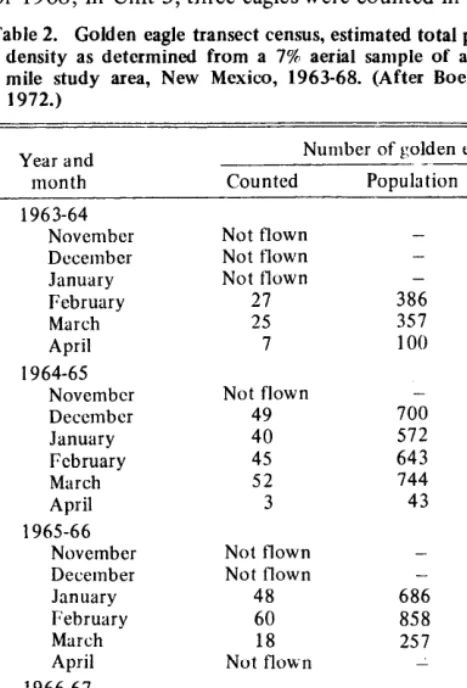
Table 2. Golden eagle transect census, estimated total population, and density as determined from a 7% aerial sample of a lO,OOO-square mile study area, New Mexico, 1963-68. (After Boeker and Bolen, 1972.)
Year and month
Number of golden eagles
Counted Population Density”
1963-64 November December January February March April 1964-65 November December January February March April 1965-66 November December January February March April 1966-67 November December January February March April 1967-68 November Decem her January February March April
Not flown -
Not flown -
Not flown -
27 386
25 357
7 100
-
4
41
Not flown - -
49 700 7
40 572 6
45 643 6
52 744 7
3 43 0.5
Not flown Not flown
48 60 18 Not flown
- - 686 858 257
Not flown Not flown
63 55 21 Not flown
- 90;’ 786 300 - 64 58 62 Not flown Not tlown Not flown
915 9
829 8
887 9
- -
- -
- -
aEagles per 100 square miles.
Month Trans-Pecos Edwards Plateaua
October - 2
November - 6
December 1 6
January 3 10
February 8 21
Marchb 23 34
April 39 17
May 23 3
June 3 trace
July trace trace
Total 100 100
- aThis region contained so few wintering eagles that censuses were discontinued (see Boeker and Bolen, 1972); the docking data for the Edwards Plateau are shown here to illustrate that lambing occurs
progressively later in the year as one moves westward into the Trans- Pecos region.
bMonth eagle migration begins.
12 JOURNAL OF RANGE MANAGEMENT 28(l), January 1975
1967, and two in February of 1968.
In summary, the census indicated-year after year -that too few eagles are present in either of the Edwards Plateau regions (Units 2 and 3) to substantiate claims of excessive eagle predation on lambs. Conversely, the number of birds in the Trans-Pecos (Unit 1) reached levels where damage to livestock
might conceivably become an economic problem (i.e., 3.5
eagles per 100 square miles).
In southeastern New Mexico, an aerial census of a 10,000 square mile study area including portions of Lincoln, Chaves,
Lea, Roosevelt, Curry, DeBaca, Guadalupe, and Torrance
counties revealed eagle populations significantly larger than those present in Texas (Table 2). The population on the New Mexico study area reached an estimated peak of 915 eagles, or 9 birds per 100 square miles during the 5 years of study.
In both Texas and New Mexico, much of the eagle
population wintering in these states begin their spring
departure in March. Accordingly, when the migration schedule
dates are compared with the lamb docking data for the
Trans-Pecos region of Texas (Table 3), it seems clear that a large proportion of lambs are born after the eagle population has departed. Docking dates for New Mexico are not available, yet it is well known that lambing takes place even later in New Mexico than in Texas, so that there is even less likelihood of
large numbers of winter eagles being present at the time
lambing takes place.
Bent (1937:315) gives the egg dates for golden eagles in the western United States as February 9 to May 18 (272 nests) and February 26 to March 24 (136 nests); for birds nesting in the arctic, the dates were May 27 to June 29 (5 nests). Arrival dates for golden eagles migrating to Alaska were listed as April 5, March 10, March 27, April 3, and April 8.
Table 4. Frequency of occurrence for transect segments with varying densities of golden eagles, New Mexico, 1966. (After Boeker and Bolen, 1972.)
Densitya class
0 4 8 12 16 20 24
January February March Total
Number of Number of Number of Number of
segments Percent segments Percent segments Percent segments Percent
7 25 6 21 19 68 32 38
7 25 5 18 4 14 16 19
8 29 3 10 3 10 14 17
3 10 9 32 1 4 13 15
0 - 4 14 0 - 4 5
2 7 0 - 1 4 3 4
1 4 1 4 0 - 2 2
Total 28 100 28 100 28 100 84 100
aF:agles per 100 square miles (O-S- low density; 12 = moderate; 16-24 : high).
The relatively large numbers of eagles wintering in New
Mexico enable some estimates to be developed for the density that eagles might reach locally (as if att ratted by a ready food supply, for example), This was done by converting the linear transect data into area units in the following way:
10,000 miles2 in study area = 357 miles2 per linear segment Sampled by transects of 28
segments each 50 miles long
If, for example, one eagle was seen in one of the segments, this represented an overall population estimate of 14 eagles for that linear segment (the transects sampled 7% of the area); hence, the density is:
357 miles2 = 25 miles2 per eagle or, 4 eagles per 100 miles2 14 eagles
When the population data are converted in this way, a
frequency distribution can be presented to show the
percentage of the transect segments with various eagle
densities (Table 4). As shown, the bulk of the transects lacked significant concentrations of eagles.
In January, 1966, when the total estimated eagle
population consisted of 686 birds, 50% of the entire New
Mexico study area fell into density classes of four eagles or fewer per 100 square miles, and high densities occurred only
on 11% of the segments. The estimated eagle population in
February, 1966, was even larger (858 birds, Table 2). This increase in total numbers, however, raised the high-density classes to 18% of the total, an increase of only 7%. Slightly less
than one-third (32%) of the segments contained a moderate
population density. By March, 1966, the wintering population was markedly less (257 eagles), and there were no sightings of eagles on nearly 70% of the segtnents. It seemed that after the population peaked in February, the eagles still in New Mexico did not often remain in dense pockets. At no time in 1966 did
more than 18% of the segments show high eagle
concentrations. Such information suggests that significant
eagle depredations, if occurring at all, are local phenomena. The census data thus bear three points. First, that wintering golden eagles in Texas are essentially absent from the major
lamb producing area encompassed by the Edwards Plateau.
Secondly, that where sizable eagle populations do exist in
Texas and New Mexico, they have often departed before or at
the time many lambs are born. Finally, even at maximum
population levels, irrespective of season, eagles are seldom
bunched in concentrations wherein predation leading to
significant economic losses might occur.
JOURNAL OF RANGE MANAGEMENT 28(l), January 1975
Eagle Foods
Exami;lation of eagle nests for the skeletal remains of their foodstuffs (prey as well as carrion) has been a traditional method of determining eagle food habits (cf. McGahan, 1967, 1968; Mollhagen et al., 1972). These and other studies have repeatedly determined that the mainstays of the golden eagle diet were lagomorphs and rodents. The results of one study, made from 41 nests in Texas and New Mexico, are shown in Table 5. Here it is shown that livestock remains were present in 70% of the nests, but only in minimal amounts (i.e., less than 2 lambs or kids per nest on the average).
It is important to emphasize that the nest collections
undoubtedly represent the accumulation of several years’
materials, so that the number of items taken peryear per nest were even less than shown. However, there is no way to differentiate the data further so that an annual estimate of the numbers of individuals in the diet can be determined.
Moreover, as golden eagles feed in part on carrion, the materials found in the nests may or may not represent outright
destruction of otherwise healthy prey. The regrettable and
illegal poisoning of eagles in Wyoming, discovered in 197 1, necessarily relied on the birds eating carrion baits.
As suggested earlier by the population analysis, the food habits data again indicate that the matter of lamb predation is quite local in nature; 14 of the 66 sheep represented in the sample came from a single nest.
Finally, note that of the 41 nests examined by Mollhagen et
al. (1972), only one was currently active when the food
materials were collected. Hence, with so few nesting eagles remaining in the Southwest, it seems rather unlikely that the nesting population renders meaningful damage to the livestock industry.
Table 5. Golden eagle food habits based on 6,981 items collected from 41 nests, Texas and New Mexico. (After MolLhagen et al., 1972.)
Nests with Animals in
Food food (%) diet (No.)
Jackrabbit 93 487
Cottontail 80 166
Rock squirrel 59 101
Sheep and goat 70 66”
Others (17 species) - 126
a1.6 individuals per nest average. although this undoubtedly represents many more than one year’s accumulation of food SO that the number
of lambs per nest per year is far less than this figure indicates. One nest contained 14 individuals, which indicates again the local nature of lambs in the eagle diet whether as carrion or prey.