Centrality Dependence of High-
p
THadron Suppression
in
Au
Au
Collisions at
p
s
NN130 GeV
C. Adler,11Z. Ahammed,23C. Allgower,12J. Amonett,14B. D. Anderson,14 M. Anderson,5G. S. Averichev,9 J. Balewski,12O. Barannikova,9,23L. S. Barnby,14J. Baudot,13S. Bekele,20V.V. Belaga,9R. Bellwied,31J. Berger,11
H. Bichsel,30A. Billmeier,31L. C. Bland,2C. O. Blyth,3B. E. Bonner,24A. Boucham,26A. Brandin,18A. Bravar,2 R.V. Cadman,1H. Caines,33M. Caldero´n de la Barca Sa´nchez,2A. Cardenas,23J. Carroll,15J. Castillo,26M. Castro,31
D. Cebra,5P. Chaloupka,20S. Chattopadhyay,31Y. Chen,6S. P. Chernenko,9M. Cherney,8A. Chikanian,33B. Choi,28 W. Christie,2J. P. Coffin,13T. M. Cormier,31J. G. Cramer,30H. J. Crawford,4W. S. Deng,2A. A. Derevschikov,22 L. Didenko,2T. Dietel,11J. E. Draper,5V. B. Dunin,9J. C. Dunlop,33V. Eckardt,16L. G. Efimov,9V. Emelianov,18 J. Engelage,4G. Eppley,24B. Erazmus,26P. Fachini,2V. Faine,2J. Faivre,13K. Filimonov,15E. Finch,33Y. Fisyak,2
D. Flierl,11K. J. Foley,2J. Fu,15,32C. A. Gagliardi,27N. Gagunashvili,9J. Gans,33L. Gaudichet,26M. Germain,13 F. Geurts,24V. Ghazikhanian,6O. Grachov,31V. Grigoriev,18M. Guedon,13E. Gushin,18T. J. Hallman,2D. Hardtke,15 J.W. Harris,33T.W. Henry,27S. Heppelmann,21T. Herston,23B. Hippolyte,13A. Hirsch,23E. Hjort,15G.W. Hoffmann,28
M. Horsley,33H. Z. Huang,6T. J. Humanic,20G. Igo,6A. Ishihara,28Yu. I. Ivanshin,10P. Jacobs,15W.W. Jacobs,12 M. Janik,29I. Johnson,15P. G. Jones,3E. G. Judd,4M. Kaneta,15M. Kaplan,7D. Keane,14J. Kiryluk,6A. Kisiel,29
J. Klay,15S. R. Klein,15A. Klyachko,12A. S. Konstantinov,22M. Kopytine,14L. Kotchenda,18A. D. Kovalenko,9 M. Kramer,19P. Kravtsov,18K. Krueger,1C. Kuhn,13A. I. Kulikov,9G. J. Kunde,33C. L. Kunz,7R. Kh. Kutuev,10 A. A. Kuznetsov,9L. Lakehal-Ayat,26M. A. C. Lamont,3J. M. Landgraf,2S. Lange,11C. P. Lansdell,28B. Lasiuk,33
F. Laue,2J. Lauret,2A. Lebedev,2R. Lednicky´,9V. M. Leontiev,22M. J. LeVine,2Q. Li,31S. J. Lindenbaum,19 M. A. Lisa,20F. Liu,32L. Liu,32Z. Liu,32Q. J. Liu,30T. Ljubicic,2W. J. Llope,24G. LoCurto,16H. Long,6R. S. Longacre,2 M. Lopez-Noriega,20W. A. Love,2T. Ludlam,2D. Lynn,2J. Ma,6R. Majka,33S. Margetis,14C. Markert,33L. Martin,26 J. Marx,15H. S. Matis,15Yu. A. Matulenko,22T. S. McShane,8F. Meissner,15Yu. Melnick,22A. Meschanin,22M. Messer,2
M. L. Miller,33Z. Milosevich,7N. G. Minaev,22J. Mitchell,24V. A. Moiseenko,10C. F. Moore,28V. Morozov,15 M. M. de Moura,31M. G. Munhoz,25J. M. Nelson,3P. Nevski,2V. A. Nikitin,10L.V. Nogach,22B. Norman,14 S. B. Nurushev,22G. Odyniec,15A. Ogawa,21V. Okorokov,18M. Oldenburg,16D. Olson,15G. Paic,20S. U. Pandey,31
Y. Panebratsev,9S. Y. Panitkin,2A. I. Pavlinov,31T. Pawlak,29V. Perevoztchikov,2W. Peryt,29V. A Petrov,10 M. Planinic,12J. Pluta,29N. Porile,23J. Porter,2A. M. Poskanzer,15E. Potrebenikova,9D. Prindle,30C. Pruneau,31 J. Putschke,16G. Rai,15G. Rakness,12O. Ravel,26R. L. Ray,28S.V. Razin,9,12D. Reichhold,8J. G. Reid,30G. Renault,26
F. Retiere,15A. Ridiger,18H. G. Ritter,15J. B. Roberts,24O.V. Rogachevski,9J. L. Romero,5A. Rose,31C. Roy,26 V. Rykov,31I. Sakrejda,15S. Salur,33J. Sandweiss,33A. C. Saulys,2I. Savin,10J. Schambach,28R. P. Scharenberg,23 N. Schmitz,16 L. S. Schroeder,15A. Schu¨ttauf,16K. Schweda,15J. Seger,8D. Seliverstov,18P. Seyboth,16E. Shahaliev,9
K. E. Shestermanov,22S. S. Shimanskii,9V. S. Shvetcov,10G. Skoro,9N. Smirnov,33R. Snellings,15P. Sorensen,6 J. Sowinski,12H. M. Spinka,1B. Srivastava,23E. J. Stephenson,12R. Stock,11A. Stolpovsky,31M. Strikhanov,18
B. Stringfellow,23C. Struck,11A. A. P. Suaide,31E. Sugarbaker,20C. Suire,2M. Sˇumbera,20B. Surrow,2 T. J. M. Symons,15A. Szanto de Toledo,25P. Szarwas,29A. Tai,6J. Takahashi,25A. H. Tang,14 J. H. Thomas,15 M. Thompson,3V. Tikhomirov,18M. Tokarev,9M. B. Tonjes,17T. A. Trainor,30S. Trentalange,6R. E. Tribble,27 V. Trofimov,18O. Tsai,6T. Ullrich,2D. G. Underwood,1G. Van Buren,2A. M. VanderMolen,17I. M. Vasilevski,10 A. N. Vasiliev,22S. E. Vigdor,12S. A. Voloshin,31F. Wang,23H. Ward,28J.W. Watson,14R. Wells,20G. D. Westfall,17 C. Whitten , Jr.,6H. Wieman,15R. Willson,20S.W. Wissink,12R. Witt,32J. Wood,6N. Xu,15Z. Xu,2A. E. Yakutin,22
E. Yamamoto,15J. Yang,6P. Yepes,24V. I. Yurevich,9Y.V. Zanevski,9I. Zborovsky´,9H. Zhang,33W. M. Zhang,14 R. Zoulkarneev,10and A. N. Zubarev9
(STAR Collaboration)
1Argonne National Laboratory, Argonne, Illinois 60439 2Brookhaven National Laboratory, Upton, New York 11973 3University of Birmingham, Birmingham, United Kingdom
8Creighton University, Omaha, Nebraska 68178 9Laboratory for High Energy (JINR), Dubna, Russia 10Particle Physics Laboratory (JINR), Dubna, Russia
11University of Frankfurt, Frankfurt, Germany 12Indiana University, Bloomington, Indiana 47408 13Institut de Recherches Subatomiques, Strasbourg, France
14Kent State University, Kent, Ohio 44242
15Lawrence Berkeley National Laboratory, Berkeley, California 16Max-Planck-Institut fu¨r Physik, Munich, Germany 17Michigan State University, East Lansing, Michigan 48824
18Moscow Engineering Physics Institute, Moscow Russia 19City College of New York, New York City, New York 10031
20The Ohio State University, Columbus, Ohio 43210
21Pennsylvania State University, University Park, Pennsylvania 16802 22Institute of High Energy Physics, Protvino, Russia
23Purdue University, West Lafayette, Indiana 47907 24Rice University, Houston, Texas 77251 25Universidade de Sao Paulo, Sao Paulo, Brazil
26SUBATECH, Nantes, France 27Texas A & M, College Station, Texas 77843
28University of Texas, Austin, Texas 78712 29Warsaw University of Technology, Warsaw, Poland 30University of Washington, Seattle, Washington 98195
31Wayne State University, Detroit, Michigan 48201 32Institute of Particle Physics, Wuhan, Hubei 430079 China
33Yale University, New Haven, Connecticut 06520
(Received 18 June 2002; published 28 October 2002)
Inclusive transverse momentum distributions of charged hadrons within0:2< pT<6:0 GeV=chave
been measured over a broad range of centrality forAuAu collisions at sNN p
130 GeV. Hadron yields are suppressed at highpT in central collisions relative to peripheral collisions and to a
nucleon-nucleon reference scaled for collision geometry. Peripheral collisions are not suppressed relative to the nucleon-nucleon reference. The suppression varies continuously at intermediate centralities. The results indicate significant nuclear medium effects on high-pT hadron production in heavy-ion collisions at
high energy.
DOI: 10.1103/PhysRevLett.89.202301 PACS numbers: 25.75.-q
QCD predicts a phase transition at high energy density from hadronic matter to a deconfined quark-gluon plasma [1]. This transition may be studied in the laboratory through the collision of heavy ions at ultrarelativistic energies. Partons propagating in a medium lose energy through gluon bremsstrahlung [2 – 4], with the magnitude of the energy loss predicted to depend strongly on the gluon density of the medium. Measurement of partonic energy loss therefore provides a unique probe of the density of the medium.
Analysis of deep inelastic scattering and Drell-Yan pair production using nuclear targets indicates that the energy loss in cold nuclear matter is 0:2–0:5 GeV=fm
for quarks with energy greater than 10 GeV [5,6]. Hard scattering of partons in nuclear collisions occurs early in the evolution of the extended system, thereby probing the phase of highest density. Energy loss softens the fragmentation of jets, leading to the suppression of high transverse momentum (high pT) hadrons in the final state [7]. The PHENIX Collaboration has reported the suppression of charged hadron and 0
pro-duction at high pT in central AuAu collisions at
center-of-mass energy per nucleon pair psNN
130 GeV, relative both to reference data from nucleon-nucleon (NN) collisions and to peripheralAuAu colli-sions [8]. The suppression is in qualitative agreement with predictions of partonic energy loss in dense matter, though quantitative conclusions require the understand-ing of other nuclear effects [8].
This Letter presents a measurement of the inclusive charged hadron yield hh=2 within 0:2< pT<
6:0 GeV=c, measured for a broad range of centrality in
AuAu collisions at psNN 130 GeV by the STAR Collaboration at the Relativistic Heavy Ion Collider (RHIC). Suppression of charged hadron production at high pT in central collisions is observed, in qualitative agreement with the PHENIX measurement [8]. The high precision and wide kinematic and centrality coverage of the data presented here permit a detailed study of nuclear medium effects on hadron production from the soft to the hard scattering regime.
RAApT
d2NAA=dp
Td
TAAd2NN=dpTd
; (1)
where TAA hNbini=NN
inel accounts for the collision
geometry, averaged over the event centrality class. hNbini, the equivalent number of binary NN collisions, is calculated using a Glauber model.RAApTis less than unity at lowpT [9]. In contrast, the yield for hard pro-cesses scales ashNbiniin the absence of nuclear medium
effects [RAApT 1], and effects of the medium may be measured at high pT by the deviation of RAApT from unity. In addition to final state energy loss,RAApTmay be affected by initial state multiple scattering [7,10] and transverse flow, both of which will enhance hadron pro-duction at high pT, and by the shadowing of nuclear parton distributions. At significantly lower ps than the present study, enhancement of hadron production at high pT has been observed in p-nucleus [11] and - [12] collisions, as well as central collisions of heavy nuclei [13]. Current estimates of shadowing effects at RHIC energies contain large uncertainties [7,14].
The STAR detector is described in [15]. Data collection utilized both a minimum bias trigger and a trigger select-ing the 10% most central events. Charged particle tracks were detected in the Time Projection Chamber (TPC), with momentum determined from their curvature in a 0.25 T magnetic field. After event selection cuts, the central data set contained 320 000 events, while the minimum bias data set contained 240 000 events. The measured minimum bias distribution, corrected for vertex finding efficiency at low multiplicity, corresponds to 94 2% of the AuAu geometric cross section AuAu
geom, assumed to be 7.2 b [16].
Centrality selection is based on the primary charged particle multiplicityNch within the pseudorapidity range jj<0:5. The most central bin is 0% –5% of AuAu
geom,
while the most peripheral bin is 60%–80%. Alternative centrality measures incorporate forward neutral energy [9,17] and its correlation with multiplicity at midrapidity. The maximum variation of thepT spectrum for different centrality measures is 4% for central events and less than 4% for more peripheral events. This variation is included in the systematic uncertainties of the reported spectra.
The analysis of inclusive charged particle spectra for pT<2 GeV=c has been described previously [9]. Ac-cepted tracks for pT >2 GeV=c have jj<0:5 and a
distance of closest approach to the primary vertex less than 1 cm to reject background. Acceptance, efficiency, and momentum resolution were determined by embed-ding simulated tracks into real raw data events. For pT >1:5 GeV=c, the Gaussian distribution of track curvature k/1=pT has a relative width of k=k
0:016pT=GeV=c0:012 for central events and k=k0:011pT=GeV=c0:013 for peripheral events. Correction was made for distortion due to finite momentum resolution.
The hadron yield decreases rapidly with increasing pT and its measurement is sensitive to small spatial dis-tortions, which generate charge sign-dependent system-atic errors in the measured track curvature. Measurement of the summed hadron yield, hh=2, is markedly less sensitive to such distortions than the yield of one charge sign alone. Each half of the cylindrical TPC is divided azimuthally into 12 sectors. High-pT tracks have small sagitta (s0:8 cmatpT 5 GeV=c) and are con-fined to a single sector. The sectorwise distribution of hh=2 has a pT-dependent rms variation of less than 5%, though with correlated variations for adja-cent sectors. These effects contribute to the systematic uncertainty.
The most significant background corrections are due to weak particle decays and antinucleon annihilation in detector material. The former are estimated based on,
, and K0s yields measured forpT<2:5 GeV=c[18,19], with extrapolation to higher pT using an exponential fit [18]. The latter are based on measured antiproton yields [20].
The major correction factors and their uncertainties are given in Table I. ‘‘Tracking’’ incorporates efficiency, acceptance, and the effects of the spatial nonuniformity of the TPC, with the latter dominating its systematic uncertainty. The total systematic uncertainty of the spec-tra is the quadrature sum of the uncertainties in Table I. For the highestpTbins it is27%for central events and 21%for peripheral events.
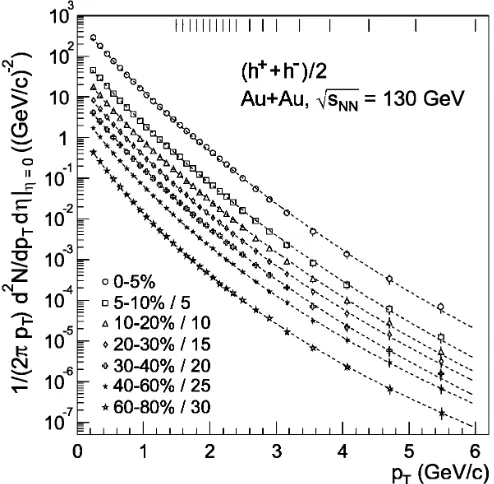
Figure 1 shows the inclusivepT distributions ofh h=2 within jj<0:5 for various centrality bins, for
AuAu collisions at sNN p
130 GeV. Error bars, which are dominated by systematic uncertainties at all pT, are generally smaller than the symbols. The spectra were fit by the pQCD-inspired power law function [21]
TABLE I. Typical multiplicative correction factors and systematic uncertainties, applied to the yields for peripheral and central collisions.
pT2 GeV=c pT5:5 GeV=c
Centrality 60%–80% 0% –5% 60% –80% 0% –5%
Tracking 1:16 0:08 1:59 0:16 1:14 0:23 1:49 0:30
Background 0:95 0:03 0:90 0:05 0:95 0:05 0:88 0:12
1 2 pT
dN dpT
C1pT=p0n; (2)
which describes pT spectra of charged hadrons for NN collisions over a wide range of ps [21–23]. Systematic changes in shape of the spectra with centrality are re-vealed by the fit parameters C, n, and mean transverse momentumhpTi 2p0=n3 in Table II. Also shown
in the Table are fit parameters for pp collisions at s
p
200 GeV[21]. Equation (2) yields a poor fit relative to the uncertainties of the data for the most central bin,
with systematic deviations from the fit function of 10% – 20%, whereas for more peripheral collisions it fits well, with parameters tending smoothly to those for pp collisions.
A more direct comparison of yields for different cen-tralities relies on estimatinghNbiniand the mean number
of participants hNparti for each centrality bin. For this
purpose, the distribution d=dNbin (and equivalently,
d=dNpart) was calculated using a Monte Carlo Glauber
model [17] with NN
inel41 1 mb and Woods-Saxon
nuclear matter density, using radius r6:5 0:1 fm
and surface diffusenessa0:535 0:027 fm[16]. Per-centile intervals of d=dNbin (calculated) andd=dNch
(measured) were equated to extract hNbini for each
cen-trality bin. The Glauber model parameters and geometric cross section were varied to estimate the systematic un-certainties. Results are given in Table II.
Because charged particle distributions at midrapidity are used for centrality selection, biases in the relation between d=dNbin and d=dNch due to fluctuations and
autocorrelations were assessed. Variation of parameters in a Monte Carlo calculation of multiplicity fluctuations for fixed collision geometry and comparison of the measured multiplicity distribution in an azimuthal quadrant cen-tered on a high-pT particle against those in the other quadrants both yielded negligible uncertainties in hNbini
andhNparti.
Table II shows the charged particle yield per partici-pant pair, 2
hNparti
dNch
d , obtained by integrating thepT spec-tra. The extrapolated yield inpT<0:2 GeV=cis20%of the total for all centralities. The dependence of 2
hNparti
dNch
d onhNparti is consistent with observations in [17].
Figure 2 shows the ratio of the central (0%–5%) spec-trum to that of the two peripheral bins (40% –60%, 60%– 80%), normalized byhNbini. The dashed lines at unity and
below show scaling with hNbini and hNparti, respectively,
and the shaded regions show the systematic uncertainties from Table II. The vertical error bars on the data points FIG. 1. Inclusive pT distributions of hh=2.
Non-central bins are scaled down by the indicated factors. The combined statistical and systematic errors are shown. Curves are fits to Eq. (2). Hash marks at the top indicate bin boundaries forpT>1:5 GeV=c.
TABLE II. Geometric quantities, charged particle density per participant pair, and fit parameters to Eq. (2), for various centrality bins and forppat 200 GeV [21], assumingNNinel41 mb. The fits to theAuAudata use uncorrelated measurement errors, which are largely systematic and non-Gaussian. Parameter errors shown also include correlated systematic uncertainties, which are added to parameter errors resulting from the fit.
Power law fit (0:2< pT<6:0 GeV=c)
Centrality hNbini hNparti
dNch
d
2 hNparti
dNch
d CGeV=c
2 hp
Ti GeV=c n
0% –5% 96567
67 350
4
4 563 39 3:22 0:23 797 60 0:520 0:010 21:9 0:5 5% –10% 76459
63 296
7
7 452 32 3:05 0:23 654 50 0:517 0:010 20:7 0:4 10% – 20% 55148
56 232
9
9 344 24 2:96 0:24 520 40 0:511 0:010 18:9 0:4 20% – 30% 34844
45 165 10
10 234 16 2:83 0:26 372 28 0:504 0:011 17:3 0:3 30% – 40% 21036
36 115 10
12 144 10 2:51 0:30 252 19 0:497 0:011 17:2 0:3 40% – 60% 902222 62
9
11 72:2 5:1 2:35 0:42 141 11 0:480 0:011 14:8 0:2 60% –80% 207
9 20
5
are the uncertainties of the central data, while the hori-zontal caps are the quadrature sum of the uncertainties of both data sets. Approximate participant scaling at low pT is seen. The ratio rises monotonically below pT
2 GeV=cand decreases at highpT. The ratio of central over most peripheral achieves a value atpT 5:5 GeV=c of0:27 0:12with additional uncertainty 0:12due to hNbini, establishing significant suppression of charged hadron production at highpT in central collisions.
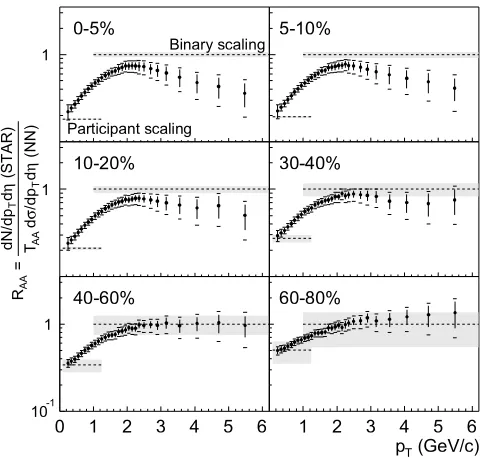
Figure 3 shows RAApT for various centrality bins relative to an NN reference spectrum, parametrized by Eq. (2) with CNN
inel 267
4
6 mb=GeV=c2, p0
1:900:17
0:09GeV=c, and n12:98
0:92
0:47 (the superscripts
and subscripts are curves that bound the systematic un-certainty). The reference was determined by fitting Eq. (2) to UA1 ppdata at ps200–900 GeV [21] and ex-trapolating to ps130 GeV. Extrapolation of the UA1 200 GeV spectrum to 130 GeV using pQCD calculations agrees to within 5% with the reference atpT 6 GeV=c [24,25]. Correction to the NN reference for the UA1 acceptance (jj<2:5), which differs from this analysis (jj<0:5), was based on two independent pQCD calcu-lations [24,26], giving a multiplicative correction of
1:17 0:06atpT 2:0 GeV=cand1:35 0:10atpT
5:5 GeV=c. The pT-dependent systematic uncertainty of theNNreference is the quadrature sum of the power law parameter and the acceptance correction uncertainties. Isospin effects are negligible for pT<6 GeV=c [25]. The error bars are the systematic uncertainties of the measured spectra, while the caps show their quadrature sum with the systematic uncertainty of theNNreference. RAApTincreases monotonically forpT<2 GeV=cat all centralities and saturates near unity for pT >
2 GeV=c in the most peripheral bins. In contrast, RAApT for the central bins reaches a maximum and then decreases strongly above pT 2 GeV=c, showing suppression of the charged hadron yield relative to the NNreference of0:36 0:16systatpT 5:5 GeV=cfor the 0% –5% bin, with additional uncertainty 0:03due to hNbini.RAApTvaries continuously as a function of cen-trality, and no centrality threshold for the onset of sup-pression is observed [27].
In summary, charged hadron production in high en-ergy collisions of heavy nuclei has been studied over a wide range ofpTand event centrality. At highpT, hadron yields scale with the number of binary collisions for peripheral collisions, while significant suppression of ha-dron production is seen for central collisions. This phe-nomenon indicates substantial energy loss of the final state partons or their hadronic fragments in the medium generated by high energy nuclear collisions, though quan-titative measurement of this effect requires additional reference data.
We thank the RHIC Operations Group and the RHIC Computing Facility at Brookhaven National Laboratory, and the National Energy Research Scientific Computing Center at Lawrence Berkeley National Laboratory for their support. This work was supported by the Division of Nuclear Physics and the Division of High Energy Physics of the Office of Science of the U.S. Department of Energy, the United States National Science Foundation, the Bundesministerium fu¨r Bildung und Forschung of Germany, the Institut National de la Physique Nucle´aire et de la Physique des Particules of France, the United Kingdom Engineering and Physical Sciences Research
η
σ
η
FIG. 3. RAApT for various centrality bins, for AuAu
relative to anNNreference spectrum. Error bars are described in the text. Errors between differentpT and centrality bins are
highly correlated.
〉
〈
〉
〈
Council, Fundac¸a˜o de Amparo a` Pesquisa do Estado de Sa˜o Paulo, Brazil, the Russian Ministry of Science and Technology, the Ministry of Education of China, and the National Science Foundation of China.
[1] J.W. Harris and B. Mu¨ller, Annu. Rev. Nucl. Part. Sci.46, 71 (1996).
[2] M. Gyulassy and M. Plu¨mer, Phys. Lett. B 243, 432 (1990).
[3] X. N. Wang and M. Gyulassy, Phys. Rev. D 44, 3501 (1991); Phys. Rev. Lett.68, 1480 (1992).
[4] M. Gyulassy and X. N. Wang, Nucl. Phys. B420, 583 (1994); R. Baier, D. Schiff, and B. G. Zakharov, Annu. Rev. Nucl. Part. Sci.50, 37 (2000).
[5] E. Wang and X. N. Wang, Phys. Rev. Lett. 89, 162301 (2002).
[6] F. Arleo, Phys. Lett. B532, 231 (2002). [7] X. N. Wang, Phys. Rev. C61, 064910 (2000). [8] K. Adcoxet al., Phys. Rev. Lett.88, 022301 (2002). [9] C. Adleret al., Phys. Rev. Lett.87, 112303 (2001). [10] G. Pappet al., Nucl. Phys.A698, 627c (2002). [11] D. Antreasyanet al., Phys. Rev. D19, 764 (1979).
[12] A. L. S. Angeliset al., Phys. Lett. B185, 213 (1987). [13] M. M. Aggarwal et al., Eur. Phys. J. C 23, 225
(2002).
[14] S. Li and X. N. Wang, Phys. Lett. B527, 85 (2002). [15] C. Adler et al., Nucl. Instrum. Methods Phys. Res.,
Sect. A, RHIC Special Volume (to be published). [16] A. J. Baltz et al., Nucl. Instrum. Methods Phys. Res.,
Sect. A417, 1 (1998).
[17] B. B. Back et al., Phys. Rev. C 65, 031901(R) (2002); K. Adcox et al., Phys. Rev. Lett. 86, 3500 (2001); I. G. Beardenet al., Phys. Lett. B523, 227 (2001).
[18] C. Adleret al., Phys. Rev. Lett.89, 092301 (2002). [19] C. Adleret al., nucl-ex/0206008.
[20] C. Adler et al., Phys. Rev. Lett. 87, 262302 (2001); K. Adcoxet al., Phys. Rev. Lett.88, 242301 (2002). [21] C. Albajaret al., Nucl. Phys.B335, 261 (1990). [22] B. Alperet al., Nucl. Phys.B100, 237 (1975). [23] F. Abeet al., Phys. Rev. Lett.61, 1819 (1988).
[24] T. Sjo¨strand et al., Comput. Phys. Commun. 135, 238 (2001).
[25] I. Vitev (private communication).
[26] F. Yuan (private communication); A. Polleri and F. Yuan, nucl-th/0108056.