RDAS: A Symmetric Key Scheme for Authenticated Query
Processing in Outsourced Databases
Lil Mar´ıa Rodr´ıguez-Henr´ıquez, Debrup Chakraborty
Departamento de Computaci´on, CINVESTAV-IPN
Av. Instituto Polit´ecnico Nacional No. 2508, Col. San Pedro Zacatenco, M´exico, D.F. 07300
email: [email protected], [email protected]
Abstract. In this paper we address the problem of authenticated query processing in outsourced databases. An authenticated query processing mechanism allows a client to verify the validity of the query responses that it gets from an un-trusted and remote server, who stores the client’s database on its behalf. We introduce a general framework called RDAS for the problem of authenticated query processing, and define the security goals for this task in line with concrete provable security. We propose several schemes which enable a client to verify both the completeness and correctness of the query responses of a server. All the schemes follow the proposed framework and are provably secure in terms of the proposed security definition. The novelty of the proposed schemes is that they use bitmap indexes as a main component for providing authentication. Bitmap indexes have recently seen lot of applications for accelerated query processing and many commercial databases implement such indexes. Bitmaps have not been previously used for a security goal. We show that the proposed schemes can match in both functionality and efficiency compared to the existing schemes. We also implement the schemes on a real database and provide extensive experimental studies on the schemes.1
1 Introduction
Cloud computing holds the promise of revolutionizing the manner in which enterprises manage, distribute, and share information. The data owner (client) can out-source almost all its infor-mation processing tasks to a “cloud”. The cloud can be seen as a collection of servers (we shall sometimes refer to it as the server) which caters the data storage, processing and maintenance needs of the client. Needless to say this new concept of computing has already brought significant savings in terms of costs for the data owner.
Among others, an important service provided by a cloud isDatabase as a Service (DAS). In this service the client delegates the duty of storage and maintenance of his/her data to a third party (an un-trusted server). This model has gained lot of popularity in the recent times. The DAS model allows the client to perform operations like create, modify and retrieve from databases in a remote location [9]. These operations are performed by the server on behalf of the client. However, delegating the duty of storage and maintenance of data to a third party brings in some new security challenges.
The two main security goals of cryptography are privacy and authentication. These security issues are relevant to the outsourced data also. The client who keeps the data with an untrusted server has two main concerns. The first one being that the data may be sensitive and the client may not want to reveal the data to the server and the second one is the data whose storage and maintenance has been delegated to the server would be used by the client. The typical usage of the data would be that the client should be able to query the database and the answers to
1 An abridged version of this work appears as:
the client’s queries would be provided by the server. It is natural for the client to be concerned about a malicious server who does not provide correct answers to the client queries. In this work we are interested in this problem. We aim to devise a scheme in which the client would be able to verify whether the server is responding correctly to its queries.
The problem of interest is of data authentication, and there are well known cryptographic solutions to the basic data authentication problem. In the symmetric key setting this has been addressed by the use of message authentication codes and in the asymmetric key setting signature schemes provide this functionality.
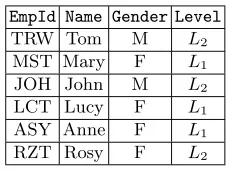
We are interested in the problem of authenticated query processing in the context of relational databases. We consider the scenario where a client delegates a relational database to an un-trusted server. When the client queries its outsourced data, it expects in return a set of records (query reply) satisfying the query’s predicates. As the server is not trusted, so it must be capable of proving the correctness of its responses. In other words, a malicious server may attempt to insert fake records into the database, modify existing records or simply skip some of them from the query response. Hence there must exist a mechanism, which can protect the client from such malicious server behavior. We describe the intricacies of the problem with the help of an example. Consider the relational database of employees data shown in Table 1.
EmpId Name Gender Level
TRW Tom M L2
MST Mary F L1
JOH John M L2
LCT Lucy F L1
ASY Anne F L1
RZT Rosy F L2
Table 1.RelationR1 (This relation would serve as a running example).
We consider that this relation has been delegated by a client to a server, and the client poses the following query
SELECT * FROM R1 WHERE Gender= ’M’ OR Level= ’L2’.
The correct response to this query is the set Res consisting of three tuples
Res={(TRW, Tom, M, L2),(JOH, John, M, L2),(RZT, Rosy, F, L2)}.
In answering the query the server can act maliciously in various ways. In the context of authen-tication, we are concerned with two properties of the response namely correctnessand complete-ness. Correctness and completeness denote two different malicious activities of the server, we explain these notions with an example below:
1. Incorrect result:The server responds with three tuples, but changes the tuple (TRW, Tom, M, L2),
with (TRW, Tom, F, L2). Moreover, it can be the case that the server responds with Res∪
{(BRW, Bob, M, L2)}, i.e., it responds with an extra tuple which is not a part of the original
relation.
It is to be noted that incomplete results are also incorrect, but we differentiate the two scenarios (as it has been previously done in the literature) by the fact that in an incorrect result the server inserts something which is not in the database, and in case of an incomplete answer the answer is correct but is not complete, in the sense that the server drops some valid tuples from the correct response. A client must be able to verify both correctness and completeness of a response.
The problem of correctness can be easily handled in the symmetric setting by adding a message authentication code to each tuple. A secure message authentication code is difficult to forge, and thus this property would not allow the server to add fake entries in its response. The completeness problem is more difficult and its solution is achieved through more involved schemes.
The problem of query completeness has been largely addressed by some interesting use of au-thenticated data structures. The basic idea involved is to store the information already present in the relation in a different form using some special data structures. This redundancy along with some special structural properties of the used data structures help in verifying completeness. A large part of the literature uses tree based authentication structures like the Merkeley hash tree [17] or its variants. Some notable works in this direction are reported in [17, 14, 5, 7, 18, 23, 25, 36]. These techniques involve using a special data structure along with some cryptographic authentication mechanism like hash functions and/or signatures schemes. The tree based struc-tures yield reasonable communication and verification costs. But, in general they require huge storage at server side, moreover the query completeness problem is largely addressed with re-spect to range queries and such queries may not be relevant in certain scenarios, say in case of databases with discrete attributes which do not have any natural metric relationship among them.
Signature schemes have also been used in a novel manner for solving the problem. One line of research has focussed on aggregated signatures [20–22, 26, 29]. Signature aggregation helps in reducing the communication cost to some extent and in some cases can function with constant extra communication overhead. A related line of research uses chain signatures. If one uses chain signatures as in [21], the use of specialized data structures may no longer be required.
Though there has been considerable amount of work on authenticated query processing on relational databases, but it has been acknowledged (for example in [37]) that the problem of query authentication largely remains open. An unified cryptographic treatment of the problem is missing in the literature. In most existing schemes cryptographic objects have been used in an ad-hoc manner, and the security guarantees that the existing schemes provide are not very clear. In this work we initiate a formal cryptographic study of the problem of query authentication in a distinct direction. We propose a new scheme which does not use any specialized data structure to address the completeness problem. Our solution involves usage of bitmap indices for this purpose. Bitmap indices have gained lot of popularity in the current days for their use in accelerated query processing [2, 32], and many commercially available databases like Oracle, IBM DB2, Sybase IQ now implement some form of bitmap index scheme in addition to the more traditional B-tree based schemes, thus it may be easy to incorporate a bitmap based scheme in a modern database without significant extra cost. To our knowledge, bitmaps have not been used till date for a security goal.
we believe that there exist scenarios where public verifiability may not be required, and in such scenarios it is better not to use the heavy machinery of public key signatures which uses computationally intensive number theoretic operations, whereas computational overheads of symmetric key message authentication schemes are minimal.
Extension of our scheme to dynamic scenarios may be possible, but in this current work we do not further deal with such possibilities, we plan to discuss the extension of our scheme to dynamic scenarios in a separate work. There exist many static transactional databases, say databases related to data warehousing applications, where efficient authenticated query processing may be required.
Next, we summarize the concrete contributions in this paper :
1. We define a generic scheme which we call as relational database authentication scheme (RDAS) which would provide the functionality of authenticated query processing. We care-fully define the security goals of RDAS in line with the tradition of concrete provable security. The security definition encompasses both correctness and completeness of a query response. Such a definition is new to the literature, and we hope that this definition would help to evaluate security of existing schemes.
2. We propose an RDAS calledRDAS1.RDAS1is designed using message authentication codes and bitmap indices in a novel manner. RDAS1is capable of authenticated query processing of simple select queries and select queries involving disjunctions of equality conditions. The extra overhead for usingRDAS1 both in terms of extra bandwidth and computation cost is not significant. We formally prove thatRDAS1 provides authentication in accordance to our security definition.
3. ThoughRDAS1is efficient and secure, a serious limitation of it is that it can only authenticate a restricted class of queries. We propose a provably secure modification calledRDAS2which is capable of authenticating a large class of queries but it has more storage and communication overhead than RDAS1. Unlike in RDAS1, in RDAS2 one needs to explicitly store bitmap indexes and also send some bitmap indexes along with the query responses. This leads to increased storage and communication costs. We discuss methods to compress bitmaps, which can lead to significant savings in case of RDAS2.
4. We provide extensions of bothRDAS1andRDAS2using the functionality of aggregate MACs. We call these schemes as RDAS1-agg and RDAS2-agg. These schemes are more efficient in terms of communication costs compared to the basic schemes.
5. We provide extensive experimental results on all the schemes on a real database, and provide hard experimental data on various performance measures. Our experiments suggests that the RDAS framework can be a viable option for practical authenticated query processing.
2 Preliminaries and Notations
Relations. In what follows, by R(A) we would denote a relation over a set of attributes A. If A={a1, a2,· · ·an}, we shall sometimes writeR(a1, a2,· · ·, an) instead ofR(A). We will assume
that each attribute has a set of permitted values, i.e., the domain of the attribute. Given an attributea,Dom(a) would represent its domain. We are mainly concerned with attributes whose domains are finite, note that for a static database each attribute always has a finite domain. By cardinality of an attribute we shall mean the cardinality of the domain of the attribute. We will denote the cardinality of an attribute abyCard(a) =|Dom(a)|.
jth tuple of relation R(A) would be denoted by tR
j and for ai ∈A by tRj[ai] we shall denote the value of attribute ai in thejth tuple inR. ForB ⊆A,tRj [B] will denote the set of values of the attributes in B in the jth tuple. We shall sometimes omit the subscripts and superscripts from tR
j and denote the tuple by t if the concerned relation is clear from the context and the tuple number is irrelevant.
Binary strings: The set of all binary strings would be denoted by{0,1}∗, and the set of nbit strings by {0,1}n. ForX
1, X2 ∈ {0,1}∗, by X1||X2 we shall mean the concatenation of X1 and
X2; and |X1|will denote the length of X1 in bits. By padℓ(X) we will denote the operation of padding ℓ zeros to the end of X, i.e., padℓ(L) = L||0ℓ. Also, if |X| ≤ ℓ, by cpad
ℓ(X) we shall mean padℓ−|X|(X). By biti(X) we will denote theith bit ofX. Given x∈ {0,1}∗ the procedure parsen(x) will break x into constituent n bit strings, i.e, parsen(x) = (x1, x2, . . . , xm), where x=x1||x2||. . .||xm and |xi|=nfor 1≤i≤m−1 and |xm| ≤n, thus making m=⌈|x|n⌉. We shall always consider that the domains of all attributes in the relations are subsets of{0,1}∗, this convention would allow us to apply transformations and functions on the values of the tuples in a relation without describing explicit encoding schemes.
By Fqwe shall mean a finite field withq elements. For our purpose we shall be interested in the field F2n for some n.n bit strings can be represented by a polynomial which coefficients are in F2. For example, if A ∈ {0,1}n such that A =a0, a1,· · · , an−1 where each ai ∈ {0,1} then A can be represented by the polynomialA(x) =Pn−1
i=0 aixi. Thus the set of allnbit strings can be treated as the fieldF2n where the addition is defined as thexorof the strings and multiplication is defined as the multiplication of the two polynomials corresponding to the strings modulo a fixed ndegree irreducible polynomial τ(x).
Bitmaps:Consider a relationR(a1, . . . , am) withnTmany rows. Consider that for each attribute ai, Dom(ai) = {vi
1, vi2, . . . viλi}, thus Card(ai) = λi for 1 ≤ i ≤ m. We define the bitmap of an attributeai corresponding to its valuevji in the relation R asBitMapR(ai, vji) =X, whereX is a binary string, such that |X|=nTand for 1≤k≤nT,
bitk(X) =
1 if tR
k[ai] =vij 0 otherwise.
This would be more clear with an example. Consider the specific relation R1 on the attributes {EmpID,Name,Gender,Level}as shown in Table 1. Dom(Gender) ={M, F}and Dom(Level) = {L1, L2}.
From this relation we can compute the following bitmaps
BitMapR1(Gender,F) = 010111 BitMapR1(Gender,M) = 101000 BitMapR1(Level, L1) = 010110
BitMapR1(Level, L2) = 101001.
tag is τ bits, we see the tag generation scheme as a function MAC : K × M → {0,1}τ, where K and M are the key and message spaces respectively. In most cases we shall write MACK(x) instead of MAC(K, x).
An attack on a MAC scheme signifies forging a message-tag pair. The types of attacks which are important for MAC schemes can be formally described as an interaction of an adversary Aand the procedure MAC. A is given an oracle access to the MAC generation procedure MACK(.), instantiated with a randomly generated key K, which is unknown toA.A can query MACK(.) with messages of its choice, and for each query xit gets MACK(x) as a response. Let us assume thatA queries with the messagesx1, x2, . . . , xq and getsy1, . . . , yq as the responses. In the end, A produces a pair (˜x,y˜), such that ˜x /∈ {x1, x2, . . . , xq}. It is said that A had committed a
successful forgery if MACK(˜x) = ˜y. We define the advantage of the adversary A in forging the message authentication code MACas follows:
AdvauthMAC(A) = Pr[Aforges ]. (1)
The probability is taken over the random choice of the key K and the randomness of the adversary.
3 Relational Database Authentication Scheme (RDAS): Definitions and Basic Notions
A relational database authentication scheme (RDAS) consists of a tuple of algorithms (K,F, Φ, Ψ,V), which are described in details in the following paragraphs.
K is the key generation algorithmand it selects one (or more) keys from a pre-specified key space and outputs them.
F is called theauthentication transform, which takes in a set of relations Rand a set of keys and outputs another set of relations R′ along with some additional data (Ms, Mc). If the set of keys isK, we shall denote this operation as (R′, M
c, Ms)← FK(R). A client who wants to store the set of relations Rin an un-trusted server, transforms Rto R′ using the authentication transform F and a set of keys. The transform F produces some additional data other than the set of relationsR′, the additional data consists of two distinct partsMs and Mc. The set of relations R′ along with Ms are stored in the server and the keys and the dataMc are retained in the client. The key generation algorithm and the authentication transform are executed in the client side.
We callΦas thequery translator, it is a transformation which takes in a query for the rela-tions inRand converts it into a query for relations inR′. For ease of discussion we shall refer a query forRto be aR-query and a query forR′ to be aR′-query. Thus, given aR-queryq, Φ(q) would be aR′-query. Thus by use of the transformΦ, the client would be able to trans-late queries meant forRto queries which can be executed on the transformed relations inR′.
Ψ is theresponse procedure. To execute a queryq on R, the client converts the query to Φ(q) and sends it to the server. The server executes the functionΨ, which takes in the query Φ(q) and usesR′ and Ms. The output of Ψ isρ, which we call as the response of the server. The server returns its responseS to the client.
3.1 Correctness and security
If we fix the set of relationsR, then anR-queryqwhen executed inRwould have a fixed answer sayans(R,q). Our goal is to transformRto R′ using an RDAS in such a way that if the query Φ(q) is sent to the server, then the answeransshould be recoverable from the server responseρ through the procedure V, if the server follows the protocol correctly. On the other hand, if the server is malicious, i.e., it deviates from the protocol and sends a response ρ′ distinct from the correct response ρ then the procedure V should reject the response by outputting ⊥. In other words, if the answer to a R-query is ans, then after running the protocol, V will either produce ansor ⊥, it would not produce an answer ans′ distinct from ans.
In the security model, we allow the adversary to choose the primary set of relations R. Given this choice of R, we compute (R′, M
c, Ms) ← FK(R), for a randomly selected set of keys K which is unknown to the adversary. We giveR′ andMsto the adversary. The adversary chooses anR-queryq and the challenger provides the adversary withΦ(q), finally the adversary outputs a response ρ, and we say that the adversary issuccessfulif VK(ρ, q, Mc)∈ {⊥/ ,ans(R,q)}.
Definition 1. Let SuccA be the event that a specific adversary A is successful in the sense as
described above. We say that an RDAS is (ǫ, t)-secure if for any adversary A which runs for time at most t Pr[SuccA]≤ǫ.
Some immediate observations regarding this security definition are as follows:
1. Encompasses both correctness and completeness: An important thing to note is that the security definition covers both completeness and correctness, as RDAS is considered secure if the verification algorithm does not accept (except with some small probability) a wrong response.
2. Concrete security and adversarial resources: The definition follows the paradigm of concrete security, where we specify the running time and the probability of success of an adversary. An (ǫ, t)-secure RDAS is really secure wheretis “reasonable” andǫis “small”. As is common in the paradigm of “concrete security”, we do not precisely define “reasonable” and “small”. These are interpreted in the context.
4 RDAS1: A generic scheme for select queries involving arbitrary disjunctions
We discuss a basic scheme for a secure RDAS which works only if the queries made are single attribute select queries or select queries involving disjunctions of an arbitrary number of equality conditions. We call this scheme asRDAS1.RDAS1can be modified to handle certain other class of queries, but for the sake of simplicity we just concentrate on a scheme which works on disjunction queries. In the later sections we would discuss several extensions of RDAS1 which can handle other types of queries and provide additional functionalities.
We describe the scheme assuming that the set of initial relations Ris a singleton set consisting of a single relation R(B), where B = {b1, b2, . . . , b|B|} is the set of attributes, and consider
A={a1, . . . , am} ⊆B to be a set of attributes on which queries are allowed, we shall callAthe
we shall throughout consider the relation R1 as depicted in Table 1 as a concrete example, and for simplicity, for R1 we shall consider the set of allowed attributes to be{Gender,level}.
RDAS1.K: The key space for RDAS1 is the same as the key space of the associated message authentication code MAC. The key generation algorithm selects a key K uniformly at random from K.
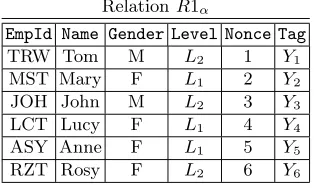
RDAS1.F: F produces two relations Rα and Rβ by the action of the key. The relation Rα is defined on the set of attributes B ∪ {Nonce,Tag}, i.e., Rα has two more attributes than in R. If R contains nTmany tuples then Rα also contain the same number of tuples. The procedure for populating the tuples of Rα is depicted in Figure 1. Basically, what this procedure does is compute a MAC for each row.
CreatingRα 1. forj= 1 tonT
2. for i= 1 to|B| 3. tRα
j [bi]←t R j[bi]; 4. end for
5. tRα
j [Nonce]←j; 6. H ←tR
j[b1]||. . .||tRj[bm]||j; 7. tRα
j [Tag]←MACK(H); 8. end for
CreatingRβ 1. forj= 1 toN
2. tRβ
j [Name]← L
1
j; 3. tRβ
j [SearchKey]← L
2
j; 4. tRβ
j [RowNo]←nT+j; 5. L← L1
j||L2j||BitMapR(Lj1,L2j)||(nT+j); 6. tRβ
j [Tag1]←MACK(L); 7. end for
Fig. 1.CreatingRαandRβ
The relation Rβ contains the attributes{Name,SearchKey,RowNo,Tag1}, irrespective of the at-tributes in relation R. Where Dom(Name) = {a1, . . . , am}, i.e., the allowed attributes in R.
And, Dom(SearchKey) =Dom(a1)∪Dom(a1)∪ · · · ∪Dom(am). LetΩ=∪mi=1({ai} ×Dom(ai)), note that the elements of Ω are ordered pairs of the form (x, y) where x ∈ Dom(Name) and y ∈Dom(SearchKey), and|Ω|=Pm
i=1Card(ai) =N. LetL be a list of the elements in Ωin an
arbitrary order. If (x, y) be the i-th element in L, then we shall denote x and y by L1
i and L2i respectively, where 1≤i≤N . The way the relation Rβ is populated is also shown in Figure 1. This procedure allows the client to store all possible pairsL1
i,L2i along with theMACcalculated over this pair concatenated with the respective bitmap and RowNo. Note that the bitmap is not explicitly stored in the relation Rβ. The transform F is executed in the client side, and the resulting relations Rα and Rβ are stored in the server.
RelationR1α
EmpId Name Gender Level Nonce Tag
TRW Tom M L2 1 Y1
MST Mary F L1 2 Y2
JOH John M L2 3 Y3
LCT Lucy F L1 4 Y4
ASY Anne F L1 5 Y5
RZT Rosy F L2 6 Y6
RelationR1β
Name SearchKey RowNo Tag1
Gender F 7 Y′
7
Gender M 8 Y8′
Level L1 9 Y9′
Level L2 10 Y10′
Table 2.RelationsR1αandR1β
The relation R1β contains the attributes {Name,SearchKey,RowNo,Tag1}, where in this case, Dom(Name) = {Gender,Level}, Dom(SearchKey) = {M, F} ∪ {L1, L2}. The tuples in R1β are
populated according to the procedure as shown in Figure 1(b), and the specific relation R1β is shown in Table 2.
RDAS1.Φ: The transform Φ, transforms a query meant for the original relation R to a set of queries which are meant to be executed on the relations Rα and Rβ which are stored in the server side.RDAS1can authenticate only certain types of queries, the allowed queries forRDAS1 are of the following form:
Q: SELECT * FROM R WHERE a1 =v1 OR a2 =v2 OR ... OR al=vl
The allowed set of queries are thus select queries on arbitrary numbers of disjunctions on different or repeated attributes2, which includes select queries on a single attribute of the form SELECT * FROM R WHERE ai =v. Given as input a valid query q,Φ(q) outputs two queries one for the relation Rα (which we call qα) and the other for Rβ (which we call qβ). For the specific query Q, Φ(Q) will output the following queries:
Qα: SELECT * FROM Rα WHERE a1 =v1 OR a2 =v2 OR ... OR al=vl
Qβ: SELECT * FROM Rβ WHERE (Name = a1 AND SearchKey = v2) OR ... OR ( Name =
al AND SearchKey =vl)
Going back to the concrete example, consider the following query Q1 on the relationR1
Q1: SELECT * FROM R1 WHERE Gender = ’M’ OR Level= ’L2’
After applying the transformation Φ(Q1) , the output queries Q1α and Q1β would be the fol-lowing:
Q1α: SELECT * FROM R1α WHERE Gender= ’M’ OR Level= ’L2’
Q1β: SELECT * FROM R1β WHERE (N ame= ’Gender’ AND Searchkey =’M’) OR (N ame= ’Level’
AND Searchkey =’L2’)
The reason for the specific structure of theqβ queries would be clear from the description of the verification process and the associated example.
RDAS1.Ψ: As discussed,Ψ is the transform executed in the server to generate the response for a set of queries produced byΦ. InRDAS1the response of the server is constructed just by running the queries specified by Φ on Rα and Rβ. We denote the response by S = (Sα, Sβ) where Sα
and Sβ corresponds to responses of qα and qβ respectively. Thus, for the example, the server executes the queries Q1α and Q1β on R1α and R1β respectively and thus returns the response S1 = (S1α, S1β) which is shown in Table 3.
RelationS1α
EmpId Name Gender Level Nonce Tag
TRW Tom M L2 1 Y1
JOH John M L2 3 Y3
RZT Rosy F L2 6 Y6
RelationS1β
Name SearchKey RowNo Tag1
Gender M 8 Y8′
Level L2 10 Y10′
Table 3.Left side: AnswerS1α, Right side: AnswerS1β
RDAS1.V: The verification procedure receives as input the responseS= (Sα, Sβ) from the server, the original query and the keys. The response of the server consists of two parts. We denote these two parts as two setsSα andSβ which are responses to the queriesqα andqβ respectively. Thus,Sα andSβ contains tuples from the relationsRα and Rβ respectively.
The transformed queries qα and qβ are also disjunctions of conditions, for aqα query the condi-tions are of the form ai =vi, whereai is an attribute and vi its value, and for a qβ query the conditions are of the form Name=v AND SearchKey=w. Thus, for the description below, we consider thatC1α OR C2α OR. . . Clα is aαquery where eachCiα is an equality condition andC1β
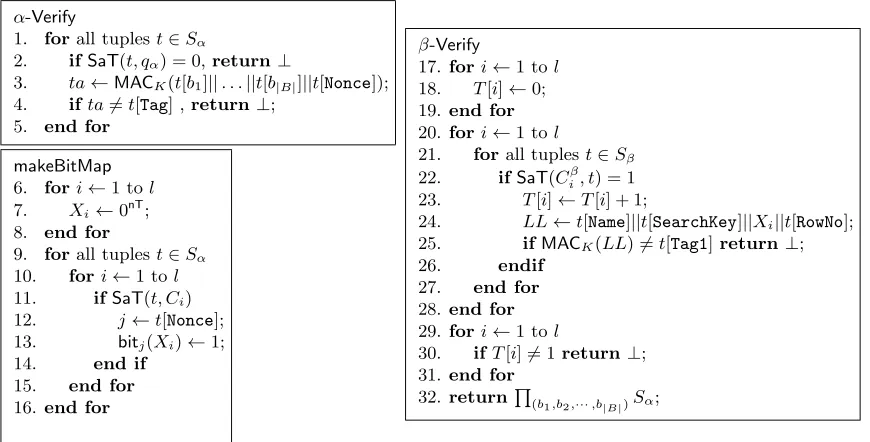
OR C2β OR . . . Clβ is aβ query where each Ciβ is a conjunction of two equality conditions. Note that the number of conditions in qα and qβ would always be the same. Let SaT be a predicate which takes as input a tuple tand a conditionC (which can also be a queryq) and outputs a 1 if the tuple t satisfies the conditionC, otherwise outputs a zero. With these notations defined, we are ready to describe the verification algorithm. The verification algorithm consists of three procedures. We name the procedures as α-Verify,makeBitMapand β-Verify. The procedures are shown in Figure 2, and they are applied sequentially in the same order as stated above.
α-Verify
1. forall tuplest∈Sα
2. if SaT(t, qα) = 0,return⊥
3. ta←MACK(t[b1]||. . .||t[b|B|]||t[Nonce]); 4. if ta6=t[Tag] ,return⊥;
5. end for
makeBitMap
6. fori←1 tol
7. Xi←0nT; 8. end for
9. forall tuplest∈Sα 10. for i←1 tol
11. ifSaT(t, Ci) 12. j←t[Nonce]; 13. bitj(Xi)←1; 14. end if
15. end for
16.end for
β-Verify
17.fori←1 tol
18. T[i]←0; 19.end for
20.fori←1 tol
21. forall tuplest∈Sβ 22. ifSaT(Ciβ, t) = 1 23. T[i]←T[i] + 1;
24. LL←t[Name]||t[SearchKey]||Xi||t[RowNo]; 25. ifMACK(LL)6=t[Tag1]return⊥; 26. endif
27. end for
28.end for
29.fori←1 tol
30. ifT[i]6= 1return⊥; 31.end for
32.returnQ(b
1,b2,···,b|B|)Sα;
Fig. 2.The procedures involved in the verification process: we assume that the verification procedure has as input the queriesqα=C1α OR C2α OR. . . Clα,qβ=C1β OR C
β
2 OR. . . C
β
The verification procedure checks for both the correctness and the completeness of the server response against the original queryq. Note that the server response consists of two distinct parts Sα and Sβ, the Sα part corresponds to the real result of the original query q and the Sβ part assists the verification process to verify the completeness of the result in Sα. In the part α -Verify, the verification procedure checks for the correctness of the tuples returned by the server. As in the transformed relation Rα a message authentication code is associated with each tuple of the original relation, hence the α-Verifypart of the verification procedure checks whether the contents of the tuples in Sα are not modified. If any of the the tuples in Sα are modified then the computed message authentication code on the tuple will not match the attribute Tag. If the computed value of tag does not match with the attributeTagfor any tuple then the verification process rejects by returning⊥. Moreover in line 2 it checks whether each tuple inSαdoes satisfy the specified query. If the verification process does not terminate in the α-Verify phase then it means that the tuples in Sα are all valid tuples of the relation Rα and they all satisfy the specified query qα. The other two parts of the verification process checks the completeness of the response.
Corresponding to each condition Name=v ANDSearchKey=win the query qβ the procedure makeBitMapconstructs the corresponding bitmap BitMapRα(v, w) using the server responseSα. Note that if the server response Sα is correct then makeBitMap would be able to construct the bitmaps corresponding to each condition inqβ correctly. This is possible due to the specific type of the allowed queries. Recall that an allowed query is formed only by the disjunctions of equality conditions. In the procedure corresponding to the l conditions in qβ,l bitmaps are constructed which are named X1, . . . , Xl (See the example later for more explanation).
In the procedure β-Verifythe response Sβ is verified using the bitmaps X1, . . . , Xl constructed before. The procedure β-Verify first verifies whether Sβ contains tuples corresponding to each condition inqβ, this is done using the counterT[i], whereiruns over the conditions inqβ. Notice, that for every condition Ciβ the server must return only one tuple inSβ. The other parts of the procedure involves in verifying the tags of the tuples against the tag’s of the computed bitmaps. To make the exposition clearer let us consider the same example we have so far considered, i.e., the relation R1 the queries Q1α,Q1β and the corresponding server responses of S1α and S1β (which are shown in Table 3). Given these responses the procedure α-Verify will not terminate, as all the tuples in S1αdo satisfy the conditions in Q1α and as they are correct responses in the sense that they are just copies of the tuples present in the relation Rα, hence the corresponding message authentication codes will match. Given the responses in S1α, one can compute the bitmaps BitMapRα(Gender, M) and BitMapRα(Level, L2). To see this, see the response S1α in
Table 3, where it says that the tuples satisfying the condition Gender=M OR Level=L2 are
the tuples with the nonce values 1, 3 and 6. Now, as the verification procedure has as input the whole of response S1α, hence it can predict correctly that the rows with the nonce value 1 and 3 satisfies the condition Gender=M and all the tuples in S1α (i.e., with nonce values 1, 3, 6) satisfies the condition Level=L2. Thus, knowing that the total number of tuples in Rα to be 6, and assuming that server response is complete then the bitmap can be computed as BitMapRα(Gender, M) = 101000. Note that the 1st and 3rd bits of this bitmap are only one, as it corresponds to the response in S1α. Similarly one can computeBitMapRα(Level, L2) = 101001.
This is precisely what the procedure makeBitMaps would do for the example that we consider. The computation of the individual bitmapsBitMapRα(Gender, M) andBitMapRα(Level, L2) are
Once these bitmaps are computed by using the procedureβ-Verifyone can verify the correctness of the responseS1β. As one can concatenate corresponding the bitmaps computed by the proce-dure makeBitMaps with the other attributes of the tuples in Sβ and compute the tag using the message authentication code and thus verify if the computed tag matches the attribute Tag1. The procedure β-Verifybasically verifies the correctness of the response Sβ, this verification is done by using the bitmaps constructed using the response Sα. The correctness of the response Sβ implies the completeness of the response Sα. We discuss about this more in the following section.
4.1 Security of RDAS1
In this section we show that the security of RDAS1 can be reduced to the security of MAC. In other words, if there exists an adversary capable of breakingRDAS1then theMACis not secure. We can distinguish two possibilities for breaking RDAS: infringe the correctness or violate the completeness of the response for a fixed query. To break the correctness the opponent must make changes in one or more tuples ofSα and still pass the verification process. This implies that the adversary must forge the respective MACs. On the other hand, to violate the completeness, the adversary must change the respective bitmaps in Sβ which also implies forging the respective MACs. Now, we introduce this notion in a formal way.
Theorem 1. Consider an adversary A attacking RDAS1 in the sense of definition 1. Let A
choose a relation R with nT tuples and the relation be such that the transformed relation Rβ
contains n′ tuples. Then there exists an adversary B attacking the message authentication code
MAC such that
Pr[SuccA]≤AdvauthMAC(B).
Also,Basks at mostnT+n′ queries to its oracle and runs for timetA+(nT+n′)(c+tMAC), where
tA is the running time of A, tMAC is the time for one MAC computation and c is a constant.
Proof. The idea of the proof is to construct an adversary Bwhose task is to forge the message authentication codeMAC.Bwill use the adversaryAby acting as its challenger. The interaction between Band A is represented in the procedure below:
AdversaryBMACK(.)
1. Receive the relationR from A; 2. Send (Rα, Rβ)←RDAS1.F(R) to A;
(Use the oracle MACK(.) to construct (Rα, Rβ); Let Qbe the set of queries asked toMACK(.)) 3. Receive a queryq from A;
4. Send (qα, qβ)←RDAS1.Φ(q) toA 5. Receive a responseρ′ fromA
6. if RDAS1.V(ρ′)6=⊥AND RDAS1.V(ρ′)6=ans(R,q); 7. (x,tag)← GenerateForgery();
8. else x← {0$ ,1}∗−Q,tag← {0$ ,1}τ; 9. return x,tag
Claim. If the condition of line 6 is satisfied, then B forges the MAC with probability 1.
If the above claim is valid then we have
Pr[B forges] = Pr[Bforges|SuccA] Pr[SuccA] + Pr[Bforges|SuccA] Pr[SuccA] (2)
= Pr[SuccA] + 1
2τ Pr[SuccA] (3)
≥Pr[SuccA],
as desired. Eq. (3) follows from (2) as according to our claim Pr[Bforges|SuccA] = 1 and Pr[B forges|[SuccA] = 21τ as the probability that the τ bit tag of a message matches with a randomτ bit string is 21τ.
Proof of Claim:Here we will basically describe the procedureGenerateForgery(). Note that the response ρ′ of A consists of (S′
α, Sβ′) and as the verification procedure does not output ⊥ hence the following must be true:
1. The tuples inS′
αandSβ′ satisfies the conditions in the queriesqαandqβrespectively, moreover there is only one tuple returned inSβ corresponding to each condition inqβ (see procedures α-Verify and β-Verify in Figure 2).
2. All the tuples inSα′ and Sβ′ are associated with their valid tags.
Moreover the condition in line 6 says that response produced by V is not correct. This can happen in the following two scenarios.
Case 1:There is a tupletup∈S′α such thattup is not in Rα. Moreover, if{b1, . . . , b|B|} be the original set of attributes, and X =tup[b1]||. . .||tup[b|B|]||tup[Nonce], then (X,tup[Tag]) is a valid message tag pair. Note, that this case signifies that the server response is incorrect. Case 2: There is notup ∈ S′
α which is not present in Rα. This case can only occur if the response is incomplete. This signifies thatA has been able to forge a tag inRβ. To see this, note that the procedureV constructs the bitmaps corresponding to the conditions in theqβ query based on the information in Sα. If the result returned in Sα is incomplete then the bitmap corresponding to some condition would be wrongly computed by V, but this wrong bitmap corresponds to the tag returned in Sβ′.
In both the above cases B can construct a forgery for the MAC in the following way:
GenerateForgery() for Case I:(X,tup[Tag]) is a valid forgery, as according to the condi-tion in line 6,tup[Tag]) is a valid tag forX, moreover astupis not inRα henceBhas never asked its oracle a query ofX.
4.2 Costs and Overheads
Storage cost:Given a relationR(B) withnTtuples, letsize(ti[b]) denote the size of the attribute b in the tuplet. Then the total size ofR (which we also denote by size(R)) would be given by
size(R) =
nT
X
i=1
X
b∈B
size(ti[b]).
If this relation R is converted into (Rα, Rβ) with the help of the authentication transform RDAS1.F, then we would have,
size(Rα) =size(R) +
nT
X
i=1
(size(ti[Nonce]) +size(ti[Tag])),
if we assume a tag of constant length of τ bits then we would have
size(Rα)≤size(R) +nT(lgnT+τ).
Again considering the set of allowed attributes ofRasA={a1, a2, . . . , am}, andN =Pmi=1Card(ai), we will have
size(Rβ) = N
X
i=1
(size(ti[Name]) +ti[SearchKey] +ti[RowNo] +size(ti[Tag1])).
If we consider sName and ssk the maximum size of the values of the attributes Name and SearchKey, then we would have
size(Rβ)≤N(sName+ssk+ lg(nT+N) +τ).
The total cost of storage at the server side would be size(Rα) +size(Rβ), and at the client side would be lg(nT) as in the client we need to store the number of tuples in the original relation. Communication Cost: Consider the query SELECT * FROM Rα WHERE a1 = v1 OR a2 = v2 OR ... OR al = vl, let the number of tuples satisfying the query be num. Let siz be the size of the response in a normal scenario without authentication. Then the maximum size of the server response in case of RDAS1 would be
sizRD1=siz+num×(lgnT+τ) +l×(sName+ssk+ lg(nT+N) +τ), (4)
where the first two terms corresponds to the Sαresponse and the remaining term counts for the Sβ response.
5 RDAS2: Selects Involving Arbitrary Boolean Connectives
RDAS1 can be modified to support SELECT queries involving all kinds of Boolean connectives at the cost of the size of the query responses. Recall that the query restriction for RDAS1arises from the problem of constructing the bitmaps of all the attributes involved in the query. We propose an extension of RDAS1 which can support queries of the form
Q:SELECT * FROM R WHERE (a1 =v1) ∆1 (a2 =v2) ∆2 ... ∆l−1 (al=vl),
1. The relationRβ produced byRDAS2.F would contain explicit bitmaps corresponding to the attributes and the values. Specifically, the attributes present inRβshould be{Name,SearchKey,
RowNo,bitmap,tag1}. Thus, for creating the relationRβ we need to add a linet Rβ
j [bitmap]← BitMapR(L1
j,L2j) after line 5 in the procedureCreatingRβ in Fig. 1.
2. The query translation procedure and the response procedure for RDAS2 remains same as that ofRDAS1.
3. The response procedure also remains the same, i.e., the server just answers the qα and qβ queries, but as theRβ relation now explicitly contains the bitmaps, hence the bitmaps would also be a part of the query.
4. For the verification procedure in RDAS2 it is not required to create the bitmaps any more, the client verifies the Sα response by the procedure α-Verify in Fig. 2, then it verifies the tags of the individual bitmaps returned in Sβ and finally computes the result bitmap using the returned bitmap and checks if the result bitmap matches with the result returned.
We now state the storage and communication costs forRDAS2following the notations in Section 4.2. The size of Rα in case of RDAS2would be the same as in RDAS1, the size of Rβ would be
size(Rβ)≤N(sName+ssk+ lg(nT+N) +τ+nT).
The size of a server response in case of RDAS2 would be
sizRD2=sizRD1+l×nT (5)
where sizRD1 is the size of the response ofRDAS1, as given in Eq. (4).
In case ofRDAS2, though we state that the bitmaps are to be explicitly stored in the relationRβ, but as most commercial databases uses bitmaps indices for accelerating query processing, hence this may not amount to extra storage in some systems. Moreover bitmaps can be compressed, there has been substantial work on suitable encoding of bitmaps such that their sizes can be reduced and the Boolean operations be applied on the compressed bitmaps [3, 4, 31, 34, 13]. Applying proper encoding of the bitmaps can drastically reduce both storage and communication costs, we elaborate on this in Section 7.
5.1 Security of RDAS2
In this section we show that as inRDAS1 the security ofRDAS2depends on the strenght of the MAC. Notice that the pairs m,tag in Sα, Sβ are the same that in RDAS1. The only difference is that inRDAS2, the complete message t[N ame]||t[SearchKey]||t[Bitmap]||t[RowN o] is stored inSβ. Thus, the security theorem for RDAS1apply to RDAS2 without any change.
Theorem 2. Consider an adversary A attacking RDAS2 in the sense of definition 1. Let A
choose a relation R with nT tuples and the relation be such that the transformed relation Rβ
contains n′ tuples. Then there exists an adversary B attacking the message authentication code
MAC such that
Pr[SuccA]≤Pr[B forges ].
Also,Basks at mostnT+n′ queries to its oracle and runs for timetA+(nT+n′)(c+tMAC), where
tA is the running time of A, tMAC is the time for one MAC computation and c is a constant.
6 Using Aggregated MACs
Deterministic message authentication codes can be suitably aggregated [10]. The main mo-tivation behind aggregated MACs is to provide authenticated communications in bandwidth constrained scenarios, say in case of a sensor network. In case of a sensor network various sensor nodes have their own secret key which they only share with the base station. Let us see an example of a sensor network consisting of k nodes labeledi1, . . . , ik. We assume a communica-tion protocol, where first the node i1 sends it authenticated data (mi1, ti1) ( consisting of the
message mi1 and the authentication tagti1, which is computed usingmi1 and the key ki1 of the
node) to the next node i2. Node i2 aggregates its own authenticated message (mi2, ti2) to the
received message and sends [(mi1, ti1),(mi2, ti2)] toi3. Thus, ultimately the base station receives
[(mi1, ti1), . . . ,(mik, tik)] from nodeik. As the base station owns the key of all the nodes, hence it can verify the authenticity of all the messages received. If we assume that the authentication tags are n bit long irrespective of the message lengths, then this communication protocol has an extra bandwidth overhead of O(k2n) bits. In case of sensor networks the data send by them are generally very short, say a temperature reading etc, thus the size of the data may be much smaller than the size of the authentication tag (if one uses a secure MAC to generate the tag, then n would be around 128 bits). Thus a O(k2n) bit extra bandwidth overhead may not be tolerated in a standard scenario. Aggregated MAC comes as a solution to this problem, if the MAC used for generating the authenticated tag is ”aggregate-able”, then nodei1 sends (mi1, ti1)
toi2,i2 sends [(mi1, mi2), ti1⊕ti2)] etc. And finally, nodeik sends [(mi1, . . . , mik);ti1⊕. . .⊕tik)] to the base station. This protocol only requires an extra bandwidth overhead of O(kn).
This aggregation of tags leads to a savings in the communication cost in bothRDAS1andRDAS2. Following the notation of Section 4.2, the size of server response for RDAS1-aggandRDAS2-agg would be
sizRD1-agg=sizRD1−τ(num+l) (6) sizRD2-agg=sizRD2−τ(num+l). (7)
6.1 Security of RDAS1-agg and RDAS2-agg
For discussion of security, first we try to formalize the security definition of the aggregated MACs. Firstly, given a MAC MAC:K × M → {0,1}τ we define the corresponding aggregated MAC MAC∗ in the single user setting as follows. The MAC generation algorithm given as input m ∈ M and a key K ∈ K outputs MACK(m). The aggregation algorithm when given two sets of messages M1, M2 ⊂ Mand two corresponding tags tag1,tag2 ∈ {0,1}τ outputs tag1⊕tag2.
The verification algorithm when given a key K ∈ K, a set of messages M ⊂ M and a tag tag∈ {0,1}τ computes
t= M
m∈M
MACK(m),
and accepts iftag=tand rejects otherwise.
An adversary A attacking MAC∗ is given oracle access to MACK(), i.e., it can know the tags corresponding to the messages of it’s choice. Let us consider that A asks q queries Q = {x1, . . . , xq} to its oracle and gets back the corresponding tags t1, . . . , tq. Finally A produces a set of messages Mf ⊂ M and a tag tagf.A is said to be successful in forging if there is at least one element m ∈Mf such that m /∈Q and the verification algorithm of MAC∗ on input (K, Mf,tagf) accepts. We define the forging advantage ofA as
Advauth-agMAC∗ (A) = Pr[Aforges].
IfMACK() is a secureMACthen so isMAC∗K(). The following theorem states this more formally.
Theorem 3. LetA be an arbitrary adversary attacking the aggregated MACMAC∗, andAruns for time T and makes q queries to its oracle. Then there exists an adversary B such that
AdvauthMAC−∗ag(A) =AdvauthMAC(B).
B in turn makes O(q) queries and runs for time O(T).
Proof. NoteBis attackingMACK, hence it hasMACKas its oracle.BrunsAas follows: whenever Aasks a querym,Breturns toA,MACK(m) through its oracle. LetQbe the set of queries made byA. Finally Aoutputs a forgery (Mf,tagf). IfAis successful in forging thenΓ =Mf\Q6=∅. Fix r∈Γ and compute
tall =
L
x∈Γ\{r}MACK(x), if Γ \ {r} 6=∅
0 otherwise.
Note that B can compute tall using its oracle. Finally, B outputs (r,tagf ⊕tall) as its forgery. It is easy to see that if A successfully forges then so does B, and the runing time of B and the
number of queries asked by B are as desired. ⊓⊔
Theorem 4. Consider an adversaryAattacking Υ ∈ {RDAS1-agg, RDAS2-agg} in the sense of definition 1. Let A choose a relation R with nTtuples and let Rβ contain n′ tuples. Then there
exists an adversary B such that
Pr[SuccA]≤AdvauthMAC(B).
Also,B asks at mostnT+n′ queries to its oracle and runs for timet
A+(nT+n′)(c+tMAC), where
tA is the running time of A, tMAC is the time for one MAC computation and c is a constant.
Proof. The proof is similar to proof of Theorem 1, with some small differences. We present the reduction in two steps. First we construct an adversary C which attacks the aggregated MAC MAC∗, and it runs the adversaryA, such that
Pr[SuccA]≤AdvauthMAC−∗ag(C). (8)
Then using Theorem 3, we have that there exists an adversary Bsuch that
AdvauthMAC−∗ag(B) =AdvauthMAC(C). (9) Thus, from equations (8) and (9) the Theorem follows.
To prove equation (9) we construct an adversary C which attacks the aggregate MAC MAC∗.C runs A(Aattacks Υ) as follows.
AdversaryCMACK(.)
1. Receive the relationR from A; 2. Send (Rα, Rβ)←Υ.F(R) to A;
(Use the oracle MACK(.) to construct (Rα, Rβ); Let Qbe the set of queries asked toMACK(.)) 3. Receive a queryq from A;
4. Send (qα, qβ)←Υ.Φ(q) toA 5. Receive a responseρ′ fromA
6. if Υ.V(ρ′)6=⊥AND Υ.V(ρ′)6=ans(R,q); 7. (x,tag)← AggregateForgery(); 8. else x← {0$ ,1}∗−Q,tag← {0$ ,1}τ; 9. return {x},tag
Description of C is almost the same as the description of adversary B as given in the proof of Theorem 1. As in the proof of Theorem 1, we claim that if the condition in line 6 is satisfied then C generates a forgery for MAC∗ with probability 1. We can see this by following the same line of arguments as in the proof of Theorem 1. We explain the procedure of AggregateForgery() briefly for Υ =RADS2-agg, the case of Υ =RADS1-agg is similar.
Let B ={b1, b2, . . . , b|B|} be the original set of attributes and let ρ′ = (Sα′, Sβ′),strα,strβ. Note that here S′
α, Sβ′ does not contain the attribute Tag and Tag1 respectively. If the condition in line 6 is satisfied then either of the two cases must be satisfied:
– Case I: There exists at least one tuple X inSα which does not correspond to any tuple in Rα. Construct a set Sα as
Sα ={t[b1]|| · · · ||t[b|B|]||t[Nonce] :t∈Sα′}.
– Case II: There exists at least one tuple X inSβ which does not correspond to any tuple in Rβ. Construct a setSβ as
Sβ ={t[Name]||t[SearchKey]||t[bitmap]||t[RowNumber] :t∈Sβ′}.
ThenSβ,strβ constitutes a valid forgery for MAC∗. ⊓⊔
7 Bitmap Compression
There had been a lot of work that has shown that bitmap based indexing works effectively in database applications. To further improve their effectiveness, compression schemes have been de-veloped, these schemes are capable of reducing the index size without increasing query processing time. The most frequent operations over bitmaps are bitwise logical operations [11], the specific compression schemes developed for bitmaps also allows logical operations to be performed on the compressed bitmaps.
RDAS2 and its variants require explicit storage of bitmaps and also the bitmaps need to be transmitted as the part of the query response, hence bitmap compression in this context can be very helpful. Our experiments that we present later also validates that using compressed bitmaps not only reduces storage and communication costs but also results in considerable savings in computation time.
Most of the compression schemes applied to bitmaps are based on run length encoding (RLE) scheme. Basic RLE works on the basis of the following simple idea. Consecutive occurrences of identical bits are detected in a bit string, such occurrences are known as a fill. Each fill in a bit string can be recorded with a counter representing its length and one bit indicating the actual value. This compression scheme is lossless and very efficient.
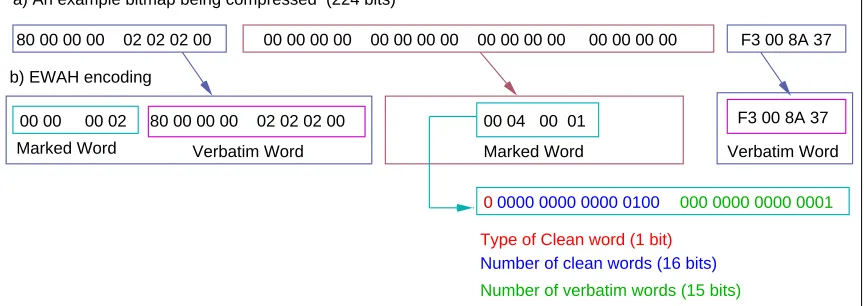
Several variants of RLE has been developed for application to bitmap compression. In our implementations we use a specific scheme called Enhanced Word Aligned Hybrid (EWAH). EWAH was studied independently by Wu et al. [11] and Lemire et al. [13]. We describe the basic scheme with an example.
EWAH divides the whole bit string X into 32 bit blocks and classify each block as either a
80 00 00 00 02 02 02 00 00 00 00 00 00 00 00 00 00 00 00 00 00 00 00 00 F3 00 8A 37 a) An example bitmap being compressed (224 bits)
b) EWAH encoding
00 00 00 02 80 00 00 00 02 02 02 00 Marked Word Verbatim Word
00 04 00 01 F3 00 8A 37
Marked Word Verbatim Word
00000 0000 0000 0100
Type of Clean word (1 bit) Number of clean words (16 bits) Number of verbatim words (15 bits)
000 0000 0000 0001
Fig. 3.EWAH compression example.
In our example the first word of the encoded string is a marked word (this is so, for all strings)
0x00 00 00 02, which means that the marked word is followed by no clean words but two dirty words. Next the following two dirty words are copied verbatim. Next the marked word
0x00040001occurs, which means that this marked word would be followed by four clean words each of zero which would be followed by one dirty word. At the end of this marked word the dirty word is written verbatim. This procedure can be easily generalized.
Also, it is not difficult to see that as the EWAH works with a granularity of 32 bits, hence bitwise operations can be easily performed on the compressed words and the compressed results can be directly obtained. In [13] one can find the algorithms to perform logical operations on RLE encoded bitmaps. These procedures can be easily extended for EWAH compression scheme.
7.1 RDAS2-cmp: RDAS2 with Compression
The changes required in RDAS2to incorporate bitmap compression are as follows:
1. The column Rβ[bitmap] in the relation Rβ would be populated by the EWAH compressed bitmaps. The MAC would also be computed using the compressed bitmaps.
2. The query translation procedure and the response procedure remains same as that ofRDAS2 (without compression).
3. The response procedure also remains the same, i.e., the server just answers the qα and qβ queries.
4. For the verification procedure inRDAS2 with compression it is not required to uncompress the bitmaps, the client verifies the Sα response by the procedureα-Verify in Fig. 2, then it verifies the tags of the individual compressed bitmaps returned in Sβ and finally computes the result bitmap using the returned compressed bitmaps, and checks if the result bitmap matches with the compressed bitmap obtained from the response.
The incorporation of compression in RDAS2 has no effect on the security but the storage and communication costs would decrease based on the amount of compression achieved.
The size of Rα in case of RDAS2 with compression would be the same as in RDAS1. Let sz cmp(tN[bitmap]) denote the size of the compressed bitmap for a given attribute and value pair, the size of Rβ would be
The size of a server response in case of RDAS2 would be
sizRD2=sizRD1+l×sz cmp(tl[bitmap]), (10)
where sizRD1 is the size of the response ofRDAS1, as given in Eq. (4).
Our experiments (presented later) clearly shows gains in both communication and computational cost if compression is used.
8 Further Extensions and Improvements
In this section we discuss several other ways in which the RDAS framework can be extended.
8.1 The case of empty replies
One limitation of RDAS1 and RDAS2is that if the server replies with an empty response in Sβ corresponding to a query then there is no way to verify the validity of the response. For example, in case of the relation R1, if a query
SELECT * FROM R1 WHERE Level = ’L3’
is posed, then response to this query would be empty, and there is no way to verify whether the response is correct. It is to be noted that a server may reply an RDAS2query which has a valid response with an empty response and in such a scenario also RDAS1 provides no mechanism to detect that the response is wrong.
If we assume knowledge of the client regarding the values of the attributes present in the relation then it would be easy for it to verify whether an empty response is the correct one. We discuss two simple ways by which RDAS1can be extended so that empty responses can be verified. The same steps are valid for RDAS2 also.
1. Recall that the authentication transform F returns two additional data items Mc and Ms, which are stored in the client and server sides respectively. InRDAS1,Mc=nTthe number of tuples in the original relation, andMsis empty. As a first solution, we suggest to augment Mc with a list of all values corresponding to each sensitive attribute in the relation. With this additional information, the client can easily verify whether an empty response is correct. This functionality comes with an additional storage cost in the client side. But if we assume that the domain of the attributes have small cardinality this storage would be much less compared to the size of the whole relation. Moreover, with this small change inRDAS1 the other efficiency and security claims remains unchanged.
2. As a second solution we propose to augment Ms with additional information. In particular, we suggest to build a list Lsta, which contains all distinct values of the attribute a which occurs in the original relation (encoded in an appropriate way). Corresponding to each such list we computelstTaga=MACK1(Lsta), and store (Lsta,lstTaga) for each sensitive attribute ainMs. Whenever the server returns an empty response corresponding to a query involving a set of attributes S, then the server includes in its response (Lsta,lstTaga) for alla∈S . It is easy to see that with this information the client can verify whether the empty response is the correct one.
8.2 Including other query types
Efficient range query processing:Range queries can be handled by RDAS2by posing a range query with several selects. But this may not be efficient. An efficient way to handle range queries would be to store range bitmaps [3, 4]. The type of bitmaps that we have used so far are called equality bitmaps, and they are good for select queries. Using range bitmaps one can encode range information of the attribute values and thus would be well suited for processing range queries. Adding other bitmap encodings in our system can be done in a straightforward way, and would increase the functionality at the cost of storage
Projection and aggregation queries:Projection and aggregation queries cannot be han-dled directly by our protocol. But, projections and aggregations can always be done in the client side if these functionalities are required. And this can also be added to the system, without hampering its security properties.
Join queries: We have not discussed the functionality of join processing for our schemes. But basic join processing (like equijoins) can again be obtained in a straightforward way by storing extra information. In particular, join bitmaps [24, 1] can be used for this purpose.
8.3 Multiuser settings
As we have stated earlier, as we use a symmetric key primitive as the main cryptographic object, thus our scheme is restricted to a single user setting, i.e., the data owner is the one who queries the database. We can replace the message authentication scheme with a public key signature scheme to extend the scheme for multiple queriers. We see no problem in doing this, but for a multiuser setting, the security definition that we give for RDAS would no more be valid, and one needs to extend this definition. Using signatures, the computational cost would in general be more than that in using MACs. The functionality of aggregation can also be used (as we used for MACs) to reduce communication costs.
8.4 Dynamic databases
We argued that there exist scenarios in which it may not be necessary to handle data updates, for instance, the case of data warehousing applications. Thus having a scheme which is valid only for static databases is useful. Most work in the literature on authenticated query processing focus on static databases. The proposals for dynamic scenario are quite few [14, 29, 37]. However, our proposal can be extended to dynamic scenarios also; this extension is not straightforward and we would report this separately soon.
9 Experimental Results
In this section we discuss the experimental results and compare the performance of RDAS1and RDAS2 in various scenarios.
9.1 The Basic Building Blocks
PMAC is a block cipher based MAC where the main operations involved are block cipher calls. The way we implement PolyMac is as follows. Let X1||X2||. . .||Xm = parsen(X), and let µ ∈ {0,1}n, we define
PolyMach,k(X, µ) = (X1h⊕X2h2⊕cpadn(Xm)hm⊕ |X|hm+1)⊕Ek(µ),
where X is the message and µ a non-repeating quantity associated with each message, Ek() is a block cipher and the additions and multiplications are in the field F2n. Such polynomial evaluation MACs are known to be secure when the quantity µis non-repeating. For our imple-mentations we taken= 128, and we consider the attributeNonceinRα andRowNoinRβ as the quantity µ. For PolyMac also we choose the block cipher as AES with 128 bit key.
One thing to notice is that PolyMac is not a deterministic MAC. It is a statefull MAC, the quantity µ is a state of the algorithm and repetition of µ completely breaks down its security. As we stated in Section 6.1 only deterministic MACs can be aggregated, thus, Theorem 3 for aggregated MACs does not hold for PolyMac. Thus PolyMac cannot be used in RDAS1-aggand RDAS2-agg.
For implementation of the block cipher in both MACs we use the new Intel dedicated instructions for AES. Finite field multiplications required for the PolyMac were implemented using the
PCLMULQDQinstruction, which can perform carry-less multiplication of two 64 bit strings. These 64 bit multiplications were combined using the Karatsuba technique to obtain multiplication of two 128 bit strings, the final reduction was performed using a technique described in [8].
9.2 Experimental Settings
All results were obtained by testing the implementations in a machine with the following specifi-cations:
– CPU:Four-core i5-2400 Intel processor (3.1GHz). – OS:Ubuntu 12.04.02 LTS.
– DataBase:PostgreSQL 9.1.9 – Compiler:gcc 4.7.3
We use Census-Income data set [6] to test performance of our schemes. This data contains weighted census data extracted from the 1994 and 1995 population surveys conducted by the U.S. Census Bureau. The number of instances in the data set is 199523. The data contains 42 demographic and employment related variables, the sum of the cardinalities of all the attributes is 103419, and the total size of the dataset is 99.1 MB.
As explained,RDAS1andRDAS2work in an environment where one needs to perform computa-tions in both the client and the server side. In our implementation all server-side computacomputa-tions are done in the PostgreSQL database using the PostgreSQL tools. We implemented the client in C, where ever possible we used the Intel SIMD instructions using Intel intrinsics. We designed the server side code in such a way such that all computations can be handled by the default Post-greSQL tools. This specific implementation choice makes our client much more powerful than the server, and also leaves space for a much more optimized implementation. Such an optimized implementation would require an implementation of all database engine functionalities, which we think is beyond the scope of this work. But, we would like to mention that this specific design choice also gives us the opportunity to see how good one can do by adding the authentication functionality to an already existing database system.
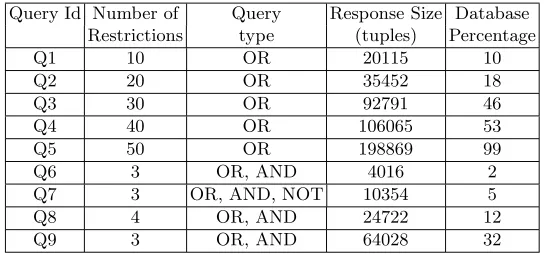
of the query response. The restrictions are all equality conditions aggregated by some Boolean operators. Query Q1-Q5 are disjunctions of equality conditions, whereas the rest of the queries have additional Boolean operators like AND and NOT. The last column shows the percentage of the response size in terms of the whole database size. Note that the number of restrictions corresponds to the number of tuples which would be included in a correct and complete Sβ response and the response size would be same as the number of tuples in the Sα result.
Query Id Number of Query Response Size Database Restrictions type (tuples) Percentage
Q1 10 OR 20115 10
Q2 20 OR 35452 18
Q3 30 OR 92791 46
Q4 40 OR 106065 53
Q5 50 OR 198869 99
Q6 3 OR, AND 4016 2
Q7 3 OR, AND, NOT 10354 5
Q8 4 OR, AND 24722 12
Q9 3 OR, AND 64028 32
Table 4.Summary of the different queries used for performance testing
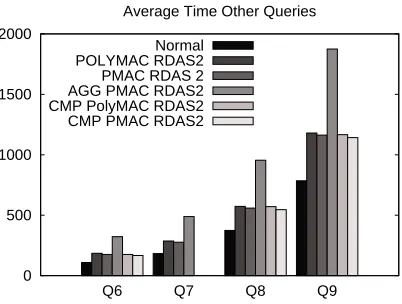
In Table 5 we summarize the queries that can be handled by our different proposed schemes. RDAS1and all its variants only can manage the queries Q1-Q5, because these are queries in which the Boolean connectives are disjunctions. On the other hand RDAS2 can handle all the queries Q1-Q9, because it is designed to work with queries involving all kinds of Boolean connectives.
RDAS1-agg and RDAS2-agg are implemented only using PMAC as PolyMac cannot be used as an aggregate MAC. As stated before, we implemented the aggregation at the server side with PostgreSQL XOR function and at the client side with the Intel SIMD instruction for xor, this of course has performance implications that we discuss later.
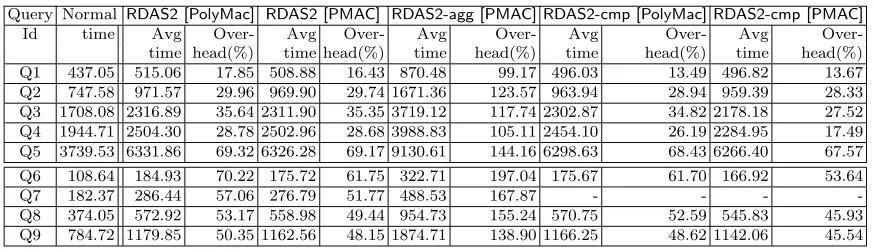
OnlyRDAS2is implemented with compression, we name the variant asRDAS2-cmp. As inRDAS1 explicit bitmaps are neither stored nor transmitted, hence the compressed bitmap version is not applicable in case ofRDAS1. For compressing the bitmaps and applying logic operations on them we used the Lemire library [12]. This library only implements OR, AND, XOR, operations over compressed bitmaps. This is the reason why report only results for queries Q1-Q9 except Q7 for RDAS2-cmp. Though using these basic operations as provided by the library one can implement other logic operations, but we have not done this, as we feel that for a proof of concept the query classes that we handle would be enough.
Scheme Queries
RDAS1 PolyMac Q1-Q5
RDAS1 PMAC Q1-Q5
RDAS1-agg Q1-Q5
RDAS2 PolyMac Q1-Q9
RDAS2 PMAC Q1-Q9
RDAS2-agg Q1-Q9
RDAS2-cmp PolyMacQ1-Q6 Q8-Q9
RDAS2-cmp PMAC Q1-Q6 Q8-Q9
9.3 Experimental results on RDAS1 and its Variants
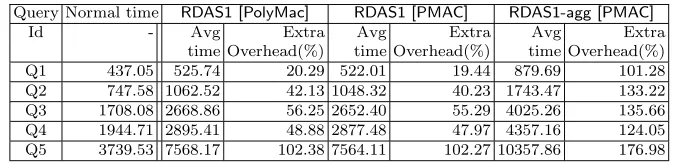
In Table 6 we report the time required for executing the set of queries (Q1,Q2,Q3,Q4,Q5). We report the normal time (i.e., the time for execution without any authentication) along with the times required for RDAS1 with both PolyMac and PMAC, and for RDAS1-agg. All reported times are in milliseconds and is the average of 250 executions of the same query. The reported time involves all steps in the authentication procedure, i.e., time for query translation, time required for the server to respond and the time for client side verification. In Table 6 we also report the extra overhead of each of our schemes over the normal scheme without authentication. The data presented in Table 6 is also presented pictorially in Figure 4.
Query Normal time RDAS1 [PolyMac] RDAS1 [PMAC] RDAS1-agg [PMAC] Id - Avg Extra Avg Extra Avg Extra
time Overhead(%) time Overhead(%) time Overhead(%) Q1 437.05 525.74 20.29 522.01 19.44 879.69 101.28 Q2 747.58 1062.52 42.13 1048.32 40.23 1743.47 133.22 Q3 1708.08 2668.86 56.25 2652.40 55.29 4025.26 135.66 Q4 1944.71 2895.41 48.88 2877.48 47.97 4357.16 124.05 Q5 3739.53 7568.17 102.38 7564.11 102.27 10357.86 176.98
Table 6.Execution times for OR queries with RDAS1.
0 2000 4000 6000 8000 10000 12000
Q1 Q2 Q3 Q4 Q5 Average Time OR Queries
Normal POLYMAC RDAS1 PMAC RDAS 1 AGG PMAC RDAS1
Fig. 4.RDAS1OR queries times (milliseconds).
The results of Table 6 show that in general PMAC is marginally faster than PolyMac. Even though the aggregated scheme is implemented with PMAC, the results shows that this scheme is very expensive, in general it takes a bit more than the double of the normal time (time to respond the query without authentication). This can be explained by the fact that in case of RDAS1-agg the server and the client need to calculate the aggregated tags, this is done by XORing all the involved tags. We will see in Table 7 that the time for responding the query increases significantly in RDAS1-aggcompared to RDAS1.
In Table 7 we present separately the following times:
1. Time required for query translation (the Φfunction).
Note that out of all the above procedures only the response procedure (Ψ) is executed in the server, and the other two procedures runs in the client. Table 7 clearly shows that the time required for query translation is negligible, the most of the time is spent in the server response and the verification procedures.
The server response procedure for RDAS1-aggis significantly more than that ofRDAS1. This is because that in case of RDAS1, the server needs to aggregate the MACs before sending them. Thus, the server needs to compute xors equal to the total number of tuples in Sα and Sβ. And this operations are not required to be performed by the server in case of RDAS1. As the server side is implemented using the PostgreSQL, these XORs are expensive. But the verification procedure in case of RDAS1-agg is marginally faster than in RDAS1. Note that the number of MAC computations in the verification process of both RDAS1 and RDAS1-agg are the same. But, in case of RDAS1 the verification process requires to compare each computed tag with the tag received. But in case of RDAS1-agg, individual tag verification is not required, here the computed tags are xor-ed and the final value is compared with the aggregated tag, which is received as a part of the query response. As stated, the verification process is implemented using SIMD instructions, hence the aggregation does not take as much time as individual comparison of the tags.
Query RDAS1 RDAS1-agg
Id φ ψ V[PolyMac]V[PMAC] φ ψ V[PMAC] Q1 .0127 442.78 83.26 77.86.0170 811.60 76.56 Q2 .0260 843.92 216.33 202.67.0339 11558.59 201.84 Q3 .0262 1806.30 862.74 844.75.0422 3209.64 827.17 Q4 .0262 1980.46 922.22 901.82.0382 3489.79 884.24 Q5 .0419 3983.31 3638.79 3560.35.0677 6868.57 3532.19
Table 7.Execution times for primitives with RDAS1-OR queries.
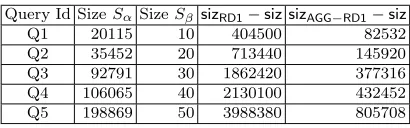
The communication overhead of RDAS1 and RDAS1-agg is discussed in Sections 4.2 and 6.1 respectively. Specifically Eq. (4) gives an upper bound on the response size for RDAS1and Eq. (6) gives the same for RDAS1-agg. In Table 8 we give the numerical values of the response size for the specific queries used in our implementation. In Table 8, columns 2 and 3 represents the size in tuples for Sα and Sβ respectively. The values in columns labeled sizRD1−siz and
sizAGG−RD1−siz represents the extra size of the response (in bytes) in case of RDAS1 and RDAS1-agg respectively. These were calculated using equations (4) and (6) respectively. For these calculations we assume the tag size to be 16 bytes, the size for the Nonce and RowNo as 4 bytes, and sName+ssk = 200 bytes. Table 8 clearly shows that RDAS1-agg has significantly
lower communication cost compared toRDAS1.
Query Id SizeSα SizeSβ sizRD1−siz sizAGG−RD1−siz
Q1 20115 10 404500 82532 Q2 35452 20 713440 145920 Q3 92791 30 1862420 377316 Q4 106065 40 2130100 432452 Q5 198869 50 3988380 805708