Multiparty Proximity Testing with Dishonest
Majority from Equality Testing
Ran Gelles
Rafail Ostrovsky
Kina Winoto
July 4, 2012
Abstract
Motivated by the recent widespread emergence of location-based services (LBS) over mobile devices, we explore efficient protocols for proximity-testing. Such protocols allow a group of friends to discover if they are all close to each other in some physical location, without revealing their individual locations to each other. We focus on hand-held devices and aim at protocols with very small communication complexity and a small number of rounds. The proximity-testing problem can be reduced to the private equality testing (PET) problem, in which parties find out whether or not they hold the same input (drawn from a low-entropy distribution) without revealing any other information about their inputs to each other. While previous works analyze the 2-party PET special case (and its LBS application), in this work we consider highly-efficient schemes for the multiparty case with no honest majority. We provide schemes for both a direct-communication setting and a setting with a honest-but-curious mediating server that does not learn the users’ inputs. Our most efficient scheme takes 2 rounds, where in each round each user sends only a couple of ElGamal ciphertexts.
1
Introduction
The ubiquity of mobile devices has led to the rise of Location-Based Services (LBS), services that depend on one’s current location [Axe05]. An interesting location-based service isproximity testing, in which users determine if they are in proximity to one another. This has multiple applications. For instance, assume you and your friends visit a mall, identified by aGROUPONR -like company who sends you a group-coupon for, say, one of the mall’s restaurants. While several products and applications based on proximity have recently appeared (such asmagnetUR, etc.),
a great deal of concern arises from privacy issues [LSHG08,GG03,ZGH07,KGMP07,STˇˇ S+09]. A recent work by Narayanan, Thiagarajan, Lakhani, Hamburg, and Boneh [NTL+11] provides a
private scheme for proximity testing by reducing the problem to private equality testing (PET) in which each of the users A and B holds a private input out of a finite set D of possible inputs (XA and XB respectively), and the aim is to jointly perform a private computation of
the predicate XA
?
= XB, without revealing the private inputs. Reducing proximity-testing to PET allows us to focus on the latter and extend the known result to the multiparty case.
can always be realized using a private set-intersection scheme if each user’s set includes only his private input Xi. Since we focus on the special case of PET rather than the general set-intersection, we are able to achieve secure protocols with improved efficiency, specifically, less communication rounds.
Our Contributions. In this work we provide efficient, constant round protocols for n-party PET, secure against a coalition of up ton−1 malicious adversaries.
We begin by extending the 2-party schemes of Narayanan et al. [NTL+11] and Lipmaa [Lip03] to an arbitrary number of users, obtaining a 2-roundn-party PET scheme that uses a mediating server, as well as a 2-round n-party PET scheme that does not rely on a mediating server.
We also consider security againstarbitrarycomputationally-bounded adversaries. While it is relatively simple to design a scheme resistant to semi-honest adversaries, this is not the case with malicious adversaries. In addition to privacy issues, malicious adversaries sometimes jeopardize the soundness of the protocol. We show schemes that are secure against a malicious adversary (with abort). To the best of our knowledge, the schemes we present here are the first n-party PETs proven secure against malicious adversaries with no honest majority.1 General purpose MPC for malicious majority also considers the notion of fairness [IOS12]. In this work we do not consider fairness: first, we allow aborts; further, only one party is supposed to learn the protocol’s output (while other parties learn nothing).
Another contribution we describe in this paper regards the efficiency of 2-party proximity testing realized using PET. We follow a method introduced by Narayanan et al. [NTL+11] and later used by Tonicelli et al. [TDdMA11], which performs a quantization of one’s locations (say, GPS position) into centers of hexagonal cells, and then runs several PET instances using the quantized locations (see discussion in [NTL+11]). By making more efficient choices of the quantization we are able to reduce the amount of PET instances performed during a single proximity testing. This improves both the computation and communication complexity by 13% to 44%, depending on the underlying scheme. Since proximity-testing applications are widely used in mobile devices, any decrease in the number of operations and the required bandwidth is important.
Overview of Techniques. Our first n-party PET scheme (based on [NTL+11]) assumes an honest-but-curious server, with the additional requirement that the server does not learn the users’ inputs. Each party sends its input to the server, masked with a random one-time pad (OTP), known to all users except the server. Using the linearity of OTP, and using randomness shared with some of the users, the server is able to compute a message which is fixed if all the parties share the same private input, and uniformly distributed otherwise. The main insight is that if all private inputs are the same, then their sum is exactly n times the value of a single input. The server can add up the (masked) inputs, deductn times Alice’s (masked) input, and multiply the result with a random number. That way, the result is fixed (as a function of the mask) if all users had the same input, and random otherwise.
Our second scheme (based on ideas from [Lip03,FNP04,NTL+11]) does not require a trusted server. The users replace the role of the server by “summing” the inputs themselves. In order to keep the inputs private yet still be able to manipulate them, we replace the OTP with homo-morphic encryptions. We also add a layer of secret sharing [BGW88] to prevent intermediate results from leaking information. Each private input is masked with a random share, however
1
the sum of all the random shares is 0 (or other value known to the parties), and thus does not affect the sum of the inputs. This scheme so far can only deal with semi-honest adversaries.
In order to obtain privacy against a malicious-adversary, it is common to use zero-knowledge proof-of-knowledge (ZKPoK) in which a prover convinces a verifier that he knows some secret, without leaking any information about the secret. When considering the multiparty case, the parties either conduct a 2-party ZKPoK sequentially, so the number of rounds becomes linear in the number of parties, or they perform multiple instances of a 2-party ZKPoK in parallel, which requires proving its security for parallel composition. To this end we use a variant which allows a single prover to perform a ZKPoK scheme withnverifiers, namely, a 1-Provern-Verifier ZKPoK scheme. On top of being zero-knowledge, the prover must convince an honest verifier that he knows some secret, even if the rest of the verifiers collude with the prover to fool the honest verifier. This task can be performed in a constant number of rounds; in addition, our variant also reduces the communication—the prover broadcasts a single message to all the verifiers rather than engaging inninstances of the same protocol. We show how to construct a 1-Provern-Verifier ZKPoK from any 2-party ZKPoK (a Σ-protocol) and a trapdoor commitment scheme. For concreteness, our PET scheme uses a 1-Prover n-Verifier ZKPoK for discrete log based on a Σ-Protocol by Schnorr [Sch91] and a trapdoor-commitment based on Pedersen’s commitment [Ped92].
Our alternative PET scheme utilizes a different underlying primitive, namely, a password-authenticated key-exchange (PAKE) [KOY01, KOY09]. Specifically, we show how to realize a 2-round PET secure against malicious adversaries, using oracle access to a PAKE subrou-tine. Thus, with the existence of constant-round UC-secure PAKE schemes such as [CHK+05,
ACCP08,HL11] we obtain a constant-round private PET. The idea is to use the PAKE in order to establish an encryption key, separately between each pair of users. If two users use the same password as an input to the PAKE protocol, they will end up sharing the same session key (otherwise their session keys will mismatch). The parties then use the keys to send random shares to each other, such that the sum of the shares is, say, 0. All these shares are then sent to Alice, who adds them up—the sum will be 0 if every pair of users used matching session keys (otherwise, the sum will be random).
Related Work. 2-party PET was inspired by Yao’s socialist millionaire’s problem [Yao82], and examined for “real-life” problems by Fagin, Naor and Winkler [FNW96]. The work of Boudot, Schoenmakers and Traor´e [BST01] gives a rigorous security proof for this problem in the random oracle model. The work of Naor and Pinkas [NP99] draws a connection between PET and Oblivious Transfer (OT). This connection is extended by Lipmaa [Lip03], providing private OT protocols based on homomorphic encryption, and showing how to realize an efficient (2-party) PET scheme using the same methods. Lipmaa also provides a security proof for PET in the semi-honest model. Tonicelli, Machado David and de Morais Alves [TDdMA11] present an efficient UC-secure scheme for a 2-party PET.
2
Preliminaries
Let us begin by describing several notations and cryptographic primitives we use throughout. We letκbe the security parameter, and assume that any function, set size or running time implicitly depends on this parameter (especially when we writeneg to describe a negligible function inκ, i.e., neg <1/poly(κ) for large enough κ). We say that two ensembles of distributions{Xκ}κ∈N,
{Yκ}κ∈N are computationally indistinguishable and write {Xκ} c
≡ {Yκ} if for any probabilistic polynomial-time (PPT) algorithmC, for large enough κ,
|Pr[C(1κ, Xκ) = 1]−Pr[C(1κ, Yκ) = 1]|< neg.
Semantically Secure Public-Key Encryption Schemes. A public-key encryption scheme
consists of three PPT algorithms (GEN, EN C, DEC) such thatGEN(1κ) = (pk, sk) generates a pair of a public and secret key, EN C(m) = c encrypts a message m and DEC(c0) = m0
decrypts a ciphertextc0.
An encryption scheme is said to be semantically secure, if for any PPT adversary Adv, and any two messagesm0, m1 of equal length chosen by the adversary,
Pr[Adv(1κ, pk, EN Cpk(mb)) =b]< 1
2+neg,
over the coin tosses of the algorithms and the uniform choice of b ∈ {0,1}, where pk is the public key generated byGEN(1κ). See [Gol04] for the analog definition for semantically secure
private-key encryptions systems.
Homomorphic Encryption. Informally, an encryption schemeEN C: (m, r, k)→EN Ck(m, r) that takes messagem, randomness r and keyk isadditively homomorphic if
EN Ck(m1, r1)·EN Ck(m2, r2) =EN Ck(m1+m2, r1◦r2)
for some deterministic binary operation ◦. See e.g. [OS07] for a formal definition. We focus on an homomorphic variant of the ElGamal scheme [Elg85], which consists of a cyclic group
G of order q in which the Decisional Diffie-Hellman (DDH) problem is difficult [Bon98], and a generator g ∈ G. A random number x ∈ Z∗
q is chosen as the private key, and the public key is (g, h) = (g, gx). To encrypt a messagemwith the above public key, one randomly picksr∈Zq and computes EN C(g,h)(m, r) = (gr, hr·hm). The decryption of a ciphertext c= (a, b) is given
byDECx(c) =b/ax=hm. It is easy to verify that this variant is additively homomorphic. Note that the decryption outputshm rather than m, however, for a low-entropy D, m can be found by searching the entire domain. The semantic security of the ElGamal scheme follows from the hardness of DDH inG.
Another homomorphic encryption system is the Paillier Encryption system [Pai99], whose security relies on the decisional composite residuosity assumption. Although our schemes are specified using the ElGamal system, they can be easily modified using variants of the Paillier encryption, or using any other semantically-secure additively homomorphic encryption.
Chosen-Plaintext Unforgeable (private-key) Encryption Schemes.
of x with non-negligible probability, even with oracle access to encryptions of any x0 6= x, Formally, we say that an encryption scheme isε-chosen-plaintext unforgeable, if, forskgenerated by GEN(1κ) and for any PPT adversaryAdv,
Pr[AdvEN Csk(·)(1κ) = (x, y) s.t. DECsk(y) =x]≤ε,
over the coin tosses of all the algorithms. Note thatAdv cannot query the oracle onx.
3
Model and Privacy Notions
We now define the ideal functionality of an asymmetric Private Equality Testing (PET) scheme. Ann-party asymmetric-PET scheme is a distributed protocol between a specific partyA(which we call Alice at times for convenience) and another n−1 parties, denoted B1, B2, . . . , Bn−1.
Each one of the users holds a private inputXA, XB1, XB2, . . . , XBn−1, respectively. Sometimes,
for ease of notation, we denote the private inputs as ¯X= (XA,X1,X2,. . .,Xn−1). At the end
of the computation, Alice obtains the value
Fideal(XA, X1, . . . , Xn−1) =
(
1 ifXA=X1 =· · ·=Xn−1
0 otherwise
and the rest of the parties obtain ⊥. That is, the protocol is asymmetric: Alice learns whether or not all the private inputs are equal, while the other parties learn nothing. From this point and on we refer to asymmetric-PET simply as PET.
We say that some realization π of a PET scheme is complete if it answers correctly for all positive instances, Pr[π( ¯X) =Fideal( ¯X) = 1] = 1. Similarly, we say that a scheme is ε-sound if for any distribution over ¯X, the protocol answers affirmatively with probability at mostεfor all negative instances, maxX¯ Pr[π( ¯X) = 1∧ Fideal( ¯X) = 0]≤ε,over the randomness of the parties.
Adversaries. In this work we consider both semi-honest (also known as honest-but-curious) and malicious adversaries, using standard notions (see for instance [Gol04]). While in the semi-honest adversary model parties are assumed to follow the protocol, in the malicious adversary model the corrupted parties might deviate from the protocol as desired, as well as intercept and block messages from other users (excluding broadcast messages). The corruption model is static.
The trusted server is always honest (even in the malicious-adversary model) and never col-ludes with other parties. However, differently from the standard notion of trusted server we assume that the server is curious (passive adversary) and require that it cannot learn the honest users’ inputs.
from a PET instance’s transcript, possibly by checking for inconsistencies between a given PET transcript and each one of the values in the (low-entropy) dictionaryD. Throughout this paper we assume|D| is polynomial in the security parameter.
We formalize the notion of privacy using standard notion of simulatability in the real/ideal paradigm. Namely, we require that for any PPT adversary Adv running π with any set of honest parties, there exists a PPT simulatorSim such that for any private inputs,Sim’s output and Adv’s view are computationally indistinguishable, yet Sim only has access to the ideal functionalityFideal,2 (rewindable) black-box access toAdv, and the trusted setup parameters of the protocol.
Assume P1, . . . , Pm are the honest parties m ≤n, where each Pi has a unique role rolei ∈ {A, B1, . . . , Bn}and a private inputXPi. Denote byV iewX¯(Adv⇔π) the view of the adversary
runningπ withP1, . . . , Pm, with inputs ¯X. The view contains all the messages and randomness of the corrupt parties. Denote by OutputX¯(SimAdv⇔ Fideal) the output of a simulator which has rewindable black-box access toAdv, running Fideal with the honest parties, with inputs ¯X. Note that both the adversary and the simulator are given the inputs of the corrupt parties
XPm+1, . . . , XPn, but are oblivious to the inputs of the honest parties XP1, . . . , XPm.
Definition 1. We say that an Equality Testing protocol π is private if for any set of m ≤n honest parties P1, . . . , Pm acting as role1, . . . ,rolem, with unique rolei ∈ {A, B1, . . . , Bn−1}, and for any PPT Adv, there exists a PPT simulator Simsuch that for any set of inputs X¯
V iewX¯(Adv⇔π)
c
≡OutputX¯(SimAdv ⇔ Fideal) if A is corrupt, and
V iewX¯(Adv⇔π)
c
≡OutputX¯(SimAdv) otherwise.
Recall that all of our definitions use an implicit security parameterκ. Specifically, the above distributions are in fact the ensembles{V iewX¯(Adv⇔π)}κ etc., and all the PPT machines run in polynomial time inκ.
In order to achieve a private PET, some assumptions are necessary. The following claim suggests that a minimal requirement for the honest parties is to resist impersonation attacks.
Claim 1. Assuming messages can be blocked (by the adversary), a private PET scheme allows each user to identify the sender of a received message.
To see this, assume a private PET with m ≥ 2 honest parties in which an honest party, (wlog) P1, cannot identify the origin of a received message. Let Adv run the PET scheme
withP1, acting as the othern−1 users (blocking the messages of the other honest users). Since P1 cannot validate the origin of his received messages, he proceeds using Adv’s messages as the
legitimate messages. Then, Adv is able to guess XP1 via a trivial guessing attack: he picks a
valuex∈ D and runs the PET scheme, setting all the inputs tox. If the PET scheme returns 1,
Advoutputsx; otherwiseAdvoutputs a uniform guess fromD − {x}. This attack succeeds with probability at least 2/|D| (assuming a uniform distribution on D), regardless of the inputs of the other honest parties, which contradicts the privacy of the scheme.
From this point and on, we assume the users communicate using an authenticated channel.
2Note that due to the asymmetric nature of the protocol,Simhas access toF
Thef-Hybrid Model. Assumef is some arbitrary subroutine used as part of the protocolπ. In order to focus on the analysis of π yet “hide” the details of f’s implementation, we use the f-hybrid model. In this model we assume the function f : (x1, . . . , xn) → (y1, . . . , yn) is implemented via an ideal trusted party who gets the inputxi from useriand outputsyi to the same user. LetV iewf andOutputf denote the same distribution as above, in thef-hybrid model. The notion of privacy (Definition1) can be extended to thef-hybrid model in a straightforward way.
Thef-hybrid model is interesting due to the following fact. If some realizationgoff is UC-secure [Can01], then proving the security ofπ in thef-hybrid model implies that an equivalent protocol that usesg to implement the functionality f is secure as well.
Lemma 2 (Universal Composability [Can01]). Let g be an n-party protocol that (UC-)securely realizes an ideal functionalityf, and let π be ann-party protocol in the f-hybrid model. Let πg be the protocol obtained fromπ by replacing each call of f with the subroutine g.
If π securely realizes some ideal functionality F in the f-hybrid model, then πg securely realizes F from scratch.
We stress that we do not prove our schemes to be UC-secure, however we will use UC-secure subprotocols as part of our schemes.
4
n
-Party Private Equality Testing with A Trusted Server
We now provide a private equality testing protocol for an arbitrary number of users, via a trusted server. Note that although the server is ‘trusted’, we require that it learns nothing out of the messages it processes. The main idea is that user A performs a generalization of the 2-party scheme [NTL+11] with each one of the users (B1toBn−1), however, replies are sent to the server S, which incorporates them all into a single reply that is sent to A. This simple extension is interesting as a first step towards obtaining a private scheme without a trusted server.
For this scheme we assume a secure channel between each party and the (semi-)trusted server. Also, we assume p is a large prime known to all parties, such that 1/p is negligible in the security parameterκ. All the parameters of the protocol should be considered as numbers inZp. The scheme is given in Protocol 1.
Protocol 1A private n-party PET with a trusted server S
(trusted) setup : Letpbe a prime number, known to all parties (pdepends on the security parameter). All the values below are overZp.
LetkA be a key known to all the users, excluding the server. In addition, for every i∈ {1, . . . , n−1},A and
Bi sharekA,i. EachBi shares randomnessrS,iwith the server. Each user has a secure private channel with the
server.
1. Alice sendsmA=XA+kA to the server.
2. EachBisendsmi=rS,i(Xi+kA) +kA,ito the server.
3. The server computesres=P
i(rS,imA−mi), and sendsresto party A.
4. Alice’s output is the boolean predicateres=? P
i−kA,i.
Proof. If all parties possess the same input, ∀i XA=Xi ≡x, we get
res=X i
rS,i[(x+kA)−(x+kA)]−kA,i =
X
i
−kA,i,
and the scheme is complete. On the other hand, if partyBj has a different input thanXA, then
res=X i6=j
rS,i(XA−Xi) +rS,j(XA−Xj)−
X
i
kA,i.
The probability that resequals P
i−kA,i is given by
Pr rS,1...rS,n−1
h X
i6=j
rS,i(XA−Xi) =−rS,j(XA−Xj)
i
=
Pr rS,1...rS,n−1
h
rS,j =
X
i6=j
rS,i(XA−Xi)(Xj−XA)−1
i
= 1
p .
Privacy. Using the above, we see that the protocol is private: theBis receive no information at all, while the value obtained by partyAis uniformly distributed in the case that some party
Bj has input Xj 6=XA, and fixed otherwise.
Theorem 4. Protocol1 is private against a semi-honest server and any coalition of semi-honest adversaries (excluding the server).
Proof. Constructing a simulator for the (only non-trivial3) case where user A is corrupt (and possibly, several of the Bis), is as follows. The simulator runsAdv to obtain the messages sent by the corrupt parties to the server. In order to simulate the server’s reply, the simulator uses the inputs XPm+1, . . . , XPn, known to him by definition, and queries Fideal. If the output is 1,
the simulator outputs P
i−kAi; otherwise, it outputs a random value. It is easy to verify that
for any given input ¯X, the simulator’s output is distributed in the same way as a transcript Protocol1.
Malicious Adversaries. The simulator described above extends to the case of malicious
adversaries. As above, we consider only the non-trivial case in which A is corrupt. Note that the simulator is given the trusted setup parameters, specifically, it learns kA and kA,i, rS,i for any corrupt Bi. The value mA sent by A can always be interpreted as XA0 +kA for some XA0 . Similarly, each message mi uniquely defines a value Xi0 = (mi −kA,i)/rS,i−kA, which can be extracted from each corrupt party’s message to the server. The simulator then queries Fideal
and continues as above.
However, in the malicious adversary model, one should keep in mind that the soundness of a protocol may be compromised. Assume the worst case scenario in which all the Bis are corrupted. In order to force res = −P
kA,i, it must be that Pi(mi−kA,i) = mAPirS,i. If the malicious adversary can choose the randomness rS,i then he can use PirS,i = 0 which allows him to control the value of the servers reply by choosing the values of mi. However,
3In the other cases, the view is only the outgoing messages of the corrupt parties, which is trivial to simulate
if the randomness is out of the adversary’s control (that is, chosen by a trusted third party), the probability that res=−P
kA,i equals the probability of guessing the value of mA, i.e., the probability to guessXA.
Theorem 5. In the malicious adversary model (with semi-honest server), the trusted server scheme (Protocol 1) is private, complete and (ε+neg)-sound, where ε is the probability of guessing XA.
We stress that in contrast to the above, the scheme is not private against a coalition that includes the server. When the server colludes with any of theBis, the key kA is revealed to the server which can learn XA from A’s message. In a similar way, if the server colludes with A, they can learn the inputs of each one of theBis. Another drawback of the above protocol is the fact that each run requires fresh pre-shared keys and randomness, which reduces the efficiency.4 In the following sections we present schemes that overcome these issues. The following schemes do not assume the existence of a trusted server, and are secure against any such malicious server that might be involved when implementing the schemes. [Yet, the above scheme is more efficient if we assume a semi-trusted parties, which is reasonable in some practical scenarios.]
5
Homomorphic PET Schemes
We now show multiparty PET schemes that do not use a trusted server. Generalizing a 2-party PET scheme into the multiparty case is not straightforward: if Alice performs a 2-party PET separately with each one of theBis, she can learn which of theBis are located next to her, and which are not, thus this trivial extension is not private.
Informally, in order to achieve privacy in the multiparty case, each user5 iperforms a secret sharing of a random value si, which is used to mask the 2-party PET result between the user and Alice. The users sum all the shares they have received from all the other users and obtain a secret sharing ofP
isi. Then, the users send all the shares to Alice, who can reconstruct
P
isi. Since the value of any individual si remains secret, Alice has no use of the separate 2-party PET results, and she must “sum” them up in order to deduct the sum of the secret shares. This prevents Alice from learning any information about the users separately, and guarantees privacy.
We assume secure channels between any two users, and letG be a cyclic group with prime order q, in which DDH is hard. We let g be a fixed generator of G. The scheme is described in Protocol 2. Note that the protocol requires only 2 rounds of communication, where a single round means simultaneous mutual communication between all the parties.
Completeness and Soundness. Each Bi sends Alice the value ˆsi along with an ElGamal encryption of the encoding ofri(Xi−XA) masked withsi,
(ai, bi) = (grirA+ti, hri(XA−Xi)+si+(rirA+ti)).
4This issue was discussed in previous works, and several solutions were suggested, such as the PRF construction
used by [NTL+11].
5
We slightly abuse the notations here, so thati, j∈ {A, B1, . . . , Bn−1}. We further abuse the notations and
Protocol 2A private n-party homomorphic PET against semi-honest coalitions
1. Each party i=A, B1, . . . , Bn−1, randomly picks si ∈Zq and computes an (n,n)-secret-sharing of si, obtaining siA, siB1, . . . , siBn−1 such that
P
jsij = si. The share sij is sent to user j over a secure channel.
2. Alice randomly picks (a private key) x∈Z∗
q, and publishes her public key (g, h) = (g, gx). Alice encodes her input as hXA and broadcasts (or sends to each party over the secure channel) an ElGamal encryption of her encoded input, that is, she sends (grA, hXA+rA) with a randomrA∈
Zq. 3. Each party i=B1, . . . , Bn−1 receives the message (aA, bA) and performs the following. The user
randomly picks two numbersri, ti and computesai=ari A·g
ti andbi =bri A·h
ti−riXi+si.
4. Each user (including Alice) computes the sum of all the shares he has (including his own, sii), ˆ
si=P
jsji, and sends Alice the messagemi= (ai, bi,si) over the secure channel.ˆ
5. Alice receives a message (u1, u2, u3)i from each of the other parties. She decrypts each message using her private key so that for every userishe gets resi = (u2)i/(u1)i
x
=hri(XA−Xi)+si . Alice also computesσ=P
i(u3)i+ ˆsA.
6. Alice’s output is the boolean predicatehσ =? hsAQ iresi.
By decoding and multiplying all these messages in Step6, Alice obtains the sum of the differences,
hPi6=A[ri(XA−Xi)+si], which equals h0+Pi6=Asi if all the users have the same input. Note that
σ =X i
ˆ
si =
X
i
X
j
sij =
X
i
si,
thus
hσ =hsA Y
i6=A
resi =hsAh
P i6=Asi.
On the other hand, if there exists a user j such that XA 6= Xj, then the value resj is a random power ofh, which is independent ofσ. The probability that Alice outputs 1 in this case isO(1/q), which is negligible.
We note that Step5 can be performed in a more efficient way by decrypting the product of all the values (u2)i, instead of decrypting each one individually.
Privacy. We show now that Protocol 2 is private in the semi-honest model. The case of an honest Alice is trivial, due to the semantic security of the encryption system. For the other case, we assume that there are 2≤m≤nhonest players, without loss of generality, B1, B2, . . . , Bm. Note that the adversary cannot learn the secret shares {sij}i,j∈{B1,...,Bm}. It is a well known
fact that the sharessij of the value si are (n−1)-wise independent. Also, the values ˆsi (Step 4) are merely an (n, n)-secret sharing of P
isi which are (n−1)-wise independent as well.All that the adversary learns is the value of the sum P
isi. Moreover, note that if si is unknown, the message (u1, u2, u3)i is an encryption of a random number, and thus random.
Theorem 6. Protocol2 is private against a semi-honest adversary.
For the case where Alice is corrupt, for every PPT adversary Adv, we construct a PPT simulatorSimin the following way. The simulator runsAdvfor the corrupt parties, and simulates the activity of the honest B1 to Bm according to the protocol until Step3 (randomly picking the secret valuessi and performing secret sharing, etc.).
In order to simulate the messagesmi of the honest parties, the simulator queriesFideal, with all the corrupt users’ inputs set toXA(obtained as part of the input ¯X). IfFideal = 0 then for each honest user’s messagemi,Simoutputs an ElGamal encryption of a random valueri, along with ˆsi according to the protocol, that is, the message mi = (gti, hti+ri,sˆi), with a random ti. If Fideal = 1 then for each honestmi, Sim outputs an ElGamal encryption of the secret share
si, that is, it outputs the message mi = (gti, hsi+ti,ˆsi). The rest of the transcript follows the protocol.
Let us analyze the distribution of the adversary’s view running the protocol with the honest parties. Assume there are m ≥ 2 honest parties. Consider the values ri(XA−Xi) +si which are sent (encrypted) by the honest parties. The secret sharing guarantees us that these values are (m−1)-independent. Although their joint distribution is not uniform, it is easy to verify that the sum of the values ri(XA−Xi) +si isPisi when all the honest parties have the same input as A, and uniform otherwise. Note that this proves the theorem, since the corresponding (plaintext) values of the simulator are distributed exactly the same.
We note that in the case where m = 1 the secret sharing has no meaning (s1 is known to
the adversary due to knowingP
isi and
P
i6=B1si), however, this case is still secure due to the
privacy of the 2-party scheme in [Lip03].
5.1 Private Homomorphic PET Against Malicious Adversaries
The above proof does not hold when the adversary is malicious, mainly due to the following two issues. First, a maliciousAcan send different messages to different parties (e.g., different values of XA with different Bis); yet, this can easily be resolved if A uses a broadcast channel. The other issue is that a maliciousAmight ignore the inputXA, and the simulator might not be able to know the valueXAactually used. Moreover, instead of choosing a secret keyxand publishing a public-key pair (g, gx), the adversary might publish and use a public key for which he does not know the secret key, so there is no hope for the simulator to learn XA from A’s encrypted message (Step2).
A standard technique to overcome this issue is to use a zero-knowledge proof of knowledge (ZKPoK) scheme, in which party A proves she knows the secret key x corresponding to the public key (g, gx), yet without revealing any information aboutx to the other parties. This also allows the simulator to extract the secretx, which in turn lets it extract the value XA fromA’s message.
Definition 2(1PnV-ZKPoK protocol6). LetRbe some binary relation and letκ()be a function from bitstrings to the interval[0..1]. An interactive protocol between a single proverP =P(x, w)
andn verifiers V1(x), . . . , Vn(x) is called a 1-Provern-Verifier Zero-Knowledge Proof of Knowl-edge(1PnV-ZKPoK) protocol for a relationR with knowledge error κ, if for any(x, w)∈R the following holds:
1. (Completeness) The honest Prover on input (x, w)∈ R interacting with honest verifiers, causes all the verifiers to accept with probability 1.
2. (Zero-knowledge) For any PPT verifiersV10, . . . , Vn0 there exists a PPT simulator that has rewindable black-box access toV10, . . . , Vn0 and produces a transcriptT that is indistinguish-able from a transcript ofV10, . . . , Vn0 with the real proverP.
3. (Extended extractability) There exists a PPT extractor Ext such that the following holds. For any proverP0 and any verifiers V10, . . . , Vj0−1, Vj0+1, . . . , Vn0 (that might collude with P0) for some 1 ≤j ≤n, let (x) be the probability (the honest) Vj accepts x. There exists a
constant c such that whenever (x) > κ(x), Ext outputs a correct w in expected time at most
|x|c
(x)−κ(x).
Note that while the zero-knowledge property is standard, when considering the proof-of-knowledge (extractability) property, the prover is allowed to collude with several of the verifiers, in order to fool an honest verifier. An extractor in this case is given black-box access to all the corrupt parties, possibly, including other verifiers.
In AppendixAwe show how to construct a 1PnV-ZKPoK from a Σ-Protocol and a (perfectly-hiding) trapdoor commitment. Specifically, we show the following:
Proposition 7. There exists a 5-move 1PnV-ZKPoK scheme for the discrete logarithm relation with negligible knowledge error.
With Proposition7we construct a PET protocol that is private against malicious adversaries, by changing Protocol2in the following way. After publishing her public keys, partyAperforms a 1P(n-1)V-ZKPoK scheme for discrete log with all of theBis. Each of theBis acts as a verifier, and continues with Protocol2only ifA succeeds in the ZKPoK (likewise,Aaborts if any check defined in the scheme fails).7 The complete scheme is given in Protocol 3. The scheme takes 9 moves, however moves 1–2 and 6–8 can be done at the same time, which leads to 6 rounds of mutual communication.
Theorem 8. Protocol3 is private against any coalition of malicious adversaries.
Proof. We prove the privacy of Protocol 3 by constructing a simulator. Note that the only difference from Protocol2is the 1PnV-ZKPoK part of the scheme, and we now explain how to change the simulator of Protocol2 accordingly.
First consider the simple case in whichAis honest. The simulator randomly chooses inputs
XP1, . . . , XPm for the honest parties, and simulates their part according to the protocol. In
particular,Sim chooses a secret key x, and performs the 1PnV-ZKPoK as the prover (which is possible since Sim knows x). It is clear that the generated transcript of the 1PnV-ZKPoK is
6We consider only PPT parties, thus this is, in fact, a ZKargument. 7
Protocol 3n-party PET with Homomorphic Encryption and ZKPoK
(trusted) setup : A groupGof prime order q(which depends on nand the security parameter κ), a generatorg. For two numbersa, b∈Zq, definea◦bto be the concatenation of the leastblogq/nc signif-icant bits ofawith the leastblogq/ncsignificant bits ofb. Dashed arrows mean private communication, while solid arrows mean broadcast.
A Party i∈ {B1, . . . , Bn−1}
Choose secret keyx∈Zq Compute public keyh=gx
(g, h) = (g, gx)
Choosetrap←Zq Letpk=gtrap
pk
Choosechi, ri←Zq Letcommi=gchipkri commi
Chooset←Zq Computea=gt
a
chi, ri
For every i verify that commi=gchipkri
Verify that commj = gchjpkrj for allj6=i
Setch=ch1◦ · · · ◦chn
Setz=x·ch+t (mod q)
trap, z
Verify thatgz=hcha, and trapis valid (pk=gtrap)
Discrete
Log
1P
n
V-ZKP
oK
ChooserA∈Zq
Choose n values sAj s.t.
P
jsAj =sA
Choose n values sij s.t.
P
jsij =si (aA, bA) = (grA, hXA+rA)
each userj sends share sjj0 to j0
Chooseri, ti∈Zq ai=ari
Ag ti
bi=bArihti−riXi+si forj0 ∈ {A, B1, . . . , Bn−1}
let ˆsj0 ≡Pjsjj0
(ai, bi,ˆsi)
resi=bi/axi σ= ˆsA+P
iˆsi Outputhσ =? hsAQ
distributed the same. The rest of the transcript is distributed correctly, as argued above, due to the semantic security of the ElGamal encryption.
In the case whereAis corrupt, the simulator performs as follows. First, it extracts the value ofx used byA via the extended extractability property of the 1PnV-ZKPoK, (if the extraction fails,Simoutputs an aborting transcript). With the knowledge of the private keyx,Simdecrypts the message (aA, bA) sent on the 7th move, and obtainshXA. Next, the simulator exhaustively checks any value inD. If for some valued∈ D,hd=hXA, the simulator usesdas the “guessed”
input of party A. Otherwise, the simulator sets d=⊥. This step is polynomial in the size of the dictionary. Next the simulator queries Fideal using d as the input of each of the corrupt parties.8 The rest of the simulation is exactly as in the proof of Protocol 2: the (plaintext of the) messages sent by the m honest users are (m−1)-independent, and their sum is random unless d=Xi for all the honest parties. Hence, if Fideal = 0, the simulator replies on the 9th move for every honest iwith (ai, bi) being encryptions of random values, and ifFideal= 1, Sim lets (ai, bi) be the encryption of the value si.
6
Realizing PET via PAKE
In this section we construct a PET scheme based on a password-authenticated key-exchange (PAKE) primitive (see for instance [GL06,KOY01,CHK+05] and references therein). PAKE is performed between two users, A and B, where each user i∈ {A, B} possesses a password pwi drawn from a low-entropy dictionaryD. The distributed computationPAKE(pwA, pwB) outputs a keyki for each user i, such that ki is uniformly distributed andkA=kB ifpwA=pwB.
On its surface, there seems to be some connection between PET and PAKE protocols, or any other password-authenticated primitives: users want to compute some functionality F whose output depends on whether or not the users share the same password. An adversary that holds a different password should not be able to learnF’s outcome, and moreover, should learn nothing about the passwords of the users. On the other hand, there are several differences: PAKE seems to be a much stronger primitive, as the users begin with nothing but a (small-entropy) password and end up with a random session key, while in PET they might pre-share some set of keys, and end up with (only) a binary output.
Surprisingly, while a secure PAKE can be performed using a single communication round in the CRS model [BPR00, KV11], a secure PET requires at least 2 rounds to avoid off-line dictionary attacks. Indeed, if we assume a single-round 2-party PET, after receiving a message fromB, it is possible for userAto simulate the PET scheme for any possible value inXA∈ D, off-line, using the received message. The simulated-PET will output 1 only for the inputXA=XB, leaking its value to Alice. One reason for this discrepancy is that when the users do not share the same password, they end up with different keys when the PAKE protocol terminates, yet
they are not aware of this fact. In order to learn whether their keys match or not (which they trivially learn during PET), an additional round is required.9
We show that ann-party PET scheme can be realized using a chosen-plaintext unforgeable semantically-secure encryption scheme along with a secure 2-party PAKE, using one’s private input as one’s password. Our construction is defined in a hybrid model, assuming a secure two-party PAKE as a sub-protocol. Specifically, Let 2PAKED,N : (pw1, pw2) → (k1, k2) be the
8
ideal functionality that accepts two passwords and outputs two numbers k1, k2 ∈ZN such that
k1, k2 are uniformly chosen andk1 =k2 ifpw1 =pw2 and pw1, pw2∈ D.
The main idea is to use 2PAKED,N in order to form secure channels between each pair of users, using their private input Xi as the 2PAKED,N password. Unless the users share the same input, they would use different keys to encrypt and decrypt messages, and “randomize” the transmitted messages. The scheme works as follows. Each user performs an (n, n)-secret sharing of the value 0 and sends the shares to the rest of the n−1 users, encrypted with a chosen-plaintext unforgeable semantically-secure encryption, using the PAKE generated key. Next, each user adds all the shares he has received, so the users still jointly hold a secret-sharing of 0. Finally, all the parties send Alice their accumulated shares.
In the case that all users hold the same password (and thus use matching encryption keys), Alice reconstructs the value 0 and learns that all the parties have the same private input. Otherwise, shares sent over channels with mis-matching keys are decrypted to a random value. This prevents Alice from reconstructing the value 0, and she learns that at least one party has a different private input. The scheme is described in Protocol4.
Protocol 4A realization of ann-party PET via 2PAKED,N
(trusted) setup : Assume ZN is some fixed finite field, where N depends on κ. Assume a symmetric-key
semantically secure 1/N-chosen-plaintext unforgeable encryption scheme (GEN, EN C, DEC), and oracle access to 2PAKED,N.
1. Each useri∈(A, B1, B2, . . . , Bn−1) runs 2PAKED,N with any other userj6=i, using his private inputXi
as his PAKE password. Let 2PAKED,N(X
i, Xj) = (skij, skji).
2. Each useri∈ (A, B1, B2, . . . , Bn−1), randomly picksn valuessij ∈ ZN such thatPjsij = 0 and sends
EN Cskij(sij) to userj∈(A, B1, B2, . . . , Bn−1).
3. Useri, upon receiving the messagemj from userj, computes ˜sji=DECskij(mj). Next, each useri6=A
sends the valueEN CskiA(sii+
P
j6=i˜sji) to Alice.
4. Alice decrypts the message from user iusing the key skAi, to obtain ˜˜si. Alice computes res = sAA+
P
i6=A(˜s˜i+ ˜siA), the sum of all the shares she has received (including her own).
5. Alice’s output is the value of the boolean predicateres= 0.?
Theorem 9. In the 2PAKED,N-hybrid model, Protocol 4 is private against any coalition of malicious adversaries.
Proof. For the case where A is honest, we note that all the information that the adversary receives is (at most) n−1 shares of an (n, n)-secret sharing scheme, thus even if the adversary is capable of correctly decrypting the received messages, his view is uniformly distributed.
Otherwise, let B1, . . . , Bm be honest. First we assume that there exists at least two honest parties Bi, Bj such thatXi 6=Xj. It follows that any honest user is incapable of decrypting all the messages he receives during Step 2, and hence the sum obtained in Step 3 in unexpected. Moreover, since the encryption scheme is 1/N-chosen-plaintext unforgeable, the decrypted value is uniformly distributed, and so is the view of the adversary (even if he succeeds in guessing all
X1, . . . , Xm). Next assume that all the honest parties share the same private input X1=· · ·= Xm. In this case as well, unless the adversary successfully guesses this private input and runs the PAKE scheme to obtain matching keys with all the honest parties, all that the adversary sees is random shares.
for 2PAKED,N. If the same password is used with all the honest parties,pwiB1 =· · ·=pwiBm,
then the simulator setsXi as this password, and otherwise it sets Xi =⊥. Next, the simulator queriesFideal using the private inputs Xi obtained in the previous step. IfFideal= 1 then the private inputs of the honest parties are the same as Adv’s inputs, and the simulator outputs a transcript following the protocol and simulating all the honest parties with the same private input as Adv. Otherwise, the simulator picks random Xi values for the honest parties (more accurately, he can choose any set of inputs such that not all of them are equal) and completes the protocol using Adv and simulating each honest party’s behavior with the random inputs. Using the fact that the adversary learns nothing about the keys used for encryption and the semantic security of the encryption scheme, the privacy follows.
By Lemma2, the existence of an efficient, constant round, UC-secure 2-party PAKE [CHK+05,
ACCP08,HL11,KV11] implies the privacy of an equivalent protocol in the standard (non-hybrid) model:
Corollary 10. Protocol4 is private against any coalition of malicious adversaries (in the stan-dard model).
We are left to show that the scheme is sound when considering a malicious adversary.
Theorem 11. Protocol 4 is (ε+neg)-sound in the malicious adversary model, where ε is the probability of guessing the password of party A.
Proof. Assume the worst-case scenario in which all theBis are corrupted. In order to cause Alice to output 1, they must send (2 sets of) messages to Alice such that the sum of their messages is a fixed10valuec. However, for at least one of the secure channels between an adversarialBi and Alice, the keys mismatch (except with small probability ε where the adversary successfully guesses the private input XA). In the case where the key Alice uses is unknown, the adversary succeeds in generating a valid encryption of some value controlled by him with only negligible probability, due to the 1/N-unforgeability of the encryption system. Thus, any message sent to Alice using a mismatching key is decrypted into a random value (or otherwise violates the 1/N-unforgeability of the encryption scheme). The shares Alice receives sum up to cwith only negligible probability, which completes the proof.
Due to rushing, the adversary can wait until he learns Alice’s message before sending a message to Alice. However, the adversary is required to send Alicetwo messages (one in Step2
and the other in Step3), while receiving from Aliceonly onemessage. Therefore no matter what the adversary does, in order to cheat successfully he must send Alice at least one message that decrypts to some given value, while other messages previously received by the adversary decrypt to different values with high probability. The adversary cannot create a successful cheating reply, even given previous received messages, due to the unforgeability of the encryption scheme.
7
Optimizing the Efficiency of 2-party Proximity Testing
As recently presented by Narayanan et al. [NTL+11], proximity testing can be realized via equality testing of quantized locations. To this end, the entire area is partitioned, using a fixed
10
grid, into several regions, and the party’s location is quantized to a center of such a region (or its index number, etc.). This same method is applicable to the multi-party case as well.
Using a grid, however, presents an inherent problem, where two parties might be arbitrarily close to each other, yet belong to different regions. A suggested remedy [ˇSTˇS+09,NTL+11] is to overlay grids atop each other. The solution of Narayanan et al. uses three hexagonal grids, which is the minimal necessary to avoid the above problem. Combining such quantization with PET yields a proximity testing scheme with constantsδ, γ such that if the parties are distanced at most δ from each other, the scheme outputs 1, and if they are at distance at least γδ, the output is guaranteed to be 0. For the hexagonal triple-grid, γ = 4/√3, and δ is controlled by the hexagon’s size. See [NTL+11] for full details and the exact definition of the parametersγ, δ. One of the main goals considered by Narayanan et al. is efficiency, and indeed their schemes are highly efficient: in their synchronous scheme Alice performs only three modular exponen-tiations, and Bob only two, and in their trusted-server (asynchronous) scheme the parties per-form several additions and one modular multiplication each.11 In addition, their schemes are bandwidth-economical: only a single message is sent by each party. Our multiparty extensions are also very efficient: Protocol2requires five exponentiations from Alice and two from Bob, but alsoO(n) multiplications; Protocol1requires just one multiplication and several additions from each of the users, while the server is required to performO(n) multiplications and additions. In the homomorphic schemes, each message contains 2 elements of the group (or field), and thus takes 2 log|G|bits, while in the trusted-server scheme each message takes only log|G|bits.12
This efficiency makes the protocol extremely suitable for mobile devices. Unfortunately, using three fixed grids triples the amount of operations needed, as the protocol runs a PET instance separately for each grid.
7.1 Improved Efficiency for 2-Party Proximity Testing
We suggest an improvement for the 2-party case, which decreases both the communication complexity and the number of operations. Assume thattfixed grids are used. Our approach is that rather than repeating the schemettimes, Alice performs the scheme using a single grid—the one in which she is closest to the center.
For the synchronous scheme, Alice just sends the number of the grid she uses along with her message, and Bob continues the scheme using the specific grid chosen by Alice. The communi-cation complexity decreases fromt·(4 log|G|) bits in the original scheme to 4 log|G|+ logt. The amount of operations also decreases by a factor oft(e.g., for the scheme in [NTL+11] we reduce the number of modular exponentiations from 15 to 5). Further, to keep the specific grid in use hidden from Bob (since it leaks some information on Alice’s location), we do the following: first we make sure that cells of different grids have different numbers. Bob performs the scheme with all possibletgrids (duplicating Alice’s messagentimes), and sends all the replies back to Alice. Alice picks the reply according to the grid she uses using 1-out-of-n Oblivious Transfer, and completes the scheme.
For the trusted server model, we can reduce the number of operations as well. Bob still performs the scheme with all possiblet grids, however, the server uses only one grid chosen by Alice. The parties can agree on a permutation π on {1,2, . . . , t} so that the ith entry sent to the server matches the π(i)-th grid. This keeps the server oblivious to the specific grid in use.
11
Omitting constant operations and encryption/decryption needed for transmitting data over a secure channel.
12The traffic also includes a single public key message and constant overhead for a secure communication. We
For the scheme of [NTL+11] witht= 3 hexagonal grids, the above reduces the total traffic from 3·(3 log|G|) bits to 5 log(|G|) + 2 bits, assuming a field of size |G|, and neglecting overhead as before. The amount of modular multiplications performed by Aand B decreases from 6 to 5.
The change in the quantization also changes the constantsδ, γ: for the triple-hexagonal grid,
δ becomes 1/√12 times the side of the hexagon, and γ =√28.
8
Conclusions
We have presented several PET schemes, based on various primitives and assumptions, and proved their privacy in the malicious adversary model. Some schemes are implemented via ElGamal encryption, however, equivalent schemes can be realized using any semantically-secure homomorphic encryption.
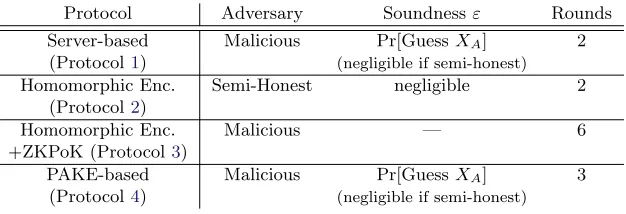
See Table1for a summary of our results. The presented schemes are highly efficient, requiring only 2-rounds of communication and a total communication complexity ofO(nlog|G|) bits, with small constants. This makes these schemes suitable for various applications on limited-resource devices, such as smart-phones.
Since our scheme is asymmetric we do not consider fairness. In the presence ofn−1 dishonest parties, such a task would require stronger primitives, see for instance [GIM+10].
Protocol Adversary Soundnessε Rounds Server-based Malicious Pr[GuessXA] 2
(Protocol1) (negligible if semi-honest)
Homomorphic Enc. Semi-Honest negligible 2 (Protocol2)
Homomorphic Enc. Malicious — 6 +ZKPoK (Protocol3)
PAKE-based Malicious Pr[GuessXA] 3
(Protocol4) (negligible if semi-honest)
Table 1: Summary of our protocols and their properties.
Acknowledgments. We thank Alan Roytman, Sanjam Garg and Akshay Wadia for useful
discussions, and thank Serge Fehr for pointing out trapdoor commitment based ZKPoK schemes to us. We also thank the anonymous reviewers for comments and suggestions.
References
[ACCP08] Michel Abdalla, Dario Catalano, C´eline Chevalier, and David Pointcheval. Efficient two-party password-based key exchange protocols in the uc framework. InProceedings of the 2008 The Cryptopgraphers’ Track at the RSA conference on Topics in cryptology, CT-RSA’08, pages 335–351. Springer Berlin, Heidelberg, 2008. [Axe05] K. Axel. Location-Based Services: Fundamentals and Operation. John Wiley & Sons, Hoboken, NJ, USA,
2005.
[BGW88] Michael Ben-Or, Shafi Goldwasser, and Avi Wigderson. Completeness theorems for non-cryptographic fault-tolerant distributed computation. In Proceedings of the twentieth annual ACM symposium on Theory of computing, STOC ’88, pages 1–10, New York, NY, USA, 1988. ACM.
[Bon98] Dan Boneh. The decision diffie-hellman problem. In Joe Buhler, editor,Algorithmic Number Theory, volume 1423 ofLecture Notes in Computer Science, pages 48–63. Springer Berlin / Heidelberg, 1998.
[BPR00] Mihir Bellare, David Pointcheval, and Phillip Rogaway. Authenticated key exchange secure against dictionary attacks. In Bart Preneel, editor,Advances in Cryptology – EUROCRYPT 2000, volume 1807 ofLecture Notes in Computer Science, pages 139–155. Springer Berlin / Heidelberg, 2000.
[BST01] Fabrice Boudot, Berry Schoenmakers, and Jacques Traor´e. A fair and efficient solution to the socialist mil-lionaires’ problem. Discrete Applied Mathematics, 111(1-2):23 – 36, 2001.
[Can01] R. Canetti. Universally composable security: a new paradigm for cryptographic protocols. InFoundations of Computer Science, 2001. Proceedings. 42nd IEEE Symposium on, pages 136 – 145, oct. 2001.
[CHK+05] Ran Canetti, Shai Halevi, Jonathan Katz, Yehuda Lindell, and Phil MacKenzie. Universally composable password-based key exchange. In Ronald Cramer, editor, Advances in Cryptology – EUROCRYPT 2005, volume 3494 ofLecture Notes in Computer Science, pages 557–557. Springer Berlin / Heidelberg, 2005. [Dam00] Ivan Damg˚ard. Efficient concurrent zero-knowledge in the auxiliary string model. In Bart Preneel, editor,
Advances in Cryptology – EUROCRYPT 2000, volume 1807 ofLecture Notes in Computer Science, pages 418–430. Springer Berlin / Heidelberg, 2000.
[Dam10] Ivan Damg˚ard. On Σ-protocols, 2010. http://www.daimi.au.dk/~ivan/Sigma.pdf.
[DFK+06] Ivan Damg˚ard, Matthias Fitzi, Eike Kiltz, Jesper Nielsen, and Tomas Toft. Unconditionally secure constant-rounds multi-party computation for equality, comparison, bits and exponentiation. In Shai Halevi and Tal Rabin, editors,Theory of Cryptography, volume 3876 ofLecture Notes in Computer Science, pages 285–304. Springer Berlin / Heidelberg, 2006.
[Elg85] T. Elgamal. A public key cryptosystem and a signature scheme based on discrete logarithms. Information Theory, IEEE Transactions on, 31(4):469 – 472, July 1985.
[Fis01] M. Fischlin. Trapdoor commitment schemes and their applications. PhD thesis, Johann Wolfgang Goethe-Universit¨at, Frankfurt am Main., 2001.
[FNP04] Michael J. Freedman, Kobbi Nissim, and Benny Pinkas. Efficient private matching and set intersection. In Christian Cachin and Jan Camenisch, editors,Advances in Cryptology – EUROCRYPT 2004, volume 3027 of
Lecture Notes in Computer Science, pages 1–19. Springer Berlin / Heidelberg, 2004.
[FNW96] Ronald Fagin, Moni Naor, and Peter Winkler. Comparing information without leaking it. Commun. ACM, 39:77–85, May 1996.
[GG03] Marco Gruteser and Dirk Grunwald. Anonymous usage of location-based services through spatial and temporal cloaking. InProceedings of the 1st international conference on Mobile systems, applications and services, MobiSys ’03, pages 31–42, New York, NY, USA, 2003. ACM.
[GIM+10] Dov Gordon, Yuval Ishai, Tal Moran, Rafail Ostrovsky, and Amit Sahai. On complete primitives for fairness. In Daniele Micciancio, editor,Theory of Cryptography, volume 5978 ofLecture Notes in Computer Science, pages 91–108. Springer Berlin / Heidelberg, 2010.
[GL06] Oded Goldreich and Yehuda Lindell. Session-key generation using human passwords only. Journal of Cryp-tology, 19:241–340, 2006.
[GLNS93] L. Gong, M.A. Lomas, R.M. Needham, and J.H. Saltzer. Protecting poorly chosen secrets from guessing attacks. Selected Areas in Communications, IEEE Journal on, 11(5):648 –656, June 1993.
[Gol04] Oded Goldreich. Foundations of cryptography. Vol II: Basic applications. Cambridge University Press, New York, 2004.
[HL10] Carmit Hazay and Yehuda Lindell. Efficient Secure Two-Party Protocols: Techniques and Constructions. Springer-Verlag New York, Inc., New York, NY, USA, 1st edition, 2010.
[HL11] Xuexian Hu and Wenfen Liu. Efficient password-based authenticated key exchange protocol in the uc frame-work. In Feng Bao, Moti Yung, Dongdai Lin, and Jiwu Jing, editors,Information Security and Cryptology, volume 6151 ofLecture Notes in Computer Science, pages 144–153. Springer Berlin / Heidelberg, 2011. [IOS12] Yuval Ishai, Rafail Ostrovsky, and Hakan Seyalioglu. Identifying cheaters without an honest majority. In
Ronald Cramer, editor,Theory of Cryptography, volume 7194 ofLecture Notes in Computer Science, pages 21–38. Springer Berlin / Heidelberg, 2012.
[KGMP07] P. Kalnis, G. Ghinita, K. Mouratidis, and D. Papadias. Preventing location-based identity inference in anonymous spatial queries. Knowledge and Data Engineering, IEEE Transactions on, 19(12):1719 –1733, 2007.
[KOY01] Jonathan Katz, Rafail Ostrovsky, and Moti Yung. Efficient password-authenticated key exchange using human-memorable passwords. In Birgit Pfitzmann, editor,Advances in Cryptology – EUROCRYPT 2001, volume 2045 ofLecture Notes in Computer Science, pages 475–494. Springer Berlin / Heidelberg, 2001.
passwords. J. ACM, 57(1):3:1–3:39, November 2009.
[KV11] Jonathan Katz and Vinod Vaikuntanathan. Round-optimal password-based authenticated key exchange. In Yuval Ishai, editor,Theory of Cryptography, volume 6597 ofLecture Notes in Computer Science, pages 293– 310. Springer Berlin / Heidelberg, 2011.
[KY01] Jonathan Katz and Moti Yung. Unforgeable encryption and chosen ciphertext secure modes of operation. In Gerhard Goos, Juris Hartmanis, Jan van Leeuwen, and Bruce Schneier, editors, Fast Software Encryption, volume 1978 ofLecture Notes in Computer Science, pages 25–36. Springer Berlin / Heidelberg, 2001. [Lip03] Helger Lipmaa. Verifiable homomorphic oblivious transfer and private equality test. InAdvances in Cryptology
– ASIACRYPT 2003, volume 2894 ofLecture Notes in Computer Science, pages 416–433. Springer Berlin / Heidelberg, 2003.
[LSHG08] Kevin A. Li, Timothy Y. Sohn, Steven Huang, and William G. Griswold. Peopletones: a system for the detection and notification of buddy proximity on mobile phones. In Proceeding of the 6th international conference on Mobile systems, applications, and services, MobiSys ’08, pages 160–173, New York, NY, USA, 2008. ACM.
[NO07] Takashi Nishide and Kazuo Ohta. Multiparty computation for interval, equality, and comparison without bit-decomposition protocol. In Tatsuaki Okamoto and Xiaoyun Wang, editors, Public Key Cryptography – PKC 2007, volume 4450 ofLecture Notes in Computer Science, pages 343–360. Springer Berlin / Heidelberg, 2007.
[NP99] Moni Naor and Benny Pinkas. Oblivious transfer and polynomial evaluation. InProceedings of the thirty-first annual ACM symposium on Theory of computing, STOC ’99, pages 245–254, New York, NY, USA, 1999. ACM.
[NTL+11] A. Narayanan, N. Thiagarajan, M. Lakhani, M. Hamburg, and D. Boneh. Location Privacy via Private Proximity Testing, 2011. The 18th Annual Network & Distributed System Security Symposium, NDSS 2011. [OS07] Rafail Ostrovsky and William Skeith. A survey of single-database private information retrieval: Techniques and applications. In Tatsuaki Okamoto and Xiaoyun Wang, editors,Public Key Cryptography – PKC 2007, volume 4450 ofLecture Notes in Computer Science, pages 393–411. Springer Berlin / Heidelberg, 2007. [Pai99] Pascal Paillier. Public-key cryptosystems based on composite degree residuosity classes. In Jacques Stern,
editor, Advances in Cryptology – EUROCRYPT ’99, volume 1592 of Lecture Notes in Computer Science, pages 223–238. Springer Berlin / Heidelberg, 1999.
[Ped92] Torben Pedersen. Non-interactive and information-theoretic secure verifiable secret sharing. In Joan Feigen-baum, editor,Advances in Cryptology – CRYPTO 1991, volume 576 ofLecture Notes in Computer Science, pages 129–140. Springer Berlin / Heidelberg, 1992.
[Sch91] C. P. Schnorr. Efficient signature generation by smart cards.Journal of Cryptology, 4:161–174, 1991. [ˇSTˇS+09] Laurynas ˇSikˇsnys, Jeppe Thomsen, Simonas ˇSaltenis, Man Yiu, and Ove Andersen. A location privacy aware
friend locator. In Nikos Mamoulis, Thomas Seidl, Torben Pedersen, Kristian Torp, and Ira Assent, editors,
Advances in Spatial and Temporal Databases, volume 5644 of Lecture Notes in Computer Science, pages 405–410. Springer Berlin / Heidelberg, 2009.
[TDdMA11] Rafael Tonicelli, Bernardo David, and Vinı cius de Morais Alves. Universally composable private proximity testing. In Xavier Boyen and Xiaofeng Chen, editors,Provable Security, volume 6980 ofLecture Notes in Computer Science, pages 222–239. Springer Berlin / Heidelberg, 2011.
[Yao82] A.C. Yao. Protocols for secure computations. In 23rd Annual Symposium on Foundations of Computer Science, pages 160–164. IEEE, 1982.
[ZGH07] Ge Zhong, Ian Goldberg, and Urs Hengartner. Louis, lester and pierre: Three protocols for location privacy. In Nikita Borisov and Philippe Golle, editors,Privacy Enhancing Technologies, volume 4776 ofLecture Notes in Computer Science, pages 62–76. Springer Berlin / Heidelberg, 2007.
Appendix
A
1-Prover
n
-Verifier Zero-Knowledge Proof of Knowledge
In this section we show a construction of a 1PnV-ZKPoK protocol from a Σ-Protocol and a trapdoor commitment. The construction is an extension of the 2-party case (see, for instance, [Dam00,HL10]).
A.1 Preliminaries
Σ-Protocol Let R denote a binary relation, and letP1,P2, andZK-Verdenote PPT algorithms.
challenge spaceC if the following holds:
1. (3-move form) The protocol is of the following form:
(i)P sets (a, state)←P1(x, w), sends ‘a’ toV and keeps ‘state’ secret.
(ii)V sends a random challenge ch←C toP.
(iii)Pcomputesz←P2(x, w, state, ch) and sendsztoV; the latter accepts ifZK-Ver(x, a, ch, z) =
Accept or otherwise rejects.
2. (Completeness) If (x, w)∈R then an honest P always causes an honest V to accept.
∀(x, w)∈R, Pr(a, state)←P1(x, w);ch←C;z←P2(x, w, state, ch);
ZK-Ver(x, a, ch, z) = Accept= 1.
3. (Special honest-verifier zero-knowledge) There is a PPT simulator which, on input (x, ch), outputs a tuple (a, ch, z) and the distribution of its output is indistinguishable from the distribution of the transcript ofP and V.
4. (Special soundness) Let (a, ch, z) and (a, ch0, z0) be two conversations with ch6=ch0, that are accepting for some givenx. There exists a PPT simulator (extractor) that on inputx
and those two conversations, computesw such that (x, w)∈R.
Trapdoor commitments A perfectly-hiding trapdoor commitment scheme on a message
spaceM is a tuple of probabilistic polynomial-time algorithms (Commit,Verify,Setup,TrapCom, TrapDecom) such that the following holds.
1. (Completeness) For any m∈M,
Prh(pk, trap)←Setup(1κ);
(comm, decom)←Commit(m, pk) :Verify(comm, decom, m, pk) = Accept
i
= 1.
2. (Perfect Hiding) for everym, m0 ∈M, and for anypkgenerated bySetup, for (commm, decomm)←
Commit(m, pk) and (commm0, decomm0) ← Commit(m0, pk), the commitments are identi-cally distributed,
commm ≡commm0.
3. (Binding) For every probabilistic polynomial time adversaryAdv,
Pr
(pk, trap)←Setup(1κ); (comm, decomm1, decomm2, m1, m2)←Adv(pk) :
Verify(comm, decomm1, pk, m1) = Accept∧
Verify(comm, decomm2, pk, m2) = Accept ∧ m1 6=m2
< neg.
4. (Trapdoor Property) The knowledge of the trapdoor allows generating commitmentcomm, distributed in a similar way to a standard commitment, which can be opened as any
(a) for everym∈M, and (commm, decomm)←Commit(m, pk),
comm≡commm.
(b) for everym∈M and decom←TrapDecom(comm, m, pk, trap)
Pr[Verify(comm, decom, m, pk) = Accept] = 1
We require that (pk, trap) is easy to verify as a valid output of Setup; assume that for a pair (pk0, trap0) ∈/ Setup(1κ) for some κ, it holds that ⊥ ← TrapCom(pk0, trap0). In that case we say that (pk0, trap0) isinvalid.
See [Fis01] for various constructions of trapdoor commitment schemes.
A.2 Construction
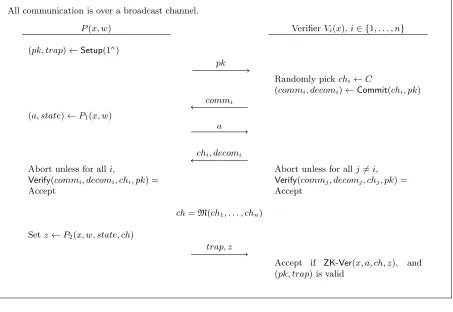
Proposition 12. Let (P1, P2,ZK-Ver) be a Σ-Protocol with challenge spaceC for a relation R, and (Commit,Verify,Setup,TrapCom,TrapDecom) be a trapdoor commitment scheme on a mes-sage space M such that Mn is isomorphic to C0 ⊆ C and M :Mn → C0 be an isomorphism. The scheme given in Figure1 is a 1PnV-ZKPoK protocol for R with knowledge error 1/|M|.
All communication is over a broadcast channel.
P(x, w) VerifierVi(x),i∈ {1, . . . , n}
(pk, trap)←Setup(1κ)
pk
Randomly pickchi←C
(commi, decomi)←Commit(chi, pk)
commi
(a, state)←P1(x, w)
a
chi, decomi
Abort unless for alli,
Verify(commi, decomi, chi, pk) =
Accept
Abort unless for allj6=i,
Verify(commj, decomj, chj, pk) =
Accept
ch=M(ch1, . . . , chn)
Setz←P2(x, w, state, ch)
trap, z
Accept if ZK-Ver(x, a, ch, z), and (pk, trap) is valid
Proof. The completeness trivially follows from the completeness of the Σ-Protocol and of the trapdoor commitment scheme.
Zero-knowledge: For any set of verifiers V10, . . . , Vn0 the simulator works as follows. The sim-ulator runs the scheme until it learns the challengeschi at the 4th move. Then, the simulator runs the simulator of the ZKPoK Σ-Protocol guaranteed by the special honest-verifier zero-knowledge property of the Σ-Protocol on input (x, ch) to obtain (a, ch, z). The simulator then rewinds the verifiers to the 3rd move, and sends a. Due to the binding property of the com-mitment scheme, the verifiers open the same challengeschi as they did on the first run (except with negligible probability), and the simulator completes the scheme as expected. Note that by forcing the verifiers to commit to chi before seeinga, their challenge is independent of a, and the honest-verifiers zero-knowledge property implies the composed scheme is zero-knowledge.
Extended extractability: Assume that for some 1≤ j ≤n, Vj is honest. For any prover P0 and verifiersV10, . . . , Vj0−1, Vj0+1, . . . , Vn0, assume thatVj acceptsxwith probability(x). We show that there exists a constant c and a PPT extractor Ext that outputs a correct w in expected time|x|c/((x)−1/|M|).
First we note that if an extractor Ext obtains two accepting transcripts, then it can ex-tract w with polynomial time using the extractor guaranteed by the special soundness of the Σ-Protocol. This property implies the extended extractability property, in a similar way as the 2-party case (see, for instance [Dam00, Dam10, HL10]). The main difference is that the extractor cannot determine the challengechused by the prover but rather only a part of itchj. Due to rushing, it is possible that the challenges ch1, . . . , chj−1, chj+1, . . . , chn are determined adversarially after learning the value ofchj. However the isomorphism guarantees that, for any strategy the corruptVi0s take, the final challenge obtained from two different valuesch0j 6=chj, must be different. That is, given chj 6= ch0j, then for any (ch1, . . . , chj−1, chj+1, . . . , chn) and (ch01, . . . , ch0j−1, ch0j+1, . . . , ch0n)
ch:=M(ch1, . . . , chn) 6= ch0 :=M(ch01, . . . , ch0n).
The proof follows from [Dam10,HL10] with straightforward adaptations, and we omit the details.