Succinct Randomized Encodings and their Applications
∗Nir Bitansky† Sanjam Garg‡ Sidharth Telang§
April 23, 2015
This is an out of date draft. The paper was merged with [LP14]. A unified version is available at http://eprint.iacr.org/2015/356.
Abstract
Arandomized encodingallows to represent a “complex” functionf(x)by a “simpler” randomized functionfˆ(x;r)whose output distribution encodesf(x), while revealing nothing else regardingx. Ex-isting randomized encodings, geared mostly to allow encoding with low parallel complexity, have proven instrumental in various strong applications such as multiparty computation and parallel cryptography.
This work focuses on another natural complexity measure:the time required to encode. We construct succinct randomized encodingswhere a computation given by a (Turing or random-access) machineM, andn-bit inputx, requiring timetand spaces, can be encoded roughly in time(n+s)·polylogt, thus inducing significant savings in time whens t. The scheme guarantees computational input-privacy and is based on indistinguishability obfuscation for a relatively simple circuit class, which can in turn be based on a polynomial version of the subgroup elimination assumption on multilinear graded encodings. We then invoke succinct randomized encodings to obtain several strong applications, including:
• Indistinguishability obfuscation for uniform (Turing or random-access) machines, where the ob-fuscated machineiO(M)computes the same function asM for inputsxof apriori-fixed maximal sizen, and is computed in time(n+s)·polylogt.
• Functional encryption for uniform machines, where a functional decryption key corresponding toM allows decryptingM(x)from encryptions of x. As in the previous case, inputs xare of apriori-fixed maximal sizen, and key derivation time is roughly(n+s)·polylogt.
• Publicly-verifiable 2-message delegation where verification time is roughly(n+s)·polylogt. We also show how to transform any 2-message delegation scheme to an essentially non-interactive system where the verifier message is reusable.
For the first application, we also require subexponentially-secure indistinguishability obfuscation for circuits, and for the second polynomial indistinguishability obfuscation, which can be replaced by more concrete polynomial hardness assumptions on multilinear graded-encodings. Previously, both applica-tions were only known based on various non-standard knowledge assumpapplica-tions.
∗
Part of this research was done at IBM T.J. Watson Research Center. †
‡
University of California, [email protected]
§
1
Introduction
The notion of arandomized encoding, pioneered by Ishai and Kushilevitz [IK00], aims to trade the com-putation of a “complex” function f(x) for the computation of a “simpler” randomized function fˆ(x;r) whose output distribution encodesf(x), but hides anything else regarding the inputx. The “complexity” of computingf is shifted to the decoding procedure that should extractf(x)fromf(x, r).ˆ
The privacy of the input x is naturally captured by an efficient simulatorSim(f(x)), who given only the output f(x), produces a simulated encoding indistinguishable from f(x;r); privacy can be perfect, statistical, or computational, according to the attained indistinguishability. Capturing what it means to “simplify the computation of f(x)” may take quite different forms according to the complexity measure of interest. Most previous work have focused on computing the randomized encodingfˆ(x;r) with lower parallel-time complexity than required for computing the original functionf, and has been quite successful. In particular, all log-space computations (and NC1 computations) were shown to have perfectly-private randomized encodings inNC0 [IK00, IK02]. When settling for privacy against computationally bounded adversaries, the latter extends to arbitrary poly-time computations [AIK06] (this is also known as Yao’s garbled circuit method [Yao82]). The constructed randomized encodings were in turn shown to have various strong applications to parallel cryptography, secure computation, verifiable delegation, and more (most of these are surveyed in [App11b]).
Succinct randomized encodings. In this work, we focus on yet another natural complexity measure: the time required to computef(x). Specifically, given the description off and the inputx, we would like to compute the encodingfˆ(x;r)in timetˆthat is significantly smaller than the timetrequired to computef(x). Decoding, in contrast, may already be as large ast, perhaps with some tolerable overhead. For this goal to be achievable,f has to be given in some succinct representation that is smaller thant, and cannot be given by, say, a size-tcircuit. Concretely, we restrict attention to the natural case thatfis represented by a uniform (deterministic) machineM, e.g., a Turing machine (TM) or a random-access machine (RAM).
Besides being interesting from a purely complexity-theoretic perspective, such succinct randomized encodings may have powerful applications analogous to those of the known randomized encodings. One such immediate application is private delegation of computation: a weak client that wishes to use the aid of a server to run a long computationMon a short private inputx, may quickly compute a succinct randomized encodingM(x), and have the server decode the resultc M(x), without the server learning anything regarding
x(with a little more effort, we can even ensure privacy of the output, and be able to verify that the server computed correctly).
Beyond shifting computation from weak parties to strong parties, succinct randomized encodings may sometimes save in computation altogether. For instance, one of the first demonstrated applications of ran-domized encodings [IK00, IK02] was in multi-party computation (MPC). Indeed, most known MPC solu-tions explicitly utilize the circuitCf(x1, . . . , xm)representing a functionf(x1, . . . , xm), and the overhead
they incur, e.g. in communication, may depend on the circuit size|C|. When the functionf is succinctly represented by a machineM, we may have the parties compute first a succinct randomizedMc(x1, . . . , xm),
and only decode at the end, thereby making communication overhead proportional to the smaller circuit that computesMc. Furthermore, the effort of decoding (proportional toM’s running time) falls only on the
parties that obtain the output.
polynomial time.1 In contrast, restricting attention to privacy against computationally-bounded adversaries, no lower bounds or barriers are known. Still, all the constructions introduced so far were based on consider-ably strong computational assumptions such as extractable witness encryption and succinct non-interactive arguments in [GKP+13a], and (a strong variant of) differing-inputs obfuscation in [GHRW14]. For once, in the language of [Nao03] these assumptions are notefficiently-falsifiable; furthermore, in some cases they are subject to impossibilities [BCPR14, GGHW14].
In light of the above, we focus on two main questions:
Can we base succinct randomized encodings on more standard assumptions? What are the applications of succinct randomized encodings?
1.1 Contributions
Our core contribution is a new construction of succinct randomized encodings based on assumptions that are considered more standard (and in particular are efficiently falsifiable). Concretely, we show
Theorem 1.1(informal). Assuming indistinguishability obfuscation (IO) and one-way functions, there exist randomized encodings where for a (Turing or random-access) machineM with running timetand spaces on inputx, it holds that for some fixed polynomialpoly(·), independent ofM andt:
• encoding takes time(|x|+s)·poly(logt,|M|, λ),
• decoding takes timet·s·poly(logt,|M|, λ)and spaces·poly(logt,|M|, λ),
where privacy holds against adversaries of arbitrary polynomial size in the security parameterλ.
Furthermore, IO is only required for a relatively simple class of circuits. First, assuming puncturable pseu-dorandom functions (PRFs) in NC1, the obfuscated circuits are also in NC1. Second, and regardless of depth, the obfuscated circuits only haveO(logt)-size inputs. Puncturable PRFs inNC1 are constructed in [BLMR13] based on decision linear assumptions on multilinear maps, and in [HKW14] based on a standard variant of decision Diffie Hellman assumption. Further more Gentry et al. [GLSW14] construct indistin-guishability obfuscation forNC1under a subgroup elimination assumption on composite-order multilinear graded encodings [GGH13a, CLT13], where the security of the assumption scales exponentially with the circuit input length. Thus, to get randomized encodings forP, we only need to rely onpolynomial assump-tions.
We then demonstrate the power of succinct randomized encodings in several applications, some new, and some analogous to previous applications of randomized encodings, but with new succinctness properties. We now overview these applications.
Succinct indistinguishability obfuscation.Typically obfuscation (and in particular IO) operates on circuits and outputs circuits of polynomially related size. Naturally, we may also want to consider obfuscation in uniform models of computation such as Turing or random-access machine. Here, given a machine M,
1
and a boundnon input-length, we would like to produce an obfuscated machineO(M)that has the same functionality on all inputs of size at most n. Crucially, the obfuscation procedure should be done much faster then the machine’s maximal running time T(n) (and corresponding circuit size).2 As in succinct randomized encodings, evaluating O(M)(x)may be proportional to the running time of M(x). We call such obfuscatorssuccinct.
Our first (and perhaps the most surprising) application of succinct randomized encodings is forsuccinct indistinguishability obfuscation(succinct IO in short). Indistinguishability here means that the (succinct) ob-fuscations of two machines that agree on all inputsx∈ {0,1}≤n, will be computationally indistinguishable.
Differently from (non-succinct) IO for circuits, any form of succinct IO realized so far [ABG+13, BCP14] assumes differing-inputs obfuscation in conjunction with succinct non-interactive arguments (which already entail strong succinctness properties); as mentioned before, these are considered very strong up to implau-sible in certain settings.
Relying on succinct randomized encodings, we show a construction based on essentially different as-sumptions (which are typically considered more standard). Concretely, we show:
Theorem 1.2(informal). Assuming succinct randomized encodings, one-way functions, and IO for circuits that are all2λε-secure, there exists succinct IO where for machineM and input boundn≤λε/2:
• obfuscatingM takes roughly the same time as encodingM(x),
• evaluating the obfuscatedO(M)takes roughly the same time and space as decoding.
As a corollary of Theorems 1.1,1.2, we obtain, from subexponentially-secure IO and one-way functions, succinct IO where the time to obfuscate depends only on the space ofM, and is essentially independent of the running time ofM. Here also, by assuming puncturable PRFs inNC1, we can rely on (subexponential) IO only forNC1.
We note that this theorem is somewhat analogous to a bootstrapping theorem by Applebaum [App13] who showed, for a strong notion of virtual black-box obfuscation [BGI+01], how (non-succinct) randomized encodings and pseudo-random functions inNC1, together with obfuscation forNC1 circuits, imply virtual black-box obfuscation forP/poly. Using the technique used to prove Theorem 1.2, and subexponentially-secure pseudo-random functions in NC1, we can extend this bootstrapping theorem to also hold for the weaker notion of IO.
Succinct functional encryption. The goal of functional encryption (FE) [O’N10, BSW11] is to allow fine-grained access control to encrypted data. Concretely, in an FE scheme for a class of functionsF, the trusted holder of the (master) secret keySKcan derive a special keySKf for any functionf ∈ F. Given an
encryption of somem, anyone that holdsSKf can learnf(m), but should not learn anything else aboutm.
The recent leap in the study of obfuscation [GGH+13b], has brought with it a corresponding leap in functional encryption. Today, functional encryption for all circuits can be constructed from IO [GGH+13b, Wat14], or even from concrete (and efficiently falsifiable) assumptions on composite order multilinear graded-encodings [GGHZ14]. Considering function families in uniform models of computation, we may hope to havesuccinct FE, where the secret keySKM corresponding to machineM can be computed faster
than the running time ofM. However, here the state is similar to succinct randomized encodings, or succinct IO, requiring essentially the same non-standard assumptions.
One can replace IO in the above constructions for circuits with the succinct IO from Theorem 1.2, and obtain FE where computingSKM is comparable to (succinctly) obfuscatingM. This, however, will incur
2
the same subepxonential loss as in the construction of succinct IO. We show, however, that we can directly construct succinct FE, while circumventing this loss:
Theorem 1.3(informal). Assuming succinct randomized encodings, one-way functions, and IO for circuits, there exists succinct functional encryption where for machineM and input boundn:
• deriving a corresponding secret keySKM takes roughly the same time as encodingM(x).
• decrypting takes roughly the same time and space as decoding.
Assuming puncturable PRFs inNC1, IO can be restricted toNC1, or replaced with the same (efficiently-falsifiable) assumptions on composite order multilinear graded encodings made in [GGHZ14].
As a corollary of Theorems 1.1,1.3, we obtain succinct FE where the key-derivation time depends only on the space ofM, and is essentially independent of the running time ofM. We note that the alternative construction based on [GGHZ14], the resulting scheme is fully secure as in [GGHZ14].
We also note that, given succinct FE, we can somewhat enhance our basic succinct randomized encod-ings to make themreusable. Such reusability was previously studied in [GKP+13b, GHRW14] and means that encoding is now split into two parts: the first part Mcis independent of the specific input xand only
depends on the machineM. The first part can then be “reused” together with a second partbxthat includes an encoding of inputx. The gain is in efficiency: while encodingMdepends on the space in our solution, it is only done once, and subsequent encodings of inputs depend only on the input size|x|and not on space. Publicly-verifiable delegation. In the basic setting of delegation, a weak client would like to delegate a long computation succinctly represented by a machine M, and input x to a server, and be able to later verify the result claimed by the server. Verification is required to be significantly faster than running the computation from scratch, and ideally we also want the corresponding protocol to only involve one message in each direction, a verifier messageσand a prover message includingM(x)and a proofπof correctness.
Recently, Kalai, Raz, and Rothblum [KRR14] gave a general solution to the problem, under the subex-ponential learning with errors assumption, where verification is essentially linear in the input x. Other solutions [GLR11, BCCT12, DFH12, BCCT13] rely on non-standard knowledge assumptions.
Based on the succinct randomized encodings from Theorem 1.1, we obtain a solution that has two ad-ditional desired features. The first ispublic-verifiability, meaning that given the (public) messageσanyone can verify the proofπ, without requiring any secret verification state. The second is input-privacy, meaning that the server does not learn anything regarding the verifier’s input.
Assuming in addition, indistinguishability obfuscation, we can turn the system into what is known as a succinct non-interactive argument(SNARG), where the verifier’s messageσisreusable; namely, the verifier can send one messageσ, and then get proofs for multiple different computations. (This is, in fact, a generic transformation the can be applied to any delegation scheme.)
Theorem 1.4 (informal). Assuming succinct randomized encodings and one-way functions, there exists publicly-verifiable 2-message delegation with input-privacy where for machineM and input boundn:
• verification takes roughly the same time as encodingM(x).
• proving takes roughly the same time and space as decoding.
Invoking the succinct randomized encodings constructed here, we obtain a system as above where verifica-tion time only depends on the space of the computaverifica-tion, but not its time. Also, like the succinct randomized encoding, the solution can also be based on a polynomial version of the subgroup elimination assumption (rather than subexponential hardness assumptions).
Other applications.We reinspect other previous applications of (non-succinct) randomized encodings and note the resulting succinctness features.
One application, already mentioned above, is to multiparty computation [IK00, IK02], where we can reduce the communication overhead from depending on the circuit size required to compute a multiparty f(x1, . . . , xm)to depending on the space required to computef, which can be much smaller. While focusing
merely on communication this problem has by now general 1-round solutions based on (multi-key) fully-homomorphic encryption [Gen09, AJL+12, LTV12, GGHR14], succinct randomized encodings also allow to shift the work load to one party (the decoder), without inducing extra rounds or strong computational assumptions (such as succinct non-interactive arguments of knowledge).
Another application is to amplification ofkey-dependent message security(KDM). In KDM encryption schemes we want semantic security to hold, even when the adversary obtains encryptions of functions of the secret key taken from a certain classF. Applebaum [App11a] essentially shows that given a scheme that is KDM-secure with respect to some class of functionsF, can be made resilient to a bigger classF0 ⊇ F, if functions inF0can be randomly encoded inF. Using succinct randomized encodings, we can roughly show that given KDM-security for circuits of some fixed polynomial sizes(such as the scheme of [BHHI10]), can be amplified to KDM-security for functions that can be computed by machines with space s, but could potentially have much larger running time.
1.2 Overview of Techniques
We now overview the main ideas behind our results, focusing on the construction of succinct randomized encodings from IO. We then sketch how the main applications are obtained.
The basic idea: obfuscating a Yao gate garbler.Our starting point is a good old non-succinct randomized encoding — Yao’s garbled circuit scheme [Yao82]. The scheme takes an arbitrary circuitC and input x and computes a randomized encodingC(x), usually referred to as the garbled circuit. While the garbledb
circuit is known to be computable inNC0 (under reasonable assumptions), the resultingC(x)b is as large
as the circuitC. Nevertheless, the fact that garbling is done in NC0 implies that the computation of each output bit is very local, and can be done by a circuit of fixed size. At a very high-level, the basic idea is, given a uniform machine, to cram all the corresponding local computations into one small obfuscated circuit that can internally generate randomness and produce each of the small pieces ofC(x). Intuitively, strongb
enough obfuscation would guarantee that this circuit leaks nothing beyondC(x)b and can be published as
the succinct randomized encoding. We next sketch in more detail how this is done.
Looking into how Yao garbling is done, note that the garbling of the large circuit C consists of gar-bling each gate separately; furthermore, this gargar-bling is local in the sense that, for each gate, it involves a small amount of randomness that will only be used in the garbling process of the few neighbouring gates. A bit more concretely, in Yao’s scheme, each wire w in the circuit is associated with two random keys Kw0, Kw1 ∈ {0,1}λ, whose length depends only on the security parameterλ. The gate garbling procedure
{Kxi
i :i∈[n]}corresponding to input wires[n]and their value according to the inputx.3
This gives rise to the following natural approach: given a uniform (say, Turing) machine M that for inputs of lengthnruns in timetand spaces, we consider the circuitCof sizeO(t·s), with bounded fan-in and fan-out, that representsM’s computation (for simplicity of exposition, we assume thatMhas a constant size description). The circuitC, in turn, can be represented by a small circuitCsc of sizeO(logt), which
given a labeli ∈ [O(t·s)]for any gategi in the circuit, outputs the corresponding gate operationand
the labels of its corresponding wires{w∈gi}. We can then obfuscate an augmented gate garbling circuit
GM,K that will garble any given gate gi, using (pseudo) random keys internally generated by a
pseudo-random functionFK. That is,GM,K is given a labeli∈[O(t·s)], invokesCsc(i)to learn the corresponding
operationand wires{w∈gi}, internally derive the required keys(Kw0, Kw1) =FK(w), and invokeGto
create the garbledbgi. We then publish the obfuscatedO(GM,K)together with the input keys{K
xi
i }, derived
consistently usingFK.
In terms of functionality and succinctness this seems like a promising solution. The size of the resulting randomized encoding, and more generally the time it takes to compute it, is polynomial in the size ofGM,K,
which is in turn polynomial in the circuit size ofGandFK, which are bothpoly(λ), and the size ofCsc,
which isO(logt); thus, the overall time of encoding ispoly(λ,logt). Decoding involves runningO(GM,K)
on eachi∈[O(t·s)], thus deriving the garbledC(x)b and then running the decoding procedure for garbled
circuits; in total this takes timet·s·O(logt+ poly(λ)).
Intuitively, to prove that the above succinct randomized encoding is secure, we would like to rely on the security of the underlying circuit garbling and that of the obfuscatorO. The question is
what kind of security do we have to require fromO?
To answer this question, let us first recall the security guarantee of Yao, which says that an efficient simulator
Sim(C, y), given only the outputy = C(x), but nothing about inputx, can generate a simulated garbled circuitCbsimthat is computationally indistinguishable fromC(x). Furthermore, similarly to the real garblingb
process, also the simulated one is local; namely, there exists a small circuitGsim(,Kw0, Kw1 :w∈g , y) that is also given the outputy, and creates simulated garbled gates. In addition, the real garbled keys{Kxi
i }
are replaced with simulated keysK0
i :i∈[n] that can correspond to the all zero input0n(or any other
string for that matter). Thus, a natural simulation strategy is to produce an obfuscation O(GsimM,K,y) of a simulated gate garblerGsimM,K,ythat is defined just likeGM,K, only that it invokesGsimrather thanG.
We would now like to argue that the real encoding{Kxi
i },O(GM,K)is computationally
indistinguish-able from the simulated
Ki0 ,O(GsimM,K,y). If the obfuscation was “ideal” and equivalent to a black-box computing the underlying function, this would follow easily. Specifically, looking just at the output distri-butions of the real and simulated obfuscations, we know that:
{Kxi
i },{GM,K(i)}i∈[O(t·s)] ≈cC(x)b ≈cCbsim≈c
Ki0 ,GsimM,K,y(i) i∈[O(t·s)] ;
indeed, the two inner distributions are indistinguishable just by the garbled circuit security guarantee, and are each identical to the corresponding outer distribution, except for the fact that the outer distributions use pseudorandom keys rather than truly random keys.
This intuition can be quite directly transformed into a proof relying on the virtual black-box definition of Barak et al. [BGI+01], which says that whatever predicate can be learned from an obfuscation can also be learned by a simulator, given only black-box access to the circuit. However, the virtual black-box definition
3
is rather strong, and in some settings impossible altogether [BGI+01, GK05, BCC+14]; moreover, as argued above it seems that we only need the obfuscation to satisfy some sort of indistinguishability requirement, rather than a strong simulation requirement. Instead, we attempt to base the scheme on the much weaker notion of indistinguishability obfuscation (IO), for which we have candidate constructions, under different assumptions on multilinear graded encodings [GGH+13b, PST14, GLSW14].
The notion of IO only guarantees that for any two circuitsC0, C1 of the same size and which compute the same function, their two obfuscationiO(C0)andiO(C1)are computationally indistinguishable. Is IO enough for recovering the above argument? For once, had we taken the circuitGM,K (and accordingly
GM,K,y) and had simply padded it to be large enough, then we could simply replace it with a circuit that has
O(t·s)hardcoded valuesGM,K(i), each returned given the corresponding inputi. Clearly, this results in
the same functionality, and thus we can rely on IO and the same argument as above. However, this beats the purpose of achieving a succinct randomized encoding.
The question is whether this padding is necessary. We typically think of IO as the best-possible obfusca-tor [BGI+01, GR07]; however, what we really mean is thatiO(C)is as good as the best possible obfuscation bO(C), when the circuitCis padded to be of sizebO(C). In contrast, virtual black-box obfuscation is truly best-possible, without having to pad, because when the circuit is regarded as an oracle, the size doesn’t mat-ter. One can naturally try to formulate a notion of best-possible obfuscation that does not require padding, but only satisfies an indistinguishability guarantee and is not as strong as virtual black-box. In Section 3.5, we explore such a notion which we callpadding-free indistinguishability obfuscation.
Relying on (plain) IO, and its cost. Aiming to avoid additional (arguably strong) assumptions, we show that, by replacing arbitrary pseudo-random functions (PRFs) with what is known aspuncturable PRFs[SW14], we can rely on plain IO, while padding proportionally to the spacesof the computation rather than the time t. We now explain the rough ideas behind this, as well as where the space comes up.
In puncturable PRFs, it is possible to efficiently puncture a given keyKat any polynomial set of pointsS in the domain of the function. The punctured functionFKS, with punctured keyKS, preserves functionality at any other point, but hides any information on{FK(x) :x∈S}; namely, these values are pseudo-random,
even given(S, KS). As shown in several recent works [BW13, BGI14, KPTZ13], such puncturable PRFs
follow from the GGM construction [GGM84].
Recall, that we would like to prove that the real {Kxi
i },O(GM,K ◦0`) is computationally
indistin-guishable from the simulatedKi0 ,O(GsimM,K,y◦0`sim), where this time the two circuits are padded with an
appropriate number of zeros, which is bounded bys·poly(λ). To show this, we will closely follow the way that Garbled circuit security is usually proven (described in detail in [LP09]). Specifically, we will show how to move from the real randomized encoding to the simulated one by a sequence ofO(t·s) hybrids, each time making only local changes to the underlying obfuscated program. In hybridi, we shall obfuscate a hybrid circuitGi
M,K ◦0`i that for all gatesj < igenerates simulated garbled gates usingGsim, and for
gatesiand beyond creates real garbled gates usingG. In the firstnhybrids, we shall also gradually change the choice of keys from{Kxi
i }to
Ki0 .
The standard garbled simulation argument shows that in stepiwe can change the real garbled gategbito
a simulated onebg
sim
i , provided that: (a) all the gates belowiwere already simulated, and (b) we know the
real value corresponding to the wire going out fromgi. The first condition, can be guaranteed by looking
at a topological order of the gates. For simplicity, we consider aO(t)-layered circuit, where each layer is of sizeO(s) is connected only to the one below and above. The second condition is also not a problem in the standard garbled circuit setting; indeed, the process generating the current hybrid distribution may “remember” the intermediate wire values for the current layer.
major different in our setting is that the adversary doesn’t see only the resulting garbled circuit, but actually sees the circuit that computes it, which internally includes a the PRF key used to generate the randomness. Not surprisingly, if this PRF key is leaked in full, the scheme is completely broken. We show, however, that IO in conjunction with a puncturable PRF guarantee sufficient hiding. Specifically, the place where the above difference kicks in is exactly when replacing a real garbled gate with a simulated one. In the standard garbled setting both are generated using true (rather than pseudo) randomness, which is completely hidden from the adversary. This is exactly where we use the puncturing property: when dealing with gategiin the
ithhybrid, we will puncture the PRF in the constant number of corresponding wires, and instead directly hardcode the garbled gatebgi(orbg
sim
i )into the circuit. This change is indistinguishable, because we did not
change the functionality of the circuit. Furthermore, now we can invoke the guaranteed pseudorandomness in punctured points, and generate the garbled gate using true randomness, just as in the standard setting, allowing us to replace the real gate by a simulated gate. Importantly, before moving to the next hybrid we unpuncture the PRF, to guarantee that the key doesn’t grow as the number of punctured points increases.4
The reason for blowing up the obfuscated circuit proportionally to the space is that we still need to remember the intermediate wires values for the currently simulated layer. Unlike the standard garbling setting where this wasn’t an issue, as the adversary anyhow sees only the resulting garbled circuit, here it is since the adversary actually sees the (obfuscated) circuit that generates the garbled circuit. In our setting, the intermediate values for the current layer will be hardwired into the circuit, and each one of them can only be “forgotten” once all the connected gates in the layer above are simulated (inducing new values to remember). As long as we simulate layer by layer, we can guarantee that the overall blowup does not exceed s·poly(λ).
IO for a simple class of circuits, and randomized encodings in NC1.Finally, we note that the obfuscated circuits in our constructions are of a special kind. First, input size of the obfuscated circuits is logts = O(logt). Second, assuming puncturable PRFs inNC1(constructed in [BLMR13, HKW14]), the obfuscated circuits can also be computed inNC1. Another thing to note is that the constructed succinct randomized encodings can be made to be inNC1. This is similar to the simple observation that randomized encodings can be composed [AIK06]; that is we can consider an outer later of anNC1randomized encoding (like Yao), that computes the inner succinct randomized encoding.
1.2.1 Main Ideas behind the Applications
We now briefly sketch the main ideas behind our three main applications.
Succinct IO.We start by the construction of succinct IO from succinct randomized encodings. The basic scheme is a natural instantiation of the bootstrapping approach of Applebaum [App13]. There the goal is to reduce obfuscation of general circuits to obfuscation ofNC1 circuits; our goal is to reduce obfuscation of uniform machines with large running time to obfuscation of significantly smaller circuits. To obfuscate a machineMwith respect to inputs of size at mostn, the idea is to obfuscate a small circuitCM,K that has a
hardwired key for a PRF, and given inputx, applies the PRF toxto derive randomness, and then computes a succinct randomized encoding ofUx(M), whereUxis a universal machine that runs the input machineM
onx. The obfuscatedO(M), given inputxuses the obfuscated circuitO(CM,K)to compute the encoding
b
Ux(M), and then decodes the result.
The analysis in [App13] would imply security in case thatOhas virtual black-box security, for arbitrary PRFs. We show that ifOhas2λε-security for security parameterλ > n2/ε, and the PRF is a puncturable
with a similar level of security, then a similar result holds for IO, rather than virtual black-box. The idea is simple, given two machinesM0, M1that compute the same function on all inputsx ∈ {0,1}≤n, we show how to move from an obfuscation ofM0 to an obfuscation of M1 with a sequence of O(2n)hybrids. In theith hybrid we obfuscate a threshold circuitCMi
0,M1,K that for inputsx < icomputes the randomized encodings usingM0, and for larger inputs usingM1 (here we naturally think of thexas the corresponding number according to its lexicographic place in{0,1}≤n). Each circuitCMi 0,M1,K is larger than the original CM0,K but only on a factor ofO(n); to invoke IO, we will need to pad them accordingly.
It is easy to see that the first and last circuits CM,Ki , compute the exact same function asCMi
0,K and CMi
1,K, respectively. To show indistinguishability of two consecutive hybrids, we simply puncture at the current pointi, hardwire the succinct randomized encodings, and rely on the fact thatUbi(M0) ≈cUbi(M0),
sinceUi(M0) = M0(i) = M1(i) = Ui(M1). Subexponential security of the circuit IO is required due to the subexponential number of hybrids. (We note that using a puncturable PRF inNC1 and the fact that the succinct randomized encoding can be computed inNC1, we can rely on IO forNC1.)
Succinct FE.We now move on to discuss the construction of succinct functional encryption, which follows rather directly from succinct randomized encodings and previous work. Roughly speaking, the idea is to start from an FE scheme for randomized circuits, rather than deterministic ones, and then in order to derive a key for a machineM, use the randomized circuit FE to derive a key for the circuit that givenx, computes a randomized encoding ofM(x). One construction of such FE schemes was shown by [GJKS13] based on IO. Another construction was shown by [GGHZ14] only for circuits inNC1, under concrete assumptions on composite-order multilinear graded encodings; this is sufficient for us since the succinct randomized encoding can be computed inNC1. The latter construction, in fact, satisfies a strong notion of adaptively-secure FE (for randomized circuits).5.
Publicly-verifiable delegation. Finally, we sketch the ideas behind our delegation scheme and SNARGs. The delegation scheme is pretty simple and similar in spirit to previous delegation schemes (in a weaker processing model) [AIK10, GGP10, GKP+13b]. To delegate a computation, given byM andx, the verifier simply sends the prover a randomized encodingMc0(x, r), whereM0is a machine that returnsrif and only
if it acceptsx, andr is a random string. The security of the randomized encoding implies that the prover learns nothing ofr, unless the computation is accepting. The scheme can be easily made publicly verifiable by publishingf(r) for some one-way functionf. Furthermore, the scheme ensures input-privacy for the verifier.
We then propose a simple transformation that can be applied to any delegation scheme in order to make the first verifier message reusable. The idea is natural: we let the verifier’s first message be an obfuscation of a circuitCK that has a hardwired keyK for a pucturable PRF, and given a computation(M, x), applies
the PRF to derive randomness and generates a first message for the delegation scheme. Thus for each new computation, a first message is effectively sampled afresh. Relying on IO and the security of the puncturable PRF, we can show that (non-adaptive) soundness is guaranteed. (Again, using puncturable PRFs inNC1, we can rely on IO forNC1.) The transformation can also be applied to privately-verifiable delegation schemes, such as the one of [KRR14] and maintains soundness, even if the prover has a verification oracle.
Organization
In Section 2 we go over preliminiaries and primitives we will be using. In Section 3 we define succinct randomized encoding schemes (Section 3.1) and present our main construction (Section 3.3). We present
our fully-succinct construction in Section 3.4. In Section 4 we present some applications of our randomized encoding schemes, particularly those of succinct indisitnguishability obfuscation (Section 4.1), succinct functional encryption (Section 4.2), publicly verifiable delegation and SNARGS forP(Section 4.3).
2
Preliminaries
We review basic concepts and definitions used throughout the paper.
2.1 Standard Computational Concepts
We rely on the standard notions of Turing machines and Boolean circuits. We say that a (uniform) Turing machine is PPT if is probabilistic and runs in polynomial time. A polynomial-size (or just polysize) circuit familyC is a sequence of circuitC = {Cλ}λ∈N, such that each circuitCλis of polynomial sizeλ
O(1)and
hasλO(1) inputs and outputs bits.
We follow the standard habit of modeling any efficient adversary strategy as a family of polynomial-sized circuits. For an adversaryAcorresponding to a family of polysize circuits{Aλ}λ∈
N, we often omit the subscriptλ, when it is clear from the context.
2.2 Indistinguishability Obfuscation
We recall the notion of indistinguishability obfuscation (IO) recently realized in [GGH+13b] using candidate multilinear maps[GGH13a].
Definition 2.1(Indistinguishability Obfuscator (IO)). A PPT machineiOis anindistinguishability obfus-catorfor a circuit class{Cλ}λ∈Nif the following conditions are satisfied:
• Functionality:for all security parametersλ∈N, for allC∈ Cλ, for all inputsx, we have that
Pr[C0(x) =C(x) :C0 ←iO(C)] = 1 .
• Indistinguishability: for any polysize distinguisherD, there exists a negligible functionαsuch that the following holds: For all security parametersλ∈ N, for all pairs of circuitsC0, C1 ∈ Cλ of the
same size, we have that ifC0(x) =C1(x)for all inputsx, then
Pr
D(iO(C0)) = 1
−PrD(iO(C1)) = 1
≤α(λ) .
2.3 Puncturable Pseudo-Random Functions
Puncturable PRFs defined by Sahai and Waters [SW14], are PRFs for which a key can be given out that allows evaluation of the PRF on all inputs, except for a designated polynomial-size set of inputs.
Definition 2.2(Puncturable PRFs). A puncturable pseudo-random functionFis given by a triple of efficient algorithms (KeyF,PunctureF, andEvalF), and a pair of computable functionsn(·)andm(·), satisfying the
- Functionality preserved under puncturing: For every polynomial size set S ⊆ {0,1}n(λ) and for
everyx∈ {0,1}n(λ)\S, we have that:
Pr[EvalF(K, x) =EvalF(KS, x) :K ←KeyF(1λ), KS=PunctureF(K, S)] = 1
- Pseudorandom at punctured points: For every polynomial size setS ⊆ {0,1}n(λ)we have that for
every polysize adversaryAwe have that:
|Pr[A(KS,EvalF(K, S)) = 1]−Pr[A(KS,EvalF(K, Um(λ)·|S|)) = 1]|= negl(λ)
whereK ←KeyF(1λ)andKS =PunctureF(K, S)andEvalF(K, S)denotes the concatenation of
EvalF(K, x1)), . . . ,EvalF(K, xk)whereS ={x1, ..., xk}is the enumeration of the elements ofSin
lexicographic order,U`denotes the uniform distribution over`bits.
The GGM tree-based construction of PRFs [GGM84] from one-way functions are easily seen to yield puncturable PRFs where the size of the punctured key grows polynomial in the size of the set S being punctured, as recently observed by [BW13, BGI14, KPTZ13]. Thus we have:
Lemma 2.1([GGM84, BW13, BGI14, KPTZ13]). If one-way functions exist, then for all efficiently com-putable functionsn(λ)andm(λ), there exists a puncturable PRF family that mapsn(λ)bits tom(λ)bits.
3
Succinct Randomized Encodings
In this section, we define fully succinct and semi-succinct randomized encodings. We then present two constructions: the first obtains semi-succinct randomized encodings based on IO for P/poly; the second obtains fully succinct randomized encodings from a new notion called padding-free indistinguishability obfuscation .
3.1 Definitions
We now define the basic concepts of succinct and semi-succinct randomized encodings. The definitions nat-urally generalize the standard definition of randomized encodings for circuits [IK00, AIK06]; the essential difference is that the computations to be encoded are succinctly represented by a Turing machine or a RAM M and inputx, and the goal is that the running time of the encoding procedure would be proportional to its succinct description, i.e. |M|+|x|rather than depend on the running time of M. In a semi-succinct randomized encoding the encoding time is allowed to depend on the spacesofM.
Definition 3.1(Succinct Randomized Encoding). A succinct randomized encoding (SRE) schemesRE con-sists of two algorithms(sRE.enc,sRE.dec)that work as follows:
• Mcx,t ← sRE.enc(M, x, t,1λ): takes as input a machineM, input x, time bound t, and a security
parameter1λ. The algorithm outputs a randomized encodingMcx,t.
• y ← sRE.dec(Mcx,t): takes as input a randomized encodingMcx,t and (deterministically) computes
the outputy.
1. Functionality: for every inputxand machineM such thatM halts onxwithintsteps,it holds that y=M(x)with overwhelming probability over the coins ofsRE.enc.
2. Security:there exists a PPT simulatorSimsatisfying: for any poly-size distinguisherD, there exists a negligibleα(·), such that for anyλ∈N, machineM, inputx, and time boundt:
Pr[D(Mcx,t) = 1]−Pr[D(Sim(y, M, t,1
|x|,1λ)) = 1]
≤α(λ)·p(t) ,
where Mc ← sRE.enc(M, x, t,1|x|,1λ), y is the output ofM(x) after t steps, and p(·) is a fixed
polynomial that does not depend on(M, x, t). 6
3. Full-succinctness:The running time ofsRE.encand the size of the encodingMcx,tarepoly(|M|,|x|,logt, λ),
depending only polylogarithmically on the computation time t. The running time of sRE.dec is poly(t, λ).
3’. Semi-succinctness: The randomized encoding is semi-succinct if encoding complexity may also de-pend on space; concretely: the running time of sRE.enc and the size of the encoding Mcx,t are
poly(|M|,|x|,logt, s, λ), where sis the maximum space used byM int steps. (The running time ofsRE.decispoly(t, λ)as above.)
Remark3.1 (Reusability). Reusable randomized encodings are such where encoding is split into two parts: the first partMcis independent of the specific inputxand only depends on the machineM. This first part
can then be “reused” together with a second partxbthat includes an encoding of input x. Such reusable randomized encodings were previously studied in [GKP+13b, GHRW14], in the context of reusable garbled circuits or RAMs. There, first encoding part is as large as the time if the computation, which can be much larger than the input; accordingly, the goal of reusability is to reuse and thus amortize the first expensive part, for many encoded inputs, where the each encoding takes time proportional only to the input size and not the time of the computation.
For fully succinct randomized encodings this is typically insignificant, because encoding is in any case independent of the time of the computation; however, for semi-succinctness this may be meaningful as now encoding depends on the space, which may be much larger than the input size. We can obtain also reusable semi-succinct randomized encodings, as a direct corollary of the succinct FE constructed in Section 4.2.
Remark3.2 (Sub-exponential security). Currently the security definition of (semi) succinct randomized en-codings addresses polynomial security. We can naturally strengthen the definition to require sub-exponential security, e.g. for constantε <1, we may require2−Ω(λε)·p(t)-indistinguishability holds against2O(λε)-size distinguishers.
Remark3.3 (Relaxed security). In our applications, we in fact settle for schemes with a relaxed security, where the simulatorSimis allowed to be inefficient.
Remark3.4 (Multi-bit output). The above description only allows for randomized encodings of machines that output a single bit. In some our applications, we will require a randomized encoding for machines with multiple output bits. This is easily achievable by providing a separate randomized encoding for each output bit. Accordingly, the running time of bothsRE.encandsRE.decincreases by a multiplicative factor of the output length.
6
3.2 Succinct Circuits and Circuit Garbling
We now describe two main tools that will be utilized by our construction. The first is the known reduction between Turing or random-access machines to succinctly represented circuits. The second is Yao’s Garbled circuit method.
Succinct circuits. We consider two models of succinctly represented circuits. In the first, a possibly large circuitCis represented by a succinct circuitCscthat can generate each of the gates in the circuitC along
with pointer to their neighbours. In the second model, we focus on layered circuitsC, where each layer is connected only to its predecessor and successor. HereC will be represented by a succinct circuitCscthat
outputs a layer (rather than a gate).
Definition 3.2(Succinct Circuit). LetC :{0,1}n→ {0,1}be a circuit with`binary gates. The gates are
topologically ordered and labeled by1, . . . , `so that if an output of gatei∈[`]is an input to gatej ∈[`] theni < j. We assume that the gates corresponding to{1, . . . , n}are input gates with fan-in one, the gate corresponding to`is the output gate with fan-out one, and{n+ 1, . . . , `−1}are intermediate gates with fan-in and fan-out at most two.
We say that C is succinctly represented by a circuit Csc, ifCsc given a gate label g ∈ [`] as input,
outputs the labels of the neighbouring gates of gateg in C, and the corresponding binary operation. Furthermore,|Csc|<|C|.
Definition 3.3 (Layered Succinct Circuit). LetC : {0,1}n → {0,1} be a circuit composed of dcircuit
layersC1, . . . Cd, where the output of each layerC1, . . . , Cd−1consists ofwoutput wires that are the input
for the next, andCdoutputs the output bit.
We say thatCis succinctly represented by a layered circuitCsc, ifCscgiven a layer labeli∈[d], outputs
Ci. Furthermore,|Csc|<|C|.
It is known that Turing and random-access machines can be reduced to either a succinct circuit or to a layered succinct circuit (paying in efficiency). Here we state a simple case of such a reduction.
Lemma 3.1(From uniform machines to succinct circuits [PF79]). Any (Turing or Ram) machineM, which for inputs of sizen, requires maximal running timet(n)and spaces(n),
1. can be reduced in timeO(|M|+ logt(n))to a circuitCscM that succinctly representsCM :{0,1}n→
{0,1}, whereCM computes the same function asM(for inputs of lengthn), and is of sizeO(t(n)s)e .
2. can be reduced in timeO(|M|+ logt(n) +s(n))to a layered circuitCscM that succinctly represents a layeredCM :{0,1}n→ {0,1}, whereCM computes the same function asM (for inputs of length
n), and is of sizeO(t(n)·s(n)).
Yao’s garbled circuit. We rely on Yao’s garbled circuit method [Yao82]. A circuit garbling scheme takes as input a circuitC and a pair of keys for every input wire and every output wire, and encodes the circuit into a garbled circuitC. Given the keys corresponding to some inputb xit is possible to decode, and obtain
the keys corresponding to the outputy=C(x), without revealing any other information about the inputx. Definition 3.4(Garbled Circuit). A circuit garbling scheme consists of two algorithms(Garb.enc,Garb.dec) that work as follows:
• Cb ← Garb.enc(C,Ki,Ko1λ): takes as input a circuitC :{0,1}n → {0,1}n, a security parameter
1λ, input keysKi =nKi0,j, Ki1,jo
j∈[n], and output keysKo =
n
Ko0,j, Ko1,jo
j∈[n], where each key is of
• Kouty ← Garb.dec(C,b Kxin): takes as input a garbled gate Cb, and input keys Kinx = n
Kxj
in,j
o
j∈[n],
corresponding to an inputx∈ {0,1}n. The algorithm produces output keysKy out =
Koutyj j∈[n].
The scheme should satisfy the following two requirements:
1. Functionality: for every input x ∈ {0,1}n, the decoding procedure Garb.dec produces the keys
corresponding to the output, namelyy=C(x).
2. Security:there exists a PPT simulatorGarb.Simsatisfying: for any poly-size distinguisherD, there exists a negligibleα(·), such that for anyλ∈N, circuitC, inputsx, x0 ∈ {0,1}n, and keysKout =
n
Kout0 ,j, Kout1 ,j
o
j∈[n]:
Pr[D
Kxin,Cb
= 1]−Pr[DKxin0,Cbsim
= 1]
≤α(λ) ,
where Kin = nK0
in,j, Kin1,j
o
j∈[n]
← {0,1}λ×2n, Kx in =
n
Kxj
in,j
o
j∈[n],
b
C ← Garb.enc(C,Kin,1λ),
b
Csim←Garb.Sim(C,Kin,Kyout,1λ),y =C(x), andKyout =nKyj
out,j
o
j∈[n]
.
Circuit garbling schemes are known to exist assuming one-way functions.
Theorem 3.1(Garbled circuits from OWFs [Yao82, LP09]). Assuming the existence of one-way functions, there exist circuit garbling schemes.
3.3 Semi-Succinct Randomized Encodings from Indistinguishability Obfuscation
We now describe a semi-succinct randomized encoding scheme based on IO. An overview is given in Sec-tion 1.2
Notation: We introduce notation that will be used in the description of the construction and its proof of security. We shall consider a layered circuitCM (corresponding to some machineM) withdlayers and at mostwinput wires per layer. We label every wire inCM with a pair(i, j)that identifies it as thejthinput wire to theithlayer ofCM. The output wire is labelled as(d+ 1,1), and the input wires by{(1, j)}j∈n; to be more explicit, we shall often denote them instead by(out,1)and{(in, j)}j∈n. In the construction below, there will be a pair of keys(K0
i,j, Ki,j1 ) associated with every wire(i, j). Consistently with the notation
in Definition 3.4, we shall denote byKi all the keys
n
Ki,j0 , Ki,j1
o
j∈[w]corresponding to the input wires to layeri, wherewis the number of such wires. Also, for a possible assignmentxi ∈ {0,1}w to these values,
we denote byKxi
i the keys
n
Kxi,j
i,j
o
j∈[w]corresponding to the bits ofxi.
3.3.1 The Scheme
Let iO be an indistinguishability obfuscator for P/poly and (Garb.enc,Garb.dec) be a circuit garbling scheme. Let(KeyF,PunctureF,EvalF)be a puncturable PRF with input lengthλand output length2λ. We
describe the encoding and decoding algorithms.
1. sRE.encfirst reduces the machineM, input length|x|and time boundtto a layered circuitCscM which is a succinct representation of circuitCM as per Lemma 3.1. Letdbe the number of layers inCM
andwbe the maximum number of input wires in any layer.
2. Next,sRE.encsamples a puncturable PRF keyK←KeyF(1λ), and derives input keysKinand output
keysKout, by runningEvalF(K,(in, j))for every wire(in, j), andEvalF(K,(out,1)).1
3. Letpad`(L[CscM, K])be the layer garbling circuit from Figure 1 padded to size`≤ |CscM| ·poly(λ), which will be specified exactly in the analysis. sRE.encoutputs(iO(pad`(L[CscM, K])),Kx
in,Kout),
whereKx
inare the keys corresponding to the input layer and concrete inputx.
Layer garbling circuitL[CscM, K]
Hardwired: a succinct representationCscM of the circuitCM which hasdlayers and at mostwinput wires per layer, and a puncturable PRF keyK ∈ {0,1}λ.
Input:a labeli∈[d]for a layer in the circuitCM.
1. ComputeCi ←CscM(i), theithlayer ofCM.
2. Generate wire keysKiandKi+1for the input and output wires forCi, by running(Ki,j0 , Ki,j1 )←
EvalF(K,(i, j))and(Ki0+1,j, Ki1+1,j)←EvalF(K,(i+ 1, j)), for everyj ∈[w].1
3. Output a garbledCi:
b
Ci ←Garb.enc(Ci,Ki,Ki+1,1λ) .
Figure 1: CircuitL[CscM, K]
The decodersRE.dec(Mcx,t):
1. ParseMcx,tas a circuitL˜and wire keysKinx,Kout.
2. For each layeri= 1. . . d,
• Compute the garbledithlayerCbi = ˜L(i).
• Using the input keysKxi
i for theithlayer, generate input keysK xi+1
i+1 for thei+ 1stlayer. That is, computeKxi+1
i+1 = Garb.dec(Cbi,Kixi), wherexi+1 is a string of length at mostw, representing the values of the wires at layeri(the first inputx1, also denoted asxin, isx).
3. Obtain a key for the output wireKoutb ,1, and according toKout = (Kout0 ,1, Kout1 ,1), output the bitb.
We show
Theorem 3.2. The randomized encoding scheme described above is a (semi-succinct) secure randomized encoding.
Remark3.5 (On the IO assumption). We note here that in the our construction we rely on indistinguishability obfuscation for circuits that take short inputsi.e. the circuit we obfuscate takes inputs of lengthlogtwhen encoding with time boundt. Indistinguishability obfuscation for such circuits is a falsifiable assumption, and using the result of [GLSW14], can be based onpolynomialhardness of multilinear group based assumptions. We also note that assuming puncturable PRFs inNC1(in particular,EvalF is inNC1), the class of circuits
we require IO for is inNC1.
Remark 3.6 (Encoding in NC1). We can modify our randomized encoding scheme so that the encoder
sRE.enc is computed by a NC1 circuit. We simply compose the above construction with a randomized encoding scheme for circuits with encoding in NC1 (e.g. Yao’s circuit garbling). That is, the encoder for the composed scheme computes a randomized encoding for the circuit sRE.enc (as described in our construction) on input(M, x, t). This will be useful for some of our applications.
Correctness and Succinctness: Correctness follows directly from the correctness of the circuit garbling scheme. Furthermore, the running time ofsRE.encand the size of the encoding Mcx,t arepoly(|CscM|, λ)
which by Lemma 3.1 is bounded bypoly(|M|,|x|,logt, s, λ), wheresis the space used byM; hence, the encoding scheme is semi-succinct.
3.3.2 Proof of Security
In this section, we prove Theorem 3.2.
Remark 3.7. We note that the following proof also works for achieving sub-exponential security for our randomized encoding scheme, assuming sub-exponential security for the indistinguishability obfuscator, puncturable PRF and garbled circuits.
Proof. Our goal is to construct a PPT simulatorSimsatisfying, for any poly-size distinguisherD, machine M, inputx, and time boundt:
Pr[D(Mcx,t) = 1]−Pr[D(Sim(y, M, t,1
|x|,1λ)) = 1]
≤α(λ)·p(t) ,
for some negligibleα(·), whereMcx,t ← sRE.enc(M, x, t,1|x|,1λ),y is the output ofM(x)aftertsteps,
andp(·)is a fixed polynomial that does not depend on(M, x, t).
Recall thatMcx,t = ( ˜L,Kinx,Kout)contains an obfuscationL˜ of a layer garbling circuit, input wire keys
Kx
in, and output wire keysKout. At high-level,SimsimulatesMcx,tby producing an obfuscation of a circuit
that applies the garbled circuit simulator to simulate fake garbled layers, and fake input keys.
SimulatorSim(y, M, t,1|x|,1λ)(differs fromsRE.encin the third of three steps):
1. Simfirst computes the succinct representationCscM of the layered circuitCM.
2. Next, Simsamples a puncturable PRF key K ← KeyF(1λ), and derives input keysKinand output
keysKout, by runningEvalF(K,(in, j))for every wire(in, j), andEvalF(K,(out,1)).
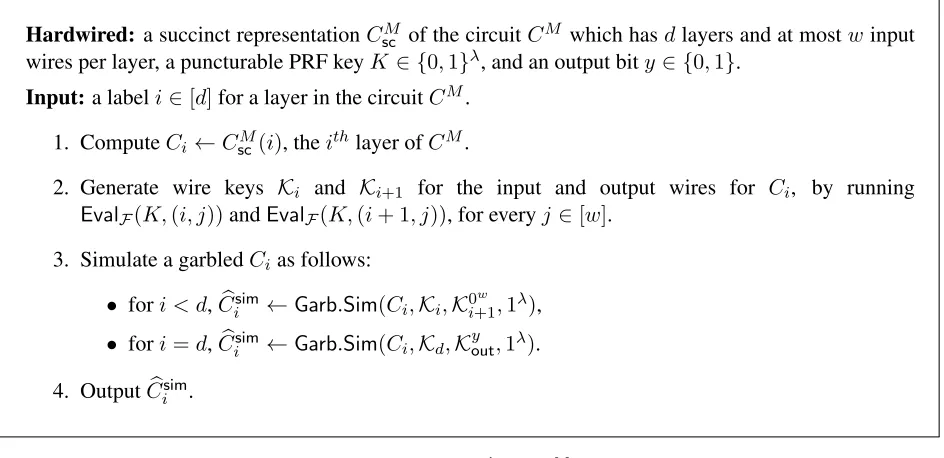
3. Let pad`(Lsim[y, CscM, K])be the layer simulating circuit from Figure 2 padded to size` ≤ |CscM| ·
poly(λ), which will be specified later on. Sim outputs (iO(pad`(Lsim[y, CscM, K])),K0n
in,Kout),
whereK0n
Layer simulating circuitLsim[y, CscM, K]
Hardwired: a succinct representationCscM of the circuitCM which hasdlayers and at mostwinput wires per layer, a puncturable PRF keyK∈ {0,1}λ, and an output bity∈ {0,1}.
Input:a labeli∈[d]for a layer in the circuitCM.
1. ComputeCi ←CscM(i), theithlayer ofCM.
2. Generate wire keys Ki and Ki+1 for the input and output wires for Ci, by running
EvalF(K,(i, j))andEvalF(K,(i+ 1, j)), for everyj∈[w].
3. Simulate a garbledCias follows:
• fori < d,Cbisim←Garb.Sim(Ci,Ki,K0
w
i+1,1λ),
• fori=d,Cbisim←Garb.Sim(Ci,Kd,Kyout,1λ).
4. OutputCbisim.
Figure 2: CircuitLsim[y, CscM, K]
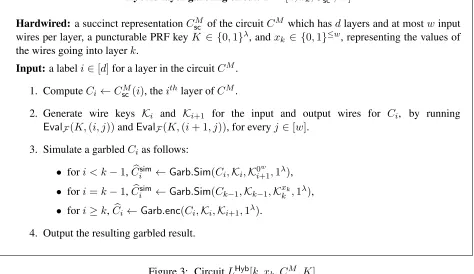
We show that the (real) randomized encoding is indistinguishable from the simulated one by a hybrid argument. Informally, we will considerdhybrid distributions, where in thekthdistribution we shall obfus-cate a hybrid layer garbling circuit that simulates all the garbled layers up to layerk, and truly garbles the layers above layerk.
Formally, for k ∈ [d+ 1] and xk ∈ {0,1}≤w, the hybrid simulated distribution Hyb(k, xk, CscM,1λ) is
defined as follows.
Hybrid simulatorHyb(k, xk, CscM,1λ)(differs fromsRE.encandSimin the third of three steps):
1. Hybfirst computes the succinct representationCscM of the layered circuitCM.
2. Next, Hybsamples a puncturable PRF keyK ← KeyF(1λ), and derives input keys Kinand output
keysKout, by runningEvalF(K,(in, j))for every wire(in, j), andEvalF(K,(out,1)).
3. Letpad`(LHyb[k, xk, CscM, K])be the hybrid layer garbling circuit from Figure 3 padded to size`≤
|CscM| ·poly(λ), which will be specified later on. Hyboutputs:
• fork >1:(iO(pad`(LHyb[k, xk, CscM, K])),K0
n
in,Kout)
• fork= 1:(iO(pad`(LHyb[1, x1, CscM, K])), K x1
in ,Kout).
First, note that for any machineM, inputxand time boundt,Mcx,thas the same distribution as the one
generated byHyb(1, x, CscM,1λ), andSim(y, M, t,1|x|,1λ)has the same distribution as the one generated byHyb(d+ 1, y, CscM,1λ)whereyis the output ofM onxintsteps.
From hereon, for some fixed (CM, x) we denote by xk ∈ {0,1}≤w the bit string corresponding to
the values of the input wires to thekth layer of CM when computed with input x. That is,x
Hybrid layer garbling circuitLHyb[k, xk, CscM, K]
Hardwired: a succinct representationCM
sc of the circuitCM which hasdlayers and at mostwinput
wires per layer, a puncturable PRF keyK ∈ {0,1}λ, andx
k ∈ {0,1}≤w, representing the values of
the wires going into layerk.
Input:a labeli∈[d]for a layer in the circuitCM.
1. ComputeCi ←CscM(i), theithlayer ofCM.
2. Generate wire keys Ki and Ki+1 for the input and output wires for Ci, by running
EvalF(K,(i, j))andEvalF(K,(i+ 1, j)), for everyj∈[w].
3. Simulate a garbledCias follows:
• fori < k−1,Cbisim←Garb.Sim(Ci,Ki,K0
w
i+1,1λ),
• fori=k−1,Cbisim←Garb.Sim(Ck−1,Kk−1,Kxkk,1λ),
• fori≥k,Cbi ←Garb.enc(Ci,Ki,Ki+1,1λ).
4. Output the resulting garbled result.
Figure 3: CircuitLHyb[k, xk, CscM, K]
Since the number of hybrids is d+ 1, which is in turn bounded byO(t) the running time ofM(x), it suffices to prove the following lemma, in order to complete the proof of the theorem.
Lemma 3.2. For any poly-size distinguisher D, there exists a negligible α(·), such that for any λ ∈ N,
machineM, inputx, and time boundt, the following is satisfied: letCscMbe the layered circuit that succinctly represents CM corresponding to (M, x, t) steps. Let dbe the number of layers inCM. Then, for every
k∈[d],
Pr[D(Hyb(k, xk, C
M
sc,1λ)) = 1]−Pr[D(Hyb(k+ 1, xk+1, CscM,1λ)) = 1]
≤α(λ) .
Proof. The lemma is proved via yet another hybrid argument. Concretely, we consider the following hybrid distributions.
- H0:This distribution is identical toHyb(k, xk, CscM,1λ).
- H1:This distribution is obtained changingHyb(k, xk, CscM,1λ)as follows. Instead of obfuscating the
circuitpad`(LHyb[k, xk, CscM, K]),Hybobfuscates a circuitpad`(L Hyb
1 [k, xk, CscM, Kk×[w],Kkxk,Cbk]),
that differs from the latter in the following ways:
1. LHyb1 uses a PRF keyKk×[w]that is punctured at the set of inputs{(k, j)}j∈[w]corresponding to the input wires to thekthlayer ofCM; that is,Kk×[w]←PunctureF(K,{k} × {1, . . . , w}).
3. fori = k−1,L1Hyb does not explicitly deriveKk usingK, but rather has only the keys Kxk
k
hardwired to it, and uses them as before to computeCbk−sim1.
4. fori=k,LHyb1 does not explicitly computeCbkusing the keysKkderived fromK, as inLHyb,
but ratherLHyb1 hasCbkhardwired, and outputs it given inputk.
- H2:This distribution is identical toH1except that the keysKkare not derived pseudorandomly from
K, but rather are sampled truly at randomKk←U2λ×w. Accordingly, the hardwired valuesKkxkand
b
Ckare now with respect to this (random) choice ofKk.
- H3:This distribution is identical toH1with the following two changes:
1. The hardwiredCbkinL
Hyb
1 is now replaced with a simulated one:
b
Cksim←Garb.Sim(Ck,Kk,K xk+1
k+1 ),1 λ) ,
whereCk←CscM(k),Kkis sampled uniformly as in the previous hybrid, andK xk+1
k+1 is obtained by computing{EvalF(Kk×[w],(k+ 1, j)) :j∈[w]}andxk+1 =Ck(xk).
2. Instead of havingKxk
k hardwired in it,L Hyb
1 hasK0 w
k hardwired.
- H4:This distribution is identical toHyb(k+ 1, xk+1, CscM,1λ).
Let`be the maximal ofL, Lsim, LHyb, LHyb1 , for any possiblek∈[d+ 1], and note that
`≤(|Ck|+|xk|)·poly(λ)≤2|Ck| ·poly(λ) .
To prove the lemma, we show that the above hybrids are computationally indistinguishable; that is, for any poly-size distinguisherD, there exists a negligibleα(·), such that for anyλ∈N,i∈[4],
|Pr[D(Hi−1) = 1]−Pr[D(Hi) = 1]| ≤α(λ)
.
- H0andH1: follows from the IO guarantee. Specifically, the only difference between the two is in the the circuit they obfuscatepad`(LHyb), orpad`(LHyb1 ); however, by the definition of LHyb1 these two circuits compute exactly the same function, and we can invoke the IO guarantee.
- H1 and H2: follows from pseudorandomness at punctured points. Specifically, any distinguisher between the two hybrids directly translates to a distinguisher between
Kk×[w],(EvalF(K,(k, j)) :j∈[w])andKk×[w], U2λ×w .
Indeed, the two distributionsH1,H2can be perfectly simulated fromKk×[w]andKk, which results in
H1ifKkare chosen according toK, and inH2, ifKkare chosen uniformly at random.
- H2andH3: follows from the security of the circuit garbling scheme. Indeed, we are guaranteed that
Kxk
k ,Cbk≈cK0
w
k ,Cbksim ,
forKk ← U2λ×w, Cbk ← Garb.enc(Ck,Kk,Kk+1,1λ), andCbksim ← Garb.Sim(Ck,Kk,K
xk+1
k+1 ,1 λ),
- H3andH4: this follows as in the indistinguishability ofH0andH2, but in reverse order. That is, we first invoke pseudorandomness at punctured points, to go from samplerKkat random, to sampling it according toK, and then “unpuncture”Katk×[w], and invoke IO.
This completes the proof of the lemma.
This completes the proof of the theorem.
3.4 Fully-Succinct Randomized Encodings from Padding-Free IO
In this section, we introduce padding-free indistinguishability obfuscation (padding-free IO ). Then we construct (fully) succinct randomized encodings from padding-free IO .
In what follows, we shall say that a PPT algorithmOis function-preserving if for any circuitC,O(C) computes the same function asO. (In particular, any obfuscatorOis function-preserving).
Definition 3.5 (padding-free IO ). Let O be a function-preserving PPT algorithm. We say that O is a padding-free indistinguishability obfuscation with respect to two distribution ensembles (C0,C1) =
{(Cλ,0,Cλ,1)}, if for any function-preserving PPTO0, ifO0(C
0)≈cO0(C1), thenO(C0)≈cO(C1).
Before showing how to construct full-succinct randomized encodings from padding-free IO, a couple of remarks are in place. First, we note that crucially, the padding-free indistinguishability obfuscation ob-fuscatorO has some fixed polynmoial blowup, whereas the obfuscatorO0 may blowup the circuit to an arbitrary poly-size. Second, we note that while this definition is implied by VBB, and may seem weaker, it is also seems unlikely to hold for general distributions.7 Nevertheless, the notion may be satisfied for certain distributions, such as the one we are interested in here.
3.4.1 The Scheme
LetObe a padding-free indistinguishability obfuscation forP/polyand(Garb.enc,Garb.dec)be a circuit garbling scheme. Let(KeyF,EvalF)be a PRF with input length λand output length2λ. We describe the
encoding and decoding algorithms.
Notation: We introduce notation that will be used in the description of the construction and its proof of security. As before, we shall consider a circuitCM corresponding to some machineM. Letsbe the size of the circuit andwbe the number of wires in the circuit. We label every gate withi∈ [s]and every wire withj ∈ [w]. Letin(i)andout(i)denote the set of input wires and output wires to gateirespectively. In the construction below, there will be a pair of keys(Kj0, Kj1)associated with every wirej ∈[w]. Adding to the notation in Definition 3.4, we shall denote byKin,i all the keys
n
Kj0, Kj1o
j∈in(i) corresponding to
7
More accurately, we mean that for any candidate padding-free indistinguishability obfuscationO, there exists two distributions
C0,C1, andO0such thatO(C0)≈cO(C1), butO(C0)6≈cO(C1). To get a sense of why this is unlikely, considerCbwhich compute
a pseudorandom function only onT values, whereT is a large enough polynomial related to the blowup ofO. In addition they output a succinct obfuscation of a program that given a small circuit, checks whether it computes the PRF correctly on theTvalues and if so, outputsb. O0
is simply an obfuscator that doesn’t have the key for the PRF, but rather has the PRF values hardwired. Using an incompressibility argument we can then show thatO0(C0)≈cO0(C1); indeed, had we replaced the pseudo-random values
with truly random values, a small circuit computing them wouldn’t exist. On the other hand,O(Cb)will already be itself such a
the input wires to gateg. Similarly,Kout,idenotes the keys
n
K0 j, Kj1
o
j∈out(i)corresponding to the output wires to gateg.KinandKout denote the set of wire keys for the input and output wires ofCM respectively.
Also, for a possible assignmentx ∈ {0,1}|in(i)| to these wires, we denote byKx
in,ithe keys
n
Kxj
j
o
j∈in(i) corresponding to the bits ofx. Kx
out,i,KxinandKoutx are defined similarly.
The encodersRE.enc(M, x, t,1λ):
1. sRE.encfirst reduces the machineM, input length|x|and time boundtto a circuitCscM which is a succinct representation of circuitCM as per Lemma 3.1.
2. Next,sRE.encsamples a puncturable PRF keyK ←KeyF(1λ).
3. Letpad`(G[x, CscM, K])be the gate garbling circuit from Figure 4 padded to size`≤poly(|CscM|,|x|, λ), which will be specified exactly in the analysis.sRE.encoutputsO(pad`(G[x, CscM, K])).
Gate garbling circuitG[x, CscM, K]
Hardwired: a succinct representationCscM of the circuitCM of sizes, a PRF keyK ∈ {0,1}λ and
inputxtoCM
Input: either of the following labels: (i)inputkeysfor the keys of the input wires corresponding to inputx, (ii)outputkeysfor the keys of the output wire, or (iii)i∈[s]for a gate in the circuitCM. Case (i): input isinputkeys
Generate and output wire keysKx
in for the input wires ofCM corresponding to inputx, by running
(Kj0, Kj1)←EvalF(K, j)and pickingK xj
j for every input wirejofCM.
Case (ii): input isoutputkeys
Generate and output wire keysKout for the output wire ofCM, by running(Kj0, Kj1) ←EvalF(K, j)
for the output wirejofCM. Case (iii): input isi∈[s]
1. Computegi←CscM(i), theithgate ofCM.
2. Generate wire keysKin,iandKout,ifor the input and output wires forgi, by running(Kj0, Kj1)←
EvalF(K, j)and for everyj ∈in(i)andout(i).1
3. Output a garbledgi:
˜
gi←Garb.enc(Ci,Kin,i,Kout,i,1λ) .
Figure 4: CircuitG[x, CscM, K]
The decodersRE.dec(Mcx,t):
1. Generate wire keysKx
in←Mcx,t(inputkeys)andKout ←Mcx,t(outputkeys).
1
Throughout, we assume WLOG thatw≤2λ
, and thus wires can be represented as inputs to the puncturable PRF in{0,1}λ