Bradley, C. & Oliver, M. (2002) The evolution of pedagogic models for work-based learning within a virtual university. Computers and Education, 38 (1-3), 37-52.
The evolution of pedagogic models for work-based
learning within a virtual university
* Claire Bradley, Learning Technology Research Institute, University of North London, 166-220 Holloway Road, London N7 8DB
Email: [email protected] Fax: 020 7314 4302
Martin Oliver, Higher Education Research and Development Unit, University College London, 1-19 Torrington Place, London, WC1E 6BT
Abstract
The process of designing a pedagogic model for work-based learning within a virtual university is not a simple matter of using ‘off the shelf’ good practice. Instead, it can be characterised as an evolutionary process that reflects the backgrounds, skills and experiences of the project partners.
The pedagogic models that evolved as part of the project will be outlined, and the reasons for rejecting each will be given. They moved from a simple model, relying on core computer-based materials (assessed by multiple choice questions with optional work-based learning), to a more sophisticated model that integrated different forms of learning. The challenges that were addressed included making learning flexible and suitable for work-based learning, the coherence of accreditation pathways, the appropriate use of the opportunities provided by online learning and the learning curves and training needs of the different project teams.
Although some of these issues were project-specific (being influenced by the needs of the learners, the aims of the project and the partners involved), the evolutionary process described in this case study illustrates that there can be a steep learning curve for the different collaborating groups within the project team. Whilst this example focuses on work-based learning, the process and the lessons may equally be applicable to a range of learning scenarios.
Keywords
Pedagogical issues; Lifelong learning; Distance learning and telelearning; Interactive learning environments; Teaching/learning strategies.
1. Introduction
This paper is based on experiences gained from the Training for Innovation in Supply Chain Management project, which was funded through ADAPT to deliver online masters-level courses in supply chain management to learners in employment through a virtual university.
2. Background
2.1 The educational context
The project set out to provide education and training for a specific group of learners: employees of Small- and Medium-sized Enterprises (SMEs). SMEs are a vital part of the UK economy; in 1996, for example, 99.1% of all business transactions in the UK involved the participation of an SME (Bagwell, 1997). However, SMEs face a number of problems in maintaining and developing the skills of their employees. They are characterised by having small training budgets and limited release time, making it difficult for staff to study full-time or on block-release courses away from the workplace. This, combined with perceived cultural differences, has resulted in a poor track record of success in the provision of training for SMEs by Higher Education institutions (HEIs) (Kewell et al., 1999).
Equally relevant in shaping work-based learning are situated theories of learning (e.g. Lave, 1997), which contrast formal learning with the informal development of skills and expertise that takes place in a contextualised way through individuals’ practice. This idea is taken further with the notion of cognitive apprenticeship, which frames learning as a process of enculturation in communities of practice (Brown et al., 1989). These views point to the central value of direct experience in learning; consequently, much work-based learning involves work-based activities, and thus concentrates on learning through work, rather than simply about work (cf. Knapper & Cropley, 1991, 104-108). Thus action learning has become a common and widely endorsed approach in work-based learning – an approach against which traditional forms of Higher Education are often compared in a disparaging way (Tosey & McNair, 2001).
There is an important corollary to this privileging of learning through work, when taken together with the necessity of learners’ perception of the relevance of their study. This is that tutors in an academic context may be unable (or at least, may be perceived to be unable) to provide the kind of insights and feedback that are of greatest relevance to the based learner. Consequently, the idea of the work-based mentor has become common, either as an adjunct to or a replacement for a tutor based in an academic institution, depending on the nature of the course.
meet the organisational needs of the host institution rather than the individual learners.
Since many of the situational characteristics outlined above will vary from learner to learner, some adult educators have moved away from the traditional format of structured, scheduled courses and towards tailored forms of learning, formalised through the use of negotiated learning contracts (Peters, 1998; cf. individualised learning in Knapper & Cropley, 1991). These provide a focus for an agreement between learner and tutor on any matters that are considered important, such as learning objectives, methods of and criteria for assessment, means and frequency of contact, and so on. This allows relevance, flexibility and responsiveness to be maximised, whilst ensuring that the quality of the learning experience can be measured against mutually agreed criteria.
In summary,
The term work-based learning is used to describe independent learning through work. It is a self-managed process supported by learning contracts, Higher Education and work-place mentors and various types of learning and guidance materials.
(University for Industry, 1999; cited in Johnson, 2000)
at least five distinct ways (the traditional ‘bridge into work’, experiential, key skills/competence, facilitated learning or a connective model of pedagogy and learning in work-based contexts), each of which privileges certain epistemological positions above others (Griffiths & Guile, 1999). Such complexities, together with more specific issues about pedagogy and structure, will be examined in greater detail in the case study that follows.
2.2 The project’s aims and methodology
Another aspect of the project that was intended to support flexible learning was the introduction of an initial training needs analysis. This was provided to allow learners to identify the most relevant materials, both in terms of their individual and their organisational needs. On the basis of this analysis, it was intended that learners would build personalised pathways through the materials using negotiated learning contracts. This tool will be described in more detail in later sections.
A key aim during the development process was to gain a shared understanding and adoption of a pedagogic model across the diverse specialisms and all the teams involved in creating the virtual university. This was required at an early stage to provide a foundation and to give direction to the subsequent development work. The model would have to be flexible in order to meet the various requirements of the project and its participants, and would need to:
• meet the needs of learners in SMEs, studying in the workplace via online delivery
• be suitable for materials delivered and supported through an online system
developed as part of the project
• fit the requirements and academic standards of a global virtual university and
allow a variety of routes to assessment.
The rest of this paper will outline the pedagogic models that were adopted and how they evolved as the development of the project progressed over time.
3. The pedagogic models
3.1 Model one: Flexible learning
The starting point was to develop a set of guidelines for authors that would underpin the project’s pedagogic approach. These initial guidelines identified the following ‘frameworks’:
• open learning (OL) - the learning should take place at the time and place of the
• computer based learning (CBL) - the learning should be delivered through a
computer system;
• work based learning (WBL) - the learning should be applicable to and developed
within a working environment.
These clearly reflect the rationale for the work. The guidelines went on to note,
Each of these frameworks impacts on the production of learning materials. The design of instructional text for use in an open learning context requires a high level of clarity, a clear learning purpose and means of engaging the learner actively in the learning process. The computer based learning platform impacts on the amount of information a learner can take in, navigation through the learning materials and makes design a central element in the production of materials. Work based learning requires us to move beyond theory into the realm of practice and to see assessment and accreditation as integral parts of the learning process.
The project was also committed to accrediting the learning experience. On this basis, certain core materials were identified (“the theory and principles of supply chain management”), and it was proposed that these be assessed using multiple choice questions, completion of which would result in an assessment grade that could be submitted to HEIs for credit. (These topics were not elaborated upon further in model one; however, they will be returned to later.)
pre-prepared materials, was to be assessed by staff based at a Regional Delivery Centre (the HEI with which the learner was registered). These staff would receive a workshop on assessing work-based learning as preparation. (Registration with an HEI was a pre-requisite for acceptance at this level.)
An advanced option was also envisaged, focusing purely on work-based learning projects. Such options would not be ‘written’ in advance, but would be negotiated on a case-by-case basis and structured by assessment practices.
Within this structure, the material was organised into units, each of which represented six learning hours: three as work-based learning, three as computer-based, with assessment activities such as multiple choice tests included in this total.
Importantly, although the guidelines proposed that authors should use learning outcomes (covering knowledge, understanding, skills and practice) to structure learning and assessment, no distinction would be made as to the ‘level’ (undergraduate, masters, etc.) to which the material would be written. Whilst the project was aimed at postgraduate qualifications, the intention was to widen its potential audience by offering materials that were suitable for undergraduate study as well. As a result, authors were encouraged to write materials that would satisfy both core and advanced levels, with decisions about the level of learners’ achievements judged on their outputs, in terms of:
• The approach to study (degree of linkage across themes or fields).
• The appropriateness of the methodology.
• The quality of communication.
Several recommendations were made to authors concerning ways in which active learning could be promoted, including:
• The identification of controversial issues.
• The use of formative assessment (with corrective feedback).
• Linking material with the real world.
Importantly, although authors were not required to carry out the technical implementation, they were expected to produce a ‘storyboard’ for the materials, which they were advised should be essentially linear (a “core learning narrative”), but containing multiple layers of information (“exemplification”, “commentary”, “thinking about…” and “further reading”).
3.2 Model two: socio-constructivist learning
Changes of staff within the project led to the initial pedagogic model being reviewed. The values represented in the initial approach, calling for motivating, vocationally relevant learning, remained unchanged; however, several concerns were raised about the pedagogic approach that had been adopted.
approaches, authors were encouraged to consider the suitability of a range of options for computer-marked assessment, including multiple choice, numerical answer, and computer-based puzzles, games or simulations with ‘completion’ criteria. In addition, a wider range of tutor-marked assessment options was suggested, such as short answer questions, reports, essays or portfolios. Tutors were also invited to consider the suitability of formal examinations and of peer assessment. The intention at this stage was to research the relative merits of different assessment practices, rather than to pre-judge the suitability of different approaches.
to provide ‘multi-level’ materials (suitable for undergraduate and postgraduate study) was dropped, since widening the audience in this way made the project too broad, so that it threatened to become incoherent.
Other issues that arose included the emphasis on text-based materials, the hierarchical (layered) structure of content and the assumption that learners would all study in isolation. In response to this, it was suggested that the linear structure of the units be maintained, but that the hierarchical structure should be flattened by placing the examples and commentaries in this main educational narrative rather than at some deeper, ‘hidden’ level in the material. The use of hyperlinks to outside materials was also considered, with the convention of using links like references at the bottom of pages (allowing users to investigate resources of interest but minimising the interruptions that might arise from links embedded within the material). Authors were also presented with a range of multimedia that could be incorporated into a web-based system, such as graphics, simple animations, sound, videos (such as ‘talking head’ clips) and simulations. The pros and cons of these (particularly in terms of speed of web-based access and development time) were highlighted, and authors were advised to discuss the suitability of incorporating such resources with the LSS team.
To encourage the introduction of these discursive approaches, and to gain feedback on the relative importance of different pedagogic elements in the materials, authors were asked to complete a “unit template”. This was a ‘map’ of each unit that illustrated what the indicative content was, roughly how long learners would be expected to spend on each section, and which pedagogic approaches (including work-based activities, self-study, discussion, formative assessment and so on) would be used in each. This template was included as an appendix in a revised set of authors’ guidelines, which was circulated amongst the project teams.
3.3 Model three: Experiential learning
When the first drafts of materials were reviewed by the LSS team, it became apparent that the authors were not designing materials according to the guidelines, continuing to work in the style most familiar to them. This provided an interesting diversity of materials, but resulted in substantial inconsistency from one module (and in some cases, units within a module) to another. Few authors had experience of writing for distance or online learning - consequently, much of the material produced read like an extended textbook, although some examples resembled un-proofed teaching notes. Their approach reflected a very lecturer-centred, rather than learner-centred, model of education, based on the transmission of information, with few opportunities for learner interaction or engagement. In several cases, the only opportunity for interaction came from formative assessed essays, some of which simply required wider reading, where the learner could expect feedback from a remote expert on their work. Although this was rarely reflected in the learning outcomes given for the units, all of which spoke of higher-order learning, this approach to learning focused on memorisation and basic understanding rather than critical interpretation, the development of skills or the work-based application of concepts. In many ways, these first submissions reflected the first pedagogic model that had been rejected.
suggested to illustrate and reinforce examples and concepts, and hyperlinks were used for presenting viewpoints and model answers to questions posed. The result was material that was highly learner-centred and interactive. It was also characterised by having a lower level of teaching input, and was stylistically very different from materials produced by the other authors.
One reason for the lack of a common approach amongst authors was that the socio-constructivist approach, based on Laurillard’s conversational framework (1993), was unfamiliar to them. This made it hard for them to reach a consensus on the types of teaching techniques that were appropriate. Another important factor was that the authors were more familiar with teaching than with writing instructional materials. At the start of the project, it was assumed by some members of the project team that adapting to write for online learning would be unproblematic; in fact, many authors required considerable time, support and feedback before they were able to acquire the skills and style required.
time per learner. Others felt that this set of skills was more appropriately viewed as part of the technical support team’s remit.
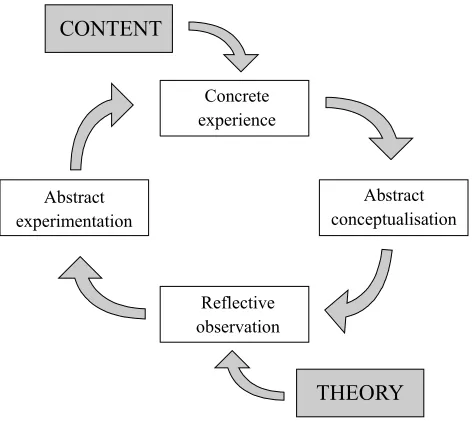
These experiences, together with subsequent discussions during team meetings, led to another revision of the pedagogic model. There was clearly a need for a model that could provide concrete recommendations about the structure of the materials, and allow an approach that all authors could relate to. Kolb’s experiential learning cycle (1984) was adopted to provide this foundation, with some adaptation to make it appropriate for online learning. Figure 1 shows how Kolb’s learning cycle was used as the basis for the design of the learning materials.
Figure 1: The use of Kolb’s learning cycle as the basis for online learning materials
Whilst learners’ experience from the workplace was an important starting point, teaching materials were also needed for those learners who required them or who desired a more theoretical grounding. Consequently, content was provided within the materials which learners could work with to enhance the concrete experience and knowledge they already had. They could combine these experiences with the new
Concrete experience
Reflective observation
Abstract conceptualisation Abstract
experimentation
knowledge they were acquiring or formulating, with external experiences from case studies and related reading materials, and were encouraged to conduct reflective observation through questions, activities, self-assessments and work-based activities. Additional content or theory enabled learners to conceptualise the topic being covered, culminating in work-based activities that promoted experimentation and work-based application. Each unit (of approximately 10 learning hours) would involve the completion of at least one learning cycle.
3.4 Model four: A pragmatic synthesis
Further evolution coincided with the release of the prototype delivery system. Although a dialogue had been ongoing between the learner support systems team, the technical developers and the authors, the prototype system reflected the designers’ intuitive pedagogic model. Again, this bore a close resemblance to the first pedagogic model, rejected earlier in the project.
The consequence of these differences of understanding was that the system underwent a rapid evolutionary process that mirrored the development of the pedagogic models. It moved from a text-oriented model towards a more flexible design that was text-led but which placed equal importance on activity, collaboration and the development of a personal ‘portfolio’ (which collated evidence from work-based practice and computer-based assessments). This can be seen as mirroring the pedagogic move from instruction to experiential learning. Structural constraints were imposed on the materials, with each unit subdivided into a number of sections including an introduction and review section. Within each section, the material was separated into content, related materials, case studies and activities, accessible through a series of ‘tabs’ along the top of the screen. Further tabs provided access to the communication facilities (discussion groups and chat rooms), the learner’s portfolio and access to support services.
materials are presented separately, learners could attempt all the activities and assessments first if they were experienced and sought fast accreditation, or alternatively they could skim through the content and go straight to the case studies to find out about real-life examples. The navigational structure supported many such permutations. The result is a hyperstructure, a highly user-centred model that allows users to have considerable freedom of access through a network of nodes of content, and to pursue non-linear pathways through it (Boyle, 1997).
Whilst the system provided a common structure for materials, some authors were still struggling to incorporate opportunities for the appropriate use of multimedia and online technology in their materials. To address this, demonstrations and examples were provided by the technical team, and suggestions were made to authors as draft materials were reviewed. A further breakthrough came with the development of templates for self-assessment activities. The technical team devised a set of ten activities that could be easily customised to work with different content. For example, multiple choice questions, keyword matching, object pairings and jigsaws (for placing process flow diagrams in sequence). These templates helped authors who had difficulty in devising self-assessments or activities that could be computer-marked. The technical developers could quickly create these activities, as the programming code and structure could be re-used and re-purposed, avoiding each activity being created from scratch. Authors were also shown how learners could key in text or submit files for their activity responses, and how these would be stored in their online portfolio, for later recall by themselves, their tutor or their mentor.
consequence, the authors’ guidelines were revised again in order to ensure that materials could effectively be integrated within the online system. This advice became more detailed and directive – something that had been specifically requested by a number of authors – and ended up being closer to a specification than to a set of guidelines. The unit template was extended so authors could map the assessment methods to learning objectives and the resulting support requirements more closely. Checklists containing the minimum criteria for academic and pedagogic requirements were devised, providing clear standards that authors should aim to achieve, and giving reviewers a checklist for quickly evaluating and providing feedback on drafts. This resulted in greater consistency across the modules, and a quicker drafting and evaluation process.
The evolution of the delivery system had a direct impact on authoring styles, as it imposed a definite structure onto the modules. Whilst this helped to provide consistency from one module to the next, its effect on authors was mixed. It benefited some authors, encouraging them to improve the structure of their materials, but hindered others as it imposed too much rigidity. For most authors, the revisions that were proposed by the LSS team centred on adding opportunities for interactivity. This became easier as materials were put online and authors could see concrete examples of the technical possibilities that were achievable, and thus learn from the techniques other authors were using.
of study. In this respect, the system acted as a ‘ceiling’ for pedagogic innovation, emphasizing the content and theory related elements of the experiential learning cycle rather than reflective observation or abstract experimentation.
Changes to learner support were also introduced. Many authors had organised the materials around the tutor, requiring a high amount of ‘contact’ time per learner for discussion and marking. This was not viable within the project’s resources, and clearly neglected less familiar forms of support such as the in-company mentors and the facilitators based at regional delivery centres. Some authors struggled to incorporate self-assessments or activities that incorporated automatic feedback. The introduction of the activity templates helped to address this balance, as did the reduction of activities that relied on bespoke tutor feedback, resulting in an increase in ‘general’ feedback and model answers.
As part of this revision of the pedagogic model, the assessment framework was also revisited. From the beginning, the intention was to operate a credit accumulation and transfer system, whereby learners could collect credits for units they successfully completed, and also accreditation of prior experience and learning (APEL). During the life of the project, individual modules were to be accredited by the authoring university prior to being recognised by the virtual university. However, it became apparent that learners could not be viewed as a homogenous group. For some, flexibility was more important than accreditation; for others, course credit was more important. It was difficult to provide enough flexibility in the system to adequately accommodate both.
common agreement about marks per module (which would be the smallest unit of accreditation) and levels of pass, merit and distinction. Within this framework, authors could choose where to place assessments throughout the module, providing it was clear they were assessable and were allocated a percentage of the overall marks available. The implication of this was that ‘just in time’ learners, who selected individual units based on their needs, were unlikely to build up the consistency required to receive credit for their study. This problem could only be resolved outside of the scope of the project, when the materials would be offered and validated through the virtual university designed to deal with such issues.
In summary, this final pedagogic model arose out of the need to devise a commonly understood and workable approach that suited all the stakeholders and met the requirements of the project. Initial models were shown to be somewhat ‘idealistic’ and, at the end of the day, impractical, for the reasons outlined above. The resulting model was based on the following characteristics:
• Modules were masters-level, of 100 learning hours each. They had a common
structure, but some variation was permitted to suit specific subject matter and author style.
• The delivery system gave structure, but also allowed learner choice of study
pathways, within both modules and units.
• Learner online discussions and exchanges of views were built into the materials.
• The learner support structure combined online tutor feedback, an in-company
mentor and regional facilitator.
• Assessment consisted of a combination of self-assessment activities which had
computer-generated feedback or model answers and tutor-marked assessments, with credits awarded on a module basis.
4. Summary and discussion
better suited to its context than the first; however, the reason for this was more to do with the breadth of perspectives that it had been exposed to rather than that it had been piloted, found to be flawed and refined. Such piloting was only possible after this stage in the evolutionary process.
These evolutionary steps could not be pre-empted. They took place in spite of the fact that all groups had been involved in discussions of the model from the outset. However, it was only when the group was presented with something that they found meaningful that they were able to engage with it in a deep way. For the authors, this happened when they first started to use the writing guidelines. For the technical developers, it was when they implemented the first completed unit materials. (Sample materials had been circulated, but since these had been discussed, rather than implemented under real conditions, additional lessons were learnt when the first real materials were acted upon.) For the delivery staff, it was being given completed materials to deliver. The implication of this was that the project’s initial plan, which assumed that several of these steps would take place in parallel, was inappropriate. Given the causal steps in the evolution of the system, a staggered introduction of parallel phases of work would have been more appropriate.
the project had an educative effect on all involved. This accommodation of perspectives, as opposed to the dominance of one model, is reflected in the fact that authors’ materials remained distinct and diverse (albeit within tighter constraints) at the end of the project.
This evolution of the pedagogic model is summarised in Table 1, below. This illustrates the way in which each new group that engaged with the model caused it to evolve, and how this engagement represented an important learning process for each group. Also recognised in the table is that the gradual process of evolution took place throughout the project, based on the ongoing experience and feedback of the different groups.
Phase 1 Phase 2 Phase 3 “Roll out” Learner support systems team Learning (produce model 2) Doing/refining (supporting authors) Doing/refining (liaison between authors and technical team) Doing/refining (liaison; re-interpreting model and guidance in light of pilot)
Doing/refining (continuing liaison; ‘troubleshooting’) Authors Learning (produce sample materials) Doing/refining (produce materials) Doing/refining (adapting materials in light of pilot)
Doing/refining (continue authoring and revising materials ) Technical team Learning (produce prototype system) Doing/refining (adapting system in light
of pilot) Doing/refining (provision of technical support) Deliverers Learning (deliver pilot) Doing/refining (delivery) Learners Learning (feedback on pilot)
This evolution occurred over a timescale of two years: phase 1 took about 6 months, phase 2 about 10 and phase 3 about 8 months. The roll-out of materials is ongoing. Given that the periods of transition were short and rapid, it seems likely that these durations reflect the volume of work (as outlined above) rather than the degree of learning involved.
The discussion so far has concentrated on features that evolved during the project. It is also worth considering the elements that remained unchanged. These included the emphasis on flexibility and on work-based learning. Significantly, these had been placed outside the arena of negotiation by the fact that they were specified in the initial project bid, and were central to the ethos of the project. Like the topics to be covered, or the project’s duration, they were contractual requirements. As such, they acted as points of reference throughout the evolutionary discussions.
5. Conclusions
Meeting the needs of work-based learners places a number of requirements on education and training providers. In this paper, the evolving pedagogic approach adopted by an online learning project, consisting of a number of HEIs and other organisations, has been described. Importantly, these evolutionary steps all reflect the sharing of the pedagogic model with a new group of stakeholders. Each group both influenced and was influenced by the discussions that took place concerning the revision of the model.
Several conclusions can be drawn from this experience. Firstly, the process of developing learning materials for a new programme is iterative and evolutionary, with any elements that are not contractually fixed being re-negotiated and re-interpreted at each step.
Secondly, at any given time, a pedagogic model should be viewed as a guiding framework, since each group of stakeholders will relate it to their own experience and expertise. This process will result in a number of different interpretations being held simultaneously – a situation that can either become a constructive tension, resulting in fruitful discussion and the development of the model, or which can lead to fragmentation and divergence, depending on the goodwill of the partners and the skill of the person responsible for the process.
This continuous process of discussion and revision – which bears all the hallmarks of a constructivist approach to project development – is inherently educational. Many aspects of this project fell outside the experience of participating authors or the technical team, for example. Each of these groups engaged with new forms of pedagogy as the development process involved them.
Finally, it is important to note that some pedagogic features remained unchanged throughout. These included the contextual factors that were important in determining the pedagogic approach, including the needs of the learners, the aims of the project and constraints imposed by the delivery system and technology.
References
Bagwell, S. (1997). Marketing Continuing Vocational Education and Training to Small and Medium Sized Enterprises: Key Issues for Higher Education Institutions. Innovations in Education and Training International, 35(3).
Boud, D. (1995). Enhancing Learning through Self Assessment. London: Kogan Page.
Boyle, T. (1997). Design for multimedia learning. London: Prentice Hall.
Brown, J., Collins, A. & Duguid, S. (1989) Situated cognition and the culture of learning. Educational Researcher, 18 (1), 32-42.
Conole, G., & Oliver, M. (1998). A pedagogical framework for embedding C&IT into the curriculum. ALT-J, 6(2), 4-16.
Griffiths, T. & Guile, D. (1999) Pedagogy in Work-Based Contexts. In Mortimore, P. (Ed) Understanding Pedagogy and its Impact on Learning. London: Paul Chapman Publishing.
Johnson, D. (2000) The Use of Learning Theories in the Design of a Work-Based Learning Course at Masters Level. Innovations in Education and Training International, 37 (2), 129-133.
Kewell, B., Hopkinson, S., Oliver, M., & Conole, G. (1999). A new kind of knowledge transfer? A report into the feasibility of embedding learning technologies within the SME market for vocational training. Cascade report no. 1, University of North London.
Knowles, M. (1984). Andragogy in Action. San Francisco: Jossey-Bass.
Kolb, D. (1984). Experiential learning. London: Prentice Hall.
Laurillard, D. (1993). Rethinking University Teaching. London: Routledge.
Lave, J. (1997) The Culture of Acquisition and the Practice of Understanding. In Kirshner, D. & Whitson, J. (Eds) Situated Cognition: Social, Semiotic and Psychological Perspectives. New Jersey: Lawrence Erlbaum.
Miller, A., Imrie, B., & Cox, K. (1998). Student Assessment in Higher Education: A Handbook for Assessing Performance. London: Kogan Page.
Peters, O. (1998) Learning and Teaching in Distance Education: Analyses and Interpretations from an International Perspective. London: Kogan Page.