Ecological validity of a simplified version
of the multiple errands shopping test
NICK ALDERMAN,1PAUL W. BURGESS,2CAROLINE KNIGHT,1andCOLLETTE HENMAN1 1The Kemsley Division, St Andrew’s Hospital, Billing Road, Northampton NN1 5DG, UK
2Institute of Cognitive Neuroscience, UCL (University College London), 17 Queen Square, London WC1N 3AR, UK
(ReceivedMarch 30, 2001;RevisedAugust 27, 2001;AcceptedJanuary 1, 2002)
Abstract
Shallice and Burgess (1991) reported the utility of the Multiple Errands Test (MET) in discriminating executive deficits in three frontal lobe patients with preserved high IQ, who were otherwise unimpaired on tests of executive function. The aim of this study was to ascertain the value of a simplified version of the MET (MET–SV) for use with the range of people more routinely encountered in clinical practice. Main findings were as follows: 1) The test discriminated well between neurological patients and controls, and the group effects remained when the difference in current general cognitive functions (WAIS–R FSIQ) was taken into account. 2) The best predictors of
performance in the healthy control group (n546) were age and the number of times participants asked for help (with more requests associated with poorer performance). 3) In the neurological group, two clear patterns of failure emerged, with performance either characterized by rule breaking or failure to achieve tasks. These two patterns were associated with different dysexecutive symptoms in everyday life. 4) The patients not only made more errors than controls, but also different ones. A scoring method that took this into account markedly increased test sensitivity. 5) Many patients passed traditional tests of executive frontal lobe function but still failed the MET–SV. This pattern was strongly associated with observed dysexecutive symptoms in everyday life. The results
demonstrate the clinical utility of the test, and suggest that there are two common and independent sources of failure on multitasking tests in a general neurological population: memory dysfunction, and initiation problems. (JINS, 2003, 9, 31–44.)
Keywords: Ecological validity, Dysexecutive syndrome, Multitasking, Multiple errands
INTRODUCTION
It is ten years since Shallice and Burgess (1991) demon-strated that patients with frontal lobe damage may be im-paired in everyday life situations requiring planning and multitasking despite normal or supernormal performance on traditional neuropsychological tests of language, memory, per-ception, and even executive functions. The explanation de-veloped at that time and subsequently (e.g., Burgess, 2000; Burgess et al., 2000) was that the cardinal situations where these patients had problems are those that require subtle planning and prospective memory, and are “ill-structured” (Goel & Grafman, 1997) in the sense that there are many different ways to approach the task and participants have to decide for themselves how they allocate their efforts.
Shallice and Burgess (1991) described two procedures that were sensitive to their patients’ particular dysexecutive problems. One was the Six Element Test, a measure of multi-tasking ability that can be conducted in the laboratory. This was subsequently developed and published as part of a bat-tery of tests that measure executive functions (Wilson et al., 1996). We now know some of the basic clinical character-istics of this type of task (e.g., Burgess et al., 2000; see Burgess, 2000 for review), and a number of variants are starting to appear in the literature (e.g., Levine et al., 1998; Manly et al., 2002). There are two key sets of findings concerning this class of test. The first is that the frontal lesions that most consistently impair performance tend to be located in the most anterior and medial aspects of the frontal lobes (Burgess, 2000; Burgess et al., 2000; Levine et al., 1998; see also Burgess et al., 2001, for related func-tional imaging evidence). The second is that test perfor-mance is a good predictor of problems with planning and “intentionality” (i.e., goal-directed behavior) in everyday Reprint requests to: Dr. Nick Alderman, Consultant Clinical
Neuro-psychologist, The Kemsley Division, St Andrew’s Hospital, Billing Road, Northampton, NN1 5DG, UK. E-mail: [email protected] DOI: 10.10170S1355617703910046
life (e.g., Burgess et al., 1998), in other words that the test has good “ecological validity.”
The second task used by Shallice and Burgess (1991) has received less attention. This was the Multiple Errands Test, a shopping task carried out in a pedestrian precinct. Partici-pants were required to achieve a number of simple tasks without breaking a series of arbitrary rules. Shallice and Burgess’s three patients were less efficient in the way they organized their efforts, completed fewer tasks and broke more rules than a group of healthy controls matched for age and intellectual ability. In addition performance of the brain-injured people was qualitatively unusual, and they made types of errors not seen in the controls.
This study demonstrated the MET to be potentially use-ful for the assessment of high level executive impairments in people whose general level of cognitive ability was “su-perior” and who passed existing frontal and other tests of cognitive functioning. However, its applicability to the range of people more typically encountered in routine clinical work remains unknown. Moreover, while the different forms of error made by patients on the test were considered, the relation between them, which would have informed our un-derstanding of the demands of multitasking was not possi-ble within a single-case design.
The first aim of the present study was therefore to pro-duce a simplified version of the Multiple Errands Test (MET– SV) more suited to general clinical use, and determine its ecological validity. The second aim was to examine the relationship between different forms of error on the test to ascertain the minimum number of theoretically separable factors determining multitasking performance. We have tried throughout to implement the task in such a way that others should be able to adapt it for their own environment.
METHOD
Research Participants
Two groups of people participated in the study. The first consisted of 46 people who had no history of neurological disease. These were recruited from amongst members of staff employed by St Andrew’s Hospital, Northampton, UK, and their associates. They were aged between 21 and 58 years (mean5 29.2, SD5 8.5). An indicator of general cognitive ability was obtained through performance on the National Adult Reading Test—Revised (NART–R: Nelson, 1991), which estimated the Wechsler Adult Intelligence Scale—Revised (WAIS–R: Wechsler, 1981). FSIQ for this group lay between 85 and 124 (mean5107.6, SD59.1). Equal numbers of male and female participants took part (n523). There were no significant gender differences re-garding either age (t50.89, p5.379) or NART FSIQ (t5 1.35, p5.183).
Controls rated themselves using the self-completion ver-sion of the Dysexecutive Questionnaire (DEX-S: Burgess et al., 1996a). Ratings are made on a Likert-type scale of
twenty of the most commonly reported dysexecutive symp-toms (e.g., disinhibition, confabulation).
Fifty people with brain injury also took part (41 male, 9 female). Thirty-six were inpatients admitted to a neurore-habilitation unit (Kemsley Division). The remaining cases were outpatients. Seventy-eight percent had sustained trau-matic brain injury (TBI) as a result of motor vehicle acci-dents. Of the remainder, 9 had incurred brain damage through cerebrovascular accident and two had undergone surgery for cerebral tumors. Severity was determined with refer-ence to duration post-traumatic amnesia, duration coma, or depth of coma when first admitted to hospital (see King, 1997). Most were categorized as “very severe” (75%). Of the rest, four were classified as “moderate,” four as “se-vere,” and one “mild.” It was not possible to determine severity of injury for one participant. Mean time since in-jury was 72.1 months (SD568.4, minimum5 6, maxi-mum5372).
Age ranged from 18 to 59 years (mean5 34.6, SD5 12.7). Estimates of optimal pre-morbid levels of general cognitive ability were obtained using the NART–R, and indicated a mean FSIQ equivalent of 99.9 (SD 5 12.9). Current levels of ability were somewhat lower (mean WAIS–R FSIQ584.1, SD512.7).
Brain injured participants completed the self-completion version of the Dysexecutive Questionnaire (DEX-S; Bur-gess et al., 1996). Patients were also rated on the second version (DEX-O: Burgess et al., 1996a) of this question-naire by someone who knew them well. For inpatients, the DEX-O was completed by a member of the clinical team. Outpatients were assessed by a family member or carer. No one was available to rate two outpatients. As part of their routine neuropsychological examination, patients also com-pleted one or more of the following: 1) the Behavioral As-sessment of the Dysexecutive Syndrome battery (BADS: Wilson et al., 1996); 2) Cognitive Estimates Test (Shallice & Evans, 1978); 3) a verbal fluency test (FAS: Benton, 1968); and 4) a modified version of the Wisconsin Card Sorting Test (MWCST: Nelson, 1976).
Test environment
The MET–SV was conducted at a shopping center in North-ampton, typical of those found in urban areas in the UK. Only the upper floor of this two level facility was used. Shops mainly comprised nationwide retail outlets selling a wide range of goods. One side of the center was dominated by a large supermarket, and there was a library and post office. An elevated clock could be seen from most locations (see Figure 1). Written permission to carry out the study was obtained.
Description of the MET–SV
likeli-hood of interpretation failures. The second was simplifica-tion of task demands; and the third was the instrucsimplifica-tion sheet given to participants had space into which the participant was informed to record the information they were required to collect. In the Shallice and Burgess study, participants were not prevented from recording information, but this strategy was not suggested to them. (See Appendix 2.)
a) tasks
There were four sets of simple tasks analogous to those in the original MET, totaling twelve separate subtasks. The first involved purchasing six items (e.g., a light bulb; see Appendix 2). The second involved locating and recording four items of information (e.g., the closing time of the li-brary on Saturday; see Appendix 2). The third was meeting the assessor at a designated point (under the clock) and stating the time 20 minutes after beginning the test. The last task was for the participant to tell the assessor when they had finished.
b) rules
To reduce ambiguity and simplify task demands, the num-ber of rules was expanded from six in the Shallice and Burgess 1991 version to nine; these were also made more explicit and were clearly presented on the instruction sheet (see Appendix 2).
Procedure
Participants were accompanied to the shopping center by one or more assessors. Before starting, two ratings were obtained. First, participants were asked to rate the state-ment “How efficient would you say you were with tasks
like shopping?” using a ten-point Likert type scale with weighted end points (“0”—“hopeless,” “10”—“excellent”). Next, a measure of familiarity with the shopping center was made using a four-point scale (“0”—“never visited,” “1”— “visited once or twice,” “2”—“visit occasionally,” “3”— “visit regularly”).
The test began under the clock. Participants were given the instructions on a clipboard, a pen, carrier bag, ten pound (sterling) note, and (if necessary) a wrist watch. The instruc-tions were read to the participants and the rules explained with reference to the instruction sheet. The boundaries of the shopping center were demonstrated clearly (demarcated by doors at either end). It was emphasized that the assessor would be following the participant at a distance to observe performance and that they should not be spoken to unless this was a specified requirement of the exercise. Next, the participants were prompted to ask any questions they had and then asked to explain what they were required to do. If necessary, instructions were repeated until the assessor was satisfied the participant knew what was expected. Finally, the start of the test was signaled by the instruction “Begin the exercise.” (See Appendix 1.)
The assessor shadowed the participant and made notes but did not initiate interaction unless this was necessary on the grounds of safety or legality (e.g., if a participant at-tempted to leave the designated boundaries of the shopping center, or attempted to leave a shop without paying for items).
At the end of the test the participant was asked to rate the question “How well do you think you did with the shopping task?” using a ten-point scale with weighted end points (“0”—“hopeless,” “10”—“excellent”).
Analysis of individual participant performance
Participant performance was reviewed by at least two asses-sors (at least one of whom had been present during the test). Errors were categorized using the Shallice and Burgess (1991) definitions, that is: 1) inefficiencies—where a more effec-tive strategy could have been applied; 2) rule breaks—where a specific rule (either social or explicitly mentioned in the task) was broken; 3) interpretation failure—where the re-quirements of a particular task were misunderstood; 4) task
failure—a task not completed satisfactorily. Because the
pro-vision of an expanded set of rules made task demands less ambiguous, it was anticipated fewer inefficiencies and inter-pretation failures would be made and most errors would be straightforward to categorize. However, there were occa-sions when it was not obvious which category an error be-longed to (e.g., when a patient went for a cup of coffee). These were resolved through discussion and the outcome recorded. In addition, the number of times help was asked for (other than from the assessor conducting the test, as this com-prised a rule breaking error) was also recorded and in-cluded in the analysis.
RESULTS
Performance of Control Participants
Error statistics for the control group are presented in Table 1. Floor effects were avoided (only one person did not make any errors at all). Most controls made seven or fewer errors (89.1%). However, five people made an excessive number of errors in comparison to the rest of those tested (9–16). The number made was disproportionate among this small group, accounting for 620202 of the total errors recorded (30.7%). Of these, the majority comprised rule breaks (47) with just eleven percent of controls responsible for forty-two percent of all rule-breaking errors.
Effects attributable to age, sex, and NART–R
in healthy controls
The number of category-specific errors made, and the total number recorded, were correlated with: age; NART–R FSIQ;
the number of times help was asked for; ratings of famil-iarity with the shopping center and with shopping in gen-eral; how well participants rated their performance; and the DEX total self-rating.
MET–SV errors were not significantly related to intellec-tual ability as estimated by the NART–R. However, there were positive correlations between age with rule breaks (r5.31) and the total number of errors made (.27). Inter-estingly, requests for help was also predictive of overall performance (.40), with more pleas associated with poorer performance.
Despite significant correlations between age and rule breaks, and rule breaks and requests for help (.41), older people did not seek help more (.17, ns). Females tended to accomplish fewer tasks than males, with the difference at-taining borderline significance (male mean51.17 [SD5 0.71], female mean51.65 [SD50.89]: t52.01, p5.050). There were no significant gender differences regarding other errors or requests for help.
Seeking help was quite common, and was undertaken by over half the controls (54.3%): 57 appeals were made by 25 people. The majority asked for help once or twice (76%), although one person made nine requests (see Table 1). There was no difference between the mean number of task fail-ures for those that sought help and those that did not (t5 0.11, ns). However, the mean number of rule breaks was significantly higher among people who asked for help (3.36,
SD 53.20) compared to those that did not (1.29, SD5 2.19: t 5 2.51, p 5 .016). People who sought help also made more total errors (5.44, SD53.65) than those that did not (3.14, SD52.63: t52.40, p5.021).
Effects of familiarity with shopping
environment in controls
Familiarity with the shopping center was investigated to determine if increased knowledge of the environment was associated with fewer overall errors. Participants were as-signed to one of four familiarity categories, determined by their rating of how frequently they had visited previously. There was no significant discrepancy between the propor-tion of participants assigned to each of the four categories
Table 1. MET–SV performance amongst neurologically healthy (N546) and brain injured participants (N550) Neurologically healthy participants Brain injured participants
Mean SD Minimum Maximum Total Mean SD Minimum Maximum Total
Inefficiencies 0.39 0.61 0 3 18 0.58 0.84 0 4 29
Interpretation Failures 0.17 0.38 0 1 8 0.14 0.45 0 2 7
Rule Breaks 2.41 2.95 0 12 111 6.90 7.24 1 28 345
– actual 2.39 2.89 0 12 110 6.52 6.97 0 28 326
– social 0.02 0.15 0 1 1 0.38 1.10 0 7 19
Task Failures 1.41 0.83 0 3 65 5.46 2.70 1 12 273
Total Errors 4.39 3.40 0 16 202 13.08 7.78 3 35 654
(chi-square51.83, ns). A series of one-way ANOVAs failed to show a significant effect of familiarity on the individual error categories, or the total number of errors made. More-over, people less familiar with the shopping center did not ask for help more frequently. Similarly, there was no asso-ciation between ratings of familiarity and participant’s per-ceptions of their abilities with tasks like shopping, or indeed, between how well they thought they had completed the MET–SV and self-ratings on the DEX.
There were no gender differences regarding ratings of familiarity, efficiency with tasks like shopping, or percep-tion of MET–SV performance. However, males believed they had more dysexecutive problems in everyday life (DEX-S male mean5 21.7 [SD5 8.1], female mean5 16.2 [SD59.5]: t52.03, p5.049). Curiously, this self-criticism was not justified by the results here, as males tended to make fewer errors than females.
Comparisons Between Brain-injured
and Control Participants
Differences between group means for each error category were examined using a series of t-tests (see Table 1). Sep-arate variance estimates were used for those comparisons where Levene’s test indicated this was appropriate (see How-ell, 1997, pp. 198–199). There were no significant differ-ences regarding inefficiencies or interpretation failures. However, the mean frequency of errors made by brain in-jured participants was significantly higher than those achieved by controls for rule breaks (t54.03, p, .001), task failures (t510.10, p,.001) and total errors (t57.18,
p,.001). (These results all survive Bonferroni correction for multiple comparisons.)
It is possible these differences might result from the small group differences in age, and familiarity with the shopping center noted between groups. This second variable is espe-cially noteworthy as patients indicated they were less fa-miliar with the environment (most indicated they had “never visited” before [74%] or “visited only once or twice” [24%]). Group comparisons were therefore repeated using age, familiarity, and NART–R scores as covariates. Homogene-ity of variance was achieved for each comparison where this was appropriate by transforming data using the squaroot method (see Howell, 1997, p. 327). The previous re-sults were preserved: (rule breaks, F511.79, p 5.001; task failures, F540.82, p,.001, total errors, F527.92,
p,.001).
Differences in patterns of error between
patients and controls
As noted above, the groups made very different numbers of errors: a typical brain-injured participant made approxi-mately three times the number of errors as an average con-trol. However the relative proportion of error types were similar across groups. Rule breaks were most common
(55.0% and 52.8% of total errors for controls and patients, respectively). Task failures were the next most frequent (con-trols 32.2%, 41.7% patients). Rank order of proportions for the remaining error types (inefficiencies and interpretation failures) were also similar (see Table 1).
There was however one interesting difference in perfor-mance pattern between groups. While only one social rule break was observed within the control group, 19 were com-mitted by the patients, which is statistically significant (chi-square 4.3, df51, p5.04).
Detailed analysis of error type
So far error analysis has followed the basic categorization provided by Shallice and Burgess (1991). The sensitivity of this method to neurological damage is demonstrated in the degree to which it can discriminate between the two groups. Using a cut-off of 12 or more errors (i.e., 5%ile of con-trols), 22050 (44%) of brain-injured participants would have been correctly classified as patients, while 4.7% controls would have been misclassified. However, deriving a single measure based only on the number of errors fails to take into account qualitative differences in performance be-tween groups. Shallice and Burgess (1991) remarked their three patients performed both quantitatively and
qualita-tively worse than their controls (p. 735) although this was
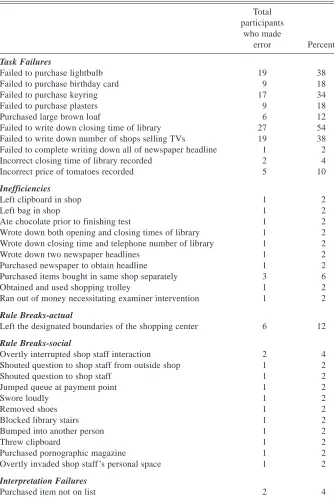
not examined directly. Supporting this view, in this study 29 individual error types (as contrasted with categories) were demonstrated by controls (see Table 2), but almost double this number were observed within the patient group (58). Twenty-five error types were shared by both groups. Four additional types appeared only in the controls perfor-mance. Critically however, brain injured participants dem-onstrated 33 error types unique to them (see Table 3). For example, 54% failed to record the library closing time (a task failure), while no control did this. Others were less numerous: for example, 4% purchased items not on the list (interpretation failure). More surprisingly, one patient bought a pornographic magazine which, needless to say, is not on the list of items participants are requested to buy, and is classed as a social rule break.
This suggested a more sensitive scoring method could be devised. Accordingly, one was formulated that reflected the “normality” of the error type similar to the method used by Shallice and Evans (1978). “Normal” or acceptable errors were those that had been seen in up to 95 percent of healthy controls. These were given a score of “1.” Errors only dem-onstrated by five percent or less of controls were assigned a weighted score of two. Errors unique to the patient group were given a weighted score of three.
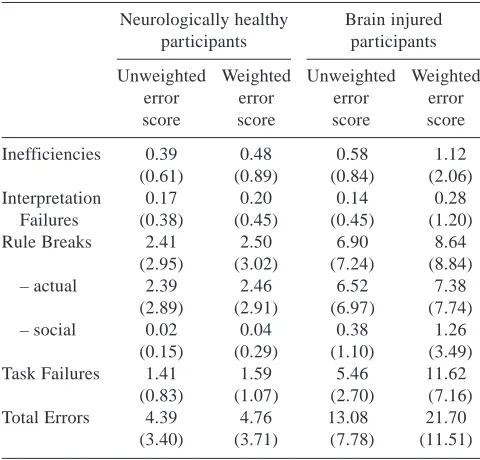
(SD511.51), a highly significant difference (t59.87, p, .0001). Effects of weighting are shown in Table 4.
Effects of age, IQ and requests for help on
patient performance
As with controls, the brain injured group showed evidence of age effects, with a modest correlation between the num-ber of task failures and age (.25, p5.040). In addition, WAIS–R FSIQ also correlated with task failures (2.32, p5 .030). Critically however, the difference between patients and controls in task failures remained after covarying for age, FSIQ and familiarity with the shopping center (F5 11.57, p5.006).
While in controls, requests for help were significantly associated with poorer performance as measured by num-ber of rule-breaks, patients showed a different pattern, with a negative correlation between help requests and task fail-ures (2.32; p5.013). We will return to this later. A higher proportion of patients used the strategy of asking for help (80% vs. 54.3% controls).
Ratings of own performance in patients
and controls
Among controls there was no significant relationship be-tween their ratings of everyday executive abilities (DEX-S score) and MET–SV performance. In contrast, there were
Table 2. Errors demonstrated by neurologically healthy participants (Note: any errors made by participants with acquired neurological disorders not shown here were assigned a weighted score of 3)
Total participants
who made
error Percent
Weighted error score
Task Failures
Failed to inform examiners had finished test 13 28.3 1
Failed to meet examiner under clock 12 26.1 1
Met examiner under clock too early (,19 minutes) 11 23.9 1
Incorrect number of shops selling TVs recorded 11 23.9 1
Failed to inform examiner of time when under clock at correct time 6 13.0 1
Purchased non-birthday card 3 6.5 1
Failed to write down price of tomatoes 2 4.3 2
Purchased white loaf 2 4.3 2
Met examiners under clock too late (.21 minutes) 1 2.2 2
Purchased cream instead of plasters 1 2.2 2
Failed to purchase chocolate bar 1 2.2 2
Failed to write down newspaper headline 1 2.2 2
Failed to purchase bread 1 2.2 2
Inefficiencies
Entered library (opening0closing times displayed outside) 11 23.9 1
Purchased multiple single items (e.g., 2 lightbulbs) 4 8.7 1
Purchased tomatoes to determine price per pound0kilo 1 2.2 2
Purchased medium brown loaf 1 2.2 2
Went to cafe for coffee 1 2.2 2
Rule Breaks-actual
Entered shop and left without making a purchase 20 43.5 1
Spoke to examiner 16 34.8 1
Spent over £5.00 10 21.7 1
Re-entered shop previously visited 1 2.2 2
Purchased items from the ‘stalls’ 1 2.2 2
Purchased more than two items in superstore 1 2.2 2
Posted own (private) letter 1 2.2 2
Rule Breaks-social
Asked staff in superstore to bake bread 1 2.2 1
Inefficiencies
Wrote down purchase code of birthday card 4 8.7 1
Believed necessary to complete entire test within 20 minutes 3 6.5 1
several significant correlations between patients ratings and performance on the test. However, these demonstrated lack of awareness, rather than presence of it: low ratings on the DEX-S were associated with increased rule breaking be-havior (2.30, p5.022), task failures (2.25, p5.047) and more total errors made (2.37, p5.005). In other words, those who were poorer at the test were those who saw themselves as having few dysexecutive problems in every-day life.
Ecological Validity of the MET – SV
The MET is inherently ecologically valid in that it is little more than a formalized version of an activity in which peo-ple naturally indulge (in Western society). However its clin-ical utility would be enhanced if it could be shown that performance on the test is representative of performance outside the situation of shopping. In order to examine this possibility we determined characteristic behavior patterns
Table 3. Errors unique to brain injured participants
Total participants
who made
error Percent
Task Failures
Failed to purchase lightbulb 19 38
Failed to purchase birthday card 9 18
Failed to purchase keyring 17 34
Failed to purchase plasters 9 18
Purchased large brown loaf 6 12
Failed to write down closing time of library 27 54
Failed to write down number of shops selling TVs 19 38 Failed to complete writing down all of newspaper headline 1 2
Incorrect closing time of library recorded 2 4
Incorrect price of tomatoes recorded 5 10
Inefficiencies
Left clipboard in shop 1 2
Left bag in shop 1 2
Ate chocolate prior to finishing test 1 2
Wrote down both opening and closing times of library 1 2 Wrote down closing time and telephone number of library 1 2
Wrote down two newspaper headlines 1 2
Purchased newspaper to obtain headline 1 2
Purchased items bought in same shop separately 3 6
Obtained and used shopping trolley 1 2
Ran out of money necessitating examiner intervention 1 2
Rule Breaks-actual
Left the designated boundaries of the shopping center 6 12
Rule Breaks-social
Overtly interrupted shop staff interaction 2 4
Shouted question to shop staff from outside shop 1 2
Shouted question to shop staff 1 2
Jumped queue at payment point 1 2
Swore loudly 1 2
Removed shoes 1 2
Blocked library stairs 1 2
Bumped into another person 1 2
Threw clipboard 1 2
Purchased pornographic magazine 1 2
Overtly invaded shop staff ’s personal space 1 2
Interpretation Failures
on this test by conducting an exploratory factor analysis of the different error categories using all participants. This suggested a two-factor structure which accounted for 62.1% of the variance (Varimax rotated). Participants’ MET–SV performance was characterized by either rule breaking be-havior or failure to achieve set tasks. The first factor con-sisted of rule breaks and interpretation failures, and accounted for 35.7% of the variance (eigenvalue51.426). The second factor contained task failures and inefficien-cies: 26.4% of the variance was explained by this factor (eigenvalue51.056).
Accordingly, patients were divided into two subgroups according to those errors made. For each person the number of rule breaking errors and interpretation failures were added together to provide a single score (labeled “ Pattern 1”), while a further index was calculated by tallying task fail-ures and inefficiencies (Pattern 2). People whose Pattern 1 score was greatest were categorized together (n519) while those Pattern 2 score was highest formed a second group (n526). Five participants achieved equal Pattern 1 and Pattern 2 scores and were excluded from subsequent analyses.
Some 574 errors were recorded. The proportion of errors made was reasonably similar between groups: thus, those
people who showed predominantly Pattern 1 accounted for 309 errors (53.8%) while those whose Pattern 2 score was greatest made a total of 265 (46.2%) errors. Rule breaks accounted for 72.5% of all errors made within the Pattern 1 group (“Rule Breakers”), and 74.2% of all rule breaking errors made by participants with acquired neurological dam-age were made by members of this group. By contrast, per-formance of the 26 people with high Pattern 2 scores was characterized by task failures which accounted for 64.5% of all errors made within the group, and 72.5% of all errors of this type (Table 5 shows a breakdown of error types for the two groups). The total mean error score for “Rule Break-ers” (n519) was 16.26 (SD510.96) while that for the “Task Failers” (n526) was 10.19 (SD53.78), a differ-ence that proved significant (t52.31, p5.031, separate variance estimates used).
We then considered the severity of the two groups’ ev-eryday dysexecutive problems as assessed by carers and relatives using the DEX questionnaire (Burgess et al., 1996a, 1998). Burgess et al. (1998) suggest that the DEX measures five principal symptom clusters: Inhibition, Intentionality, Executive memory, Positive affect, and Negative affect. Accordingly, we compared the severity of the five symp-tom clusters between the two groups (Rule Breakers and Task Failers). For two of the symptom clusters, the differ-ence proved significant. Rule Breakers showed more se-vere executive memory symptoms, whose principal items are confabulation, deficits in temporal sequencing (i.e., mis-taking the order of events) and perseveration (t52.13, p5 .04). By contrast, Task Failers showed more symptoms of “negative affect” (e.g., shallow affect and apathy; t52.30,
p5.027).
Requests for help amongst “rule breakers”
and “task failers”
The influence of group (neurologically healthy vs. acquired neurological damage) and error style (“rule breakers” vs. “task failers”) on requests for help were investigated. All participants who could be categorized by error style were included in the analysis (“rule breakers”: controls N520, brain injured N519 [mean requests for help 2.20 vs. 7.77]; “task failers”: controls N523, brain injured N526 [mean requests for help 1.00 vs. 2.86]) using a 232 ANCOVA in which familiarity was entered as a covariate. Both main effects were significant (group: F511.55, p5.001; error style: F 5 12.61, p 5 .001). Interaction effects attained borderline significance (F53.82, p5.054).
Table 4. Unweighted and weighted error scores by category and group
Neurologically healthy participants
Brain injured participants Unweighted
error score
Weighted error score
Unweighted error score
Weighted error score
Inefficiencies 0.39 0.48 0.58 1.12
(0.61) (0.89) (0.84) (2.06)
Interpretation 0.17 0.20 0.14 0.28
Failures (0.38) (0.45) (0.45) (1.20)
Rule Breaks 2.41 2.50 6.90 8.64
(2.95) (3.02) (7.24) (8.84)
– actual 2.39 2.46 6.52 7.38
(2.89) (2.91) (6.97) (7.74)
– social 0.02 0.04 0.38 1.26
(0.15) (0.29) (1.10) (3.49)
Task Failures 1.41 1.59 5.46 11.62
(0.83) (1.07) (2.70) (7.16)
Total Errors 4.39 4.76 13.08 21.70
(3.40) (3.71) (7.78) (11.51)
Table 5. Distribution of MET–SV error types amongst the two subgroups of brain injured participants
Inefficiencies
Interpretation failures
Rule breaks
Task failures
Total errors
Group 1: Rule Breakers 14 6 224 65 309
The observation that brain injured people frequently ask others for help while carrying out the MET–SV appears to reflect an exaggeration of a strategy noted amongst con-trols, especially for “rule breakers.” But does it help performance?
Correlations were computed for the two patient sub-groups determined by error style. These suggested the ef-fect of help seeking behavior on MET–SV performance differed. Asking for help was perhaps an aid to those par-ticipants whose performance was characterized by achieve-ment of less tasks: those who sought assistance attained more tasks than those who did not (correlation between requests for help and weighted task failures5 2.42, p5 .017). However, while asking for help does appear to ben-efit MET–SV performance among “task failers,” it appears to be of no benefit to people whose performance is charac-terized by rule breaking (correlation between requests for help and weighted rule breaks5.72, p, .001, and total weighted errors5.48, p5.023). One interpretation of this result is that the subgroup of participants who most employ help seeking as a strategy are those who derive the least benefit from it.
Relation between MET–SV and other executive
function tests in patients
The distinction between two error styles was supported by the differential pattern of Person correlations with other executive test scores. Given the number of correlations in-volved we will consider only those that were significantly different from zero at the p,.01 level. Across all patients, number of task failures was related to MWCST persever-ative errors (r5.39) and BADS profile score (2.46). The latter chiefly reflected individual correlations with two sub-tests: Zoo-Map (2.46) and Six Element Test (2.41). By contrast, rule breaks of both types (i.e., task rule breaks and social rule breaks) were related only to performance on the Action Program subtest of the BADS (2.40 social; 2.42 task;2.43 total rule-breaks) although there was also a mar-ginally significant relationship between Cognitive Esti-mates and one of the break measures (social rule-break,2.33, p,.05).
In order to determine the sensitivity of the MET-SV in comparison to other executive function tests, the following procedure was adopted:
First, the proportion of patients who passed each of the three traditional experimentally-derived tests (Cognitive Es-timates, Verbal Fluency, MWCST) was determined. Cut-off scores (below the 5% level of controls) were identified from data reported in two previous studies (Wilson et al., 1996; Burgess et al., 1998). The results were surprising. Despite the neurological group consisting mainly of peo-ple whose damage was classed as “severe,” most patients who were given them passed these tests (Cognitive Esti-mates 93.3%; FAS Verbal Fluency 80.9%; MWCST cat-egories achieved 89.5%, total errors 84.2%, perseverative errors 92.1%).
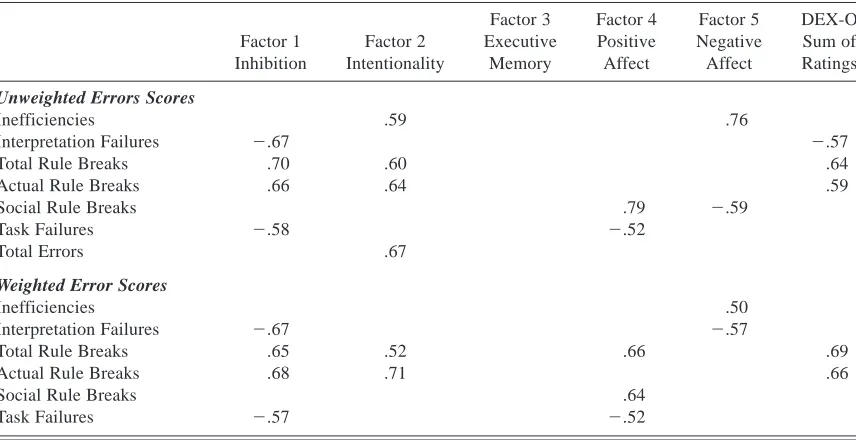
Twenty-nine patients completed all three frontal lobe tests: Seventeen (61%) achieved scores within acceptable limits on all of them. However on the MET–SV, only 5 patients achieved error scores that lay within the normal range. This suggests that the MET–SV is especially sensitive to execu-tive function difficulties. A counter-argument might be, how-ever, MET–SV failures can be caused by non-executive cognitive deficits to which the traditional executive tests are less sensitive. We can test this possibility. If it were true, we would not expect MET–SV failures to be strongly asso-ciated (over the group as a whole), with everyday observed dysexecutive symptoms (since the possibility of strongly correlated executive and non-executive deficits can be ex-cluded in this group—see results of partialling for FSIQ above). Consequently, the various MET–SV error catego-ries were correlated with the five factors plus the total sum of ratings from the DEX questionnaire.
Table 6 shows that MET–SV error category scores were highly predictive of ratings of executive symptoms in the group of patients who passed the traditional executive tests but failed the MET–SV shopping task. Significant correla-tions were found between errors and four DEX factors, and the total sum of ratings. Disinhibition and difficulties with formulating and following goal-oriented plans were espe-cially associated with rule breaking behavior. Interestingly, ratings concerning positive affect (variable motivation, ag-gression, and euphoria) specifically related to social rule breaks, a finding which has good face validity. While WAIS–R FSIQ did not correlate with errors, age was asso-ciated with task failures. However, the pattern of associa-tions remained unchanged when partial correlaassocia-tions were calculated in which variance attributed to age was con-trolled (unweighted task failures with intentionality, partial
r5 2.70; weighted task failures with intentionality, partial r52.61).
DISCUSSION
1998; Manly et al., 2002; Robertson et al., 1994; Wilson et al., 1985, 1989, 1997).
The results of this study also strongly indicate that even patients with severe brain injury may do well on traditional executive function tests, while still presenting with a dys-executive syndrome as assessed both by a real-world shop-ping task and general behavioral observation in everyday life. This dissociation was first shown in patients who achieved FSIQs at or above the “superior” level (Shallice & Burgess, 1991). It is remarkable however to find a similar pattern in a group of patients whose injuries are more se-vere, and whose performance on cognitive tests is more variable. It is likely that the explanation for the frontal0 MET performance dissociation made by Shallice and Bur-gess also applies to patients of more mixed ability. While the patient group studied here were relatively heteroge-neous, we would argue this is characteristic of many people referred for neuropsychological examination in routine clin-ical practice. Nevertheless, it would be useful to study if patients with mild and moderate severity of injury perform on the MET–SV in a similar way to the three “superior” level patients described by Shallice and Burgess and the more severe, variable sample reported here.
A further result of importance for the clinical utility of the test is that the MET–SV appears to have independence from the potentially biasing effects of general intellectual ability, familiarity with the environment and gender. None of these was associated with the performance of controls. With regard to patients, there was a modest correlation be-tween the current level of intellectual ability (WAIS–R FSIQ) and task failures. However, the finding that patients make significantly more errors of this type than controls was pre-served when variability ascribed to FSIQ was statistically controlled. This key result runs counter to the suggestion
that the MET–SV failures in our patients were principally due to non-executive problems. In any case, even if there had been an association, it is entirely plausible that the WAIS–R was being failed for executive reasons well tapped by the MET–SV and which also affect WAIS–R perfor-mance. In this context, the finding of group differences after covarying for FSIQ seems even more remarkable.
Equally interesting were the findings concerning two vari-ables that were predictive of performance. The first, age, was a significant factor in the performance of both controls and patients. The second variable was requests for help; how-ever, the nature of this relationship was unexpected. In con-trols more requests was associated with greater numbers of rule breaks, with no significant relationship with task fail-ures. In patients, this positive association between requests for help and rule-breaks also appeared, but was stronger. How-ever there was a significant negative correlation between re-quests for help and task failures. It is tempting therefore to see this result as suggesting a general performance princi-ple: that people who readily ask for help are also those who tend to break task rules. This cannot be explained by sug-gesting that those asking for help are finding the task more difficult: they are actually achieving more tasks. However within the group who tended to fail to carry out tasks, those who asked for more help tended to do better. One possible explanation for these results is that asking for help is ben-eficial for both groups in terms of achieving set goals, but may also be an indicator of a general tendency towards disinhibition. Whatever the actual reason, it is clear that use of this strategy was not determined by age, general ability, gender, or environmental familiarity. It was also not asso-ciated with any of the three sets of ratings made.
The findings relating to these ratings of performance were also instructive. For the controls, ratings of their abilities
Table 6. Correlations between error categories and the DEX-O for 17 brain injured participants who passed traditional executive function tests but failed the MET–SV ( p,.05, 1-tailed)
Factor 1 Inhibition
Factor 2 Intentionality
Factor 3 Executive
Memory
Factor 4 Positive Affect
Factor 5 Negative Affect
DEX-O Sum of Ratings
Unweighted Errors Scores
Inefficiencies .59 .76
Interpretation Failures 2.67 2.57
Total Rule Breaks .70 .60 .64
Actual Rule Breaks .66 .64 .59
Social Rule Breaks .79 2.59
Task Failures 2.58 2.52
Total Errors .67
Weighted Error Scores
Inefficiencies .50
Interpretation Failures 2.67 2.57
Total Rule Breaks .65 .52 .66 .69
Actual Rule Breaks .68 .71 .66
Social Rule Breaks .64
bore little relationship to their actual performance. Most believed they had performed satisfactorily, and at debrief-ing participants were often unaware of their errors. This would provide one explanation of the lack of the accuracy of their ratings. However, the pattern among patients was quite different in that those that performed poorly also tended to be those who rated themselves as having few executive problems in everyday life. This result is difficult to explain in terms of unawareness or error on the MET-SV. Instead it is suggestive of a more widespread problem with accurate assessment of executive abilities (i.e., “insight”). However this impairment is not one of applying a consistent stan-dard, as one might expect if the root of the problem were an inability to use the scale, or engage in the judgement task itself. A problem of this kind would not result in a signifi-cant negative correlation. Instead, it suggests an over-confidence in abilities. But whether this overover-confidence is a root cause, or is secondary to an inability to notice errors has yet to be established.
An anecdotal example may however help. PD, originally described by Burgess et al. (1996b), had incurred a severe brain injury as a result of a fall and showed a wide range of dysexecutive problems (see also Alderman, 1996). On the MET–SV his total weighted error score was 44; the major-ity of these were rule breaks (28). He also frequently asked for help (16). On one occasion during the test, he left the supermarket, stopped, and consulted his written instruc-tions. He then looked up and appropriately sought assis-tance from a passer-by. He enquired as to the whereabouts of the library (one of the test items requires the participant to record the closing time of the library on Saturday). The passer-by told him and then added the helpful information “. . . I don’t know if its still open—I know it shuts at 4:30 on
a Saturday but I don’t know when it closes during the week.”
PD offered his thanks and proceeded to the library where he spent some time finding this very same information. At debriefing he recalled asking for help in this instance, but was unaware that he had also been told the very informa-tion he was seeking. This example seems more consistent with a monitoring deficit than a problem of overconfidence. This study also confirmed the proposition made origi-nally by Shallice and Burgess (1991) that not all forms of error are equivalent in terms of their significance. While some errors are typical, others are characteristic of acquired neurological damage. For example, no neurologically healthy participant failed to write down the closing time of the library which is perceived as quite an important aspect of the test by controls: in contrast, this error was demonstrated by over half the patients (54%). Other task failures more characteristic of brain injury included the failure to chase certain items (e.g., a lightbulb [38%]; failure to pur-chase a key ring [34%]; and failure to write down the number of shops selling televisions [38%]). However some patient errors were much more idiosyncratic. For example, one participant sat down and took off his shoes, while another threw his clipboard: no healthy participant engaged in sim-ilar behavior!
A key finding in this respect concerns social rule breaks, of which the two instances described above are examples. Although the patients made more than three times the num-ber of general errors as the controls, they made nineteen times the number of social rules breaks. Even allowing for the relatively small numbers involved in this comparison, this difference was significant. These errors are therefore of particular diagnostic significance. The advantage of tasks such as the MET–SV is that they involve free interactions and social behavior that may be observed. This is not a feature typical of executive function tests and yet these results suggest this aspect of behavior is particularly instructive.
A further finding is that there appear to be two distinct patterns of MET–SV failure. People who show the first pattern tend to break task rules. These patients are those in whom carers tend to notice memory disturbances, espe-cially those relating to memory control (e.g., confabulation, problems with temporal sequencing, and perseveration). Cer-tainly a pure amnesia would not be a sufficient explanation of these people’s difficulties since they have the task in-structions with them at all times. Moreover, the amnesia explanation still does not work even if one suggests that this hypothetical basic memory problem would lead to for-getting to consult the instruction sheets. Such a perfor-mance would be characterized by incomplete tasks, and this was not the case. It appears not to be the case that they fail to consult the instructions, or that they forget what they want to do. Instead it appears to be that they fail to act upon the information they receive (as in the case of PD), or mis-understand what the instructions intend. This pattern has similarities with other failures in everyday life previously called “monitoring” errors (e.g., Alderman, 1996, 2001; Alderman et al., 1995).
The results clearly indicate that these two impairments (“monitoring” and “initiation”) in this heterogeneous neuro-logical group are orthogonal. Indeed, the quite extreme de-gree of categorization that could be achieved perhaps suggests that they are mutually exclusive, which may give a clue to the nature of them.
The distinction between the two patterns of MET–SV failure was supported by the differential relationship that these measures showed with scores from the other execu-tive tasks. Thus, three individual test measures (MWCST perseverative errors; Zoo-Map test and the Six Element Test (SET)) were significantly related to number of MET–SV task failures. These results may inform a characterization of the underlying processing deficit. The Wisconsin Card Sorting Test has been argued to have a “working memory” component (e.g., Kimberg & Farah, 1993). The Zoo-Map test is a test of planning (participants are asked to plan a trip round a zoo), and the SET is a multitasking test with a strong prospective memory component as well as planning demands (Burgess, 2000). The MET–SV is also a multitask-ing test (see Burgess, 2000 for a description of the charac-teristics of this class of task). These results are therefore congruent with the model of multitasking presented by Bur-gess et al. (2000), where this function is supported by three cognitive constructs: memory, “intentionality” (largely pro-spective memory), and planning.
The relationship between the Action Program Test and rule-breaking behavior is less straightforwardly explained. Relatively little is known about the demands made by the Action Program Test. However it is assumed to have a judge-ment and reasoning component (Klosowska, 1976). This is also true of the Cognitive Estimates Test (Shallice & Evans, 1978). Both tests also involve initiating this unprompted consideration process before acting. This may be the link with rule-breaking behavior. However this speculation re-mains to be investigated.
A potential weakness of the present study is that the ex-act contribution of non-executive cognitive impairments other than those measured by the WAIS–R is not known. Another important point concerns the applicability of the method reported here to other settings, an important con-sideration to clinicians who want to utilize the test.
We have addressed both points in a further study which adapted the MET–SV for use in a typical hospital setting. Knight et al. (Knight, 1999; Knight et al., 2002) found a correlation between the two test versions of .83 ( p,.001). This suggests that if clinicians were to apply the methodol-ogy of the MET–SV to their own patients within a local shopping facility, it is likely that broadly comparable re-sults would be obtained. Knight et al. also administered a wider range of cognitive tests than given here, with the results suggesting that non-executive deficits (e.g., visual perception) were not a major factor in test performance. Only memory impairment, as measured by lower profile scores on the RBMT (Wilson, Cockburn & Baddeley, 1985) was also associated with a tendency to fail more set tasks, and recent functional imaging evidence in particular strongly
shows the involvement of executive frontal lobe processes in memory (e.g., Burgess et al., 2001).
The present study also does not address the issue of the brain localization of the processes relevant to shopping. However there is evidence from other studies that have used multitasking tests. Burgess et al. (2000) administered a variant of the Six Elements Test (Burgess & Shallice, 1991; Burgess et al., 1996) to a group of 60 acute neurolog-ical (mainly tumor) patients. This task required following a set of arbitrary rules and self-initiated task switching, and in this way overlaps with the MET–SV. Burgess and his colleagues found three sources of failure: memory prob-lems, planning failures and failures of “intentionality” (i.e., following rules and attempting all the necessary tasks). Of course it is possible that the locus of these patients’ impair-ments was not the same as with this (predominantly head-injured) group. However there is obvious similarity in the nature of the “intentionality” failures. Interestingly Burgess et al. (2000) did not distinguish between the two failures of omission and commission, with both found to result from lesions to the most anterior aspects of the frontal lobes (see also Levine et al., 1998). However the results of the present study suggest that these two patterns of failures might be considered as potentially separable.
These results perhaps suggest that different rehabilitation techniques may be useful. For instance, people who make task failures may be helped through training in the use of ex-ternal aids or compensatory strategies, such as checklists (e.g., see Burke et al., 1991). Robertson, Levine, and their col-leagues have also achieved promising results with people with everyday disorganization problems using Goal Manage-ment Training and other methods (Robertson, 1996; Levine et al., 2000; Manly et al., 2002). For the “Rule-Breakers,” if our characterization of their impairments as problems with monitoring is correct, these have been shown to be resistant to some of the more frequently used neurobehavioral inter-ventions (Alderman, 1996). However there are some indica-tions that these people can be helped by methods that remediate or circumvent their monitoring problems (e.g., Alderman et al., 1995; Alderman & Knight, 1997).
ACKNOWLEDGMENTS
The authors would like to thank Julie Davies, Padraig McDonnell, Sarah Clare, Louise Essex, and Cheryl Jones for their invaluable assistance in collecting MET-SV data, and to Dr Brian Moffat, Clinical Director of the Kemsley Division. Thanks are extended to the managers of the Weston Favell Shopping Centre, Northamp-ton, UK, for giving permission for testing to take place, and to all people, both employees and members of the public, for their tol-erance and patience. Paul Burgess is supported by Wellcome Trust grant ref. 0492410Z0960WRE0HA0JAT.
REFERENCES
Alderman, N. (2001). Management of challenging behaviour. In R.Ll. Wood and T. McMillan (Eds.), Neurobehavioural dis-ability and social handicap (pp. 175–207). Hove, Psychology Press.
Alderman, N. & Knight, C. (1997). The effectiveness of DRL in the management and treatment of severe behaviour disorders following brain injury. Brain Injury, 11, 79–101.
Alderman, N., Fry, R.K., & Youngson, H.A. (1995). Improvement of self-monitoring skills, reduction of behaviour disturbance and the dysexecutive syndrome: Comparison of response cost and a new programme of self-monitoring training. Neuropsy-chological Rehabilitation, 5, 193–221.
Benton, A.L. (1968). Differential behaviour effects in frontal lobe disease. Neuropsychologia, 6, 53– 60.
Brazzelli, M., Colombo, N., Della Sala, S., & Spinnler, H. (1994). Spared and impaired cognitive abilities after bilateral frontal damage. Cortex, 30, 27–51.
Burgess, P.W. (1997). Theory and methodology in executive func-tion research. In P. Rabbitt (Ed.), Methodology of frontal and executive function (pp. 81–116). Hove: Taylor and Francis. Burgess, P.W. (2000). Strategy application disorder: the role of the
frontal lobe in human multitasking research. Psychological Re-search, 63, 279–288.
Burgess, P.W., Alderman, N., Wilson, B.A., Evans, J.J., & Emslie, H. (1996a). The Dysexecutive Questionnaire. In B.A. Wilson, N. Alderman, P.W. Burgess, H. Emslie, & J.J. Evans (1996). Behavioural Assessment of the Dysexecutive Syndrome. Bury St Edmunds: Thames Valley Test Company.
Burgess, P.W., Baxter, D., Rose, M.J., & Alderman, N. (1996b). Delusional Paramnesic Misidentification. In P.W. Halligan and J.C. Marshall (Eds.), Method in madness: Case studies in cog-nitive neuropsychiatry. Hove: Psychology Press.
Burgess, P.W., Alderman, N., Evans, J.J., Emslie, H., & Wilson, B.A. (1998). The ecological validity of tests of executive func-tion. Journal of the International Neuropsychological Society, 4, 547–558.
Burgess, P.W. & Shallice, T. (1996). Response suppression, initi-ation and strategy use following frontal lobe lesions. Neuro-psychologia, 34, 263–273.
Burgess, P.W., Veitch, E.J., Costello, A. de L., & Shallice, T. (2000). The cognitive and neuroanatomical correlates of multitasking. Neuropsychologia, 38, 848–863.
Burgess, P.W., Quayle, A., & Frith, C.D. (2001). Brain regions involved in prospective memory as determined by positron emission tomography. Neuropsychologia, 39, 545–555. Burke, W.H., Zencius, A.H., Weslowski, M.D., & Doubleday, F.
(1991). Improving executive function disorders in brain-injured clients. Brain Injury, 5, 241–252.
Goel, V., Grafman, J., Tajik, J., Gana, S., & Danto, D. (1997). A study of the performance of patients with frontal lobe lesions in a financial planning task. Brain, 120, 1805–1822.
Howell, D.C. (1997). Statistical methods for psychology (4th ed.). Belmont, CA: Duxbury Press.
Kimberg, D.Y. & Farah, M.J. (1993). A unified account of cogni-tive impairments following frontal lobe damage: The role of working memory in complex, organised behavior. Journal of Experimental Psychology: General, 122, 411– 428.
King, N. (1997). Mild head injury: neuropathology, sequelae, mea-surement and recovery. British Journal of Clinical Psychol-ogy, 36, 161–184.
Klosowska, D. (1976). Relation between ability to program
ac-tions and location of brain damage. Polish Psychological Bul-letin, 7, 245–255.
Knight, C. (1999). The development of a hospital version of the multiple errands test to assess executive functioning following severe acquired brain injury. Unpublished Doctoral Thesis. UK: The University of Birmingham.
Knight, C., Alderman, N., & Burgess, P.W. (2002). Development of a Simplified Version of the Multiple Errands Test for Use in Hospital Settings. Neuropsychological Rehabilitation, 12, 231– 255.
Levine, B., Robertson, I., Clare, L., Carter, G., Hong, J., Wilson, B.A., Duncan, J., & Stuss, D.T. (2000). Rehabilitation of exec-utive functioning: An experimental-clinical validation of goal management training. Journal of the International Neuropsy-chological Society, 6, 299–312.
Levine, B., Stuss, D.T., Milberg, W.P., Alexander, M.P., Schwartz, M., & Macdonald, R. (1998). The effects of focal and diffuse brain damage on strategy application: Evidence from focal le-sions, traumatic brain injury, and normal ageing. Journal of the International Neuropsychological Society, 4, 247–264. Manly, T., Hawkins, K., Evans, J., & Robertson, I. H. (2002).
Rehabilitation of executive function: Facilitation of effective goal management on complex tasks using periodic auditory alerts. Neuropsychologia, 40, 271–281.
Nelson, H.E. (1991). The National Adult Reading Test (2nd ed.). Windsor, Berkshire: NFER Nelson.
Nelson, H.E. (1976). A modified card sorting test sensitive to frontal lobe defects. Cortex, 12, 313–324.
Posner, M.I. & Rothbart, M.K. (1998). Attention, self-regulation and consciousness. Philosophical Transactions of the Royal Society of London B, 353, 1915–1927.
Robertson, I.H. (1996). Goal Management Training: A Clinical Manual. Cambridge: PsyConsult.
Robertson, I.H., Ward, T., Ridgeway, V., & Nimmo-Smith, I. (1994). Test of Everyday Attention. Bury St Edmunds: Thames Valley Test Company.
Rolls, E.T. (2000). Memory systems in the brain. Annual Review of Psychology, 51, 599– 630.
Shallice, T. & Evans, M.E. (1978). The involvement of the frontal lobes in cognitive estimation. Cortex, 14, 294–303.
Shallice, T. & Burgess, P.W. (1991). Deficits in strategy applica-tion following frontal lobe damage in man. Brain, 114, 727– 741.
Stuss, D.T., Gow, C.A., & Hetherington, C.R. (1992). “No longer Gage”: Frontal lobe dysfunction and emotional changes. Jour-nal of Consulting and Clinical Psychology, 60, 349–359. Wechsler, D. (1981). The Wechsler Adult Intelligence Scale–
Revised. Texas, San Antonia: The Psychological Corporation. Wilson, B.A., Cockburn, J., & Baddeley, A. (1985). The River-mead Behavioural Memory Test. Bury St Edmunds: Thames Valley Test Company.
Wilson, B.A., Cockburn, J., & Halligan, P.W. (1989). The Behav-ioural Inattention Test. Bury St Edmunds: Thames Valley Test Company.
Wilson, B.A., Alderman, N., Burgess, P.W., Emslie, H., & Evans, J.J. (1996). Behavioural Assessment of the Dysexecutive Syn-drome. Bury St. Edmunds: Thames Valley Test Company. Wilson, B.A., Evans, J.J., Alderman, N., Burgess, P.W., & Emslie,
Appendix 1
MET – SV Task Instructions (read to participant)
MULTIPLE ERRANDS TEST
This test makes use of the following items: - pen0pencil
- instructions on a clipboard for the subject - carrier bag
- £10 note
- examiner to have stopwatch, pad and pen to record ob-servations of subject
Ensure the subject is wearing a watch before leaving for the shopping centre.
Before leaving, obtain ratings for shopping efficiency and familiarity with the Weston Favell Shopping Centre (see separate sheet).
On return to the hospital, obtain the rating for how well the subject felt they executed the task (see separate sheet).
Once on the upper floor of the Weston Favell Shopping Centre proceed to the clock. Give the subject the clipboard, pen0pencil, carrier bag and £10 note. Read the following instructions to the subject:
“In this exercise I want you to complete three tasks. The tasks are: to buy the six items listed on this sheet (examiner
to indicate and describe items on sheet); to obtain and write
down four pieces of information (examiner to indicate and
describe items on sheet); and to meet me under this clock
20 minutes after I have said “ . . . begin the exercise” and tell me the time.
However, whilst completing this exercise you must obey the rules listed on your instruction sheet (examiner to
indi-cate and describe rules on sheet).
You must carry out all of these tasks but you may do so in any order. You should spend no more than £5: although I’ve given you £10 you should spend no more than five. You should stay within the limits of the upper floor of the shopping centre. This means you must not leave by the doors at either end, use any lifts, stair or escalators. No shop should be entered other than to buy something, so if you go into a shop it should be with the intention of buying something. You should not go back into a shop you have already been in, so if you’ve been into a particular shop you should not go back into it again. You should not buy any items from the stalls: these are the stalls (show0gesture to subject) you must only buy items from shops. You should buy no more than two items from Tesco. Take as little time as possible to complete this exercise without rushing excessively.
During this exercise I shall be following you from a dis-tance and observing what you are doing. Please do not speak to me unless this is part of the exercise.
Finally, approach me and tell me when you have completed the exercise.
Is that clear, have you any questions? (clarify any questions
the subject has)
Now tell me what you must do. (ensure subject is clear
about what they must do)
“Begin the exercise.” (examiner to start timing at this point)
Appendix 2
MET – SV Written Instructions/Recording Sheet (given to and carried by participant)
INSTRUCTIONS
In this exercise you should complete the following three tasks:
1) You should buy the following items small brown loaf bar of chocolate packet of plasters single light bulb birthday card key ring
2) You should obtain the following information and write it down in the spaces below
1. What is the headline from either today’s ‘Daily Mail’, ‘Daily Mirror’ or ‘The Sun’ newspaper? 2. What is the closing time of the library on
Saturday?
3. What is the price of 1 pound or kilogram of tomatoes?
4. How many shops sell televisions?
3) You must meet me under the clock 20 minutes after you have started this task and tell me the time.
TELL THE PERSON OBSERVING YOU WHEN YOU HAVE COMPLETED THE EXERCISE
Whilst carrying out this exercise you must obey the follow-ing rules:
c You must carry out all these tasks but may do so in any order
c You should spend no more than £5
c You should stay within the limits of the upper floor of the shopping centre
c No shop should be entered other than to buy something c You should not go back into a shop you have already
been in
c You should not buy any item from the stalls c You should buy no more than 2 items in Tesco c Take as little time to complete this exercise without
rushing excessively
![Fig. 1. Plan view of the upper level of the shopping center. Key: enclosed areasstalls; ‘L’plasters [6, 7, 12]; birthday card [1, 3, 4, 5, 7, 12]; chocolate [4, 6, 7, 8, 12]; light bulb [1, 7, 12]; key ring [1, 2, 3, 5,9, 10, 11, 7, 12]](https://thumb-us.123doks.com/thumbv2/123dok_us/7864547.1304597/3.612.106.499.61.257/upper-shopping-center-enclosed-areasstalls-plasters-birthday-chocolate.webp)