Survey for Incentive Mechanism to Reduce
Problem of Free Riders in Peer To Peer Network
Priyanka kumrawat1, Kamal Borana2 1
ME Scholar Department of Computer Science & Engineering, Sushila Devi Bansal College of Engineering Indore,
2
Assistant Professor Department of Computer Science & Engineering, Sushila Devi Bansal College of Engineering Indore,
RGTU Bhopal, India.
Abstract— Peer-to-peer networks have formerly been bringing into all embracing use such as file-sharing, distributed computing, e-commerce and so on. We consider the universal difficulty of free rider in peer to peer computing. P2P working out characterize a developing low-cost substitute to cluster systems, given that scalable and fault-tolerant access to distributed computational resources. P2P architectures take benefit of the under operation of personal computers, integrating them into a platform based on the sharing of computational resources between geographically distributed equals. The participation of their component nodes (or peers) is voluntary. Although cooperation is the key to the success of a peer-to-peer system, it is difficult to cultivate without an effective incentive mechanism. In fact, many P2P systems lack such a mechanism and accordingly suffer from free riding. Free-riders consume resources donated by other peers while not donating any of their own. Experience with peer-to-peer systems exhibit that in the deficiency of incentive to give, a large proportion of the peers only consume the resources of the system. Free-riding is a concern because it decreases the effectiveness of the shared resources in the system, potentially to the point of system collapse. Our concept reduces the problem of free rider & incentive mechanism in a distributed peer to peer network. Through our propose approach improves the performance and the parameters we approach are: Number of Trusted Transaction, Speed of Transmitted Files, and Total Number of Transaction.
Keywords: — Free-riding, Bayesian networks, Peer-to-peer.
I. INTRODUCTION
Peer-to-peer (P2P) networks connect a lot of end-hosts also referred to as peers in an ad-hoc method. There is no dedicated server in P2P paradigm; each peer can take advantage of other peer connected in network. P2P networks have been classically used for file sharing application, which allow peers to share digitized content such as common documents, electronic books, multimedia streaming [1], distributed computing, e-business and dynamic heterogeneity [2].
Bit Torrent [3] the large scale standard P2P technology for delivering of rich media on Internet, It has joined Orb Network [6]. This join effort make Bit Torrent download feasible and enjoyable on any connected device. A P2P network offers a scalable and fault-tolerant mechanism to position nodes anywhere on a network without continue a huge quantity of routing state.
Performance of P2P system is heavily depended on cooperation level of peers [5]. If peer are not enough cooperative system may not achieve desired performance
or even worse, may degrade to client – server mechanism. There are illegal peers who does not obey the rule of P2P network known as free riders and malicious peer. A peer only download and consume resource which are donate by other peers in network and does not donate any of its resource and files is known as free riders. A peer who shares corrupted files and resource is known as malicious peers. An early measurement study reveals that nearly 75% of peer in Genutella network [5] shares no files and top 1% of sharing peers contribute to approximately 50% of download files. Trust and reputation based mechanism [7,8,9,10] is more significant in P2P system.
Yong Weng, V- chilly proposed Bayesian based trust model [11]. They introduced task distributor. Task distributor accounts trusted transaction of each peer and distributes subtask to peer to calculate probability of peer according to their trusted transaction.
In this paper we also proposed Bayesian theorem trusted model. There is a incentive method based on three different feature of trust such as number of trusted transaction, speed of transmitted files, And last feature is total number of transaction.
Number of Trusted Transaction:-- If peer i is sending a file to peer j and if peer j is completely satisfy with peer i’s transaction than it called trusted transaction.
Speed of Transmitted Files:-- If speed of service demander and service supplier does not synchronized than it will cause traffic congestion in network .In these paper we have categorized speed in three category such as High, Medium, Low. According category we calculate creditability of peer.
Total Number of Transaction:-- To determine activeness of peer it is necessary to account total number of transaction that peer has done till now.
II. LITERATURE SURVEY
prevent ID-changing cheating) with an historic term used to differentiate between newcomers and old collaborative peers. Reinvestment of the credits obtained by the local owners of the areas, called area “manager”, increases system throughput enormously, this being the main contribution of this work. CoDiP2P improves CompuP2P and their Grid achieved a better throughput due to reinvesting and discouraging free riding through the credit-like mechanism.
CoDiP2P: The peers that make up the system have two roles, as workers and managers and are grouped together by areas. The architecture of CoDiP2P is a tree of areas. In each CoDiP2P area there are only one Manager and N Workers, where N depends on the network properties, bandwidth and latency. The main goal of the manager is to manage peers in the same area and schedule jobs to be executed over the workers. At the same time, these workers can also submit jobs to their corresponding manager. The main features of CoDiP2P involved in resource management are the followings: Balanced peer insertion of new peers, scheduling of multitasking job maintenance which keeps the system updated in periods of T seconds and peer output, used also to re-balance the tree when a peer leaves the system. The insertion and output cost is ɵ(logSize(Ai)(N)), where Size(Ai) is the area capacity and N is the number of peers in the system. The cost of the maintenance algorithm is hardly worse, ɵ(Size(Ai)). These low costs justify the choice of a tree-like architecture. For more information see [5]. According to these credits, manager indentifies free rider and contributing peer.
Runhua Zhang, Ying Liu, Jianpin Wu. A Relative Probability Based Incentive Mechanism in P2P Systems [13]: They proposed a novel incentive mechanism based on relative probability to effectively limit the gain of free riders. In this model, the factor that determines how the peer would be treated when it sends downloading requests is based on not only the history record of the peer itself, but also the competitors’. They presented a novel relative probability based mechanism in a new defined model there a peer can send several requests at a time with limited out connections. On the other hand, in the new mechanism, the ratio a peer would be served is controlled by all the competitors, not a single peer to make incentive mechanism more robust.
Model and Assumption: In this section, they presented a new model for the peer cooperation in file sharing P2P networks. We introduce some parameters in this model, such as the maximum number of outbound connections and requests, to make it more like a real implemented system. Finally, we illustrate the model as follows:
Data: Target data is divided into blocks whose size and value are normalized to 1.
Peer type: Peers are classified into co-operator and non-co-operator. Co-operators always follow a certain strategy to accept downloading requests from the other peers with some probability, while non co-operators will only contribute under very few conditions. We assume there is a threshold
ratios (between 0 and 1) for every non-co-operator,
and its uploading-downloading ratio is ratioud. Non co-operator will accept downloading request only when ratioud is less than ratios. (i.e. ratioud of non co-operator will be limited below ratios )
Peer resources: Outbound connections for a
single peer are limited to cono, while the life cycle of a connection is t slot. And the number of
inbound connections won’t be greater than 100. The bandwidth is also normalized to 1, which means only one data block could be delivered through a time slot.
Connection requests: A peer randomly selects other peers in the system, and sends downloading requests if they have useful data blocks. The upper limit of request is request max.
Stolen portion of co-operators’ uploads: As non co-operators contribute very little, most of their downloaded data is stolen from co-operators. We use portions to describe the portion of co-operators’ uploads stolen by non-co-operators. And portions can be calculated by subtracting the average downloading rate of co-operators from their average uploading rate. That is:
So the work flow of a peer during a time slot in this model can be described as:
Step 1: Drop expired uploading connections.
Step 2: Drop expired downloading requests.
Step 3: Send out new downloading requests.
Step 4: Accepting new downloading requests
from others.(Choose some from large amount of requests)
Step 5: Upload a data block to every accepted peer. In this model, co-operators accept requests at a certain probability like in [18].
By probability based model, algorithm get pa that is
probability of acceptance. In probability based model, peers will win the competition for data blocks at some kind of probability, and an incentive strategy needs to limit the probability for non co-operators to win. We assume that when a peer sends out a downloading request, the probability of acceptance is pa. So if there are requestmax
requests at a time, the chance that this peer could not find a downloading connection will be: 1
.
When request maxis a large number, like hundreds, Prwill be very low even if pais small. Therefore it’s very hard to completely prevent a peer from downloading anything. On the other hand, this means that a peer can deliberately increase its request maxto get more in connection (short for
inbound connection) when its pa gets too low, and non co-operators usually do like this. Obviously, for any peer, request max of other peers is uncontrollable, so all the
Hongfang –Luo, Lai-Deng Di-Wen. Research on P2P network selection of super node mechanism based on trusted model [14]: This paper worked on semi distributed P2P network. Peer who’s having strong performance selecting as supper node in which information of other common nodes are stored. Query request transmits only to supper node which forward query request to suitable leaf node. Before selecting node in P2P network first it filter the threshold of common node and get alternative supper node. Threshold is filter according to peer’s computing ability, trust degree, bandwidth, and number of neighbour node of peer. Form alternative super node it select super node, selection is based on overall trust degree of node which is weighted average values of directed trust and recommendation trust degree.
Direct Trust: If peer have record of trusted transaction of peer is known as direct trust.
Indirect Trust: if peer does not have any record about peer than it will assure for peer from other peer is known as recommendation trust.
Trust degree is calculated by the reword and
penalty.
Reword: If peer has trusted transaction than it would be reworded.
Penalty: If peer has un trusted transaction than it will have penalty.
Chow-Sing Lin, Yi –chi cheng: A Barter based incentive method for P2P media streaming [15]: They worked on reciprocity. There is an incentive principle is require service receiver to provide similar service for service provider in return. In this way provide reciprocity between each peer. However this exist asymmetric service ability between peer, which usually arises from the difference in peer’s interest or the data they have in their storage. They introduced direct and indirect reciprocity.
Direct Reciprocity: If P2P file sharing system, it is often the case that a peer, Pi, has certain files
that some other peer, Pj , is interested in whereas Pj has files that Pi is interested in to reciprocate
with is direct reciprocity.
Indirect Reciprocity: For example, in a P2P file sharing system, it is often the case that a peer, Pi,
has certain files that some other peer, Pj, is
interested in whereas Pj has no files that Pi is
interested in to reciprocate with. The phenomenon is particularly evident in the case of P2P media streaming systems since peers in such systems totally rely on their parent peers to provide the entire stream and thus surely have no stream blocks desired by their parent peers to reciprocate with. The asymmetric service abilities between peers prohibit peers from simultaneously and directly reciprocating with each other, and inevitably lead most work on P2P resource-sharing schemes to be based on non-simultaneous and either direct.
In this paper they proposed a simple but effective incentive mechanism for P2P media streaming. With a flexible video coding technique, Multiple Description Coding (MDC), Multiple Description Coding (MDC) is a coding technique
capable of encoding the streaming content into a set of sub streams called descriptions [19], [20].
They make peers possess symmetric service capability and thus enable simultaneous and direct reciprocity. Peers serve and monitor each other. No complicated scheme is required to prevent peers from free riding. Furthermore, the contribution levels of peers can be instantly reflected in their perceived quality during a streaming session without the maintenance of contribution history for peers.
In their proposed barter-based incentive mechanism, the only way for peers to improve their viewing quality is to trade the descriptions they have for the ones they lack. A peer, pi, is required to advertise its trading proposal, which
includes two parameters K Iin and K iout.. K iout indicates the
number of descriptions pi is willing to offer to its trading
partner while while Kiin indicates the number of descriptions pi requires its trading partner to reciprocate
with. Given that peers are strategic, Kiinshould be greater than or equal to FPi(Kiout) and Kiout should be less than or
equal to CPi(Kim).
For a peer pj , it will consider trading with pi only if the
trading proposal is beneficial to it. In other words, Kiin should be less than or equal to CPj(Kiout) or Kioutshould be greater than or equal to FPj(Kiin). If this is the case, pi and pj will trade with each other according to the trading
proposal. The attribute the prevalence of free riders in a P2P system to the failure of existing incentive mechanisms to efficiently tackle the difficulty posed by asymmetric service abilities between peers The trading proposal of each peer can be advertised in a centralized or distributed manner (e.g. through the content publisher or gossiping). For simplicity, in this paper, the content publisher content serves as the intermediary between peers to facilitate peers to find out their qualified traders. To trade what it has for what it lacks, a peer, pi, can advertise its trading proposal
on the content publisher and wait for responses from other peers that want to trade with it. On the other hand, a peer can issue a query to the content publisher to search for beneficial trading proposals that are proposed by others and meet its requirement. After finding out a qualified trader via the content publisher, a peer will send a request to the qualified trader directly and start their trade in a peer-to-peer manner.
Although the current searching scheme for facilitating peers to find out qualified traders is totally centralized, it is possible to devise a decentralized trader searching scheme, which they leaved to their future work.
Farag Azzedin: Trust-Based Taxonomy for Free Riders
in Distributed Multimedia Systems [16]: They proposed
other words, a source peer can appraise but it cannot complain. Using its black list, a source peer will not interact with a black listed target peer.
The algorithm uses an activity-set model to monitor the activeness of each peer. By activeness, we mean the trustworthy contribution of a peer. Let Δ be the activity-set window. The idea is to examine the number of times peer a got appraised in the current activity-set window Δa
c and the
Previous activity-set window Δap and hence the trustworthy
contribution of peer a (TCa) can be measured according to equation 2.
1
0
(2)
In equation 2, AC is the activity constant, where 0 ≤ AC ≤1 and is used to tune the comparison operation between Δac
and Δap. If the TCa is 0 , then peer a is considered to be a
free rider. Otherwise, it is not free riders.
Yong WANG 1, Kerui HUANG 1, Bin WANG 1,
Zhiguang QIN 1, and Ge HUANG2 Privacy Prevention
Based on Trust Model for P2P Streaming Systems [17]: They proposed a time-space dynamic trust model for legalizing peers' content delivery services. They incorporated time dimension using time-frame, which captures experience and recommendation's time-sensitivity, at the same time, they introduced space dimension using IP addresses, which reflects the peers' physical locations and relations. Together, these two dimensions are adjusted using positive feedback control mechanism, thus, trust valuation can reflect the dynamics of the trust environment. Their simulation modelling and results show that, out proposed trust model has advantages in time-space dynamic trust relationship. It is capable to detect and penalize the illegally media contents sharing peers, as well as those that exhibit malicious behaviour. Moreover, the trust model can filter out dishonest peers effectively. The goal of the DyTrust model [22] is to get more accurate trust value of a peer reflecting the 'fresh' trust status. Suppose peer i is the end-peer collecting the feedbacks about the trust status of peer j during period [t start, tend]. If
– is divided into different sub-periods
, … . , , , the sub-period
is called time-frame and calculate trust value in these time frame with different formula.[17] .
In P2P streaming networks, peers are prone to select physical close neighbours to optimize system performances and provide better user experience. In this scenario, peer’s physical location should be involved, in their model, based on the above time-frame trust evaluation method, peer’s IP addresses are also taken into account.
Many peers in the streaming system are using dynamic IP address by DHCP protocol. The malicious peers can perform Sybil and eclipse attack by utilizing IP spoofing [17]. A common counter method is to require the client logon the streaming system with its username and password. However, the malicious peers can avoid the limits by logon as guest or registering more than one username in the system. They noticed the fact that the Internet IP address
ranges with the physical locations. Thus they defined the connected peers within an IP address range as a connected community and give the connected community, CTn represents the credibility of the whole Connected community in time-frame n.
The CTn actually reflects the possibility of the peers in a connected community suffering attacks. If the CT" is acceptable, a peer can select it neighbours in this connected community although there may exist malicious peers. Because the malicious peers in the connected community can not influence the whole community service quality, and the probability of suffering attacks is very small. If the CT" is "bad", a peer may refuse the neighbours in this connected community even if a candidate peer has high trust value. By this way, the streaming system can limit the influence of the malicious peers, and make the service quality of a "good" community better.
In the streaming system, the CT" of each connected community is cached in the super peers, which updates its cached value during forwarding messages.
III. PROPOSED METHOD
We proposed incentive mechanism to classification of free rider in peer to peer network. During which we attracts to innovative peer for contribute in a calculation. So we make available an explanation of that predicament & we work on it. The procedure in pure P2P computing systems a task distributor peer (who receives downloading request) announces job accessibility, it obtain the reply from quantity of task processor peers (who sends downloading request) to development task. If task distributor peer allocate subtask to such task processor peers which has low reliability or high expanse, the task distributor peer will not get the accurate consequences or will not get consequences within essential time period. If this type of situation occurs frequently, the task distributor peer will be aggravated. One solution to resolve the free riding problem in P2Psystems is to apply an incentive mechanism that influences node’s behaviours in a certain manner to increase the utility of the whole system. The incentive mechanisms need to address the challenges that arise from the P2P characteristics, latest development trends of distributed computing and implementation techniques. Moreover during design phrase the mechanism, one should also consider the effectiveness of the incentive mechanism and its psychological influences. We propose the following design requirements:
Decentralization: As most of the P2P systems are decentralized, the incentive mechanisms also need to be self-managed, that is no dedicated centralized entity should be involved in monitoring node’s behaviours, assessing their contributions, storing data and so forth. In this way, the scalability and fault-tolerance properties of P2P systems are preserved.
much more complex tasks than classic P2P applications. such as file sharing and video streaming. P2P overlay networks have been widely applied for resource discovery in such new technologies [24]. To cope with the high demand of richer interaction and collaboration between system users, the incentive mechanisms should be able to function effectively in the environment with high service diversity.
Reward: The most important principle of an incentive mechanism is to reward the node’s contributions. To evaluate a node’ s contribution, one can collect information from many sources such as personal experience, trusted third parties, collective global history and so forth [23]. However, the aggregation of the collected information should be carefully considered as the trust relationship in distributed systems is not guaranteed and the update of such information can be very frequent. Moreover, the mechanism designer should also take the heterogeneity of the P2P systems into account since the nodes can have various capability and the services are from different contexts.
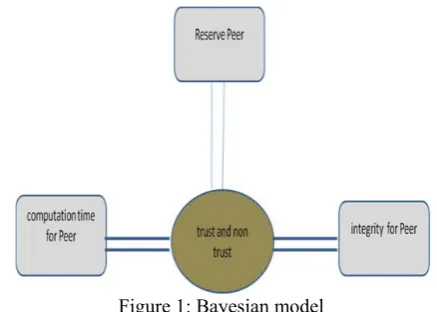
Bayesian Network-Based Trust Model: Bayesian network is relationship network that uses statistic methods to represent probability between different agents. Its theoretical foundation is Bay’s rules. Through Bayesian network we introduce concept of task distributor and task processor. Here task distributor calculates trust according to certain parameter and submit subtask to task processing peer who is having more trust value than other. In peer-to-peer file sharing applications, our approach can also be integrated with current file sharing protocols, such as Gnutella. In file sharing systems in peer-to-peer network, each peer plays two roles, the role of file provider offering files to other peers and the role of user using files provided by other peers. In order to distinguish the two roles of each peer, in the rest of the paper, when a peer acts as a file provider, we call it file provider; otherwise, we call it simply agent. Agents will develop two kinds of trust, the trust in file provider’s competence (in providing files) and the trust in other agent’s reliability in making recommendations.
It calculates two types of trust: Agent’s competence in providing services. The other is the trust in another agent’s reliability in providing recommendations about other agents. Here the reliability includes two aspects: whether the agent is truthful in telling its information and whether the agent is trustworthy or not. Since agents are heterogeneous, they judge other agent’s behaviour by different criteria. If their criteria are similar, one agent can trust another agent. If their criteria are different, they cannot trust each other even if both of them tell the truth. We assume all the agents are truthful in telling their evaluations. So we only take care of the situation where agents have different ways of judging issues, which reflects different user types. We will use a peer-to-peer file sharing application as an example to describe our approach, however this approach is general
and can be applied to other domains, like web-services, e-commence, recommender systems or peer-to-peer distributed computing.
Figure 1: Bayesian model
Since agents are heterogeneous, they judge issues by different criteria. If their criteria are similar, one agent can trust another agent. If their criteria are different, they cannot trust each other even if both of them tell the truth. In the implementation of such a system based on trust and reputation, some issues have to be considered.
1) How does an agent develop and update its trust in a reference that makes recommendations?
2) When will an agent ask for recommendations about another agent that it is going to interact with?
3) How does an agent decide if another agent is trustworthy to interact with, according to its direct experiences or reputation, or both?
4) How does an agent combine together, the recommendations for a given agent coming from different references? Since the recommendations might come from trusted agents, non trusted agents or strangers, an agent has to decide how to deal with them. 5) How many kinds of trust does an agent need to
develop with another agent in a single context? In most situations, agents need to develop multiple trust relationships with each other in order to evaluate each other from different perspectives. For example, agent A might trust agent B in providing music files with good quality. But agent A might not trust agent B in offering movie files with the same quality as music files.
In this paper we also proposed Bayesian theorem trusted model. There is a incentive method based on three different feature of trust such as number of trusted transaction, speed of transmitted files, And last feature is total number of transaction.
Number of Trusted Transaction:-- If peer I is sending a file to peer j and if peer j is completely satisfy with peer i’s transaction than it called trusted transaction.
Speed of Transmitted Files:-- If speed of service demander and service supplier does not synchronized than it will cause traffic congestion in network .In these paper we have categorized speed in three category such as High, Medium, Low. According category we calculate creditability of peer.
Total Number of Transaction:-- To determine activeness of peer it is necessary to account total number of transaction that peer has done till now. According to these three parameters we apply Bay’s theorem and calculate trust.
Estimate operation: Subsequent to every transaction among task processor peer, the task distributor peer will estimate the operation. The task distributor peer strength have dissimilar standard to evaluate operation. The largely estimate of a transaction is a permutation of estimate of every characteristic connected to transaction related to this transaction, such as speed of transaction, number of trusted trisection, total number of transaction have done till now. How to merge estimate of every portion depends on task distributor peer’s necessities.
For example some tasks require high accuracy while a quantity of concerned concerning fast processing .Number of transaction gives an outcome. Transaction= TR, X, Y. ST =satisfied trusted transaction =T.UD=unsatisfied transaction= NT. Transaction gives a outcome Conditional probability for node TR result, TR =1 TR =0. Number of Transaction gives the result X, Y, 1 , 0 ,. T1, T2, T3, Represent number of trust Transaction when peer credibility(C) value of high, medium, low respectively. NT1, NT2, NT3 Represents number of non trust transaction when peer credibility value of high, medium, low respectively.
Conditional probability for node’s credibility is high. High number of transaction is given TR=1. T1 Probabilities’
when TR=1 H! 1 / By equ.1
Conditional probability for node’s credibility is high. High number of transaction is given TR=0. NT1 Probabilities’ when TR=0 "H"!O 0 / ,
We perform the same Transaction medium and low credibility. Perform the consequence Is the conditional probability with the condition that a transaction is trusted. It measures the probability that task processor peer has high credibility and Transaction is trust. The Probability can calculate according to the following formula
"H" 1 "H" 1 / 1 P(CR=”H”TR=1)=
P(CR=”H”
1 ⁄
TR=1)= ⁄ P(TR=1)= ⁄
P(CR=”H” TR=1)= ⁄ ⁄ ⁄ Equation 1.
P(CR=”H” TR=1)= ⁄ Same way we calculated probabilities next operation
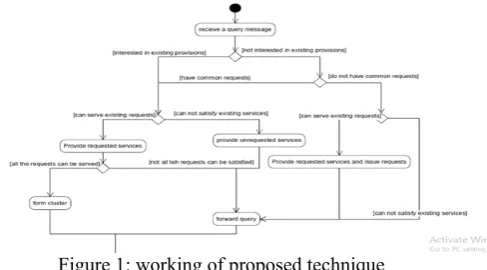
Figure 1: working of proposed technique
For the sake of simplicity, each node in our system plays only one role at a time, either the role of file provider or the role of an agent. Every agent only knows other agents directly connected with it and a few file providers at the beginning. Every agent has an interest vector. The interest vector is composed of five elements: music, movie, image, document and software. The value of each element indicates the strength of the agent’s interests in the corresponding file type. The files the agent wants to download are generated based on its interest vector. Every agent keeps two lists. One is the agent list that records all the other agents that the agent has interacted with and its trust values in these agents. The other is the file provider list that records the known file providers and the corresponding Bayesian networks representing the agent’s trusts in these file providers. Each file provider has a capability vector showing its capabilities indifferent aspects, i.e. providing files with different types, qualities and download speeds
To maintain the believe table lightweight, we utilize a First in First out (FIFO) queue data construction to store the set of probabilities in bench entries. If a queue is complete and a novel probability is concerning to be insert, we will delete the Oldest probability and put in the novel probability. In this method, we forever confirmation node’s nearly all recent activities.
Proposed algorithm Distributed Peer Selection Collection
1. when a message μ from i is received do
2. When a message μ from j which is i’s neighbour is
received do
3. if j acknowledges μ then 4. update amount which peer i has
5. uploaded/downloaded to/from j using Equ.1
6. end if; 7. else
8. if it happens for the first time then 9. detect i as suspicious peer for cheating.
12. determine i as malicious peer for cheating;
13. inform to i’s neighbours if necessary;
14. end else; 15. end else; 16. end when; 17. end when; 18. after t seconds do
19. for each peer p whose bank set peer k belongs to do
20. for each q∈p‘s neighbours do
21. send the updated p’s contribution;
22. end for; 23. end for; 24. end after;
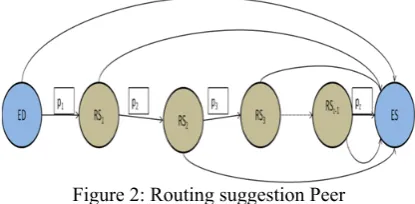
We are also approaching to shortest path algorithm from Examine Demander Peer (ED) to Examine Supplier peer (ES). Examine demander peer sends query messages, and decides one or a collection of service supplier peers to take out a transaction Examine supplier Peer (ES). It topic service information, and make available service for single or a group of ES Searching path. The query messages are sent beginning ED to ES one by one. It is a prepared peers’ group according to the peer progression of receiving messages. Routing suggestion Peer (RS). It includes each one of the peers on the searching path excluding ED and ES. We describe the Routing suggestion Set,
Figure 2: Routing suggestion Peer
Profit distribution support routing trust estimate algorithm In P2P networks, a peer might be a ED, a ES, and also a RS. RS ahead query messages for further peers. Since of peers’ autonomy and self-interest, in organize to diminish the resource utilization, RS is reluctant to advance query message, still malicious RS propel query messages to the peers which present unreliable resource, so that it causes ED’s great loss. In the profit sharing based routing trust evaluation algorithm, according to RS s contribution, ES shares transaction proceeds with RS. And by advance routing query messages for extra peers, RS gets other peers’ routing trust in sequence. So it provisions a effective method to replicate RS to forward query messages.
Evaluation of peers’ contribution at what time searching resource, if present are numerous searching path from examine Demander Peer to Examine supplier Peer, we neglect the longer searching conduit, and Examine Demander Peer chooses Routing suggestion Peer which on the shorter performance to have a say to the entirety proceeds. Going on the searching path, if RR is closer to Examine Demander Peer it has supplementary consequence on the transaction. Explicitly, routing suggestion Peer which is previously ED create supplementary giving to the transaction. If the transaction is doing well, the Routing
offer Peer can increase huge arrangement income, although, if ineffective, the Routing proposition Peer will get a huge transaction accountability for it.
IV. CONCLUSION
Our perception we diminish the difficulty of free rider & incentive method in a distributed peer to peer network based on Bayesian networks. The paper initiate into the classification proceeds distribution method in HRM for the earliest time and suggest the proceeds distribution based routing trust estimate algorithm based on Bayesian networks , which formulate service demander peers contribute to proceeds with routing suggest peers according to their involvement. The routing suggestion peers support other peers in advance query communication, and obtain their neighbours routing trust in sequence. On this support, we suggest the routing trust attentive topology optimization protocol. We show through performs analysis that, the proceeds distribution based routing trust estimate algorithm construct straightforward peers meet to the core of networks, and create malicious and free-riders disinterested to the circumference of networks. It enlarges the straightforward peers’ resource query effectiveness, and nearby the explanation of topology.
REFERENCES
[1.] Thomas Silverston Olivier Fourmauxand Jon Towards an Incentive Mechanism for Peer-to-Peer Multimedia Live Streaming Systems (2008) IEEE.
[2.] Yong Wang, Vinny Cahill1, Elizabeth Gray,” Bayesian Network Based Trust Management” TCD-CS-50-2007.
[3.] Huaizhi Li and MukeshSinghal,”Trust Management in Distributed Systems “Published by the IEEE Computer Society- February 2007. [4.] Shah, P., Paris, F.: “Peer-to-Peer Multimedia Streaming Using Bit
Torrent”; the IEEE Performance, Computing, and Communications Conference, (April 2007) 340-347.
[5.] D. Hughes, G. Coulson, and J. Walkerdine, “Free riding on gnutella revisited: the bell tolls?” Distributed Systems Online, IEEE, vol. 6,
no. 6, pp. –, June 2005.
[6.] Orb Networks, Inc. http://www.orb.com/.
[7.] A. Habib and J. Chuang, “Incentive mechanism for peer-to-peer media streaming,” in Quality of Service, 2004. IWQOS 2004. Twelfth
IEEE International Workshop on, 7-9 June 2004, pp. 171–180.
[8.] Chang, J., Wang, H., and Gang, Y, "A Dynamic Trust Metric for P2P Systems," In. Proceedings of the Fifth international Conference on Grid and Cooperative Computing Workshops (GCCW06). IEEE Computer Society, Washington, DC, Oct. 21 - 23, 2006.117-120 [9.] Yang, J., Li, Y, Huang, B., and Ming, J., "Preventing DDoS Attacks
Based on Credit Model for P2P Streaming System," In. Proceedings of the 5th international Conference on Autonomic and Trusted Computing. Oslo, Norway, June 23 - 25, 2008
[10.] Yizhi Ren, Mingchu Li, Cheng Guo, Yongrui Cui, and Sakurai, K, "Trust Similarity Measure in Trust Model for P2P Networks," EUC '08. IEEE/IFIP International Conference on Embedded and Ubiquitous Computing, voI.2, no., pp.107-112, 17-20 Dec. 2008 [11.] Yong Wang1;2, Vinny Cahill1, Elizabeth Gray1, Colin Harris1, and
Lejian Liao3,” Bayesian Network Based Trust Management” Springer-Verlag, (2006).
[12.] Josep Rius, Fernando Cores, Francesc Solsona A New Credit-Based Incentive Mechanism for P2P Scheduling with User Modeling. Josep Rius, Fernando Cores, Francesc Solsona (2009) IEEE.
[13.] Runhua Zhang, Ying Liu, Jianpin Wu” A Relative Probability Based Incentive Mechanism in P2P Systems” 978-1-4244-5824-0/- 2010 IEEE.
[14.] Hongfang –Luo, Lai-Deng Di-Wen. Research on P2P network selection of super node mechanism based on trusted model. [15.] Chow-Sing Lin, Yi –chi cheng: A Barter based incentive method for
[16.] Farag Azzedin: Trust-Based Taxonomy for Free Riders in Distributed Multimedia Systems.
[17.] Yong Wang, Kerui Huang, Bin Wang, Zhiguang Qin, and Ge Huang,” Privacy Prevention Based on Trust Model for P2P Streaming Systems” 978-1-4244-8223-81101-2010 IEEE.
[18.] Bridge Q. Zhao, John C.S. Lui, Dah-Ming Chiu. Mathematical modelling of incentive policies in p2p systems. Proceedings of the 3rd international workshop on Economics of networked systems,
Seattle, WA, USA, 2008.
[19.] Y. Wang, A. Reibman, and S. Lin, “Multiple description coding for video delivery,” Proceedings of the IEEE, vol. 93, no. 1, pp. 57–70,
Jan.2005.
[20.] V. Goyal, “Multiple description coding: compression meets the network,” Signal Processing Magazine, IEEE, vol. 18, no. 5, pp. 74– 93, Sep. 2001.
[21.] Aberer, K., Datta, A., Hauswirth, M.: “P-Grid: Dynamics of self- organization processes in structured P2P systems”; Proc. Peer-to-Peer Systems and Applications, Lect. Notes in Comp. Sci. 3845, Springer, Berlin. 2005.
[22.] CHANG Jun-Sheng, WANG Huai-Min, and YIN Gang. "DyTrust • A Time-Frame Based Dynamic Trust Model for P2P Systems," Chinese Journal of Computers, 2006, 29(8} 1301-1307.
[23.] B. Balasubramanian and V.K. Garg, “Fused Data Structure Library (Implemented in Java 1.6),” Parallel and Distributed Systems Laboratory, http://maple.ece.utexas.edu, 2010.