Application areas of multi-user virtual
environments in the healthcare context
Reza GHANBARZADEH a,1, Amir Hossein GHAPANCHI a and Michael BLUMENSTEIN a
aSchool of Information and Communication Technology,
Griffith University, Queensland, Australia
Abstract. This study conducts a systematic literature review on the application of the three-dimensional virtual worlds (3DVW) in healthcare context. During the past decade, 3DVWs have emerged as a cutting edge technology that has much to offer to the healthcare sector. Our systematic review began with an initial set of 1088 studies published from 1990 to 2013 which have used 3DVWs for the healthcare specific purposes. We found a variety of areas of application for the 3DVWs in healthcare, and categorised them into the following categories: education, treatment, evaluation, lifestyle and simulation. The presented big picture of application areas of 3DVWs in this study can be very valuable and insightful for the researchers and healthcare community.
Keywords. Three-dimensional virtual worlds, 3DVW, multi-user virtual environment, MUVE, healthcare, health
Introduction
Since the introduction of Web II, there has been a remarkable improvement in the potential of web applications. As a new technology, Web II facilitates and extends various activities such as collaboration, communication, social networking, and participation between computer and Internet users [1, 2]. The three-dimensional immersive virtual worlds (3DVW) are one of the significant applications of Web II, which are computer-generated, simulated, on-line, graphic, multimedia and three-dimensional environments. They are usually run on the web, and their users can ‘Live in’ having interaction via their own graphical self-representations known as ‘avatar’ [3, 4]. 3DVWs share most of the capabilities of virtual reality technologies, especially the rendering of 3D space, and they are accessible to users via Internet-connected high-speed computers. In particular, these virtual worlds are collaborative and persistent (they exist even when users are not online and logged in) and, as a multi-user environment, they support social networking and interactivity [5, 6].
3DVWs show high potential for healthcare purposes. These virtual worlds currently feature a lot of medical and health-related projects, and they offer opportunities for different groups such as patients, physicians, providers, educators and healthcare institutions for improving the quality and efficiency of their care, treatment and education.
1Corresponding Author.
Previously several studies have been conducted related to this topic and we address some of them as follows. In [7], 3DVWs and their educational potential to health and medical educators and librarians have been introduced. Another study, [8], provides an overview of 3DVWs which are currently used in healthcare professional education and medicine. A survey of activities related to health on Second Life (www.secondlife.com) is conducted in [9]. The opportunities which are available for nursing students inside the multi-user virtual environment are presented in [10].
This paper conducts a systematic review of current researches into the application of 3DVWs in healthcare and medical contexts. This literature review helps us to shape the future direction of research by providing an understanding of previous studies, and recurring themes in the literature, and identifies gaps in the existing studies to date.
The remainder of this article has been organised as follows: Section 1 explains the applied research method for our systematic review. Section 2 presents the results, and Section 3 concludes the article
1.Research Methodology
This study follows systematic literature review guidelines to achieve research objectives. A systematic literature review is a methodical approach to identification, evaluation, and interpretation of the available former studies conducted on a specific research topic [11].
1.1.Searching and Selecting Procedures
The process of search for relevant literature was completed in six different stages. Figure 1 indicates the stages of study selection for systematic review in this study using Kitchenham’s guidelines [11].
Figure 1. Stages of the study selection procedure.
was 37. To increase the comprehensiveness of this study, we investigated the reference papers of these 37 papers in Stage 6. This yielded an additional 1183 papers. We discarded 1152 papers on the basis of their titles. Another six papers were excluded based on their abstracts, resulting in 25 remaining papers. Altogether, as of 20 Aug 2013, we had 2271 papers, of which 2209 were discarded for being unrelated to our topic. Therefore, the total number of relevant papers in our systematic review was 62. In neither iteration was there any paper exclusion on the basis of the full text.
1.2.Resources Searched
The following scientific databases were used for searching the keywords: PubMed, ScienceDirect, ProQuest, IEEE Explore and ACM Digital Library.
1.3.Search Terms
To perform the search operations, we used the advanced search service of each scientific database. According to the search patterns of each database’s search engine, the title, abstract, keywords and in some cases the full text of the papers were sourced. The search was performed by using 42 keywords in three sets including the keywords related to ‘three dimensional’, ‘virtual world’ and ‘health’. To see the list of keywords, please visit the following link: https://sites.google.com/site/3dvwpaperkeywords/
1.4.Inclusion and Exclusion Criteria
In order to perform material selection for this systematic review, two inclusion and exclusion criterion were considered. The studies published between 1990 and 2013 were included, and the studies in languages other than English were excluded, and there were no relevant papers between the years 1990 and 2005.
1.5.Data Extraction
3DVWs and their application areas in health-related activities were extracted from 62 studies in this study. 3DVWs have been designed, implemented and applied in a wide variety of categories, contexts and sub-contexts in conjunction with healthcare and medical purposes.
1.6.Data Analysis
2.Results
According to this study, 3DVWs have been used in various applications in health-related activities and we identified them in five main categories: education; treatment; simulation; evaluation; lifestyle. The education category was divided into two sub-categories: academic education and professional education. Figure 2 depicts the result of our classification.
Figure 2. The major categories of application area of 3DVWs in the healthcare sector.
The education category includes the largest number of papers, namely 34. In contrast, three papers are related to lifestyle category which has the least number of articles. Despite the fact that treatment plays a crucial role in the healthcare and medical sector, only nine papers are in this category. Eight papers are allocated to the evaluation category; and four papers have used 3DVWs for simulation purposes. From the total of 62 papers, 4 papers [7-10] have done surveys and literature reviews on this subject. The five main categories and their specifications will be described in detail.
2.1.Treatment
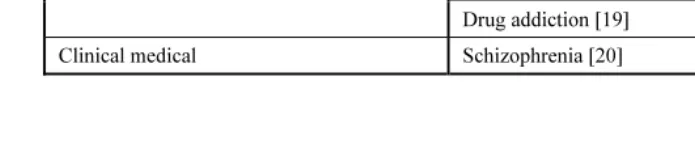
According to this category, various applications of 3D virtual worlds for treatment purposes in healthcare were developed in 9 studies. In most of the studies, practitioners, physicians, nurses, medical staff and patients had their own avatars were entering in a specific environment in a virtual world and patients were treated using specialised methods and techniques. Treatment was performed in two health contexts: clinical treatment and psychological treatment. Table 1 shows the contexts and sub-contexts related to studies for which 3DVWs have been used for treatment purposes.
2.2.Simulation
purposes. Table 2 indicates the health contexts and their sub-contexts related to the papers which have used 3DVWs for simulation.
Table 1. Healthcare contexts and sub-contexts in the treatment category
Context Sub-Context/Reference
Psychology
Psychological stress [12]
Quality of life of cancer patients [13] PTSD (Post Traumatic Stress Disorder) [14] Military mental healthcare [15]
Stress reduction program [16] PTSD [17]
Different addictions [18] Drug addiction [19] Clinical medical Schizophrenia [20]
Table 2. Healthcare contexts and sub-contexts in the simulation category
2.3.Evaluation
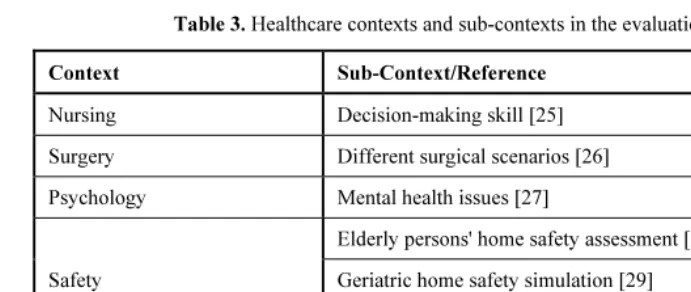
Studies in the evaluation category focus on the assessment and evaluation applications of 3DVWs in healthcare. In most of the studies, these virtual worlds were used for evaluating a particular proficiency in specific groups such as nurses and sergeants, assessing of safety in specific environments, measuring of the factors in emergency services, or investigating a rate of improvement in a specific patient. 3DVWs have been used for evaluation in the contexts such as nursing, surgery, psychology, safety regulatory focus and emergency. Table 3 demonstrates the complete details in context and sub-contexts of published papers related to this category.
2.4.Lifestyle
According to our study, in order to improve people’s lifestyle, especially in terms of obesity and overweighting, 3DVWs have been used in three various fitness programs. All of studies in this category have used these 3DVWs for extending obesity prevention and weight loss programs. Table 4 represents the context and sub-contexts of the papers in this group.
Context Sub-Context/Reference
Healthcare logistics Simulation [21]
Table 3. Healthcare contexts and sub-contexts in the evaluation category
Table 4. Healthcare contexts and sub-contexts in the lifestyle category
2.5.Education
We found that the majority of studies in this literature review, applied 3D virtual worlds for educational and pedagogical purposes in healthcare. Education category consists of two main sub-categories: academic education and professional education. Academic education mostly focuses on university-related applications of 3DVWs for healthcare. This category is mainly related to training programs for students and academic staff in universities and educational institutions. Papers in this category used virtual worlds in contexts such as nursing, emergency health, public health etc. Professional education sub-category used virtual worlds for training in professional health such as educational programs for nurses, physicians, hospital staff etc., in the healthcare contexts as nursing, public health, radiotherapy and clinical medical. All papers in the professional education sub-category conducted educational programs for non-academic learners. Tables 5 and 6 show the contexts and sub-contexts of the papers which used 3DVWs in the professional and academic educations respectively.
3.Conclusion
In order to provide a comprehensive picture of 3DVW applications in healthcare, and update the literature, we performed a systematic literature review in this field. We also highlighted various health contexts and sub-contexts that have applied 3DVWs. To
Context Sub-Context/Reference
Nursing Decision-making skill [25] Surgery Different surgical scenarios [26] Psychology Mental health issues [27]
Safety
Elderly persons' home safety assessment [28] Geriatric home safety simulation [29] Geriatric home safety [30]
Regulatory focus Trustworthiness [31] Emergency Mock oral examination [32]
Context Sub-Context/Reference
Fitness
Obesity preventing [33] Obesity and diabetes/stress [5]
Table 5. Healthcare contexts and sub-contexts in the professional education category
Table 6. Healthcare contexts and sub-contexts in the academic education category
Context Sub-Context/Reference
Nursing
Public health services [35]
Graduate, undergraduate and doctoral courses [36] Patient safety simulation [37]
Nutrition [38]
Public health issues (various activities) [39] Clinical simulation [40]
Postpartum haemorrhage simulation [41] Acute-care medicine (Emergency) [42] Disaster scenario [43]
ICU first hour shift handover process [44] Rapid sequence intubation (RSI) [45]
Emergency
Accident rescue procedure [46] Trauma management [47]
Speed and accuracy of nurse response [48] Pre-hospital CPR training [49]
Cardiopulmonary resuscitation (CPR)[50] Managing emergencies and disasters [4] Medical education Virtual patient simulation [51] Safety Construction safety [52] Healthcare higher education Distance education [53] Pharmacy Drug safety... [54]
Home assessment ...Patient-centred decision-making… [55] Public health Public health [56]
Context Sub-Context/Reference
Radiotherapy Cancer care [57]
Nursing Facilitate nursing journal clubs [58]
Patient-centred communication Counselling patients about colorectal cancer [59] Delivering bad news to patients [60]
Healthcare higher education Patient safety [61] Clinical medical Diabetes care [62] Diabetes type 2 [63] Laboratory Animal care [64]
Public health
Sexual health [65] Sexual health [66]
conduct this systematic literature review, we found 62 studies from five top-ranked scientific databases from 1990 to 2013. According to the main area of research of these studies, we classified them to five main categories to explain the use of 3DVWs in the healthcare sector: education, treatment, simulation, lifestyle and evaluation.
We found that the education category, including academic and professional sub-categories, with 34 of all papers, contains the largest amount of the papers in this study. It shows that 3DVWs are increasing in popularity as a supplementary means for educational purposes, and various well-known healthcare and medical institutions are adopting these cutting edge web 2.0 technologies to support their teaching and learning purposes.
The results of the current study and the proposed taxonomy can be beneficial for a wide range of institutions and individuals to recognise various areas of application of 3D virtual worlds in their professional, business, educational and organisational decisions. This study also attempts to help them to determine various directions for practice in their own areas. For instance we can point to decision-makers, educational communities, hospitals, practitioners, nurses, patients, pharmaceutical companies, nursing homes, health marketers, disaster managers, public health providers, and addiction treatment institutes etc. which are able to use 3DVWs in relation with their specific field.
We also found that despite the fact that a large number of studies have been conducted on application of 3DVWs in healthcare, still there are many gaps in this field. The results of this study can be beneficial for researchers who are enthusiastic in this field for better understanding of the topic and previous studies, helping them to shape the future direction of research on 3DVWs, and identify gaps in the literature.
References
[1] Eysenbach, G., Medicine 2.0: social networking, collaboration, participation, apomediation, and openness. Journal of Medical Internet Research, 2008. 10(3)
[2] Kamel Boulos, M.N. and S. Wheeler, The emerging Web 2.0 social software: an enabling suite of sociable technologies in health and health care education1. Health Information & Libraries Journal, 2007. 24(1): p. 2-23.
[3] Bell, M. W. Toward a definition of “virtual worlds.” Journal of VirtualWorlds Research, 2008, 1(1), 2-5.
[4] Boulos, M.N. and D. Burden, Web GIS in practice V: 3-D interactive and real-time mapping in Second Life. International Journal of Health Geographics, 2007. 6(1): p. 51.
[5] Morie, J.F. and E. Chance, Extending the reach of health care for obesity and diabetes using virtual worlds. Journal of diabetes science and technology, 2011. 5(2): p. 272-276.
[6] Montoya, M.M., A.P. Massey, and N.S. Lockwood, 3D collaborative virtual environments: exploring the link between collaborative behaviors and team performance. Decision Sciences, 2011. 42(2): p. 451-476.
[7] Boulos, M.N.K., L. Hetherington, and S. Wheeler, Second Life: an overview of the potential of 3 D virtual worlds in medical and health education. Health Information & Libraries Journal, 2007. 24(4): p. 233-245.
[8] Hansen M. M., Versatile, Immersive, Creative and Dynamic Virtual 3-D Healthcare Learning Environments: A Review of the Literature. 2008.
[10] Peck, B. and C. Miller, I think I can, I think I can, I think I can… I know I can Multi-user Virtual Environments (MUVEs) as a means of developing competence and confidence in undergraduate nursing students An Australian perspective. Procedia-Social and Behavioral Sciences, 2010. 2(2): p. 4571-4575.
[11] Kitchenham, B., Procedures for performing systematic reviews. Keele, UK, Keele University, 2004. 33: p. 2004.