Almog Benin Sivan Toledo Eran Tromer [email protected] [email protected] [email protected]
Blavatnik School of Computer Science, Tel-Aviv University
Abstract. Existing standards (ZigBee and Bluetooth Low Energy) for networked low-power wireless devices do not support secure association (or pairing) of new devices into a network: their association process is vulnerable to man-in-the-middle attacks. This paper addresses three es-sential aspects in attaining secure association for such devices.
First, we dene a user-interface primitive, oblivious comparison, that allows users to approve authentic associations and abort compromised ones. This distills and generalizes several existing approve/abort mech-anisms, and moreover we experimentally show that OC can be imple-mented using very little hardware: one LED and one switch.
Second, we provide a new Message Recognition Protocol (MRP) that allows devices associated using oblivious comparison to exchange au-thenticated messages without the use of public-key cryptography (which exceeds the capabilities of many IoT devices). This protocol improves upon previously proposed MRPs in several respects.
Third, we propose a robust denition of security for MRPs that is based on universal composability, and show that our MRP satises this deni-tion.
1 Introduction
Devices that compute and communicate need to ensure that they communicate with the intended party rather than an attacker. Achieving this goal requires two main components: a mechanism for the user to specify the intended parties, and a protocol that allows secure (authenticated and perhaps private) communication between the intended parties. These should be proven secure under a well-dened model and denition, that capture the capabilities of pertinent adversaries. Many recent work address this challenges for various types for devices; see [32, 6, 20, 34] for discussions and surveys.
Achieving the same goal with low-power computationally-weak devices with a very minimal user interface is extremely hard. In fact, the task is considered so hard that standardization bodies gave up. In both ZigBee and Bluetooth Low Energy (BLE, also called Bluetooth Smart) the association phase, in which a new device is added to a mesh network or paired with another device, is completely vulnerable to simple man-in-the-middle (MITM) attacks1.
The goal of this paper is to show that secure association is possible for the low-power computationally-weak devices that make up the Internet of Things (IoT),
even if they have a very minimal user interface. Our solutions are applicable to interoperable devices intended to be deployed by the end consumer. If adopted, our solutions can rectify severe vulnerabilities in ZigBee and BLE and can secure emerging IoT standards.
To address this problem, this paper addresses the three components that are necessary for secure association. First, we propose (in Section 2) an abstract user-interface primitive for specifying the intended parties in an association (pairing) process. The specication is passive; the devices are told to associate (without telling them with whom to associate), for example by pressing a button on each device. They then attempt to nd a willing party. If successful, they present to the user enough information to allow the user to decide whether the two parties are the intended ones or not. If yes, she approves the association (say by pressing the button again). If not, she aborts the association attempt (e.g. by not pressing the button until a timeout elapses). We show that wireless devices with only a single LED as a display device can present sucient information to the user to allow her to reliably approve or abort associations. This primitive, which we call oblivious comparison (OC), generalizes several concrete user-interface mechanisms that have been proposed for devices with richer user interfaces.
Once the intended parties are established using OC, they need a protocol for secure exchange of (logical) messages over the insecure (physical) connection. Establishes an authenticated and private channel, in this setting, seems to re-quire public-key cryptography, which is too expensive for many IoT devices (as is indeed the assumption in both ZigBee and BLE). Instead, we pursue (in Sec-tions 4 and 5) the notion of message recognition protocol (MRP): informally, a protocol to exchange authenticated messages but without ensuring privacy. This allows lightweight implementations that rely only on symmetric-key cryptogra-phy. MRPs have been discussed in the literature, but without adequate formal denitions, and indeed we show that ad-hoc security denitions for MRPs can completely fail to authenticate messages if the attacker can somehow aect the choice of transmitted messages (a chosen-message attack). We propose stronger denitions, in both the chosen-message stand-alone setting and in the framework of universal composability (UC) [4]; we show them equivalent to each other, and strictly stronger than the weaker denition.
Finally, we propose (in Section 6) a new MRP: the PEBIUS protocol. PE-BIUS improves on prior MRPs in being (1) bidirectional, thereby more ecient, (2) can run forever, whereas some of the prior MRPs in the literature are limited to an a priori xed number of rounds, and (3) is proved secure under the UC sense, and in particular is secure against chosen-message attacks.
2 User Interaction for Secure Association
IoT devices have only one rich interface to the outside world, namely a data radio. The radio cannot be used to transfer identifying information for secure pairing because doing so leaves devices vulnerable to MITM attacks. (ZigBee does use this mechanism in its so-called standard-security mode, which transfers the network's master key over the air and in the clear; this mode is fundamen-tally insecure.) What other mechanisms can be used to transfer this information into IoT devices?
2.1 Background on Unsuitable or Ineective Mechanisms
One mechanism relies on preinstallation of this information. One example is Zig-Bee's high-security mode that assume that the network's master key is stored at manufacture time or at rmware-update time. This is infeasible for interop-erable IoT devices intended to be deployed by consumer, and as a consequence, no ZigBee device that we are aware of uses it. Another common example of preinstallation is the inclusion of prestored cryptographic certicates in main-stream operating systems (e.g., CA root certicates). This mechanism appears to be inappropriate for IoT devices because (1) there is no usable and reliable mechanism to invalidate/replace compromised certicates on IoT devices, (2) the mechanism requires public-key computations that are considered too expen-sive for ZigBee and Bluetooth Low Energy (BLE) devices, and (3) the stored certicates allow authentication of a named party in a protocol (e.g., domain name), but many IoT devices are nameless (some devices may be large enough to carry a printed identifying name, similar to a MAC address, but this is not a common practice). Even if the diculties with certicates are overcome, they only allow association if at least one of the devices has a rich enough interface to allow the user to specify or approve the name of the other device; this is not the case when two simple IoT devices need to be associated (e.g., a light bulb and a controlling switch). We that this mechanism is unsuitable for IoT.
Another class of mechanisms relies on out-of-band data transfer. In these mechanisms, one device provides the user with the information to transfer (e.g., encodes it and displays it on a screen), which the user types into the other device (e.g., using a keyboard). This mechanism is used in Bluetooth's [12] passkey-entry association mode (unfortunately, the implementation of this mode in Bluetooth 4 is insecure [18], and so is the similar PIN mode in Bluetooth 2.0 [11][31]). The data can be transferred not only by a human user, but also using high-bandwidth input devices such as a high-resolution camera [24]. There are numerous sug-gested methods for out-of-band data transfer (see [6, 14] and the references therein).
2.2 Out-of-Band Oblivious Comparisons
We now show that a number of user-interaction mechanisms, in existing stan-dards and literature, all implement an abstract primitive that we call oblivious comparison (OC). This common functionality has not been recognized and de-ned in the literature. In the following, we provide a denition of oblivious comparison, and review prior implementations. In Section 2.3 we describe a new implementation using very little hardware, and in Section 5 we discuss a universally-composable denition of OC
Denition 1. An out-of-band oblivious comparison between devices A and B
consists of the following steps. Initially, A and B hold values, vA and vB re-spectively (derived from their previous interaction, which in our setting is over a non-condential and unauthenticated bidirectional channel). They would like check whethervA=vB.
1. Each ofAandB sends the value they derived from the rst step to a verier
(e.g., a human user). The (unidirectional) channel to the verier must allow the verier to ascertain that the values came fromAandB, and to determine
whether the sent values are identical.
2. The verier informs AandB whether the values were identical, via a
(uni-directional, non-condential) channel that cannot be spoofed (e.g., a button). In Bluetooth's numeric comparison mode [17], the two devices attempt to agree on a string (six decimal digits). The negotiation is done in-band on the not-yet-authenticated wireless channel. Both then display the string to the user (this is the rst channel; the verier is the human user and she ascertains the identity of the devices by visual inspection and hand-eye coordination). The user presses a switch on each device to tell it whether the two strings are identical, in which case the association succeeds (this is the second channel). Note that the user only has to compare the values, and not remember them. In the Bluetooth standard, the string is essentially a hash of the concatenation of the public keys of the two devices, which are also transmitted in-band.
Bluetooth's numeric comparison requires a rich out-of-band user interface (a numeric display), but the literature contains other mechanisms that essentially implement oblivious comparison, using less resources.
Saxena et al. proposed a mechanism that uses an LED on one device and a video camera on the other [30]. The device with the LED blinks it in a pattern that represents the value. The device with the camera observes the blinking and compares it to the value it stores. This device also serves as a verier. If the values are identical, the device with the camera tells the user (e.g., using an LED or a display) to tell the other devices that the comparison passed. The human is used to implement the third channel; physical proximity and the direction of the camera are used to implement the second.
the display). The sequence advances manually by one bit every time the user presses a key on the device that she holds. If the colors dier, the user aborts the association. If both devices display the same value, they associate when the entire bit string has been presented.
Prasad and Saxena [28] describe an alternative, where the user copies a bit pattern from one device to the other by pressing a button every time an LED blinks. They also propose Blink-Blink [28], based on a human comparing the blinking and glowing patterns of LEDs (two LEDs on each device), as well as Blink-Beep and Beep-Beep variants. We discuss this further below. Note that press-to-advance, Blink-Blink and 1-LED OC (described below) all contradict an assertion by Kuo et al. [15] who claimed that devices with only a button and an LED cannot be securely paired.
Goodrich et al. [10], and [28] in their Beep-Beep scheme, propose a mechanism based on the human ability to tell whether two simultaneous series of audio tones are identical. The authenticity of the display channel relies on identication of audio sources; this mechanism is appropriate for headsets, perhaps not to loudspeakers. Combinations of audio and visual signals are also possible. Transitive OC. Association protocols based on OC can be easily extended from pairwise association to network-wide association. Suppose that in a commu-nication network, nodesAandT have established an authenticated channel and
that nodesB andT have established such a channel. NodesA andB can now
associate so that they can communicate directly (they can obviously exchange authenticated messages through the trusted partyT, but direct communication
is usually more ecient). They attempt to agree on a value v using an
unau-thenticated channel (rst channel in the denition) and then both send the value they believed they agreed on to the verierT using the authenticated channels. T checks whether the two values are identical and informs both parties of the
result, also using the authenticated channels. For example, in a ZigBee network a user might associate a new nodeAwith a nearby routerT that is already part
of a mesh network with trust centerB. NowAandB establish an authenticated
communication channel throughT.
2.3 1-LED Oblivious Comparison
We propose a new oblivious comparison mechanism, 1-LED OC, that requires merely a single LED and a single button in each device, and moreover require minimal input from the user (a single button press). The devices simultaneously blink their LED using an on-o pattern derived the value that the devices agreed upon, and the user decides whether the patterns are identical or very dierent, pressing the buttons accordingly, as explained next.
In 1-LED OC, the parties A and B proceed as follows. First, each party
Fig. 2.1. The LED comparison experiment.
Here, h is a hash function, that we formally model as a random oracle, and
concretely instantiate using SHA-256. The hat values, RcA and dRB, represents the corresponding received value, which might be corrupted. The encoding of a stringsinto a blinking pattern is as follows: we derive a pseudorandom sequence Sfroms,by usingsas the seed into a pseudorandom generator (e.g., any stream
cipher); then for each bitSiofS, in sequence, the LED is turned o for a xed period τ if Si = 0, and turned on for a period τ if Si = 1. The two devices perform the blinking synchronously (up to the accuracy of their shared clock), until their respective buttons are pressed by the user.Figure 2.1 shows a physical realization
The blink periodτ can be pretty short: our experiments below suggest that τ ≈ 66ms works well. Practically, delays and clock drifts are insignicant at the time scale of human perception. Low-power low-cost RF devices can easily synchronize their clocks to within better than a millisecond, and their real-time clocks are accurate to 100ppm or better. These translate to a drift of about 4.4ms over 256 periods of 66ms each2. For comparison, Steinmetz researched the
human perception of media synchronization [33], and found that humans fail to detect synchronization error of ±80ms. Moreover, if drift becomes a problem, the two devices can wirelessly re-synchronize while blinking.
Comparison to Blink-Blink. The aforementioned Blink-Blink scheme [28] is also based on comparing LED, but takes a dierent approach. Blink-Blink uses a Short Authentication String protocol and requires bit-accurate comparison of short strings (15 bits). It thus uses slow blinking rates (300ms to 800ms), and uses two LEDs per device to ensure synchronization of the strings. 1-LED OC, instead, compares long pseudorandom, relying not on bit-level accuracy but on the ability to distinguish identical sequences from nearly-independent sequences; we can thus use a blinking rate that is an order of magnitude faster (40ms to 66ms), and do not need an extra LED for synchronization.
Experimental methodology. To demonstrate the feasibility of the 1-LED OC, we tested this mechanism on human subjects. The devices were bare Tmote 2 In the extreme case, each device deviate from the desired time by256·66µs·100ppm=
Sky boards running Contiki that we custom programmed for this task. The devices were attached to at surface to keep the LEDs exactly 7cm from each other (see Figure 2.1). The devices coordinated the values and the timing using radio messages. They also recorded the interaction for analysis.
Human subjects were presented with LED blinking sequences on these de-vices. They were instructed to press the button on the rightmost device once they decided whether the sequences are identical: a long press (3 seconds or longer) if the user believed the sequences are identical, and a short press (less than 3 seconds) if dierent. The next sequence was presented 3 seconds after the button press. To help subjects understand the task, the rst 6 sequences were training sequences. In these sequences, a green LED would light after the user's input if the user was right and a red LED would light if she was wrong. The training runs were excluded from the analysis. After the training runs, which were displayed at a rate of 15bps, the user classied 8 sequences at the same rate. They were followed by 2 training sequences at 25bps and then 8 test sequences at 25bps.
The experiment was conducted on 10 volunteers, age 1466, of both genders.3
Experimental results. Most of the subjects gave the correct answer to all of the sessions. In a few cases, the subject classied the sequence correctly but accidentally pressed the button incorrectly; if the subject immediately indicated verbally that he knows that he was wrong, we regarded such answers as cor-rect, under the assumption that in a real scenario, the user would immediately dissociate the devices after mis-pressing the validation button.
All except one subject classied all sequences correctly. That single subject had 2 false-positive answers (out of 16). We conclude that the oblivious compar-ison using blinking LEDs is an easy task for humans.
3 Message Authenticity With Privacy
In the previous section, we discuss how to transfer a short bit string authentically. In this section and the rest of the paper, we discuss how to bootstrap from a shared string into exchanging authenticated messages: a Message Authentication Protocol (MAP).
In this section we discuss association models which can provide both authen-tic and private communication channel. All the methods in this section aim to establish a shared secret key between two devices. Once the key is established, the devices can communicate securely using standard symmetric primitives (sym-metric encryption and MAC, or signcryption such as CCM-AES).
Preinstallation. If both devices are manufactured by the same origin, and the devices are intended to communicate with each other in advance, then the manufacturer can install the secret keys for the communication in both devices in advance.
Out of band (OOB). By out of band we mean that the secrets does not relay over the RF channel. If one device has an input interface and the other one has 3 The experiment is ongoing. The nal version of the paper will include a larger subject
an output interface such that a (short) bit string can be transferred securely (authentically and condentially), then both devices can generate their secret key and output them to such interface. A human user then can take these keys and enter them into the input interface of the respective other device. Examples of such mechanisms are the Bluetooth's passkey-entry[12] and barcode-camera pairing mechanism [24].
Public key infrastructure (PKI). PKI is very common way to bootstrap a secure channel in the Internet. Loosely speaking, in PKI there is a trusted third party (Certicate Authority, CA), which holds the bit strings to be authenticated (public-keys) of servers. Whenever a client in the Internet wants to initiate a secured connection with a server, it asks the server for its public key and a certication for that key, signed by the CA. By verifying this certicate the client can be sure that the public key belongs to the server.
Anonymous channel. This protocol [5] assumes the existence of an anony-mous channel between the devices. Anonyanony-mous channel is a broadcast channel that hides the origin of the messages. In this protocol, A can send the secret
bit 1 to B by broadcasting an (empty) packet with the source eld set to A.
Similarly, A can send the secret bit0 to B by broadcasting an (empty) packet
with the source eld set toB. OnlyB can identify the real source of the packet
(since it did not send it, the source isA), and can recover the secret bit (1if the source is set toAor0otherwise). An eavesdropper cannot retrieve the secret bit since it cannot gure out whether the packet was actually sent by A or B. By
randomly generating nsuch packetsAand B can agree on ann-bit secret key.
While the theoretical idea is very elegant, it is unclear whether such anonymous channels can be implemented at reasonable cost, given the numerous methods available for ngerprinting and geometrically locating devices.
Accelerometer. This method [23] assumes that both devices have an ac-celerometer peripheral. The human user holds these two devices, and shakes them together. Using the accelerometer, the devices tracks the movements of the device, and generates a bit string based on this information. Since the de-vices are shaken in the similar way, they will generate similar bit strings. By assuming that humans can create random bit strings by shaking the devices, this bit string is the shared secret.
Bluetooth's numeric comparison. Bluetooth [12] oers some association models for initiating secure connection. One of them is the numeric comparison association model. In this model, each device outputs to a screen a string, and a human user is requested to compare them, and inform the devices with the answer. Loosely speaking, Bluetooth uses Die-Hellman to exchange the public-keys between the parties, and asks the human user whether the parties agrees on the same public-keys. After that, the parties can agree on a new common private-key condentially, using the authenticated public-key. This protocol was proved to be secured by Lindell [17].
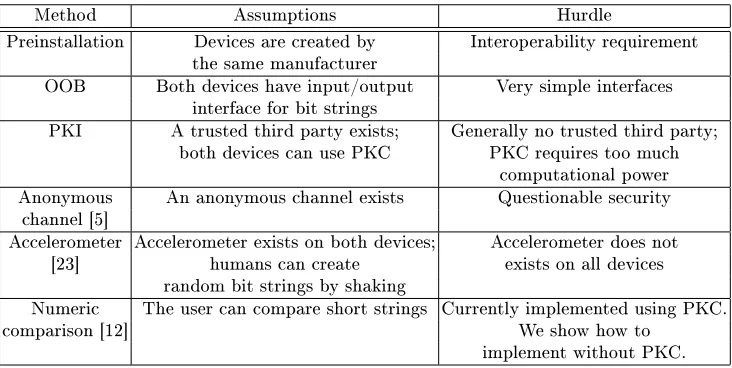
Figure 3.1 compares these methods and explains why they infeasible for low-power devices. As can be gured out from the table, these association models are not suitable for low-power devices. In the next section, we show that if au-thenticity (without secrecy) suces, then there exist alternatives that surmount all of these hurdles.
Method Assumptions Hurdle
Preinstallation Devices are created by Interoperability requirement the same manufacturer
OOB Both devices have input/output Very simple interfaces interface for bit strings
PKI A trusted third party exists; Generally no trusted third party; both devices can use PKC PKC requires too much
computational power Anonymous An anonymous channel exists Questionable security
channel [5]
Accelerometer Accelerometer exists on both devices; Accelerometer does not [23] humans can create exists on all devices
random bit strings by shaking
Numeric The user can compare short strings Currently implemented using PKC.
comparison [12] We show how to
implement without PKC.
Fig. 3.1. Comparison of bootstrapping methods for initial shared secret between two devices.
4 Message Authenticity Without Privacy
primitive (broadcasting), this approach requires the devices to be synchronized4
which in turn is achievable using heavy tools such as PKC [27].
Another approach, that does not require synchronization (but does not pro-vide broadcasting), is several protocols called Message Recognition Protocol [1, 35, 13, 19, 21, 8, 22]. In this section, we focus on this notion, and see how it can be combined with OC to achieve message authentication protocol.
Recognition vs. Authentication. MRP provides a weaker security guaran-tee than the standard message authentication protocol (MAP). While the for-mer provides guarantee that the messages originated by a party he negotiated in the past, the latter provides guarantee that the messages originated by a party with a particular identity (expressed by knowledge of some identity-specic se-cret). For example, consider a standard Die-Hellman key agreement protocol, in which there is no exchange of certicate or other involvement of third party. The protocol ends with agreement on a symmetric key which is used later for au-thenticating messages (by means of MAC) of each other. This protocol provides message recognition, since the messages can be recognized to be originated by the same party which was involved in the Die-Hellman key exchange. However, the identity of that party is not assured, since it is vulnerable to MITM attack; thus this protocol does not provide message authentication. In this section will show a generic method which utilizes OC and MRP to achieve authentication. 4.1 Dening Message Recognition Protocols
Weimerskirch and Westhof [35] provided a candidate message recognition pro-tocol, without clearly stating its security property. Subsequently, Hammel et al. [13] implemented that protocol and introduced the term message recognition for its claimed security property, but their denition and treatment were still informal (and indeed that protocol was later found out to be completely inse-cure [19]). Mashatan and Vaudenay [22] they gave a dierent protocol, with an ad-hoc denition of Message Recognition Protocol tailored to their construction. Informal tailored denitions were also used in other papers [19, 21, 8], and as we discuss in 5, this leave crucial aspects undened. One such aspect is who chooses the logical messages to be transmitted, with what computational power and with what knowledge. Although message choice arises within Gehrmann's proof style [7], used by some of those papers, it is impossible to infer that from the informal security denitions. We address this gap by providing a formal, general denition of Message Recognition Protocol (MRP).
Our denition focuses on the upward interface of the protocol in the protocol stack, as it will be used by higher layers, separately from the trivial downward interfaces of the protocol (plain, insecure "transmit" and "receive"). For simpli-fying the notation, we chose to use the formalism of Interactive Turing Machine (ITM), as used previously in the literature (such as in [4]), which are randomized and encapsulate the reception and transmission of the underlying messages.
Denition 2 (Message Recognition Protocol). Let k ∈ N∪ {∞}. A k
-Message Recognition Protocol (k-MRP) is a tuple of interactive algorithmsΠ = (AI, BI, AD, BD). The initialization-phase algorithmsAI andBI exchange mes-sages with each other.5 AI outputs the initial statesA
0 for the data phase. Sim-ilarly, BI outputs sB0. The data phase algorithms AD and BD can exchange messages with each other over the underlying insecure channel; we call these physical messages. At iteration i of the data phase, AD receives as input: (1) a state sA
i−1, and (2) a string to transmit mAi called the logical message. AD outputs: (1) a new state sAi ; (2) a binary value of acceptance/rejection of the
session bAi , and (3) a logical message that was allegedly sent by the other BD machine mb
B
i ; (4) . Then, in that iteration, BD receives as inputsBi−1 andmBi , and outputs sBi , bBi and mbAi . Without adversary interference, mAi = mbAi and mBi =mbBi for allk≥i∈N.
Adversarial model. The adversary is modeled as stateful interactive algo-rithm M which can passively eavesdrop on AI and BI, and actively corrupt communication betweenAD andBD. The adversary cannot observe or corrupt the local state maintained by A (i.e., AI and AD) or B (i.e.,BI and BD). To model the eavesdropping on the initialization step, we let the initial statesM0 of
M be the whole transcript of AI and BI. Thereafter, the state ofM, denoted
sMi , is updated during the execution ofAD andBD.
M receives as input a statesM
i−1 and returns as output a new statesMi . For simplicity, we dene that running a protocolΠ in the presence of an adversary M is done by passing the whole message exchanged betweenADandBDthrough
M, so the adversary can perform any MITM operation on their communication
(change, delay, reorder or instantiate new messages).
Protocol execution. Each party receives the logical message to be sent from the higher layer in the network protocol stack. We model it here by the functions
GenMsgP(P ∈A, B), which receives as input all of the messages received till now
from the other party.6The execution dened in Denition 3 using Algorithm 1,
and demonstrated in Figure 4.1. We use the hat notation (b·) to represent the corresponding received value, which might be corrupted by the adversary. Denition 3. LetΠ = (AI, BI, AD, BD)be an MRP. Let M be an adversary. The k-execution of these instances of the protocol alongside the adversaryM is
dened by running Algorithm 1, and denoted byEXECkΠ,M.7
5 Note that some protocols limit the number of logical messages that can be sent (because of implementation issues). This number is represented here byk. To handle
this case, we require the protocol instance to output bPi = 0 when it reaches this limit.
6 Alternative ways to model the message choice are discussed in Section 5. 7 In the rst iteration (i= 1), since the parties have not sent yet any message,A
Dand
BD have no message for output (mA0 and mB0 are not dened). We denemA0 and
Algorithm 1 Adversarial game 1. RunAI andBI, and let sA0
←AI()and sB0
←BI(). 2. Denote bytthe whole transcript of the execution ofAI andBI. 3. Start runningAD,BDandM.
4. sM0,B←t.
5. Forifrom1tokdo:
(a) RunM: sM i−1,A
←M(sM i−1,B) (b) mA
i ←GenMsgA mB0, . . . , mBi−1
(c) sAi, bAi,mˆBi
←AD sAi−1, mAi
(d) IfbAi = 1andmBi−16= ˆmBi−1, returnwin. Else ifbAi = 0, returnfail. (e) RunM: sMi,B
←M(sMi−1,A) (f) mBi ←GenMsg
B
mA0, . . . , m
A i
(g) sBi, b
B i ,mˆ
A i
←BD sBi−1, m
B i
(h) IfbB
i = 1andmAi−16= ˆmiA−1, returnwin. Else ifbAi = 0, returnfail. 6. Returnfail.
Denition 4 (Non-chosen-message securek-MRP). LetΠ = (AI, BI, AD, BD) be ank-MRP. Letk∈N∪ {∞}. We say thatΠ is a non-chosen-message secure
k-MRP if for any n∈N, for any k' s.t.k≥k0 =K(n), whereK is any
polyno-mial function, any functions GenMsgA andGenMsgB, and any ecient (PPT)
adversaryM,PrhEXECkΠ,M0 =wini=negl(n).
Delay. Some approaches to optimize the overhead of the protocol (in terms of communication, memory and computation) use information across iterations. For that, these data phase ITMs (ADandBD) need to buer the messages received and verify the correctness of the messages only in future iterations. This delay can be captured by our non-chosen-message security denition by modifying the data phase ITMs to return the buered message (instead of the current), and the execution algorithm (Algorithm 1) to verify the correctness of these buered messages. Denition 5 formalizes these modications, by introducing the delay parameterd∈N0. Note that protocols with delayd >0can be easily modied to hold the original non-chosen-message security denition (Denition 4) withd= 0, by sending a dummy empty logical messagesdtimes after each logical message
sent. (Of course, this modication inuence the communication, memory and computation overhead). In Section 6 we show our delayed secure MRP with
d= 1, and in Section 7 we proof that this protocol satises Denition 5.
Denition 5. [Delayed non-chosen-message securek-MRP] Delayed
non-chosen-message securek-MRP with delayd∈N0is dened similarly to Denition 4, with the following modications: (1) The data phase ITMs,AD andBD, are modied to return the mb
B
i−d andmb A
i−d, respectively8. (2) In Algorithm 1, the correctness check of the messages,mAi 6= ˆmAi andmBi 6= ˆmBi , are replaced by mAi−d6= ˆmAi−d
8 For brevity, we assignmP
s
A
0
AI BI
AD M BD
s0B
sA
i sBi
sA0 =t
sM i,B
d
mB i b
A i
IfbAi = 1andmdBi 6=mBi , win
d
mA i
bBi
IfbBi = 1 andmdAi 6=mAi, win
After
k
iterations,
fail
GenMsgA(·)
mAi
GenMsgB(·)
mBi t
physical messages input/output
Fig. 4.1. Demonstration of MRP execution algorithm (Algorithm 1).
andmBi−d 6= ˆmBi−d, respectively. (3) In Algorithm 1, the logical messages
gener-ation ofAD is modied to be generated by GenMsgA mB0, . . . , mBi−1−d
, and the logical messages generation ofBDis modied to be generated byGenMsgB mA0, . . . , mAi−d
. 4.2 General MRP framework
In the following, we describe a unied framework that is common to the various MRP protocols in the literature.
Stateful protocols. All of the proposals of an MRP protocol are stateful. That means that each party maintains and updates information about the session. In these protocols, the state of each party consists of (1) a transient key that is secret to that party; (2) authenticated non-secret commitment to some secret information held by the other party; and (3) possibly other information, based on the specic MRP. The protocols proceed by iterations. During each iteration, each party can transfer one logical message authentically to the other party, while opening the commitment and revealing the key in the old state, and updating the state to contain a new commitment and a new key. The protocols vary in the way they update the state. There are two basic approaches.
The rst approach is based on hash chains [35, 19, 8, 22]. Leth:{0,1}∗ → {0,1}n be a CRH. Hash-chains of length k are series of secrets of the form ai = h(ai−1), ∀0 < i < k, and a0 ← {0,1}
n
. In this approach, during the initialization phase, each party generates an hash-chain, ai and bi respectively. Thei-th state of partyAcontains as a key the index of the current chain's item ak−i and as the commitment on the current key of the other party the value of
this approach is the need to hold the whole\part of the chain of lengthkin the
memory. Choosing small k results in signicant limitation on the messages to
transmit, and large k results in memory waste. However, it seems to be easier
to prove the correctness of protocol based on such approach.
The second approach generates a new state on-the-y [1, 21]. The keys are not generated in advance during the initialization phase. Instead, during each iteration, each partyxgenerates a new key, computes a commitment on that key,
and sends the commitment to the other partyy. The key is revealed only after
verifying that y received (but not yet accepted) any message of that iteration.
For that, upon receiving any message, y should reveal a committed secret of
his own, and x should verify that the secret matches this commitment. The
commitments for the next iteration is added to the current iteration's messages. The authenticity of the commitment of the next iteration is implied by the authenticity of the message of the current iteration. As oppose to the former approach, in this one the parties are not limited on the number of messages to send/receive, and should not store many keys in advance.
Phases. Each protocol consists of two phases. The initialization phase is per-formed once at the beginning of each session and usually lasts for short time. The main mission of this phase is to established initial state for both parties. The phase basically consists of the following steps for each party: (1) generation of secret(s); (2) generation of commitment(s) on the secret(s); (3) authenticated exchange of the commitment on a secret; (4) completion of initial state estab-lishment. It is possible to replace the transmission of this authenticated data by our suggestion of oblivious comparison of Section 2.2, as we explain later in this section. If this phase nishes correctly (that means, the adversary does not changed the authenticated data), the parties move to the next phase.
The data phase consists of the iterations mentioned above, and lasts till the end of the session. The main mission of this phase is to perform the transmission of logical messages between the parties. The general structure of each iteration consists of the following general steps for each party: (1) transmission of a new message with some authentication data about it; (2) transmission of the current secret information (and thus making it public); (3) receiving of the current se-cret information of the other party and authenticating it using the authenticated commitment; (4) receiving a new message from the other party and authenticat-ing it by similar way9; (5) updating the state, as discussed above.
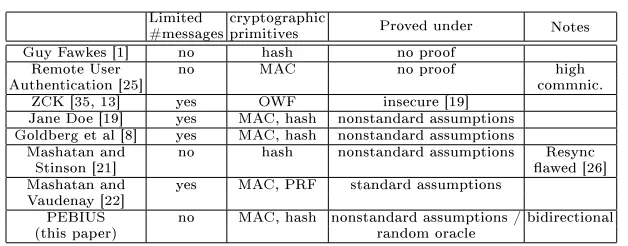
Table 4.2 compares existing MRPs . 4.3 Discussion
Limited
#messagescryptographicprimitives Proved under Notes
Guy Fawkes [1] no hash no proof
Remote User no MAC no proof high
Authentication [25] commnic.
ZCK [35, 13] yes OWF insecure [19] Jane Doe [19] yes MAC, hash nonstandard assumptions Goldberg et al [8] yes MAC, hash nonstandard assumptions
Mashatan and no hash nonstandard assumptions Resync
Stinson [21] awed [26]
Mashatan and yes MAC, PRF standard assumptions Vaudenay [22]
PEBIUS no MAC, hash nonstandard assumptions / bidirectional
(this paper) random oracle
Fig. 4.2. Comparison of several MRPs. The "hash" primitive refers to hash functions with either well-dened but nonstandard properties, undened properties, or modeled as random oracles (see "Proved under").
by combining MRPs with Oblivious-Comparison (Section 2.2), we can achieve MAP-like protocol, as follows. Both parties executes the initialization phase of the MRP over the insecure channel. Thereafter, OC is used to authenticate the conversation in the MRP initialization phase, to ensure the correct parties are involved. Subsequently, in the data phase, the exchanged messages are assured to be generated by same (hence, correct) parties as in the initialization phrase.
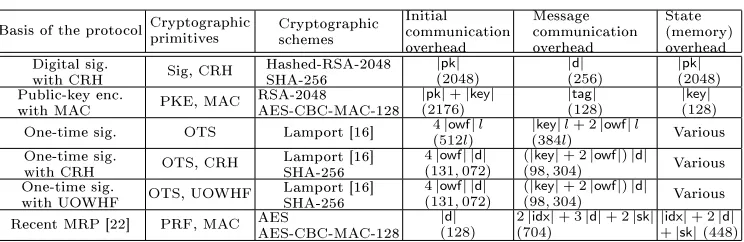
MRP-based MAPs vs PKC-based MAPs. Table 4.3 quantitatively com-pares an MRP-based MAP (using the recent MRP of [22]) to PKC-based MAPs and some other alternatives.
Synchronization. MRPs are inherently vulnerable to denial-of-service attacks because their states must remain synchronized. Some suggestion for resynchro-nization process were made [35, 21], but later proved to be awed [19, 26]. Resynchronization is impossible without public-key cryptography [9].
Bidirectional protocol. We dene MRP as bidirectional protocol, since most targeted devices of interest here require authenticated bidirectional communica-tion channel (for example, a remote controller asks a sensor for a command, and the sensor sends back the response). Most of the current MRPs are designed as unidirectional (Asends logical messages, andBreceives them). One can convert
an existing (unidirectional) MRP into bidirectional one, by instantiating two in-stances of the protocol at each party: one as A(the sender) and the other asB
(the receiver). The drawback of this method is a doubling of the communication and memory overhead. But in some MRPs, state and messages can be shared between the instances, getting bidirectional communication nearly for free. More specically, one can use the secret information inB (the receiver party), which
is used to re-establish a new commitment, to also transfer also a logical message of B; but this must be done and analyzed carefully, since for hash-chain-based
Basis of the protocol Cryptographicprimitives Cryptographicschemes Initialcommunication overhead
Message communication overhead
State (memory) overhead Digital sig.
with CRH Sig, CRH Hashed-RSA-2048SHA-256
|pk|
(2048)
|d|
(256)
|pk|
(2048)
Public-key enc.
with MAC PKE, MAC RSA-2048AES-CBC-MAC-128
|pk|+|key|
(2176)
|tag|
(128)
|key|
(128)
One-time sig. OTS Lamport [16] 4(512|owfl)|l (|key384|ll)+ 2|owf|l Various One-time sig.
with CRH OTS, CRH Lamport [16]SHA-256
4|owf| |d|
(131,072)
(|key|+ 2|owf|)|d|
(98,304) Various
One-time sig.
with UOWHF OTS, UOWHF Lamport [16]SHA-256
4|owf| |d|
(131,072)
(|key|+ 2|owf|)|d|
(98,304) Various
Recent MRP [22] PRF, MAC AESAES-CBC-MAC-128 |(d128| ) (2704|idx)|+ 3|d|+ 2|sk||+idx|sk|+ 2|(448|d|)
Fig. 4.3. Comparison of our suggestion to the alternatives. OWF is one way function, PKE is public-key encryption, Sig is digital signature scheme, CRH is collision resistant hash function, OTS is one time signature and UOWHF is universal one way hash function. For overhead calculations, |pk| denotes the length of the public-key, |owf|
denotes the length of the output of the OWF,|d|denotes the length of the digest of
the hashes/PRF, |key|denotes the length of the secret key of MACs, symmetric-key
encryption or secret preimage of OWF,|tag|denotes the length of the tag of the MAC,
|idx|is an incremental index of the current message to send andldenotes the length of
the message. The overhead is the extra communication requires (on top of the logical messages), in bits, when the protocol is instantiated using the specied scheme. Where the Lamport [16] scheme is used, for concreteness we instantiate using AES-128.
5 Chosen-Message Attacks and Composability
In the formalization of the security of MRP, there arises the question of modeling the generation of logical messages. Obviously, these sent messages can depend on the previously-received messages, but they may also depend on additional inputs, perhaps adversarially-controlled, which are not modeled as network communica-tion. For example, consider a sensor which transmits some physical measurement to a remote server. An adversary which has some control over the sensor's en-vironment can thereby aect its logical messages exceeding the above model and denition.
5.1 Chosen-Message Resistance
The parties A and B are supposed to generate logical messages (provided as
mod-eling security of the MRP, we should make the worst case assumption that the adversary chooses the logical messages.
Hence, we extend Denition 4 to handle this issue. We model the choice of logical messages by instructing the parties to receive them from the adversary (which can choose them as any eciently-computable function of the transcript thus far). For that, we modify Denition 4 and Algorithm 1, so the adversary outputs (in addition to the other values) also the logical message to be sent, and the adversarial game just forwards it to the respective party as an input. Denition 6 (Chosen-message securek-MRP). Chosen-message securek
-MRP is similar to non-chosen-message secure k-MRP (Denition 4), with the
following modications: (1) The adversary have an additional output value, which represents the logical message to be generated by the respective party. In Algo-rithm 1, this value is namedmA
i for the former call to the adversary, andmBi to the latter. (2) In Algorithm 1, the (two) calls ofGenMsgP function are removed.
We can gain the delayed version of the chosen-message version by applying to Denition 6 the same modications done by Denition 5 to Denition 4. Denition 7 captures this notion.
Denition 7 (Delayed chosen-message securek-MRP). The delayed
chosen-message secure k-MRP denition is obtained from Denition 4 by applying the
modications of both Denition 5 and Denition 6. 5.2 Importance of Chosen-Message Security
We now show that chosen-message attacks can indeed break schemes that are secure in the non-chosen-message sense. Intuitively, the adversary can observe the physical messages exchanged betweenπAandπB to learn information about their randomized internal state, and exploit this to maliciously choose logical messages that will interact badly this internal state. Theorem 1 shows that such an attack could exist, even against a protocol that is secure against non-chosen-message adversaries.
Theorem 1. Assume there exists an MRP π which is chosen-message secure
(fullls Denition 6). Then there exists an MRPπ0 which is not chosen-message
secure, but is non-chosen-message secure (fullls Denition 4).
Proof. Consider any MRPs,πthat is chosen-message secure by Denition 6. i.e.,
resistant to MITM even when the logical message are chosen by the adversary. We shall construct a new protocol,π0 protocol, which is not secure in this sense,
but is still secure by Denition 4 (i.e., without chosen-messages). protocol π0 proceeds like π, with the following modication. Whenever aπ0 instance π0
A is initialized for party A, a random number t, called the trapdoor, is drawn and
sent verbatim in a physical message to B. PartyB simply ignore this message
(but the adversary observes it). From this point on,πA0 keeps track of whether it
has ever been asked to send a logical message equal to the trapdoort. Once that
happens,π0A enters failure mode and simply output the xed logical message
In the chosen-message case, the adversary (who eavesdropped the trapdoor can then causeAto send the trapdoor as a logical message. Thereafterπ0A will
always claim to receive the message0, which clearly violates security.
However,π0is still secure under Denition 4, sinceπ0Ahas a negligible
proba-bility of entering failure mode. Indeed, if the adversary cannot choose the logical messages (but can perform any MITM operation), then the logical messages are generated by functions (GenMsgP) which depend only on the previous received
logical messages, and not the randomly chosen trapdoor value. Hence there is negligible probability thatπ0A will be asked to send the trapdoor value. ut
5.3 Universal Composability Overview
The previous discussion, of the separation between the two denition, was born as a result of careful analysis of recent MRP's security proofs, which revealed the absence of consideration in chosen-message attack. After revealing that, one may wonder if there is more considerations about the protocol's environment that should be made, and how to handle them? Since such an issue applies for many other protocols (even beyond the context of authentication), we decided to look for a more standardized methodology to handle composition of protocols of our concern.
The Universal Composability (UC) methodology can be used for handling this issue. Loosely speaking, UC adopts an indistinguishability approach for proving properties of security protocols in such a way that make it easy to compose these protocols with other protocols, preserving the security properties guaranteed for each protocol alone. Here we give a short introduction to the notion of Universal Composability framework; here we use the UC variant dened in [4, Section 4.4.1], and the terminology and notation of [4] for interactive Turing machine (ITM), and public delayed output (which means an output that the ideal functionality generates to a party, and the adversary can read it and delay its delivery).
The adversary in UC is called the environment (recall that we regard to the dummy-adversary alternative denition of UC as dened in [4, Section 4.4.1]), which represents whatever is external to the current protocol execution (includ-ing other protocols and their adversaries, the human users, physical message transmission, etc.). The environment outputs a binary value (0 or 1). The secu-rity is dened by indistinguishability of the output of the environment between two execution models.
In the real model, the environment communicated with parties, who executes an instance of the protocol to be proved secure. The parties receive input and produce output to the environment, and exchanges physical messages between themselves via the environment (so these messages may be modied by the environment).
In the ideal model, a new principal is introduced, called the ideal functional-ity,FIDEAL, which can be thought as a trusted third party.FIDEAL is essentially
each party the result of the protocol's calculations. The actual parties are repre-sented by dummy parties, who just provides the input to the ideal functionality
FIDEAL, and receives from it the output. In addition, there is a simulator S,
which can communicate with the ideal functionality, and suppose to convince the environment that she works in the real model, rather than the ideal model. UC realization. A protocolπis said to realize an ideal functionalityFIDEAL,
if for each environmentE, there exists a simulatorS such that the environment
can distinguish (by outputting 0 or 1) between execution in the real model and execution in the ideal model, with at most negligible probability. That is, π
mimics the operation of the ideal functionality correctly. By dening anFIDEAL,
one is basically denes the security in the UC methodology.
Universal composition. Letπbe some arbitrary protocol where the parties
make ideal calls to some ideal functionalityFIDEAL. That is, in addition to the
standard set of instructions, πmay include instructions to provide instances of FIDEALwith some input values, and to obtain output values from these instances
of FIDEAL. We call such protocols FIDEAL-hybrid protocols. Now, letρbe a
pro-tocol that UC-realizes FIDEAL, according to the above denition. Construct the
composed protocolπρby starting with protocolπ, and replacing each invocation of a new instance ofFIDEALwith an invocation of a new instance ofρ. Similarly,
inputs given to an instance of FIDEAL are now given to the corresponding
in-stance ofρ, and any output of an instance ofρis treated as an output obtained
from the corresponding instance of FIDEAL. The universal composition theorem
states that running protocol πρ, with no access to FIDEAL, has essentially the
same eect as running the originalFIDEAL-hybrid protocolπ.
5.4 Dening UC-secure MAP
Another methodology to handle this issue is Universal Composability (UC) [4]. Security denitions in the UC style are guaranteed to compose, i.e., security can be analyzed for a single instance of the protocol, but is guaranteed to hold even when the protocol runs concurrently with other instances of itself and of other protocols (a property which is nontrivial, and often false for other denition styles). This includes, in particular, the case where inputs to the protocol are aected by the adversary, i.e., chosen-message attacks.
In the UC framework, security is dened by specifying an ideal functionality, that describes the correct functionality of the protocol. Proving that a protocol satises such security denition is done by proving that the protocol and the ideal functionality are indistinguishable to the surrounding environment (including the adversary), and thus the latter cannot gain advantage, beyond what's permitted by the ideal functionality, from corrupting the protocol's execution. Here we give the security denition for multiple message authentication in UC, by dening the ideal functionality, and show how MRP can be combined with OC to provide UC-secure message authentication.
Ideal functionality for multiple message authentication. An ideal func-tionality for single-message authentication protocol, calledFAUTH, was given in
other. Multiple messages can be transferred with authentication, and bidirec-tionally, by composing that ideal functionality multiple times (which is indeed secure, by the universal composition theorem of [4, Section 2.3]). However, in our context this yields an impractical protocol, since every session of the protocol requires an oblivious comparison (involving the human user) in the initialization phase. To allow the results of a single OC to be stored and reused for multiple messages, we extend the ideal functionality into a new one, FAUTHk,
captur-ing message authentication protocol that are bidirectional and transmit up to
k back-and-forth messages (where k∈N∪ {∞}).10 Basically, FAUTHk operates
much likeFAUTH of [4], but is extended to multiple messages, as follows.
Denition 8 (FAUTHk). Let k ∈ N∪ {∞}. The ideal functionality FAUTHk is
dened as follows.
1. For roundsi= 1,2,3, . . . , k do:
(a) Await an input Send, sid, B, mA i
from party
A, and generate a public
delayed output Sent, sid, A, mAi toB.
(b) Await an input Send, sid, B, mB i
from party
B, and generate a public
delayed output Sent, sid, B, mBi toA.
2. Upon receiving a message (Abort, sid, P, m)from the adversary, where P ∈ {A, B}, send (Abort, sid, P, m)to the other party, and halt.
3. Upon receiving(Corrupt-party, A, sid, m0)from the adversary, if the(Sent, A, sid, m)output is not yet delivered to B, then output (Sent, A, sid, m0)toB.
4. Upon receiving(Corrupt-party, B, sid, m0)from the adversary, if the(Sent, B, sid, m)output is not yet delivered to A, then output (Sent, B, sid, m0)toA.
The two last lines in Denition 8 capture the notion of party corruption [4]. Note that party corruption is not a signicant issue for us, since we do not deal with secrecy, but we included that notion inside the denition for completeness. Ideal functionality for oblivious comparison . In order to realize the mes-sage authentication protocols we discussed in this paper to the ideal functionality
FAUTHk, we need to use the oblivious-comparison primitive, that compares bit
strings between two parties (see Section 2.2). To express this in the UC frame-work, we dene its ideal functionality,FOC, as follows11.
Denition 9 (Oblivious comparison ideal functionality: FOC).
1. Upon receiving Send, sid, A, xAfromA and Send, sid, B, xBfromB:
(a) IfxA =xB then generate public delayed output (Sent, sid,OC,Equal)to
B and(Sent, sid,OC,Equal)toA.
(b) else generate public delayed output (Sent, sid,OC,Unequal) to B and
(Sent, sid,OC,Unequal)toA.
10We support a limitk on the number of logical messages transferred by ideal func-tionality, since many existing MRPs support only an a priori bounded number of messages. Our PEBIUS MRP, in Section 6, supportsk=∞.
11We omitted the explicit corrupting handling from F
A FOC B
RunAI RunBI
Transcript ofAI Transcript of BI RunFOC
result result
Ifresult=Unequal, Ifresult=Unequal,
then abort then abort
else runADktimes Else runBD ktimes
Fig. 5.1. The hybrid protocolπAUTHk.
5.5 Attaining UC-secure MAP
Analogously to Section 4, we show here how to create an MAP from an MRP, given access toFOC, the ideal functionality of oblivious comparison. That is, how
to create a FOC-hybrid protocol that realizes the FAUTHk ideal functionality.12
Given an k-MRP, πMRPk = (AI, BI, AD, BD), the corresponding FOC-hybrid
protocolπAUTHk is specied in Figure 5.1.
Theorem 2. LetπMRPk= (AI, BI, AD, BD)be a chosen-message securek-MRP (Denition 6). LetπAUTHk be its hybrid protocol, as specied in Figure 5.1. Then
πAUTHk UC-realizes FAUTHk in theFOC-hybrid model.
Proof. We need to prove that if for each chosen-message adversaryM,M cannot
break the adversarial game of Denition 6, then there exists a simulatorS such
that for each environmentE,EXECFAUTHk,S,E ≈EXECπ,E.
We shall construct the simulatorS as an ITM that interacts with an
envi-ronmentE and the ideal functionalityFAUTHk by emulating the instances of the
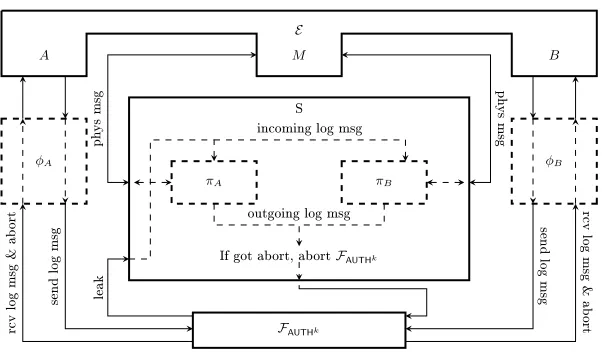
protocol, as follows (see Figure 5.2). On startup, S initializes two instances of
the protocol:πA, πB. The exchange of physical messages betweenπA andπB is done by communicating with E (so E can modify these messages). Whenever E
S
πA πB
FAUTHk E
A M B
send
log
msg
rcv
lo
g
msg
&
ab
ort send
log
msg
rcv
log
msg
&
ab
ort
leak
ph
ys
msg
incoming log msg
ph
ys
msg
outgoing log msg
If got abort, abortFAUTHk
φA φB
Fig. 5.2. The simulatorS.
sends a logical message to FAUTHk (via a dummy party φA, φB), FAUTHk leaks
the message to S, and upon receiving such a leaked logical message sent by P ∈ {A, B}, S forwards that message to πP (as a logical message to be sent by P). Consequentially, πP generates physical message(s) and transmits them; these are routed by S into E. When πP outputs a logical message (supposedly received from the other party), S tells FAUTHk to release the delayed logical
message (even in the case of wrong logical message). WhenπP outputsabort,S sends(abort, sid, P, m)toFAUTHk.
By proving that the simulatorS indeed succeeds in fooling the environment
(i.e., simulating the real model), we infer that EXECFAUTHk,S0,E ≡ EXECπ,E, as
desired. ut
Let us now argue that the simulatorSindeed succeeds in fooling the
environ-ment (i.e., simulating the real model). To do so, let us dene another simulator
S0, similarly toS but for the following modication. When S0 invokes π A and the latter produces a logical messagemˆB
i allegedly sent byB, instead of ignoring the content ofmˆB
i that message,S0 checks whether this message is correct (i.e., matchesmB
i that was earlier leaked byFAUTHk). If mˆiB 6=mBi thenS0 will not
ignore this (asS does) but instead forward the incorrect messagemˆB
i toE (by-passFAUTHk) and moreover block (i.e. delay the sending of the message forever)
the sending of the correct messagemBi fromFM RP toE. The analogous change is also made in the other direction (whenπB outputsmˆAi allegedly sent fromA). Note that S0 is not a valid simulator as required by UC, because the UC ideal model does not allow the simulator to talk directly to the environment; but as we will show in Lemma 2,S0 behaves essentially the same asS.
the same as the UC real model (Corollary 1). For that, we dene the notion of view, as follows.
Denition 10 (View). Let πbe an MRP, andS0 as dened above. Dene the view VFAUTHk
E,S0 of an execution of FAUTHk in the UC ideal model
with environmentE and simulatorS0as the concatenation of: (1) the physical (but not logical) messages thatM receives; (2) the logical messages the each
dummy party receives as input and (3) the randomness of the environment
E.
Dene the view Vπ
M of an adversary M in the chosen-message denition as the concatenation of: (1) the physical (but not logical) messages that M
receives; (2) the logical messages the each party receives as input and (3) the randomness of the adversaryM.
Note that the view denition should not include the physical/logical mes-sages that outputted to the environment/adversary, because it is given by the randomness and the other parts of the view.
Lemma 1. Let π be an MRP, and S0 as dened above. For each environment
E, there exists a chosen-message adversaryME, such that VFAUTHk
E,S0 ≡VMπE.
Proof. Let E be a UC environment. We dene the chosen-message adversary ME to behave as E: ME operates in the same way as E does with regard to
exchanging the physical messages, operates in the same wayE does with regard
to generation of logical messages ofA, B respectively.
Consider the execution ofπ in the chosen-message model in the presence of
the adversaryME, versus the execution ofπin the UC ideal model withE and S0, when xing identical randomness for the analogous principals (e.g., theπ
A ITI in the chosen-message execution vs. the πA ITI inside S0 in the UC ideal execution). We shall show that the two executions essentially identical, i.e., the same messages are exchanges between the analogous principals. This invariant follows from the essentially identical handling of all messages, as follows.
Indeed, in both models, the logical messages are generated in the same way (byE in the UC ideal model, and similarly by denition, byME in the
chosen-message model), and are received as input by πA andπB. The intervention in the physical message communication between πA and πB is also done in the same way (by E in the UC ideal model, and similarly by denition, byME in
the chosen-message model). Therefore, πA and πB produces the same physical messages and outputs in both executions.
Let us verify that the outputs ofπA are handled identically in both model (the analysis forπB is analogous). There are three cases. (1) πA outputsabort in the chosen-message model, andA aborts. In the ideal model,S0 sendsabort toFAUTHk, which causesφA to abort as well. (2)πA outputs the correct logical
message in the chosen-message model. In the ideal model,S0tellsF
AUTHkto send
the correct logical message theA, soAalso receives the correct logical message.
ideal model,S0 understands that the message is wrong, and bypassesF
AUTHk so
Areceives the wrong message as well. ut
Letπbe an MRP, andE be an environment. LetME be the chosen-message
adversary given by Lemma 1. In the real model of UC, the parties run the proto-col instancesπAandπB. Note that the environment is involved in their physical messages exchange, and controls the generation of logical messages, exactly as in the chosen-message execution. Thus, the chosen-message execution ofπwith ME and the execution in the real model of UC of π are essentially equivalent,
because their respective views are equivalent, by Lemma 1 (the environment E
and the adversary ME have the same view distribution, so they have the same
output distribution).
It follows, in particular, that the ideal-model execution withS0 is equivalent to the real-model UC execution:
Corollary 1. EXECFAUTHk,S0,E ≡EXECπ,E
There remains to show thatS0 is essentially the same as S: Lemma 2. EXECFAUTHk,S,E ≈EXECFAUTHk,S0,E
Proof. Let BADEπ be the event that during the execution of E against S and FAUTHk, πA or πB (which are emulated inside S) ever output wrong logical message. The probability thatE will output 1 when running withSandFAUTHk
is, by Bayes's theorem:
PrhEXECF
AUTHk,S,E = 1
i
=
PrhEXECFAUTHk,S,E = 1|BAD E
π i
PrhBADEπ i
+ PrhEXECF
AUTHk,S,E= 1|BAD E
π i
PrhBADEπ i Similarly for S0:
PrhEXECF
AUTHk,S0,E= 1
i
=
Pr
h EXECF
AUTHk,S0,E = 1|BAD E
π i
Pr
h BADEπ
i
+ PrhEXECF
AUTHk,S0,E= 1|BAD E
π i
PrhBADEπ i
Observe thatSandS0behaves identically outside the eventBADE
π, so above, the two last terms are equal. Thus the dierence in the probability of the envi-ronment's output is at most:
|PrhEXECF
AUTHk,S,E= 1
i
−PrhEXECF
AUTHk,S0,E = 1
i
|=
|PrhEXECFAUTHk,S,E= 1|BAD E
π i
−PrhEXECF
AUTHk,S0,E = 1|BAD E
π i
|
·PrhBADEπ i
≤ 1·PrhBADEπ i
There remains to show thatPr
BADEπ
LetME be the adversary given by Lemma 1. By the premise thatπsatises
Denition 4,ME cannot convince a party to receive a wrong logical message with
non-negligible probability, so Pr
BADEπ
=negl(n). Now, because the views are equivalent (VFAUTHk
E,S0 ≡VMπE), it follows thatEXECFAUTHk,S,E ≈EXECFAUTHk,S0,E.
u t
Corollary 2. EXECFAUTHk,S,E ≈EXECπ,E
6 PEBIUS MRP
We present the PEBIUS MRP, a Perpetual Bidirectional U C-Secure message recognition protocol. PEBIUS is secure under the strongest denitions given above: it is UC-secure and, equivalently, chosen-message secure). Our protocol diers from prior MRPs (see Section 4.2), as follows.
Most prior MRPs [8, 19, 22, 35] used hash chains, which entailed two draw-backs: an a-priori limit on the number of logical messages that can be sent, and expensive storage (or recomputation) of the hash chain. Some also use a trusted third party, or a high network overhead.
To avoid such issues, PEBIUS generate fresh key in each session, as done in [21]. However, PEBIUS is also inherently bidirectional and thus more ecient than using a unidirectional MRP in both directions (see Section4.3).
6.1 Cryptographic Primitives for PEBIUS PEBIUS use the following cryptographic primitives.
Message Authentication Code (MAC). We denote the usage of this func-tion by MAC(k, x), where k is the private key and x is the (variable length)
message to be authenticated. The key generation of the MAC is denoted by
GenKey(). One such MAC that we can use is AES-CBC-MAC. We note that this method should deal properly with variable-length messages. Otherwise, it will be vulnerable to message concatenation, as described in [2] .
Hash function. For simplicity here, we model this as a random oracle f(x), wherexis the input to the functions. In Section 7.3, we discuss the concrete and
plausible (though nonstandard) properties requires of the hash function, which are indeed all fullled by random oracles. Practically,f(x)would be implemented by a standard cryptographic hash, such as SHA-256.
6.2 The PEBIUS Protocol
We next describe the PEBIUS MRP Π = (AI, BI, AD, BD), which (as shown Section 7) is a delayed chosen-message secure∞-MRP (Denition 7). Following
Theorem 2, Π is also universally composable. Let f be a random oracle and
MAC be a message authentication code, as dened above.
AI() BI()
K1A←GenKey(),CA1 ←f(K1A) K0B←GenKey(),C0B←f(K0B)
KB
1 ←GenKey(),C1B←f(K1B)
CA
1
C0B,C1B
d
mB
0 ←λ Kd0A←0
n, c
CA
0 ←f(Kd0A),mdA0 ←λ
c
σA
0 ←MAC(Kd0A,
D c
CA
0,mdA0
E
)
σB0 ←MAC(K0B,
C0B, mB0
)
σB0
Return(sB
0) Return(sB0)
see footnote1
Fig. 6.1. The PEBIUS initialization phase, Π. The state variable sA0 contains all of
the local variables used inAI; and analogously forB.
parties has a commitment on the key of the other party, and the keys are revealed at the next iteration. As a result, when each of the parties receives the key, he can verify that the key is correct (using the commitment on the key) and that the logical message is correct (using the correct key and the MAC on the logical message). In order to be able to send other logical messages at the following iterations, we need new keys. We achieve that by transferring a commitment on the fresh keys inside the logical message of each iteration.
Initialization phase. The goal of the initialization phase (implemented byAI andBI, see Figure 6.1) is to transfer commitments on the rst keys to each party. Recall that in MRP we assume that this phase is executed with authenticity (but without condentiality), so each party can trust these commitments. Each party generates keys: K1A of A and K0B, K1B of B, and commitments on these keys: C1A, C0B, C1B, respectively. We note that during the data phase,Asends the rst logical message, and that is the reason of this asymmetric (thatB generates two
keys and Agenerates just one). In the following lines, in order to simplify the
description of the data phase, we generate some dummy variables to compensate on this asymmetric.
AD(sAi−1,mA
i) BD(s
B i−1,mB
i )
1.KiA+1←GenKey(),CiA+1←f(KiA+1)
2. σiA←MAC K A i ,
CiA+1, m
A i
3.
KA
i−1, CiA+1, mAi, σAi
4. IfC[A
i−16=f(K[iA−1)or
5. σdA
i−16=MAC
[
KA i−1,
D c
CA i ,m[Ai−1
E ,
6. then return(sBi ,0,⊥).
7. KiB+1←GenKey(),C
B
i+1←f(K
B i+1)
8. σB
i ←MAC KiB,
CB i+1, mBi
9.
KiB−1, CiB+1, mBi , σBi 10. IfC[B
i−16=f(K[iB−1)or Return(s
B
i,1,m[Ai−1).
11.σdB i−16=MAC
[
KB i−1,
D d
CB i ,m[
B i−1
E , 12. then return(sA
i,0,⊥). 13. Return(sA
i,1,m[Bi−1).
Fig. 6.2. Iteration i (i >= 1) of the PEBIUS data phase, Π. The state variablesAj (j∈N)contains all of the local variables of partyAat the end of thej-th iteration of
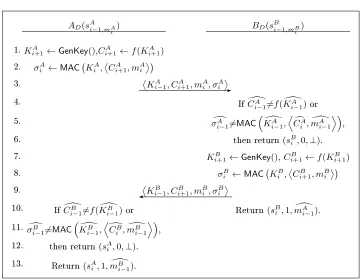
AD; and analogously forB.
Data phase. During each iteration of the data phase (i.e., a single execution ofADandBD, see Figure 6.2), each party sends one logical message to the other party. Both parties start by generating a fresh new key for the next iteration and a commitment on this key. Then, they use the key of the current iteration to produce a signature on the logical message and the new commitment. Thereafter,
A sends the logical message, the new commitment and the signature on them.
Upon reception,Bresponds with symmetrical values, plus the key of the previous
iteration. Upon receiving this key, A can recognize that the key, the logical
message and the commitment are generated by the previously-negotiated entity (of the initialization phase) and accept the message, or reject, if the verication fails. Then,Asends a key toB, which performs similar verications.
7 Security Proof of PEBIUS
7.1 Conversations
they represents the transcript of the protocol executed by them (one conversation forA, and the other one of B), without interference of any adversary.
Denition 11 (Conversation). LetEXECkΠ,M be an execution of the protocol.
For any party P ∈A, B we can capture its conversation (for this execution) by
a sequence:
K= (τ1, α1, β1),(τ2, α2, β2), . . . ,(τm, αm, βm).
This sequence encodes that at time13τ1partyP was askedα1and responded
with β1; and then, at some timeτ2 > τ1, partyP was asked α2 and answered
β2; and so forth, until, nally, at timeτmpartyP was askedαmand answered
βm.
Denition 12 (Matching conversations). Let EXECkΠ,M be an execution of
the protocol withR= 2ρ−1moves. LetK andK0 be the conversations ofAand
B, respectively.
1. We say that K0 is a matching conversation to K if there exist τ
0 < τ1 <
· · ·< τR andα1, β1, . . . , αρ, βρ such thatK is prexed by
(τ0, λ, α1),(τ2, β1, α2),(τ4, β2, α3), . . . ,(τ2ρ−4, βρ−2, αρ−1),(τ2ρ−2, βρ−1, αρ) andK0 is prexed by
(τ1, α1, β1),(τ3, α2, β2),(τ5, α3, β3), . . . ,(τ2ρ−3, αρ−1, βρ−1). 2. We say that K is a matching conversation to K0 if there exist τ
0 < τ1 <
· · ·< τR andα1, β1, . . . , αρ, βρ such thatK0 is prexed by
(τ1, α1, β1),(τ3, α2, β2),(τ5, α3, β3), . . . ,(τ2ρ−3, αρ−1, βρ−1),(τ2ρ−1, αρ,∗) andK is prexed by
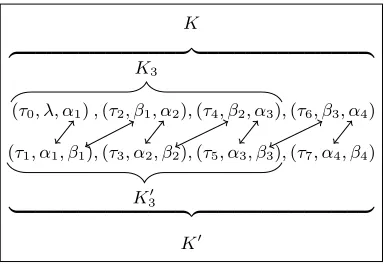
(τ0, λ, α1),(τ2, β1, α2),(τ4, β2, α3), . . . ,(τ2ρ−4, βρ−2, αρ−1),(τ2ρ−2, βρ−1, αρ). Figure 7.1 illustrates the matching conversation notion.
Denition 13. Let a ≤ b ∈ N and let K be a conversation. A conversation that consist from (b−a+ 1)-tuples of K starting at the a-tuple till the b-tuple
is a sub-conversation of K. We denote such conversations by Ka,b, and use the shorthandKb=K1,b.
By convention, for each conversation K we denote by K0 = λ the empty conversation. Matching-conversations are dened for conversations. We dene a similar notion for sub-conversations: