Argument for NP
Li Hongda, Pan Dongxue, Ni Peifang
The Data Assurance and Communication Security Research Center, School of Cyber Security, University of Chinese Academy of Sciences, Beijing 100093, China
Abstract. The standard zero knowledge notion is formalized by requiring that for any probabilistic polynomial-time (PPT) verifierV∗, there is a PPT algorithm (simulator)SV∗, such that the outputs ofSV∗is indistinguishable from real
pro-tocol views. The simulator is not permitted to access the verifierV∗’s private state. So the power ofSV∗is, in fact, inferior to that ofV∗.
In this paper, a new simulation method, called augmented black-box simulation, is presented by permitting the simulator to have access to the verifier’s current private state in a special manner. The augmented black-box simulator only has the same computing power as the verifier although it is given access to the ver-ifier’s current private state. Therefore, augmented black-box simulation is a rea-sonable method to prove zero knowledge property, and brings results that hard to obtain with previous simulation techniques. Zero knowledge property, proved by means of augmented black-box simulation, is called augmented black-box zero-knowledge.
We present a 5-round statistical augmented black-box zero-knowledge argument for Exact Cover Problem under the Decision Multilinear No-Exact-Cover As-sumption. In addition, we show a 2-round computational augmented black-box zero-knowledge argument protocol for Exact Cover problem under the Deci-sion Multilinear No-Exact-Cover Assumption and the assumption of the exis-tence of hash functions. It is well known that 2-round zero knowledge protocols does not exist under general zero knowledge notion. Besides, following [18], we consider leakage-resilient property of augmented black-box zero knowledge, and prove that the presented statistical zero-knowledge protocol has optimal leakage-resilient property.
Key word: zero-knowledge proofs (arguments), black-box simulation, constant-round, Exact-Cover problem, leakage-resilient.
1
Introduction
a PPT algorithm (simulator)S, such that the two distribution, the output ofS(x)and the view ofV∗in the real protocol, are indistinguishable. According to the relation be-tween these two distributions, zero-knowledge property is divided into computational zero knowledge and statistical zero knowledge, responding to computationally or statis-tically indistinguishable condition. Besides, according to the limit on the power of the prover, zero-knowledge protocols are divided into two types, zero-knowledge proofs (ZKP) and zero-knowledge arguments (ZKA).
In fact, the original notion of zero knowledge in [20] is computational zero knowl-edge and only considers the stand-alone setting, where the protocol runs in complete isolation. Such zero knowledge property cannot be maintained when many protocols are run concurrently. In order to construct more practical zero-knowledge protocols, Dolev, Dwork and Naor [13] introduced non-malleable zero knowledge and [15] stud-ied concurrent zero-knowledge. Following these two works, a lot of works, such as [19, 27, 31, 11, 34, 30], devoted to studying protocols with concurrent zero-knowledge property and non-malleable zero knowledge property.
Statistical zero-knowledge proofs have statistical zero-knowledge property and sta-tistical soundness. Unfortunately, [16, 2] showed that no language beyond the languages inAM∩coAMhas statistical zero-knowledge proofs. [27] provided concurrent statisti-cal zero-knowledge proofs for a variety of non-trivial problems without any complexity assumption.
A weaker notion is statistical zero-knowledge arguments, first presented by Bras-sard, Chaum, and Crepeau in [4]. G. Brassard gave the first perfect zero-knowledge protocol for any statement in NP with constant rounds, which is a 6-round perfect zero-knowledge argument for NP [5], where the perfect zero-zero-knowledge property means that the output of the simulator is identical to the real protocol views. Naor et al. [29] showed a construction of a statistically hiding bit-commitment scheme and then obtained an effi-cient perfect zero-knowledge argument, with non-constant round, for all of NP from any one-way permutation. Their result gave the first general reduction that zero-knowledge arguments for NP can be constructed given any one-way permutation. Nguyen et al [28] constructed a relaxed variant of statistically hiding commitments, called 1-out-of-2-binding commitments, and then obtained a statistical zero-knowledge argument for NP with a polynomial number of rounds under the (minimal) complexity assumption that one-way functions exist. There are also works [19, 30, 24] devoted to concurrent statistical zero-knowledge arguments and non-malleable statistical zero-knowledge ar-guments. In this paper, we also consider statistical zero-knowledge arguments for NP and present a 5-round protocol. (reducing the round complexity)
verifier’s strategy, such as to utilize its strategy description as Barak does in [3]. Un-til Barak presented his non-black-box simulation technique, almost all zero knowledge protocols are black-box zero knowledge. Under the existence of collision-resistant hash functions,. Barak first gave a bounded concurrent constant-round zero knowledge ar-gument for NP which was proved not to exist in black-box setting [3]. Subsequently, a lot of works followed the Barak’s work [6, 33, 11, 26]. Specifically, [12] showed a constant-round resettably-sound zero-knowledge argument based only on the existence of one-way functions by non-black-box simulation.
Recently, Garg et al. [18] introduced leakage-resilient zero-knowledge (LRZK), which guarantees the zero-knowledge property in stronger adversarial models where an malicious verifier has the ability to obtain leakage of the secret states of the honest prover by launching a side-channel attack. LRZK requires that for any cheating verifier V∗that can obtainlbits of leakage information about the prover’s state via a series of
leakage queriesf1, f2, ..., there exists a simulatorS with the leakage oracleLnwsuch that the simulator can output an indistinguishable view of the malicious verifier and simulate the leakage as well.
In this paper, we consider zero-knowledge property by a new simulation paradigm, called augmented black-box simulation. The formal definition of zero knowledge under this simulation paradigm is first presented in our another work. Roughly speaking, the simulator in the augmented black-box setting is given not only an oracle access to the verifier’s strategy program but also an access to the verifier’s current private information in a special manner. Let hP, Vibe an interactive proof system for language L, the augmented black-box simulation is formalized as follows.
Consider an extended verifierVb: Vb has the same strategy and interacts with the
proverPasV, and simultaneously outputsV’s current private state secretly on its pri-vate output tape. The black-box simulator ofhP,Vbiwith oracle access to the extended
verifierVb and its private output tape is called the augmented black-box simulator of
1.1 Our results
In this paper, we present a 5-round statistical zero-knowledge argument and a 2-round computational zero knowledge argument for Exact Cover problemΠ = (ECY, ECN), a promise problem which is NP-complete, under the notion of augmented black-box zero-knowledge. This notion of zero-knowledge is formalized by augmented black-box simulation technique, where the simulator has oracle access to an extended verifierVb.
b
V has one more private output tape than the verifierV. AndVb outputs the messageV
outputs together withV’s current private state, from which the message is computed. Our construction of the 5-round statistical zero-knowledge argument includes two 3-round interactive arguments for two Exact Cover problems. The construction consists of three stages. In the first stage, the proverP and the verifierV execute the first two round of the 3-round interactive argument protocol forx∈ECY. In the second stage, P andV execute the 3-round interactive argument, in whichV proves toP y∈ECY, whereyis obtained by reducing part of the messages in the first stage to an Exact Cover problem. And in the last stage, P proceeds the last round of the 3-round interactive argument forx∈ECY,Pcompletes the proof by sending a value (which can also be computed byV) that is computed from the value specified byV in the first stage.V accepts if and only if the value sent byPis correct. The soundness is guaranteed by the Decision Multilinear No-Exact-Cover Assumption and the simulation is completed by a PPT simulator with oracle access toVb. Hence then,Scan obtainV’s private state and
thus obtain the value specified byV in the first stage and use it to complete the proof. Our 2-round computational zero-knowledge argument for Exact Cover Problem is very simple. Except the Decision Multilinear No-Exact-Cover Assumption, the protocol has used collision-resistant hash functions. Since in our protocol, a cheating verifier cannot verify the correctness of the proof from an honest prover, the construction of BP P simulator in [21] does not applicable for our 2-round zero-knowledge protocol. Therefore, we claim that our result does not contradict with the well known lower-bound of Goldreich and Oren [21], which says that 2-round auxiliary input zero knowledge argument exists only for trivial languages.
In addition, we consider leakage-resilient property of augmented black-box zero knowledge, and prove that the given statistical zero-knowledge argument is leakage-resilient. The length of leakages obtained by the leakage-resilient simulator from the leakage oracle is the same as that of the leakages obtained by the verifier.
1.2 Related work
Zero KnowledgeRelevant to our work are the works on simulation techniques for zero knowledge. Besides the black-box simulation and Barak’s non-black-box simulation technique, there are some other non-black-box simulation techniques.
Recently, based on the impossibility of program obfuscation, [9] gave a new non-black-box simulation technique . Assuming that the malicious verifier chooses an un-obfuscatable function, of which the properties consist of black-box unlearnablility and non-black-box learnability. The prover interacting with the verifier has oracle access to this function and thus the prover cannot learn this function from the query-answer behavior. The simulator with the code ofV∗’s algorithm, in essence, is given an ob-fuscation ofV∗’s algorithm. By the non-black-box learnability of the unobfuscatable function, the simulator can learn this function and then simulate the verifier’s view. [10] constructed robust unobfuscatable functions, by which they reduced the assumptions required for resettably-sound zero-knowledge to one-way functions.
[14] promoted the simulator’s ability by using the “distinguisher-dependent” simu-lator, which permits the simulator to know the possibly cheating verifier’s programV∗, the distinguisherT, and the distributionDon inputs. That is, for anyV∗and PPT dis-tinguisherT, there exists a simulatorST, such that for any distributionD, the output of ST is indistinguishable from the real view forT. By the distinguisher-dependent sim-ulator, C. Dwork et al. in [14] weakened the definition of zero-knowledge and proved the existence of 3-round weak zero-knowledge argument for NP, which was recently constructed from the obfuscation of point functions by Bitansky and Paneth [8].
Leakage-resilient Zero KnowledgeIn [18], Garg et al. showed a(1 +)-LRZK proof system under a standard general assumption (the existence of statistically hiding commitment scheme that is public-coin w.r.t. the receiver) for any >0. That is, for any >0, there exists a proof system such that for any PPT verifier which can obtainlbits leakage there exists a simulator, obtaining at most(1+)·lbits of leakage from the leak-age oracleLn
w, can simulate the verifier’s view. The round complexity of the protocol in [18] is at leastω(logn)/, wherenis the security parameter. Pandey [32] constructed the first constant-round LRZK argument with= 0under the assumption of DDH and collision-resistant hash functions. Very Recently, Kiyoshima [25] constructed the first LRZK argument system only under the existence of the collision-resilient hash function family.
1.3 Organization
Section 2 contains the standard definitions, cryptographic tools, and the relaxed notion of zero knowledge used in our protocols. In section 3, we present a 5-round statisti-cal zero-knowledge argument for Exact-Cover problem. In section 4, we first restatisti-call the model of leakage-resilient zero knowledge, and prove the construction in section 3 is a leakage-resilient zero-knowledge argument. In section 5, we show a 2-round computa-tional zero-knowledge argument for Exact-Cover problem.
2
Preliminaries
neg(·)to denote an unspecified negligible function,poly(·)an unspecified polynomial. We use “X =c Y” (“X =s Y”) to denote that probabilistic distributionsX andY are computationally (statistically) indistinguishable. Unless otherwise stated, we useλto denote the security parameter.
We recall the following definitions.
2.1 Exact Cover problem
Recall the well-known NP-complete problem, Exact Cover problem: Given a finite set X, and a collection of subsets ofX,T = {T1,· · ·, Tl : Ti ⊆ X}, decide whether there is a subsetT0 ⊆ T such that every element ofX lies in exactly one element of T0, which equals that whether there exists a subsetI⊆ {1,· · · , l}such that∪
i∈ITi= X;∀i6=j∈I, Ti∩Tj =∅.
LetECY andECN be all “Yes” and “No” instances of the Exact Cover problem respectively. A witness of an “Yes ” instance(X,T = {T1,· · · , Tl}) is the subset
I ⊆ [l]such that{Ti : i ∈ I} is a partition ofX. The corresponding NP-relation is denoted byREC.
2.2 Multi-linear map
LetG1,· · ·, Gn be a sequence of groups of the same orderp, andg1,· · · , gn be the
corresponding generators. Define a set of maps
ei,j:Gi×Gj→Gi+j,i+j≤n
satisfyingei,j(gia, gbj) =gabi+jfor anya, b∈Zp. Then, {ei,j :Gi×Gj→Gi+j :i, j≥1, i+j≤n}
is called multilinear map. For convenience, we writeei,j(gia, gbj)ase(gai, gjb) =gabi+j.
Similarly, for anyi1,· · · , it∈[n]withi1+· · ·+it≤n, we define multilinear map
e gai1
i1 ,· · ·g
ait it
= (gi1+···+it) ai1···ait.
Assume there is a PPT generation algorithmG. The output ofG(1λ, n;r), where r∈R {0,1}poly(λincludes the description of a sequence of groupsG1,· · · , Gnof the same prime orderp, the corresponding generatorsg1,· · ·, gn, and a multilinear mape.
For simplicity, the out ofG(1λ, n;r)is denoted bypp.
Definition 1. Decision Multilinear No-Exact-Cover Problem. [17]Letx = {X;T }
be a “No” instance of Exact Cover Problem (x∈ECN), where|X|=n. Let
((G1, g1),· · · ,(Gn, gn), e, p)← G(1λ, n;r)
where the prime order p = p(λ) andλ is the security parameter. Let` = |T |and
a1,· · · , an, rbe uniformly selected fromZp. For everyi∈[`], lethi = (g|Ti|)
Q j∈Tiaj.
Definition 2. Decision Multilinear No-Exact-Cover Assumption. [17]The Decision
Multilinear No- Exact-Cover Assumption is that for every instances x ∈ ECN, all
PPT algorithms Acan solve the Decision Multilinear No-Exact-Cover Problem with
negligible probability.
2.3 Zero knowledge
Definition 3. Interactive Proof System.A pair of interactive Turing machineshP, Vi
is called an interactive proof system for a languageLif machineV is polynomial-time and the following two conditions hold:
– Completeness: There exists a negligible functioncsuch that for everyx∈L,
Pr[hP, Vi(x) = 1]>1−c(|x|)
– Soundness: There exists a negligible functionssuch that for everyx /∈Land every interactive machineB, it holds that
Pr[hP, Vi(x) = 1]< s(|x|)
c(·)is called the completeness error, ands(·)the soundness error.
An interactive proofhP, Vi(x)for a promise problemΠ is zero-knowledge if the possibly malicious verifierV learns nothing from the interaction withP except the fact that x ∈ ΠY being proven is true. It implies that whateverV could learn from the interaction could be obtained byV with an oracleOΠ. When being queried with an instancex∈Π,OΠreturns1ifx∈ΠY and returns0otherwise.
LetV iewP
V(z)(x)denote the view ofV with auxiliary inputzin the real execution
of the protocol with P. ThusV iewP
V(z)(x)includes the random coins of V and the
messages received fromP. It is reasonable that whateverV learned from the interaction can be computed fromV iewP
V(z)(x). Therefore, zero knowledge requires that for any
PPTV∗, there is a simulatorSwith some advantage againstP, such that the output of Sis indistinguishable fromV iewP
V∗(z)(x).
Definition 4. Zero-knowledge Proof.LethP, Vibe an interactive proof system for a promise problemΠ.hP, Viis said to be zero-knowledge if for every PPT malicious verifierV∗ there exists a PPT algorithmS such that{V iewVP∗(z)(x)}x∈ΠY,z∈{0,1}∗
and{S(x, z)}x∈ΠY,z∈{0,1}∗are computationally indistinguishable.
If{V iewP
V∗(z)(x)}x∈ΠY,z∈{0,1}∗ and{S(x, z)}x∈ΠY,z∈{0,1}∗are statistically
in-distinguishable, the interactive proof systemhP, Viis called statistical zero-knowledge.
2.4 Augmented black-box Zero knowledge
message, we assume that the verifierV sends an empty stringλbeforeP’s. And we assume that the round number ofhP, Viis2k(n), where nis the security parameter andk(n)is a positive polynomial.V’s next message depends on its random coins and all messages that have been received fromP so far. AndP’s next message depends on its private input, random coins, and all messages received. In the(2i−1)th round,V sendsαi, and then receivesβi responded byP in the(2i)th round,i= 1,· · ·, k. We useαi =⊥(βi=⊥) to denoteV (P) aborts. At the end of the interaction, the verifier V decides whether to accept or reject the proof.
We useN extV(x, z;·)to denote the next message function of V with common inputxand auxiliaryz, and letrV =r1· · ·rk beV’s all random coins. In(2i−1)th
round,V first computes αi = N extV(x, z;i, ri,{βj}j∈[i−1]) with random coinsri and all received messages{βj}j∈[i−1], and then sendsαi toP,i ∈ [k].V’s private
information used to generateαi is denoted bystate(Vi), which will be stored whenV sendsαi.
To introduce the augmented black-box simulator, we first recall the definition of the extended verifierVb (an imaginary verifier) for anyV.Vb does the same asV when
it interacts withP except that it records its secret state on the private output tape, the tapeV does not have. That is, in(2i−1)th round,Vb computesαi and then sendsαi toP asV, fori ∈ [k], and at the same timeVb honestly writesstate
(i)
V on its private output tape. Obviously, the augmented verifierVb differs fromV only in the output of
V’s private informationstate(Vi), which is used to generate αi. Hence then, the next message function ofVb, denoted byN ext
b
V(x, rV,·,·), is defined as follows:
αi, state(Vi)←N ext b
V x, rV;i,{βj}j∈[i−1],i= 1,· · ·, k
where αi = N extV(x, rV, i,{βj}j∈[i−1]) is written on Vb’s communication output
tape, andV’s private informationstate(Vi), used to generateαi, is written onVb’s
pri-vate output tape. For any malicious verifierV∗, the corresponding extended verifierVb∗
computesαiwith the next message function selected byV∗.
1. Uniformly selectrV, and seti= 1,βe0=λ.
2. Make a query toOΠwithx. It returnsb.
3. InvokeO b
V(x, rV;·)with
i,βie−1
, and receiveαi, state(Vi).
4. Verify αi as an honest prover. If the verification fails, output
x, rV,{βje}j∈[i−1]
and stop.
5. Else, verify thatαiis computed correctly fromstate(Vi).
– If the verification succeeds and b = 1, prepare βei from x, {statejV}j∈[i],{αj}j∈[i] and{βje}j∈[i−1], such thatβie is acceptable
byVb. If no correctβeican be obtained, fail and stop. – Else, randomly selectβie from a proper set.
6. i←i+ 1and return to step 3 ifi≤k.
7. Outputx, rV,{βje}j∈[k]
.
LetO b
V be the oracle of the next message function ofVb.O
b
V(x, r;·)indicatesVb
with common inputxand random coinsr. That is, when being queried with messages
(i,{βj}j∈[i−1]),OVb(x, r;·)first computesαi =N extV(x, r;i,{βj}j∈[i−1])with the
private statestate(Vi)and then answers with(αi, state(Vi)).
Then, the augmented black-box simulatorS with oracle access toO b
V(·)receives both the verifier’s message αi and its private statestate
(i)
V used to compute αi, and thenScan complete the simulation more effectively. For anyV, the construction of the PPT algorithmSwith access to oracleOΠ, which outputs1when being queried with x ∈ ΠY and outputs0otherwise, and oracleO
b
V, written byS
OΠ,OVb, is depicted in Figure 1.
Therefore, the augmented black-box zero knowledge is formally defined by requir-ing that for any verifierV∗with auxiliary inputz(the corresponding extended verifier isVc∗), there is a PPT algorithmSwith the oraclesOΠandOVc∗, such that the output
ofS(x, z)and the real protocol viewV iewVP∗(z)(x)are indistinguishable.
Definition 5. Augmented Black-box Zero-knowledge Proof.LethP, Vibe an inter-active proof system for a promise problem Π. hP, Vi is an called (auxiliary-input)
augmented black-box computational zero-knowledge proof if for every PPT V∗, the
corresponding extended verifier is denoted byVc∗, there exists an augmented black-box simulatorSOΠ,OVd∗, such that
1) The probability thatSOΠ,OVd∗(x, z)fails is at most 1
2.
2) Under the condition that the augmented black-box simulator does not fail, the real protocol viewV iewPV∗(z)(x) andSOπ,OVd∗(x, z)are computationally
indis-tinguishable. That is,SOπ,OVd∗(x, z) c
=nV iewPV∗(z)(x) o
If the simulationSOΠ,OVd∗(x, z)is statistically closed or identical to the real
pro-tocol viewV iewP
V∗(z)(x)under the condition that the augmented black-box simulator does not fail,hP, Vi(x)is an called statistical or perfect augmented black-box zero knowledge proof.
3
Constant-round zero-knowledge arguments for Exact Cover
problem
The goal in this section is to construct constant-round augmented black-box zero-knowledge argument protocols for Exact Cover problemΠEC = (ECY, ECN), an NP-complete promise problem, under the Decision Multilinear No-Exact-Cover As-sumption.
Assumex = (X;T) ∈Π,X ={x1,· · · , xn},T = (T1,· · ·, Tl). Ifx∈ ECY then we have∃I⊆ {1,· · ·, l},∪i∈ITi=X;∀i6=j∈I, Ti∩Tj=∅.
LetG(1λ, n), wheren=|X|, be a PPT generation algorithm such that the output of G(1λ, n)consists of description of a sequence of groupsG
1,· · · , Gnof the same prime
orderq, whereq is exponential inλ, the corresponding generatorsg1,· · · , gn, and a
multilinear mape. The output ofG(1λ, n)is denoted bypp= ({(Gi, gi),}n
We start from a simple interactive proof for Exact-Cover problem. The construction of 3-round interactive protocol is in figure 2.
The completeness of the protocol is easy to see, and the soundness come from the Decision Multilinear No-Exact-Cover Assumption. The protocol is only honest verifier zero knowledge because any simulator is unable to generatesA = g
Qn i=1ai
n correctly
when the malicious verifier randomly picksAj ∈G|Tj|, being related to the prover’s first message, even if it is an augmented black-box simulator.
P((X,T);I) V(X,T)
1. Generate parameter pp= ({(Gi, gi),}n
i=1, e, q)
by G(1λ, n;r
1) with r1 ∈
{0,1}∗.
2. Selectr∈Zq∗.
r1, RP =grn −−−−−−−−−→
1. GenerateppbyG(1λ, n;r
1)
withr1. Check the validity
ofRP, abort if check fails. 2. Choosea1,· · · , an ∈Zq∗. 3. Compute
Aj= (g|Tj|)
Q i∈Tjai
wherej= 1,· · ·, `. {Aj}k
j=1
←−−−−−− 1. Check the validity of Aj,
abort if the check fails. 2. Otherwise, compute
e
A=e({Aj}j∈I)
D=Aer
−−−−−−→ 1. Accept iffD=R Qn
i=1ai P
Figure 2: Interactive profs for Exact Cover Problem
In order to get zero knowledge property, we can require the verifier to prove{Aj}l j=1
is generated correctly after he sends{Aj}lj=1 to the prover. The prover sends the last
message only if the verifier’s proof is accepted. Specifically, for the instance x = (X,T)and any givenpp= ((G1, g1),· · ·,(Gn, gn), e, q), define set
Lx−pp =
n
{Aj, Tj}l
j=1:Tj ∈ T; ∃a1,· · ·, an∈Zq∗, Aj= (g|Tj|)
Q i∈Tjai
, j∈[`]o.
To prove{Aj}l
j=1is generated honestly is to prove that{(Aj, Tj)}lj=1 ∈ Lx−pp.
To this end, reduceLx−ppto Exact-Cover ProblemΠEC. Assume thaty= (X0,T0)∈ ΠECis an instance of Exact-Cover Problem obtained from{(Aj, Tj)}l
j=1, where|X0|=
mandT0 ={T0
1,· · ·, Tk0}. It is known that{(Aj, Tj)}lj=1 ∈ Lx−ppiffy ∈ ECyes. Therefore, to prove{Aj}l
j=1is honestly generated, the verifier and the prover can
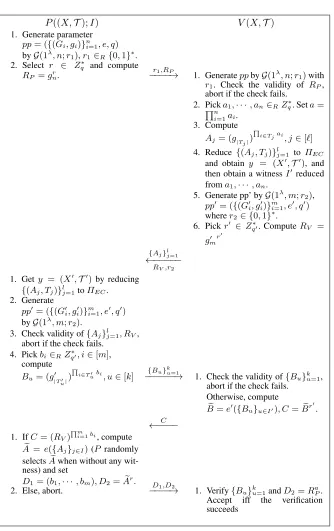
P((X,T);I) V(X,T)
1. Generate parameter pp= ({(Gi, gi)}n
i=1, e, q)
byG(1λ, n;r1)
,r1∈R{0,1}∗. 2. Select r ∈ Zq∗ and compute
RP =gr
n. −−−−→r1,RP 1. GenerateppbyG(1λ, n;r
1)with
r1. Check the validity of RP,
abort if the check fails.
2. Picka1,· · ·, an∈RZq∗. Seta= Qn
i=1ai.
3. Compute Aj= (g|
Tj|) Q
i∈Tjai , j∈[`]
4. Reduce{(Aj, Tj)}l
j=1 to ΠEC
and obtain y = (X0,T0 ), and then obtain a witnessI0reduced froma1,· · ·, an.
5. Generate pp’ byG(1λ, m;r
2),
pp0= ({(G0i, gi0)}mi=1, e0, q0)
wherer2∈ {0,1}∗.
6. Pickr0 ∈ Zq∗0. ComputeRV =
g0m r0
{Aj}lj=1
←−−−−− RV,r2
1. Gety = (X0,T0
) by reducing
{(Aj, Tj)}l
j=1toΠEC.
2. Generate pp0= ({(G0i, g
0
i)} m i=1, e
0
, q0)
byG(1λ, m;r2). 3. Check validity of{Aj}l
j=1, RV,
abort if the check fails. 4. Pickbi∈RZq∗0, i∈[m],
compute Bu= (g0|
Tu0|) Q
i∈Tu0 bi, u∈[k] {Bu} k u=1
−−−−−−→ 1. Check the validity of{Bu}k u=1,
abort if the check fails. Otherwise, compute
e
B=e0({Bu}u∈I0), C=Ber
0
. C
←−−−− 1. IfC= (RV)Qmi=1bi, compute
e
A = e({Aj}j∈I)(P randomly selectsAewhen without any wit-ness) and set
D1= (b1,· · ·, bm), D2=Aer.
2. Else, abort. −−−−→D1,D2 1. Verify{Bu}k
u=1andD2=RaP. Accept iff the verification succeeds
Our zero-knowledge argumenthP, Viconsists of three stages. In the first stage, the proverPand the verifierV execute the first two round of the 3-round interactive proof protocol, and obtainy∈ΠECby reducingLx−pptoΠEC; In the second stage,Pand V execute the 3-round interactive proof to letV prove toP thaty∈ECyes. In the last stage,Pproceeds the last round of the 3-round interactive proof, that is,PsendsDto V, when the proof in the second stage is accepted. The detailed construction is depicted in Figure 3.
Theorem 1. Assume that Decision Multilinear No-Exact-Cover Assumption holds. The construction in Figure 3 is an interactive argument forx∈ECY.
Proof. Completeness. It is obvious to see that, ifP andV execute the protocol hon-estly, V can computes C = e0({Bu}u∈I0)r
0
and P can computes D1 = RaP = e({Aj}j∈I)r when x ∈ ECyes. And so, if x ∈ ECyes, P can always convince V to accept.
Soundness. Supposex= (X;T)∈ECN. Obviously, we only need to prove that the probability that the malicious proverP∗outputs the correctD =Aeris negligible.
And notice that ifV accepts, it means{Bu}u are honestly generated, and soBer 0
=
Rb1···bm
V can be computed fromRV andD1 = (b1,· · ·, bm), D2 =Aer. Therefore, if
P∗ can convince V,P∗ must be able to computeA = g Qn
i=1ai
n from {Aj}lj=1. By the assumption, it is impossible except for a negligible probability. Thus the soundness
follows.
Theorem 2. Assume that Decision Multilinear No-Exact-Cover Assumption holds. The construction in Figure 3 is statistical augmented black-box zero knowledge.
For anyV∗, the simulation is completed by a PPT simulator with oraclesOΠ,OVb, whereOΠreturns 1 ifx∈ΠY and 0 otherwise, andOVb is the next message function of the extended verifierVb (see the details in subsections 2.3 and 2.4).
First,SOΠ,OVb does the same as P to interact with V∗ in the first stage and the second stage. Next, ifV∗’s proof in the stage 2 is correct, the simulator computesA=
ga
nfrom the records ofV∗’s private state, wherea=
Qn
i=1ai. If it succeeds, setD2=
Ar. Else, randomly selectD
2.
Proof. For any verifierV∗, the augmented black-box simulatorSOEC,OVd∗(x,·;·) pro-ceeds as follows:
1. Uniformly selectrV∗∈ {0,1}poly(n)forO
c V∗(x,·;·).
2. Make a query toOECwithxand obtain its returnδx. 3. Execute the first two round of the protocol.
– Randomly selectr1∈ {0,1}∗and generatepp= ((G1, g1),· · ·,(Gn, gn), e, q)
byG(1λ, n;r
1). Selectr∈Zq∗. – Make a query to O
c
V∗(x, rV∗;·) with(RP = gnr, r1). If it aborts, stop and
output(x, rV∗, RP, r1). Else, receive({Aj}lj=1, r2, RV). In addition,
simula-tor obtainsV∗’s current private states1=state (1)
V∗, which is used to produce
({Aj}l
4. Gety= (X0,T0)from{A
j, Tj}lj=1, whereX0={v10,· · ·, vm0 }andT0={Ti}ki=1,
by reducingLx−ppto Exact-Cover problem.
5. Generatepp0 = ((G01, g10),· · · ,(Gn0, g0n), e0, q0)byG(1λ, m;r
2)
6. If{Aj}jorRV is not valid, stop and output(x, rV∗, r1, RP).
7. Otherwise,
– Select b1,· · ·, bm ∈R Zq∗0, and set D1 = (b1,· · ·, bm). Compute Bu =
(g0
|T0
u|
)
Q i∈T0
ubi,u= 1,· · ·, k. – Make a query toO
c
V∗(x, rV∗;·)with({Bu}u). IfV∗aborts, stop and output
(x, rV∗, r1, RP,{Bu}u). Else, obtainV∗’s returnC and current private state
s2=state (2)
V∗.
8. IfC6= (RV) Qm
i=1bi, stop and output(x, r
V∗, r1, RP,{Bu}u).
9. Else, computeAe=g
Qn i=1ai
n fromV∗’s private states1ands2, which should
con-taina1,· · · , an ∈Zq∗from which{Aj}jis computed if the verifier is honest. If it succeeds, setD2=Aerwhenδx= 1, or randomly selectD2 ∈Gnwhenδx = 0; Otherwise, randomly selectD2∈Gnwhenδx= 0, or fail and stop whenδx= 1 10. Output(x, rV∗, RP, r1,{Bu}u,(D1, D2)).
Next, we will prove that the output of the simulator{SOEC,OVd∗(x,·;·)(x)}is sta-tistically indistinguishable from the view{V iewVP(∗x,I)(x)}of the verifier playing the
protocol with an honest proverPwith witness for the proven statementx.
Lemma 1. The probability that the simulator fails without output is negligible. Proof. Denoted byBadStatethe event that the simulatorSOEC,OVd∗(x,·;·)cannot com-puteAe=g
Qn i=1ai
n fromV∗’s private states1 ands2. Notice the event “the simulator
fails and stops” takes place iff the eventx ∈ECyes∧BadState∧(C =RbV)takes place. It is easy to see that
Pr[(x∈ECyes)∧BadState∧(C=RVb )]≤Pr[BadState∧(C=RbV)]
Furthermore, if y ∈ ECyes but the verifier V∗ does not have a witnessI0 for y ∈ ECyes(BadStatetakes place), then the probability thatV∗can provey ∈ECyesis negligible. Therefore,
Pr[(y∈ECyes)∧(C=Rb
V)∧BadState]≤neg(·) and we have
Pr[(C=RbV)∧BadState]
= Pr[(y∈ECno)∧(C=RbV)∧BadState] + Pr[(y∈ECyes)∧(C=RbV)∧BadState]
≤Pr[(y∈ECno)∧(C=RbV)] +neg(·)
By Decision Multilinear No-Exact-Cover Assumption,Pr[(y ∈ ECno)∧(C = Rb
V)]is negligible. All above, the probability that the simulator fails without output is negligible.x∈ECyesmeans the proverPhonestly computesAebyAe=e({Aj}j∈I)
Lemma 2. For any randomly selected(rV∗, r1, RP), we have
PrhV iewPV(∗x,I)(x) = (x, rV∗, r1, RP) i
= PrhSOEC,OVd∗(x,·;·)(x) = (x, rV∗, r1, RP) i
Lemma 3. For any randomly selected(rV∗, pp, RP,(b1, . . . , bm)), we have
PrhV iewVP(∗x,I)(x) = (x, rV∗, r,RP,{Bu}u) i
= PrhSOEC,OVd∗(x,·;·)(x) = (x, rV∗, r1, RP,{Bu}u) i
The only difference between the simulator and the prover is that, instead of com-puting A from {Aj}j, the simulator need to compute Afrom the received state of the verifier. So, the simulation will fail when the verifier’s malicious act in generating {Aj}j. Concretely, the failure arises only under(C=RbV)∧BadState(BadStateis defined in proof of Lemma 1), which takes place with a negligible .
Lemma 4. For any(r1, RP,{Bu}u, D= (D1, D2)), it holds that
PrhV iewVP(∗x,I)(x) = (x, rV∗, r1, RP,{Bu}u, D) i
= PrhSOEC,OVd∗(x,·;·)(x) = (x, rv∗, r1, RP,{Bu}u, D) i
±neg(·)
Proof. The probability that the simulator outputs(x, rV∗, r1, RP,{Bu}u, D), by the
Lemma 1–3, is almost equal to the probability that the view of V∗ is in the form
(x, rV∗, r1, RP,{Bu}u, D)except for a negligible probability.
Because the simulator is same as an honest prover in step3-step7, the only differ-ence between the output of the simulator and that ofV∗ isD2. For convenience, the
simulator’s output is denoted by(x, rV∗, r1, RP,{Bu}u, D0= (D1, D02)).
In the view ofV∗,Dis computed byD2=Aror selected randomly fromGn, but
the simulator generatesD02fromV∗’s state or selects randomly fromGn. It is known
that the simulator randomly selectD0
2 ∈ Gn iffδx = 0, that is x ∈ ECno. Since P selectD2 randomly fromGn when x∈ ECno, we obtain thatPr[D02 ∈R Gn] =
Pr[D2∈RGn].
Next, we prove thatD20 has the same distribution asD2when the simulator
com-putesD02withV∗’s private state. The simulator computesD2withV∗’s private state
implies(x∈ECyes)∧(C=RbV), and then meansD2=e({Aj}j∈I). So, let Γgood= (x∈ECyes)∧(C=RbV)∧(¬BadState),
Γbad= (x∈ECyes)∧(C=RbV)∧(BadState), we obtain
Pr[D0
2=D2|(x∈ECyes)∧(C=RbV)]
= Pr[¬BadState∧(D02=D2)|(x∈ECyes)∧(C=RVb)]
+ Pr[BadState∧(D02=D2)|(x∈ECyes)∧(C=RbV)]
= Pr[¬BadState|(x∈ECyes)∧(C=Rb
V)] Pr[(D20 =D2)|Γgood]
Furthermore, by the following fact:
Pr[D02=D2|Γgood] = Pr[D20 =D2|(x∈ECyes)∧(C=RbV)∧(¬BadState)] = 1
Pr[D02=D2|Γbad] = Pr[D02=D2|(x∈ECyes)∧(C=RbV)∧(BadState)] = 0
we have
Pr[D02=D2|(x∈ECyes)∧(C=RbV)]
= Pr[¬BadState|(x∈ECyes)∧(C=RbV)]
= 1−Pr[BadState|(x∈ECyes)∧(C=Rb
V)] = 1−neg(·).
Combining withPr[D20 ∈R Gn|x ∈ ECno] = Pr[D2 ∈R Gn|x ∈ ECno], we obtain
Pr[D02=D2|(C=RbV)] = 1−neg(·).
This Lemma is proved.
These four lemmas complete the proof of Theorem 2.
4
Leakage-resilient zero-knowledge argument
We recall the notions of leakage-resilient zero knowledge in [18, 32, 25], show the description of the augmented black-box simulator with access to leakage oracle, and present the definition of leakage-resilient zero knowledge according to our another work on augmented black-box zero-knowledge. We show a construction of statistical leakage-resilient zero-knowledge argument according to this definition.
Recently, Garg et al. [18] introduced leakage-resilient zero-knowledge (LRZK) such that in the setting where adversarial verifiers can obtain arbitrary leakage on the internal state (including the witness and the random coins) of the honest prover throughout the execution of the protocol. LRZK guarantees the zero-knowledge property in stronger adversarial models where an malicious verifier has the ability to obtain leakage of the secret states of the honest prover by launching a side-channel attack. In this model, a malicious verifier makes a series of leakage queries throughout the execution of the pro-tocol, and whenever the prover sends message, he sends answers to the leakage queries as well. More concretely, lethP, Vibe an interactive proof for a promise problemΠ. In the prover’s round of the interaction,P sends a message toV, and then updates its current private statestate(at the beginning of the interaction,stateis initialized to be the private auxiliary inputw) by setting state = state||rat that time, wherer is a random coin used byPin the current round. And thenPresponds withf(state)to the leakage queryf launched byV.
LRZK requires that for any cheating verifierV∗ that can obtainl bits of leakage information about the prover’s state via a series of leakage queriesf1, f2, ..., there
ex-ists a simulatorS with the leakage oracle Ln
w such that the simulator can output an indistinguishable view of the malicious verifier and simulate the leakage as well. The leakage oracleLn
wis parametrized by the witness wof the proven statement and the security parametern. On inputing a computable leakage functionf0(·),Ln
f0(w)toV, wheref0(·)is usually prepared bySfromV∗’s leakage queryf0(·,·)about the witness and randomness.
In [18], Garg et al. proposedλ-leakage-resilient zero knowledge, which requires that for anyV∗there exists a simulatorSwith leakage oracleLn,λ
w (·)such that the output of SandV iewV∗are indistinguishable andLn,λw (·)sends at most`0S =λ`V∗bits leakage,
where`V is the total number of leaking bits received byV. Clearly,λ≥1. And later the work in [32, 25] reducesλto1. Next, we recall leakage-resilient zero knowledge according to the definition of augmented black-box zero knowledge.
As assumed previously, lethP, Vibe a2k(n)-round interactive proof system for a promise problemΠ. Fori= 1,· · · , k, the verifier sendsαito the prover and receives βifrom the prover. However, the next message functions here in the leakage setting is different. The verifier’s next message function takes the leakages received as a part of input, while the prover’s next message function takes the current leakage query as a part of input. That is, the proverPcomputesβifrom the current private statestate
(i)
P which containsw(the witness forx∈ΠY) and his random coins, namely,βi =P(state(Pi)), and answers a leakage queryfionstate
(i)
P issued byV. And the next message function ofV is as follows:
(αi, fi(·)) =N extV x, rV, βi−1, Fi−1, i= 1,· · · , k
whereβi−1= (β1,· · ·, βi−1),Fi−1= (f1(state (1)
P ),· · ·, fi−1(state (i−1)
P ), andFi−1
is all the leakage received byV. After sendingαitoP,V receivesβiandfi(state(Pi))
(ifV does not issue any leakage queryfi, setfi(state
(i)
P )to be the empty stringλ). And for any verifierV described above, the extended verifierVb is defined as in subsection
2.5, and soVb’s next message function is as follows:
αi, fi(·), state(Vi)=N ext b
V x, rV, βi−1, Fi−1), i= 1,· · · , k.
O b
V(x, r;·,·)is also defined as in subsection 2.5. When queried with(i, βi−1, Fi−1),
O b
V(x, r;·)returns(αi, fi, state
(i)
V ).
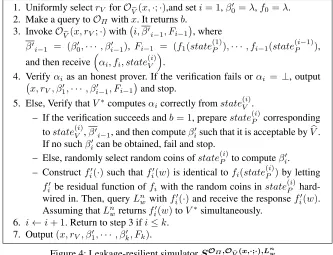
Leakage-resilient zero-knowledge proofshP, Vi(x)for a promise problem Π re-quire that for any malicious verifier launching leakage attack, the verifier can learn nothing beyond x∈ ΠY and the leakage. To formulate this, for any verifierV∗, the construction of the leakage-resilient simulator with the oraclesOΠ,O
c
V∗(x,·;·)and
the leakage oracleLnw, written asSOΠ,OVd∗(x,·;·),L n
w, is depicted in Figure 4.
LetLV iewVP(z)(x)consist of the view of V with any auxiliary input z and the
received leakage.
Definition 6. Leakage-resilient Augmented Black-box Zero-knowledge Proof (Argu-ment).LethP, Vibe an interactive proof system for some languageL.hP, Viis called leakage-resilient augmented black-box zero-knowledge proof system if for any PPT ver-ifierV∗with auxiliaryz, the corresponding extended verifier is denoted byVc∗, there exists an augmented black-box simulatorSwith oraclesOL,OVc∗ andLnw, such that LV iewP
V∗(z)(x)andS
OL,OVd∗(x;·),L n
IfSOL,OVd∗(x;·),L n
w(x)is statistically closed or identical toLV iewP
V∗(z)(x)when it does not fail,hP, Vi(x)is called statistical or perfect leakage-resilient augmented black-box zero-knowledge proof (argument).
If the soundness security holds for an all powerful prover,hP, Viis called an (sta-tistical) leakage-resilient augmented black-box zero-knowledge argument.
1. Uniformly selectrV forOVb(x,·;·),and seti= 1,β
0
0=λ,f0=λ.
2. Make a query toOΠwithx. It returnsb. 3. InvokeO
b
V(x, rV;·)with i, β0i−1, Fi−1, where
β0
i−1 = (β00,· · · , βi0−1), Fi−1 = (f1(state (1)
P ),· · ·, fi−1(state
(i−1)
P ), and then receiveαi, fi, state
(i)
V
.
4. Verifyαi as an honest prover. If the verification fails orαi = ⊥, output x, rV, β10,· · · , βi0−1, Fi−1and stop.
5. Else, Verify thatV∗computesαicorrectly fromstate
(i)
V .
– If the verification succeeds andb= 1, preparestate(Pi)corresponding tostate(Vi),β0
i−1, and then computeβi0such that it is acceptable byVb.
If no suchβi0can be obtained, fail and stop.
– Else, randomly select random coins ofstate(Pi)to computeβi0.
– Constructfi0(·)such thatfi0(w)is identical to fi(state(Pi))by letting fi0 be residual function offi with the random coins instate(Pi) hard-wired in. Then, queryLn
wwithfi0(·)and receive the responsefi0(w). Assuming thatLn
wreturnsfi0(w)toV∗simultaneously. 6. i←i+ 1. Return to step 3 ifi≤k.
7. Output(x, rV, β10,· · ·, βk0, Fk).
Figure 4: Leakage-resilient simulatorSOΠ,OVc(x,·;·),L
n w
Theorem 3. The construction presented in Figure 2 is a statistical leakage-resilient augmented black-box zero-knowledge argument, if the conditions in Theorem 2 hold.
Proof. We need to construct leakage-resilient augmented black-box simulator. We can see that it is easy to constructSOEC,OVd∗(x,·;·),L
n
I by modifyingSOEC,OVd∗(x,·;·)defined in the proof of Theorem 2. For any verifierV∗, the leakage-resilient augmented black-box simulatorSOEC,OVd∗(x,·;·),L
n
I proceeds as follows:
1. Uniformly selectrV∗∈ {0,1}poly(n)forO
c V∗(x,·;·).
2. Make a query toOECwithxand obtain its returnδx. 3. Execute the first two round of the protocol.
– Randomly selectr1∈ {0,1}∗and generatepp= ((G1, g1),· · ·,(Gn, gn), e, q)
byG(1λ, n;r1). Selectr∈Zq∗. – Make a query to O
c
V∗(x, rV∗;·) with(RP = g
r
n, r1). If it aborts, stop and
output (x, rV∗, RP, r1). Else, and receive ({Aj}lj=1, r2, RV)and a leakage
queryf1(·,·). In addition to, simulator obtainsV∗’s current private states1=
– Generate leakage query function by setting f10(·) = f1(·, r). Query leakage
oracleLn
I withf10 and obtainf10(I).
4. Gety= (X0,T0)from{Aj, Tj}l
j=1, whereX0={v10,· · ·, vm0 }andT0={Ti}ki=1,
by reducingLx−ppto Exact-Cover problem.
5. Generatepp0 = ((G01, g10),· · · ,(Gn0, g0n), e0, q0)byG(1λ, m;r
2)
6. If{Aj}jorRV is not valid, stop and output(x, rV, r1, RP;f1(I)).
7. Otherwise,
– Selectb1,· · ·, bm∈RZq∗0and setD1= (b1,· · ·, bm).
ComputeBu= (g0
|Tu0|)
Q
i∈Tu0bi,u= 1,· · · , k. – Make a query toO
c
V∗(x, rV∗;·)with{Bu}u. If V∗ aborts, stop and output
(x, rV∗, r1, RP,{Bu}u, f1(I)). Else, obtainV∗’s return C, a leakage query
functionf2(·,·)and current private states2=state (2)
V∗.
– Generate leakage query function by setting f20(·) = f2(·, r,(b1,· · ·, bm)).
Query leakage oracleLnI withf20 and obtainf20(I).
8. IfC6=R Qm
i=1
V bi, stop and output(x, rV∗, r1, RP,{Bu}u,(f10(I), f20(I))).
9. Else:
– ComputeAe =g
Qn i=1ai
n fromV∗’s private states1ands2. If it succeeds, set
D2=Aerwhenδx= 1, or randomly selectD2∈Gnwhenδx= 0; Otherwise,
randomly selectD2∈Gnwhenδx= 0, or fail and stop whenδx= 1.
– Make a query to O c
V∗(x, rV∗;·) withD = (D1, D2)and receive a leakage
query functionf3(·,·).
– Generate leakage query function by setting f30(·) = f3(·, r). Query leakage
oracleLnI withf30 obtainf30(I).
10. Output(x, rV∗, RP, r1,{Bu}u,(D1, D2),(f10(I), f20(I), f30(I))).
Notice thatP’s response is independent with the holding witnessI(althoughPuses Ito compute his last messageD2). So, the simulator’s leakages(f10(I), f20(I), f30(I))
are identical to the real leakages. By the proof of Theorem 2, the simulator’s out-put{SOEC,OVd∗(x,·;·),L
n
I(x)}is statistically indistinguishable from{LV iewP(x,I) V∗ (x)}.
That is, the theorem is correct.
5
2-round computational zero-knowledge arguments for Exact
Cover problem
The goal in this section is to construct a 2-round augmented computational black-box zero-knowledge argument for Exact Cover problemEC = (ECY, ECN)under the Decision Multilinear No-Exact-Cover Assumption and the assumption of the existence of hash functions.
Let{HK}Kbe a family of hash functions, whereK←Gen(1λ)andHK:Gn→ {0,1}∗. For any instancex = (X;T) ∈ EC, where|X| = n,|T | = l, andpp =
((G1, g1),· · · ,(Gn, gn), e, q)← G(1λ,1n;r), define the language
Lx−pp =
(
({Aj, Tj}l
j=1, K, t) :1)∃a1,· · ·, an∈Zq∗, Aj= (g|Tj|)
Q i∈Tjai
, j∈[`]
2)t=HK(g Q
iai
n )
)
LetGandG0 be two groups. ForA ∈ GandB ∈ G0,A⊕B denotes the exclusive OR operation on the its binary coded values. The details of the 2-round augmented computational black-box zero-knowledge argument for Exact Cover problem EC = (ECY, ECN)is depicted in Figure 5.
P(x= (X,T);I) V(x= (X,T))
({Aj}j, t) ←−−−−−−−
(r1, α)
1. Selectr1randomly and set
pp← G(1λ,1n;r1).
2. Selecta1,· · ·, an∈Zq∗. 3. ComputeA= (gn)Qni=1ai
Aj= (g| Tj|)
Q
i∈Tjai , j∈[`]. 4. GenerateK:K ← Gen(1λ;α)
and computet=HK(A).
1. Generatepp,Kusingr1andα.
2. Check the validity of({Aj}j, t). If the check fails, abort.
Otherwise, proceed the following steps.
3. Reduce Lx−pp to Exact Cover Problem and obtain an instance
y= (X0, T0={Ti0}ki=1})
where|X0|=m, Ti0⊆[m]. 4. Selectr2∈R{0,1}∗, and set
pp0← G(1λ,1m;r2), where pp0= ({(G0i, g0i)}mi=1, e0, q0).
5. Selectb1,· · ·, bm∈Zq∗0, and let
Bu= (g0
|Tu0|) Q
i∈Tu0bi, u∈[k] , B= (gm0 )
Qm i=1bi.
6. ComputeAe = e({Aj}j∈I)and setD=HK(Ae⊕B).
{Bu}u, D −−−−−−−→
r2
1. Obtain y and a witness I0 ⊆
[k]from({Aj, Tj}l
j=1, K, t)and
a1,· · ·, an.
2. Generatepp0← G(1λ,1m;r2)
3. ComputeBe=e
0
({Bu}u∈I0)
4. Accept iffD=HK(A⊕Be) Figure 5: 2-round computational ZKA for Exact Cover Problem
Theorem 4. Assume{HK}Kis a family of collision-resist hash functions and that the
Decision Multilinear No-Exact-Cover Assumption holds. The construction in Figure 4 is an interactive argument forx∈ECY.
Proof. Completeness. It is obvious to see that ifx ∈ ECY andV executes the pro-tocol honestly,P can compute the committed value of{Aj}j byAe=e({Aj}j∈I) =
g Q
i∈[n]ai
n using the witnessIforx∈ECY, andV can compute the committed value of {Bu}ubyBe = e0({Bu}u∈I0) = g0m
Q
i∈[m]bi using the witness I0 for y ∈ EC
Soundness. Ifx= (X;T) ∈ECN, the probability that the malicious proverP∗ outputs the correct{Bu}u, D = HK(Ae⊕B)is negligible. In fact, by the Decision
Multilinear No-Exact-Cover Assumption,P∗can getAe =gna only from the message
({Aj}j, t, r1, α)except for a negligible probability.
On the contrary, assume that there is a PPT adversaryAthat can obtainAe = gan
from({Aj}j, HK(A), pp, K)with non-negligible probability, then we can construct a PPT distinguisherDthat can distinguish({Aj}j, ga
n)and({Aj}j, ger
n), whereer∈RZ ∗
q, with non-negligible probability.Dworks as follows:
Given({Aj}j, A∗ ∈ Gn, pp),Dgenerates K ← Gen(1λ), and invokesAwith
({Aj}j, HK(A∗), pp, K), ifAoutputsA∗,Doutputs1, and outputs0otherwise. Sincex = (X;T) ∈ ECN, ifA∗ = ger
n,HK(A∗)is independent of{Aj}j, the property of the hash functions guarantees that no PPT algorithm can obtainA∗ from HK(A∗)except for a negligible probability, thusDcan distinguish({Aj}j, gna)and
({Aj}j, ger
n)with non-negligible probability. It contradicts the Decision Multilinear No-Exact-Cover Assumption. Therefore, there is no PPT algorithm can obtainAe=ganfrom
({Aj}j, t, r1, α)except for a negligible probability.
In a word,P∗can produce correctD =HK(Ae⊕B)with negligible probability
and make honestV accept his proof with negligible probability. Thus the soundness follows.
This completes the proof.
Theorem 5. Under the same condition as Theorem 4, the construction in Figure 5 is augmented computational black-box zero-knowledge.
Proof. For any verifierV∗, the augmented black-box simulatorSOEC,OVd∗(x,·;·) pro-ceeds as follows:
1. Uniformly selectrV∗∈ {0,1}poly(n)forO
c V∗(x,·;·).
2. Make a query toOECwithxand obtain its returnbx. 3. InvokeO
c
V∗(x, rV∗;·)and receive the message{Aj}j, t,(r1, α)andV∗’s current
private states1=state (1)
V∗
4. Generatepp,Kusingr1andαrespectively. Check the validity of({Aj}j, t). If the
check fails, abort. Otherwise, proceed the following steps. 5. Obtainyandpp0as an honest prover.
6. Compute all{Bu}uandBas an honest prover.
7. ComputeAefromV∗’s current states1such thatt=HK(Ae). If it fails orbx= 0,
selectAe∈RGn. And then computeD=HK(Ae⊕B).
8. Output(x, rV∗,{Bu}u, r2, D).
Next, we will prove that in the condition that the verifier V∗ plays the protocol with an honest prover P holding witness for the proven statement x, the output of the simulator{SOEC,OVd∗(x,·;·)(x)}is computationally indistinguishable from the view {V iewVP(∗x,I)(x)}of the verifierV∗.
Honest zero knowledge:IfV∗produces({Aj}j, t)honestly,V∗’s private states1
containsa1,· · · , an ∈Zq∗such thatAj = (g|Tj|)
Q i∈Tjai
andt =HK(g Qn
any randomly selected(rV∗, r2,(b1,· · ·, bm)), it holds that
PrhV iewVP(∗x,I)(x) = (x, rV∗,{Bu}u, r2, D) i
= PrhSOEC,OVd∗(x,·;·)(x) = (x, rV∗,{Bu}u, r2, D) i
Zero knowledge:For the malicious verifierV∗,{SOEC,OVd∗(x,·;·)(x)}may differ from{V iewVP(∗x,I)(x)}only whenV∗produces({Aj}j, t)dishonestly. That is,V∗’s
private states1does not containa1,· · · , an ∈Zq∗such thatAj = (g|Tj|)
Q i∈Tjai
and
t=HK(g Qn
i=1ai
n ). In this condition, the proverP will computeAe=e({Aj}j∈I)and setD=HK(Ae⊕B)while the simulatorSOEC,OVd∗(x,·;·)randomly selectsAe∈RGn and setsD=HK(Ae⊕B).
IfV∗ produces({Aj}j, t)dishonestly andy /∈ ECY,P randomly selectsB and computes D = HK(Ae⊕B) while the simulator randomly selectsAeand B,
com-putesD=HK(Ae⊕B). In this case, forAecomputed byP,({Aj}lj=1,{Bu}ku=1, D=
HK(Ae⊕B))and({Aj}lj=1,{Bu}ku=1, D=HK(Ae⊕UG0
m))are indistinguishable, and meanwhile,({Aj}l
j=1,{Bu}
k
u=1, D=HK(Ae⊕UG0
m))and({Aj} l
j=1,{Bu}
k
u=1, D=
HK(UGn⊕B))are indistinguishable. Therefore,{SOEC,OVd∗(x,·;·)(x)}is computation-ally indistinguishable from the view ofV∗. Here,UGn(UG0
m) is uniformly distributed onGn(G0m).
AssumeV∗produces({Aj}j, t)dishonestly buty ∈ ECY. This means that there
exist a1,· · ·, an ∈ Zq∗ such that Aj = (g|Tj|)
Q i∈Tjai
and t = HK(g Q
i∈[n]ai n ). If V∗ is unable to geta1,· · ·, an ∈ Zq∗, V∗ will be unable to compute correct Be =
B. As above, we can obtain{SOEC,OVd∗(x,·;·)(x)}is computationally indistinguishable from the view ofV∗. If V∗ is able to get a1,· · ·, an ∈ Zq∗, the simulator can also obtain a1,· · ·, an ∈ Zq∗, then the simulator is the same as P. In the case that the simulator cannot obtaina1,· · · , an∈Zq∗butV∗can, the simulator fails. This happens with a negligible probability. On the contrary, ifV∗ computesa1,· · ·, an ∈ Zq∗with noticeable probability,V∗must can determine whetherTj ∈ I for anyTj ∈ T with noticeable probability (for convenience, we consider when there exists only one witness I for the statementx= (X;T)):V∗ computesa1,· · · , an ∈ Zq∗ fromT − {Tj}, if succeeds then accepts “Tj∈/I”, otherwise, accepts “Tj∈I”.
Combining the cases above,{SOEC,OVd∗(x,·;·)(x)}and{V iewP(x,I)
V∗ (x)}are
com-putationally indistinguishable in the condition thatV∗produces({Aj}j, t)dishonestly.
This completes the proof.
References
1. M. Abe, S. Fehr. Perfect NIZK with adaptive soundness. In TCC, pages 118-136, 2007. 2. W. Aiello, J. Hstad. Statistical zero-knowledge languages can be recognized in two rounds.
Journal of Computer and System Science, 42(3):327-345, 1991.
3. B. Barak. How to go beyond the black-box simulation barrier. In FOCS, pages 106-115, 2001.
5. G. Brassard, C. Cr´epeau and M. Yung. Constant round perfect zero knowledge computation-ally convincing protocols. Theoretical Computer Science, Vol. 84, No. 1, 1991.
6. B. Barak, Y. Lindell. Strict polynomial-time in simulation and extractor. In 34th ACM Sym-posium on the Theory of Computing, 2002:484-493.
7. M. Bellare, A. Palacio. The knowledge-of-exponent assumptions and 3-round zero-knowledge protocols. In CRYPTO, pages 273-289, 2004.
8. N. Bitansky, O. Paneth. Point obfuscation and 3-round zero knowledge. TCC 2012. LNCS, Volume 7194, pages 189-207, 2012.
9. N. Bitansky, O. Paneth. On the impossibility of approximate obfuscation and application to resettable cryptography. In STOC 2013, pages 241-250.
10. N. Bitansky, O. Paneth. On Non-Black-Box Simulation and the Impossibility of Approxi-mate Obfuscation. SIAM J. Comput. 44(5), 1325-1383(2015).
11. Kai-Min Chung, Huijia Lin, R. Pass. On constant round concurrent zero knowledge from falsifiable. http://eprint.iacr.org/2012/563.pdf
12. Kai-Min Chung, R. Pass, K. Seth. Non-black-box simulation from one-way functions and applications to resettable security. STOC, 2013, pp. 231-240.
13. D. Dolev, C. Dwork, and M. Naor. Non-malleable cryptography (extended abstract). In STOC, pages 542-552, 1991.
14. C. Dwork, M. Naor, O. Reingold, and L. Stockmeyer. Magic functions. In Memoriam: Bernard M. Dwork 1923-1998. Journal of the ACM, 50(6):852-921, 2003.
15. C. Dwork, M. Naor, and A. Sahai. Concurrent zero-knowledge. In STOC, pages 409-418, 1998.
16. L. Fortnow. The complexity of perfect zero-knowledge. In Advance in Computing Research, Volume 5, pages 327-343,1989.
17. S. Garg, C. Gentry, A. Sahai. Witness encryption and its applications. In STOC 2013. 18. S. Garg, A. Jain, A. Sahai. Leakage-resilient zero knowledge. In CRYPTO, pages 297-315,
2011.
19. V. Goyal, R. Moriarty, R. Ostrovsky, A. Sahaiy. Concurrent statistical zero-knowledge argu-ments for NP from one way functions. http://eprint.iacr.org/2006/400.
20. S. Goldwasser, S. Micali, and C. Rackoff. The Knowledge Complexity of Interactive Proof Systems. SIAM J. Comput., 18(1):186-208, 1989.
21. O. Goldreich, Y. Oren. Definition And Properties of Zero-Knowledge Proof Systems. J. Cryptology, 7(1): 1-32, 1994.
22. J. Groth. Short pairing-based non-interactive zero-knowledge arguments. In ASI- ACRYPT, pages 321-340, 2010.
23. S. Hada, T. Tanaka. On the existence of 3-round zero-knowledge protocols. In CRYPTO, pages 408-423, 1998.
24. S. Kiyoshima. Statistical concurrent non-malleable zero-knowledge from one-way functions. In CRYPTO, LNCS 9216, pages 85-106, 2015.
25. S. Kiyoshima. Constant-round leakage-resilient zero-knowledge from collision resistance. In: Fischlin, M., Coron, J.-S. (eds.): EUROCRYPT 2016, Part II. LNCS, vol. 9666, pp. 93-123(2016).
26. Hongda Li, Dengguo Feng. Constant-Round Zero-Knowledge Proofs of Knowledge with Strict Polynomial-time Extractors for NP. Science China Information Sciences, 57(1):012111:1-012111:13
27. Daniele Micciancio, Shien Jin Ong, Amit Sahai, Salil P. Vadhan. Concurrent zero knowledge without complexity assumptions. In TCC, pages 1-20, 2006.
29. M. Naor, R. Ostrovsky, R. Venkatasan, M. Yung. Perfect zero knowledge arguments for NP can be based on general complexity assumptions. Advances in cryptology - Crypto 92 Proceedings, Lecture Notes in Computer Science Vol. 740, E. Brickell ed., Springer-Verlag, 1992.
30. C. Orlandi, R. Ostrovsky, V. Rao, I. Visconti. Statistical Concurrent Non-Malleable Zero Knowledge. In: Lindell, Y. (ed.) TCC 2014. LNCS, vol. 8349, pp. 167-191. Springer, Hei-delberg (2014).
31. R. Ostrovsky, G. Persiano, I. Visconti. Constant-round concurrent NMWI and its relation to NMZK. ECCC Report No. 95, 2006. 5 Theory of Cryptography, Fifth Theory of Cryptogra-phy Conference, TCC 2008, New York, USA, March 19-21, 2008.
32. O. Pandey. Achieving constant round leakage-resilient zero knowledge. In: Lindell, Y. (ed.) TCC 2014. LNCS, vol. 8349, pp. 146-166. Springer, Heidelberg (2014).
33. R. Pass, A. Rosen. New and improved constructions of non-malleable cryptographic proto-cols. In Proc. 37th STOC, ACM, 2005, pages 533-542.