IN THIS
ISSUE
Whaf is Range Managemeni?. _._. _____ ___. ___________._.____._ __... _ _,._ _ __._ ..DonaZd W. Hedrick Greater Profif from Livesiock in the Infermouniain Wesf wifh Efficienf Ranch Managemen~...Forrest M. Willhite and Albert R. Grable Influence of Soil Compacfion on Emergence and Firsf-Year Growfh of
Seeded Grasses...~__._.~.__.~_ ______ ____ ._._ ___.____ _._._.__ Howard Burton, Wayne G. McCulZy, Howard M. Taylor and James E. Box, Jr. Compefifion in a Blue Grama-Broom Snakeweed-Acfinea Communify and
Responses fo Selecfive Herbicides..._ _.__ __.__. _.___.__. _ . . ..___. Donald A. Jameson Crude Profein in Rumen Confenfs and in Forage
Dwight R. Cable and R. Phil Shumway Seed Physical Characferisfics And Germinafion of Hardinggrass (Phalaris
fuberosa var sfenopfera (Hack.) Hifch.)
R. Derwyn B. WhaZZey, Cyrus M. McKeZZ, and Lisle R. Green An Infroducfion fo Range Managemenf _____ ______ ______ ~..__._. _..._..___. _ __..__. L. A. Stoddart Ferfilizafion of Mixed Cheafgrass-Bluebunch Wheafgrass Sfands
A. M. Wilson, G. A. Harris, and D. H. Gates Technical Nofes:
Effecf of a Wildfire on Idaho Fescue and Bluebunch Wheafgrass C. Eugene Conrad and Charles E. Poulton Caffle Grazing Time is Related to Temperature and Humidify
John H. Ehrenreich and ArdeZZ J. Bjugstad A Low Cost Apparafus for Taking Undisfurbed Soil Cores Thadis W. Box Direcf Processing of Field Dafa
George M. Angleton, Charles D. Bonham, and Larry L. Shannon Germinafion Requirements of Scarlel Globemallow
R. J. Page, D. L. Goodwin, and N. E. West Managemeni Nofes:
Confrolling Blowoufs for Forage Producfion
A. C. Everson, B. E. DahZ, and A. H. Denham Mesquife Confrol on fhe Coronado National Foresf...CharZes R. Ames Grazing Caifle on Sub-irrigafed Meadows
Donald C. Clanton and Donald F. Burzlaff Cowboy on fhe Coconino... ____.. _________________.________ _.__ ..______ _.__ . . . ..KeZ M. Fox Foxboro Allofmenf .___._._ _______._________.____ ____ __ _.__. ____ _... _____ ____ . . . ..James L. Perry Book Reviews:
Hisfory of Wyoming (Russell D. Lloyd); The Changing Mile (Don D. Dwyer); Soil Ferfilify and Fertilizers (Arthur L. Bell) ______ _ ..____ _ _.__ ____ ________ __
News and Nofes.... _.._. _.._ _..__.. ___.______.________.______ __.___ _ ..__. ___._________________._.~_.~__.._.~..._.~.~_~.._____. Iniernafional News .__._.___________..___.._._._.~._._..~.._______ __.__ ___ ___._ ___._____.________ __.__ _____._______._.___
Ausiralian Arid Zone Research Conference...CarZton H. Herbel
Wifh fhe Secfions __..__ __.____._._______.__ ______ ________.__ _._______. ________________.___._.~._ _..__. ____________.____________ Se&on Officers, 1966... . . ..___ _._ _____. _ __.._ __________.____.___.____ __.. _ _.__ _____________.__ _..__ _____~__._.__ Sociefy Business ____ _________ __.. _ ____ __._.____ ._._ __ ____ _..____._____.._._______________ ____ _.._._ _.__. ___________._ ____ _._.___
ASRM Commiffees, 1966.. ._.__ _______ ___.__. ____________._ __.__. _._._..______ . .._ __ _.__ _________._____.__.__.~~._ Reporf of 1966 Annual Meefing, New Orleans...~.__.~..._.__.~_._. Range Seeding Equipmeni Commiffee Meefs... __._. __ __._. .A. B. Evanko
111 112
116 121 124
129 133 134
136 141 142 143 145
147 146 151 153 155
156 156 161 161 163 164 165 165 167 169
Journal of
Volume 19, Number 3 May, 1966RANGE
MANAGEMENT
Editorial
WHAT IS RANGE MANAGEMENT?
DONALD W. HEDRICK Professor of Range Management, Oregon State University, Corvallis.
Since our professional society has been in existence for nearly two decades it seems appropriate to critically examine and reflect upon what we mean by the term,
range management. This ques-
tion is prompted by the innate desire of most of us to maintain a propriety and dignity befitting our profession. In order to do this and keep in step with mod-
ern trends, many of us have
identified ourselves with “range
science” during the past ten
years. Whenever this name
change more nearly reflects our present activities it has been worthwhile. However, in this at- tempt to gain identity and re- spect the question is: Have we
unconsciously short-changed our
profession in applied science or technology?
I’m afraid that I’ve been as guilty as anyone in the attempt to impress my campus colleagues with the importance of science in
range management. In this at-
tempt I’ve failed to recognize that we have a responsibility just as important as the science aspect; i.e., how can we, with.the help of the best scientific facts available, manipulate the forage resource for the maximum over- all benefit of humanity. True, this requires a tremendous sci- entific understanding in the in- teraction of soils, plants, and ani- mals, but one cannot effectively
manipulate these resources with- out application of scientific find-
ings which is basically tech-
nology.
This importance of technology and its relationship to the sci- ences has, for me at least, been clarified by the Yale chemist, Harold G. Cassidy, in the Ameri- can Scientist, September, 1963.
He wrote on the subject “The
Muse and the Axiom.” Members of the Range Society can take heart in his statements, For ex-
ample, “Technologies unite the
humanities and the sciences.” He describes three activities - an- alytic, synthetic, and application to practice-that are carried on in the sciences, humanities, tech-
nologies, and philosophies by
their practitioners. “Analytic ac- tivities are those of reporting, collecting, separating, and dis- tinguishing. Synthetic are those of generalizing and ordering. The third activity-that which closes the circle-the activity which ap- plies the generalizations to prac- tice, serves as a test of their validity at the same time that it serves the uses of life. The sci- ences and humanities are in part
characterized by the dominant
role of analytic and synthetic activities; . . . the technologies by the major emphasis upon appli- cation to practice. But, in all of them, all three activities are pursued (the italics are mine) : this is why they are of equal stature, and they belong in the college or university.”
Aren’t we short-changing our
profession in limiting a defini- tion of range management to sci- ence and art? Isn’t it more appro- priate in view of the developing body of knowledge at our dis-
111
posal to include technology in our definition ? It seems to be a normal and logical, evolutionary
development to go through a
series of steps in which art
changes from a dominant to sub- ordinate role. If so, aren’t we
entering a new phase with a
greater sense of predictability in applying our scientific knowl- edge to our range management
problems? Which means that
technology is becoming more im-
portant and the art in range
management less so. When
viewed in this light a revision of the definition of range manage- ment may be long overdue.
To avoid the criticism of rais- ing questions and not providing any answers I’m suggesting con- sideration of the following defi-
nition of range management
which I’ve used and found suit- able in teaching an introductory
course: “Range management is
the manipulation of the soil,
plant, and animal complex used by grazing animals.” This man- agement is based on the best sci- entific information available on
these complexes which occur
largely on uncultivated land,
where native plants are predomi- nant, and where other natural
resource values-watershed, for-
estry, wildlife, recreation, etc.-
may be important. With minor
changes such as the substitution of arable for uncultivated, im- proved for native, and the dele- tion or addition of other land uses, this definition also fits pas-
ture management as well. More
Greater Profit from Livestock in
the Intermountain West with
Efficient Ranch Management’
FORREST M. WILLHITE AND ALBERT R. GRABLE Research Soil Scientists, Agricultural Research Service, USDA, Grand Junction, Colorado.2
Highlight
Livesfock producers are in serious economic difficulty because forage and livesfock managemenf have changed very liffle over fhe years. If ranchers are fo meef fhe challenge of fhe cosf-price squeeze, fhey musf in- fegrafe improved livestock manage- meni wifh more efficient use of their range and meadows. This consisfs of increasing fhe qualify and quantify of forage fo give larger rafe of gain on more calves over a longer period of fime. If is possible fo achieve a severalfold increase in meaf produc- fion per unif of land and livesfock resources.
The livestock producer, in
particular the cow-calf operator, must greatly increase his income to meet the challenge of the cost- price squeeze. According to Col-
orado Agricultural Statistics,
(1964) “. . . this was a difficult year for the Colorado stockmen, . . . gross income realized from the sale of livestock and live- stock products declined 4% . . .” and “at the same time, produc-
tion expenses climbed even
higher.” Ranchers have several alternatives - actually several “horns” to their dilemma. Some of the alternatives are vertical integration with feeders and re- tailers, government subsidy, sale of land and cattle, or more effi-
cient management of their re-
sources. The cattle industry has rejected direct subsidy. Vertical
1 Contribution from the Northern Plains Branch, Soil and Water Con- servation Research Division, Agri- cultural Research Service, USDA, and the Colorado Agricultural Ex- periment Station. Scientific Jour- nal Series 1038, Colorado Agricul- tural Experiment Station.
2The senior author is also Associate Agronomist, Colorado Agricultural Experiment Station.
integration has occurred on a
very limited scale. With great reluctance many ranchers, espe-
cially the smaller ones, have
been forced to sell. Operators who expand their holdings with the hope of improving their in- come, but retain the same level of efficiency, may find them- selves in worse economic diffi- culties than before. The last al- ternative is increased efficiency
in production-more salable
meat per unit of land or live- stock with a reasonable expendi- ture of capital. Many ranchers are unwilling to change because they feel that alternatives to
present management practices
are too difficult or costly.
The purpose of this paper is to present some alternatives and to show how present ranch man-
agement might be changed for
greater profit from soil, water, and livestock resources. These are not the only alternatives and they may not be the most profit- able. The discussion is directed toward cow-calf operators in the high-altitude areas of the West, but the principles are valid for
any livestock producer. This
paper was written to invite
challenge from the people who
actually produce livestock-the farmers and ranchers.
Currenf Ranch Managemenf Overall ranch management in the mountain meadow areas has changed little in the last 50 years. Practices are built around the pattern of nature which provides green grass in the spring for rapid growth of young animals. In general, livestock spend about 150 days (from June to October)
112
on summer range, mostly public domain, about 180 days on the home ranch on hay, and about 30 days on spring or aftermath pas- ture from hay meadows. Calves are usually dropped from April through May and are sold for feeders sometime between Octo- ber and December. Some calves are carried over and sold as year- lings or are kept for replace-
ments. Weaning percentages are
probably about 80. A survey of the West made in 1954 (Ens- minger et al., 1955)) showed 77% of the cows giving birth and 67% of the cows weaning calves.
Cattle numbers in the moun- tain meadow areas are difficult to determine accurately, but are believed to have increased slight- ly on most ranches. Cattle allot- ments on public lands have de- clined over the years. Decreases
in range allotments have been
offset by increased forage pro-
duction from newly irrigated
lands and from “improved” na-
tive meadows. In 1935 the acre- age of wild hay in Colorado was 354,000; in 1962 it was 282,000. Yields of wild hay have been about 1 ton/acre for many years, but yields from different kinds
of “improved” meadows range
from 1.5 to 2.5 tons (Colorado Agriculture Statistics, 1950,1964). Increased use of fertilizer in re- cent years also has contributed
to greater livestock numbers.
Date of meadow harvest, depend- ing on climatic conditions, ranges from late July to late September and has changed very little over
the years. Many ranchers har-
vest from mid-August to mid-
September and most find it nec- essary to use protein supple- ments to offset the poor quality forages that result from late har- vest.
Resulf of Currenf Managemenf Pracfices
Production through the years has remained rather constant as
EFFICIENT RANCH MANAGEMENT 113
to 1957. The values in Table 1 were calculated from numbers and total weights reported by the Denver Record Stockman and The Omaha Daily Journal Stockman. The sample repre- sents about 5 to 10% of the total calves sold at these markets. Many calves undoubtedly were from plains and dryland areas but this in no way affects the points to be made in this paper. Average weights were essential- ly constant over the 23 years. As expected, weights slightly in- creased with late sale. The aver- age weaner weight for the whole period was 348 and 372 lb at Den- ver and Omaha, respectively. Records of direct sales of 7,322 weaners at the Gunnison County Mountain Meadow Research Cor- poration from 1960 to 1964 show an average weight of 375 lb for October through December. Ste- vens and Agee (1962), working with 35 Wyoming ranchers with an average cow herd of 340, found an average weaning weight of 360 lb in 1959. Assum- ing a 65-lb birth weight on May 1 and an average date of sale on November 15, the weaners sold at Denver gained 1.4 lb and at
Omaha 1.5 lb/day (200 days). Calves from Gunnison gained 1.6 lb (partially due to less shrink- age than at central markets) and calves in Wyoming gained 1.5 lb/day. The range of average calf weights at Denver was from 336 to 371 lb and at Omaha 342 to 380 lb over the 23-year period. Very likely this weight range partially reflects range and moisture con- ditions. Over a large area, for a long period, management has es- tablished a constant gain of about 1.4 lb/day. Most ranchers are very pleased when their weaner calves average 400 lb, or 1.7 lb/day; yet Menter (1963) says, “I am forced to produce this heavier calf (500 lb), because I can no longer make a good profit on a 400 lb average.”
Additional information that management has not been changed perceptibly was noted in the 1951 to 1960 weights of long-yearlings sold at Denver which were 690 and 620 lb for steers and heifers, respectively. Steer weights by years ranged from 670 to 712 and heifer weights ranged from 602 to 638 lb during this lo-year period. Average weight of all yearlings
Table 1. Average weighf in pounds of weaner calves sold fhrough fhe Den- ver and Omaha Cenfral Markefs from Ocfober fhrough December from 1935 to 1957.
No. of No. of
calves sampled Ave. wt. calves sampled Ave. wt.
Year Denver Omaha Denver Omaha Year Denver Omaha Denver Omaha
1935 4155 1795 382 364 1947 8840 2720 346 379 1936 5956 2605 338 342 1948 10074 3099 348 369 1937 4115 3343 349 370 1949 9347 3608 342 356 1938 4899 4668 371 360 1950 11248 3605 350 389 1939 5503 6354 361 358 1951 3228 4632 354 379 1940 7928 6553 356 371 1952 5343 12911 352 370 1941 7535 4503 362 381 1953 5801 11377 343 373 1942 9004 5381 348 371 1954 5635 8665 336 373 1943 10201 2783 347 380 1955 3612 7387 360 377 1944 14495 3723 338 374 1956 2014 4253 360 376 1945 12577 4236 336 367 1957 2765 4253 355 382 1946 17931 3173 338 374 Avg. Years 7487 5362 348 372
Weight by months at Denver
October November December
Period No. calves Ave. wt. No. calves Ave. wt. No. calves Ave. wt.
1935-40 8829 336 14626 364 7624 374 1941-50 47547 338 50381 349 13324 350 1951-57 8438 340 13161 350 6902 354 All 64814 338 78168 352 27850 358
in all years was 670 lb on No- vember 1. At Gunnison from 1961 through 1964, 1184 yearlings sold directly to feeders aver- aged 610 lb. The 35 ranchers con- sidered by Stevens and Agee (1962) produced yearlings (most- ly steers) with an average sale weight of 657 lb. Again assuming a 65-lb birth weight on May 1 and an average date of sale on November 15, average daily gain of the yearlings was essentially constant at 1.0 lb/day.
Since the number of cattle units per acre of land and wean- ing percentages have increased little, and rate of gain of calves and yearlings is essentially con- stant, beef production per unit of land or livestock has remained constant over the last 30 years. The analysis by Stevens and Agee (1962) of the ranchers in Wyoming shows that existing management practices resulted in a profit in 1959 less than $9.00 per cattle unit for large ranches; small ranches actually lost $1.13 per cattle unit. Return on invest- ment was 6.5% from the large ranches and 4.9% from the small ranches, and for all ranches ranged from 13.4 to 2.8%. As they point out, “Cattle prices were favorable in 1959 compared with the past lo-year period.” (Average price per pound of all beef sold was nearly 25$ in 1959.) With the low cattle prices and high operating costs of recent years, is it any wonder the cattle industry is in financial difficul- ty? According to Gronewoller, Colorado State University farm management specialist, about
$105 is needed today to produce a
weaner calf worth $75 to $108 (Denver Post, November 14, 1965).
Solufions Suggesfed by Research
114 WILLHITE AND GRABLE
among the most important are
water control and fertilizers. Water control is necessary and desirable for improving stands of desirable forage species, especial-
ly legumes. On most meadows
water control implies some de- gree of land leveling, which must
be followed by reseeding. Ex-
amples of 4 to 6 tons of hay pro- duced on properly irrigated leg-
ume and grass-legume meadows
have been reported, even at ele- vations of 6000 or 8000 ft. (Lewis, 1957; Willhite, 1963; Fulcher, 1960.) The total cost of meadow
improvement may often be paid
for by production of grain or cereal hays during the first two years.
Assuming good stands of desir- able species and a moderate de- gree of water control, fertilizers can be used effectively. Again, examples of 4- to 6-ton yields are available. At altitudes be- low 8000 ft two harvests per sea- son plus frequent reapplication of fertilizer are necessary. Nitro- gen fertilizers must be applied before each growing period. To obtain maximum yields at alti- tudes over 8000 ft. hay must be cut about August 1, which per-
mits regrowth of about 0.5
ton/acre for late fall pasture.
However, fertilizers are not a
“cure-all” or magic wand. As
shown by Willhite (1963) im-
proper use of nitrogen fertilizer can result in reduced profit. This occurs because calf production per cow does not necessarily in-
crease just because hay yield
increases; twice as much low-
quality, late-cut hay will carry twice as many cows, but at the same level of efficiency. Hence, ranchers who are losing money now likely will continue to lose money. Some gain in resource efficiency is possible in many cases with increased size (Ste- vens and Agee, 1962). Quality of forage, as well as quantity, must be increased for the cow-calf or yearling operators to derive full benefit from fertilizer.
For young growing animals
forage quality primarily means crude protein content. Protein content declines steadily through- out the growing season, particu- larly after flowering of grasses and legumes. (Nearly all nutrient element and vitamin contents de- cline with maturity, and deficien- cies are critical in certain areas.) Crude protein in grasses drops from about 16% at early leafy stage to 5% at maturity; clovers
will contain somewhat greater
levels. However, neither is good feed at full maturity. Therefore, the progressive decline in nutri- tive value of forages must be balanced against progressive in- crease in yield. As discussed by Willhite (1963), this can be ac-
complished without reduced
yield, and at lower altitudes, with increased yield. Further-
more, changes in amount and
quality of feed must be inte- grated with animal requirements for maximum gain. This is true whether referring to range, irri- gated pastures, or hay.
Livestock Management.-How can producers improve livestock
efficiency? People disagree on
the solution. Ensminger et al. (1955) say, “Selection of breed- ing stock on the basis of produc- tion records is the only logical way to achieve this goal (greater efficiency of production).” Baker (1963), on the other hand, states,
“Within the animal sciences
themselves, nutrition and its ap- plication has played the most im- portant role to date in improving cattle production practices. The limits of animal improvements are set by our knowledge of nu- trition and its use.” Without a doubt these individuals recog-
nize the importance of both
breeding and nutrition. However,
improvements in breeding, con-
sisting primarily of the use of bulls with “better” conformation, obviously has not increased daily rate of gain or beef production per unit of land or livestock in the area served by the Denver
and Omaha Markets. Therefore, “nutrition and its use” must be the limiting production factor for existing conditions. Referring
to feedlot operations, Beeson
(1963) states, “Over the past 50 years, the rate of gain in beef cattle has increased about 42% and feed efficiency 30% by im-
provement in cattle rations.”
This implies that calf and year-
ling performance on meadows
and ranges can also be improved with better nutrition.
Research has shown the poten- tial. In a 5-year experiment at Hayden, Colorado, on improved meadows and pastures producing 4 to 5 tons of forage/year, calves gained 2.1 lb/day from birth to weaning (550 lbs at 230 days).
Cows and calves received only
hay and pasture plus salt and minerals (Willhite and Grable, 1965). Others have shown that calves and yearlings are capable of gaining 2.0 lb/day with ample pasture or excellent quality hay (Burson et al., 1961; Bogard et al., 1963; Van Keuren and Heine-
mann, 1958). Robertson and
Tore11 (1958) and Johnson (1953) obtained daily rates of gain of 2.0 lbs or more on range when quantity and quality of feed was not limiting. Obviously, cattle have great potential. In its sim- plest form, the problem of maxi- mum production is how to main-
tain a maximum rate of gain
over the longest possible time with the largest possible number of calves per unit of land and livestock. Livestock efficiency can be improved only with an increase in one or more of the three factors-rate of gain, dura-
tion of gain, and number of
calves per cattle unit.
Early performance of calves
is determined largely by milk
flow of dams, which in turn is determined largely by nutrition. This is illustrated by data of Renbarger et al. (1964) who fed
Hereford dams at 4 different
EFFICIENT RANCH MANAGEMENT 115
lb/day on the different rations. Daily rate of gain from birth (March) to weaning (October) for calves from the respective groups was 1.36, 1.47, 1.54, and 1.62 lb.
Moreover, more dams fed on a
high plane came into heat and bred back earlier than those on lower planes of nutrition. Birth weights of calves are greater when dams are well fed, increas- ing from about 65 lb with late- cut hay to about 80 lbs with early-cut hay. Examples of nutri-
tional differences in birth
weights are given by Wiltbank et al. (1962) and Wallace and
Raleigh (1964). However, dams
should not be overly fat at par- turition of calves.
Milk flow and calf size can be adjusted to forage quantity and quality to increase calf perform- ance throughout the year. When calves are first dropped, many cannot use all the milk produced
by their dams. With present
management practices of calving in May and going on range in June, the milk flow from the dam, forage quality, and often quantity, are difficult to inte- grate. Generally, by the time the calf is big enough to use a large supply, flow of milk and quality of forage are far below require- ments. The net result is daily gains similar to those reported for yearling heifers by Johnson (1963): 2.4 lbs in June, 1.8 lbs in August, 1.4 lbs in September, and 0 in October. Robertson and Tore11 (1958) reported even ear- lier declines in rate of gain of yearling steers and heifers. Calves are buffered to some ex- tent against such sharp declines in gain by milk from their dams, but calf gain must drop sharply also. No data are available, but it is suspected that daily gain of calves and yearlings on after- math growth of the native hay meadows during the late fall is also very low. The stubble re- maining after harvest is usually harsh and sere; very few mead- ows are refertilized after harvest
and frequently no fall irrigation is practiced. In fact, good quality fall pasture is almost nonexistent and feeding of hay and supple- ments does not usually start un- til snowfall. Late calving, low- quality and, frequently, insuffi- cient feed, account for low wean-
er and yearling weights shown
previously. Ic
The answer to this state of affairs is earlier calving and
timely management of feed and
livestock. Calves dropped in ear- ly spring usually have all the
milk available that they can
drink, even with late-cut hay, and by May or June they are large enough to eat early pasture
and consume the greater milk
flow that coincides with the first green feed. In addition, calves will be larger and hence better
able to survive when turned
onto range in June. Calf mor- tality between birth and wean- ing in the West is about 12% (Ensminger et al., 1955).
Earlier calving in the high- altitude areas will require more
shelter and labor, However,
shelters need not be elaborate or costly and the labor demand for early calving practices will occur during a slack season. Simple pole-type structures that can be easily moved from place to place may be used for hay and calf shelters. Four or five extra calves and a saving of 10% of the for- age will buy considerable shelter. These costs will be offset by the
need for fewer bulls. Since
breeding season would occur
while cattle are in breeding pas- tures on the home ranch, 1 bull per 40 or 50 sows would be suf- ficient whereas 1 bull per 20 or 25 cows is needed on the range.
Pregnancy testing and calving records will also pay dividends, In 1954 only 25’/( of the barren COWS in the U. S. were culled and replaced (Ensminger et al., 1955) which means 15c/(> of all the ma- ture cows were “free boarders.”
To halt the decline in rate of gain that occurs in late summer
and fall, additional quality feed must be supplied. This can be accomplished by feeding supple- ments to livestock on the range, earlier roundup, and late fall pasture on the ranch, or some combination of these practices. However, summer range is often inaccessible, and livestock are widely dispersed, so supplemen- tation may not be feasible. Range improvements such as reseeding and rotational grazing provide more forage, but little can be done to halt forage maturation and decline in crude protein con- tent. Therefore, to prevent de- clining rate of gain, livestock must be gathered earlier. Mead- ows on the ranch can provide pasture (or hay) to maintain high growth rates of the calves and yearlings.
Thus, research suggests a pro-
gram of improvement based on
earlier calving and sustained
growth rate of young animals
coupled with improved forage
management. The net result is
more calves and yearlings per
cow unit and longer periods of rapid growth. In addition, great- er yields of forage will permit increasing herd size, but this generally should come only after obtaining greater efficiency. Re- search shows that improvements are possible. The economic situa-
tion dictates that they must
come. How much longer can the industry support 15% free board- ers and 80% calf crop, zero pro- duction for 10 to 2Ov of the year, and in many cases a net loss on every unit of production?
Integrated Forage and Live-
stock Management-Many com-
binations of management prac-
tices may be used to improve
livestock performance and re-
source use. Perhaps the simplest way to demonstrate the value of some of these practices is to show
results of combinations that
116 WILLHITE AND GRABLE
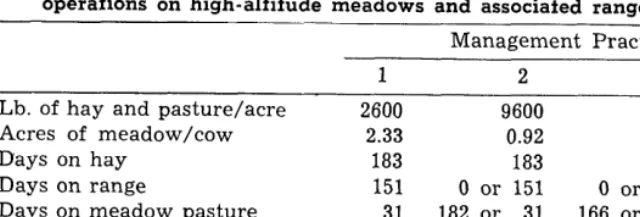
Table 2. Examples of four different management combinaiions for cow-calf operafions on high-altitude meadows and associated range.
Management Practices1
1 2 3 4
Lb. of hay and pasture/acre 2600 9600 9600 9600
Acres of meadow/cow 2.33 0.92 1.03 1.16
Days on hay 183 183 199 199
Days on range 151 0 or 151 0 or 75 0
Days on meadow pasture 31 182 or 31 166 or 91 166
Lb. of weaner/cow 278 278 540 570
Lb. of weaner/acre of meadow 119 302 524 492 IOne refers to existing management practices.
Two assumes only an increase in forage production.
Three assumes an increase in forage production plus earlier calving, longer feeding, earlier roundup from range, and greater weaning percentage. Four is the same as three except no range is available and weaning per- centage increases further.
22 lbs dry weight/day and pas- ture and/or range consumption of 29 lb/day for each mature cow or cow-calf combination. In cal- culating the pounds of weaner beef produced annually per acre of meadow, the quantity of for- age needed to produce a dam as well as the forage consumed by the cow-calf pair must be con- sidered. Using the above values for forage consumption and as- suming (1) a dam first calves as a lOOO-lb, 2-year old, (2) dams produce 10 calves, and (3) a bull services 20 cows, it is estimated that about 2000 lbs of forage/year must be charged to each calf for production of its dam.
Practice No. 1 illustrates the result of existing management. Dams consume 4000 lbs of late- cut hay from November 15 to May 15 and 900 lbs of aftermath pasture from October 16 to No- vember 15. Therefore, after pro- rating a share of the 2000-lb cor- rection for production of the dam (1170 lbs), 2.33 acres of meadow are needed for each cow. From May 16 to October 15, cattle are on range. It is assumed that sufficient range is available to match meadow production (65 animal unit days/acre of ranch meadow). Together, ranch and range will carry 43 cows and 2 bulls for each 100 acres of mead- ow. Average calving date is May 1; 200 days later, 8Oy of the cows
wean 347-113 calves for a produc- tion level of 278 lb of beef/cow and 119 lb/acre of hay meadow.
Practice No. 2 assumes no change in management except use of commerical fertilizer or legumes to increase yields of late-cut hay from 2600 to 9600 lb/acre. Range resources are fixed at the same level as in Practice No. 1, so some of the increased forage production on the ranch can be used for 151 days of summer pasture for extra cows (66 head/100 acres of mead- ow). Net pounds of weaner per cow does not change but produc- tion of beef per acre increases from 119 to 302. (Actually, pro- duction per cow will increase slightly because legumes and fer- tilizer will increase the quality of late-cut as well as early-cut fcrages, but the increase in qual- ity is much smaller with late-cut harvest .)
Practice No. 3 incorporates both improved forage and live- stock management. Forage pro- duction is increased as in Prac- tice 2, but hay is cut earlier to improve quality. Regrowth is used for hay or late pasture. Cows are fed hay for 199 days to maintain high growth rates of calves in the fall. Part of the herd goes to range at the same stocking rate, but only for 75 days, so that irrigated pasture on the ranch is needed for either
91 or 166 days for cows on range and pasture, respectively; daily gain remains at or near 2.0 lb. Cows are bred 60 days earlier than in Practices 1 and 2 to more nearly match the calves’ protein needs with forage production and quality. Calves are weaned at 260 days at a weight of 600 lbs (80-lb birth weight). Weaning percentage is 90 instead of 80 because all calves are born be- fore going to range and are on range only half as long as with the first two practices. Beef pro- duction increases to 540 lb/cow and 524 lb/acre of meadow.
Practice No. 4 is exactly as in 3, except no range is available. Weaning percentage increases to 95% because livestock are under close scrutiny at all times. Pro- duction per cow increases slight- ly because of greater weaning percentage but production per acre drops slightly because no range is available.
Is Efficient Ranch Management Practical?
The examples above show that production of forage and beef can be greatly increased. Simi- lar increases have been obtained experimentally and could be ob- tained in all ranch operations. Gross returns from various prac- tices are easy to evaluate-sim- ply multiply market price by saleable product. On the other hand, determining the costs of efficient management is diffi- cult. Economic data are limited. Every ranch presents a new set of variables. However, some economic analysis is possible.
EFFICIENT RANCH MANAGEMENT 117
frequent changing of water. Hay- ing costs will nearly double be- cause of a second harvest but cost per ton will decrease (Ful- cher, 1960, p.22). If these are the only costs, 183 lb/acre of addi- tional beef is certainly economi- cal with present cattle prices,
However, most ranchers will
need an initial investment of at least $50/acre, and possibly twice that much, plus annual costs, to put their land in shape for con- trolled irrigation and fertiliza- tion (Fulcher, 1960; Sitler and Rehnberg, 1954). Now the margin of 183 lbs of beef looks smaller, although still profitable. If, on the other hand, all practices are integrated as in Practices 3 and 4, the margin is about 400 lb/acre of extra beef per year. Even if calves sell for 20@/lb and in- creases in forage yields are only half of those projected, capital
investments on meadow im-
provements appear to be eco-
nomically feasible. A more com- plete analysis is needed to eval- uate all facets of efficient man- agement.
The preceding discussion
shows that improved manage-
ment results in heavier weaners and yearlings. Some ranchers ex-
press reluctance to produce
heavier calves because feeders
discriminate against them with
lower prices. The cow-calf and
yearling operators feel they must continue to produce light calves with low-quality forage and in-
efficient management so that
feeders can show greater effi- ciency with high-quality forages
and concentrates. Riggs (1958)
cites evidence “that cattle which
make a continuous maximum
gain to a given weight are more efficient converters of nutrients than those fed at levels which do not permit such rapid develop- ment.” He later states, “Weights of 100 lbs for each month of age at weaning are being achieved
though not too commonly. This
type of production probably rep- resents the ultimate economy in
converting low cost feeds to
highly desirable human food.” Many ranchers who raise year- lings feel that high growth rates for calves and yearlings during winter are uneconomical because gain during the next summer
grazing period might be low.
This is not necessarily true. For overwintering calves, Wallace et al. (1962) found that gain in- creased with crude protein in-
take, and gain on pasture or
range the following summer was
not reduced until winter gain
exceeded 1.6 lb/day. Even then the decline was not great. More- over, net profits were greater from calves wintered on a high nutritional plane than from those
on low-quality meadow hay.
With average daily gains of 2.0 lbs, a yearling can be produced in 12 instead of 18 months, thus,
saving the feed necessary to
carry these animals for 180 days.
No protein supplements are
needed with early-cut forage
management, a considerable sav- ing for many ranchers.
Who is to reap the benefits from growth potential of young beef cattle? Carroll et al. (1964) discuss the question: “The cattle feeder can expect more profit from retarded cattle that exhibit compensatory growth and he fre- quently will pay more for them;
however, the cattle producer
generally cannot produce re-
tarded cattle just for the higher price. Unless the producer in-
tends to reap the benefits of
compensatory growth himself, he
should consider supplementing
weaned calves for continuous
growth, because at no later
period in their lives will they respond with larger live-weight gains in return for the feed.”
Perhaps feeders should en-
courage ranchers as a means of protecting their supply of raw product and also a means of im- proving their own efficiency. The recent change by the U.S.D.A. to permit younger, leaner ani- mals to reach a higher grade may
have a profound influence on the outcome of this problem. With
proper management of water,
forage, and livestock, and maybe a short period of feeding home- grown concentrates, ranchers can produce a 750- to 800-lb steer for slaughter at one year of age.
All available evidence indi-
cates that the increases in effi- ciency of beef production pro- jected in Table 2 are possible.
Economic analyses of ranches
and discussions with bankers
and ranchers indicate increased efficiency is necessary. The ex- amples were developed to show the potential of land and water resources for livestock produc- tion-to show that resources are not the limiting factor for great- er profit. Each individual will
achieve according to his man-
agerial ability and his desire to meet the challenge of progress.
LITERATURE CITED BAKER, M. L. 1963. The scientist.
Cattle Guard, p. 9. August. Reprint of a talk presented at the Ameri- can National Cattleman’s Assn. Annual Meeting. Lincoln, Nebr. July 18-19, 1963.
BEESON, W. M., 1963. The influence of feed additives on the production of food. Agr. Food Chem. 41: 374; 375.
BURSON, P. M., A. L. HARVEY, AND A. R. SCHMID. 1961. Beef from grasslands. Minn. Agr. Exp. Sta. Bull. 452. 34 p.
CARROLL, F. D., D. D. NELSON, H. WOLF, AND G. PLANCE. 1964. Energy utilization in heifers as affected by a low-protein isocaloric diet. J. Anim. Sci. 23: 758-763. . COLORADO AGRICULTURAL STATISTICS.
1950. Colo. Dep. Agr. 105 p. COLORADO AGRICULTURAL STATISTICS.
1964. Colo. Dep. Agr. 81. p. ENSMINCER, M. E., M. W. GALCAN,
AND W. L. SLOCUM. 1955. Problems and practices of American cattle- men. Wash. Agr. Exp. Sta. Bull. 562. 89 p.
FULCHER, G. D. 1960. Economics of meadow improvement in northern Nevada. Nev. Agr. Exp. Sta. Bull. 215. 23 p.
118 WILLHITE AND GRABLE
LEWIS, R. D. 1957. Mountain mead- improvement in Wyoming. ?yo. Agr. Exp. Sta. Bull. 350. 19p. MENTER, R. 1963. The producer. Cat- tle Guard. p. 9, August. Reprint of a talk presented at the American National Cattlemen’s Assn. Annual Meeting. Lincoln, Neb. July 18- 19, 1963.
REMBARGER, R. E., L. J. SMITHSON, D. F. STEPHENS, AND L. S. POPE. 1964. Effect of nutrition before and after calving on performance of beef heifers. J. Anim. Sci. 23:293.
(Abstr.) .
RIGGS, J. K. 1958. Fifty years of progress in beef cattle nutrition. J. Anim. Sci. 17: 981-1006.
ROBERTSON, J. H., AND C. TORELL. 1958. Phenology as related to chemical composition of plants and to cattle gains on summer ranges
in Nevada. Nev. Agr. Exp. Sta. Bull. 197. 38 p.
SITLER, H. G., AND R. D. REHNBERG. 1954. Northeastern Colorado Irri- gated pastures-cost and produc- tion. Colorado Agr. Exp. Sta. Bull. 437-A. 71 p.
STEVENS, D. M., AND D. ACEE. 1962. Mountain-valley cattle ranching in Wyoming. Wyo. Agr. Exp. Sta. Bull. 386. 56 p.
VAN KEUREN, R. W., AND W. W. HEINEMANN. 1958. A comparison on grass-legume mixtures and grass under irrigation as pastues for yearling steers. Agron. J. 50: 85-88.
WALLACE, J. D., AND R. J. RALEIGH. 1964. Calf production from Here- ford cows wintered at different nutrition levels. Proc. West. Sec. Amer. Sot. Animal Sci. 15: LVII
(l-5).
WALLACE, J. D., R. J. RALEIGH, F. HUBBERT, JR., AND W. A. SAWYER. 1962. Winter feeding and manage- ment of range calves. Ore. Agr. Exp. Sta. Bull. 584. 22 p.
WILLHITE, F. M. 1963. How to im- prove mountain meadows in the West. Plant Food Rev. 9: 5-8. WILLHITE, F. M., AND A. R. GRABLE.
1965. Improved cow-calf manage- ment for optimum utilization of soil and water resources in the mountain meadow areas of the West. Ms. prepared for Jour. Anim. Sci.
WILTBANK, J. N., W. W. ROWDEN, J. E. INGALLS, K. E. GREGORY, AND R. M. KOCH. 1962. Effect of energy level on reproductive phenomena of mature Hereford cows. J. Anim. Sci. 21: 219-225.
Influence of Soil Compaction on Emergence and First-Year
Growth of Seeded Grasses
HOWARD BARTONI, WAYNE G. Mc- CULLY, HOWARD M. TAYLOR AND
JAMES E. Box, JR. Technician and Associate Professor, Texas Agricultural Experiment Sta- tion; and Research Soil Scientists, USDA, Auburn, Alabama and Wat- kinsville, Georgia, respectively.
Highlight
Adequate soil preparation will eliminate any compacted layers formed under cultivation and aid in securing a vigorous stand of grass on land converted from cash crop to pasture. Seedling emergence is not affected, but a compacted soil layer depresses the vigor of young grass plants by limiting roof penetration and the volume of soil from which moisture for growfh can be ex- tracted. The curtailment of forage production is more pronounced with time.
Farmers and ranchers chang- ing from a cash crop to perennial grass often have difficulty in es- tablishing a satisfactory stand of
quate for livestock forage and soil protection will benefit many segments of agriculture, especial- ly livestock producers. Coopera- tive work was undertaken at the Big Spring Field Station be- tween the Texas Agricultural Experiment Station and the Soil and Water Conservation Re- search Division, Agricultural Re- search Service, to determine some of the causes for the limited success in establishing grass on cultivated land.
Compacted soil zones or pans occur widely in cultivated soils. These soil pans usually are formed immediately below nor- mal tillage depth in sandy as well as in fine-textured soils. The
pans are very persistent in loam, fine sandy loam, and loamy fine sand soils of the Southern Great Plains.
Compacted soil zones and pans have been shown to restrict the yields of many crop plants. Cot- ton and grain sorghum (Taylor et al., 1964) corn (Phillips and
grown on soils with compacted layers. Roots of sudangrass pene- trated compacted cores
more
readily than did soybean roots under laboratory conditions. . The restrictive influence of compacted soil layers on produc- tion of many field crops is well documented, but very little is known concerning the reaction of forage plants to similar soil conditions. Few roots of native grasses growing in a prairie sod were present in the dense sub- soil found at a shallow depth (Fox, Weaver, and Lipps, 1953). A compacted soil layer was shown to be associated with a depression of livestock produc- tion after 20 years of relatively heavy grazing use (Rhoades et al., 1964). In view of these find- ings, it seemed reasonable that a compacted soil pan would influ- ence the establishment of seeded grasses.
Procedure
An Amarillo sandy clay loam, -which had been cultivated for a grass. Minimizing the risk of es- Kir kham, 1962) t o m a t o e s number of years, and on which tablishing a stand of grass ade- (Flocker et al., 1959), sugarcane sorghum had been grown the
118 WILLHITE AND GRABLE
LEWIS, R. D. 1957. Mountain mead- improvement in Wyoming. ?yo. Agr. Exp. Sta. Bull. 350. 19p. MENTER, R. 1963. The producer. Cat- tle Guard. p. 9, August. Reprint of a talk presented at the American National Cattlemen’s Assn. Annual Meeting. Lincoln, Neb. July 18- 19, 1963.
REMBARGER, R. E., L. J. SMITHSON, D. F. STEPHENS, AND L. S. POPE. 1964. Effect of nutrition before and after calving on performance of beef heifers. J. Anim. Sci. 23:293.
(Abstr.) .
RIGGS, J. K. 1958. Fifty years of progress in beef cattle nutrition. J. Anim. Sci. 17: 981-1006.
ROBERTSON, J. H., AND C. TORELL. 1958. Phenology as related to chemical composition of plants and to cattle gains on summer ranges
in Nevada. Nev. Agr. Exp. Sta. Bull. 197. 38 p.
SITLER, H. G., AND R. D. REHNBERG. 1954. Northeastern Colorado Irri- gated pastures-cost and produc- tion. Colorado Agr. Exp. Sta. Bull. 437-A. 71 p.
STEVENS, D. M., AND D. ACEE. 1962. Mountain-valley cattle ranching in Wyoming. Wyo. Agr. Exp. Sta. Bull. 386. 56 p.
VAN KEUREN, R. W., AND W. W. HEINEMANN. 1958. A comparison on grass-legume mixtures and grass under irrigation as pastues for yearling steers. Agron. J. 50: 85-88.
WALLACE, J. D., AND R. J. RALEIGH. 1964. Calf production from Here- ford cows wintered at different nutrition levels. Proc. West. Sec. Amer. Sot. Animal Sci. 15: LVII
(l-5).
WALLACE, J. D., R. J. RALEIGH, F. HUBBERT, JR., AND W. A. SAWYER. 1962. Winter feeding and manage- ment of range calves. Ore. Agr. Exp. Sta. Bull. 584. 22 p.
WILLHITE, F. M. 1963. How to im- prove mountain meadows in the West. Plant Food Rev. 9: 5-8. WILLHITE, F. M., AND A. R. GRABLE.
1965. Improved cow-calf manage- ment for optimum utilization of soil and water resources in the mountain meadow areas of the West. Ms. prepared for Jour. Anim. Sci.
WILTBANK, J. N., W. W. ROWDEN, J. E. INGALLS, K. E. GREGORY, AND R. M. KOCH. 1962. Effect of energy level on reproductive phenomena of mature Hereford cows. J. Anim. Sci. 21: 219-225.
Influence of Soil Compaction on Emergence and First-Year
Growth of Seeded Grasses
HOWARD BARTONI, WAYNE G. Mc- CULLY, HOWARD M. TAYLOR AND
JAMES E. Box, JR. Technician and Associate Professor, Texas Agricultural Experiment Sta- tion; and Research Soil Scientists, USDA, Auburn, Alabama and Wat- kinsville, Georgia, respectively.
Highlight
Adequate soil preparation will eliminate any compacted layers formed under cultivation and aid in securing a vigorous stand of grass on land converted from cash crop to pasture. Seedling emergence is not affected, but a compacted soil layer depresses the vigor of young grass plants by limiting roof penetration and the volume of soil from which moisture for growfh can be ex- tracted. The curtailment of forage production is more pronounced with time.
Farmers and ranchers chang- ing from a cash crop to perennial grass often have difficulty in es- tablishing a satisfactory stand of
quate for livestock forage and soil protection will benefit many segments of agriculture, especial- ly livestock producers. Coopera- tive work was undertaken at the Big Spring Field Station be- tween the Texas Agricultural Experiment Station and the Soil and Water Conservation Re- search Division, Agricultural Re- search Service, to determine some of the causes for the limited success in establishing grass on cultivated land.
Compacted soil zones or pans occur widely in cultivated soils. These soil pans usually are formed immediately below nor- mal tillage depth in sandy as well as in fine-textured soils. The
pans are very persistent in loam, fine sandy loam, and loamy fine sand soils of the Southern Great Plains.
Compacted soil zones and pans have been shown to restrict the yields of many crop plants. Cot- ton and grain sorghum (Taylor et al., 1964) corn (Phillips and
grown on soils with compacted layers. Roots of sudangrass pene- trated compacted cores
more
readily than did soybean roots under laboratory conditions. . The restrictive influence of compacted soil layers on produc- tion of many field crops is well documented, but very little is known concerning the reaction of forage plants to similar soil conditions. Few roots of native grasses growing in a prairie sod were present in the dense sub- soil found at a shallow depth (Fox, Weaver, and Lipps, 1953). A compacted soil layer was shown to be associated with a depression of livestock produc- tion after 20 years of relatively heavy grazing use (Rhoades et al., 1964). In view of these find- ings, it seemed reasonable that a compacted soil pan would influ- ence the establishment of seeded grasses.
Procedure
An Amarillo sandy clay loam, -which had been cultivated for a grass. Minimizing the risk of es- Kir kham, 1962) t o m a t o e s number of years, and on which tablishing a stand of grass ade- (Flocker et al., 1959), sugarcane sorghum had been grown the
SOIL COMPACTION 121
4 inches below the soil surface did not affect the number of emergent seedlings. However, the height of these young plants was associated with the im- posed soil compaction, and the plant response to the restricted soil volume available for root growth became more pronounced with time.
The benefits from tillage to eliminate compacted soil pans are vividly demonstrated by this experiment. The compacted soil layers not only increase the risk of establishing an acceptable stand of seeded grass, but they reduce the vigor of the‘surviving plants.
LITERATURE CITED
FLOCKER, W. J., ET AL. 1959. Some growth responses of tomatoes to soil compaction. Soil Sci. Sot. Amer. Proc. 231: 188-191.
Fox, R. L., J. E. WEAVER, AND R. C. LIPPs. 1953. Influence of certain soil profile characteristics upon the distribution of roots of grasses. Agron. J. 45: 583-589.
JOHNSTON, J. R. 1945. An accurate method for determining volume of soil clods. Soil Sci. 59: 449-452. PHILLIPS, R. E., AND D. KIRKHAM.
1962. Mechanical impedance and corn seedling root growth. Soil Sci. Sot. Amer. Proc. 26: 319-322. RHOADES, E. D., L. F. LOCKE, H. M.
TAYLOR, AND E. H. MCILVAIN. 1964. Water intake on a sandy range as affected by 20 years of differential
Competition in a Blue Grama-Broom
Snakeweed-Actinea Community and
Responses to Selective Herbicides
DONALD A. JAMESON
Principal Plant Physiologist, Rocky Mountain Forest and Range Exp. Sta., Forest Service, U.S.D.A., FZagstaff, Arizona.1
Highlight
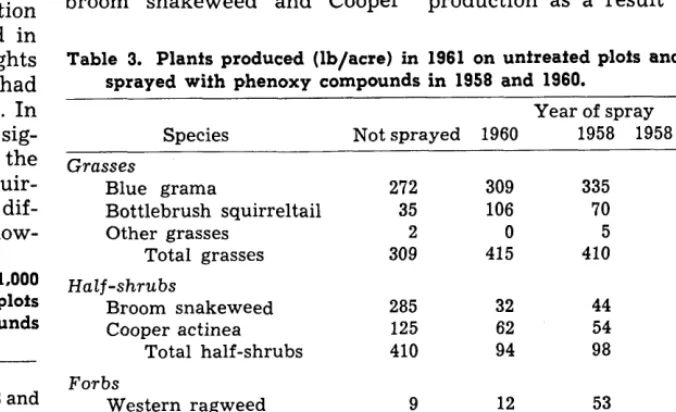
In a blue grama-broom snake- weed-Cooper acfinea community, the presence of half -shrubs suppressed the growth of blue grama. Blue grama and forbs were increased when fhe half-shrubs were reduced by selective phenoxy sprays.
The portions of the juniper- pinyon woodland in Arizona and western New Mexico with high- est rainfall and greatest poten-
1In cooperation with Northern Ari- zona University; central headquar- ters maintained at Fort Collins in cooperation with Colorado State University.
2 Latin nomenclature follows Kear- ney and Peebles, 1960.
:jThomas N. Johnsen, Jr., of the Ag- ricultural Research Service, U. S. Department of Agriculture, pro- vided and applied the chemical sprays.
tial for forage production are also particularly susceptible to weed infestations, and undesir- able half-shrubs and forbs often outproduce desirable grasses. Typically, these areas fall along the Mogollon escarpment, and on other areas of rough topography. The study reported here shows the interrelations among some of the important species of these areas. These interrelations were studied by modifying the amounts of the different species with selective herbicides.
Methods
The study area was located at an elevation of 6,400 ft on the Beaver Creek Watershed, Coconino National Forest, 40 miles south of Flagstaff, Arizona. Precipitation, about equally divided between a winter and sum- mer season, totals about 20 inches
cattle stocking rates. J. ‘Range Manage. 17: 185-190.
TAYLOR, H. M., AND H. R. GARDNER, 1963. Penetration of cotton seed- ling taproots as influenced by bulk density, moisture content and strength of soil. Soil Sci. 93: 153- 156.
TAYLOR, H. M., L. F. LOCKE, AND J. E. Box. 1964. Pans in Southern Great Plains soils. III. Their effects on yield of cotton and grain sorghum. Agron. J. 56: 542-545.
TROUSE, A. C., JR., AND R. P. HUM- BERT. 1961. Some effects of soil compaction on the development of sugarcane roots. Soil Sci. 91: 208- 217.
ZIMMERMAN, R. P., AND L. T. KARDOS. 1961. Effect of bulk density on root growth. Soil Sci. 91: 280-288.
annually. The study was located in a natural opening among the alli- gator juniper trees (Juniperus dep- peana.)2 In addition, trees near the plot were removed to eliminate their competition with the herbaceous plants. Soils in the area, silty clays and clay loams, have developed from basalt.
At the time the study began, the area had been closed to grazing for 3 years. Blue grama (Bouteloua gracilis), bottlebrush squirreltail (Sitanion hystrix), broom snakeweed (Gutierrezia sarothrae), Cooper ac- tinea (Hymenoxis cooperi), and a number of forbs comprised the vege- tation. In aspect, half-shrubs were most conspicuous.
A series of 96 plots was laid out in the study enclosure. These plots were 9 x 9 ft, separated by 2-ft-wide walkways. All measurements were made on the 5- x 5-ft center of each study plot except production of squirreltail, which was determined on 8- x 8-ft areas. Weed competition was varied by spraying some of the plots with selective phenoxy com- pounds3 (2,4-D and 2,4,5-T). Spray treatments were (1) None (Check),
SOIL COMPACTION 121
4 inches below the soil surface did not affect the number of emergent seedlings. However, the height of these young plants was associated with the im- posed soil compaction, and the plant response to the restricted soil volume available for root growth became more pronounced with time.
The benefits from tillage to eliminate compacted soil pans are vividly demonstrated by this experiment. The compacted soil layers not only increase the risk of establishing an acceptable stand of seeded grass, but they reduce the vigor of the‘surviving plants.
LITERATURE CITED
FLOCKER, W. J., ET AL. 1959. Some growth responses of tomatoes to soil compaction. Soil Sci. Sot. Amer. Proc. 231: 188-191.
Fox, R. L., J. E. WEAVER, AND R. C. LIPPs. 1953. Influence of certain soil profile characteristics upon the distribution of roots of grasses. Agron. J. 45: 583-589.
JOHNSTON, J. R. 1945. An accurate method for determining volume of soil clods. Soil Sci. 59: 449-452. PHILLIPS, R. E., AND D. KIRKHAM.
1962. Mechanical impedance and corn seedling root growth. Soil Sci. Sot. Amer. Proc. 26: 319-322. RHOADES, E. D., L. F. LOCKE, H. M.
TAYLOR, AND E. H. MCILVAIN. 1964. Water intake on a sandy range as affected by 20 years of differential
Competition in a Blue Grama-Broom
Snakeweed-Actinea Community and
Responses to Selective Herbicides
DONALD A. JAMESON
Principal Plant Physiologist, Rocky Mountain Forest and Range Exp. Sta., Forest Service, U.S.D.A., FZagstaff, Arizona.1
Highlight
In a blue grama-broom snake- weed-Cooper acfinea community, the presence of half -shrubs suppressed the growth of blue grama. Blue grama and forbs were increased when fhe half-shrubs were reduced by selective phenoxy sprays.
The portions of the juniper- pinyon woodland in Arizona and western New Mexico with high- est rainfall and greatest poten-
1In cooperation with Northern Ari- zona University; central headquar- ters maintained at Fort Collins in cooperation with Colorado State University.
2 Latin nomenclature follows Kear- ney and Peebles, 1960.
:jThomas N. Johnsen, Jr., of the Ag- ricultural Research Service, U. S. Department of Agriculture, pro- vided and applied the chemical sprays.
tial for forage production are also particularly susceptible to weed infestations, and undesir- able half-shrubs and forbs often outproduce desirable grasses. Typically, these areas fall along the Mogollon escarpment, and on other areas of rough topography. The study reported here shows the interrelations among some of the important species of these areas. These interrelations were studied by modifying the amounts of the different species with selective herbicides.
Methods
The study area was located at an elevation of 6,400 ft on the Beaver Creek Watershed, Coconino National Forest, 40 miles south of Flagstaff, Arizona. Precipitation, about equally divided between a winter and sum- mer season, totals about 20 inches
cattle stocking rates. J. ‘Range Manage. 17: 185-190.
TAYLOR, H. M., AND H. R. GARDNER, 1963. Penetration of cotton seed- ling taproots as influenced by bulk density, moisture content and strength of soil. Soil Sci. 93: 153- 156.
TAYLOR, H. M., L. F. LOCKE, AND J. E. Box. 1964. Pans in Southern Great Plains soils. III. Their effects on yield of cotton and grain sorghum. Agron. J. 56: 542-545.
TROUSE, A. C., JR., AND R. P. HUM- BERT. 1961. Some effects of soil compaction on the development of sugarcane roots. Soil Sci. 91: 208- 217.
ZIMMERMAN, R. P., AND L. T. KARDOS. 1961. Effect of bulk density on root growth. Soil Sci. 91: 280-288.
annually. The study was located in a natural opening among the alli- gator juniper trees (Juniperus dep- peana.)2 In addition, trees near the plot were removed to eliminate their competition with the herbaceous plants. Soils in the area, silty clays and clay loams, have developed from basalt.
At the time the study began, the area had been closed to grazing for 3 years. Blue grama (Bouteloua gracilis), bottlebrush squirreltail (Sitanion hystrix), broom snakeweed (Gutierrezia sarothrae), Cooper ac- tinea (Hymenoxis cooperi), and a number of forbs comprised the vege- tation. In aspect, half-shrubs were most conspicuous.
A series of 96 plots was laid out in the study enclosure. These plots were 9 x 9 ft, separated by 2-ft-wide walkways. All measurements were made on the 5- x 5-ft center of each study plot except production of squirreltail, which was determined on 8- x 8-ft areas. Weed competition was varied by spraying some of the plots with selective phenoxy com- pounds3 (2,4-D and 2,4,5-T). Spray treatments were (1) None (Check),