Web Based Computer Games as an Educational Tools: Mapping the
Malaysian Surrounding Issues
Roslina Ibrahim
College of Science and Technology,
UTM Jalan Semarak, 54100
Kuala Lumpur, Malaysia.
[email protected]
Azizah Jaafar
Department of Information Science
Faculty of Technology and Science
Information,UKM, Selangor
[email protected]
Abstract
The advancement of computer and web technology has enabled the growth of one of the most popular application nowadays: online computer games. Thousands of online games are available on the internet consists of different genre, graphics and patterns which enable gamers around the world play their favourite games alone or simultaneously. The engagement and immersion provided by games is no doubt is very high. For this matter, the games should be exploited as a medium for teaching and learning because we may never have experienced same level of engagement in our conventional teaching and learning medium among our students. However, designing and developing educational computer games is a multidisciplinary activity involving computer expert, educational expert, art designers and story creator. Therefore, the process of creating such games is never be easy especially if we want to achieved something the best in terms of good game play and by the same time gaining lot of learning benefits. This study will define the issues and elements needed in this multidisciplinary activity. This will be as a guide in the design and development of an online computer games for teaching and learning purposes.
1.
Introduction
Computer and video games are one phenomenal in this century that influenced many people to get involved with it. Certain parts in the world have already recognized this medium of entertainment as part of their life styles activities. Many research and
articles have proof that games play activities is very popular nowadays [1], [2],[3] and [4]. This industry contributing billions of dollar in US alone in the past few years as said by Siwek 2007 [4]. This is an indication of how computer and video games are changing the activity of world inhabitant as how internet transforms people lifestyles nowadays.
Education on the other hand, is an activity evolved probably since the starting of human existing in this world, keep changing and adapting through times based on theory and technology founded by humans. Computer technology, introduced around three decades ago have experience tremendous development since then, ranging from simple word processor to the application in many fields such as medical, space science, business, government, communication, corporate and education. The list doesn’t seem to stop there because this evolving technology always finds its ways to adapt into new fields. In education, the combinations of this technology have seem many changes in the way people learn and acquire knowledge. Internet for example, has enabled unreached information can be find in just a single click, not to mention the services available on the internet nowadays. It might be not too exaggerate to say that many people would find their life empty without internet these days.
However, the studies of educational games proper theories in terms of educational theories in general and interface design specifically for girls seem to be lacking. Therefore, here the educational elements and interface design elements needed in a web based educational games specifically for girls to be discussed.
These review findings hopefully will benefits the designer of educational games especially in the early phases of the computer games planning (content and interface design, and prototyping) since these phase are very important but many designers failed during this because of lacks in the theoretical aspects.
2.
Elements in a computer based games
Computer based games contains many its own elements that the designer have to define in the early phases of a development. These elements are originally from the basis of computer games itself which mainly is for entertainment. Even though our focus is on educational games, the basic structure of the games is still from the origin of the games. These are the elements that differentiate this media compared to other media such as video, animation and multimedia courseware. Each of the elements are discussed below.
2.1. Computer games genre
Computer games genre, is basically the way the games was designed to be play. Mark [8] in 2000 said that the idea of genre has not been without difficulties, for example in defining what exactly it means, the overlapping between genres and the fact that genres will always evolved as long as the innovation is applied into games. Prensky [5] says that today computer games are generally recognized as falling into one of eight genres, which often overlap. Some writers define genres on its own [5] and [8], some define it as genre and subgenres of one another [6], [7]. This section will discuss some of the most common genres available (adapted from the resources mentioned), describe by its name and some descriptions.
a)Adventure: Usually are set in a “world” made up by rooms or screens, involving objects which are more complex. Objectives normally need to be completed in several steps, for example findings the keys, unlock the
door, findings health potion and so on. It requires the player to solve various puzzles and problems by interacting with the player, non player character and the environments inside the games. Adventure games can be further classified into text adventure and graphic adventure.
b) Educational: Mark [8] says that these games are designed to teach, whereby the main objectives is involved in learning the lessons or subject matter. This is different from rather straight forward set of lessons or exercises, it is rather designed in a form of games. Many scholar and practitioner have initiated that this medium of learning is not impossible will change the ways of learning in the future [5].
c) Action: This genre is characterized by gameplay which emphasizes on combat. After all, that is what gamers normally do when they play video games, especially on games that require the character to fight with another character in order to get through the game session. Action games have many others own categories such as action adventure, fighting, maze, shooting and so on.
d) Strategy: This games focusing on strategy, thinking skills and plan the gamers need in order to accomplish the games. Usually the games can content can range from war strategy, checkers, chess, and monopoly. Among the subcategories for this games are real times strategy, turn based strategy and war games.
e) Simulation: There are broad types of games simulation exists, such as vehicle simulation, business simulation or military simulation. Perhaps the most common one we always heard is flight simulation. Simulation games attempts to copy or simulate a real situation that will happen during certain times based on certain circumstances that happen. Furthermore, any real life action/situation which shows the flow of events based on decisions can be adapted into simulations games. Among the examples of the simulation are military simulations, buildings worlds, running a company or business decision making.
g) Puzzle: Prensky stated that ‘puzzles game is just that’, problems to be solved, typically visual, stripped of all story pretense. This games usually does not have conflicts between character, but rather to figure out the solutions which often involves solving enigmas, navigation, manipulating or reconfiguring objects. It also requires the player to solve logic puzzles or navigate complex locations such as mazes.
h) Sport Games: According to Prensky, this category of games is focusing on content, rather than the game play. Some says it is the adaptations of existing sports or variations of them while some emphasize on paying the sport and some says it is the strategy behind the sport. Examples are American football, Baseball, bowling, golf and so on.
i) Multiplayer Online Games (MOGs): This perhaps among the latest genres invented. The basis of this genre is from RPGs, while the RPGs are a single player games, MOGs are played by many other players simultaneously. The current advancements of this genre is massively multiplayer online games (MMOGs). As the name suggest, it require many player to play the games at the same time.
In conclusion, computer games genre does play an important part especially for the designer in designing their games. This is definitely having some effects on the types of user and their age because their preferences in games genre also will determine the success of the games created purposely for them. The wide range of genres available is somehow offering many opportunities for the designer to predetermine their games design. Different writer will define their genres differently, some even called it games taxonomy or games categories, however al l the definitions is obviously lead to one purposes, and as of to date, to my knowledge none of the genres documentation are actually acknowledged as the best neither the worst. As the matter of fact, the overlapping of computer and video games genres are considerably massive. This, however leave to the designer to skilfully understand and select the most appropriate to them.
2.2. Computer
games
characteristics
The characteristics of computer games is probably the main factor that makes the game is very much
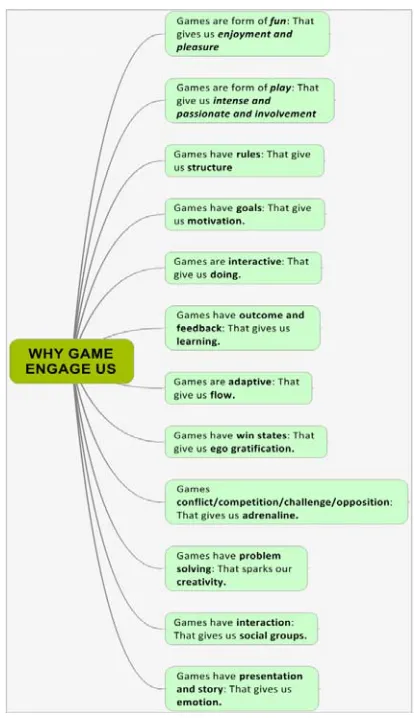
different from any other medias, its contribute to the success of computer games compared to other computer related activities as well as non-computer related activities. The characteristics usually define during the game design and development which involved activities between player and game itself. The better the design, the stronger the games characteristics are. Prensky elaborated one of the most important characteristics of a games: engaging. He further classified engaging into fun, plays and games itself. There are twelve elements of engagement according to him shown in Figure 1.
Figure 1. The engagement provided by computer games modified from Prensky 2001
path and decision which player can choose in order to complete the games. In other words, audience actively involved in the game session while for movie they only watch the story passively. Games also provide multisensory task whereby the player will use three of five sensors a human have (look, touch and hear).
The characteristics mentioned above are basically generic and can be apply to any sort of games types. Since the focus here is towards educational games, I have found those characteristics are applied in educational games with some or little modification. Definitely, since the main purpose of the games are different, many dissimilarities can be found especially in terms of games content. The game characteristics define in many different ways based on a specific usage to the writer. Garzotto [9] in 2007, stated in her research into the effectiveness of computer games, define her own characteristics of effective educational games in terms of content, enjoyment and social interaction. In content, she further divide it into several entities, same with enjoyment and social interaction. The details of characteristics of effective educational games are as in the Figure 2.
Figure 2. The Characteristics of Effective Educational Games modified from Garzotto
2007
It is obvious that the diverse elements of a game can actually be manipulated into creating such a beneficial medium and activities in teaching and learning. However, combining these two distinct areas can be challenging especially to cater many types of
user and many setting of educational institutions in the world.
2.3.
Computer games platform
The birth of electronic games probably started from introduction of Pong, created by Willy Higinbotham on an oscilloscope in 1958, it took quite some time before the introduction of arcade games which only begins to be recognised in 1970s. Then, it was followed by console games in later 1970s. During the mid 1970s, a few pioneer of computer games evolved such as William Crowther who developed Colossal Cave using assembly language, refined by Donald Woods who introduced Zork later on. It was originally played on mainframe. It continues to evolved until today as the available platforms now is quite plenty. Those platforms have several distinctions, therefore games developed for each platforms also differ in some important aspects; such as interface design, storyline, content creation and so on. Followings are several platforms available in the market nowadays [14].
a) Arcade: is standalone game system that can be found in the public places. In Malaysia, it can be found mainly at shopping complex with its own area of entertainment outlet. It normally used token as the medium for playing the game.
b)Console: this game usually played at home, attached to television set. Examples are Sony Playstation, Microsoft Xbox and Nintendo Gamecube. It comes with its own player and controller. Game developers normally developed their games for specific console and it only can be play on that particular console.
c) Computer: This type of electronic games is normally played at home, cybercafé, office and so on as long as the computer is there. The minus point can be the requirements of hardware and software needed by each games. The more powerful the games, the higher the computer specifications needed. Some computer developed specifically for games playing purposes, focusing on higher processing speed, memory, disk space, graphics and sound card. Also, some middleware and plug-ins sometimes required for high end gaming intention.
Content
Target/Goal
Integration
Scaffolding
Extensibility
Media Matching
Content
Target/Goal
Integration
Scaffolding
Extensibility
Media Matching
Enjoyment
Clear Goals
Concentrati on
Challenge
Feedback
Social
Interactio
n
Connectio n
d)Online: It is played on computer platform (recently, console technology also introduced its own online games). What the player need is internet connections; game information is stored on a server. Large online games can involve thousands of player , some even millions such as in Half-Life: Counterstrike, a Massively multiplayer online games (MMOGs)
e) Handheld: This games particularly popilar among younger generation, teenager to school children due to its mobility and lower price tag. Examples are Sony PSP, Gameboy, Gameboy Advance and Nintendo DS. Lately, the trend also moving towards mobile phone, since the device is easily available and multifunctional. However, games purposely develop for mobile phone is still in its infancy in terms of its graphics and capabilities compared to other devices.
3. Instructional Design Models
Instruction is asset of events that facilitates learning whilst design means a creative pattern or a rational, logical, sequential process intended to solve problems, thus, instructional design can be define as “the systematic process of translating principles of learning and instruction into plans for instructional materials and activities” as said by Rio Sumarni Sharifuddin [10] in 2007. According to Albion et al (n.d) [11] instructional design is categorized by four which are as follows:
Instructional Design as a Process: ID is the systematic development of instructional specifications using learning and instructional theory to ensure the quality of instruction.
Instructional Design as a Discipline: ID is a branch of knowledge concerned with research and theory about instructional strategies and the process for developing and implementing those strategies.
Instructional Design as a Science: ID is the science of creating detailed specifications for the development, implementations, evaluation, and maintenance of situations that facilitate the learning both large and small units of subjects matter at levels of complexity.
Instructional Design as Reality: ID can start at any point in the design process. Often a glimmer of an idea is developed to give the core of an instruction situation.
Rio Sumarni Sharifuddin emphasises that the greatest objective of ID is to serve the learning needs and success of student through effective content and interaction design. The benefits of systematic process
ID enables an instructor to: Identify the performance problem, determine the goals and objectives, define your learners and their needs, develop strategies to meet needs and goals, assess learning outcomes, evaluate if goals, objectives and needs are met.
There are several ID models available. The ID models consist of its component that described the meaning and activities in each component. According to Dick and Carey and Carey in 2005 [13], instructional design models are based, in part, of many years of research on the learning process. Each component of the model is based on theory and, in most instances, on research that demonstrates the effectiveness of those components. Several ID models are ADDIE, Dick and Carey, Hannafin and Peck. These ID models will be discussed in another article purposely on elaboration of the models in educational games.
3.1. Learning Theories for Educational
Games
Since the games that were discussed here is for the educational purposes, one thing for sure that we have to include in the games are learning theories. Described here are two learning theories that can be apply into educational games. From the literature, many learning theories can be found, however, some of articles organized it in different ways compared to the similar articles. Even though the meaning of each theory is the same, some differences can be found in the classification. Two resources of learning theories are discussed here.
Table 1. Learning theories, characteristic, strengths and weaknesses (Rio Sumarni
Sharifuddin 2007)
L T
Characteristics Strengths Weaknesses
B eh avi ou ri sm Learning occurs when there are changes in behaviour; behaviour that can be measured, did not consider the thinking behind behaviour.
Student focuses to the information and can react to the information Not suitable stimulus for the response Co gn itiv e Thinking process behind the behaviour; what is in the mind.
Train for one method and enhance consistencies Student learn through one method which may be not the best Co nst ruct iv ism
Each individual has his/her own mental framework via their experience.
Learning occurs when there is disequilibrium between new knowledge and prior knowledge. Student interpret reality in different form No consistencies Each student has different mental model
LT: Learning Theories
Second is from Ang and Rao in 2003), they have discussed three learning theories which are; behavioural, cognitive and motivation learning theories purposely in computer game perspective. According to them, behavioural learning theories emphasises on observable changes in behaviour, behaviourist treat learner as a black box that receives stimuli. The things that happening inside the box can be studied by observing the behaviour elicited by the stimulus. They further examined some theories that said to be fall into this category which is classical conditioning by Petrovich Pavlov and operant conditioning by Burrhus Frederic Skinner.
Classical conditioning is the process of associating a previously neutral stimulus with an unconditioned
stimulus to conjure up a condition response. Unconditioned stimulus is a stimulus suggest a voluntarily response known as unconditioned response. Example given is in First Person Shooter (FPS) games whereby player opens fire involuntarily when seeing the crook.
Operant conditioning, according to Skinner in (Ang and Rao 2003) is depend on two kinds of behaviour: respondent behaviour, which is elicited by a known stimulus, and operant behaviour, which is not elicited by a known stimulus. Example of respondent behaviour is casting magic when sighting the monster while walking about and jumping without particular reason are operant behaviour since there are correlations with known stimuli.
As for cognitive learning theories, they further added that cognitive theorists argues that learning is more complex process and includes problem solving and thinking skills together with repetition of a stimulus response chain, in other word, it is an explanation of learning that focus on mental process. Some examples of games are adventure games, strategy games (i.e chess, backgammon), and puzzles games and memory card games.
Ang and Rao [12] classified constructivism under cognitive learning theories, which the meaning is the learner must discover and transfer information by themselves. One of the models under this category is discovery learning, whereby the students interact with their environments by exploration and manipulation surrounded objects. This theory might suit the adventure games whereby the player navigate through their games “world” and discovered many new things and learn about it. They also have to understand and adapt into the games environment by taking actions in order to survive the games. They can do it spontaneously based on experience they gather in earlier session and by trial and error. This also suits the categories of learning by doing.
injected in education because of the seriousness of the educational content and subject matter itself.
4. Methodology and Future Research
This research will examine the existing framework and
methodology of educational games specifically for the design and development such games. Then, we will develop our own methodology and framework based on our thorough studies of existing methodologies and framework. Since educational games is basically combination of computer games in educational setting, our framework will be focus on those kind of games which we believe will benefit lots of educational games designer and developer.
Furthermore, such framework is still lacking, especially from the perspective of both field. We will further define our research into Malaysian based female approach, particularly for higher education learning purposes.
In addition, the game will be an online games based since web is the medium with high potential of
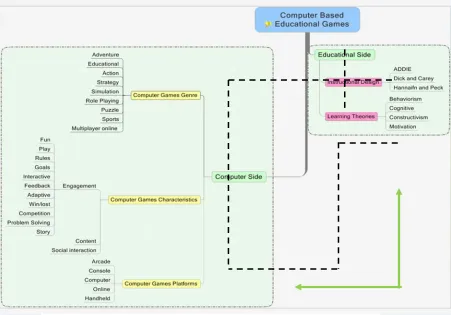
opportunities in term of lowering down the cost (save on CD printing, packaging and CD cover design, distribution cost, and publishing cost) and its nature of mobility as the user can access the games wherever they are as long as they have the access to the internet. The elements of computer games and instructional design discussed in previous section is defined in conceptual design model as in Figure 3.
5. Conclusion
The rapid growth of internet applications is making online educational games escalation in an advanced stage. The benefits, possibilities and chances offered by online applications are unarguable, especially in educational field. Online educational games, an application argued to have many possibilities for learner retention, enjoyment, motivation, and challenges seems to have many advantages. This is because the online distributions,
unlike CDROM, have many benefits such as cost effective, easier to obtain, mobility and sustainable
The design and development of educational games require much and diverse knowledge from the development team. In order to develop a high quality educational games which contain excellent games elements, the games itself need a combination of sound games anatomy and the educational theories. Combination of these two is definitely necessary for the above purposes. The games elements, learning theories and instructional design models are reviewed here. Those elements are required to design an ‘educational’ game for educational purposes. One need to understand the elements of computer games in order to design the “behaviour” of educational games, learning theories is purposely to understand the students’ information processing while ID models required for supporting the entire process of design, development and evaluation of educational games.
Hopefully, by seeing its benefits, we can work towards finding the rights framework of online educational games design and development, and also its distribution, for the development of teaching and learning purposes.
6. References
[1]Krotoski, Aleks. 2004. Chicks And Joysticks:An
Exploration of Women Gaming. Entertainment and Leisure
Software Publishers Association (ELSPA). UK.
[2]Entertainment Software Association Report Sales.
Demographic and Usage Data, 2007. United States of
America (atas talian) http://www.theesa.com/archives/files/ESA-EF%202007.pdf )
[3]Perez, Joaquin. 2006. Women and Videogames: Habits
and preferences of the video gamers. Women in Games
International, White Paper. Madrid, Spain.
[4]Siwek, Stephen E. 2007. Video Games in the 21st
Century:Economic Contributions of the US software
Entertainment Industry. Entertainment Software Association
Report, United States of America. (http://www.theesa.com/files/VideoGames-final.pdf
[5]Prensky, Marc. 2001. Digital Game-Based Learning. New
York: Mc Graw Hill.
[6]Bjork, Staffan. Holopainen, Jussi.2005. Patterns in Game
Design. Massachusetts: Charles River Media
[7]Http://en.wikipedia.org/wiki/Video_games_genres
(accessed date 15 April 2008).[8]Garzotto, Franca. 2007. Investigating the Educational
Effectiveness of Multiplayer Online Games for Children,
ACM IDC Aalborg, Denmark: ACM Press
[9]Mark J.P.Wolf.2000. The Medium of the Video Game.
Texas. University of Texas Press.
[10]Rio Sumarni Sharifuddin. 2007. Innovative Design of
Instructional Materials for Teaching and Learning Purpose
Using Technology. Proceedings of UTM Teaching and
Learning Symposium. Skudai Johor, Malaysia. Pg 49-60.
[11]Abion,P et al (n.d). What is Instructional Design? Retrieved on March 15 2008. (http://www.usaidd.net/`male/Whatisidt.html.
[12]Ang Chee Siang, Radha Krishna Rao. 2003. Theories of
Learning: A Computer Game Perspective IEEE fifth
International Symposium on Multimedia Software Engineering (ISMSE'03).
[13]Dick, Walter. Carey, Lou. Carey, O. James. 2005. The
Systematic Design of Instruction. Sixth Edition. Boston.
Pearson
[14]Novak, Jeannie. 2005. Game Development Essentials: