CROWD MODELLING BEHAVIOUR BASED ON MODIFIED MICROSCOPIC MODELS IN PANIC SITUATION
HAMIZAN BINTI SHARBINI
A project report submitted in partial fulfillment of the requirement for the award of the degree of
Master of Science (Computer Science)
Faculty of Computer Science and Information Systems Universiti Teknologi Malaysia
ABSTRAK
TABLE OF CONTENT
CHAPTER TITLE PAGE
DECLARATION ii
ACKNOWLEDGEMENT iii
ABSTRACT iv
ABSTRAK v
TABLE OF CONTENT vi
LIST OF TABLES ix
LIST OF FIGURES xi
LIST OF ABBREVIATION xiii
LIST OF APPENDICES xiv
1 INTRODUCTION 1
1.1 Introduction 1
1.2 Problem Background 5
1.3 Problem Statement 7
1.4 Objective of the Study 8
1.5 Scope of the Study 9
1.6 Significance of the Study 9
2 LITERATURE REVIEW 11
2.1 Introduction 11
2.2 Crowd Modelling and Simulation 12
2.3 Crowd Simulation 22 2.4 Crowd Behaviour in Normal and Panic Situation 25 2.5 Crowd Model: Microscopic and Macroscopic Level 30 2.5.1 Models in Panic Situation 32
2.6 Anti-Arching Component 41
2.7 “Faster-is-Slower” Effects 42
2.8 Discussion and Summary 44
3 PROJECT METHODOLOGY 48
3.1 Introduction 48
3.2 Research Framework 49
3.2.1 Phase 1: Analysis from Literature Review 50 3.2.2 Phase 2: Modification and Implementation 51 3.2.3 Phase 3: Testing and Evaluation 61
3.3 Hardware and Software Requirement 62
3.4 Assumptions and Limitations 62
3.5 Summary 63
4 EXPERIMENTAL RESULT 64
4.1 Introduction 64
4.2 Observation and Discussion 65 4.3 Results of the modification of the existing simulation
model in panic situation (Anti-Arching phenomenon) 67 4.4 Results of the experiment for proving
‘faster-is-slower’ effect. 70
4.5 Summary 72
5 CONCLUSION AND FUTURE WORK 73
5.1 Conclusion 73
5.2 Summary of Work 75
5.3 Suggestions for Future Work 75
REFERENCES 77
LIST OF TABLES
TABLE NO. TITLE PAGE
1.1 Differences between crowd visualization and
crowd realism (Helbing et.al, 2000) 3 2.1 The comparison between the advantage and
disadvantages between the existing crowd
simualtion system or model 17
2.2 The differences of normal and panic situation 23 2.3 Group and Individual parameter describing
crowd behaviour 28
2.4 Characteristic of emergency behaviour 29 2.5 General differences of Microscopic and
Macroscopic level in crowd simulation 31 2.6 Microscopic and Macroscopic approach in Panic
or Emergency Situation 32
2.7 Comparison of the approaches introduces in
emergency or panic situation 33
3.1 Hardware Requirement 62
3.2 Software Requirement 62
4.1 Differences between the crowd movement in panic situation with and without Anti-Arching
component 65
LIST OF FIGURES
FIGURE NO TITLE PAGE
1.1 Crowd simulation niche research area 2 1.2 Applications of crowd simulation 2 1.3 Lord of the Rings Trilogy as an example of
crowd visualization by using the tool “Massive” 3 1.4 Simulation of a ship evacuation, using the tool
EXODUS as an example of crowd realism 4 1.5 The conceptual model of simulating crowd
movement and evacuation 10
2.1 Alignment 12
2.2 Cohesion 22
2.3 Separation 12
2.4 The taxonomy of crowds based on the early works of
Brown(1954) and (Forsyth,1999) 13
2.5 Pipeline for simulating crowd 22
2.6 Crowd situation main groups 22
2.7 Football fans in Sheffield. 24
2.8 Helbing Model for panic situation 24
2.9 System Architecture for Evacuation 30 2.10 The basis for the simulation structure 36 2.11 The time and position setting for the particles 36 2.12 (a-c) shows the three styles of the neighbouring
2.13 Two possible configurations of repulsion 40 2.14 Three possible configurations of friction 40
Faster-is-slower effect induced by increasing the level of velocity
2.15 High Level Way Finding Diagram 42
2.16 Faster-is-Slower effect induced by increasing the level
of velocity 43
2.17 Flow rate of the evacuation system as a function of vd 44
2.18 Differences between the movement of CA and SF model 46
3.1 The overall research framework 50
3.2 The project framework on how to achieve the objectives
stated earlier 51
3.3 Simulation of arching and clogging phenomenon 53 3.4 Normal schematic of arching and clogging phenomenon 53 3.5 Normal chronology of crowd movement in
panic situation 54
3.6 Modified chronology of crowd movement in panic
situation 57
3.7 Modified schematic of arching and clogging phenomenon
during panic situation 57
3.8 The direction of the particles, which is based on the
direction of center point(circle movement) 58 3.9 Movement of the particle is based on value of PI in circle
concepts 59
4.1 Early simulation stage. (a) Depict the original arching
formation. (b) Depict the modified version of particles 68 4.2 (a) Obvious arching and clogging. (b) Early stage of
arching formation 69
4.3 (a) and (c) Obvious arching and clogging at the exit.
(b) and (d) Initial dispersal movement by the particles 69 4.4 (a) Still forming arching until the end of simulation.
(b) Dispersal of movement still occurred 70 4.5 Graph showing the ‘trend’ of the original and the
LIST OF ABBREVIATIONS
AB - Agent Based
ABM - Agent Based Model
CA - Cellular Automata
LIST OF APPENDICES
APPENDIX TITLE PAGE
CHAPTER 1
INTRODUCTION
1.1 Introduction
In this modern era, human population had evolved and there are even questions: are we too many in this planet? Do we need to plan all the movement in computer graphics when it comes to crowd simulation? Do we need to have a huge database just to remember the movements of each individual? Could we just make a module to decide the movement intelligently?
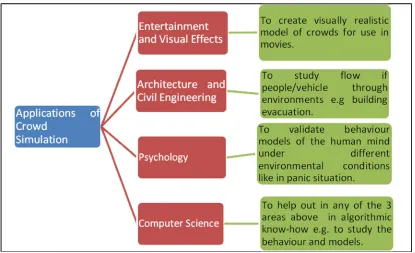
useful in many areas such as in education, entertainment, architecture, urban engineering, training, and virtual heritage. The applications of crowd simulation can be summarized as shown in Figure 1.2.
Figure 1.1: Crowd simulation niche research area
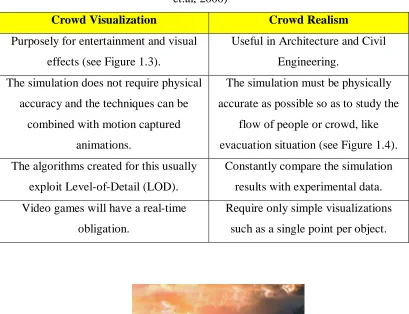
There are various crowd simulation techniques which generally can be divided into two main categories, namely crowd visualization and crowd realism. So, what are the main differences between these two techniques? Table 1.1 below listed the differences between the crowd visualization and crowd realism.
Table 1.1: Differences between crowd visualization and crowd realism (Helbing et.al, 2000)
Crowd Visualization Crowd Realism
Purposely for entertainment and visual effects (see Figure 1.3).
Useful in Architecture and Civil Engineering.
The simulation does not require physical accuracy and the techniques can be
combined with motion captured animations.
The simulation must be physically accurate as possible so as to study the
flow of people or crowd, like evacuation situation (see Figure 1.4). The algorithms created for this usually
exploit Level-of-Detail (LOD).
Constantly compare the simulation results with experimental data. Video games will have a real-time
obligation.
Require only simple visualizations such as a single point per object.
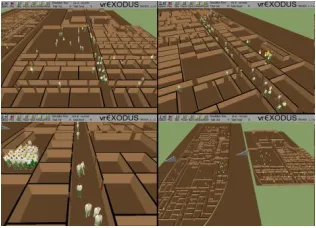
Figure 1.4: Simulation of a ship evacuation, using the tool EXODUS as an example of crowd realism
In this project, it is focusing more on emergency or panic situation. Of course, life does not always flow smoothly when out of a sudden, an emergency situation erupts and the crowd may get to freak-out and gone hysterical. Also, when it comes to panic or emergency situation, it is hard to determine the path since the crowd can become irrational and uncontrolled.
Crowd simulation under panic evacuation situation is fairly important as we need to acknowledge several approaches done in this area. The simulation plays an important role as a platform to demonstrate the models in more visualize way and to achieve realism of crowd movement behaviour in escape panic situation. During an escape panic, few of characteristics (Altshuler et. al., 2005) will be shown such as listed below:
1) Individuals trying to move faster than normal. 2) Individuals push or interactions become physical. 3) Arching and clogging observed at exits.
4) Escape slowed by fallen or dead individuals serving as obstacles. 5) Tendency toward mass or copied behaviour.
1.2 Problem Background
Generally, there are still three major problems as mentioned by Sun et. al., (2009) in the research area pertaining to crowd simulation as listed below:
1) The realism of the behaviours during the simulation 2) High-quality visualization
3) Computational cost
The realisms in the behaviour of large human crowds remain an immense challenge. With the purpose of achieving high level of realism, gestures and interaction between individual characters is very crucial (Murakami et. al., 2002). Most of the work has been done to simulate realistic behaviours (Nuria, 2006) meanwhile (Treuille, 2006) has worked on achieving real-time simulation for very large crowds. Yet, it is still less work that stress on changes of behaviour when crowd is in high density.
During panic situation, it is not necessarily the crowd will act as a ‘crowd’ but rather as a group of individual. As part of the crowd in panic situation, there will be a group of individuals who will act accordingly like following leader, relatives or friends. The existing crowd behaviour theories in panic situation comprise not only panic theory itself, but also include decision-making theory and urgency theory. However, there is still an issue in regards of human communication during this emergency condition and human relationship in aiding the decision making process during the simulation of evacuation in panic situation.
There already exist many crowd evacuation model in panic or emergency situation namely cellular automata models, lattice gas models, social force models, fluid-dynamic models, agent-based models, game theoretic models, and approaches based on experiments with animals. The division of crowd can be classified into macro level and micro level. On a macro level, crowd behaviour is essentially emergent phenomena caused by panic within a crowd. On micro level, crowd behaviours can be modelled as decision-making processes of individual humans influenced by panic. As such, the generalized force model which is used to describe crowd behaviour has been extended to cater for individualism.
On a macroscopic level, crowd behaviour is essentially emergent phenomena caused by panic within a crowd. On microscopic level, crowd behaviours can be modelled as decision-making processes of individual humans influenced by panic. A generalized force model (Helbing et. al., 2000) that used to describe the crowd behaviour such that it takes individual parameters like panic, desired, velocity, actual velocity, mass, radius position(centre of mass). These parameters later will be converted in symbol as a mathematical notation for the purpose of computing the model in evacuation simulation. We will elaborate on this model in Chapter 2.
The issues still remain whereby existing models somehow still lack of crucial human behaviour in regards of panic or emergency situation. Helbing et. al., (2000) have shown that in a space with multi-exit, people usually clog at one exit and ignore the other alternatives, so what the situations would be if each agent could make their own judgments, rather than simply randomly walking or following his neighbours. This means, we need to add more behaviour and characteristic i.e. decision making process in order to analyze the time taken for particular evacuation or egress procedure. The said models which falls under microscopic level are also known as particle model since the agent (humanoid) will be simulated as particle, not fluid motion.
1.3 Problem Statement
There are two fundamental issues in simulating the crowd modelling behaviour in panic situation:
there is a space or room with multi-exit, people usually clog at one exit and ignore the other alternatives, but the situation may give different result if the individual in the crowd have its own way of judgment, for example go the other way and find its own exit.
Secondly, crowd in immense density and differences in individual social forces during panic situation evacuation may result in varied such that the time taken for the crowd as a whole will be affected (fast or slow).
1.4 Project Objectives
The objectives for this project are as follows:
1. To study the differences in crowd’s movement characteristic in panic situation with and without Anti-Arching component.
2. To modify the existing crowd movement simulation so as to liberate the arching and clogging behaviour and look more realistic during emergency evacuation.
1.5 Scope Of The Study
The scope of this project will be as follows:
1. The simulation of the crowd takes into consideration in escape panic or emergency situation only, not under normal situation.
2. The environment of the crowd will be simulated in one room specified by 10m x 10m length with 1.2m door width’s size.
3. The crowd of people will be represented by particles with specific crowd numbers is set to 100 particles in this panic scenario.
4. The crowd realism element will consider only on crowd movement behaviour.
5. The proposed technique will focus on the enhancement of the previous crowd behaviour model in escape panic situation under microscopic level.
6. The crowd simulation will be in simple visualization as single point per object.
1.6 Significance Of The Study
and leads to the output which is different from best possible case.
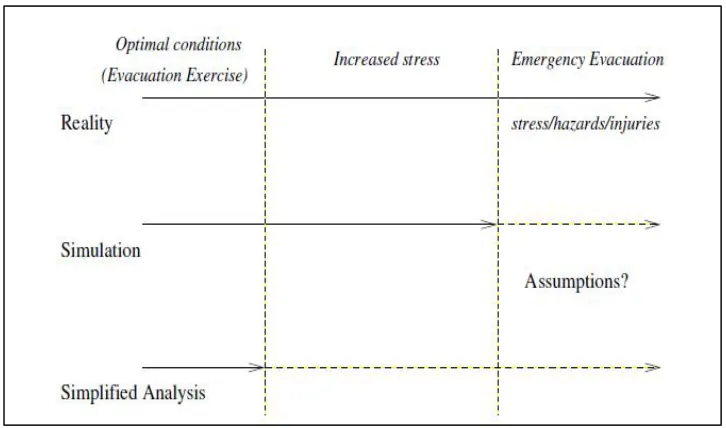
Figure 1.5: The conceptual model of simulating crowd movement and evacuation (Kl¨upfel, 2003)
REFERENCES
Altshuler, E., et al.,(2005). Symmetry Breaking in Escaping Ants. The American Naturalist. 166:6. 2005.
Banks, S. B., Stytz, M. R., Dompke, U., & Sutton, J. (2006). Enabling Multi-National Cultural Experimentation Through Use of a Virtual Institute for Human Behavior Representation. Proceedings of SimTect 2006. Retrieved 18 February 2008 from http://www.siaa.asn.au/get/2423620543.pdf.
Bayazit, O.B., Lien, J.-M. and Amato, N.M. (2002). Roadmap-based flocking for complex environments. in Proceedings of Pacific Conference on Computer Graphics and Applications, 104-113.
Blue V.J. and Adler J.L., (2000). Cellular automata microsimulation of bi-directional pedestrian flow. Transportation Research Record, Journal of the Transportation Research Board, page 135—14, 2000.
Borgers, A., & Timmermans, H. (1986). City centre entry points, store location patterns and pedestrian route choice behaviour: A micro level simulation model. Socio-Economic Planning Sciences, 20 (1), pp. 25-31.
Brown, R. W. (1954). Mass Phenomena. Handbook of social psychology. G. Lindzey (ed.). Addison-Wesley, Cambridge, Mass. 2: 833–876.
Bouvier and Guilloteau, P., (1996). Crowd simulation in immersive space management. 3Rd EUROGRAPHICS Workshop on Virtual Environments, Monte Carlo.
Bouvier,E., Cohen,E., and Najman,L.,(1997). From crowd simulation to airbag deplyoment: particle systems, a new paradigm of simulation. Journal of Electronic Imaging, 6(1):94–107, January 1997.
Kinetic Model to Simulate Evacuation, Proceedings of PED 2008, Wupertaal, Germany, Feb, 2008.
Calvert,T. and et. al.(1994). Towards the Autonomous of Multiple Human Figures.
IEEE Computer Graphics & Applications, v. pp. 69-75.
Chalmet, L. G., Francis R. L., Saunders, P. B.,(1982). Network Models for Building Evacuation, Management Science, Vol. 28, No. 1, Jan., 1982, pp. 86-105. Chenney, S., (2004). Flow tiles. In SCA '04: Proceedings of the 2004 ACM
SIGGRAPH / Eurographics symposium on Computer animation, pages 233-242, Aire-la-Ville, Switzerland, Switzerland, 2004. Eurographics Association.
Cornwell, J.B., Silverman, B.G., O'Brien, K. and Johns, M. (2002). A Demonstration of the PMF-Extraction Approach: Modelling The Effects of Sound on Crowd Behavior. Proceedings of the Eleventh Conference on Computer Generated Forces and Behavioral Representation. Orlando, Florida, pp107-113.
Davoda, J. and Ketterl,N. (2009). Crowd Simulation. Research Seminar on Computer Graphics and Image Processing, SS2009. Institut für ComputerGraphik und Algorithmen, TU Wien, Austria.
Elliott, D. & Smith, D. (1993). Football stadia disasters in the United Kingdom: learning from tragedy. Industrial & Environmental Crisis Quarterly, 7(3), (pp. 205-229).
El Rhalib, A. and Taleb-Bendiab, A. (2005). Harnessing Agent-Based Games Research for Analysis of Collective Agent Behaviour in Critical Settings.
Proceedings of the second GSFC/IEEE Workshop on Radical Agent Concepts
(WRAC'05), NASA GSFC Visitor's Centre, Greenbelt, MD.
Emptage, R. and Davis, Cole. (2009). Biocomplexity in Escape Panic. Retrieved April 13, 2009 from Seminar on Interdisciplinary Biological Research:
Mathematical and Computational Modelling in Biology Website: http://www.nd.edu/~malber/sem_un/sem_und.html
EXODUS, Evacuation software. Retrieved March 20, 2009, from Exodus Website: http://fseg.gre.ac.uk/exodus
Forsyth, D.R., (1999). Group Dynamics. Wadsworth Publishing, 1999. Belmont, CA, 3 edition.
Foudil, C and Djedi,N.,(2006). A computer simulation model of emergency egress for space planners. Georgian Electronic Scientific Journal, 8(1):17–27. Foudil,C. And Rabiaa, C., (2009). Crowd Simulation Influenced by Agent’s
Sociopsychological State. Lesia Laboratory, Biskra University. Available online:http://lesia.univbiskra.net/IMAGE2009/Documents/Communications/0 8-Chighoub.pdf
Funge, J., Tu X., Terzopoulos, D. (1999). Cognitive modelling knowledge, reasoning and planning for intelligent character. Proceedings of ACM SIGGRAPH99, Annual Conference Series, ACM SIGGRAPH.
Galea, E.R.,(2003). Pedestrian and Evacuation Dynamics 2003. Proc. Of the 2nd international conference. Editor. pp 307-18.
Georgoudas, I.G, Sirakoulis G.C., Andreadis, I.T.,(2006). A simulation tool for modelling pedestrian dynamics during evacuation of large areas. In:
Maglogiannis I, Karpouzis K, Bramer M, editors.International federation for
information processing, artificial intelligence applications and innovations,
vol. 204. Boston: Springer; p. 618–26.
Hareesh P.V., Hatanaka, T., Sawada, K., (1998). Simulation of Crowd Behaviour during Emergency Evacuation based on Artificial Life. Human Media Technology Group, Advanced Technology Research Lab, Matsushita Electric
Works, Ltd., Osaka, Japan.
Henein, C.M., and White, T., (2007). Macroscopic effects of microscopic forces between agents in crowd models. Physica A, Volume 373, 1 January 2007. Helbing, D., Farkas, I., and Vicsek, T. (2000). Simulating Dynamical Features of
Escape Panic. Nature, v. 407, pp. 487-490.
Helbing, D., Farkas I., and Vicsek, T., (2003). Simulation software for `Simulating dynamical features of escape panic. Available online: http://angel.elte.hu/~panic/
Helbing,D., Johansson, A. and Al-Abideen, H. Z., (2007). Dynamics of crowd disasters: An empirical study. Phys. Rev. E 75, 046109 (2007).
Henderson, L. F. (1974). On the Fluid Mechanic of Human Crowd Motion. Transportation Research, 8:509-515.
Spatial Economics, Vol. 5, 2005, pp. 193–216.
Hughes, R. L. (2002). A continuum theory for the flow of pedestrians. Tranportation Research Part B, 36:507-535.
Hughes., R. L. (2003). The flow of human crowds. Annual Review of Fluid Mechanics, 35:169-182.
Karasova, V. and Lawson. G. (2008). Methods for Predicting Human Behaviour in Emergencies. An Analysis of Scientific Literature. Proceedings of GISRUK. Kaup, D. J., Clarke, T. L., Oleson, R., Malone, L., and Jentsch, F. G. (2008).
Introducing age-based parameters into simulations of crowd dymanics. In
Proceedings of the 40th Conference on Winter Simulation (Miami, Florida, December 07 - 10, 2008).
Mason,S. Hill,R., Mönch,L., and Eds, O.R.,(2008 ). Winter Simulation Conference. Winter Simulation Conference, 895-902.
Kavraki, L., Svestka, P., Latombe, J. and Overmars, M. (1996). Probabilistic roadmaps for path planning in high-dimensional configuration spaces. IEEE Transaction on Robotics and Automation, 12 (4). 566-580.
Keating, J.P. (1982). The myth of panic. Fire Journal. 76(3), pp. 57-61, 60-61, 147. Kirchner, A. and Schadschneider, A., (2002). Simulation of evacuation processes
using a bionics-inspired cellular automaton model for pedestrian dynamics,
Physica A 312 (2002), pp. 260–276.
Kirchner, A., Namazi, A., Nishinari, K. and Schadschneider, A.(2003). Role of Conflicts in the Floor Field Cellular Automaton Model for Pedestrian Dynamics. in 2nd International Conference on Pedestrians and Evacuation Dynamics,51-62.
Krantz, F. (1988). History from below. Oxford, UK, Blackwell.
Kl¨upfel,H., Schreckenberg,M., and K¨oni, T.M.,(2007). Models for Crowd Movement and Egress Simulation,In Traffic and Granular Flow 2003.Springerlink pp. 357-372.
Lachman, R., Tatsuoka, M. and Bonk, W.J. (1961). Human Behaviour during the Tsunami of May 1960. Research on the Hawaiian disaster explores the consequences of an ambiguous warning system, Science 133 pp1405-1409. Laughery, R. (2005). Simulation and modelling for analysing human performance.
Wilson, J.R. and Corlett, N. (Eds). Evaluation of Human Work. Taylor and
Lerner, A., Chrysanthou, Y. and Cohen-or, D.(2006). Efficient cells-and-portals partitioning. Computer Animation & Virtual Worlds, Wiley, 21-40.
Li, X., Chen, T., Shen, S., Yuan, H. (2008). Lattice gas simulation and experiment study of evacuation dynamics. Physica A, 2008, doi:10.1016/j.physa.2008.05.024
Lin,Y., Fedchenia1, I., LaBarre, B., and Tomastik R., (2008). Agent-Based Simulation of Evacuation: An Office Building Case Study. Proceedings of PED 2008, Wupertaal, Germany, Feb, 2008.
Liu, F., & Ronghua, L. (2003). Intelligent Crowd Simulation. Computational Science and Its Applications. ICCSA, pp. 962. Montreal, Canada.
Loscos, C., Marchal, D. and Meyer, A. (2003). Intuitive crowd behaviour in dense urban environments using local laws. IEEE Theory and Practice of Computer Graphics, 122.
McGrath, J. E. (1970). A Conceptual formulation for research on stress. Social and Psychological factors in stress. Chapter 2.
Musse, S.R., Thalmann, D., (1997). A Model of Human Crowd Behavior: Group Inter-Relationship and Collision Detection Analysis. Eurographics Workshop on Animation and Simulation, Hungary.
Musse, S.R., and Thalmann, D.(2001). Hierarchical model for real time simulation of virtual human crowds. IEEE Transactions on Visualization and Computer Graphics, 7(2): 152—164.
Saiwaki, N., T. Komatsu, T. Yoshida, and S. Nishida. (1997). Automatic generation of moving crowd using chaos model. Proceedings of the IEEE International Conference on System, Man and Cybernetics, 4:3715-3721.
Nishinari, K., Sugawara, K. , Kazama, T., Schadschneider, A., and Chowdhury, D., (2006). Modelling of self-driven particles: foraging ants and pedestrians,
Physica A 372 (2006).
Olfati-Saber, R. (2004). Flocking for multi-agent dynamic systems: Algorithms and theory. IEEE Transactions on Automatic Control.
Pan, X.S., Han, C.S., Dauber, K. and Law, K.H., (2007). A multi-agent based framework for the simulation of human and social behaviors during emergency evacuations, AI and Society 22 (2007), pp. 113–132.
Parisi, D.R. and Dorso, C.O.,(2005). Microscopic dynamics of pedestrian evacuation,
Paris, S. And Donikian P.et.S., (2007). Pedestrian Reactive Navigation for Crowd Simulation: a Predictive Approach. EUROGRAPHICS 2007 / D. Cohen-Or and P. Slavík,2007.
Parisi, D.R. and Dorso, C.O. ,(2007). Morphological and dynamical aspects of the room evacuation process, Physica A 385 (2007).
Parisi, D.R., Gilmana, M., Moldovan, H., (2009). A modification of the Social Force Model can reproduce experimental data of pedestrian flows in normal conditions. Physica A: Statistical Mechanics and its Applications. Volume 388, Issue 17, 1 September 2009, Pages 3600-3608.
Pelechano, N. and Badler, N. (2006). Modelling Crowd and Trained Leader Behavior during Building Evacuation. IEEE Computer Graphics and Applications. 26(6): 80–86.
Pelechino G.N.,( 2006). Modeling Realistic high density autonomous agent crowd movement; social forces, communication, roles and psychological influences.
PhD thesis, Philadelphia, PA, USA.
Pelechano, N., Malkawi, A. (2007). Comparison of Crowd Simulation for Building Evacuation and an Alternative Approach. The 10th International Building Performance Simulation Association Conference and Exhibition. Beijing ,China.
Pelechano, N., Allbeck, J. and Badler, N. (2007). Controlling Individual Agents in High-Density Crowd Simulation. ACM SIGGRAPH / Eurographics Symposium on Computer Animation (SCA'07).August 3-4, San Diego, USA. Pelechino, N, Malkawi, A. (2008). Evacuation simulation models: Challenges in
modelling high rise building evacuation with cellular automata approaches.
Automation in Construction 17, 377385.
Perry R.W. and Lindell M.K. (2003). Understanding Citizen Response to Disasters with Implications for Terrorism. Journal of Contingencies and Crisis Management 11 pp49–60.
Pettre, J., Laumond, J.-P. and Thalmann, D. (2005). A Navigation Graph for real-time crowd animation on multilayered and uneven terrain. First International Workshop on Crowd Simulation, 81-90.
Quarantelli, E.L. (2001). The sociology of panic. Smelsed and Baltes, editors, International Encyclopedia of the Social and Behavioral Sciences.
Reeves W.T., (1983). Particle systems - a technique for modeling a class of fuzzy objects. ACM Transactions on Graphics, 2:359–376, 1983.
Reynolds, C., (1987). Flocks, Herds and Schools: A Distributed Behavioral Model.
Computer Graphics, 21(4), pp.25-34.
Reynolds, C., (1999). Steering behaviors for autonomous characters. In Game Developers Conference 1999.
Roloff, M.E., (1981). Interpersonal Communication-The social Exchange Approach.
SAGE Publication, v.6, London.
Shao, W. and Terzopulus, D., (2005). Autonomous pedestrians. Proceedings of ACM SIGGRAPH / Eurographics Symposium on Computer Animation.19-28. Sime, J. (1984). Escape Behavior In Fire: ‘Panic’ Or Affiliation? PhD Thesis,
Department of Psychology, University of Surrey.
Silverman, B., Bharathy, G., Cornwell, J. and O’Brien, K. (2006). Human Behavior Models for Agents in Simulators and Games: Part II - Gamebots for a Foreign Culture. Presence, 15 (2), 163-185.
Song, W.G., Yu, Y.F., Wang, B.H., Fan, W.C., (2006). Evacuation Behaviors at Exit in CA Model with Force Essentials: A Comparison with Social Force Model. Physica A, 371, 2006, pp. 658-666.
Still G.K., (2000). Crowd Dynamics. PhD thesis, University of Warwick.
Stroele, J. (2008). How do pedestrian crowds react when they are in an emergency situation - models and softwares. University of Illinois at Urbana-Champaign.
Sun, L., Liu, Y., Sun, J., and Bian, L.,(2009). The hierarchical behavior model for crowd simulation. In Proceedings of the 8th international Conference on Virtual Reality Continuum and Its Applications in industry (Yokohama, Japan, December 14 - 15, 2009). S. N. Spencer, Ed. VRCAI '09. ACM, New York, NY, 279-284. DOI=http://doi.acm.org/10.1145/1670252.1670313 Sung, M., Kovar, L. and Gleicher, M. (2005).Fast and accurate goal-directed motion
synthesis for crowds., 291-300.Symposium on Computer Animation.
Tasse, F.P. and Glass, K. (2008). Crowd Simulation of Pedestrians in a Virtual City. Techia, F., Loscos, C., Conroy, R. and Chrysanthou, Y. (2001). Agent behavior
ACM/EG Games Technology Conference.
Thalmann, D. (2002). Simulating a human society: The challenges. In J. Vince and R. Earnshaw, (Eds.), Advances in Modelling, Animation and Rendering:
Proceedings of Computer Graphics International, New York: Springer, pp. 25-38.
Thalman, D., Musse, S.R. and Kallmann, M. (1999). Virtual Humans' Behavior: Individuals, Groups, and Crowds. Proceedings of Digital Media Futures, 13-15.
Treuille, A., Cooper, S., & Popovic, Z. (2006). Continuum crowds. SIGGRAPH’06. Proceedings of the 33rd International Conference on Computer Graphics and
Interactive Techniques.
pp. 11601168, Boston, MA.
Thomas, G. and Donikian, S. (2002). Virtual Humans Animation in Informed Urban Environments. Proceedings of Computer Animation, 112.
Tu, X., and Terzopoulos, D. (1994). Artificial fishes: physics, locomotion, perception,
behavior. In SIGGRAPH '94: Proceedings of the 21st annual conference on Computer graphics and interactive techniques, pages 43-50, New York, NY, USA, 1994. ACM.
Treuille, A., Cooper, S., and Popovic, Z.(2006). Continuum crowds. ACM Trans. Graph., 25(3):1160-1168.
Turner, A. (2002). Encoding natural movement as an agentbased system: an investigation into human pedestrian behaviour in the built environment.
Environment and Planning B: Planning and Design. 29 (4), pp. 473-490. Vaught, C. and Wiehagen, W. J.(1991). Escape from a mine fire: Emergent
perspective and work group behavior. Journal of Applied Behavioral Science, 27(4), (pp. 452- 474).
Waldau N., Schreckenberg M., Gatermann P. (2003). Design criteria related to orientation in buildings during high-stress situations crowd simulation models and their applications.
Weng, W.G., Chen, T., Yuan, H.Y., and Fan, W.C., (2006). Cellular Automaton Simulation of Pedestrian Counter Flow with Different Walk Velocities.
Physical Review, E74, 2006, doi:10.1103/PhysRevE.74.036102.
Cellular automaton model for evacuation process with obstacles, Physica A
382 , pp. 631–642.
Velastin, S., Yin, J.H., and Davies A.C., (1994). Measurement of Crowd Density using Image Processing. VII European Signal Processing Conference, EUSIPCO-94, Edinburgh, UK.
Yang, L.Z., Zhao, D.L., Li, J., and Fang, T.Y.,(2005). Simulation of the kin behavior in building occupant evacuation based on cellular automaton,
Building and Environment 40 (2005).
Yua, W.F. and Tan, K.H., (2007). An evacuation model using cellular automata,
Physica A 384 (2007), pp. 549–566.
Zarboutis, N. and Marmaras, N., (2004). Searching efficient plans for emergency rescue through simulation: the case of a metro fire, Cognition, Technology and Work 6 (2004), pp. 117–126.
Zheng, M.H., Kushimori Y., Kumbura T.,(2002). A model describing collective behaviors of pedestrians with various personalities in danger situations. In:
Wang LP, Rajapakse JC, Fukushima K, Lee SY, Yao X, editors. Proceedings
of the 9th international conference on neural information processing