COMPUTER-BASED MALAY STUTTERING ASSESSMENT
SYSTEM
OOI CHIA AI
iii
iv
ACKNOWLEDGEMENT
I would like to take this opportunity to extend my sincere gratitude and
appreciation to many people who made this thesis possible. Special thanks are due to my supervisor, Associate Professor Dr. Jasmy bin Yunus for his invaluable guidance, suggestions and full support in all aspects during the research.
Mega thanks go to the Faculty of Electrical Engineering of Universiti
Teknologi Malaysia for the full support in this project. Thanks are also due to UTM-PTP for the research funding.
I would like to express my sincere thanks to Hospital Sultanah Aminah and primary schools located at Skudai district as well, for their assistance in conducting the numerous experiments during the research.
v
ABSTRACT
vi
ABSTRAK
vii
TABLE OF CONTENTS
CHAPTER TITLE PAGE
DECLARATION ii
DEDICATION iii
ACKNOWLEDGEMENT iv
ABSTRACT v
ABSTRAK vi
TABLE OF CONTENTS vii
LIST OF TABLES xii
LIST OF FIGURES xiii
LIST OF ABBREVIATIONS xv
LIST OF APPENDICES xvii
1 INTRODUCTION 1.1 Background and Motivation 1
1.2 Problem Statement 3
1.3 Research Objectives 5
1.4 Scope of Work 5
1.5 Research Approach 6
1.6 Significance of Research Work 7
1.7 Thesis Layout 8
2 STUTTERING ASSESSMENT AND DIAGNOSIS 2.1 Introduction 9
2.1.1 Features of Stuttering Assessment 10
viii 2.1.3 Computer-based Assessment System 12 2.2 The Variability of Fluency 14 2.2.1 Definition of Stuttering 15 2.2.2 Characteristics of Stuttering 18 2.2.3 Types of Stuttering 22 2.3 Basic Considerations When Assessing Young
Children 23
2.4 Formal Measures of Assessment System 25 2.4.1 Stuttering Severity Instrument (SSI-3) 25 2.4.2 Modified Erickson Scale of Communication
Attitudes (S-24) 26
2.4.3 Perception of Stuttering Inventory (PSI) 26 2.4.4 Locus of Control Behaviour (LCB) 27
2.4.5 Crowe’s Protocols 27
2.4.6 Communication Attitude Test-Revised
(CAT-R) 28
2.4.7 A-19 Scale for Children Who Stutter 28 2.5 Stuttering Therapy Techniques 29
2.5.1 Shadowing 30
2.5.2 Metronome 30
2.5.3 DAF 31
2.5.4 Rate Control 32
2.5.5 Regulated Breathing (RB) 32
2.5.6 Easy onset 33
2.5.7 Counselling 33
2.5.8 Prolonged Speech (PS) 34
2.6 Summary 34
3 STUTTERING ASSESSMENT FRAMEWORK DESIGN
3.1 Introduction 35
ix
3.3.3 Economic and Time Constraints 38
3.3.4 SLP’s Beliefs 39
3.4 Basic Stuttering Treatment Approaches 39
3.4.1 Fluency Shaping (FS) 41
3.4.2 Stuttering Modification (SM) 42
3.4.3 Why Fluency Shaping (FS)? 43
3.5 Problem Formulation 44
3.5.1 The Uniqueness of Each Individual 44
3.5.2 Difficulty in Identifying Appropriate Therapy Technique 45
3.5.3 Time Consumption in Classical Manual Assessment System 46
3.5.4 Validity 47
3.6 Underlying Design Principles 48
3.6.1 Audio and Visual Feedbacks 49
3.6.2 Monitoring and Assessment 50
3.6.3 Clinical Evaluation 51
3.6.4 Motivation 52
3.7 System Design 54
3.8 Criteria for Selection of Scoring Parameters 55
3.9 Summary 57
4 DEVELOPMENT OF COMPUTER-BASED STUTTERING ASSESSMENT SYSTEM 4.1 Introduction 58
4.2 System Requirements 58
4.2.1 Hardware Requirements 59
4.2.2 Software Requirements 59
4.3 System Descriptions 59
4.4 Coding 62
4.4.1 Audio File Format 63
4.4.2 Sampling 63
4.4.3 Resolution Bit 64
x
4.4.5 DC Offset Removal 65
4.4.6 Windowing 67
4.4.7 Time Domain Filtering 69
4.4.8 Recording and Playback of Speech Utterances 70
4.4.8.1 Playback 71
4.4.8.2 Recording 71
4.4.9 Background Noise Level Detection 72
4.4.10 History File 73
4.4.11 Client Identification 73
4.4.12 Compression and Decompression Using Speex 74
4.4.12.1 Encoding 77
4.4.12.2 Decoding 78
4.5 Scoring 79
4.5.1 Start Location 80
4.5.2 End Location 80
4.5.3 Maximum Magnitude 82
4.5.4 Duration 83
4.6 Summary 85
5 CLINICAL EVALUATION OF COMPUTER-BASED STUTTERING ASSESSMENT SYSTEM 5.1 Introduction 86
5.2 Implementing Clinical Trials among School-age Children 86
5.2.1 Test Subjects 87
5.2.2 Experimental Set-Up 88
5.2.3 Scenario 89
5.2.3.1 Shadowing Task 90
5.2.3.2 Metronome Task 90
5.2.3.3 DAF Task 91
5.3 Assessment Procedures 92
5.4 Data Collection 101
5.5 Results or Quantitative Analyses 102
xi 5.5.2 Results Analysis by SLP 110 5.5.3 Comparison between Software and SLP
Analyses 111
5.5.4 Description of Individual Test Subjects 113
5.6 Summary 114
6 CONCLUSION
6.1 Introduction 115
6.2 Future Works 117
REFERENCES 119-127
xii
LIST OF TABLES
TABLE NO. TITLE PAGE
5.1 Occurrence Frequency of Stuttering Behaviours in Test
Subjects 103
5.2 The Range and Quartile Distribution of the Frequency
Indices for Stuttering Characteristics 104 5.3 Software Scoring for Test Subjects 105
5.4 Software Scoring for Control Data 105
5.5 %SS for Each Therapy Technique 111
xiii
LIST OF FIGURES
FIGURE NO. TITLE PAGE
1.1 Research Development Process 7
2.1 Speech Waveforms and Sound Spectrograms of a Male
Client Saying “PLoS Biology” 17
3.1 Comparisons between Fluency Shaping and Stuttering
Modification 40
3.2 Five Steps to Implementing EBP 52
4.1 System Block Diagram 61
4.2 Flowchart: DC Offset Removal 67
4.3 Common Window Functions 68
4.4 Flowchart: Background Noise Level Detection 72 4.5 Dialog Box: The Loading of Wave Files 74
4.6 Dialog Box: Client Identification 74
4.7 Wave File Information 76
4.8 Speex File Information 76
4.9 Encoding Process 77
4.10 Decoding Process 78
4.11 Flowchart: The Scoring of Start Location 81 4.12 Flowchart: The Scoring of End Location 82 4.13 Flowchart: The Scoring of Maximum Magnitude Comparison 84 4.14 Flowchart: The Scoring of Duration Comparison 85
5.1 Shadowing Task 90
5.2 Metronome Task 91
5.3 DAF Task 92
xiv 5.6 Selection of Five Pre-recorded Wave Files 94
5.7 Selection of Text File 95
5.8 Input of User Name 95
5.9 Input of History File and Its Location 96
5.10 The Enabling of Buttons 97
5.11 The AMP of SLP 97
5.12 The AMP of Client superimposed on SLP's AMP 98 5.13 The File Saving of Recorded Utterances 99 5.14 The File Playing of Both SLP and Subject's Utterances 100
5.15 The Display of Fireworks 100
5.16 The Display of the Information of Attempted Utterances 106 5.17 The Scoring Comparison for Start Location Parameter 107 5.18 The Scoring Comparison for End Location Parameter 107 5.19 The Scoring Comparison for Maximum Magnitude Location
Parameter 108
5.20 The Scoring Comparison for Maximum Magnitude Location
Parameter 109
xv
LIST OF ABBREVIATIONS
ADC - Analogue to Digital Converter AMP - Average Magnitude Profile
API - Application Programming Interface
ASHA - American Speech-Language-Hearing Association AWS - Adults Who Stutter
CAT-R - Communication Attitude Test-Revised CBR - Constant Bit-Rate
CODEC - Compression Decompression
CPU - Central Processing Unit CWS - Children Who Stutter
DAC - Digital to Analogue Converter DAF - Delayed Auditory Feedback
DC - Direct Current
DMA - Direct Memory Access DSP - Digital Signal Processing EBP - Evidence-Based Practice
FS - Fluency Shaping
GDI - Graphics Device Interface GUI - Graphical User Interface ISA - Industry Standard Architecture LCB - Locus of Control Behaviour
LPF - Low Pass Filter
MFC - Microsoft Foundation Class
OS - Operating System
PC - Personal Computer
xvi
PS - Prolonged Speech
PSI - Perception of Stuttering Inventory PWS - Person Who Stutter
RB - Regulated Breathing
RIFF - Resource Interchange File Format
S-24 - Modified Erickson Scale of Communication Attitudes SLP - Speech-Language Pathologist
SM - Stuttering Modification SS - Stuttered Syllables
SSI-3 - Stuttering Severity Instrument
SSMP - Successful Stuttering Management Program SW/M - Stuttered Words per Minute
xvii
LIST OF APPENDICES
APPENDIX TITLE PAGE
A Wave File Format 128
B Stuttering Severity Instrument (SSI-3) 138
C Modified Erickson Scale of Communication Attitudes (S-24) 139
D Locus of Control Behaviour (LCB) 140
E Communication Attitude Test-Revised (Cat-R) 141
F A-19 Scale for Children Who Stutter 142
G Stuttering Prediction Instrument for Young Children (SPI) 144
H Physician’s Screening Procedure for Children Who May Stutter 148
CHAPTER 1
INTRODUCTION
1.1 Background and Motivation
Stuttering has attracted extensive research interests over the past decades. Stuttering research is exploring ways to improve the diagnosis and treatment of stuttering as well as to identify its causes. Emphasis is being placed on improving the ability to determine which children will outgrow their stuttering and which children will stutter the rest of their lives.
Recent research has been focused on the therapy program such as Lidcombe Program, Camperdown Program, Prolonged Speech-based Stuttering Treatment and others. Many classical manual inventories, scales, and procedures have been
developed for assessing the quality of both the surface as well as the deep structure of stuttering such as Stuttering Severity Instrument (SSI-3), Modified Erickson Scale of Communication Attitudes (S-24), Perception of Stuttering Inventory (PSI) and so on. However, far less effort has been done on the computer-based stuttering
assessment system.
2 Numerous therapy techniques exist to treat stuttering, yet there remains a paucity of empirically motivated stuttering treatment outcomes research. Despite repeated calls for increased outcome documentation on stuttering treatment, the stuttering literature remains characterized by primarily ‘‘assertion-based’’ or ‘‘opinion-based’’ treatments, which by definition are based on unverified treatment techniques and/or procedures [3].
Conversely, ‘‘evidence-based’’ treatments, based on well-researched and scientifically validated techniques, remain relatively rare in the field of stuttering and are usually limited to behavioural and fluency shaping (FS). The objective
assessment of specific stuttering treatment approaches is also important to elucidate therapy techniques that contribute to desired outcomes. However, identifying the appropriate therapy techniques manually can be difficult, given the multidimensional nature of stuttering [4].
A study [5] consisted of 98 children who stutter (CWS) ranged from 9 to 14 years old were divided into four groups:
1. The first group was treated by speech-language pathologist (SLP) in a speech clinic.
2. In the second group, the parents were trained to administer the stuttering therapy to their children, but the children did not see a SLP.
3. In the third group, the children used speech biofeedback computers designed for treating stuttering. They were not treated by SLPs, and their parents were not involved.
4. The control group received no therapy.
One year after the therapy program ended: 1. 48% of the children treated by SLPs were fluent.
2. 63% of the children treated by their parents were fluent. 3. 71% of the children treated by computers were fluent. 4. The control group's speech did not improve.
3 level, the computers and the parents were about four times more effective than the SLPs and this encourages the implementation of a computer-based stuttering assessment system to improve clients’ fluency.
Computer-based stuttering assessment system implements the function of complicated and expensive acoustic equipment available only at well-equipped speech-language pathology clinics.
1.2 Problem Statement
Why computer-based stuttering assessment system should be implemented to replace the classical manual assessment approach? What is possible during clinical session is often determined by treatment variables such as the availability, setting, and cost of services. The drawbacks and insufficiencies of classical manual stuttering assessment include:
a) Time - There were at least 115 therapy techniques that decreased stuttering markedly [6]. Each of the PWS exhibits a unique response to different therapeutic approaches. The technique that works so dramatically for one stutterer does not necessarily work dramatically, or at all, for other PWS. Stuttering is so variable and so highly individualized that, few would disagree, no one method works for all PWS.
Without computer-based system, SLP has to try every single therapy
4 b) Cost - Due to the typical length of treatment and the usual lack of
reimbursement by insurance companies, the cost of successful treatment can quickly become prohibitive for many clients [8]. The longer the SLP takes to assess a client, the higher the cost of diagnosis. The cost of clinical session is a major consideration for nearly every client. Some individuals simply cannot afford professional help unless the services are covered by insurance (which is not typically the case for fluency disorders) or are available at a reduced rate. A computer-based stuttering assessment is capable to reduce the diagnosis duration and thus reduce the costs of clinical session for client.
c) Effectiveness - The success of treatment is closely tied to the ability of an experienced SLP to determine a client’s readiness for change and adjust treatment techniques accordingly. Thus the utility of the techniques depends on the SLP’s ability to apply the right technique (s) at the right time. Often, an approach is chosen because it coincides with the personality of the SLP and her view of reality. The SLP’s perception of the client should be as accurate as possible. If SLP apply the wrong therapy technique on a particular client, not only the client will not show any improvement, the client may need longer time for assessment process.
One of the features of stuttering is that it tends to change with time. This requires SLP to give full attention to each client’s progress. This is impossible in sole traditional clinical treatment without the assistance of a computer-based diagnosis tool. Research [5] indicates that computers were the most effective, the parents are the next most effective, and the SLPs were the least effective.
d) Uniformity - The scores from manual measures provide quantitative
information that is very subjective due to different human perception. This quantitative measurement may vary from one SLP to another which leads to the scoring inconsistencies. Scoring generated by computer-based system enables SLPs in different locations to be on “the same page” regarding the general severity, suitable therapy techniques and the overall characteristics of clients.
5 commitment and motivation by the client. The problem could be eliminated if SLPs use a "user-friendly" stuttering relief approach where this could be enhanced by the use of a computer-based system. An experienced and interesting guide such as computer-based scoring analyses can show the way or, at the very least, make the journey more efficient and often more pleasant. It is essential that the child enjoys the assessment process and finds it to be a positive experience.
1.3 Research Objectives
The objectives of the research work are to develop a computer-based Malay stuttering assessment system and to verify its operation in a real clinical session. The computer-based assessment system is able to assist SLP in determining suitable stuttering therapy techniques for each client. The application is capable to reduce time consumption required to determine suitable therapy technique for each client.
The effectiveness of stuttering assessment process is improved as computer-based approach has been proved to be the most effective in treating PWS. Scoring generated by the computer-based system ensures the consistency and uniformity regarding the general stuttering severity of a particular client. Computer-based system provides interesting guide which motivate client to enjoy the assessment process.
1.4 Scope of Work
6 (DSP) techniques are implemented to analyze speech signals. Software is designed based on standard speech FS techniques that can be easily incorporated into current fluency rehabilitation regimen. Three stuttering therapy techniques are introduced in computer-based. They are Shadowing, Metronome and Delayed Auditory Feedback (DAF). These three techniques are chosen because they are the most commonly used therapy techniques in Malaysia based on discussion with SLPs in Malaysian
hospitals. Once the computer-based stuttering assessment system is developed, it is verified in the real stuttering clients through clinical trial carried out among primary school's students. Hospital Sultanah Aminah assisted in the clinical trials, as well as giving professional feedback.
1.5 Research Approach
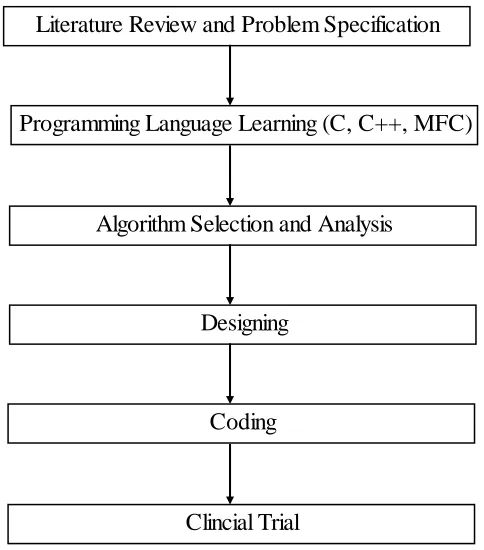
The development process can be broken into six phases as shown in Figure 1.1. During the first phase, hardware and software required for computer-based stuttering assessment system are identified. Hardware includes microphone, earphones and desktop equipped with sound card, while software means Operating System (OS), the development tools and the necessary drivers. Window XP OS is chosen due to its availability and familiarity. Sound card must be able to work with Window XP.
Prior to the designing and coding stage, basic principles and strategies of stuttering assessment systems are analyzed. Both the FS and stuttering modification (SM) treatment approaches are reviewed and compared. Digital audio processing theories and principles are studied in detail. Algorithm selection and analysis are made for the recording and playback procedures such as windowing, and filtering.
Next, the program flowcharts of stuttering assessment operation are
7
Figure 1.1: Research Development Process
1.6 Significance of Research Work
Implementing a stuttering assessment in a computer-based system is very important because the use of computer technology in stuttering assessment is still new in Malaysia and currently no computer-based assessment tool is available to assist SLPs in determining suitable therapy technique for each client. Coming up with a clean implementation not only helps better understanding of the available stuttering therapy techniques, but also allows extensions to the introduction of more stuttering therapy techniques in computer-based.
The implementation of computer-based Malay stuttering assessment system aids SLP to determine suitable therapy techniques for each client during the clinical assessment process. Each client exhibits a unique response to the treatment
strategies. The uniqueness of each individual PWS prevents any specific recommendations of therapy techniques from being universally applicable.
Literature Review and Problem Specification
Programming Language Learning (C, C++, MFC)
Algorithm Selection and Analysis
Designing
Coding
8 Without the use of computer-based assessment system, normally 2 to 3 months are required to determine suitable technique for each client. The computer-based assessment system is capable to reduce the amount of time needed for the determination of therapy techniques and the possibility of error occurrence in the manual calculation of percentage of stuttered syllables (SS).
The algorithms involved in the design of assessment procedures and the introduction of three therapy techniques in computer-based are our original ideas.
1.7 Thesis Layout
The content of the thesis is organized as follows. Chapter two describes the generic characteristics of stuttering assessment system and survey of current
assessment systems used in clinical sessions. Not all systems are mentioned here, but rather those systems that are intuitively relevant for our case of computer-based assessment system.
Chapter three depicts the problem formulation and underlying design principles of computer-based Malay stuttering assessment system, by pointing out some relevant topics such as the basic stuttering treatment approaches including FS and SM, and the criteria for selection of scoring parameters.
Clinical trials on control data and test subjects have been carried out to make sure that the system runs properly before its practicality was verified. The details of the development of computer-based Malay stuttering assessment system are