FEASIBILITY STUDY ON INCORPORATING IEC/ISO27001
INFORMATION SECURITY MANAGEMENT SYSTEM (ISMS) STANDARD IN IT SERVICES ENVIRONMENT
HAU LIAN HONG
A project report submitted in partial fulfilment of the requirements for the award of the degree of Master of Computer Science (Information Security)
Advance Informatics School (AIS)
Faculty of Computer Science and Information Systems Universiti Teknologi Malaysia
iii
ACKNOWLEDGEMENT
I would like to express my gratitude and special appreciation to a wonderful group of people who have been there to support and make this project a success.
Special thanks to my project supervisor Dr. Bharanidharan Shanmugam who have been encouraging and supportive throughout the research study period. He was very supportive and committed on our regular meeting for project progress updates and guidance.
iv
ABSTRAK
Kajian Kemungkinan menggabungkan IEC/ISO27001 Sistem Pengurusan
Keselamatan Maklumat (ISMS) dalam bidang IT Persekitaran Perkhidmatan adalah satu
kajian penyelidikan dengan mengambil organisasi sebagai kajian kes untuk menjalankan
kajian kemungkinan tentang keselamatan maklumat organisasi yang sedia ada dan
mencadangkan ISO27001 ISMS maklumat rangka kerja keselamatan kepada organisasi.
Aktiviti-aktiviti yang melibatkan penilaian keselamatan jurang, merangka dokumen
mandatori kerana setiap ISO 27001 standard keperluan ISMS. Objektif kajian ini adalah
untuk mengenal pasti insiden keselamatan maklumat umum dan ISO27001 amalan
ISMS tindakan pembetulan dan pencegahan. Disamping itu, kajian ini memberi tumpuan
kepada menganalisis keadaan semasa organisasi dengan menjalankan kajian
kemungkinan mengenai kesediaan ISO27001 ISMS yang diamalkan oleh organisasi.
Metodologi kajian ini telah diperolehi dengan rangka kerja penyelidikan operasi yang
terdiri daripada beberapa fasa projek, ISO27001 fasa pelaksanaan ISMS yang dipetakan
kepada serahan. Serahan dan hasil yang diharapkan adalah siri set dokumen yang perlu
mematuhi standard ISO27001 ISMS seperti draf awal pengguna dasar ISMS, metodologi
penilaian risiko, laporan penilaian risiko, penyata kebolehgunaan (SOA) akan
dibangunkan untuk memenuhi keperluan ISO27001 ISMS dan kriteria. Juga, sebahagian
daripada aktiviti mandatori seperti taksiran jurang, penilaian risiko keselamatan
maklumat akan dicadangkan dan dijalankan dengan laporan yang berkaitan akan
disediakan sebagai sebahagian daripada keputusan dan penemuan untuk mencapai
objektif kajian penyelidikan ini. Kajian penyelidikan ini tidak meliputi kitaran
pelaksanaan keseluruhan ISMS ISO27001. Oleh itu, kerja-kerja masa depan kajian
penyelidikan ini boleh diteruskan dari pentas dengan membangunkan dasar dan prosedur
v
ABSTRACT
vi
TABLE OF CONTENTS
CHAPTER TITLE PAGE
DECLARATION i
DEDICATION ii
ACKNOWLEDGEMENT iii
ABSTRAK iv
ABSTRACT v
TABLE OF CONTENTS vi
LIST OF TABLES xi
LIST OF FIGURES xiii
LIST OF APPENDIX xiv
1 INTRODUCTION 1
1.1 Overview 1
1.2 Background of the problem 3
1.3 Problem Statement 4
1.4 Project Aim 4
1.5 Research Questions 5
1.6 Research Objectives 5
1.7 Research Scope 5
1.8 Summary 7
vii
2 LITERATURE REVIEW 8
2.1 Introduction 8
2.2 Overview of Data Security Breaches 9
2.3 Common Security Threats 10
2.3.1 Cybercrime Threats 11
2.3.2 Insider Threats 12
2.4 Common Security Controls 12
2.4.1 Organizational Security Awareness 12
2.4.2 Government Legislation and Compliance 14
2.4.3 Information Handling 14
2.4.4 Separation of Duties 15
2.5 The Consideration of Information Security Blueprint
15
2.5.1 IEC/ISO 27001 ISMS 15
2.5.2 Gartner Information Security Governance Model 19
2.6 ISO27001 ISMS Gap Assessment 20
2.7 Risk Assessment Framework Recommendation for Information Security Management System (ISMS)
24
2.7.1 ISO 31000 Risk Management 25
2.7.2 Health Insurance Portability and Accountability Act (HIPAA)
25
2.7.3 Control Objectives for Information and Related Technology (COBIT)
26
2.7.4 Sarbanes-Oxley (SOX) 27
2.7.5 ISO/IEC 27005 Information Security Risk Management
28
2.7.6 The Advantages and Disadvantages of Risk Assessment Framework
29
viii 2.8 Common Problems in ISO27001 ISMS Project
Implementation
32
2.9 Critical Success Factors and Lessons Learned 34 2.10 Summary Table of Literature Review 35
2.11 Summary 41
3 METHODOLOGY 42
3.1 Introduction 42
3.2 Research Operational Framework 42
3.3 ISMS Implementation Methodology 43
3.3.1 Phase 1: Assessing the Current Gaps of ISMS 44 3.3.2 Phase 2: Scoping and Security Organization
Development
45
3.3.3 Phase 3: Risk Assessment Methodology & Report
45
3.4 Research Design 45
3.5 Research Data Analysis and Findings
Presentation
46
3.6 Summary of Research Techniques 49
3.7 Summary 51
4 ISMS IMPLEMENTATION 52
4.1 Introduction 52
4.2 ISO27001 ISMS Policy Document Design and Planning
53
4.2.1 The Objective of Information Security Policy 53
4.2.2 ISMS Scoping Development 54
4.2.3 ISMS Committee and Responsibilities 54
ix
4.2.3.2ISMS Advisor 55
4.2.3.3ISMS Manager 55
4.2.3.4ISMS Committee Member 55
4.2.4 Documentation Controls 56
4.2.5 Training and Awareness 57
4.2.6 ISMS Measurement and Improvement 58
4.3 Gap Assessment Approach 58
4.3.1 ISMS Gap Assessment Maturity Level Rating 61 4.3.2 ISMS Controls Compliant Level for Gap
Assessment
62
4.3.3 The Example of Gap Assessment Report 62
4.4 Risk Assessment Methodology 63
4.4.1 Risk Assessment Objectives, Scope and Responsibilities Identification
65
4.4.2 Assets Identification and Valuation 65 4.4.2.1The primary and Supporting Assets 65 4.4.3 Threats Identification and Valuation 67 4.4.3.1Threat Level Details and Action Required 67 4.4.4 Vulnerabilities Identification and Valuation 68
4.4.5 Risk Measurement 68
4.4.6 Risk Treatment Plan 70
4.4.7 Control Objectives and Selection 71
4.4.8 Residual Risk 72
4.5 Summary 72
5 ISMS DELIVERABLES AND RESULTS 73
5.1 Introduction 73
5.2 ISMS Gap Assessment Report 73
5.2.1 Summary of Gap Assessment Results 74
x
5.4 Statement of Applicability (SOA) 89
5.5 Internal Audit Report 90
5.5.1 Establishment of ISMS 91
5.5.2 Implementation of ISMS 91
5.5.3 ISMS Documentation 91
5.5.4 Compliance to the ISO27001 91
5.6 Summary 92
6 CONCLUSION 94
6.1 Introduction 94
6.2 Contribution of Research 94
6.2.1 Formulation of ISMS Organization 95
6.2.2 ISMS Awareness Program 95
6.2.3 Development of ISMS Policy 96
6.2.4 Formulation of Risk Assessment Methodology 96 6.2.5 Statement of Applicability (SOA) Development 96 6.2.6 Formulation of Gap Assessment Approach 97
6.2.7 Conducting ISMS Internal Audit 97
6.3 Future Work & Conclusion 97
6.3.1 Phase 4: Policy and Procedures Development 98
6.3.2 Phase 5: Management Review 98
6.3.3 Phase 6: Certification Audit 99
REFERENCES 100
xi
LIST OF TABLES
TABLE NO TITLE PAGE
1.1 Number of Certificates Per Country (Version 215, August 2012)
2
1.2 ISO27001 ISMS Implementation Phase and Project Phases Mapping
6
2.1 Risk Assessment Framework Comparison Table 30
2.2 Summary Table of Literature Review 35
3.1 ISO27001 ISMS Implementation Phase and Deliverables Mapping
43
3.2 User Group Involvement for Guided Checklist 47 3.3 ISO27001 ISMS Implementation Phase and Research
Technique Mapping
50
4.1 User Group Involvement for Gap Assessment 59 4.2 Background and Qualification of the Process Owner 60 4.3 Risk Assessment Methodology Process Flow Chart 64
4.4 Business Impact Table 66
4.5 Risk Measurement 69
5.1 Mandatory Documentation Findings 75
xii 5.7 User Group Involvement for Risk Assessment 85
5.8 Risk Assessment Approach 86
5.9 Example of Risk Assessment Report 88
5.10 Example of Statement of Applicability (Not Applicable)
xiii
LIST OF FIGURES
FIGURES NO TITLE PAGE
2.1 Organization System (Veiga and Eloff, 2010) 13 2.2 Example Questions by Kruger and Kearney (2006) 14
2.3 ISMS PDCA Model (ISO/IEC 27001:2005) 17
2.4 Typical ISO27001 Implementation Process 18 2.5 The Gartner Information Security Governance Model 19
2.6 Gap Assessment Compliant Level 23
2.7 Maturity Benchmark of Compliant for Each Domain 23 2.8 The information security risk process by ISO 27005
(Cath Everett, 2011)
29
3.1 ISMS implementation Methodology 44
3.2 Sample Spider Web Diagram on Maturity Level 49
4.1 ISMS Committee Organization Chart 54
4.2 ISMS Controls Compliant Level 62
4.3 Example of Gap Assessment Report 63
5.1 ISMS Controls Maturity Level 77
5.2 Percentage of ISMS Controls Maturity Level 78
xiv
LIST OF APPENDIX
APPENDIX TITLE PAGE
A PROJECT GANTT CHART 103
B ISO27001 COMPLIANCE CHECKLIST 107
C CHECKLIST 1 109
D CHECKLIST 2 113
E CHECKLIST 3 (Risk Assessment Report) 117
F THREAT LIST 127
G VULNERABILITIES LIST 129
1
CHAPTER 1
INTRODUCTION
1.1 Overview
In recent years, Cybercrime and Cybercriminal activities are relatively concerning to most of the organization as they growth of their businesses widely especially the way organization is managing the information asset to prevent information leakage is still the most challenging issue. As of today, when the Government is planning to enforce information security policy such as Personal Data Protection Act, Cyber Law Act, and Evidence Act are getting important for the organization to comply. Most of the organization seeing the challenges to comply with this regulatory and more importantly the question will be “What should we do about it” when it comes to the managing the information security as a whole on their information assets, people, processes and at the same time to adhere the legal compliance.
2 In this study, the implementation of ISMS will be conducted on the IT Services Centre (ISC) organization as a case study to identify the gaps of ISMS best practices and the implementation roadmap is focusing on the planning stage of ISMS implementation. The core business of the IT Services Centre (ISC) is providing IT services and operation support to the various organizations, which focusing in Property investment businesses. The ISC has identified the Data Centre activities as the scope for the ISO27001 ISMS certification.
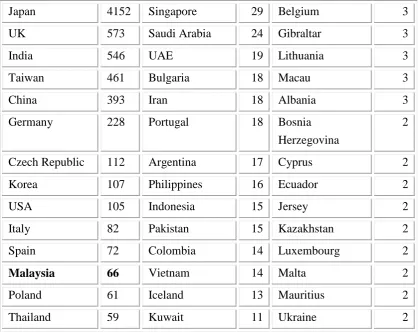
At a glance, the following Table 1.1 shows the number of ISO27001 certification issued worldwide. As of August 2012, total of 66 Malaysia organizations that were declared their ISO27001 certification out of the total 7940 organizations world-wide. Based on the total number of certificate issued for each country, Malaysia was ranged at 12 worldwide and this shows that ISO27001 certification is important and brings benefit to the organization.
Table 1.1: Number of Certificates Per Country (Version 215, August 2012).
(http://www.iso27001certificates.com)
Japan 4152 Singapore 29 Belgium 3
UK 573 Saudi Arabia 24 Gibraltar 3
India 546 UAE 19 Lithuania 3
Taiwan 461 Bulgaria 18 Macau 3
China 393 Iran 18 Albania 3
Germany 228 Portugal 18 Bosnia
Herzegovina
2
Czech Republic 112 Argentina 17 Cyprus 2
Korea 107 Philippines 16 Ecuador 2
USA 105 Indonesia 15 Jersey 2
Italy 82 Pakistan 15 Kazakhstan 2
Spain 72 Colombia 14 Luxembourg 2
Malaysia 66 Vietnam 14 Malta 2
Poland 61 Iceland 13 Mauritius 2
3 1.2 Background of the Problem
IT Services Centre Sdn. Bhd. (ISC) has an intention to reduce the cost and complexity of its IT infrastructure, while continuing to support multiple operations systems. The challenge to the implementation of ISC was in deciding on the right IT governance and security best practice framework to drive and manage the day-to-day operation in a secure and holistic manner. With the existing Information Technology Infrastructure Library (ITIL) framework is being practicing internally, ISC would like to uphold the principles of good IT governance, risk management, IT security and controls presently wishes to further strengthen these by achieving ISO/IEC27001 (the information security management system certification standard).
Based on the research study in common security threats faced by most of the organization, the researcher Lo and Chen (2012) highlighted the cybercrime was one of the key concerns by most of the organization such as information security breaches, identity theft and financial fraud. Subsequently, the famous common security threats is insider threats as described by Farn et al. (2008). The insider was classified into 2 types – malicious and non-malicious. The key challenges by most of the organization now days, they are more concerning on the non-malicious attack, meaning the defects of the information security breach was caused by unintentionally or careless with lack of knowledge or experience employees. Hence, most of the organizations believe that the insider threats are the most dangerous and difficult to control without clear understanding on the segregation of duties and responsibilities.
As the IT Services Centre has never conducted any feasibility study on managing the information security, the gap assessment is method that allows the organization to conduct a feasibility study on assessing the maturity level of current practice of ISMS. The outcome from the gap assessment could derive the approach and initiatives to implement the ISO27001 ISMS within an organization.
Risk assessment also playing an important role to ensure the organization is understand their risk profile by considering the tolerant risk versus the risk appetite on their day-to-day business operation (Cath Everett, 2011).
4 organization to maintain the security controls and improve confidentiality, integrity and availability.
1.3 Problem Statement
The information security is getting important now days that most of the organizations are concerning how to control and prevent the confidential information leakage from the organization to the outsider. The IT Services Centre does not have any clear visibility of the current maturity level of managing information security. Based on their existing practices, there is no benchmark or IT security framework for the organization to follow and adopt. Therefore, this research study is focus on the significant feasibility study on how the organization can adopt the ISO27001 ISMS standard framework in order to apply the recommended security controls and best practices to mitigate the complexity of infrastructure of organization information leakage and improve confidentiality, integrity and availability of information security within an organization.
1.4 Project Aim
5
1.5 Research Questions
i. What are the current security trends and the best practices of corrective and preventive actions for the organization to maintain confidentiality, integrity and availability of information security?
ii. What is the approach to conduct ISMS gap assessment exercise and the presentation of gap assessment report?
iii. What is the methodology used to conduct risk assessment?
iv. How to formulate the planning on ISMS policy document to comply with ISO27001 standard?
1.6 Research Objectives
i. To identify the current trend of common information security incidents and understand the ISO27001 ISMS practices on corrective and prevention actions.
ii. To propose gap assessment approach and carry out a feasibility study to conduct gap assessment by identifying the current maturity level of ISMS in IT services environment.
iii. To propose ISO27001 ISMS risk assessment methodology for the organization and finalize a complete risk assessment report.
iv. To formulate an implementation plan based on ISO27001 ISMS standard.
1.7 Research Scope
6 The ISMS scope covers the data centre facilities management includes the services offering such as data centre hosting facilities, and the day-to-day operation services within the data centre of the IT Services Centre.
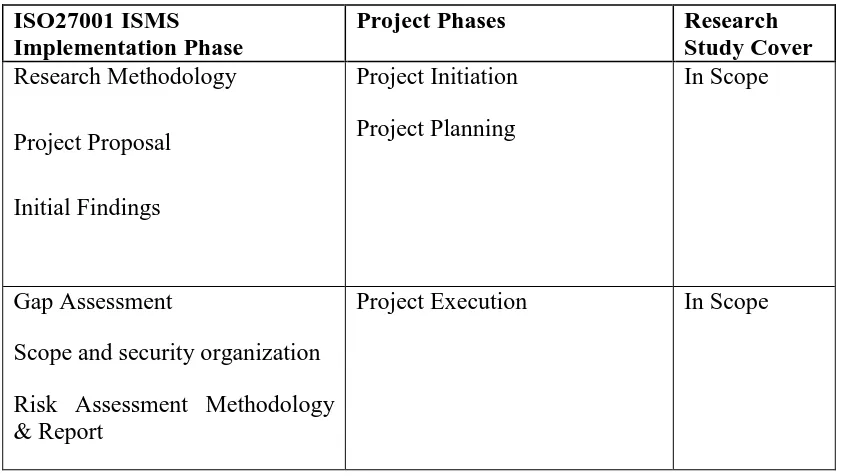
The implementation of ISO 27001 ISMS will be running as accordance to the project phases. The basis of the project phases is for monitoring, guidance and management of the ISO27001 ISMS implementation for the IT Services Centre.
For the purpose of this ISO27001 ISMS implementation, the project phases break down into Initiation, Planning, Execution, Monitoring & Control and Project Closure & Post implementation. Table 1.2 showing the direct mapping on project phases to the ISO27001 ISMS implementation phase..
Table 1.2: ISO27001 ISMS Implementation Phase and Project Phases Mapping
ISO27001 ISMS Implementation Phase
Project Phases Research
Study Cover Research Methodology
Project Proposal Initial Findings
Project Initiation Project Planning
In Scope
Gap Assessment
Scope and security organization Risk Assessment Methodology & Report
7 1.8 Summary
100
REFERENCES
Armerding Taylor (2012). The 15 worst data security breaches of the 21st Century. URL: Last Access on
http://www.csoonline.com/article/700263/the-15-worst-data-security-breaches-of-the-21st-century.
Al-Mayahi, and P. Mansoor. (2008). ISO27001 gap analysis – case study.
Boris Mutafelija and Harvey Stromberg. (2012). Mapping ISO to CMMI. Software Engineering Institute. URL: Last Access on:
http://www.sei.cmu.edu/cmmi/solutions/cmmi12-iso.cfm.
http://www.sei.cmu.edu/cmmi/compatibility/index.cfm.
http://www.sei.cmu.edu/cmmi/compatibility/iso.cfm.
Basie von Solms. (2005). Information Security governance: COBIT or ISO 17799 or both. Computers & Security. 24: 99-104.
Cath Everett. (2011). A risky business: ISO 31000 and 27005 unwrapped. URL: Last Access on:
http://www.sciencedirect.com/science/article/pii/S136137231170015X
Candace Gray. (2003). Understanding and complying with HIPAA. Journal of PeriAnesthesia Nursing. 1089-9472.
Chaiw Kok Kee. (2012). Journey towards Excellence in Information Security Management ISO 27001 ISMS – A Lesson Learnt. URL: Last Access on:
http://www.skmm.gov.my/skmmgovmy/media/General/pdf/ISMS_ASTRO.pdf
101
Christian, B., and Lahti. (2005). Sarbanes-Oxley IT Compliance Using COBIT and Open Source Tools. Pg. 31-57. Chapter 2 - SOX and COBIT Defined.
Chris Byrnes. (2012). Gartner Powerpoint Presentation Slide. Developing a Realistic Infosec Management Strategy.
Collmann, J., Lambert, D., Brummett, M., DeFord, D., Coleman, J., Cooper, T., McCall, K., Seymour, D., Alberts, C., and Dorofee, A. (2004). Beyond good practice: why HIPAA only addresses part of the data security problem. International Congress Series. 1268: 113-118.
Da Veiga, A., and Eloff, J. (2010). A framework and assessment instrument for information security culture. Computers & security. 29: 196-207.
Edward Humphreys. (2008). Information security management standards:
Compliance, governance and risk management. Information Security Technical Report. 13: 247-255.
Gary Hardy. (2006). Using IT governance and COBIT to deliver value with IT and respond to legal, regulatory and compliance challenges. Information Security Technical Report. 55-61.
ISO27K Toolkit. IsecT Ltd (2012).
URL: Last Access on http://www.iso27001security.com/html/27001.html.
Karin Hone, and Eloff, J.H.P. (2002). Information security policy - what do
international information security standards say. Computers & Security, Volume 21, Issue 5, Page: 402-409.
102 Kwo-Jean Farn, Shu-Kuo Lin, and Chi-Chun Lo. (2008). A study on e-Taiwan
information system security classification and implementation. Computer Standards & Interfaces. 30: 1-7.
Nigel Martin, and John Rice. (2011). Cybercrime: Understanding and addressing the concerns of stakeholders. Computers & Security. 30: 803-814.
Sevgi Ozkan, and Bilge Karabacak. (2010). Collaborative risk method for information security management practices: A case context within Turkey. International Journal of Information Management. 30: 567-572.
Steve Wright. (2006). Measuring the effectiveness of security using ISO27001 White Paper.
Stuart Broderick, J. (2006). ISMS, security standards and security regulations, Information Security Technical Report, Volume 11, Issue 1, Page: 26-31. Whitman ME, and Mattord HK. (2003). Principles of information security.
Kennesaw State University: Thomson Course Technology.