SOFTWARE TESTING PROCESS FOR SHARED BANKING SERVICES (SBS) SYSTEM
NORAKMAR BINTI ARBAIN @ SULAIMAN
SOFTWARE TESTING PROCESS FOR SHARED BANKING SERVICES (SBS) SYSTEM
NORAKMAR BINTI ARBAIN @ SULAIMAN
A project report submitted in partial fulfillment of the requirements for the award of the degree of
MSc. (Computer Science – Real Time Software Engineering)
Centre for Advanced Software Engineering Faculty of Computer Science and Information System
Universiti Teknologi Malaysia
v
ABSTRACT
vi
ABSTRAK
vii
TABLE OF CONTENTS
CHAPTER TITLE PAGE
DECLARATION ii
DEDICATION iii ACKNOWLEDGEMENT iv
ABSTRACT v
ABSTRAK vi TABLE OF CONTENTS vii
LIST OF TABLES xi
LIST OF FIGURES xiii
LIST OF ABBREVIATIONS xv
LIST OF APPENDICES xvii
1 INTRODUCTION 1
1.1 Organization Background 1 1.1.1 HeiTech Padu Berhad Overview 1 1.1.2 Business and Services at HeiTech Padu Berhad 1 1.1.3 Research and Product Innovation Center (R@PIC) Division 3
1.2 Project Background 4 1.2.1 Industrial Project Overview 4 1.2.2 Shared Banking Services (SBS) System Overview 5
2 SCOPES AND OBJECTIVES 7
2.1 Vision Statement 7
2.2 Project Objectives 7
2.3 Project Scopes 8
viii
2.5 Project Deliverables 8
3 LITERATURE STUDY 9
3.1 Software Testing Process 9
3.1.1 Definition and Principles of Software Testing 9 3.1.2 Relationship between Testing with Verification
and Validation 11
3.1.3 Software Testing Concepts 13 3.1.4 Software Testing Methods 22
3.1.5 Testing Techniques 23
3.1.6 Types of Testing 28
3.1.7 Level of Testing 30
3.1.8 The Challenges and Current Research 36
3.2 Software Testing Model 38
3.2.1 V- Model 38
3.2.2 W- Model 41
3.2.3 Butterfly Model 44
3.2.4 Summary 47
4 TESTING METHODOLOGIES 50
4.1 Introduction 50
4.2 HeiTech Software Testing Process 51
4.2.1 Testing Concepts 52
4.2.2 Main Activities 53
4.2.3 Testing Levels 58
4.2.4 Testing Types 60
4.2.5 Roles and Responsibilities 66 4.2.6 Test Documentations / Artifacts 67 4.2.7 Advantages and Disadvantages 68
4.3 RUP Test Discipline 69
4.3.1 Test Concepts 73
4.3.2 Main Activities 75
ix
4.3.5 Advantages and Disadvantages 91 4.4 Systematic Test and Evaluation Process (STEP) 93
4.4.1 Testing Concepts 94
4.4.2 Main Activities 95
4.4.3 STEP Architecture 97
4.4.4 Timing of STEP Activities 98
4.4.5 Elements of STEP 100
4.4.6 Test Documentations / Artifacts 102 4.4.7 Roles and Responsibilities 102 4.4.8 Advantages and Disadvantages 103
4.5 Summary 105
5 SHARED BANKING SERVICES (SBS) SYSTEM 107
5.1 Introduction 107
5.2 Core Banking Systems 107
5.3 Shared Banking Services (SBS) at R@PIC 110
5.3.1 Transaction System 112
5.3.2 Utilities 114
5.3.3 System Configuration 117
5.4 Testing Characteristics for SBS System 118
5.4.1 Functionality Testing 121
5.4.2 Performance Testing 122
5.4.3 Automation Test 124
5.4.4 Security Test 125
5.4.5 Advantages 126
5.5 SBS Testing Implementation at R@PIC 127
5.5.1 Plan Test 128
5.5.2 Design Test 129
5.5.3 Implement Test 129
5.5.4 Evaluate Test 130
6 CUSTOMIZED SOFTWARE TESTING PROCESS 131 6.1 Issues with Software Testing Implementation at
x
6.2 Developing A Customized Software Testing
Process (CSTP) 132
6.2.1 Main Phases for Testing Correspond to
Software Development Phases 132 6.2.2 Main Activities of Software Testing
Methodologies 133
6.2.3 Main SBS Testing Characteristics 134 6.2.4 Proposed Customized Software Testing
Process (CSTP) for SBS 135
7 CONCLUSION AND RECOMMENDATION 148
7.1 Recap 148
7.2 Project Outcome 149
7.3 Future Study 151
7.4 Summary 151
REFERENCES 154
CHAPTER 1
INTRODUCTION
1.1 Organization Background
1.1.1 HeiTech Padu Berhad Overview
HeiTech Padu Berhad [1] is a public listed company, which also as a Malaysia’s leading ICT Solutions and Services provider. HeiTech draws its strength from many years of experiences by working with the customers from both public and private sectors to transformed theirs business from manual processes to automated systems and provide effective information system solutions. This enables relevant business decisions to be made accurately and timely.
1.1.2 Business and Services at HeiTech Padu Berhad
i. HeiTech Padu Berhad Core Business
2
ii. HeiTech Padu Berhad - Electronic Government Solution Suite (e- GSS)
HeiTech’s Electronic Government Solution Suite (e-GSS) is a solution that links people, process and technology in a seamlessly integrated manner to deliver value and convenience to the citizens at large.
e-GSS is readily integrated the following solutions in it offering, which are:-
Biometric fingerprint solution
Photo captures solution
Card personalization solution
Smart card personalization solution
Barcode solution
RFID solution
Passport printing solution (centralized and decentralized)
Card Printing solution (centralized and decentralized)
Document scanning solution
Digital signature
iii. HeiTech Enterprise Solution Suite (HESS)
HeiTech Enterprise Solution Suite (HESS) is a set of products that ease the implementation of an enterprise system, which enable applications residing on legacy systems to be offered via multi-delivery channels such as web browser, self-service kiosk and mobile devices. This suite is able to support multi-protocols and is available both for open source and window-based platforms. HESS consists of 4 products which are:
E-Connect
RFID Middleware
Device Service Server
3
iv. HeiTech Padu Berhad Emerging Business
HeiTech has also ventured into non-traditional areas of expertise such as:
Content Development & Distribution
Data Management & Processing
Electronic Commerce
1.1.3 Research and Product Innovation Center (R@PIC) Division
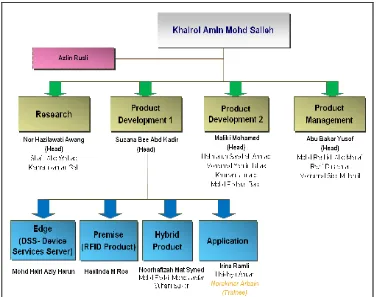
Research and Product Innovation Center (R@PIC) Division or previously known as Applied Research and Development (AR&D) Division was formed in October 2001. Figure 1.1 below shows the organizational structure of R@PIC division.
4
Objectives and scope of this division are to research, develop and enhance HeiTech proprietary software products, to develop application components that are application independent, to conduct research on new and emerging technologies that could be beneficial to software development in HeiTech and also to promote knowledge sharing culture in HeiTech as a whole.
1.2 Project Background
1.2.1 Industrial Project Overview
Software testing process is important in software development activities. Therefore, this industrial project is focused on software testing process that currently practices in HeiTech. This research also covers on several testing process that being establish and currently practice in many organizations, which are RUP Test Discipline [2,3] and Systematic Test and Evaluation Process (STEP) [4,5]. Hence, these testing methodologies are being chosen in order to refer for several criteria that can implemented later for the proposed software testing process on banking application, such as Shared Banking Services (SBS) system.
Shared Banking Services (SBS) system [6,7] is currently in development stage and the contribution requires for this industrial project is in testing phase of this system. This SBS system is being developed by Product Development Team in Research and Product Innovation Center (R@PIC) Division at HeiTech. Hence, this project also defined SBS modules and its characteristics that require specific software testing process.
5
software testing process can be practices in future as it suits for testing client-server application or banking application system.
1.2.2 Shared Banking Services (SBS) System Overview
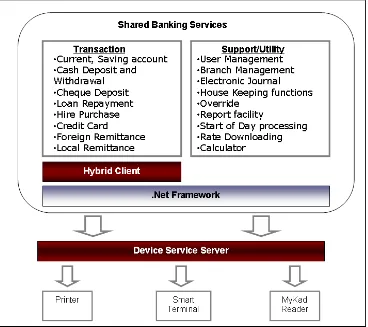
Shared Banking Services (SBS) [6] is a counter-based transaction system developed on top of a software framework (Hybrid Client) for developing a front-end, transaction based system. SBS system offers selected banking services that can be carried out at Pos Malaysia (PMB) branches. SBS consists of two main systems namely transaction systems and support or utility functions. Figure 1.2 shows the overall components view of Shared Banking Services (SBS) application system.
154
REFERENCES
1. HeiTech Padu Berhad. Retrieved on November 3, 2008, from
http://www.heitech.com.my/.
2. Test Discipline in RUP. Retrieved on December 8, 2008, from http://www.ibm.com/us/en/
3. IBM Rational Method Composer 7.0.1. Method Composer Application. 2008
4. Hetzel, William C. The Complete Guide to Software Testing. 2nd edition. Wellesley, MA. : QED Information Sciences, Inc. 1988.
5. Rick D. Craig and Stefan P. Jaskiel. Systematic Software Testing. USA: STQE Publishing. 2002
6. R@PIC. Shared Banking Services (SBS) Scope of Work, SOW Version 3.0. 2008.
7. R@PIC. Shared Banking Services (SBS) User Functional Specification, UFS Sign-off Version. 2008.
8. Myers G. J. Revised and Updated by Tom Badgett, Todd M. Thomas with Corey Sandler The Art of Software Testing. 2nd edition. New York, USA: John Wiley and Sons. 2004
9. Institute of Electrical and Electronic Engineers. IEEE Standard Glossary of Software Engineering Terminology. New York. IEEE Std 610.12 – 1990.
1990
155
11. Bach, J. Exploratory Testing Explained. 2003. Retrieved on February 16, 2009, from http://www.satisfice.com
12. John E. Bentley. Paper 141-30 Software Testing Fundamentals—Concepts, Roles, and Terminology. Wachovia Bank, Charlotte NC.
13. Institute of Electrical and Electronic Engineers. IEEE Standard for Software Verification and Validation Plans. New York. IEEE Std 1012 – 1986. 1986
14. Schmidt, Michael E.C. Implementing the IEEE Software Engineering Standards. USA: Sams Publishing. 2000
15. P.K. Davis, Generalizing Concepts of Methods of Verification, Validation and Accreditation (VV&A) for Military Simulations. RAND Report. 1992
16. Ron Patton. Software Testing. Indiana, USA : Sams Publishing. 2nd edition. 2006
17. Beizer, B. Software Testing Techniques. 2nd edition. USA: Van Nostrand Reinhold. 1990
18. M. Harrold. Testing: A Roadmap. International Conference on Software Engineering, (ICSE 00). ACM Press, New York. 2000
19. SEI. Software Quality Measurement: A Framework for Counting Problems Retrieved on November 3, 2008, from
www.sei.cmu.edu/pub/documents/92.reports/pdf/tr22.92.pdf
20. Kaner C. Software Testing as a Social Science. IFIP Working Group10.4, Florida Institute of Technology, Siena Italy. 2004
21. William E. Perry. Effective Methods for Software Testing. 2nd edition. John Wiley & Sons: USA. 2000
22. Scott Barber & Karen N. Johnson. A Close Look at the Five Schools of Software Testing. 2009
156
24. Rob Pirozzi. Introduction to Software Testing. LogiGear Corporation. Retrieved on November 19, 2008, from
http://www.logigear.com/newsletter/introduction_to_software_testing.asp
25. Goutam Kumar Saha. Understanding Software Testing Concepts
ACM Ubiquity Vol. 9, Issue6, 2008 February 12, 2008 - February 18, 2008
26. Peter Sestoft. Systematic Software Testin. IT University of Copenhagen, Denmark. Version 2. 2008
27. Lee Copeland. A Practitioner's Guide to Software Test Design, USA: STQE Publishing. 2004
28. Software Testing Guide Book. Software Testing Research Lab, Retrieved on January 14, 2009, from http://www.softrel.org/Modeling.html
29. Perry, William E. How to Test Software Packages : A step- by- step Guide to Assuring They Do What You Want. New York, USA: John Wiley & Sons.
1986
30. Kaner C. The Ongoing Revolution in Software Testing. Software Test & Performance Conference. December 8. 2004
31. John Watkins. Testing IT: An Off-the-Shelf Software Testing Process. Cambridge, United Kingdom: Cambridge University Press. 2001
32. Wasif Afzal. Metrics in Software Test Planning and Test Design Processes. Msc. Thesis. Sweden. 2007
33. Kaner C. Fundamental of Software Testing. Florida Tech, Colloquium Presentation, Butler University. 2003
34. Srinivasan D., Gopalaswamy R. Software Testing: Principles and Practices. New Delhi, India: Pearson Education. 2006
157
36. PMOC. V-Model Testing – Process Model Configuration Using SVG. 2003. Retrieved on March 3, 2009 from http://www.soberit.hut.fi/T-76.115/02-03/palautukset/groups/pmoc/de/vmodel.pdf
37. Paul Gerrard. Managing Projects with Intelligence. Gerrard Consulting Limited. 2004
38. Software Development Models. Retrieved on January 22, 2009, from
http://sqa.fyicenter.com/FAQ/Software-Development-Models/Software_Development_Models_W_Model.html
39. Spillner A. The W-MODEL – Strengthening the Bond Between Development and Test. University of Applied Sciences Bremen. Germany. 2002
40. James Christie. V Model Article. Retrieved on January 26, 2009, from http://www.clarotesting.com/page11.htm
41. Test methodology. Retrieved on January 26, 2009, from http://www.kynetia.com/quality/methodology.html
42. Test Development Model. Software Testing Research Lab, Retrieved on January 26, 2009, from http://www.softrel.org/Modeling.html
43. Student Accountant. Developing Systems. The V model relevant to Professional Scheme Paper 2. 2006. Retrieved on April 15, 2009, from
http://www.accaglobal.com/pubs/students/publications/student_accountant/
44. HeiTech. Application Development Information System (ADVISE). 2008
45. Fantinato, M. Applying Extended Finite State Machines in Software Testing. 2003
46. Rational Software Team. RUP: Best Practices for Software Development Team. Rational Software White Paper, 1998. Retrieved on December 6, 2008,
from http://www.rational.com
158
Banking Info. 2005. Retrieved on March 10, 2009, from http://www.bankinginfo.com.my
48. Morton Stephen D. The Butterfly Model for Test Development Applied Dynamics International. 2001
49. Li Jin-Hua, Li Qiong, Li Jing. The W-Model for Testing Software Product Lines. International Symposioum on Computer Science and Computional Technology. 2008
50. Per Runeson, Greberg P. Extreme Programming and Rational Unified Process – Contrasts or Synonyms? Lund University, Sweden. 2004.
51. Banking Application. Retrieved on March 18, 2009, from
http://findarticles.com/p/articles/mi_m4153/is_n1_v48/ai_10380967
52. Infotech Banking Services. Retrieved on March 18, 2009, from http://www.3i-infotech.com/content/services/software_testing.aspx
53. Third Eye. Software Testing. Retrieved on February 25, 2009, from http://www.stcthirdeye.com/banking.htm
54. Thinksoft Global. Software Testing. Retrieved on February 25, 2009, from http://www.thinksoftglobal.com/business_areas/core_banking/
55. Rodina. Requirements Validation. Retrieved on April 20, 2009, from http://fsktm.um.edu.my/~rodina/WKES3202_LEC4_Rodina.ppt