
AGEING MANAGEMENT OF CONCRETE STRUCTURES IN NUCLEAR
POWER PLANTS
J.Moore1, J.Tcherner2, D.Naus3, M.Bakirov4, J.Puttonen5,!"#$%&6
1Nuclear Engineer, International Atomic Energy Agency, Austria 2Senior Civil Engineer, Candu Energy, Canada
3Consultant, USA
4Center of Material Science and Lifetime Management Ltd., Russian Federation 5Professor, Aalto University, Finland
6!"#$#%&$"'($)%*+,-%./012$#%
ABSTRACT
Operating experience (OPEX) has shown that effective control of the ageing degradation of the major Nuclear Power Plant (NPP) components is important to plant safety and plant life; it is also important from economic point of view. Thus, ageing in NPPs must be effectively managed to ensure availability of design functions throughout plant life cycle. A series of reports on the assessment and management of ageing of major NPP components has been issued by the International Atomic Energy Agency (IAEA) in 1990s including TECDOC-1025 for concrete containment building. Recently, TECDOC-1025 has undergone a major revision to incorporate lessons learned and was expanded to include concrete structures other than containment building that are necessary for safe, reliable and economical operation of NPP.
The revised document (NP-T-3.5) planned to be released in 2015 includes state of the art information regarding ageing management of concrete structures in NPPs. It contains background material on ageing related degradation mechanisms that is necessary to ensure understanding of ageing. It also includes new and practical information on current practices and techniques for inspection, monitoring and mitigation of ageing degradation. The document is intended for NPP owners/operators, designers, engineers and specialists to establish, implement, and improve ageing management for NPPs, facilitate dialogue between owners / operators and regulators when dealing with age-related licensing issues, and to consider ageing in new plant design, in modifications, and in approaches to efficiently mitigate ageing effects.
The paper describes main updates included in the new document (NP-T-3.5) and discusses good industry practices to ensure integrity of concrete structures during different NPP lifecycle phases; i.e. design, fabrication, construction, commissioning, operation (including long-term operation and extended shutdown), and decommissioning.
INTRODUCTION
Concrete is a durable material and its performance as part of the containment function in NPPs has been good. However, experience shows that ageing degradation of concrete structures, often caused or accelerated by factors such as faulty design, use of unsuitable or poor quality materials, improper construction, exposure to aggressive environments, excessive structural loads, and accident conditions, can impair safety functions and increase risks to public health and safety. Effective ageing management of concrete structures in NPPs is therefore required to ensure their fitness-for-service throughout plant service life and during decommissioning (refer to Figure 1).
Significant ageing events related to concrete structures of NPPs have occurred and have been evaluated since the first publication of the document in 1998, e.g. delamination of concrete, alkali aggregate reactions, larger than anticipated loss of the prestressing force, spent fuel pool leakage, corrosion of steel in water intake structures, etc. These events led to a better understanding of the degradation mechanisms and necessitated new ageing management actions. Furthermore, in addition to containment building the importance of other concrete structure has been recognized.
OBJECTIVE AND SCOPE of NP-T-3.5
The document NP-T-3.5 is intended for NPP owners/operators, designers, engineers and specialists to:
! establish, implement, and improve Ageing Management Plans / Programmes (AMPs) for NPPs;
! facilitate dialogue between owners / operators and regulators when dealing with age-related licensing
issues;
! consider ageing in new plant design, in modifications, and in approaches to mitigate ageing effects.
While original TECDOC 1025 [1] was intended to address containment structures, NP-T-3.5 is applicable to all concrete structures associated with a typical NPP. Some document additions include information related to cooling towers, water intake structures, and spent fuel bays, among others.
The new document specifically includes:
! state of the art information regarding ageing management of NPP concrete structures throughout their
entire service life;
! background material indicating the importance of AMPs;
! current practices and techniques for assessing fitness-for-service, and for inspection, monitoring and
mitigation of ageing-related degradation of concrete containment buildings (CCBs) and other concrete structures important to safe and reliable operation of NPPs;
! technical bases for developing and implementing a systematic AMP;
! guidelines that can be used to help assure that ageing management is taken into account during
different NPP lifecycle phases; i.e. design, fabrication, construction, commissioning, operation (including long-term operation and extended shutdown), and decommissioning;
! research materials related to ageing and lessons learned;
! documentation of industry operating experience, events, and applicable codes and standards.
GUIDELINES FOR AGEING MANAGEMENT
To simplify application, the new document follows the structure of the generic Ageing Management methodology defined in IAEA Safety Guide NS-G-2.12 [2].
1. understanding ageing
2. developing ageing management plan 3. operating to minimize ageing mechanisms
4. performing inspections, monitoring and assessment to detect and assess ageing effects 5. performing maintenance to manage ageing effects.
As illustrated in Figure 2, ageing management is a loop process that allows for improvements of effectiveness of ageing management programme based on better understanding of ageing.
Understanding of ageing is paramount for effective ageing management. The document describes potential ageing mechanisms associated with materials and components of NPP concrete structures including concrete, reinforcement, prestressing systems, metallic and non-metallic liners, anchorages, foundations and piles, waterstops, seals, gaskets, and protective coatings.
Operating experience enables further advancements in understanding of the ageing phenomena, including understanding of degradation mechanisms and their consequences, locations and areas that are most effected, appropriate inspection, testing, monitoring techniques and mitigation strategies. Significant ageing events related to concrete structures of NPPs that occurred since publication of the first document in 1998 have been evaluated and results are compiled in the new document as well as the implemented remedial measures.
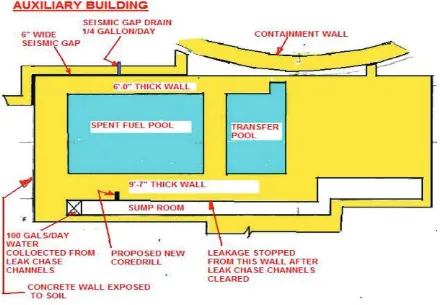
In general, performance of NPP concrete containment buildings has been very good, however many NPP concrete structures, including containment, have experienced degradation that has required remedial action. Initial problem areas identified were primarily related to material, design, and construction errors. As structures age, in addition to the design and construction deficiencies (e.g. corrosion of steel liner as shown in Figure 3), incidences of degradation related to environmental effects, are increasingly occurring. Based on OPEX, in addition to containment building the importance of other concrete structure has been recognized. Spent fuel pools leakage (Figure 4) and the consequences of the Fukushima accident for the spent fuel pools prompted addressing ageing of the spent fuel pools structures in the new document.
Condition monitoring and mitigation strategies have been defined in the new document for each Ageing Related Degradation Mechanism (ARDM) in addition to ageing stressors/operating conditions, ageing mechanisms, ageing effects and potential degradation sites.
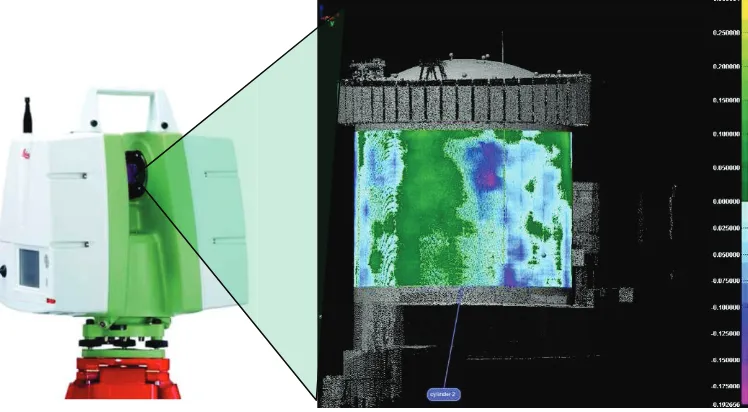
Historically visual inspection methods were primarily used to detect degradation. Development of Remote Operating Vehicles (ROVs) enables enhancing inspection, specifically the inspections of the areas that are not readily accessible (Figure 5 and Figure 6). Recent developments in non-destructive methods and analysis tools allows for faster and more reliable detection and assessment of the degradation (Figure 7). Instrumented monitoring has been proven effective as it can provide verification of design assumptions as well as monitoring short and long term performance of a structure. Finite element analysis has been proven useful to identify areas with high stress concentration in order to focus investigative activities (Figure 8).
SUMMARY AND CONCLUSIONS
Concrete structures are receiving increased attention at both a utility and regulatory level as original NPP structures age and new operating experience becomes available. They require detailed attention to ensure that plants are able to perform their required safety functions and to minimize costs.
Concrete ageing has been identified as one of the most important issues in relation to plant life management and life extension. Manufacturers, utilities, and new reactor designers need to address how concrete structures may be managed for long-life operation and what must be considered to ensure that they are reliable throughout their service life.
The new document makes the following conclusions with respect to concrete ageing in NPPs:
! AMPs and methodologies have been developed for NPPs and are generally well established.
Programme structures for concrete and civil structures are similar to other plant component programmes, such as electrical or mechanical components. Common IAEA Safety Guide information is available [2].
! Degradations mechanisms and results are described in detail, and characteristics of a wide range of
concrete inspection, monitoring, and repair techniques are presented. However, no single set can cover all requirements or circumstances, and techniques continue to be refined and developed.
! Cracking has been the most commonly observed form of degradation. Degradation factors of primary
concern are rebar corrosion due to concrete carbonation or presence of chloride ions, excessive loss of prestressing force, excessive containment leakage, and leaching due to percolation of fluids through concrete.
Some specific issues with respect to concrete ageing are:
! Increasing requirements on concrete structures beyond what was originally envisaged, due to plant
life extensions, security, and evolving safety requirements.
! As structures age, environmental stressors have increased potential for impacting on the functionality
and durability of structures.
! There is a need for routine re-evaluation of operating experience and research results related to
concrete ageing, and adjustment of AMPs as necessary.
! There is a need for re-evaluation of actual operating environmental conditions (e.g. radiation,
temperature, and humidity) and structure behaviour against design assumptions.
! There is a need for strict quality control during the construction phase of new NPPs to ensure concrete
quality for long term reliability.
! New construction should consider provisions for monitoring (e.g. using embedded instruments) and
inspection (i.e. ensuring accessibility) of concrete structures, as well as incorporating long-term durability requirements in the design.
REFERENCES
[1] INTERNATIONAL ATOMIC ENERGY AGENCY, Assessment and Management of Ageing of Major Nuclear Power Plant Components Important to Safety: Concrete Containment Buildings, IAEA TECDOC 1025, Vienna: IAEA, 1998.
[2] INTERNATIONAL ATOMIC ENERGY AGENCY, Ageing Management for Nuclear Power Plants, IAEA Safety Standards Series Safety Guide NS-G-2.12, Vienna: IAEA, 2009.
[4] UNITED STATES NUCLEAR REGULATORY COMMISSION, “Containment Liner Corrosion Operating Experience Summary. Technical Letter Report – Revision 1” Darrell S. Dunn et. al, Office of Nuclear Regulatory Research. 2011.
[5] UNITED STATES NUCLEAR REGULATORY COMMISSION, “Advisory Committee on Reactor Safeguards Plant License Renewal Subcommittee, Official Transcript of Proceeding Nuclear Regulatory Commission, Work Order NRC-577, Neal R. Gross and Company Inc., Court Reporters and Transcribers,” USNRC, 2010.
[6] J.TCHERNER et. al.“ Performance Surveillance of Gentilly-1 Reactor Building GFRP Repair Using Fiber Optic Sensors and Strain Gauges” SMiRT 20, Finland 2009.
[7] Á. ALMÁSI and O. ÁRPÁD, “Egy 1034% 42125% 56(77868% 9:4:0#% ;5+<+$'%=2)>'?52” (Repairing of a
group of 100 m tall ventilation chimneys), Vasbetonépítés 2000/1.
Figure 2 Systematic Approach to Managing Ageing of a Structure or Component (adapted from Figure 1 in [2])
Figure 4 Plan View of Fuel-handling Building Showing Relative Location of Spent Fuel Pool, Transfer Pool, and Containment Building [5]
Figure 6 Photograph of Debris in Spent Fuel Pool during Decommissioning Work using ROV (courtesy Atlantas Marine)
Figure 8 Containment Finite Element Model Showing Areas with Tensile Streses at Maximum Temperature Gradient (courtesy Center of Material Science and Lifetime Management Ltd.)
a) Before repair b) After repair
a) Before repair b) After repair
![Figure 1 Lifetime Periods of Structures, Systems and Components (based on Figure 4 of [3])](https://thumb-us.123doks.com/thumbv2/123dok_us/1208862.1151822/5.612.84.553.238.565/figure-lifetime-periods-structures-systems-components-based-figure.webp)
![Figure 3 Example of Corrosion Occurrence Originating from the Concrete Side of the Liner [4]: (a) paint blister, and (b) wood embedded in concrete after section of liner was removed](https://thumb-us.123doks.com/thumbv2/123dok_us/1208862.1151822/6.612.75.542.71.472/figure-example-corrosion-occurrence-originating-concrete-embedded-concrete.webp)
![Figure 9 Gentilly 1 Reactor Building Ring Beam Repair [6]](https://thumb-us.123doks.com/thumbv2/123dok_us/1208862.1151822/9.612.77.536.64.346/figure-gentilly-reactor-building-ring-beam-repair.webp)
![Figure 10 Repair of a Group of Ventilation Chimneys at Paks NPP [7]](https://thumb-us.123doks.com/thumbv2/123dok_us/1208862.1151822/10.612.84.517.64.359/figure-repair-group-ventilation-chimneys-paks-npp.webp)