Digital Object Identifier 10.1109/ACCESS.2017.2778093
Cloud Computing Fitness for E-Government
Implementation: Importance-Performance
Analysis
FATHEY MOHAMMED 1,2, AHMED IBRAHIM ALZAHRANI3,
OSAMA ALFARRAJ3, and OTHMAN IBRAHIM2
1Department of Information Technology, Faculty of Engineering and Information Technology, Taiz University, Taiz 6803, Yemen 2Department of Information Systems, Faculty of Computing, Universiti Teknologi Malaysia, Johor Bahru 81310, Malaysia 3Computer Science Department, Community College, King Saud University, Riyadh 11451, Saudi Arabia
Corresponding author: Fathey Mohammed ([email protected])
This work was supported by the Deanship of Scientific Research at King Saud University through Research Group under Grant RG-1438-062.
ABSTRACT The means through which governments deliver services and the way they operate may be considerably enhanced through cloud computing. It can help to address e-government implementation challenges and revolutionize e-government systems in terms of cost savings and the professional use of resources. The aim of this paper is to analyze the importance and performance of the factors that influence the fitness of cloud computing for e-government implementation. This paper integrates the task technology fit model with the diffusion of innovation theory to address this issue. Yemeni public institutions were identified as sources for data collection and 292 information technology employees participated as sample respondents for a structured questionnaire. Security, compatibility, relative advantage, and tasks were the variables found to affect the fitness of cloud computing for e-government activities. However, no impact was seen from the standpoints of trialability and complexity of the technology. In terms of assessing the fitness of cloud computing for e-government services, a greater understanding among policy formulators was sought through the importance-performance matrix analysis (IPMA). The results of IPMA can help identifying areas for strategic focus to assess cloud computing as an alternative technology to implement e-government services.
INDEX TERMS Cloud computing, DOI, e-government, importance-performance matrix analysis, TTF.
I. INTRODUCTION
Governments all over the world have recognized the poten-tial opportunities offered by information communication technology (ICT) to increase efficiency in internal pro-cesses and offer better services to citizens by implementing e-government systems. As a result, significant competitive disadvantages may be incurred by governments that overlook the strengths of emerging ICT technologies. Many develop-ing countries are facdevelop-ing an array of governance challenges, such as corruption, poor public management, lack of appro-priate transparency and responsibility in public decision-making powers, and the provisioning of public services [1]. E-government can be utilized as a tool to improve government processes in order to meet these challenges [1]–[4]. Nev-ertheless, as Ebrahim and Irani [5] noted, a robust technical system and proficient technical capabilities are necessary for introducing e-government technology, which itself entails
significant hazards and expense. Moreover, as Gant [6], Kanaan [7], and Al-Rashidi [8] emphasized, poor literacy and education level, a deficiency in ICT capabilities, insufficient technology systems, and scarce resources are all difficulties faced by developing states. Therefore, for developing coun-tries, specifically countries in the early stages of develop-ment or those that have not yet initiated an e-governdevelop-ment project, there is an increasing need to exploit the opportunities created by the new emerging ICT technologies as they invest in ICT to implement e-government systems. Cloud comput-ing is one such innovative technology that can extend services in an economical manner, as well as provide considerable opportunities to offer user-centered services.
Cloud computing can provide a good basis to address some of the aforementioned challenges faced by govern-ments. It has the potential to revolutionize e-government systems in terms of cost saving and the actual and
sional use of resources [9]–[11]. Further, cloud computing has recently created a revolution in the way ICT is used by organizations and individuals. Tripathi and Parihar [12] explained that in terms of fulfilling the unanticipated requests for resources, strong performance has been estab-lished with regard to state sector utilization of cloud-based services.
Many researchers have studied cloud computing in the context of e-government implementation [9]–[11], [13]–[21]. Moreover, it has been found that only 12% of the proposed models investigate the variables affecting e-government uti-lization of cloud computing, while 88% of the reviewed models propose integrating cloud computing in the process of e-government implementation [22].
Furthermore, Raiet al.[23] conducted a systematic review of cloud computing adoption factors and concluded that cloud adoption research is currently in the seminal stage and requires further studies to mature.
The decision to adopt new technology to implement a system may involve some risk. Therefore, developing a model that can examine the fitness of this technology for the context requirements is valuable. The choice of whether to employ cloud computing may be shaped by a consideration of variables influencing the fitness of cloud computing to the specific needs of the e-government of a developing state. Therefore, the choice of whether to provide e-government services through the utilization of cloud computing may be facilitated based on the model proposed in this research. By analyzing the importance and performance of these factors, insight and derived recommendations are provided for government policymakers and Information Technology (IT) managers to measure the fitness of cloud computing as an alternative technology for e-government services.
The following section reviews the related literature. In the subsequent section, a theoretical background is established, the model is presented, and hypotheses are proposed. Then, the methodology followed in this study is described. The next section presents the data analysis and results. Finally, an importance-performance analysis is conducted and a dis-cussion is presented on the findings of the study.
II. RELATED WORK
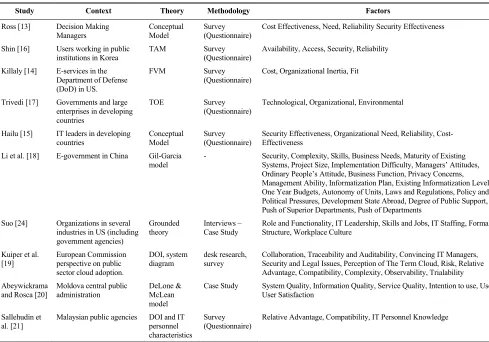
Since 2009, within the Information System (IS) context, attention has been paid to e-government and the potential for utilizing cloud computing within it. In terms of strategic IT development and the potential utilization of cloud computing for an institution, relevant variables were determined through the conceptual model developed by Ross [13]. Cost effec-tiveness, need for cloud computing, reliability, and perceived security effectiveness were considered. Furthermore, the U.S. Department of Defense (DoD) was assessed to determine the viability of cloud computing for the introduction of e-services by Killaly [14]. The acceptance of cloud computing by the DoD was investigated by proposing a Viability-Willingness Model (VWM), which was built based on the Fit-Viability
Model (FVM). Acceptance of cloud computing was found to be shaped by viability, which in turn is formulated through perceived technological appropriateness, organizational iner-tia, and cost.
In research conducted by Hailu [15], the cost-effectiveness, reliability, organizational need, and security effectiveness of cloud computing were assessed in relation to the perspectives of IT experts (in developing states) on the utilization of cloud computing. The advocating of cloud computing tool adoption by the IT experts was found to be positively related to their views on cost effectiveness, reliability, organizational need, and security effectiveness. Additionally, the implementation of cloud computing by government bodies was investigated by Shin [16]. The influence of key characteristics of cloud computing on behavioral intention was considered, and a the-oretical acceptance model was proposed to explore the factors influencing user perception of cloud computing. The model was developed by integrating TAM with specific influencing factors, such as availability, access, security, and reliability. The model was empirically verified by investigating the per-ception of users working in public institutions. The results showed that user intention and behavior are influenced by the perceived features of cloud services.
The utilization of cloud computing by big corporations and governments was the focus of the model developed by Trivedi [17]. Research on the Technology Organization Environment (TOE) model, as well as various case studies, was considered by Trivedi to identify significant variables. The TOE framework was applied to identify technologi-cal, organizational, and environmental factors. The proposed model helps organizations to understand what capabilities they need to develop to be able to adopt cloud comput-ing. Further, Liet al.[18] analyzed the current situation of e-government in China and the cloud computing services and discussed the potential of implementing cloud computing for e-government. By considering the challenges arising from the application of cloud computing for e-government service delivery, the variables affecting e-government introduction could be assessed. Determining the variables shaping cloud utilization was conducted via the Gil-Garcia model.
model. Ultimately, state sector utilization of cloud computing was found to be affected by risk and innovative variables such as trialability, observability, complexity, compatibility, and relative advantage, alongside other variables like defini-tional perspectives of ‘‘cloud,’’ security and legal challenges, persuasion of IT heads, auditability and traceability, and cooperation.
Abeywickrama and Rosca [20] investigated how cloud computing can enhance the value of public service delivery. Case study research on the Moldova central public adminis-tration was conducted. A success model based on the DeLone & McLean (D & M) model was proposed and factors related to system quality, information quality, service quality, inten-tion to use, use, and user satisfacinten-tion were examined. In the context of state bodies in Malaysia, potential variables affect-ing the choice to utilize cloud computaffect-ing were investigated by Sallehudinet al.[21]. A model was developed by integrating the DOI theory and IT personnel characteristics. Improve-ments in service provisions in the state sector of Malaysia through cloud computing was investigated in relation to influ-ential variables through the devised model. The implemen-tation of cloud computing in this context was found to be shaped by human variables, such as the understanding of IT employees, as well as innovation characteristics like compati-bility and relative advantage. Table 1 summarizes the context, theoretical background, methodology, and examined factors in the previous studies. The variables that shape the utilization of cloud computing in e-government environments have been assessed in various literature along with their devised models, and are illustrated in Table 1. Different perspectives and theories were applied to propose the models and examine the influencing factors. Quantitative methodology utilizing questionnaires was mostly used to verify the proposed mod-els, and various factors were examined. These factors include technological, organizational, environmental, economic, and human factors. However, adoption of a technology does not enhanced the performance of an organization unless this technology fit the organizations’ requirements [25]. Previous studies ignored measuring the fitness of cloud computing to the tasks of e-government implementation in developing countries.
Furthermore, a number of research studies reviewed the concept of cloud computing in the e-government envi-ronment by focusing on identifying e-government chal-lenges, as well as the benefits and barriers of e-governance on the cloud [26]–[28]. However, these studies sur-veyed the benefits and barriers of cloud computing based on its characteristics, with an absence of an empirical fieldwork. As a means of identifying the major impe-tuses behind the utilization of cloud computing across state sector institutions, various states and examples were explored by Mohammed and Ibrahim [29], posing an alter-native approach. The transition of service provision to cloud systems by state sector bodies was determined to be shaped by scalability and economization requirements as major and pervasive variables. Also by reviewing the cloud adoption
drivers, Raiet al.[23] concluded that cost savings, optimum resource utilization, unlimited scalability of resources, and less maintainability are the most common drivers. Aligning these drivers with common e-government implementation challenges (ICT infrastructure, human resources and finan-cial resources) shows that cloud computing may fit with the e-government implementation requirements in developing countries.
III. THEORETICAL FOUNDATION
According to Baas and van Rekom [30], the linkage of tech-nology to performance in IS research resulted in two main streams: the task-technology fit (TTF) model, and adoption-and utilization-focused models. Previous studies focused on cloud utilization in the context of e-government. The perspec-tives of IT employees and managers on cloud computing and its impact are considered by existing literature to shape the utilization of cloud computing. However, technology adop-tion is not always voluntary, and thus the performance impact is dependent on the supportive and instrumental value of the technology, rather than the degree of utilization [30]. There-fore, as Goodhue and Thompson [25] argue, if the adopted technology does not fit the requirements, higher utilization will not increase productivity. Hence, considering these two main streams can contribute to investigate the fitness of a technology to specific requirements toward adoption of this technology while ensuring higher productivity. Accordingly, this research proposes integrating two dominant theories: TTF and DOI. TTF identifies the factors that predict tech-nology usage and performance [25], [30], [31]. Nevertheless, as Leeet al.[32] explained, in terms of technology diffusion studies, DOI is considered to be an important theoretical model that is widely applied by analysts in studies on the utilization of innovative technologies.
A. TASK TECHNOLOGY FIT
The TTF model matches the capabilities of the technology to the demands of the task. It measures the ability of a technol-ogy to support a task [25]. TTF model has four key constructs, task characteristics, technology characteristics, task technol-ogy fit and performance/utilization. Task characteristics and technology characteristics together affect the task technology fit, which in turns affects performance or utilization as a dependent construct. The TTF model implies that technology is used if the available functions support the activities of the user. If no sufficient benefits exist, the technology is less frequently utilized [33]. Cloud computing characteristics may support e-government implementation tasks and thus can be used for implementing more effective e-government services. Accordingly, this research applies the TTF model to measure the effect of the fitness of cloud computing to e-government implementation tasks.
B. DIFFUSION OF INNOVATION THEORY
TABLE 1. Literature of cloud computing adoption in the E-government context.
is the DOI theory developed by Rogers and Shoemaker [34]. The DOI theory is used to explain the mechanism of the adoption and assists in predicting whether a new inven-tion will be successful. The theory postulates that certain attributes of an innovation can influence its adoption and at the same time affect the rate of acceptance of the innovation. According to Rogers, these characteristics include relative advantage, compatibility, complexity, trialability, and observ-ability. There are a number of studies that tested the DOI model in the context of cloud computing adoption [35]–[43]. Although cloud computing innovation comes with new char-acteristics compared to previous generations of computing, its adoption has not been fully understood in the context of e-government [22], [23].
IV. PROPOSED MODEL AND HYPOTHESES
The TTF model is specifically adapted to help determine whether cloud computing is a suitable option for imple-menting e-government tasks. It is measured by identifying e-government related tasks and requirements, and assessing the impact of cloud computing by using DOI factors. Accord-ingly, various constructs have been identified in the con-text of cloud computing fitness for e-government implemen-tation. Fitness is defined by Goodhue and Thompson [25] as the extent to which technology functionality matches
task requirements. Lippert and Forman [44] also defined the fitness as the extent to which a technology provides fea-tures and fits the requirements of the task. According to Lianget al.[45], fitness measures the extent to which the characteristics of a technology matches the needs of the task. In the context of the current study, fitness is defined as the extent to which cloud computing is consistent with the specific requirement of e-government implementation. On the other hand, task characteristics refer to the task requirements within the organization [45]. Task requirements can be defined as ability or behavior requirements [46]. In the current study, the task construct assesses the government-related requirements and actions that are performed to pro-vide e-services. In other words, the computational require-ments of government bodies in relation to the utilization of e-government services are explored. UN report [47] and Krishnan and Teo [48] explained that in order to replicate the ability to undertake activities that would typically occur offline, e-government infrastructure must be introduced and enhanced to provide internet-based public-sector services.
Therefore, this research proposes the following hypothesis:
H1: The e-government-related task requirements
In addition, by considering the technological factors influencing cloud computing adoption in the litera-ture [35], [38], [40], [43], [49], relative advantage, com-patibility, complexity, trialability, and security are proposed to measure the technology aspect of the fitness of cloud computing for e-government services implementation.
The extent to which an innovation is considered supe-rior to the concept that it supplants was characterized by Rogers [50] as relative advantage. As Nuseibeh [39] and Tehrani and Shirazi [43] explained specifically in relation to cloud computing utilization research, the extent that deci-sion makers consider cloud systems as superior to different computing paradigms characterizes relative advantage. Many studies examined relative advantage as a factor that posi-tively influences cloud computing adoption decision mak-ing [35], [38], [51]. In addition, the relative advantage impact on the fitness of information technology was examined in dif-ferent contexts [52], [53]. In the context of this research, rela-tive advantage can be seen as one of the factors that influence cloud computing fitness to e-government implementation. Therefore, this study postulates the following hypothesis:
H3: Relative advantage positively influences the fitness of
cloud computing to the computing needs of an organi-zation to implement e-government services.
Compatibility is the extent to which the value of the innovation is consistent with existing values, beliefs, and the needs of the context [50]. Morgan and Conboy [38] and Tehrani and Shirazi [43] explained that compatibility is concerned with the degree to which the present require-ments, capabilities, and technology of an institution are com-patible with cloud computing. Compatibility was widely used to study the diffusion of cloud computing adop-tion [35], [37]–[39], [41], [42], [51]. Further, several research studies examined compatibility as a factor to measure task–technology fitness [25], [31], [52], [54]. Furthermore,
Lamet al.[52] demonstrates the relationship between the
perceived compatibility of an IT system and the fitness of this system for task characteristics. E-government adoption and the effect of compatibility on the fitness of cloud computing is assessed in this research, with the subsequent hypothesis devised in this respect:
H3: Compatibility positively affects the fitness of cloud
computing to the computing needs of an organization, in order to implement e-government services.
The extent to which a new concept or item is consid-ered to be challenging to comprehend and utilize was the definition that Roger and Shoemaker [34] initially gave for complexity (as a DOI variable). Multiple studies examined complexity as a factor that negatively influences cloud com-puting adoption [35], [38], [39], [42], [43], [51]. Further, Goodhue and Thompson [25] defined complexity as a factor of the TTF. In addition, Leeet al.[54] examined complexity as one of the factors used to measure the fitness of technology for specific tasks. This study tests the effect of the percep-tion of complexity by the IT staff on the fitness of cloud
computing on the context of public sector organizations. Therefore, this study proposes the following hypothesis:
H4: Complexity negatively influences the fitness of cloud
computing to the computing needs of an organization to implement e-government services.
Furthermore, as Rogers [55] suggested, trialability is the extent to which a restricted trialing of an innovation can be undertaken and how it affects the diffusion of an inno-vation. Trialability is an important factor in cloud comput-ing [43]. Tehrani and Shirazi [43], Morgan and Conboy [38], and Alshamaila [35] examined this factor in the context of cloud computing. Further, Dishawet al.[33] examined the influence of trialability on TTF. The degree of fitness of cloud computing for e-government adoption can be deter-mined based on the utilization of hybrid, private, or state models of particular e-services to assess the following cloud services: software as a service, platform as a service, or infras-tructure as a service. Hence, this study aims to re-examine trialability to measure cloud computing fitness to implement e-government services. Therefore, the following hypothesis is proposed:
H5: Trialability positively influences the fitness of cloud
computing to the computing needs of an organization to implement e-government services.
Security can be defined as the ability to prevent unauthorized access or modification to information in stor-age, processing, or transit [56]. Conklin [57] noted that one of the primary issues for governments in relation to cloud computing platforms is data confidentiality and secu-rity. Lianet al.[36] also suggested that significant appre-hension exists regarding confidentiality and security of data on cloud computing platforms. Therefore, there are lim-its on which applications can be safely transferred to the cloud. As a result, an organization must carefully assess the pros and cons of transferring various applications and data to the cloud [13]. Thus, it is important to understand whether the security concerns significantly influence the fit-ness of cloud computing to e-government implementation requirements. Therefore, this study proposed the following hypothesis:
H6: Security negatively influences the fitness of cloud
com-puting to the comcom-puting needs of an organization in the implementation e-government services.
Fig. 1 represents the proposed research model.
V. RESEARCH METHOD
FIGURE 1. The research model.
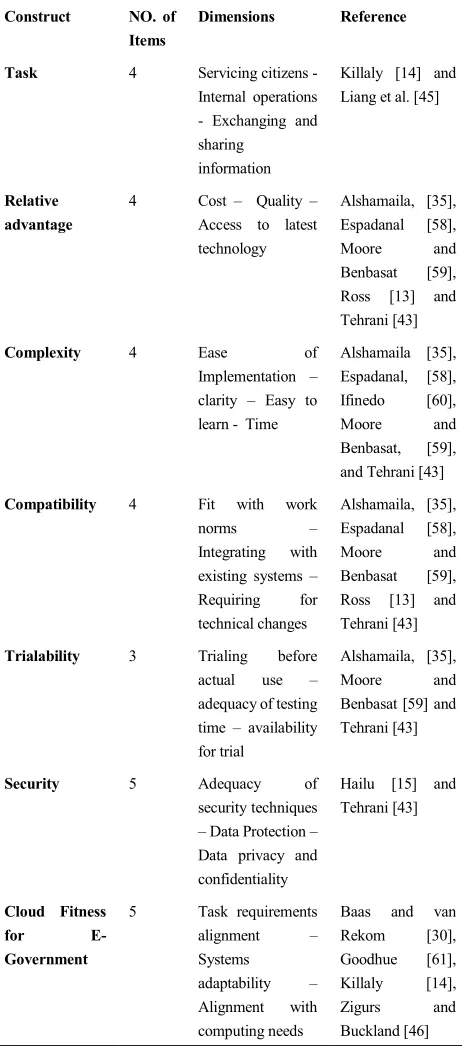
literature. Then, the dimensions of each construct are identi-fied. To measure each dimension, one item or more is adapted from the literature by considering the subject under investiga-tion (cloud computing) and the context (e-government). Con-structs’ dimensions, number of items and related references are illustrated in Table 2. For the detailed list of items used in the instrument see the Appendix. All items that address constructs in the model are based on a five-point Likert scale where 1 represents strongly disagree and 5 represents strongly agree. A nominal scale is used in the demographics section.
Because organizations associated with different types of services may have different characteristics and different lev-els of experience with e-services provisions, the study inten-tionally targeted a variety of organizations. This makes the sample less biased and more representative. Fifty organi-zations were identified and contacted. The researcher vis-ited each organization and explained the questionnaire to the manager and the IT staff before distributing it to them. At the end of the data collection journey, the study managed successfully to distribute approximately 380 questionnaires and collected 296, thus achieving an overall response rate of 77.9%.
VI. RESULTS
A. DESCRIPTIVE STATISTICS
The statistics analysis shows that 78.1% of the participants have a bachelor’s degree, 16.8% have a master’s degree, 4.5% have a diploma degree, and 0.3% have a PhD degree (0.3 is missed data, in which the respondent did not provide any information). With respect to the field of subjects, the results showed that 35.6% of participants have an IT background, 34.9% have a computer science background, 20.5% have an engineering background, and the rest hold an informa-tion systems and management background. With respect to
TABLE 2.Instrument development.
TABLE 3. Reliability and validity results.
B. MODEL ANALYSIS
To verify the model, partial least squares (PLS) was used for the data analysis. Structural equation modelling using PLS follows two-stage analytical procedures, measurement model assessment, and structural model assessment [62]. In the measurement model assessment, the reliability and validity of the constructs are examined. Structural model assessment aims to verify the model hypotheses.
1) MEASUREMENT MODEL
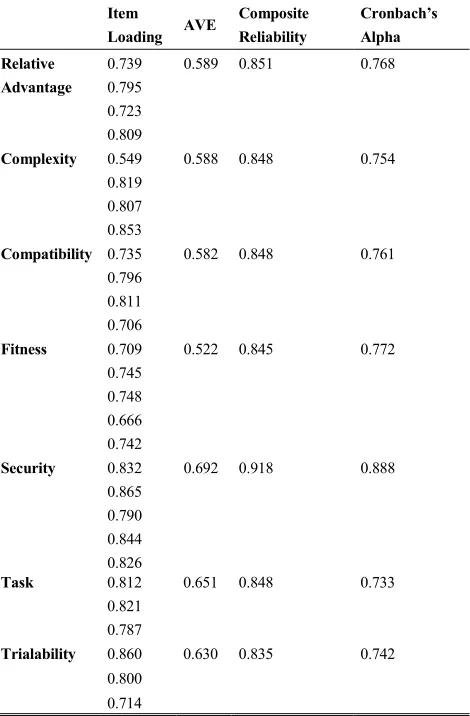
The measurement model is analyzed to verify the reliability and validity of the measurement. To examine the reliabil-ity of the item, three indicators can be used [63]: internal consistency by item loading, composite reliability, and Cron-bach’s Alpha. As shown in Table 3, all of the item loadings are above the minimum cut off point of 0.50 [64], which indicates satisfactory internal consistency. In terms of com-posite reliability, all values were above 0.7, which satisfies the criteria [63], [65], [66] as shown in Table 3. Cronbach’s Alpha also exceeds the minimum criteria of 0.7 [67] for all constructs (see Table 3). Hence, the measurement model provided sufficient evidence in terms of reliability.
With respect to validity, convergent validity and discrim-inant validity should be assessed. In terms of convergent validity, the average variance extracted (AVE) values meet the minimum criteria of 0.50 [63], [65] (Table 3), which means that for each construct, the items share more than 50 % of their variance. For discriminant validity (see Table 4), the square root of AVE for each construct is greater than the inter-correlations of the construct with other constructs in the research model [65], [66], [68]. This indicates that each con-struct is distinct and captures phenomena not represented by other constructs. Thus, the measurement model is satisfactory and in terms of reliability and validity.
2) STRUCTURAL MODEL
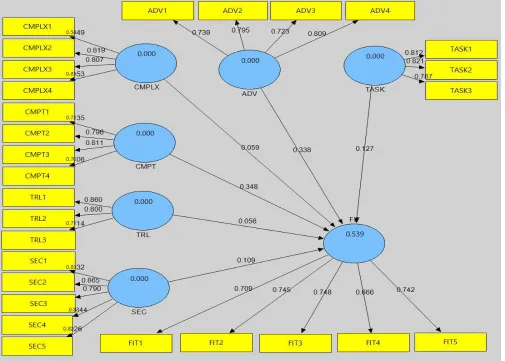
The structural model is assessed using the significance of the path coefficients, which indicates the strengths of the relationships between the dependent and independent vari-ables, and the R2 value, which represents the amount of variance explained by independent variables. The R2values for the dependent variable (Fitness) is 0.54 (See Fig. 2). This value reveals that the innovation factors with task characteristics explain approximately 54% of the fitness of cloud computing for implementing e-government services. To test the hypotheses, the significance of each path is estimated using a PLS bootstrapping method that utilizes 5,000 resamples [69]. Table 5 presents the results of the hypotheses testing, which includes t-values and p values in addition to the path coefficients. The results showed that hypotheses H4 and H5 are rejected while the rest are accepted.
VII. IMPORTANCE-PERFORMANCE MATRIX ANALYSIS The Importance-Performance Matrix Analysis (IPMA) extends the results of the measurement and structural models by adding a dimension that considers the performance of the latent variables. It is carried out in order to identify the possible areas that need to be addressed and improved with management activities [70]. The IPMA contrasts the total effects representing the importance of the predecessor con-structs in shaping a certain target construct, and their index values indicate their performance [71]. When conducting an IPMA on the indicator level, the mean value of an indicator represents its average performance. To facilitate the inter-pretation and comparison of performance levels, the IPMA rescales indicator scores on a range between 0 and 100, with 0 representing the lowest performance and 100 representing the highest performance. The rescaling of an indicator i proceeds via the following formula [70]:
Xirescaled = (xi−Minscale[x])
(Maxscale[x]−Minscale[x]).100
TABLE 4. Discriminant validity results.
FIGURE 2. PLS algorithm results.
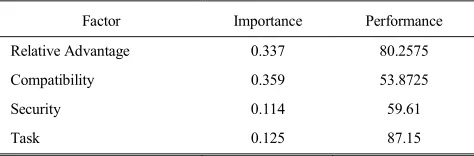
The IPMA of path modelling for cloud government fitness was carried out. By measuring the total effect (i.e., importance) and index values of the latent variables (i.e., performance). The latent variables with relatively low importance and relatively low performance on the fitness of cloud computing for e-government implementation are identified to provide managerial insights. First, the total effect (direct and indirect effects) of the relationships between the
TABLE 5. Hypotheses testing results.
FIGURE 3. IPMA of the factors influencing the FIT construct.
TABLE 6. IPMA results.
in term of importance-performance, whereas the security exhibits the lowest value of importance and a relatively low level of performance. Further, despite the fact that task identi-fication has a low value of importance, it has the highest value of performance. On the other hand, compatibility exhibits the highest value of importance, but it performs poorly compared to other factors in assessing the fitness of cloud computing to the tasks of e-government implementation.
VIII. DISCUSSION
Prior research demonstrated that cloud computing has advan-tages that, if exploited, can revolutionize e-government ser-vices provisions [9], [45], [72]–[74]. However, developing
countries still face major barriers in the development of e-government initiatives, such as IT infrastructure, costs, and lack of resources. Therefore, this study proposes a model to examine the factors that influence the fitness of cloud computing for e-government implementation. The variables that must be assessed in order to determine the fitness of cloud computing to deliver e-government services in state sector institutions are identified through the devised model. The proposed model hypothesized that the fitness of cloud computing to implement e-government is influenced by the tasks of e-government from one side, and the innovation factors of cloud computing from the other side.
Based on the results of this study, the fitness of cloud computing to introduce e-government services is shaped by the tasks that must be executed in relation to it. The related hypothesis is supported at the 0.01 level with p value 0.003, which indicates that specifying the tasks to be performed using cloud computing has an important role as a predictor of the fitness of cloud computing for e-government imple-mentation. This finding is relevant to the original model of TTF and related studies. Further, the results show that the path coefficient of the related relationship is 0.127, which is above the criterion of 0.100 [75]. Therefore, the fitness of cloud computing for e-government tasks appears to be influenced by the task features themselves. Additionally, the fitness of cloud computing for e-government tasks is shaped by security, compatibility, and relative advantage as technology variables. While compatibility and relative advan-tage positively influence the fitness of cloud computing for e-government implementation, security has negative effect. This reflects that security of information on the cloud is a significant area of concern for governments. Therefore, governments should pay more attention when using cloud computing to process information that is critical to national security, to citizens’ privacy, or to manage critical govern-ment operations. The related hypotheses were supported at level 0.01. The related path coefficients also show the high effect of these factors on the fitness of cloud computing to e-government tasks. These results are consistent with the related literature [31], [52]–[54].
empirical investigation show that thepvalue of the relation-ship between complexity and fit is 0.341, which significantly exceeds the significant value at level 0.1. This means that this study does not support the existence of a relationship between the complexity of cloud computing and its fitness to implement e-government services. Regarding the rela-tionship between the complexity and technology fitness for specific tasks, Lamet al.[52] confirms this relationship in the context of IT adoption by a hotel employee. However, Lee et al. [54] rejects that the complexity of a personal dig-ital assistant (PDA) affects its fitness for insurance industry tasks. In the context of cloud computing, the results of the study by Lowet al.[37] shows that the effect of complex-ity on cloud computing adoption is not supported. Further, Stieninger and Nedbal [76] demonstrates that due to sim-ple administration tools, high usability, and high degree of automation, experts do not consider cloud computing as a very complex technology to implement. This is consistent with the finding of this research. Furthermore, IT experts believe that it is not essential to be able to try out cloud ser-vices for long enough to measure its fitness for organization tasks. This interprets the result of this study in regarding to the trialability (Hypothesis 6). The output of the empirical analysis shows that this hypothesis is not supported (withp
value 0.232). In addition, a path coefficient value of 0.056 represents a weak relationship [63]. The outcome is in accor-dance with Tehrani and Shirazi [43] and the current research. To assign priority to management-oriented measures, IPMA has been conducted. Based on the results, the relative advantage of cloud computing is highly relevant to measuring its fitness for e-government implementation tasks, due to its significant impact. This dimension scored a high index value of importance; however, the minor potential for a further increase of performance can be applied. Efforts should be directed at maintaining or expanding the performance level of this area. With regard to compatibility, nearly the same strate-gies can be applied to performance, although the index value is significantly lower than the relative advantage. In order to determine the fitness of cloud computing for undertak-ing e-government tasks, compatibility characteristics must attain and sustain a particular degree of performance. For the dimension of task identification, results indicate that this factor has a high level of performance while scoring a low importance value. In addition, security has a low impact and scoring a relatively low index value of performance, which imposes a relatively substantial potential for further improvements.
IX. CONCLUSION
The main features of cloud computing, measured services, elasticity, and resource pooling may make it an ideal solution to e-government implementation challenges, which include cost, lack of compatibility, and insufficient IT skill. How-ever, before applying this technology, the factors that influ-ence the fitness of this technology for e-government tasks should be investigated. Therefore, TTF was selected to be
the foundation for this research model. It was integrated with DOI theory to measure the fitness of cloud computing (as an innovation) for e-government implementation tasks. Hence, this study contributes to the literature by extending the TTF to measure the fit regardless of the specific attributes of a technology, as well as empirically examining the model on new technology (cloud computing). Consequently, this study contributes to the understanding of cloud computing the context of e-government.
Moreover, the choice of whether to utilize cloud computing may be expedited by designing and verifying a cloud com-puting fitness model in relation to e-government tasks. The degree to which expenditure and time spent can be limited through cloud computing determines its fitness in relation to different technologies. In addition, adopting cloud computing depends on its compatibility for the specific requirement of the e-government project, as well as the security and privacy requirements and the controls that can be provided by cloud computing technology. Therefore, this study model can help policy makers and those who supervise e-governments to evaluate this modern technology as they design the roadmap for e-government.
For future research, studies can be conducted for investi-gating cloud computing adoption for e-government imple-mentation by applying different methodologies. A case study with a qualitative approach can be applied for a specific e-government project. A specific cloud model (Public, Private, Community or Hybrid) can be exam-ined to be adopted for a specific type of e-government services.
APPENDIX
THE INSTRUMENT ITEMS Task
- E-government ensures providing effective services to citizens.
- E-government enhances the internal operation perfor-mance of the organization.
- E-government helps facilitate effective exchanging and sharing of information between organizations.
Relative advantage
- Providing e-services over the cloud will lower costs. - Using cloud computing makes it easier for organizations
to implement e-government services.
- Cloud computing allows for the utilization of the latest versions of technology.
- Using cloud computing would improve the quality of the work performed by organizations.
Complexity
- It is easy to get cloud computing services to do what organization officials want them to do.
- Interacting with cloud computing services is not clear and is difficult to understand.
- It takes too much time for IT staff to use cloud comput-ing to perform their normal duties.
Compatibility
- Using cloud computing fits well with the way the orga-nization usually performs.
- The cloud can easily be integrated into existing IT infras-tructure.
- Cloud computing is compatible with the systems that are already in use.
- Using cloud computing services does not require many technical changes.
Trialability
- Before deciding to use any of cloud computing services, it can be tested properly.
- It is essential to be able to try out cloud services properly before deciding whether it fits with the tasks of an organization
- It is essential to be able to try cloud services (on a trial basis) for a certain amount of time to evaluate its capability.
Security
- Cloud computing provides sufficient security controls. - The security systems built into cloud computing services
are strong enough to protect organization data.
- Cloud providers maintain the privacy and confidentiality of organization data.
- The servers and data centers of cloud providers are secure.
- Overall, cloud computing technology is more secure than traditional computing methods.
Fitness
- The computing task requirements of an organization to implement e-government services closely align with cloud services.
- Cloud computing will satisfy the computing needs of an organization to implement e-government services. - Cloud Computing would be a good way to share and
exchange information between organizations.
- Current e-government applications can be easily adapted to the cloud.
- It seems that cloud computing fits well with organization requirements to provide e-government services.
REFERENCES
[1] T. Schuppan, ‘‘E-Government in developing countries: Experiences from sub-Saharan Africa,’’Government Inf. Quart., vol. 26, no. 1, pp. 118–127, 2009.
[2] M. M. Brown, ‘‘Understanding e-government benefits: An examination of leading-edge local governments,’’Amer. Rev. Public Admin., vol. 37, no. 2, pp. 178–197, 2007.
[3] J. R. Gil-García and T. A. Pardo, ‘‘E-government success factors: Mapping practical tools to theoretical foundations,’’Government Inf. Quart., vol. 22, no. 2, pp. 187–216, 2005.
[4] J. R. Gil-García, ‘‘Exploring e-government benefits and success factors,’’ inEncyclopedia of Digital Government. Hershey, PA, USA: IGI Global, 2007, pp. 803–811.
[5] Z. Ebrahim and Z. Irani, ‘‘E-government adoption: Architecture and barri-ers,’’Bus. Process Manage. J., vol. 11, no0. 5, pp. 589–611, 2005.
[6] J. Gant, ‘‘Electronic government for developing countries,’’ Int. Telecom-mun. Union (ITU), Geneva, Switzerland, Tech. Rep. 2-52, Aug. 2008. [7] R. K. Kanaan, ‘‘Making sense of e-government implementation in Jordan:
A qualitative investigation,’’ Ph.D. dissertation, De Montfort Univ., Leices-ter, U.K., 2009.
[8] H. Al-Rashidi, ‘‘The role of internal stakeholders and influencing fac-tors during the phases of e-government initiative implementation,’’ Ph.D. dissertation, School Inf. Syst., Comput. Math., Brunel Univ., Uxbridge, U.K., 2013.
[9] O. Nasr and G. H. Galal-Edeen, ‘‘Proposed development model of e-government to appropriate cloud computing,’’Int. J. Rev. Comput., vol. 9, no. 2, pp. 1–7, 2012.
[10] S. Alshomrani and S. Qamar, ‘‘Cloud based E-government: Benefits and challenges,’’Int. J. Multidisciplinary Sci. Eng., vol. 4, no. 6, pp. 1–7, 2013. [11] K. L. Bansal, S. K. Sharma, and S. Sood, ‘‘Impact of cloud computing in implementing cost effective e-governance operations,’’Gian Jyoti E-J., vol. 1, no. 2, p. P10, 2012.
[12] A. Tripathi and B. Parihar, ‘‘E-governance challenges and cloud benefits,’’ inProc. IEEE Int. Conf. Comput. Sci. Autom. Eng. (CSAE), Jun. 2011, pp. 351–354.
[13] V. W. Ross, ‘‘Factors influencing the adoption of cloud computing by deci-sion making managers,’’ Ph.D. dissertation, Capella Univ., Minneapolis, MN, USA, 2010.
[14] M. S. Killaly, ‘‘I can, but I won’t: An exploratory study on people and new information technologies in the military,’’ M.S. thesis, Graduate School Eng. Manage., Air Force Inst. Technol., Wright-Patterson AFB, Greene County, OH, USA, 2011.
[15] A. Hailu, ‘‘Factors influencing cloud-computing technology adoption in developing countries,’’ Ph.D. dissertation, School Bus. Technol., Capella Univ., Minneapolis, MN, USA, 2012.
[16] D.-H. Shin, ‘‘User centric cloud service model in public sectors: Policy implications of cloud services,’’Government Inf. Quart., vol. 30, no. 2, pp. 194–203, 2013.
[17] H. Trivedi, ‘‘Cloud computing adoption model for governments and large enterprises,’’ Ph.D dissertation, Sloan School Manage., Massachusetts Inst. Technol., Cambridge, MA, USA, 2013.
[18] G. Li, Q. P. Zhang, W. Wang, and Z. Q. Feng, ‘‘Analysis on influence factors of implementing e-government public cloud,’’Appl. Mech. Mater., vols. 411-414, pp. 2157–2160, Sep. 2013.
[19] E. Kuiper, F. Van Dam, A. Reiter, and M. Janssen, ‘‘Factors influencing the adoption of and business case for cloud computing in the public sector,’’ in
Proc. eChallenges Conf., Oct. 2014, pp. 1–10.
[20] M. Abeywickrama and V. Rosca, ‘‘Public organizations flying in the cloud: A case study of cloud computing value creation in Moldova central public administration,’’ Ph.D. dissertation, Dept. Informat., Umeå, Sweden, 2015. [21] H. Sallehudin, R. C. Razak, and M. Ismail, ‘‘Factors influencing cloud computing adoption in the public sector: An empirical analysis,’’
J. Entrepreneurship Bus., vol. 3, no. 1, pp. 30–45, 2015.
[22] F. Mohammed and O. Ibrahim, ‘‘Models of adopting cloud computing in the E-government context: A review,’’J. Teknol., vol. 73, no. 2, pp. 51–59, 2015.
[23] R. Rai, G. Sahoo, and S. Mehfuz, ‘‘Exploring the factors influencing the cloud computing adoption: A systematic study on cloud migration,’’
SpringerPlus, vol. 4, no. 1, p. 197, 2015.
[24] S. Suo, ‘‘Cloud implementation in organizations: Critical success fac-tors, challenges, and impacts on the it function,’’ Ph.D. dissertation, The Pennsylvania State Univ., State College, PA, USA, 2013.
[25] D. L. Goodhue and R. L. Thompson, ‘‘Task-technology fit and individual performance,’’ MIS Quart., vol. 19, no. 2, pp. 213–236, 1995.
[26] K. Smitha, T. Thomas, and K. Chitharanjan, ‘‘Cloud based E-governance system: A survey,’’Procedia Eng., vol. 38, pp. 3816–3823, Jan. 2012.
[27] C. Tsaravas and M. Themistocleous, ‘‘Cloud computing and eGovernment: A literature review,’’ inProc. Eur., Medit. Middle Eastern Conf. Inf. Syst., 2011, pp. 154–164.
[28] K. Vats, S. Sharma, and A. Rathee, ‘‘A review of cloud computing and E-governance,’’Int. J. Adv. Res. Comput. Sci. Softw. Eng., vol. 2, no. 2, pp. 1–5, 2012.
[29] F. Mohammed and O. B. Ibrahim, ‘‘Drivers of cloud computing adoption for E-government services implementation,’’Int. J. Distrib. Syst. Technol., vol. 6, no. 1, pp. 1–14, 2015.
[31] T. S. H. Teo and B. Men, ‘‘Knowledge portals in Chinese consulting firms: A task–technology fit perspective,’’Eur. J. Inf. Syst., vol. 17, no. 6, pp. 557–574, 2008.
[32] Y.-H. Lee, Y.-C. Hsieh, and C.-N. Hsu, ‘‘Adding innovation diffusion theory to the technology acceptance model: Supporting employees’ inten-tions to use e-learning systems,’’J. Educ. Technol. Soc., vol. 14, no. 4, pp. 124–137, 2011.
[33] M. Dishaw, D. Strong, and D. B. Bandy, ‘‘Extending the task-technology fit model with self-efficacy constructs,’’ inProc. AMCIS, 2002, p. 143. [34] E. M. Rogers and F. Shoemaker,Diffusion of Innovation: A Cross-Cultural
Approach. New York, NY, USA: Free Press, 1983.
[35] Y. Y. Alshamaila, ‘‘An empirical investigation of factors affecting cloud computing adoption among SMEs in the North East of England,’’ Ph.D. dissertation, Newcastle Univ. Business School, Newcastle upon Tyne, U.K., 2013.s
[36] J.-W. Lian, D. C. Yen, and Y.-T. Wang, ‘‘An exploratory study to understand the critical factors affecting the decision to adopt cloud computing in Taiwan hospital,’’Int. J. Inf. Manage., vol. 34, no. 1, pp. 28–36, 2014. [37] C. Low, Y. Chen, and M. Wu, ‘‘Understanding the determinants of
cloud computing adoption,’’Ind. Manage. Data Syst., vol. 111, no. 7, pp. 1006–1023, 2011.
[38] L. Morgan and K. Conboy, ‘‘Factors affecting the adoption of cloud computing: An exploratory study,’’ inProc. ECIS Completed Res., 2013, p. 124.
[39] H. Nuseibeh, ‘‘Adoption of cloud computing in organizations,’’ inProc. AMCIS, 2011, p. 372.
[40] P. Rieger, H. Gewald, and B. Schumacher, ‘‘Cloud-computing in banking influential factors, benefits and risks from a decision maker’s perspective,’’ inProc. 19th Amer. Conf. Inf. Syst., Chicago, IL, USA, Aug. 2013. [41] A. Saedi and N. A. Iahad, ‘‘An integrated theoretical framework for cloud
computing adoption by small and medium-sized enterprises,’’ inProc. PACIS, 2013, p. 48.
[42] M. Tan and T. T. Lin, ‘‘Exploring organizational adoption of cloud com-puting in Singapore,’’ inProc. 19th ITS Biennial Conf., Moving Forward Future Technol., Opening Platform All, Bangkok, Thailand, Nov. 2012. [43] S. R. Tehrani and F. Shirazi, ‘‘Factors influencing the adoption of cloud
computing by small and medium size enterprises (SMEs),’’ inProc. Int. Conf. Hum. Interface Manage. Inf., 2014, pp. 631–642.
[44] S. K. Lippert and H. Forman, ‘‘A supply chain study of technology trust and antecedents to technology internalization consequences,’’Int. J. Phys. Distrib. Logistics Manage., vol. 36, no. 4, pp. 271–288, 2006.
[45] T.-P. Liang, C.-W. Huang, Y.-H. Yeh, and B. Lin, ‘‘Adoption of mobile technology in business: A fit-viability model,’’Ind. Manage. Data Syst., vol. 107, no. 8, pp. 1154–1169, 2007.
[46] I. Zigurs and B. K. Buckland, ‘‘A theory of task/technology fit and group support systems effectiveness,’’MIS Quart., no. 22, no. 3, pp. 313–334, 1998.
[47] U. N. D. o. Economic, ‘‘United nations E-government survey 2010: lever-aging e-government at a time of financial and economic crisis,’’ United Nations Publications, Tech. Rep. 924916, 2010, vol. 2.
[48] S. Krishnan and T. Teo, ‘‘E-government, e-business, and national environ-mental performance,’’ inProc. 15th Pacific Asia Conf. Inf. Syst. PACIS, Brisbane, Qld., Queens., Australia, Jul. 2011.
[49] H.-P. Fu and T.-S. Chang, ‘‘An analysis of the factors affecting the adoption of cloud consumer relationship management in the machinery industry in Taiwan,’’Inf. Develop., vol. 32, no. 5, pp. 1741–1756, 2016.
[50] E. M. Rogers,Diffusion of Innovation Theory. New York, NY, USA: Free Press, 1995.
[51] H. P. Borgman, B. Bahli, H. Heier, and F. Schewski, ‘‘Cloudrise: Exploring cloud computing adoption and governance with the TOE framework,’’ in
Proc. 46th Hawaii Int. Conf. Syst. Sci. (HICSS), 2013, pp. 4425–4435. [52] T. Lam, V. Cho, and H. Qu, ‘‘A study of hotel employee behavioral
intentions towards adoption of information technology,’’Int. J. Hospitality Manage., vol. 26, no. 1, pp. 49–65, 2007.
[53] W. D. Nance and D. W. Straub, ‘‘An investigation of task/technology fit and information technology choices in knowledge work,’’J. Inf. Te chnol. Manage., vol. 7, nos. 3–4, pp. 1–14, 1996.
[54] C.-C. Lee, H. K. Cheng, and H.-H. Cheng, ‘‘An empirical study of mobile commerce in insurance industry: Task–technology fit and individual dif-ferences,’’Decision Support Syst., vol. 43, no. 1, pp. 95–110, 2007. [55] E. M. Rogers, ‘‘Elements of diffusion,’’ inDiffusion of Innovations, vol. 5.
New York, NY, USA: Free Press, 2003, pp. 1–38.
[56] J. B. Joshi, W. G. Aref, A. Ghafoor, and E. H. Spafford, ‘‘Security models for Web-based applications,’’Commun. ACM, vol. 44, no. 2, pp. 38–44, 2001.
[57] W. A. Conklin, ‘‘Barriers to adoption of E-government,’’ inProc. 40th Annu. Hawaii Int. Conf. Syst. Sci., (HICSS), 2007, p. 98.
[58] M. B. N. Espadanal, ‘‘Cloud computing adoption—Determinants of cloud computing adoption by firms,’’ Ph.D. dissertation, Univ. Nova de Lisboa, Lisbon, Portugal, 2012.
[59] G. C. Moore and I. Benbasat, ‘‘Development of an instrument to measure the perceptions of adopting an information technology innovation,’’Inf. Syst. Res., vol. 2, no. 3, pp. 192–222, 1991.
[60] P. Ifinedo, ‘‘An empirical analysis of factors influencing Internet/e-business technologies adoption by SMEs in Canada,’’Int. J. Inf. Technol. Decision Making, vol. 10, no. 4, pp. 731–766, 2011.
[61] D. L. Goodhue, ‘‘Development and measurement validity of a task-technology fit instrument for user evaluations of information system,’’
Decision Sci., vol. 29, no. 1, pp. 105–138, 1998.
[62] J. C. Anderson and D. W. Gerbing, ‘‘Structural equation modeling in practice: A review and recommended two-step approach,’’Psychol. Bull., vol. 103, no. 3, pp. 411–423, 1988.
[63] J. F. Hair, G. T. M. Hult, C. Ringle, and M. Sarstedt,A Primer on Partial Least Squares Structural Equation Modeling (PLS-SEM). Newbury Park, CA, USA: Sage, 2014.
[64] D. Gefen, D. Straub, and M.-C. Boudreau, ‘‘Structural equation modeling and regression: Guidelines for research practice,’’Commun. Assoc. Inf. Syst., vol. 4, no. 1, p. 7, 2000.
[65] A. Alzahrani, B. C. Stahl, and M. Prior, ‘‘Developing an instrument for E-public services’ acceptance using confirmatory factor analysis: Middle east context,’’J. Org. User Comput., vol. 24, no. 3, pp. 18–44, 2012. [66] W. W. Chin, ‘‘How to write up and report PLS analyses,’’ inHandbook of
Partial Least Squares. 2010, pp. 655–690.
[67] J. F. Hair, C. M. Ringle, and M. Sarstedt, ‘‘PLS-SEM: Indeed a silver bullet,’’J. Marketing Theory Pract., vol. 19, no. 2, pp. 139–152, 2011. [68] S. Y. Komiak and I. Benbasat, ‘‘The effects of personalization and
familiar-ity on trust and adoption of recommendation agents,’’MIS Quart., vol. 30, no. 4, pp. 941–960, 2006.
[69] W. W. Chin, ‘‘The partial least squares approach to structural equation modeling,’’Modern Methods Bus. Res., vol. 295, no. 2, pp. 295–336, 1998. [70] C. Hock, C. M. Ringle, and M. Sarstedt, ‘‘Management of multi-purpose stadiums: Importance and performance measurement of service inter-faces,’’Int. J. Services Technol. Manage., vol. 14, nos. 2–3, pp. 188–207, 2010.
[71] C. Fornell, M. D. Johnson, E. W. Anderson, J. Cha, and B. E. Bryant, ‘‘The American customer satisfaction index: Nature, purpose, and find-ings,’’J. Marketing, vol. 64, no. 4, pp. 7–18, 1996.
[72] S. Bhardwaj, L. Jain, and S. Jain, ‘‘Cloud computing: A study of infrastruc-ture as a service (IAAS),’’Int. J. Eng. Inf. Technol., vol. 2, no. 1, pp. 60–63, 2010.
[73] A. Chandrasekaran and M. Kapoor, ‘‘State of cloud computing in the public sectorŰA strategic analysis of the business case and overview of initiatives across Asia Pacific,’’Frost Sullivan, pp. 1–17, 2011. [Online]. Available: http://www.frost.com/prod/servlet/cio/232651119
[74] R. K. Das, S. Patnaik, and A. K. Misro, ‘‘Adoption of cloud computing in e-governance,’’ inAdvanced Computing(Communications in Computer and Information Science), vol. 133. Berlin, Germany: Springer, 2011, pp. 161–172.
[75] N. Urbach and F. Ahlemann, ‘‘Structural equation modeling in information systems research using partial least squares,’’J. Inf. Technol. Theory Appl., vol. 11, no. 2, 2010, Art. no. 2.
[76] M. Stieninger and D. Nedbal, ‘‘Diffusion and acceptance of cloud comput-ing in SMEs: Towards a valence model of relevant factors,’’ inProc. 47th Hawaii Int. Conf. Syst. Sci. (HICSS), 2014, pp. 3307–3316.
AHMED IBRAHIM ALZAHRANI received the master’s and Ph.D. degrees in computer science from Western Illinois University, USA, and De Montfort University, U.K., respectively. He is cur-rently an Assistant Professor and the Head with the Informatics Research Group, Computer Sci-ence Department, Community College, King Saud University. His main research interests span over IT diffusion and innovation, information technol-ogy management, human behavior modeling in technology usage, online social networks, and human–computer interaction using cognitive research.
OSAMA ALFARRAJ received the master’s and Ph.D. degrees in information and communica-tion technology (ICT) from Griffith University in 2008 and 2013, respectively. His Ph.D. disserta-tion investigates the factors influencing the devel-opment of e-government in Saudi Arabia and it is a qualitative investigation of the developer’s per-spectives. He is currently an Assistant Professor of ICT with King Saudi University, Riyadh, Saudi Arabia. He is also a Faculty Member with the Computer Science Department, Community College, King Saudi University. His research interests include electronic commerce, m-government, and the e-health systems.
OTHMAN IBRAHIMreceived the B.Sc. degree in computer science from Universiti Teknologi Malaysia (UTM) in 1997 and the M.Sc. degree in information technology from Universiti Kebangsaan Malaysia in 1999. He is currently Associate Professor with the Information Systems Department, Faculty of Computing, UTM.