ITERATIVE PROCESS TO IMPROVE SIMPLE ADAPTIVE SUBDIVISION SURFACES METHOD FOR TRIANGULAR MESHES
NOOR ASMA BINTI HUSAIN
A thesis submitted in fulfilment of the requirements for the award of the degree of
Master of Science (Computer Science)
Faculty of Computer Science and Information System Universiti Teknologi Malaysia
iii
To my beloved parent
Husain Bin Sarkan and RamlahBinti Ahmad who taught me never give up
Thank you
iv
AKNOWLEDGEMENT
With the name of ALLAH The Merciful. All praise goes to ALLAH, God of The Universe and All living things. Sholawat to Prophet of Muhammad S.A.W. Thankful to God that gave me the unbelievable strength to successfully complete this thesis and research. In preparing this thesis, I was in contact with many people, researchers, and academicians. They have contributed towards my understanding and thoughts.
I wish to express my sincere appreciation to my main research supervisor, Dr. Mohd Shafry Mohd Rahim, for encouragement, guidance, critics and friendship. I am also very thankful to my co-supervisors, Dr. Abdullah Bade for his guidance, advices and motivation.
Thanks go to Malaysian Ministry of Science, Technology and Innovation MOSTI grant (Vot:79404) for financial support of this research and Universiti Teknologi Malaysia (UTM) especially for Department of Computer Graphics and Multimedia.
v
ABSTRACT
vi
ABSTRAK
vii
TABLE OF CONTENTS
CHAPTER TITLE PAGE
DECLARATION ii
DEDICATION iii
AKNOWLEDGEMENT iv
ABSTRACT viii
ABSTRAK v
TABLE OF CONTENTS vii
LIST OF TABLES xi
LIST OF FIGURES xiii
LIST OF ABBREVIATIONS xvi
LIST OF APPENDICES xvii
1 INTRODUCTION
1.1 Overview 1
1.2 Problem Background 3
1.3 Problem Statement 7
1.4 Research Goal 8
1.5 Research Objective 9
1.6 Research Scope 9
1.7 Research Justification 10
1.8 Thesis Organization 10
2 LITERATURE REVIEW 2.1 Introduction 12
2.2 3D Computer Graphics 12
viii
2.4 3D Mesh Data Structure 14
2.4.1 Corner-Table 14
2.5 3D Computer Graphics Production 15
2.5.1 3D Modeling Process 15
2.5.2 3D Rendering 16
2.6 Subdivision Surfaces 17
2.6.1 Subdivision Surfaces Application 18 2.6.2 Subdivision Surfaces Properties 19
2.6.3 Subdivision Surfaces Schemes 21
2.6.4 Comparative Study 27
2.6.5 Butterfly Scheme 29
2.7 Adaptive Subdivision 30
2.7.1 Selection Area 30
2.7.2 Handling Cracks 32
2.7.3 Comparative Study 34
2.7.4 Degree of Interest (DoI) 38
2.7.5 Simple Triangulation 38
2.8 Discussion 40
3 RESEARCH METHODOLOGY
3.1 Introduction 42
3.2 Research Framework Development 43
3.3 Design Proposed Method 44
3.3.1 3D Objects Acquisition (Input Files) 45 3.4 Iterative Adaptive Subdivision Surface (IteAs) Algorithm 45
3.4.1 Data Structure Representation 46 3.4.2 Adaptive Subdivision Surface 47
3.4.2.1 Selection Areas 47
3.4.2.2 Subdivision Scheme 48
3.4.2.3 Handling Cracks 48
3.4.3 Iterative Process 49
3.4.4 Output Files 50
3.5 Development & Testing 50
ix
3.7 Summary 52
4 ITERATIVE ADAPTIVE SUBDIVISION SURFACES METHOD
4.1 Introduction 53
4.2 The Concept of Iterative Adaptive Subdivision Method 53 4.2.1 Basic idea of Adaptive Subdivision 54
4.2.2 Basic idea of Iterative Adaptive Subdivision 55
4.2.3 Memory Management 56
4.2.4 Object Representation 57
4.3 Iterative Adaptive Subdivision Surface Method 58 4.3.1 Create Triangle Mesh 58
4.3.2 Corner Table Representation 60
4.3.3 Normalization and Angle between Faces (ABF) 62 4.3.4 Selection Area 64
4.3.5 Butterfly Subdivision Scheme 65
4.3.6 Handling Cracks 67
4.3.7 Optimization Process 69
4.3.8 Smooth Surfaces 71
4.3.9 Iterative Process 71
4.4 Summary 72
5 RESULT AND ANALYSIS 5.1 Introduction 73
5.2 Implementation of Iterative Adaptive Subdivision Method 74
5.3 Prototype Development 77
5.4 Testing & Validation 79
5.5 Result & Analysis 82
5.6 Evaluation 98
5.7 Summary 100
6 CONCLUSION AND FUTURE WORKS 6.1 Research Summary 101 6.2 Contributions 102
x
Method 102
6.2.2 A New Method of Threshold Value Dtermination 103
6.2.3 Enhanced Process with Prototype Development 103
6.3 Future Works 104
6.3.1 Selection Area 104
6.3.2 Handling Cracks 104
6.3.3 Real-Time Environment 105
6.3.4 Another Subdivision Scheme 105
6.3.5 Cross Field 105
6.4 Conclusion 106
REFERENCES 108
Appendix A - List of Journaland Publications 113
Appendix B - Data of Frame per Second and Memory Usage in
Original Method
114
Appendix C - Data of Frame per Second and Memory Usage in
Iteration Method
xi
LIST OF TABLES
TABLE NO. TITLE PAGE
2.1 The comparison between subdivision schemes 27 2.2 Comparison between methods of selection area 35 2.3 Comparison of handling cracks methods 36 3.1 Hardware Requirement for Standard PC 51 3.2 Hardware Requirement for High Performance PC 51
3.3 Software Requirements 51
4.1 Corner Table configuration 67
5.1 Pre-defined Threshold 80
5.2 Result of original method for Eight object. 82 5.3 Result of IteAS method for Eight object. 83 5.4 Percentages of improvement IteAS method for Eight
object 84
5.5 Smooth appearance for Eight object 85
5.6 Result of original method for Torso object. 86 5.7 Resut of IteAS method for Torso object. 86 5.8 Percentages of improvement IteAS method for Torso
object 87
5.9 Smooth appearances for Torso Object 88
xii
5.12 Percentages of improvement IteAS method for Chess
object. 90
5.13 Smooth appearances for Chess Object 90 5.14 Result of original method for Muffin object 91 5.15 Result ofIteAS method for Muffin object 92 5.16 Percentages of improvement IteAS method for Muffin
object. 92
5.17 Smooth appearances for Muffin Object 93 5.18 Result of original method for Dragon object 93 5.19 Result ofIteAS method for Dragon object 94 5.20 Percentages of improvement IteAS method for Dragon
object. 95
5.21 Smooth appearances for Dragon Object 95
xiii
LIST OF FIGURES
FIGURE NO. TITLE PAGE
1.1 A Geri’s Game 2
1.2 The comparison between regular subdivision and
adaptive subdivision 4
2.1 General Conceptual Framework 13
2.2 Example model of subdivision surfaces, Female
head (ear) 18
2.3 Examples of interactive games development and
animation 19
2.4 Triangular and quadrilateral shape 20
2.5 Left is interpolation: right is approximate 21 2.6 Subdivision masks for Doo-Sabin scheme 22 2.7 Subdivision masks for Catmull-Clark scheme 23
2.8 A basic of triangular subdivision 24
2.9 Subdivision masks for Loop scheme 25
2.10 Subdivision masks for Butterfly scheme 25 2.11 Subdivision masks for Kobbelt scheme 27 2.12 Shows a comparison for a cube by different
schemes 29
2.13 Example of crack created. 33
xiv
can happen at ends of triangles where one triangle used to meet their adjacent without being connected
to it 39
2.15 Three conditions that fixed cracks 39
2.16 Example of a simple triangulation case. 40 3.1 Research phases for development of an
enhancement of adaptive subdivision surface
method using iterative concept 43
3.2 Design of proposed method 46
3.3 Example of corner table 47
4.1 Diagram of memory management in adaptive
subdivision process 56
4.2 Example flow of adaptive subdivision from base mesh to limit surfaces to proof that their
smoothness were maintained as well as regular
subdivision 57
4.3 Vertices and triangles connectivity 58
4.4 Iterative process of adaptive subdivision method
59 4.5 Corner Table representation with its label c.o, c.v,
c.n, c.p, c.l, and c.r in a triangle mesh 61 4.6 Using adjacency table for triangle mesh traversal 61
4.7 Normal vector 62
4.8 Example of an angle between two adjacent faces 64
4.9 Butterfly mask with corner labels 66
4.10 Construct new Corner Table 67
4.11 Example of creating of crack 68
4.12 Configuration of subdivision on handling cracks
condition 68
5.1 The console that shows number of vertices and
xv
5.2 The developed prototype to implement proposed
research 78 5.3 Shows the comparison the number of triangles
between Original and IteAS method 96 5.4 Shows a comparison frame per second between
Original and IteAS method 97
5.5 Shows a comparison memory usage between
xvi
LIST OF ABBREVIATIONS
CAD - Computer-Aided Design
2D - Two-Dimensional
3D - Three-Dimensional
NURBS - Non-Uniform Rational Basis Splines
FPS - Frame per-second
DOI - Degree of Interest (DOI
CA - Conical Angle
RGB - Red Green Blue
LOD - Level of Detail
LMR - Local Mesh Realignment GPU - Graphic Processing Unit
PC - Personal Computer
VF - Vertex Flatness
RAM - Random Access Memory ABF - Angle Between Faces MB - Megabyte (1,000,000 Bytes)
xvii
LIST OF APPENDICES
APPENDIX TITLE PAGE
A List of Journal and Publications 113
B Data of Frame per Second and Memory Usage in
Original Method 114
C Data of Frame per Second and Memory Usage in
CHAPTER 1
INTRODUCTION
1.1 Overview
Computer graphics areas had widely used because it made computers easier to interact with, better for understanding and interpreting such as graphics presentation, computer-aided design (CAD), image processing, simulation & virtual reality, and entertainment. The most attractive and widely used application in this field is computer games development and 3D animation industry. In fact, the needs of computer graphicsdevelopment such as modelling and rendering phase had revolutionized became more sophisticated. Fortunately, development of the latest technology has given more benefit to this field to deliver visual appearances and produce real-time environment with 3D contents (Edward, 2008).
2 NURBS especially in handling arbitrary topology. Smoothness of subdivision surface can be easily maintained because it dependent to subdivision algorithm.
A basic idea of subdivision method had been proposed by G de Rham which uses corner cutting to produce a smooth curve. G de Rahm described a 2D subdivision scheme in 1947 and was rediscovered by Chaikin (1974). The concept is extended to subdivision schemes by two separate groups in 1978 which were Catmull Clark and Doo Sabin. They implied the beginning of subdivision for modelling surface. Subsequent works were with Loop (1987) and Dyn (1990).Recently, subdivision surface has found the way to expand its wing in computer graphic applications and computer aided geometric design (CAGD)(Zorin,2000).
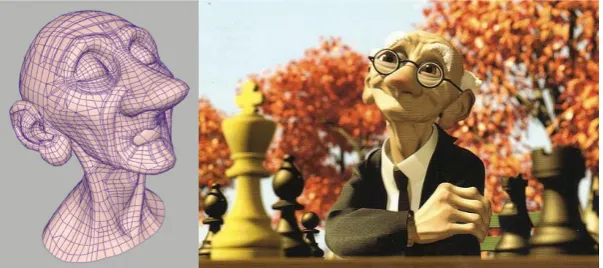
Subdivision surfaces had already been used in many areas especially including the animation movies development. NURBS was applied in the first Toy Story movie in 1995. Then, subdivision surfaces were contributed in a Bug’s Life movie in 1998. Pixar started demonstrating subdivision surfaces in 1997 in a short film called Geri’s Game (DeRose, 1998). From 1999 onwards, everything they worked on was with subdivision surfaces, which are Toy Story 2, Monsters Inc and Finding Nemo.Maya, Rhino, 3D Max and Light Wave modelling and animation software also used subdivision as a great tool with the same purpose(Peter and Zorin, 1998; Peter, 2009).
3
1.2 Problem Background
Generally, subdivision surface is a refinement operation that is uniformly applied to a polygon mesh to produce smooth surfaces. There are few steps needed to be made to subdivide and refine surfaces become smooth. Basically, a midpoint between two points from coarse mesh needs to be calculated. New vertices were inserted at the midpoint, and new edges were created to form a new mesh. Then, the mesh needs to be refined by applying a set of subdivision rules (Warren, 1995).
Subdivision surfaces consist of several schemes that are used to produce smooth surfaces which are Doo Sabin, Catmull Clark, Loop, Butterfly, Kobbelt subdivision scheme. Each scheme has its own rules and properties to produce smoothness such as mesh type, continuity, approximation or interpolation, and evaluation mask (Doo and Sabin, 1978; Catmull and Clark, 1978; Loop, 1987; Dyn et al, 1990; Kobbelt, 2000; Zorin, 2000).
However, there are two main issues that arose in subdivision surfaces while accomplishing the objective of subdivision surfaces. The issues are geometry modeling and rendering process.
In geometric modeling, two sub issues that arose were addressed to implementation of subdivision algorithms (Dyn and Levin, 2002). First, to compute the limit values and limit derivatives at dyadic points through the subdivision process for any refinement level.Second, to get the best possible approximation of desired surface from choosing initial control points from a given scheme with the highest possible approximation power.
4 will lead a heavy computational load and also rapidly exceeds the memory limitations (Pulli and Segal, 1996; Lomont, 2007).
The focus of this research is to address issues in the rendering process which is the process of subdivision surface is slow, and rendering process takes a lot of memory and time. One approach to solve these issues has been studied to find out if only necessary areas can be subdivided and can avoid unnecessary refinement on other areas of the mesh while approximated to the limit surface. In certain cases, subdivisions of the entire mesh are not necessary or required. Adaptive subdivision is an approach that provides a rule to find out whether a given polygon meshes required for being subdivided to further subdivision at the next step of subdivision (Amresh et.al, 2001).
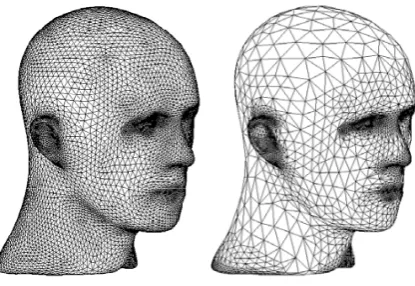
Figure 1.2 The comparison between regular subdivision and adaptive subdivision
(Pakdel and Samavati, 2004)
The concept of adaptive subdivision surface is a refinement to the certain areas of the control mesh. Adaptive subdivision produces smooth surfaces precisely same as well as the regular subdivision to the entire mesh although only subdivides at the selected area. Therefore, all vertices must have the similar connectivity within the selected area as a regular subdivision.
5 selection area to be subdivided while prevent unnecessary locations and to avoid cracks that are created from the differences subdivision depth of adjacent faces generations meet at an edge. Cracks must be removed because it will appear some artifact at the mesh (Pakdel and Samavati, 2004).
Previously, adaptive subdivision methods have been observed which can be categorized by two ways which is identifying the surfaces by vertex split or face split (Amreshet.al, 2001). A crack was not produced when refinement process based on vertex split. However, adaptive subdivision method based on face split will produce the cracks. Then, related works about adaptive subdivision based on selection area and handling cracks also have been reviewed.
6
After the selection area work efficiently, another problem that will occur needs to be highlighted. While a subdivision process working based on face split, cracks are created between subdivided and non-subdivided areas. Based on ideas for handling cracks, a new method had been proposed that called as red-green triangulation which removing cracks by inserting new edge into the triangular mesh was developed. This method consists of two conditions which are green triangulation and red triangulation. Green triangulation is bisecting for faces with one crack, while red triangulation is quadrisect faces with more than one cracks (Bank et.al, 1983). According to Amreshet.al (2001), a simple triangulation method was introduced to remove cracks by bisecting an adjacent face that has not been subdivided. Seeger et.al, (2001) have discussed how to apply simplest mesh modification with triangle mesh subdivision by vertex splitting. The dyadic refinement is decomposed into atomic local operations based on the popular vertex split operation which called as quarks. Liu and Kondo (2004) proposed method that was identified which vertex in a face is labeled as ‘dead’. They also proposed appropriate mesh refinements based on the three vertices properties. They address these cracks problem and provide a solution which is called local mesh realignment (LMR).
Pakdel and Samavati (2004) proposed a new adaptive subdivision algorithm that subdivides the adjacent faces around the selected area. This method used Loop subdivision scheme to handle cracks and more efficient rather than two previous methods which are red-green triangulation and restricted mesh in effect creating a surface that gradually increases in subdivision depth. In 2007, they introduced a new incremental adaptive subdivision method for triangular mesh. It produces surfaces from coarse mesh to fine model which have consistent connectivity and geometry with steadily increases in subdivision depth. The combination methods of restricting mesh and limiting the difference depth of adjacent faces are potential to obtain better behaved adaptive subdivision especially for handling cracks.
7
Amor et.al (2000) presented architecture to implement the adaptive subdivision of triangular meshes according to the surface complexity which the coarse triangle meshes is tessellated described by the displacement map. This was a standard architecture and characterized by data management efficiency that minimizes the data storage. It also avoids remaining cycles that would be linked with the multiple data accesses needed for each subdivision step. In 2001, this adaptive displacement mapping algorithms in hardware was improved. They presented a meshing scheme and new architecture that practicable in hardware that brings for speedy access using a small memory.
New adaptive rendering method for general Catmull-Clark subdivision surfaces is based on direct evaluation of the limit surface to produce an inscribed polyhedron. Inscribed approximation typically provides quicker convergent rate that produces less polygons at the last rendering process rather than circumscribed approximation. This method implements evaluation of the limit surface at the points that are required at the final rendering process. Therefore, this method is efficient in memory and speed (Lai et.al, 2005).
1.3 Problem Statement
non-8 subdivide areas should be avoided.Appropriate mesh refinements based on its neighboring faces properties should be proposed. Several methods have been proposed to overcome these issues. The methods proposed to determine face requirement for subdivision and can be efficiently computed for selection area such as Dihedral Angle and Gaussian curvature. Several methods also have been proposed to handle crack in adaptive subdivision surfaces with steadily change of resolution all over the surface with consistent connectivity and geometry such as Simple Triangulation, Red Green Triangulation and Incremental Adaptive. Unfortunately, the result of adaptive subdivision when it reaches the higher level of subdivision still brings the problem with memory consumption (Pulli and Segal, 1996; Wu et.al, 2005; Lomont, 2007; Patney and Owens, 2008; Zhao, F. and X. Ai. 2010). There are needs of enhancement process which can reduce cost of memory consumption.
Thus, the issue on how the memory could be optimised to reduce the rendering time even adaptive subdivision process reaches the higher level was discussed. This research is based on Wu et.al, 2005 and Zhao, F. and X. Ai, (2010) methods. Their method proposed a process of adaptive subdivision surfaces method but not focused on rendering process. This research is aimed to enhance their methods on reduce memory consumption and to improve the process of adaptive subdivision surfaces method.
1.4 Research Goal
9
1.5 Research Objective
To achieve the goal of this research, the following objectives are stated:
Objective:
1) To enhance the adaptive subdivision method by the iterative process for improving speeds and maintains smooth graphic appearances
2) To propose the new methods of adaptive subdivision method by determining threshold value for selection area.
3) To produce an enhanced process of adaptive subdivision with prototype development.
1.6 Research Scope
The scopes for this research are:
1. The proposed method focus on the memory consumption for subdivision surfaces rendering process.
2. This research used a triangular meshes data (data triangulation file format).
3. To produce a smooth surfaces from coarse mesh using Butterfly subdivision scheme.
4. Other features such as texturing, lighting and shading were not discussed. 5. This research is not focused on subdivision sharp feature.
6. This research is not focused for handling cracks.
10
1.7 Research Justification
This research is particularly important in the computer graphics field. Some of the famous applications such as animation, film production and games development are taken into account the modeling process that related with the subdivision process. For example is a short film story, Geri’s Game (Zorin, 2000). Recent interest in adaptive subdivision surfaces has inspired many groups to conduct research in this area. With the adaptive subdivision surfaces, the developer can represent details of polygonal mesh in a way to looks smooth and realistic such a real world while a number of the polygon can be reduced that it may be easy for rendering problems. This research was discussed several approaches that focused on selection criteria and handling cracks that appear while an adaptive approach adapted to the subdivision process (Bank et.al, 1983; Amreshet.al, 2001; Pakdel and Samavati, 2004; and Puppo and Panozzo, 2009). An enhancement process in adaptive subdivision method has been proposed and lead to the efficiency for better result than the previous method.
1.8 Thesis Organization
The state of the art in the areas of computer graphics especially in subdivision surfaces method was described in Chapter 1. The problem on this field was stated; alongside with the objectives, goal, scope and justification of this research.
Chapter 2 reviews the literature review of previous related to this research study. This chapter consists of (1) Subdivision Surfaces (2) Adaptive Subdivision: and (3) Comparative Study.
11 the research methodology and proposed design method. Both hardware and software specification requirements are discussed here.
Chapter 4 is a detailed description on the proposed method which is the iterative process on basic adaptive subdivision method based on framework given in Chapter 3. The underlying ideas are explained in detail and mathematical formulations are derived. All necessary mathematical formulas are given and explained.
In chapter 5, an iterative adaptive subdivision method is implemented. One prototype has been developed to implement and test the objects. Testing and evaluation for several objects was done to justify the efficiency of the new method based on comparison to the previous one.
108
REFERENCES
Amor, M.,B´oo, M., Doggett,M.,Hirche, J., and Strasser, W. (2000).A Meshing
Scheme for Memory Efficient Adaptive Rendering of Subdivision Surfaces.WSI/GRIS.Universit¨atT¨ubingen.
Amresh, A., Farin, G. andRazdan, A. (2003).AdaptiveSubdivision Schemes for
Triangular Meshes.Hierarchical and Geometric Methods in Scientific
Visualization.319–327.
Bank,E.R., Sherman,A. H., and Weiser,A. (1983).Some Refinement Algorithms and
Data Structures for Regular Local Mesh Refinement.Scientific Computing,
IMACS/North-Holland.3-17.
Bates, D.(2009).Adaptive General-Degree Subdivision for 3D Surfaces. Robinson
College. 42.
Bernardini, F. and Rushmeier, H. (2002).The 3D Model Acquisition
Pipeline.Computer Graphics Forum :TheEurographics Association and
Blackwell Publishers Ltd. 21(2), 149–172.
Bolz, J. and Schr¨oder, P.(2002).Rapid Evaluation of Catmull-Clark Subdivision
Surfaces.Proceedings of the Seventh International Conference on3D Web
Technology 2002. Tempe, Arizona, USA.
Booy,M.,Amoryy,M.,Doggett, M.,Hirche, J.,andStrasser,W. (2001).Hardware
Support for Adaptive Subdivision Surface Rendering. Proceedings of the
ACM Siggraph/Eurographics2001, New York USA.
Catmull, E. and Clark, J. (1978).Recursively Generated B-Spline Surfaces on
Arbitrary Topological Meshes.Computer Aided Design.10:350-355.
Chen, Z.,Luo, X., and Ling, R. (2007).An Adaptive Subdivision Method Based On
Limit Surface Normal.Computer Aided Design and Computer Graphic 10th
109
Cope, K. (2002).Female head (ear). A study in subdivision surfaces in
Mirai.http://www.ozcot.com/mod_ears.htm.
DeRose, T., Kass, M., and Truong, T. (1998). Subdivision Surfaces in Character
Animation.Proceedings of the 25th Annual Conference Computer Graphics
and Interactive Techniques,New York, NY: ACM Press. 32:85–94.
Doo, D., and Sabin, M. (1978).Behaviour of Recursive Division Surfaces near
Extraordinary Points.Computer Aided Design. 10:356-360.
Dyn, N., Gregory, J., and Levin, D. (1990).AButtery Subdivision Scheme for
Surface Interpolation with Tension Control.ACM Trans. Graph.9:160-169.
Edward A. (2008). Interactive Computer Graphic; ATop-Down Approach Using
OpenGL. Pearson International Edition, Fifth Edition.
Funkhouser, T. 2002.Overview of 3D Object Representations.Princeton University.
Gardere, L. and Landry,B. (2002). Project 2: Subdivision Surfaces.
http://www.cc.gatech.edu/~lgardere/graphics/SubdivisionSurfaces.html.
Isenberg, T., Hartmann,K., and K¨onig, H. (2003).Interest Value Driven Adaptive
Subdivision.Simulation und Visualisierung, SCS European Publishing
House.139-149.
Jean E., and Schweitzer.(1996). Analysis and Application of Subdivision Surfaces.
Department of Computer Science and Engineering, University of
Washington, August 1996.
Kobbelt, L.P., Bischoff,S., and Botsch, M.,(2000).Geometric Modeling Based on
Polygonal Meshes.TheEurographics Association 2000.
Kobbelt, L. (2000). √3 Subdivision.Computer Graphics Proceedings,SIGGRAPH
2000.103-112.
Kovacs,D.,Mtchell, J., Drone, S., and Zorin,D. (2009). Real Time Creased
Approximate Subdivision Surfaces. Proceedings of the 2009 Symposium on
Interactive 3D Graphics and Games.155-160.
Lai, S. and Cheng, F.F. (2005).Adaptive Rendering of Catmull-Clark Subdivision
Surfaces.Ninth International Conference on Computer Aided Design and
Computer Graphics (CAD/CG 2005).
Lavou´e, G.(2008). Basic Background in 3D Object Processing.John Wiley & Sons,
110
Li, G., and Ma, W. (2009).Adaptive Refinement for Unified Subdivisions with
Sharp Features.Computer-Aided Design and Applications.
Liu, W., and Kondo,K. (2004). An Adaptive Scheme for Subdivision Surfaces
based on Triangular Meshes. Journal for Geometry and Graphics
.8(1),69-80.
Loop, C. (1987).SmoothSubdivision Surfaces Based on
Triangles.Master’sThesis.University of Utah, Department of Mathematics.
Lomont, C.(2007).High Performance Subdivision Surfaces.www.lomont.org.
Meyer, M., Desbrun, M.,Schr¨oder, P., and Barr,A.H. (2003).Discrete
Differential-Geometry Operators for Triangulated 2-Manifolds.Visualization and
Mathematics III: Heidelberg: Springer-Verlag.
Muller, H. and Jaeschke,R. (1998).Adaptive Subdivision Curves and
Surfaces.Proceeding Computer Graphics International.48-58.
Pakdel, H.R., and Samavati, F. (2004).Incremental Adaptive Loop
Subdivision.International Conference on Computational Science and Its
Applications 2004.Springer-Verlag Berlin Heidelberg.
Pakdel, H.R., and Samavati, F. (2005).IncrementalCatmull-Clark Subdivision.3-D
Digital Imaging and Modeling.
Pakdel, H.R., and Samavati, F. (2007).IncrementalSubdivision for Triangle
Meshes.International Journal Computational Science and Engineering.3(1)
13.
Panozzo, D. and Puppo,E. (2010).Adaptive LOD Editing of Quad Meshes.The 7th
International Conference on Virtual Reality, Computer Graphics, Visualization and Interaction.Franschhoek, South Africa: ACM Siggraph. Patney, A. and Owens,J.D. (2008).Real-Time Reyes-Style Adaptive Surface
Subdivision.ACM Transactions on Graphics.27(5).
Peters, J.O., and Ni,T. (2009).Efficient Substitutes for Subdivision
Surfaces.University of Florida.
Piegl, L. (1991).On NURBS: A Survey.ComputerGraphics and Applications,
IEEE.11(1).
Pulli, K., and Segal, M.(1996).Fast Rendering of Subdivision Surfaces.University of
Washington, Seattle.
Puppo, E. and Panozzo, D. (2009).RGBSubdivision.IEEE Transactions on
111
Razdan,A. and Bae, M. (2002).A Hybrid Approach to Feature Segmentation of
Triangle Meshes.PRISMand Computer Science and Engineering, Arizona State University.Elsevier.
Rossignac, J., Safonova, A., and Szymczak, A. (2001). 3D Compression Made
Simple: Edgebreaker on a Corner-Table.Proceedings of Shape Modeling
International Conference, Genoa, Italy.
Samavati, F.(2009).Modeling for Computer Graphics CPSC 589/689 Course Notes.
University of Calgary.
Seeger, S., Hormann, K., H¨ausler, G.,andGreiner,G. (2001).A Sub-Atomic
Subdivision Approach.Proceedings of the Vision Modeling and
Visualization Conference 2001. Stuttgart, Germany: Aka GmbH.
Severn, A. andSamavati, F. (2006).Fast Intersections for Subdivision
Surfaces.Department of Computer Science, University of
Calgary.ICCSA.Springer-Verlag Berlin Heidelberg,
Smith, C. (2006).On Vertex-Vertex Systems and Their Use in Geometric and
Biological Modelling. Department of Computer Science, University of Calgary: Calgary, Alberta. 216.
Stam, J. (1998).ExactEvaluation of Catmull-Clark Subdivision Surfaces at Arbitrary
Parameter Values.Proceedings of SIGGRAPH 98.395–404.
Suresh, S. and Agam, G. (2007).Incremental Adaptive Subdivision of Mesh
Surfaces.Proceedings of SPIE-IS&T Electronic Imaging.
Theoharis, T., Papaioannou,G.,Platis,N.,andPatrikalakis,N.M. (2008).Graphics & Visualization – Principles and Algortihms, A K Peters Ltd. 191-299.
Tobler, R.F. and S. Maierhofer,. 2006.A Mesh Data Structure for Rendering and
Subdivision.Short Communications Proceedings WSCG’2006. Plzen, Czech
Republic.
Umlauf, G. (2003).A Technique for Verifying the Smoothness of Subdivision
Schemes.Geometric Modeling and Computing.1-4.
Warren, J.(1995).Subdivision Methods for Geometric Design.Department of
112
Warren,J.,andSchaefer,S. (2004). A Factored Approach to Subdivision
Surfaces.IEEE Computer Graphics and Applications. 24(3)74-81. May/June
2004.
Wu, J., Liu, W.,andWang, T. (2005). Adaptive Refinement Scheme for Subdivision
Surfaces based on Triangular Meshes. Ninth International Conference on
Computer Aided Design and Computer Graphics. 2005: IEEE.
Wu, X., and Peters, J. (2005).An Accurate Error Measure for Adaptive Subdivision
Surfaces.Proceedings of the International Conference on Shape Modeling
and Applications.Cambridge, Massachusetts IEEE Computer Society.
Zhao, F. and X. Ai.(2010).An Adjustable Adaptive Subdivision Surface Modeling
Based onTriangle Meshes. Applied Mechanics and Materials. 26(28)
702-705.
Zhen-Yu, Y., Shao-Wen, X., and Wei-Yong, W.(2010).An Adaptive Loop
Subdivision Algorithm for Keeping Local Features With Mesh
Segmentation. IEEE.
Zorin, D. (1996).Ck Continuity of Subdivision Surfaces.Department of Computer
Science, California Institute of Technology.
Zorin, D., and Kristjansson, D. (2002).Evaluation of Piecewise Smooth Subdivision
Surfaces.The Visual Computer. 18, 5–6, 299–315.
Zorin, D.(1998).Stationary Subdivision and Multiresolution Surface
Representations. California Institute of Technology: Pasadena, California. Zorin, D., Schr¨oder, and P., Sweldens, W.(1996). Interpolating Subdivision for
Meshes with Arbitrary Topology.Computer Graphic Proceeding
(SIGGRAPH 1996).189-192.
Zorin, D., Schr¨oder, P.,andSweldens, W., (1997).InteractiveMultiresolution Mesh
Editing.Proceedings of the 24th International Conference on Computer
Graphics and Interactive Techniques. ACM Press/Addison-Wesley Publishing Co. 259-268.
Zorin, D. and Schr¨oder,P. (2000).Subdivision for Modeling and Animation.ACM