A CONSUMER PERCEPTION TRUST MODEL FOR
E-COMMERCE
(MODEL KEPERCAYAAN UNTUK E-DAGANG BERASASKAN
PERSEPSI PENGGUNA)
No Vot
78196 (FRGS)
AB RAZAK CHE HUSSIN HALINA MOHAMED DAHLAN
MAHADI BAHARI
JABATAN SISTEM MAKLUMAT
FAKULTI SAINS KOMPUTER DAN SISTEM MAKLUMAT
UNIVERSITI TEKNOLOGI MALAYSIA
© 2008-2009 Universiti Teknologi Malaysia – All Rights Reserved BORANG PENGESAHAN
LAPORAN AKHIR PENYELIDIKAN
TAJUK PROJEK :
A CONSUMER PERCEPTION TRUST MODEL FOR E-COMMERCE
Saya . DR. AB RAZAK CHE HUSSIN . (HURUF BESAR)
Mengaku membenarkan Laporan Akhir Penyelidikan ini disimpan di Perpustakaan Universiti Teknologi Malaysia dengan syarat-syarat kegunaan seperti berikut :
1. Laporan Akhir Penyelidikan ini adalah hakmilik Universiti Teknologi Malaysia. 2. Perpustakaan Universiti Teknologi Malaysia dibenarkan membuat salinan untuk
tujuan rujukan sahaja.
3. Perpustakaan dibenarkan membuat penjualan salinan Laporan Akhir Penyelidikan ini bagi kategori TIDAK TERHAD.
4. * Sila tandakan ( / )
SULIT (Mengandungi maklumat yang berdarjah keselamatan atau
Kepentingan Malaysia seperti yang termaktub di dalam
AKTA RAHSIA RASMI 1972).
TERHAD (Mengandungi maklumat TERHAD yang telah ditentukan oleh Organisasi/badan di mana penyelidikan dijalankan).
TIDAK
TERHAD
_____________________________________
TANDATANGAN KETUA PENYELIDIK
_____DR. AB RAZAK CHE HUSSIN__ Nama & Cop Ketua Penyelidik
Tarikh : 30 Disember 2009
CATATAN : * Jika Laporan Akhir Penyelidikan ini SULIT atau TERHAD, sila lampirkan surat daripada pihak
We wish to express our sincere appreciation to Ministry of Higher Education and Universiti Teknologi Malaysia for providing the research fund and facilities in conducting this research under the vot 78196.
Thanks also to all research member for giving cooperation, encouragement and providing support.
ABSTRACT
TABLE OF CONTENT
CHAPTER CONTENT PAGE
ACKNOWLEDGEMENT i
ABSTRACT ii
ABSTRAK iii
TABLE OF CONTENT iv
LIST OF TABLES xiii
LIST OF FIGURES xv
LIST OF APPENDICES xvii
1 INTRODUCTION
1.1 Introduction 1
1.2 Problem Background 2
1.3 Problem Statement 4
1.4 Project Objectives 4
1.5 Project Scope 4
1.6 The Project Importance 5
1.7 Chapter Summary 5
2 LITERATURE REVIEW
2.1 Introduction 6
2.2 A Terminology of Electronic Commerce 9 2.3 Electronic Commerce: Classification, Types or
Categories? 10
2.4 Doing Business Online: Several EC Business
Models 13
2.4.1 Online Marketing 13
2.4.2 Online Auctions 13
2.5 Improving EC by Learning the Limitations 14 2.6 Current Issues Related to E-Commerce 16
2.6.1 E-Commerce Site Breach: Security Issues
In E-Commerce 17
2.6.2 Online Purchasing Intention: Consumer
Behavior Issues 19
2.6.3 Purchasing Legal Product Online:
E-Commerce Legal Issues 20
2.7 Consumer Behavior Typology 22
2.7.1 Online Consumer Behavior 24 2.7.2 Customer Decision Making 27
2.7.2.1 Online Consumer Decision
Making Process Models 29 2.8 Trust in Electronic Commerce 30
2.8.1 Definition of Trust 30
2.8.2 The Concept of Trust in Online
Environment 32
2.8.3 Trust versus Trustworthiness 35 2.8.4 E-Commerce Trust Indicators or
Attributes 37
2.8.5 Various Trust Models in Electronic
Commerce 38
2.9 Mechanisms and Technologies to Build Trust 41
2.9.1 Encryption Approach 42
2.9.2 Secure Socket Layer (SSL) 42 2.9.3 Secure Hypertext Transfer Protocol 42
2.9.4 Trust Seal Programs 43
2.9.5 Visual Advisor 44
2.9.6 Digital Signature 44
2.9.7 Secure Electronic Transaction (SET) 44 2.9.8 Privacy Policy Statement 45
2.9.9 Digital Certificate 45
2.11 Summary and Discussion 50
3 RESEARCH METHODOLOGY
3.1 Introduction 52
3.2 Structured Analysis Methodology 53
3.2.1 Planning Phase 55
3.2.2 Analysis Phase 55
3.2.3 Design Phase 56
3.2.4 Implementation Phase 57
3.2.5 Operation and Testing Phase 58 3.3 Justification for Choosing SDLC as the Research
Methodology 58
3.4 System Requirement 59
3.4.1 Hardware Requirement 60
3.4.2 Software Requirement 60
3.5 Project Work Plan 60
3.6 Chapter Summary 61
4 ANALYSIS AND SYSTEM DESIGN
4.1 Introduction 62
4.2 Findings on Three Related Trust Models 62 4.3 Findings on Mechanisms and Technologies to
Integrate Web Trust 63
4.3.1 Technology for Securing Communication
Channels 64
4.3.2 Interacting with Customer 66 4.3.2.1 Customer Feedback 66 4.3.2.2 Testimonials and Reference
from Past Users 66
4.3.3 Stating a Clear Privacy and Security
Policy 67
4.3.6 Providing Accurate Vendor Information And Product Descriptions 69 4.4 Findings on Online Consumer Behavior 69 4.5 The Proposed Conceptual Model 70
4.5.1 Consumer Threshold 70
4.5.2 Web Merchant Threshold 73 4.5.3 Online Consumer Validation Survey
for Proposed Model 76
4.5.3.1 Analysis on Survey Result 77
4.6 System Features and Design 79
4.6.1 Conceptual Design 82
4.6.1.1 Context Diagram 83
4.6.1.2 DFD Level 0 84
4.6.2 Physical Design 85
4.6.2.1 System Storage 85
4.6.3 Admin Flow Chart 86
4.6.4 Customer Flow Chart 87
4.7 Chapter Summary 88
5 IMPLEMENTATION AND TESTING
5.1 Introduction 89
5.2 Consumer Validation towards Proposed Model 89 5.3 Choosing the Right E-Commerce Software 92 5.3.1 An Overview of PrestaShop 92
5.4 Technovice Online Store 93
5.4.1 Trust Mechanisms Validation 96 5.4.1.1 Technology for Securing Comm.
Channels 96
5.4.1.4 Professional Web Design 99 5.4.1.5 Acquiring Third Party Services 99 5.4.1.6 Accurate Vendor and Product
Information 100
5.5 Testing Phase 102
5.5.1 Prototype Testing 102
5.5.2 Prototype Testing: Survey and Result 103 5.5.2.1 Section A: Result and Analysis 104 5.5.2.2 Section B: Result and Analysis 105 5.5.2.3 Section C: Result and Analysis 107 5.5.2.4 Section D: Result and Analysis 108 5.5.2.5 Section E: Result and Analysis 109 5.5.2.6 Section F: Result and Analysis 110 5.5.2.7 Section G: Result and Analysis 111 5.5.3 Overall Survey Analysis 112
5.4 Chapter Summary 114
6 ORGANIZATIONAL STRATEGIES
6.1 Introduction 116
6.2 Implementation Strategies 116
6.3 Change Management 118
6.3.1 Financial Aspect 119
6.3.2 Technological Aspect 119
6.3.3 People Aspect 120
6.4 Impact towards Organization and Study Field 120 6.5 Suggestion on using Guidelines 121
7.1 Achievements 124
7.2 Obstacles and Challenges 125
7.3 Hopes and Expectations 125
7.4 Suggestions 126
7.5 Conclusion 126
REFERENCE 127
LIST OF TABLES
TABLE NO. TITLE PAGE
2.1 Highlighted Limitations of E-Commerce 15 2.2 Potential Limitations on the growth of B2C
E-commerce 16
2.3 Security Controls 18
2.4 A Table of Summarized Trust Definition 34
2.5 Top ten trust attributes 38
2.6 The related study of trust in e-Commerce 39 2.7 Previous studies that closely related to this research 40 2.8 Trust Inducing Features for Web Design 47 2.9 Guidelines for Integrating Trust in Online Stores 48
2.10 Trust Triggers 49
4.1 Common mechanism and technologies to
Integrate Online Trust 64
4.2 Technologies for implementing security measures
in the communication channels 65
4.3 Types of Personality 72
4.4 Online Survey Result using esurveyspro.com 76
4.5 Tables in store1 database 85
5.1 Consumer Validation Result 90
5.2 Important features in an e-commerce website 105
5.3 Result of Section B 106
5.4 Result of Section C 107
5.5 Result of Section D 108
5.6 Result of Section E 110
5.7 Result of Section F 111
5.8 Result of Section G 111
5.9 Respondent’s Trust Level 113
6.1 Implementation Strategies 117
FIGURE NO. TITLE PAGE
2.1 Literature Review Framework 8
2.2 Different types of e-commerce 11
2.3 Customers: Types, Roles, and Behaviors 22
2.4 EC Consumer Behavior Model 25
2.5 Theoretical Framework of Consumer Attitudes
And Behavior on the Web 26
2.6 Stages in consumer decision-making 28
2.7 Conceptual Framework of Online Consumer
Behavior 29
2.8 A Basic Theoretical Trust-based Decision Making
Model in Electronic 30
2.9 A Relationship between Consumer and Internet
Merchant 31
2.10 Consumer’s Trust Formation Model 35
2.11 VeriSign Secure Seal 43
3.1 Research Methodology 54
4.1 A Proposed Conceptual Model for Integrating Trust In E-Commerce Website Design and Development 75 4.2 Online Survey Graphical Representation 77
4.3 Context Diagram 83
4.4 DFD Level 0 84
4.5 Admin Flow Chart 86
4.6 Customer Flow Chart 87
5.1 Technovice Online Store Back Office Login 94 5.2 Technovice Online Store Back Office Page 94
5.3 Technovice Online Store Front Page 95
5.4 Technovice Online Store Product Page 95
5.5 User Comment in Product Page 97
5.7 Terms and Condition Page 98
5.8 Professional Web Design 99
5.9 Acquiring Third Party Services 100
5.10 Our Location Page 101
5.11 Product Information Page 101
5.12 Comparison between Internet experience and
Buying experience 104
5.13 Overall Mean for Each Survey Section 113
INTRODUCTION
1.1 Introduction
Internet has been a commonly accepted means of technology to conduct daily activities. The growth of the Internet since the starting of a new millennium has been extraordinary. Recent statistic developed by Miniwatts Marketing Group (2007) indicates that the Internet users in Asia region alone has exceeded to about 450 million. In Malaysia, the Internet penetration over the total population has increased from 15 % in 2000 to 47.8 % in 2007. This is due to the increasing number of Internet subscribers as Malaysia moved towards advance information, communication and multimedia services.
if they are satisfied, then the will purchase the item. A part from that, an electronic transaction has numerous disadvantages and it involved a lot of risk rather than normal or traditional transaction.
Several studies have focused on various aspect of trust to understand more about the concept of consumer trust in an online environment. These studies include proposing different kind of models and framework (Tan and Thoen, 2000; Lee and Turban, 2001; McKnight and Chevany, 2001; Delone and McLean, 2004; Corritore et al, 2003; Pennanen, 2005), discussing the issue on consumer behavior and intentions when engaging in e-commerce activities (Schiffman and Kanuk, 1994; Holt, 1995; Koufaris et al, 2001; Kotler and Armstrong, 2002; Turban and King, 2003; Sheth and Mittal, 2004; Solomon et al, 2006; Chen and Barnes, 2007), looking into the trustworthiness of e-commerce website (Mayer et al, 1995; Belanger et al, 2002; Nielsen et al, 2000; Che Hussin et al, 2003), arguing about trust and web design (Yang et al, 2005; Lumsden and MacKay, 2006; Corritore et al, 2001; Friedman et al, 1999), and also provide an understandable guideline on how trust can be integrate during web development process (Nah and Davis, 2002; Yang et al, 2005).
Yet, there are no researches conducted that focuses on constructing and testing a functional e-commerce website that incorporated consumer trust in its development process. Thus, this study focuses on how consumer trust can be integrated when developing an e-commerce website and also proposing a trust model that takes into accounts the user behavior aspects.
1.2 Problem Background
2003) yet there is still issues related to trust and trustworthiness that exist today. Different approach and method have been discussed for the past few years on understanding the trust issue but there is no clear or direct solution.
As discussed, many studies have been conducted regarding this issue that focused more on understanding consumer’s trust when he or she visits an e-commerce website. Many of the result from these various studies have come out with different sorts of models, frameworks or approaches on how to understand consumers’ experience and feeling (mostly about trust) or react when they engaged in e-commerce activities. All of them gave a much clearer approach on how to understand consumer trust and how it is formed but none of them did a study on the development processes of e-commerce website itself besides focusing on the characteristics of the websites.
If an e-commerce website can be build based on all the models and frameworks related to trust, the author would assume that this would furthermore increase the level of trust among consumer. Thus, this study is about integrating consumer trust when building or developing an e-commerce website. A part from that, this study also proposed a model that studies the aspect of user or consumer behavior associated with trust that can be utilize when constructing the e-commerce website.
1.3 Problem Statement
The main question that requires an answer is “How to build an e-commerce website that take into account issues that is associated with consumer trust?”
1.4 Project Objectives
The objectives of this project are as follow:
i) To identify trust indicators in an e-commerce website and to study the
different kind of trust models.
ii) To propose a consumer trust model that take into account user behavior
aspect.
iii) To develop an e-commerce prototype that supports the research findings.
1.5 Project Scope
i) This study will only focus on trust issue although there are other issues
associated with e-commerce.
ii) The prototype will not operate as a complete e-commerce website but
consumer trust will be the main priority in the development process.
iii) This study is focused on business to consumer (B2C) concept in
e-commerce
Trust will always exist no matter how prefect the security is or how small the risk is in e-commerce environment. Finding a clearer solution to this matter will encourage more researchers in this field to uncover the weaknesses and find a better solution. If trust can be level down, a brighter prospect awaits for e-commerce. This study hopes to reveal the benefits when integrating trust in constructing an e-commerce website and provide few guidelines for incorporating trusts elements in the website. The model and website prototype developed will hope to guide developer and business oriented individuals or organizations to build a trusted and customer oriented e-commerce website. It is also hope to give a better understanding about trust related technologies and general knowledge on how these technologies can be adopt in an e-commerce website to increase the level of trust and the intention to purchase.
1.7 Summary
LITERATURE REVIEW
2.1 Introduction
E-Commerce (EC) is now becoming one of the important commodities for business organizations to perform transaction over the Internet in today’s networked and technology-based economy. Today, EC has the potential to revolutionize business implementations, change business operations and business-to-consumer operations. Although EC has emerged as a powerful and sophisticated electronic medium for business transactions, there are few issues that can diminish the growth of EC.
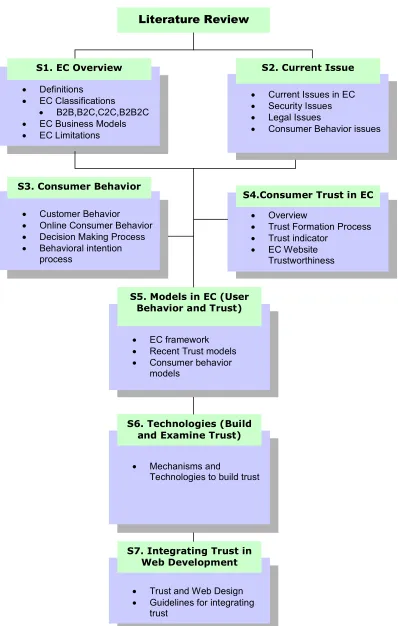
model which is one of the objectives that needs to be achieved in this study. Technologies plays an important role in EC where developers or business people are searching for new technologies to be implement in their EC website for performance and security purposes. Section 6 involve topics related to technologies for building and examining trust such as trust technologies in the market today, privacy and security policies, etc.
Figure 2.1: Literature Review Framework Literature Review
• Definitions • EC Classifications
• B2B,B2C,C2C,B2B2C • EC Business Models • EC Limitations
S1. EC Overview
• Current Issues in EC • Security Issues • Legal Issues
• Consumer Behavior issues S2. Current Issue
• Overview
• Trust Formation Process • Trust indicator
• EC Website Trustworthiness
S4.Consumer Trust in EC • Customer Behavior
• Online Consumer Behavior • Decision Making Process • Behavioral intention
process
S3. Consumer Behavior
• EC framework • Recent Trust models • Consumer behavior
models
S5. Models in EC (User Behavior and Trust)
• Mechanisms and
Technologies to build trust S6. Technologies (Build
and Examine Trust)
• Trust and Web Design • Guidelines for integrating
trust
There are various definitions of electronic commerce (EC) coined by famous scholars. New definitions arise parallel with the evolving of technologies to adapt with the current situation and environment. Yet, there is one definition that still remains intact with the real meaning of electronic commerce. Kalakota and Whinston (1997) define EC from four different perspectives, which somehow described the role that EC plays in different area. Several EC related books have adopted these definitions:
i) From a communications perspective, EC is the delivery of goods, services, information, or payment over computer networks or by any other electronic means.
ii) From a business perspective, EC is the application of technology toward the automation of business transactions and workflow.
iii) From a service perspective, EC is a tool that addresses the desire of firms, consumers, and management to cut service costs while improving the quality of customer service and increasing the speed of service delivery.
iv) From an online perspective, EC provides the capability of buying and selling products and information over the Internet and other online services.
Turban and King (2003) added two more perspectives to the list.
v) From a collaborations perspective, EC is the facilitator for inter- and intra- organizational collaboration
vi) From a community perspective, EC provides a gathering place for community members, to learn, transact and collaborate.
Lee and Rahman (2003) also added one perspective to the list.
From the above definitions, the authors manage to define EC as the use of an electronic-based medium such as the Internet to perform various activities or processes electronically, that include transaction, automation, collaboration and services.
2.3 Electronic Commerce: Classifications, Types or Categories?
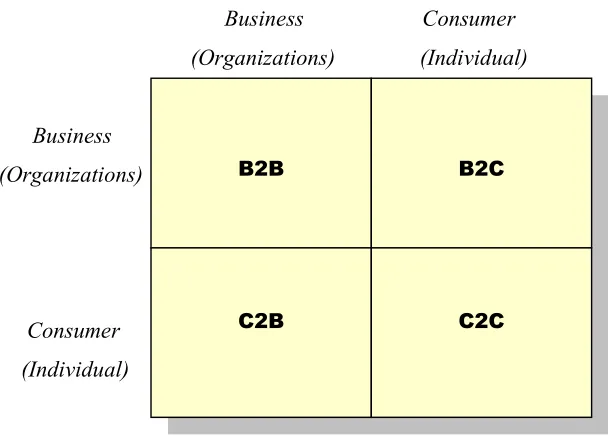
EC can be divided into several sub categories depending on their functions. Some scholars refer these sub categories as types, models and classification. But in the context of EC as a tool to conduct business activities, the author agreed for these sub categories to be referred as categories of EC. Although there are several categories emerged based on the evolving and complex way of EC implementations, only four categories are consider the basic foundation for this emergence. This study focused on B2C implementations, as it is suitable with the objectives of study, which is related to consumer behavior generally, and consumer trust in EC specifically. Figure 2.2 shows the different type of e-commerce categories.
There are many books and papers that explain and discussed about each of these categories but the author chose the definitions from (Rayport and Jowarski, 2002) because their definitions are more understandable and direct in the context of EC implementations.
i) Business-to-business (B2B)
B2B activity refers to the full spectrum of e-commerce that can occur between two organizations. Among other activities, this includes purchasing and procurement, supplier management, inventory management, channel management, sales activities, payment management and service and support.
ii) Business-to-consumer (B2C)
instance, as with smaller B2B interactions, transactions that relate to the “back-office” of the customer (e.g., inventory management at the home) are often not tracked electronically. However, all customer-facing, or front office, activities are typically tracked. These include sales activities, consumer search, frequently asked questions, and service and support.
iii) Consumer-to-consumer (C2C)
C2C exchanges involve transactions between or among consumers. These exchanges can include third-party involvement, as in the case of the auction website eBay. Other activities include classified ads, games, jobs, web-based communications, and personal services. C2C is also often referred to as peer-to-peer (P2P).
iv) Consumer-to-business (C2B)
Consumer can band together to present themselves as a buyer group in a C2B relationship. These groups may be caused-related advocacy groups at SpeakOut.com.
Business Consumer (Organizations) (Individual)
Business
(Organizations)
Consumer (Individual)
Figure 2.2: Different types of e-commerce (Chan et. al, 2001)
B2B B2C
Some of the categories in EC implementations are described briefly by Turban and King (2003). They provide several categories that are rising rapidly in the field of EC today.
v) Mobile Commerce
E-commerce transactions and activities conducted in a wireless environment. Most of the wireless device used to conduct this type of business is mobile phones. Entrepreneurs and business people are trying to adapt this environment because of its potential for conducting small and quick business transaction.
vi) Intrabusiness (organizational) EC
This category includes all internal organizational activities that involve the exchange of goods, services, or information among various units and individuals in that organization. Activities can range from selling corporate products to employees to online training and collaborative design efforts. It is usually performed on intranets or corporate portals.
vii) Exchange-to-exchange (E2E)
An exchange describes a public electronic market with many buyers and sellers. As these proliferate, it is logical for exchanges to connect to one another. E2E is a formal system that connects exchanges.
viii) E-government: Government-to-citizens (G2C)
In e-government EC, a government entity buys or provides goods, services or information to businesses or individual citizens.
ix) Business-to-business-to-consumer (B2B2C)
Businesses today are implementing numerous ways to make their business available online and can be accepted by all levels of Internet users. Achieving a common goal, which is to sell goods and services with low cost and high profit, are the aspirations for most business opportunist. Manipulating the benefits of information and technology (in this context is e-commerce) to meet with their business needs and the expectations of their target customer has brought out various business models implemented today.
The term value proposition refers to the benefits a company can derive from using electronic commerce and in B2C e-commerce; a value proposition defines how a company product or service fulfills a customer need. The value proposition is an important part of the marketing plan of any product or services (Turban and King, 2003).
2.4.1 Online Marketing
The most widely and obvious models used in EC today. Newly emerge company are utilizing this model to market and sell their products digitally. It is usually adopted when selling online from manufacturers to customers (eliminating intermediaries) or from retailers to consumers (making distribution more efficient). Obviously, is implemented in B2C and B2B environment.
2.4.2 Online Auctions
2.4.3Products and Services Customization
These types of model focused on delivering product and service according to the customer’s specifications. It means that a customer will specify how the product will be produce based on their interest. Dell Computers through it website, are among the companies that utilizes this kind of model to sell their products. Customers will have the option to build their own computers from scratch or buy the recommended specification offered. Product customization also exists in automotive industries where buyers will decide their vehicle specifications and appearance.
2.4.4 Supply Chain Improvers
Companies that use the concept of supply chain management are best described using this business model. Supply chain helps big retail company such as Wal-Mart to fill-up their inventory efficiently and quick. Reduction of time and cost are the main benefits of this business models.
2.5 Improving EC by Learning the Limitations
Technological Limitation Non-technological Limitations
1. There is a lack of universal accepted
standards for quality, security, and reliability.
1. Security and privacy concerns defer
customers from buying.
2. The telecommunications bandwidth is
insufficient.
2. Trust in EC an in unknown sellers hinders
buying.
3. Software development tools are still
evolving
3. National and international government
regulations sometimes get in the way.
4. There are difficulties in integrating the
Internet and EC software with some existing
(legacy) applications and databases
4. It is difficult to measure the benefits of EC,
such as the effectiveness of online
advertising. There is a lack of mature
methodology.
5. Special Web servers in addition to the
network serves are needed (added cost).
5. Some customers like to feel and touch
products. Customers are resistant to the
change from a real to an online store.
6. Internet accessibility is still expensive
and/or inconvenient.
6. People do not yet sufficiently trust
paperless, faceless transactions.
7. There is insufficient number (critical mass)
of sellers and buyers needed for profitable
EC operations.
B2C e-commerce is expected to grow and expand in the future as Internet users’ increase in number due to high broadband Web access in household. Consumer will have the opportunity to gain more knowledge about the online environment hence become an online shopper. In business-to consumer environment, there are two types of transformation that occurs. The first is the transformation of consumer into a computer user and the second, the transformation of physical store into a digital store or a Website in other word ( Koufaris et al, 2001).
Table 2.2: Potential Limitations on the growth of B2C e-commerce (Laudon and Traver, 2007)
LIMITING FACTOR COMMENT
Expensive technology
Using the Internet requires a $4000 PC
(minimal) and a connect charge ranging from
about $10 to $60 depending on the speed of
service
Sophisticated skill set
The skills required to make effective use of
the Internet and e-commerce capabilities are
far more sophisticated than, say, for
television or newspaper.
Persistent cultural attraction of physical
markets and traditional shopping experience
For many, shopping is a cultural and social
event where people meet directly with
merchants and other consumers. This social
experience has not yet been fully duplicated
in digital form.
Persistent global inequity limiting access to
telephones and personal computers
Much of the world’s population does not
have telephone service, PCs, or cell phones
2.6 Current Issues Related to E-Commerce
situation.
2.6.1E-Commerce Site Breached: Security Issues in E-Commerce
Security is one of the most challenging problems faced by consumers who wish to trade in the e-commerce world. The problem results from the vulnerabilities of the Internet upon which e-commerce is based (Suh and Han, 2003). E-commerce relies on the information that is transmitted through computer network. We never know whether while transmitting the information, it might have stopped at any point of transfer and viewed by an eavesdropper. If weaknesses in software systems have been detected by hackers and use them to their advantage, catastrophe may follow (Lee and Rahman, 2003). Internet merchant will have to face the loss of consumer trust and loyalty and probably affect consumer not to purchase online anymore if this situation occurs. The damage faced by consumers may affect their perception about the security of any e-commerce website because their privacy has been invaded.
Until today, security issues in any technological-based domain especially e-commerce are still undergoing research and development to identify the common issue that are haunting the security aspect in the development of e-commerce sites. Businesses are spending more of their IT budget allocation on improving the security of core systems and enterprise applications. Although there is a critical need for a more reliable security approach, management a more focuses on keeping the customers rather than looking into the internal security situations (Olkowski, 2001). Olkowski also stated that when an e-commerce site is breached or attacked, the customer retention factor is so volatile in e-commerce that it could kill the merchant and business just by the fear and mistrust instilled in customer.
threat and increasing Internet reliance for e-commerce, a Worldwide E-commerce Prevention Network was formed by American Express and e-tailers such as Amazon.com and Buy.com. This group has proposed several strategies for merchants to adopt as a secure and safety precaution such as obtaining real-time information from a credit card company, use of address verifications system, use of credit card verification codes, purchased of rule-based detection system, and purchase of predictive statistical models (Merkow, 2001).
Suh and Han (2003) stated that security control for confidentiality, reliability, and protection of information is a crucial prerequisite for the functioning of e-commerce. They summarize five categories of security control requirement from various scholars’ research and study, which are: authentication, nonrepudiation, confidentiality, privacy protection, and data integrity. Table 2.3 shows the summarization of these requirements.
Table 2.3: Security Controls (Suh and Han, 2003)
Security Control Comment
1. Authentication
Ensures that the trading parties in an
electronic transaction or communication are
who they claim to be.
2. Non-repudiation
Neither of the trading parties should be able
to deny having to participate in transaction
after the fact.
3. Confidentiality
Warrants that all communication between
trading parties are restricted to the parties
involved in the transaction.
4. Privacy protection
Ensures that personal information about
customers collected from their electronic
transaction is protected from disclosure
without permission
5. Data Integrity Data in transmissions are not created,
privacy protection and data integrity as the most important security controls that have an affect on trust and actual use. This is due to well-publicized security breaches.
2.6.2 Online Purchasing Intention: Consumer Behavior Issues
Consumers are the main players that contribute to the future direction of EC. In this era of ICT, cyber crimes have emerge as one of the most frequent crimes committed and the main victims of these unethical activities are consumer who participated in Internet activities. This cause has influenced the decision-making and perception of consumer about engaging in any online transaction or purchasing activities. They’re concern about their privacy and personal information that maybe misused by uninvited parties.
Many scholars have conducted empirical study on online consumer behavior that focus on different criteria in the context of online trust. Some studies are focus on the technological and economical aspect of a consumer profile. According to (Mahmood et al, 2004), economic condition and technological savvy of online shoppers significantly affected their trust of an e-business. The study also supports the hypothesis that technological savvy plays an important role in building online shoppers’ trust for an e-business. Another study by (Alesina and Ferrera, 2004) stated that there is a relationship between income and trust while (Zak and Knack, 2001) indicated that trust is lower when investor’s wages are low.
interact with customers to understand their needs and could provide customers with suggestion to fulfill those needs.
A study of 299 consumers across 12 countries in three broad regions of the world (North America, Western Europe, and Latin and South America) indicate that the three important critical factors that affect customer’s online purchase intention and loyalty are quality, affect and trust. The trustworthiness of the site has a positive impact on both purchase intention and loyalty. It follows that web sites need to engender trust by providing such things as service guarantees, privacy policies, third-party credentials of credibility, and customer testimonials (Lynch et al, 2001).
2.6.3 Purchasing Legal Product Online: E-Commerce Legal Issues
Businesses that operate on the Web must comply with the same laws and regulations that govern the operations of all business. If they do not, they face the same set of penalties – fines, reparation payments, court-imposed dissolution, and even jail time for officers and owners (Schneider, 2007). Businesses operating on the Web face two additional complicating factors as they try to comply with the law. First, the Web extends a company’s reach beyond traditional boundaries. It means that, when a business uses the Internet or the Web as foundation, it immediately becomes an international business. Second, the Web increases the speed and efficiency of business communications. Customers often have much interactive and complex relationship with online merchants than they do with traditional merchants.
According to Schneider, legal issues that affect a company’s ability to conduct electronic commerce are:
i) Borders and Jurisdiction
Defining, establishing, and asserting jurisdictions are much more difficult on the Internet than they are in the physical world. Governments that want to enforce laws regarding business conduct on the Internet must establish jurisdiction over that conduct.
iii) Conflict of Laws
Since online businesses usually serve broad markets that span many localities and many states, they generally look to federal laws for guidance that can lead to problems with state and local laws.
iv) Contracting and Contract Enforcement in EC
Contracts are a key element of traditional business practices, and they are equally important on the Internet. An implied contract can be formed by two or more parties that act as if a contract exists, even if no contract has been written and signed. Every kind of agreement or exchange between parties, no matter how simple, is a type of contract. There are several type of contract written on the Web such as warranty disclaimers, terms of service agreement and etc.
v) Use and Protection of Intellectual Property in Online Business
2.7 Consumer Behavior Typology
Consumer behavior disciplinary has become one of the most researched domains as business firms and corporations are evolving rapidly due to the advance growth of business and ICT opportunities. Businesses are striving to stay competitive in the market by conducting research and development to understand the complex area of customer behavior. Finding a clearer approach to understand what are the customer intentions and needs, will give extra benefits and advantages to any business organizations.
At the early development of this field, buyer behavior was used as the term to reflect an emphasis on the interaction between consumers and producers at the time of purchase but now marketer have recognize that consumer behavior is a process, not merely what happens at the moment a consumer hands over money or a credit card and in turn receives some good or service. Sheth and Mittal (2004) viewed customers as one entity that play it part in two context where they define customer behavior is the mental and physical activities undertaken by household and business customers that result in decisions and actions to pay for, purchase, and use products and services. Conventionally, the term ‘consumer’ has referred to household market while the term ‘customer’ is corresponding to business market Figure 2.3 shows the types, roles and behaviors of customer. A customer can play one or all three of the following roles: (1) a buyer (i.e., selecting a product), (2) a payer (i.e., paying for a product), or (3) a user/consumer (i.e., using or consuming a product).
Figure 2.3: Customers: Types, Roles, and Behaviors (Sheth and Mittal, 2006)
Households (consumer)
Businesses
Mental Activities Physical Activities
Behaviors
Customer types Roles
Users Buyers
Their definition of consumer behavior includes both mental and physical activities. Examples of mental activities are assessing the suitability of a product or service brand, making inferences about a product’s or service’s qualities from advertising information, and evaluating actual experience with the product. Physical activities include visiting stores, searching for information on the Net, talking to salespeople, and issuing a purchase order.
According to Shiffman and Kunak (1994), consumer behavior refers to the behavior that consumers display in searching for, purchasing, using, evaluating, and disposing of products and services that they expect will satisfy their needs while Solomon et al (2006) gave a definition that is more sensible in the context of consumer behavior as a process, where they define consumer behavior as the study of the process involved when individuals or groups select, purchase, use, or dispose of products, services, ideas and experiences to satisfy needs and desires. These definitions explain about the actions (purchase, use, etc) and process (from actions to satisfying needs) that a consumer involved in while engaging in business activities to achieve a common goal (satisfying needs).
Consumers take many forms, ranging from 6-year-old child pleading with her mother for win gums to an executive in a large corporation deciding on an extremely expensive computer system. The items that are consumed can include anything from tinned beans to a message, democracy, rap music, and even other people (the image of rock stars, for example). A consumer researcher has developed a classifications scheme in an attempt to explore the different ways that products and experiences can provide meaning to people (Holt, 1995). The analysis conducted by Holt, identified four distinct types of consumption activities:
ii) Consuming as integration – using and manipulating consumption objects to express aspects of the self. For example, some fans express their solidarity with the team by identifying with, say, the mascot and adopting some of its characteristic traits.
iii) Consuming as classification – the activities that consumers engage in to communicate their association with objects, both to self and to others. For example, spectators might dress up in the team’s colors and buy souvenirs to demonstrate to others that they are diehard fans.
iv) Consuming as play – consumers use objects to participate in a mutual experience and merge their identities with that of a group. For example, happy fans might scream in unison and engage in an orgy of jumping and hugging when their team scores a goal.
2.7.1 Online Consumer Behavior
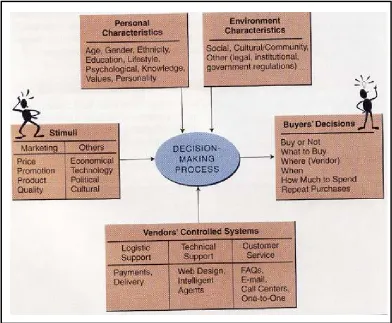
Consumers act and behave in a different way when engaging in business actions, which involve different trading atmosphere. The behavioral patterns and intention differs in conventional business activities (purchasing from physically located stores) and online business activities (purchasing from Internet merchant). From the discussion about consumer behavior above, the author defines online consumer behavior as “the process of performing actions (search, purchase, sell, etc) by a consumer while engaging in online trading activities that satisfy their needs and intentions”. Figure 2.4 shows the basic of consumer behavior models, adjusted to fit the EC environment.
Figure 2.4: EC Consumer Behavior Model (Turban and King, 2003)
Koufaris et al (2002) proposed a theoretical framework for consumer attitude and behavior on the Web shown in Figure 2.5. The model includes shopping enjoyment and perceived control as attitudinal variables that directly affect online consumer behavior. While convenience and control are at the top of consumers’ lists of benefits from online shopping (Clawson, 1993), enjoyment of the online shopping experience may also be an important determinant of customer loyalty (Rice, 1997). The study found that a Web-based company must provide new customers with both an enjoyable experience and high levels of perceived control to entice them to return.
customers, novelty quickly wears off, and product involvement is more important in increasing shopping enjoyment. This relationship seems to increase with the number of past visits to the Web store.
The study also shows that value-added search mechanisms are used more when customer needs are less specific. In other words, the less certain customers are about what they are looking for, the more they will use search mechanisms that provide value-added information.
Figure 2.5: Theoretical Framework of Consumer Attitudes and Behavior on the Web (Koufaris et al, 2002)
Online consumer can be divided into two types: individual consumers, who get much of the media attention, and organizational buyers, who do most of the actual shopping in cyberspace. Organizational buyers include governments, private corporations, resellers, and public organizations. Purchases by organizational buyers are generally used to create other products (services) by adding value to the products.
2.7.2 Customer Decision Making
Consumers are the parties that make the choice and decision in any online business. Consumers possessed the power to decide which online business will emerge as the top player in the market and which will face its downfall. Customer decisions are decisions that they make in the marketplace as buyers, payers and users. These decisions include whether to purchase, what to purchase, when to purchase, from whom to purchase, and how to pay for it (Sheth and Mittal, 2004). When a consumer makes a decision whether to engage in any online transaction, there a certain roles played by the consumer that contribute in the decision making process. According to Kotler and Armstrong (2002), there are five roles played by consumer concerning the decision-making process:
i) Initiator. The person who first suggest or thinks of the idea of buying a particular product or service.
ii) Influencer. A person whose advice or view carries some weight in making a final purchasing decision.
iii) Decider. The person who ultimately makes a buying decision or any part of it – whether to buy, what to buy, how to buy, or where to buy. iv) Buyer. The person who makes an actual purchase.
v) User. The person who consumes or uses a product or service.
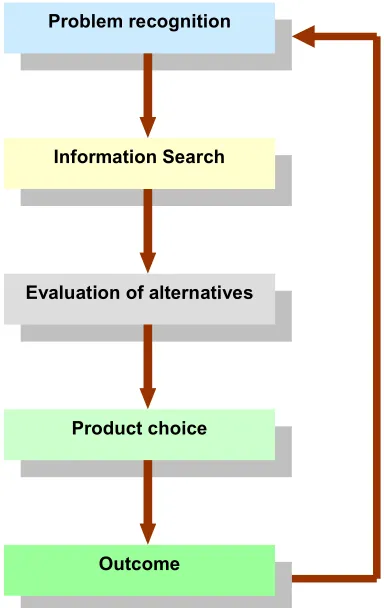
The process of making decisions and end up with purchase is an act of response to a problem (Solomon et al, 2006). Solomon et al has indicated the stages in consumer decision-making shown in Figure 2.6. The stages focus on how consumers recognize the problem, or need for a product; their search for information about product choices; and the ways in which they evaluate alternatives to arrive at a decision.
environment for appropriate data to make a reasonable decision. Much of the effort that goes into a purchase decision occurs at the stage in which a choice must be made from the available alternatives.
Once the relevant options from a category have been assembled and evaluated, a choice must be made among them (Putsis and Srinivasan, 1994). The choice can be influenced by integrating information form sources such as prior experience with the product or a similar one, information present at the time of purchase, and beliefs about brands that have been created by advertising (Smith, 1993).
Figure 2.6: Stages in consumer decision-making (Solomon et al, 2002)
Problem recognition
Information Search
Evaluation of alternatives
Product choice
2.7.2.1Online Consumer Decision Making Process Model
In order to understand the buying behavior of Internet consumers, it is first necessary to understand how consumers make their decisions on what product or services to purchase online. The Internet affects customer decision-making behavior in all three stages: pre-purchase, purchase and post purchase. Figure 2.7 shows the conceptual framework of online consumer behavior consist of the three stages and each component or process in the stages.
Figure 2.7: Conceptual Framework of Online Consumer Behavior (Sheth and Mittal, 2004)
The behavior of consumer who purchase from Internet merchant and traditional merchant differs when it comes to the stages to make a payment. This is when trust came into place in the electronic environment. This is because of some of the characteristics of Internet cyber transactions — they are blind, borderless, can occur 24 h a day and 7 days a week, and are non-instantaneous (payment may occur days or weeks before delivery is completed) — can cause consumers to be concerned that the seller won't adhere to its transactional obligations (Kim et al, 2007).
Consequently, trust in an Internet business is focused much more on transaction processes (Kim et al, 2005), in contrast to that of traditional transactions involving
Problem recognition
Information search
Evaluation of Alternative
PRE PURCHASE PURCHASE
Personaliza- tion
Privacy Concern
Security Concern Trust in
Online Purchase
POST PURCHASE
Satisfaction & Loyalty
brick-and mortar stores where trust tends to be focused on face-to-face personal relationships. Figure 2.8 shows the basic theoretical trust-based decision making model in electronic commerce proposed from the research conducted by Kim et al (2007). The result of the study suggest that a consumer’s trust directly and indirectly affects his or hers purchasing intention. The study also provides evidence that a consumer's perceived risk reduces the consumer's intention to purchase, whereas a consumer's perceived benefit increases the consumer's purchasing intention.
Figure 2.8: A Basic Theoretical Trust-based Decision Making Model in Electronic Commerce (Kim et al, 2007)
2.8 Trust in Electronic Commerce
2.8.1 Definition of Trust
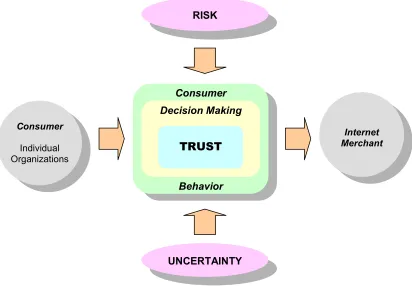
elevated in e-commerce because of the high degree of uncertainty and risk present in most on line transactions (Benassi, 1999; Fung and Lee, 1999). In today’s electronic world of business, trust is the center component between the consumer and the Internet Merchant. Researchers found trust very important, especially, in the relationships between consumers and e-vendors (Ratnasingham 1998; Merrilees & Frye 2003). Figure 2.9 shows the basic relationship between consumer and Internet merchant when trust initiated as consumers makes decisions due to risky and uncertainty situations.
Figure 2.9: A Relationship between Consumer and Internet Merchant
Although many scholars have acknowledge that trust is a critical requirement for the growth of e-commerce, yet, the true concept of consumer trust in the electronic environment is still in its infancy. In order to focus on trust in e-commerce, understanding the basic definition of trust is crucial in this study. Various scholars have used the trust definition below as the foundation of conducting research related to trust (Zand, 1972; Boss, 1978; Mayer et al., 1995; McAllister, 1995; Rocco, 1998; Corritore et al.,2001) but few scholars noted that the definition is abstract because it
TRUST Decision Making
Consumer
Behavior
Consumer
Individual Organizations
Internet Merchant
RISK
does not name any source of the vulnerabilities nor does it clarify the structure of trust requiring situation (Corritore et al, 2001; Reigelsberger et al, 2003). Thus, newer definition emerged as the context of the online environment changes to adapt and understand clearly the concept of trust.
“Trust is the willingness to be vulnerable based on positive expectations about the action of others”.
Mayer et al (1995) defines trust as:
“The willingness of a party to be vulnerable to the actions of another party based on the expectation that the other will perform a particular action
important to the trustor, irrespective to the ability to monitor or control that
other party.”
Trust is a complex, multidimensional, context-dependent construct (Gefen, 2000; McKnight et al, 2002). According to Nah and Davis (2002), consumer trust in the context of e-commerce can be define as
“The willingness of the consumer (trustor) to be vulnerable to the actions of
an online party (trustee) by engaging in online relationship exchanges with
the party.”
By providing sensitive information to the online party as part of the exchanges, the consumer, who has limited ability to monitor or control the behavior of the online party, becomes vulnerable to the action of the party.
2.8.2 The Concept of Trust in Online Environment
Reigelsberger et al 2003; Patton & Josang 2004; Pennanen 2005). A key reason for people’s lack of willingness to provide information or shop online is “the fundamental lack of faith (or trust) between most businesses and consumers on the Web” (Hoffman et al 1999).
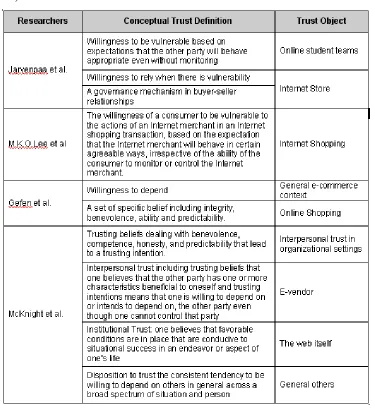
In order to understand the why this situation occurs, it is first necessary to understands the concept of consumer trust in the online environment. Several famous researchers have proposed the concept of consumer trust in electronic commerce (Jarvenpaa et al 1998; Lee and Turban; 2001; Gefen et al 2003; McKnight et al 1998). The conceptual trust definition in electronic commerce proposed by the scholars have been summarized in Table 2.4
Table 2.4: A Table of Summarized Conceptual Trust Definitions (Zhong and Shao, 2001)
consumer’s risk perception in e-commerce.
Figure 2.10: Consumer’s Trust Formation Model (Pennanen, 2005)
2.8.3 Trust versus Trustworthiness
trustworthiness; ability, benevolence, and integrity while Belanger et al (2002) define trustworthiness as the perception of confidence in the electronic marketer’s reliability and integrity. Belanger et al definition highlights the need for e-commerce firms to reliable protects (secure) the private information given by customers and to use it with integrity in order to increase electronic consumer trust. Few scholars have adopted these three dimensions in their research (Lee and Turban, 2001).
According to these scholars, the ability of a merchant is reflected in its ability to handle sales transactions and the expertise to generally conduct business over the Internet (Belanger et al, 2002). There are several other dimensions like honesty (Kumar et al, 1995), consistency, openness (Hosmer, 1995), competence (Garbarino and Lee, 2003), transaction abilities, legal integrity and etchical orientation (Edmondson and Carroll, 1999 ; Ibrahim and Angelids, 1993). The three dimensions that are related in the context of e-commerce are competence, benevolence and integrity (McKnight et al, 2002; Bhattacherjee 2002).
Trustworthiness is an important aspect when considering consumer trust because it directly reflects the ability of the e-commerce site to stay protective against other unauthorized party and also protect its consumer’s personal information. It gives the first impression that influences the consumer’s decisions to purchase or just leave the website at the end of the process.
makes recommendations for communicating trustworthiness that include providing:
i) Company information that is easy to find ii) Pricing including taxes and shipping costs iii) Early in interaction
iv) Balanced information about products
v) Professional Web Design with human error message vi) Clear and friendly privacy
vii) Security and return policies
viii) Appropriate request for personal information and clear explanation for why information is being sought
ix) Alternative methods of ordering
x) Access to helpful people through email or live chat
2.8.4 E-Commerce Trust Indicator or Attributes
Trust attributes can exist in different formats and have different purposes (Reigelberger et al, 2003; Che-Hussin and Macaulay, 2003). Trust attributes can provide sufficient knowledge and trust for online consumer about the trustworthiness of an e-commerce website. The important step in establishing consumer trust is providing assurances that the consumer’s personal information will be protected (Cheskin Research, 1999).
Table 2.5: Top ten trust attributes (Che-Hussin et al, 2003)
Trust Dimension Rank Trust Attributes
1. Company telephone number
2. Company e-mail address
3. Privacy Policy
4. Company address
Merchant-Trust 5. Third party for secure transaction
(e.g. VerSign)
6. Third party for personal data protection (e.g. Truste)
7. Consumer feedback form
8. Recommendation of website by a third party (e.g. Shopsafe)
9. Specific staff name
10. Photo of staff
2.8.5 Various Trust Models in Electronic Commerce
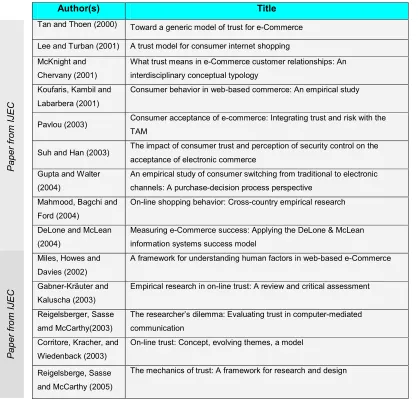
Table 2.6: The related study of trust in EC
Author(s) Title
Tan and Thoen (2000) Toward a generic model of trust for e-Commerce
Lee and Turban (2001) A trust model for consumer internet shopping McKnight and
Chervany (2001)
What trust means in e-Commerce customer relationships: An interdisciplinary conceptual typology
Koufaris, Kambil and Labarbera (2001)
Consumer behavior in web-based commerce: An empirical study
Pavlou (2003) Consumer acceptance of e-commerce: Integrating trust and risk with the TAM
Suh and Han (2003) The impact of consumer trust and perception of security control on the acceptance of electronic commerce
Gupta and Walter (2004)
An empirical study of consumer switching from traditional to electronic channels: A purchase-decision process perspective
Mahmood, Bagchi and Ford (2004)
On-line shopping behavior: Cross-country empirical research
DeLone and McLean (2004)
Measuring e-Commerce success: Applying the DeLone & McLean information systems success model
Miles, Howes and Davies (2002)
A framework for understanding human factors in web-based e-Commerce
Gabner-Kräuter and Kaluscha (2003)
Empirical research in on-line trust: A review and critical assessment
Reigelsberger, Sasse amd McCarthy(2003)
The researcher’s dilemma: Evaluating trust in computer-mediated communication
Corritore, Kracher, and Wiedenback (2003)
On-line trust: Concept, evolving themes, a model
Reigelsberge, Sasse and McCarthy (2005)
The mechanics of trust: A framework for research and design
Table 2.7: Previous studies that closely related to this research
Author(s) Key Content Consumer Behavior Key to trust attributes
Lee and Turban
(2001)
Trust is based on Internet
merchant, Internet technology,
infrastructure, and other factors.
- Security, third-party certification, company size and demographic variables.
McKnight and
Chervany (2001)
Trust is based on disposition to
trust, institutional based, and trust in
vendor.
Purchasing,
cooperating, and
information sharing.
Privacy policy, 3rd party seals, interacting
with customers, reputation building, links
to other sites and guarantees.
Koufaris, Kambil and
Labarbera (2001)
Trust is based on individual factors
and website factors.
Unplanned purchase
and intention to return.
Internal search engine, navigation,
interface, layout, classification of product,
product presentation, on-click shopping
cart, music, color and customer review.
DeLone and McLean
(2004)
Identified six success dimensions
i.e. system quality, information
quality, service quality, usage, user
satisfaction, and net benefits.
-
Security, navigation, privacy, feedback,
help, accuracy, relevance. Completeness,
content personalization, search, purchase
order and entertainment.
Corritore, Kracher
and Wiedenbeck
(2003)
Factors that impact on-line trust are
based on perception of credibility,
ease of use and risk.
- Search and navigation.
Reigelsberger,
Sasse and McCarthy
(2005)
Trust between customer and vendor
is based on the signals that show
the trustworthiness of the vendor.
- Recommendation, feedback, reputation, brand, trust seal, location and privacy.
As discussed earlier, the rapid advancement in information and communication technology (ICT) have change the way people live their live directly and indirectly in today’s information age. These changes have developed a new kind of technology-based society that rely and depend fully on technologies to get thing done. According to Lee and Rahman (2002), information systems play increasingly important roles in our society, which make society increasingly dependent on their correct functioning. This results in high demands for consistent functionality, reliability and availability of such systems.
There is a strong relation between consumer trust and security aspects that govern the whole transaction processes in an e-commerce website. As a new form of commercial activity, e-commerce involves more uncertainty and risks that traditional commerce because they are less well known to consumers. Factors that affecting trust in e-commerce for consumers include security risks, privacy issue and lack of reliability e-commerce processes in general (Patton and Josang, 2004). A consumer cannot monitor the safety and security of sending sensitive personal and financial information (Lee and Turban, 2001). Online business organizations should search for high-tech security mechanism to protect itself from intrusion and also protect it customer from being indirectly invaded. There are two lines of defense for e-commerce which are technology solutions and policy solutions (Laudon and Traver, 2007).
2.9.1 Encryption Approach
Encryption is the process of transforming plain text or data into cipher text that cannot be read by anyone other that the sender and the receiver. The purpose of encryption is (a) to secure stored information and (b) to secure information transmission. There are several types of encryption that differs in the context of it’s functionalities. In Symmetric Key Encryption, both the sender and the receiver use the same key to encrypt and decrypt messages while Public Key Encryption used two mathematically related digital keys which are public key and private key.
2.9.2 Secure Socket Layer
The most common form of securing channels is through the Secure Sockets Layer (SSL) of TCP/IP. The SSL protocol provides data encryption, server authentication, optional client authentication, and message integrity for TCP/IP connections. Secure Socket Layer (SSL) is a security protocol, first developed by Netscape Communications Corporation and now taken over by the transport layer security working groups. The design goal of the protocol is to prevent eavesdropping, tampering or message forgery when a data is transported over the Internet between two communicating applications (Lee and Rahman, 2003).
2.9.3 Secure Hypertext Transfer Protocol (S-HTTP)
A number of Trustmark seals have been developed to provide assurance about Web business practices and policies through the Web interface. One example is TRUSTe, which audit a site’s stated privacy policies and allows sites to display the TRUSTe seal if privacy policies and disclosure meet specific standards (Patton and Josang, 2004). Cheskin and Sapient (1999) found that where trustmark seals were recognized, they increase consumer perceptions of a site’s trustworthiness. Seal programs such as TRUSTe, BBBOnLine, MultiCheck and WebTrust allow licensees who abide by posted privacy policies and/or allow compliance monitoring to display means for addressing consumer privacy concerns (Meinert et al, 2006). Figure 2.11 shows an example of a secured seal from VeriSign. Third party security seal are increasingly used by business to communicate their commitment to security (Belanger et al, 2002). A survey conducted for Privacy and American Business found that 62% of consumers believe that third party privacy seals would reduce their privacy concerns (Newsbyte, 2002)
2.9.5Visual Advisor
Reserchers at MIT’s Media Lab have developed prototypes called Embodied Conventional Agents (ECAs) and one of their designed is designed specifically for the e-commerce domain of real estate (Bickmore and Cassell, 2001). Linguistics researchers, who have an understanding of the way trust is build through conversational rituals, are working with information technology researchers, to create computer-generated agents in a human-like form, with the ability to engage in social dialogue (Patton and Josang, 2004).
2.9.6Digital Signature
Digital signature means a digital method executed by a party with the intent to authenticate a record, which is a unique to the person using it and is capable of verification. It is linked to the data in such a manner that if the data is changed, the electronic signature is invalidated. A digital signature is normally a hash of the message which is encrypted with the owner’s private key (Lee and Rahman, 2003).
2.9.7 Secure Electronic Transaction (SET)
A privacy policy statement is a contractual commitment to consumers outlining how their personal information will be treated. The evidence suggests that posting a self-reported guarantee of compliance with e-commerce standards is an effective means of increasing consumer trust (Pennington el al, 2003; Ranganathan & Ganapathy, 2002) Privacy policy statements appear to be most beneficial to the web merchants that have the greatest need to increase consumer trust (Grewal et al, 2003). Privacy is the willingness of consumers to share information over the Internet that allows purchases to be conducted (Belanger et al, 2002).
2.9.9Digital Certificate
2.10 Trust and Web Design
Building online trust is an essential component for vendors to succeed in an e-commerce environment – where transactions are more impersonal and anonymous – as this affects consumers’ purchase intentions (Chen and Barnes, 2007). Online initial trust is important when consumers engage or visit an e-commerce website that ensures the final result which is purchasing something. The author have discussed earlier about how consumer behave when they involve in e-commerce and provide the model on how trust is formed when influenced by other characteristics such as demographic, culture and etc. Personality also effects the consumer decision making and purchase intentions. According to Head and Hassanein (2002), individual consumers differ in their trusting personality and what they experience from online vendors might influence their level of trust.
Online initial trust exists due to the uncertainty situation experience by the consumer whether the website can be trusted or not. The trustworthiness of the website can somehow induce the level of trust and reduces uncertainty situations (perceived risk) when consumers are aware of the trust attributes, triggers or indicators that are incorporated in the website. Perceived risk is an uncertainty in the purchase environment where consumers may consider the purchase outcomes and the importance or serious results associated with making a wrong or unsuitable decision (Hunter et al., 2004). It is crucial for Internet merchants to build this initial trust among consumers to provide the feel of safety and confidence to search for information and purchase item. E-commerce website should be design effective and structurally to provide a positive first impression. An e-commerce website provides a consumer with a first impression about the vendor’s trustworthiness and this impression strongly influences the consumer’s development of initial trust (Akhter, 2004; Basso et al, 2001; Kim et al, 2003; Wang and Emurian, 2004).
2.9. These guidelines a more understandable and focuses on the every aspect of e-commerce web development process.
Table 2.8: Trust Inducing Features for Web Design (Yang et al, 2005)
Dimensions Trust Inducing Features
Graphic Design
1. Symmetric Framework
2. 3D dynamic and half screen size graphs
3. Well chosen and good shot photograph
Structure Design
4. Logical e-catalog and retrieval access
5. Easy to use navigation
6. Product instruction and purchasing guide
7. Without broken links and missing pictures
Content Design
8. Displaying its seals of approval or third party
certificates
9. Involve some representative audio or video clips
10. Former buyer and feedback information
Social Cue or Signals Design
11. Synchronous communication media