ALI NODEHI
ALI NODEHI
A thesis submitted in fulfilment of the requirements for the award of the degree of
Doctor of Philosophy (Computer Science)
Faculty of Computing Universiti Teknologi Malaysia
ACKNOWLEDGEMENT
I would like to express my sincere appreciation to my Parents, who have always
supported me emotionally and financially and dealt with difficulties while I was away
for my studies. I would also thank Behoush, my beloved wife, who helped me and
encouraged me for my studies.
My sincere thanks to my supervisor, Prof. Dr. Ghazali Bin Sulong for
friendship, motivation, and encouragement. I also appreciate his quick and logical
response to my academic problems and helpful guidelines and recommendations.
I would like to thank the staff of Universiti Teknologi Malaysia, and especially
the Faculty of Computing, for their kind cooperation.
Lastly, I wish to thank all the people who have helped me during conducting
my PhD project and the ones who provided such a great academic environment for
ABSTRACT
Fractal image compression (FIC) is a lossy compression method that has the
potential to improve the performance of image transmission and image storage and
provide security against illicit monitoring. The important features of FIC are high
compression ratio and high resolution of decompressed images but the main problem of
FIC is the computational complexity of the algorithm. Besides that, the FIC also suffers
from a high number of Mean Square Error (MSE) computations for the best matching
search between range blocks and domain blocks, which limits the algorithm. In this
thesis, two approaches are proposed. Firstly, a new algorithm based on Imperialist
competitive algorithm (ICA) is introduced. This is followed by a two-tier algorithm as
the second approach to improve further the performance of the algorithm and reduce
the MSE computation of FIC. In the first tier, based on edge property, all the range
and domain blocks are classified using Discrete Cosine Transform. In the second tier,
ICA is used according to the classified blocks. In the ICA, the solution is divided into
two groups known as developed and undeveloped countries to maintain the quality of
the retrieved image and accelerate the algorithm operation. The MSE value is only
calculated for the developed countries. Experimental results show that the proposed
algorithm performed better than Genetic algorithms (GAs) and Full-search algorithm
in terms of MSE computation. Moreover, in terms of Peak Signal-to-Noise Ratio, the
approaches produced high quality decompressed image which is better than that of the
ABSTRAK
Pemampatan Imej Fraktal (PIF) adalah satu kaedah pemampatan
separa-mampat yang mempunyai potensi untuk meningkatkan prestasi penghantaran dan
penyimpanan imej serta menyediakan keselamatan terhadap pemantauan haram.
Ciri-ciri penting PIF adalah mempunyai nisbah pemampatan dan resolusi yang tinggi bagi
imej nyahmampat tetapi algoritma pengiraannya sangat kompleks dan ia merupakan
masaalah utamanya. Disamping itu, PIF juga memerlukan bilangan pengiraan
Ralat Kuasa dua Terkecil (RKT) yang tinggi bagi membuat carian terbaik antara
blok-perbagai dan blok-domain, justeru menghadkan lagi kemampuan algoritma
tersebut. Dalam tesis ini, dua pendekatan dikemukakan. Pertamanya, satu
pendekatan baru diperkenalkan berdasarkan kepada Algoritma Kompetitif Imperialis
(AKI). Seterusnya untuk meningkatkan prestasi algoritma tersebut dan mengurangkan
pengiraan RKT, satu algoritma dua peringkat dicadangkan sebagai pendekatan kedua.
Dalam peringkat pertama, berdasarkan bentuk pinggir, semua domain dan
blok-perbagai dikelaskan menggunakan Transformasi Kosain Diskret. Dalam peringkat
kedua, AKI digunakan mengikut blok yang telah diklasifikasikan. Dalam AKI,
untuk mengekalkan kualiti imej nyahmampat dan mempercepatkan operasi algoritma,
penyelesaian tersebut dibahagikan kepada dua kumpulan dan dikenali sebagai negara
maju dan negara mundur. Seterusnya nilai RKT dikira untuk negara maju sahaja.
Hasil eksperimen menunjukkan bahawa algoritma yang dicadangkan mempunyai
prestasi yang lebih baik daripada Algoritma Genetik (AG) dan Algoritma Carian
Penuh dari segi kiraan RKT. Keputusan juga menunjukkan bahawa Nisbah
Puncak-Signal terhadap Hingar dan kualiti imej nyahmampat yang diperolehi oleh kaedah yang
TABLE OF CONTENTS
CHAPTER TITLE PAGE
DECLARATION ii
DEDICATION iii
ACKNOWLEDGEMENT iv
ABSTRACT v
ABSTRAK vi
TABLE OF CONTENTS vii
LIST OF TABLES x
LIST OF FIGURES xii
LIST OF ABBREVIATIONS xvi
LIST OF SYMBOLS xviii
LIST OF APPENDICES xx
1 INTRODUCTION 1
1.1 Background of the Problem 4
1.2 Statement of the Problem 12
1.3 Questions of Research 13
1.4 Aim of the Research 13
1.5 Objectives of Research 13
1.6 Research Scope 14
1.7 Research Significance 14
1.8 Organization of the Thesis 15
2 LITERATURE REVIEW 16
2.1 Introduction 16
2.2 Image Compression Methods 17
2.2.1 Huffman Coding 17
2.2.2 Arithmetic Coding 18
2.2.4 Block Truncated Coding 21
2.2.5 Joint Photographic Experts Group 21
2.3 Fractals and Fractal Image Compression 22
2.3.1 Fractals and Iterated Function Systems 24
2.3.1.1 Iterations 24
2.3.1.2 The Copy Machine Algorithm 25
2.3.1.3 Metric Spaces, Mappings and
Transformations 25
2.3.1.4 Convergence and Contractions 30
2.3.2 IFS Fractals 32
2.3.2.1 Hausdorff Space 32
2.3.2.2 Iterated Function Systems 33
2.3.3 The Random IFS Approach 35
2.3.4 Using IFS fractals for FIC 36
2.3.5 The Fractal Transform Theory 38
2.3.6 The algorithm of Fractal Image
Compres-sion 40
2.3.6.1 Encoding 40
2.3.6.2 Decoding 42
2.4 Related Works 42
2.5 Evolutionary Optimization 57
2.5.1 Genetic Algorithm 59
2.5.1.1 Search Space 60
2.5.1.2 Implementation Details 61
2.5.1.3 Selection Operator 61
2.5.1.4 Crossover Operator 62
2.5.1.5 Mutation Operator 62
2.5.2 Imperialist Competitive Algorithm 63
2.6 Summary 66
3 RESEARCH METHODOLOGY 67
3.1 Introduction 67
3.2 Research Design and Procedure 67
3.3 An Overview of the Research Framework 70
3.4 Instrumentation and Data set 71
3.5 Evaluation Metrics 72
4 A NEW APPROACH TO FRACTAL IMAGE
COM-PRESSION USING IMPERIALIST COMPETITIVE
ALGORITHM 74
4.1 Introduction 74
4.2 Basic Algorithm of Fractal Image Compression 74
4.3 Proposed ICA-based Fractal Image Compression 80
4.4 Experimental Results 96
4.5 Summary 106
5 ENHANCING IMPERIALIST COMPETITIVE
ALGO-RITHM BASED ON DISCRETE COSINE
TRANS-FORM 108
5.1 Introduction 108
5.2 Discrete Cosine Transform 108
5.3 DCT Imperialist Competitive Algorithm for Fractal
Image Compression 113
5.3.1 Tier one: Image Partitioning Based on
DCT Coefficient 113
5.3.2 Tier two: DCT-ICA for Fractal Image
Compression 118
5.4 Experimental Results 124
5.5 Summary 138
6 CONCLUSIONS 139
6.1 Introduction 139
6.2 Research Contribution 141
6.3 Suggestion for Future Works 142
REFERENCES 144
LIST OF TABLES
TABLE NO. TITLE PAGE
1.1 The chronology of FIC. 5
2.1 The probability for each character. 18
2.2 The probability and range for each character in the
arithmetic coding. 19
2.3 The encoding steps in arithmetic coding. 20
2.4 The summarization of related works. 56
2.5 The summarization of related works. 57
4.1 The eight transformations on the dihedral group. 76
4.2 Comparison between the proposed ICA-based FIC
method, Wu-GA1, Vences-GA, and Full-search in MSE and PSNR (Number of decades=10, Initial
imperialists=20,Initial countries=160 ). 97
4.3 Comparison between the proposed ICA-based FIC
method, Wu-GA1, Vences-GA, and Full-search in
MSE and PSNR (Number of decades=10, Initial
imperialists=20,Initial countries=200). 99
4.4 Comparison between the proposed ICA-based
FIC method, Wu-GA2, Traditional-GA, and
Full-search(Number of decades=10, Initial imperialists=30,
Initial countries=250). 101
4.5 PSNR per number of initial countries and number of
initial imperialists for Lena. 104
4.6 Number of MSE computations per number of initial
imperialists and number of initial countries for Lena. 105
5.1 The values ofF(0,1) for the sample image. 110
5.2 The values ofF(1,0) for the sample image. 110
5.3 The value ofTAandTD. 125
5.5 Comparison between the proposed ICA, proposed
DCT-ICA, Vences-GA, Wu-GA1, and Full-search (Initial
countries=160, Initial imperialists=10, Number of
decades=10). 126
5.6 Comparison between the proposed ICA, proposed
DCT-ICA, Vences-GA, Wu-GA1, and Full-search (Initial countries=200, Initial imperialists=10, Number of
decades=10). 128
5.7 Comparison between the proposed ICA, proposed
DCT-ICA, Traditional-GA, Wu-GA2, and Full-search
(GA without elitism, Initial countries=250, Initial
imperialists=10, Number of decades=10). 130
5.8 Comparison between the proposed ICA, proposed
DCT-ICA, Traditional-GA, Wu-GA2, and Full-search (GA
with elitism, Initial countries=250, Initial
imperial-ists=10, Number of decades=10). 132
5.9 Comparison between the proposed ICA-based FIC
method and proposed DCT-ICA-based FIC method
LIST OF FIGURES
FIGURE NO. TITLE PAGE
1.1 The compression techniques. 2
1.2 The original image and its range pool and domain pool. 7
1.3 The range pool. 8
1.4 The domain pool. 9
2.1 The imperialistic competition (Atashpaz-Gargari and
Lucas, 2007). 65
3.1 Procedure of research. 68
3.2 Flowchart of research. 69
4.1 The range pool. 75
4.2 The domain pool. 75
4.3 The effects of block flip by the Dihedral transformations. 76
4.4 The flowchart of Full-search algorithm. 79
4.5 The flowchart of ICA-based FIC algorithm. 82
4.6 The coding of the addresses for domain blocks. 84
4.7 An example of a country and its location in original
image. 85
4.8 An example of 10 countries that are initialized randomly. 86
4.9 The sample of 10 countries and their power values. 87
4.10 Ranking the power of countries. 88
4.11 The imperialists, empires and colonies. 89
4.12 Moving mechanism. 89
4.13 Moving mechanism in original image. 91
4.14 An example of a moving mechanism in original image. 91
4.15 The power of colony is more than its imperialist. 92
4.16 The process of exchanging the position between an
imperialist and its colony. 92
4.17 The position exchange of the colony due to revolution. 93
4.18 The imperialistic competition. 94
4.20 Comparison between the proposed ICA and other
methods in PSNR for different images (Number
of decades=10, Initial imperialists=20, Initial
coun-tries=160). 98
4.21 Comparison between the proposed ICA and other
meth-ods in number of MSE computation for different images (Full-search=475799552, Number of decades=10, Initial
imperialists=20, Initial countries=160). 98
4.22 Comparison between the proposed ICA and other
methods in PSNR for different images (Number
of decades=10, Initial imperialists=20, Initial
coun-tries=200). 100
4.23 Comparison between the proposed ICA and other
meth-ods in number of MSE computation for different images
(Full-search=475799552, Number of decades=10, Initial
imperialists=20, Initial countries=200 ). 100
4.24 Comparison between the proposed ICA and other
methods in PSNR for different images (Number
of decades=10, Initial imperialists=30, Initial
coun-tries=250). 102
4.25 Comparison between the proposed ICA and other
meth-ods in number of MSE computation for different images
(Full-search=475799552, Number of decades=10, Initial
imperialists=30, Initial countries=250). 102
4.26 PSNR per number of initial countries and number of
initial imperialists for Lena. 104
4.27 Number of MSE computations per number of initial
imperialists and number of initial countries for Lena. 105
5.1 The values of pixels of a sample image. 111
5.2 The original image partitioned into blocks by 8×8 size. 112
5.3 a) The coefficient pair before normalization, b) Absolute
coefficient pair before normalization. 114
5.4 The coefficient pair after normalization. 115
5.5 The flowchart of the classification algorithm. 117
5.6 The flowchart of proposed DCT-ICA for FIC . 122
5.7 The flowchart of proposed DCT-ICA for FIC (Internal
5.8 Comparison between the proposed ICA, the proposed
DCT-ICA and other methods in PSNR for different
images (Initial countries=160, Initial imperialists=10,
Number of decades=10). 127
5.9 Comparison between the proposed ICA, the proposed
DCT-ICA and other methods in number of MSE computations for different images (Initial countries=160,
Initial imperialists=10, Number of decades=10,
Full-search=475799552). 127
5.10 Comparison between the proposed ICA, the proposed
DCT-ICA and other methods in PSNR for different
images (Initial countries=200, Initial imperialists=10,
Number of decades=10). 129
5.11 Comparison between the proposed ICA, the proposed
DCT-ICA and other methods in number of MSE computations for different images (Initial countries=200,
Initial imperialists=10, Number of decades=10,
Full-search=475799552). 129
5.12 Comparison between the proposed ICA, the proposed
DCT-ICA and other methods in PSNR for different
images (Initial countries=250, Initial imperialists=10,
Number of decades=10, GAs without elitism). 131
5.13 Comparison between the proposed ICA, the proposed
DCT-ICA and other methods in number of MSE computations for different images (Initial countries=250,
Initial imperialists=10, Number of decades=10,
Full-search=475799552, GA without elitism). 131
5.14 Comparison between the proposed ICA, the proposed
DCT-ICA and other methods in PSNR for different
images (GA with elitism, Initial countries=250, Initial
imperialists=10, Number of decades=10, GAs with
elitism). 133
5.15 Comparison between the proposed ICA, the proposed DCT-ICA and other methods in number of MSE
computations for different images (Initial countries=250,
Initial imperialists=10, Number of decades=10,
5.16 Number of MSE computations per number of initial
imperialists for Lena (Initial countries=300, Number of
decades=10). 135
5.17 PSNR value per number of initial imperialists for Lena
(Initial countries=300, Number of decades=10). 135
B.1 Lena. 151
B.2 Pepper. 152
B.3 F16. 153
LIST OF ABBREVIATIONS
BTC – Block Truncated Coding
CMFB – Cosine-Modulated Filter Banks
DCT – Discrete Cosine Transform
EA – Evolutionary Algorithm
EO – Evolutionary Optimization
FFT – Fast Fourier Transform
FIC – Fractal Image Compression
GA – Genetic Algorithm
HFIC – Huber Fractal Image Compression
ICA – Imperialist Competitive Algorithm
IFS – Iterated Function System
JPEG – Joint Photographic Experts Group
JPG – Joint Photographic Experts Group
LIFSM – Local Iteration Function System with gray level Maps
LIFSMD – Local Iteration Function System with gray level Maps and Discrete cosine transform
LIFSMI – Local Iteration Function System with gray level Maps and dimensional Interpolation
MA – Memetic Algorithm
MRCM – Multiple Reduction Copying Machine
MSE – Mean Squared Error
PIFS – Partitioned Iterated Function Systems
PSNR – Peak Signal-to-Noise Ratio
PSO – Participle Swarm Optimization
RBFC – Region-Based Fractal Coder
SNR – Signal-to-Noise Ratio
VQ – Vector Quantization
LIST OF SYMBOLS
AFDCT – DCT absolute coefficient pair
β – A number greater than one
cn – The cost of thenth imperialist
Cn – The normalized cost of thenthimperialist
CN – Number of all counties
d – The distance between colony and the imperialist position
D – The domain pool
T – Number of decades
DS – The diagonal/sub-diagonal edge class
f – A given 256×256 gray level image
F(0,1) – The intensity variation between the lower half and upper half of image block
F(1,0) – The intensity variation between the right half and left half of image block
HV – The horizontal/vertical edge class
k – The orientation type
λ – A random number with a uniform distribution in the range of
(0,1)
(F(1,0)
N, F(0,1)
N)– Normalize absolute coefficient pairs
NCn – The number of colonies of thenth imperialist
Ncol – The number of all colonies of imperialist
NE – number of empires
NIB – Number of image blocks
NTCn – The normalized total cost of thenth empire
p – The contrast of an image block
Pn – The imperialist’s normalized power
pt – The transformation type
px – The domain block’s in the horizontal position
py – The domain block’s in the vertical position
q – The brightness of an image block
R – The range pool
RN – Number of range blocks
S – The smooth type class
TCn – The total cost of thenthempire
TD – The distance threshold
TA – The angle threshold
u – A sub-sample domain block
v – A sub-sample rang block
(xold,yold) – The old position of the country
(x0,y0) – The new position of the country after moving
(xi,yi) – The position of empire corresponding to the country
ζ – The positive number considered to be between 0 and 1
LIST OF APPENDICES
APPENDIX TITLE PAGE
A LIST OF PUBLICATIONS 151
B THE STANDARD IMAGES 152
INTRODUCTION
In recent years, multimedia has wieldy emerged, therefore, images are
increasingly required to be stored in large number and high quality. One of the
problems is that images with high quality have generally a large size. To solve
this problem, it is needed to find some suitable methods for compression of images.
In compression process, the amount of data needed for representation of a certain
quantity of information is reduced. In other words, the compression technique aimed at
eliminating the redundancy in data in such a way that a quality-acceptable image could
be reconstructed. Compression of images can be useful in saving the storage space, and
the compressed images need less time to be transmitted via modem. Therefore, in both
cases it is completely economical. Compression algorithms also provide a level of
security against illicit monitoring. Compression algorithms tend to encounter several
problems such as the speed of operation and the required degree of compression that
should be considered while designing new algorithms. It is obvious that in cases a
program is attempted to be run directly from the compressed state of algorithms, it is
important to enhance the speed of decompression process.
Compression methods can be essentially divided into two groups (Gonzalez
and Woods, 2006). First, ”lossless” compression that works through reducing the
redundant data. What would be decompressed is a copy exactly taken from the original,
without any loss of the data. Two examples of this type of algorithms are Arithmetic
Coding and Huffman Encoding. Second, ”lossy” compression in which the exact
It eliminates the redundant data and attempts to create something nearly identical to
the original. One obvious matter is that the lossless compression methods should
be applied to text files or programs, whereas the lossy methods are suitable only for
sound data or graphics, in which there is no need for exact reproduction. One method
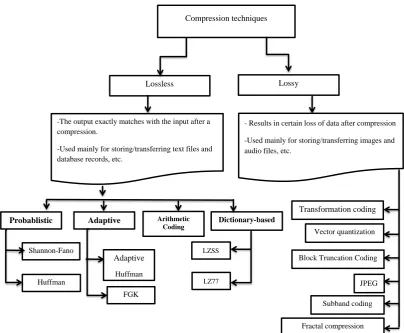
based on lossy compression is fractal image compression, hereinafter called FIC (see
Figure 1.1).
Compression techniques
Lossy Lossless
-The output exactly matches with the input after a compression.
-Used mainly for storing/transferring text files and database records, etc.
Probablistic Adaptive Arithmetic Coding Shannon-Fano Huffman FGK Dictionary-based LZ77 LZSS
- Results in certain loss of data after compression -Used mainly for storing/transferring images and audio files, etc.
Adaptive
Huffman
Transformation coding
Block Truncation Coding
Subband coding Vector quantization
Fractal compression JPEG
Figure 1.1: The compression techniques.
In 1975, the term ’fractal’ for the first time was used by Benoit B. Mandelbrot
who was a French mathematician. This word was derived from the Latin ’fractus’
that meant ’fragmented and irregular’ or ’broken’. Indeed, it can be said that
of Nature (Mandelbrot, 1983). Mandelbrot, in his book, argued that the classical
Euclidean geometry did not have adequate capacity for the description of numerous
natural objects, such as trees, clouds, coastlines, and mountains. Therefore, he
proposed and developed the fractal geometry.
With classical Euclidean shapes only two parameters, length and position, are
needed to describe the shape; whereas, fractals require three parameters: complicated
structure on a wide range of scales, repetition of structures at different length scales
(self-similarity), and a ’fractal dimension’ that is not an integer (Mandelbrot, 1983).
Self-similarity is found in sets or shapes that have repetitive patterns on smaller scales.
A line and a square are two Euclidean shapes that are self-similar. Enlarging and
replicating the line can produce the square, just as reducing the square can form the
line (Benot Mandelbrot and Cot, 1977). In this case, the line has dimension 1, and the
square has dimension 2. It seems possible that a form between a line and a square,
say a jagged line, can have a dimension between 1 and 2 (Benot Mandelbrot and Cot,
1977).
Fractals are categorized mainly into two groups: nonlinear and linear.
Nonlinear fractals, in turn, are divided into two popular types: Julia sets and
Mandelbrot set that are fractals of the complex plane (Benot Mandelbrot and Cot, 1977;
Mandelbrot, 1983). Since Mandlebrot’s success in making the research of fractals
and their applications popular, many people have learned to create fractal illustrations.
Today these beautiful images can be generated easily on a personal computer, and
have spawned a popular field of computer graphics art. Some of fractal images are
Sierpinski triangle, Mandelbrot set, Cantor set, Julia set, Koch curve, Apollonian
gasket, Douady rabbit, Sierpinski Hexagon, Pinwheel fractal, and etc. Nevertheless,
those fractals that are applied to image compression are from linear group and they are
of the real plane. Therefore, the employed fractals are not chaotic; that is, they do not
have any sensitivity to the initial conditions. These fractals are from Iterated Function
Theory. Simply, Iterated Function System (IFS) refers to a set of contractive affine
1.1 Background of the Problem
The history of FIC dates from 1977 (the year Mandelbrot’s book, namely,
The Fractal Geometry of Nature was published). In 1981, Hutchinson demonstrated
a branch of mathematics known as Iterated Function Theory (Hutchinson, 1981;
Mandelbrot, 2004a). About one decade later, Michael Barnsley, a researcher from
Georgia Tech, published a book, tittled, ”Fractals Everywhere”, which presented
the mathematics of the Iterated Functions Systems (IFSs), and proved a result that
was recognized as the Collage Theorem (Barnsley and Rising, 2000). This theorem
determined how IFS could represent an image. It led to exploring new possibilities.
If, in forward direction, the fractal mathematics creates natural looking images, then,
in the reverse direction, can it not compress images? To go from a particular image to
an IFS, which can create the original (or closely similar to it) is referred to as inverse
problem, which so far, it has been remained unsolved (Barnsley and Hurd, 1993).
Barnsley claimed that he had solved the inverse problem with his Collage
Theorem. He was granted a software patent and found the Iterated Systems
Incorporated. Barnsley publicized his success in BYTE magazine (issued in January
1988). In his article, the inverse problem was not addressed; however, it presented
a number of images that were compressed purportedly in excess of 10,000:1. Since
that time, scholars have attempted to automate this process, but all attempts have
failed. Barnsley (1988) admitted that each complex image needs nearly 100 hours
for encoding and 30 minutes required for decoding on the Masscomp (Barnsley and
Sloan, 1988). In March 1988, based on Barnsley’s findings, one of his PhD students
designed a modified scheme to represent the images, which was named Partitioned
Iterated Function Systems (PIFS). Barnsley was again granted patent on an algorithm
that was capable of automatically converting an image to a PIFS, compressing the
image into the process. Jacquin employed the algorithm in a software (Jacquin, 1993).
That was not a sophisticated and speedy algorithm, but a full automatic. It came at
the price: gone was promise of 10,000:1 compression. Typically, a 24-bit color image
could be compressed from 8:1 to 50:1; at the same time, it was looking ”pretty good”.
paper. Finally, a short story of FIC is summarized in Table 1.1.
Table 1.1: The chronology of FIC.
Year Tittle Type Descriptions
1977 The Fractal Geometry of Nature
book Benoit Mandelbrot finishes the first edition of book.
1981 Fractals and Self Similarity book John E. Hutchinson publishes this book.
1983 The Fractal Geometry of Nature book Revised edition of the book is published
1985 Iterated Function Systems and the Global Construction of Fractals
paper
Michael F. Barnsley and Stephen Demko introduce Iterated Function Theory in their paper
1987 Iterated Systems Incorporated paper Iterated Systems Incorporated is founded in Georgia
1988 A Better Way to Compress Images
Paper Michael Barnsley and Alan D. Sloan wrote the article
1988 Fractals Everywhere book Barnsley publishes the book
1990 first patent of Barnsley's patent Barnsley's first patent
1991 Method and Apparatus for
Processing Digital Data
Patent M. Barnsley and A. Sloan are granted US Patent
1991 Image Data Compression Using
Fractal Techniques
Paper J.M. Beaumont publishes a paper
1992 describes the first practical
fractal image compression method
Paper Arnaud E. Jacquin publishes an article
1992 Microsoft Encarta software Microsoft Corporation publish the multimedia
encyclopedia which uses fractal image compression to great effect
1993 Fractal Image Compression book Michael Barnsley and Lyman P. Hurd published
this book
For compress an original image, the FIC algorithm can be described as follows.
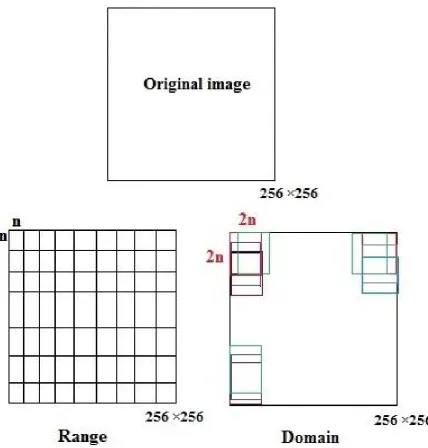
First, algorithm considers two copies of the original image. Image 1 is partitioned into
non-overlapped blocks with the size ofn×n, each of which is known as range block.
The set of these range blocks is known as range pool. Image 2 is partitioned into
overlapped blocks with the size of 2n×2n, each of which is known as domain block.
The set of these domain blocks is known as domain pool. Figure 1.2 shows the original
image and its range pool and domain pool. In FIC, for each range block, the algorithm
should find a domain block that is most similar to that range block. The similarity
computing the quantityd, in which pandqcan be obtained as follow:
p=[n
2hu,vi − hu,1i hv,1i]
[n2hu,ui − hu,1i2] (1.1)
and
q= 1
n2[hv,1i −phu,1i] (1.2)
wherenis size of candidate-range-block.
d=kp.uk+q,vk, 1≤k≤8 (1.3)
whereuk represents the eight transformations of u, and pandqare the adjustment of
the contrast and brightness, respectively.
Based on this quantity, all researchers used MSE for measuring the similarity
between the candidate-range-block and candidate-domain-block. The less MSE value,
the more similar they will be to each other. In FIC, eight rotations are performed on
each domain block, each of which is known as affine transformation. These affine
transformations include rotation 0◦, 90◦, 180◦, 270◦, horizontal flip, vertical flip, flip
relative to 135◦, and flip relative to 45◦. To find a domain block that is most similar to
each candidate-range-block, each of the eight affine transformations is performed on
each domain block. In each case, the MSE value is computed. The domain block with
the smallest MSE value is determined as the most similar one to its
candidate-range-block. For this candidate-range-block, algorithm saves the address of its corresponding
domain block, the affine transformation performed on this domain block, contrast, and
Figure 1.2: The original image and its range pool and domain pool.
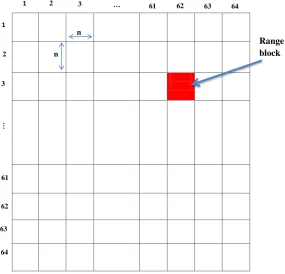
For example, let f be a given 256×256 gray level image and n be 4. The
range pool RP is considered as the set of all non-overlapping blocks of size 4×4,
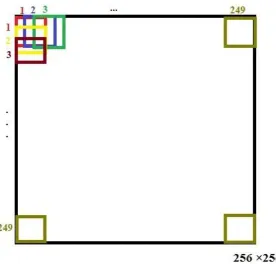
making up(256÷4)2=4,096 blocks (See Figure 1.3). DP is the domain pool and
it determines the set of all possible overlapping blocks of size 8×8 of the image
f, making up (256−8+1)2 =62,001 blocks (See Figure 1.4). Addition of eight
Finally, for encoding this image based on FIC method (Full-search algorithm), the
496,008×4,096=2,031,648,768 MSE computations are needed. With this huge
amount of computations, even if a high performance workstation is used, the
Full-search algorithm is very slow. Decreasing the number of MSE computations is the
main challenge that FIC face.
This problem has been attractive to many researchers in this filed of study.
Generally, the methods that deal with the FIC problem are divided into two groups:
methods that are based on evolutionary algorithm (EA) and those that are not based on
EA. Those groups are investigated as follows.
1
2
3
63
64 62 61
1 2 3 … 61 62 63 64
…
n
Range block
n
256 ×256
Figure 1.4: The domain pool.
During the past decades, researchers have proposed various computer
simulation of natural processes for solving optimization problems. The Evolutionary
Optimization (EO) is a popular and useful field of research and developing algorithms
to solve many problems (Sarkeret al., 2002). Evolutionary algorithms (EAs) are search
methods that take their inspiration from natural selection and survival of the fittest
in the biological world. EAs differ from more traditional optimization techniques in
that they involve a search from a ”population” of solutions, not from a single point.
For instance, genetic algorithm (GA) is considered as an evolutionary algorithm in
which some candidate solutions are evolved for the given problems (Sivanandam and
Deepa, 2010). The evolutionary algorithms can help the FIC problem by decreasing
the number of MSE computations and find near optimal solutions. In several works,
GA has been used to improve the FIC algorithm (Xuan and Dequn, 1996; Vences and
Rudomin, 1997; Mitra et al., 1998; Xun and Zhongqiu, 2000; Gafour et al., 2003;
Mohamed and Aoued, 2005; Liangbin and Lifeng, 2007; Wu et al., 2006, 2007; Wu
employing GA, wherein each chromosome contains the PIFS of the range blocks. In
their algorithms, the chromosome fitness that is achieved by evolutionary process is
measured by the distance existing between the range blocks and domain blocks. Xuan
and Dequn (1996) proposed a method for finding the IFS code of fractal image, and
examining the effect of mutation and crossover on FIC. Vences and Rudomin (1997)
proposed a GA method for FIC. However their algorithm has a high speed, the retrieved
image does not have enough quality. In studies conducted by Mitra et al. (1998) and
Xun and Zhongqiu (2000), FIC is performed through GA method which is based on an
elitism model. Elitism is a mechanism in GA based on which some suitable solutions
are selected and transferred to the next generation. A decrease in search space is the
result of finding the best self-similarity. An increase in the speed of FIC algorithm
was observed despite a decrease in the quality of retrieved image. A spatial correlation
genetic is proposed by Wu et al. (2006). Their algorithm consists of two stages. The
first one is performing the spatial correlation in image for both domain pool and rang
pool. This is performed for exploiting local optima. If the local optima obtained from
the first stage is not satisfactory, the second stage will be done to find the best
self-similarity in the whole image. In their study, the number of MSE computations was
reduced, however, it was still too much. Wu et al. (2007) proposed a schema genetic
algorithm (SGA) for FIC. In this algorithm, they adapted the genetic operators based on
the schema theorem within the evolutionary process. In terms of the number of MSE
computations and the quality of retrieved image, this algorithm performed better than
the previous ones. A GA algorithm with a hybrid select mechanism were presented
by Wu et al. (2010). In their algorithm, using elitism and selecting suitable solutions,
GA could reduce the number of MSE computations. In above-mentioned studies, GA
could reduce to some extend the number of MSE computations; however, one of the
GA drawbacks was that it might be trapped in local optima, which led to reducing the
quality of retrieved image and extra computation.
Another method that do not use EA is no-search method. Furao and Hasegawa
(2004) introduced a no-search fractal encoding algorithm by which they could select
a domain block with the same center as the range block; in this condition, the domain
domain blocks and the range blocks have the same texture, and matching between the
domain blocks and range block is achievable. However in this algorithm, the number
of MSE computations was reduced, the quality of retrieved image was reduced, too.
This is because a suitable domain block is not necessarily located near to the range
block location. Wang and Wang (2008) enhanced a no-search FIC algorithm by a
modified gray-level transform. The gray-level transformation, as one form of digital
image processing for the reduction of redundant shadows of image. For enhancing the
possibility of successful matching for a domain block and a range block, a modified
gray-level transform was introduced. Afterward, a no-search FIC coding method was
suggested by means of two gray-level transforms, one for the small blocks and the
other for the large blocks according to the quad-tree partition scheme. It was done
in order to accelerate the encoding process time, but the quality of retrieved image
is not good. In another study, based on a modified gray-level transform, Wang et al.
(2010) enhanced a no-search FIC coding method. To decrease the minimum matching
error between a certain range block and its related domain block, they enhanced the
gray-level transform and called it fitting plane. Although the fitting plane is capable
of enhancing the probability of successful range-domain matching, the quality of
retrieved image is not good.
However the problem of FIC has received a great attention from the research
community, this problem should be investigated more. Some optimization methods
could reduce to some extent the number of MSE computations; although, the quality of
retrieved image has been remarkably decreased. On the other hand, some researchers
have put an emphasis on reserving the quality of retrieved image, which has led to an
1.2 Statement of the Problem
Some important features of FIC are high compression ratio and high-resolution
reconstructed images. On the other hand, as we described in the previous section, for
each range block, the FIC algorithm should find a domain block that is most similar to
that range block. To find a domain block that is most similar to each
candidate-range-block, each of the eight affine transformations is performed on each domain block.
In each case, the MSE value is computed. The domain block with the smallest MSE
value is determined as the most similar one to its candidate-range-block. Because
of huge amount of MSE computations, the basic algorithm of FIC runs very slowly,
even with a high performance workstation. Therefore, the main problem of FIC is
high number of MSE computations. During recent years, several methods have been
designed for solving this problem. The FIC is a rough problem that has many local
optima. The problem of some evolutionary algorithms is that they may be trapped in
local optima. Evolutionary algorithms are considered suitable for FIC since they can
reduce the number of MSE computations of FIC; however, it is a challenging issue to
find an evolutionary algorithm capable of escaping from the local optima. In the FIC
algorithm, for each candidate range block, a suitable domain block should be selected
from among domain block pool. Another problem in FIC algorithm is how to search
a domain block that is suitable for candidate range block. In the FIC algorithm, for
each candidate range block, all domain blocks are computed, then the best domain
block is selected as the best matched domain block with the range block. Therefore,
the best quality of retrieved image is obtained. As evolutionary algorithms search
for just some of the possible solutions, algorithm may fail to select the best domain
block. As a result, the quality of retrieved image may reduce. Therefor, a problem is
to decrease the number of MSE computations and, at the same time, to preserve the
quality of retrieved image as much as possible. Another challenging issue is that not
all elements of domain pool are suitable for candidate range block. A suitable strategy
is to differentiate the proper and improper domain blocks, then the most suitable one
can be selected from among proper domain blocks. It can decrease the search space,
which can lead to acceleration of the FIC algorithm. Therefore, it is important to find
1.3 Questions of Research
Based on research statement, there is one main question that is how to decrease
the number of MSE computation of FIC and preserve the quality of retrieved image as
much as possible? Based on this question, some sub questions are arisen as follow:
(i) How to enhance an evolutionary algorithm in order to improve search space?
(ii) How to eliminate ineffectual elements from domain pool?
(iii) How to increase the quality of retrieved image while decreasing the
computation?
1.4 Aim of the Research
To decrease the number of MSE computations of FIC and to preserve the
quality of retrieved image as much as possible by using evolutionary algorithm.
1.5 Objectives of Research
To attain research aim, the following research objectives have been identified:
(i) To develop an approach for decreasing the number of MSE computations of
(ii) To eliminate ineffectual element of domain pool and decrease the search
space.
(iii) To find appropriate domain blocks and preserve the quality of retrieved image
as much as possible.
1.6 Research Scope
For this study the following constraints are considered:
(i) This research concentrates on gray scale images only.
(ii) Using evolutionary algorithm, this research mainly focuses on decreasing the
number of MSE computations and preserve the quality of retrieved image as
much as possible.
(iii) This research doesn’t focus on compression ratio.
(iv) Performance of the algorithm is evaluated and validated by MATLAB.
1.7 Research Significance
In this research, the problem of FIC is introduced. It can be a significant
research because it proposes and develop several algorithms that could be used as
a benchmark for newly designed algorithms and it provides a criterion for other
researchers to evaluate their algorithms with a near-optimal solution. Additionally,
pool and candidate solutions. These techniques can result in decreasing the number of
MSE computations of FIC and preserve the quality of retrieved image.
1.8 Organization of the Thesis
This thesis encompasses six chapters. Chapter 1 presents current challenges
and historical background of FIC. In addition the objectives and scopes of thesis
are in this chapter. Chapter 2 presents the methods of image compression, fractals
and FIC. In this chapter the basic algorithm and mathematical background of FIC
is introduced. Additionally, the related works about FIC are reviewed. In final part
of Chapter 2, the Evolutionary Algorithms (EA) is presented. Chapter 3 presents
the methodology of the current study. Framework and overview of the research
methodology, instrumentation and data set, and evaluation metrics of the research are
introduced in this chapter. Chapter 4 presents the new approaches of FIC based on
ICA that led to improve performance of FIC. Chapter 5 presents the speedup FIC
by ICA based on discrete cosine transform (DCT). Finally, chapter 6 concludes the
REFERENCES
Atashpaz-Gargari, E. and Lucas, C. (2007). Imperialist competitive algorithm: An
algorithm for optimization inspired by imperialistic competition. InIEEE Congress
on Evolutionary Computation 2007. 25-28 September. Singapore, 4661–4667.
Barni, M. (2006). Document and Image Compression. USA: Taylor and Francis.
Barnsley, M. and Rising, H. (2000).Fractals everywhere. The University of California,
USA: Academic Press Professional.
Barnsley, M. and Sloan, A. (1988). A better way to compress images.Byte Magazine.
9(7), 215–223.
Barnsley, M. F. and Hurd, L. P. (1993). Fractal image compression. The University of Michigan, USA: A K Peters.
Belloulata, K. and Konrad, J. (2002). Fractal image compression with region-based
functionality.IEEE Transactions on Image Processing. 11(4), 351–362.
Bratteli, O. and Jrgensen, P. E. T. (1999). Iterated function systems and permutation
representations of the Cuntz algebra. USA: American Mathematical Society.
Chang, H. T. and Kuo, C. (2000). Iteration-free fractal image coding based on efficient
domain pool design.IEEE Transactions on Image Processing. 9(3), 329–339.
Chung, K. L. and Hsu, C. H. (2006). Novel prediction and subblock-based algorithm
for fractal image compression.Chaos, Solitons and Fractals. 29(1), 215–222.
Cochran, W. O., Hart, J. C. and Flynn, P. J. (1996). Fractal volume compression.IEEE
Transactions on Visualization and Computer Graphics. 2(4), 313–322.
Crownover, R. M. (1995). Introduction to fractals and chaos. The University of
Michigan, USA: Jones and Bartlett.
Davoine, F., Antonini, M., Chassery, J. M. and Barlaud, M. (1996). Fractal
image compression based on Delaunay triangulation and vector quantization.IEEE
Transactions on Image Processing. 5(2), 338–346.
Distasi, R., Nappi, M. and Riccio, D. (2006). A range/domain approximation
Processing. 15(1), 89–97.
Distasi, R., Polvere, M. and Nappi, M. (1998). Split decision functions in fractal image
coding.Electronics Letters. 34(8), 751–753.
Duh, D. J., Jeng, J. H. and Chen, S. Y. (2005). DCT based simple classification scheme
for fractal image compression.Image and Vision Computing. 23(13), 1115–1121.
Eades, A. (1994). The image processing handbook. Microscopy Research and
Technique. 28(1), 75–95.
Fisher, Y. (2012).Fractal Image Compression: Theory and Application. UK: Springer.
Furao, S. and Hasegawa, O. (2004). A fast no search fractal image coding method.
Signal Processing: Image Communication. 19(5), 393–404.
Gafour, A., Faraoun, K. and Lehireche, A. (2003). Genetic fractal image compression.
InACS/IEEE International Conference on Computer Systems and Applications.
14-18 July. Tunisia, 132–138.
Gao, X., Hong, B., Luo, L. and He, Z. (1997). Fractal image coding using
cosine-modulated filter banks.IEEE Transactions on Consumer Electronics. 43(1), 62–68.
Ghosh, S. K., Mukherjee, J. and Das, P. P. (2004). Fractal image compression: a
randomized approach.Pattern Recognition Letters. 25(9), 1013–1024.
Gonzalez, R. C. and Woods, R. E. (2006). Digital Image Processing (3-th ed.). Upper
Saddle River, NJ, USA: Prentice-Hall, Inc.
Hamzaoui, R. (1996). Decoding algorithm for fractal image compression.Electronics
Letters. 32(14), 1273–1274.
Hamzaoui, R. and Saupe, D. (2000). Combining fractal image compression and vector
quantization.IEEE Transactions on Image Processing. 9(2), 197–208.
Hamzaoui, R., Saupe, D. and Hiller, M. (2001). Distortion Minimization with Fast Local Search for Fractal Image Compression.Journal of Visual Communication and
Image Representation. 12(4), 450–468.
Hankerson, D., Harris, G. A. and Johnson, P. D. (2010). Introduction to Information
Theory and Data Compression. (2-th ed.). New York, USA: CRC Press company.
Hart, J. C. (1996). Fractal image compression and recurrent iterated function systems.
IEEE Computer Graphics and Applications. 16(4), 25–33.
Hartenstein, H., Ruhl, M. and Saupe, D. (2000). Region-based fractal image
compression.IEEE Transactions on Image Processing. 9(7), 1171–1184.
He, C., Yang, S. X. and Huang, X. (2004a). Progressive decoding method for fractal
He, C., Yang, S. X. and Xu, X. (2004b). Fast fractal image compression based on
one-norm of normalised block.Electronics Letters. 40(17), 1052–1053.
He, C. J., Li, G. P. and Shen, X. N. (2007). Interpolation decoding method with variable parameters for fractal image compression. Chaos, Solitons and Fractals.
32(4), 1429–1439.
Hufnagl, C. and Uhl, A. (2000). Algorithms for Fractal Image Compression on
Massively Parallel SIMD Arrays.Real-Time Imaging. 6(4), 267–281.
Hutchinson, J. (1981). Fractals and Self-Similarity.Indiana University Mathematics
Journal. 30, 713–747.
Jackson, D. J., Mahmoud, W., Stapleton, W. A. and Gaughan, P. T. (1997).
Faster fractal image compression using quadtree recomposition.Image and Vision
Computing. 15(10), 759–767.
Jacquin, A. E. (1993). Fractal image coding: a review. Proceedings of the IEEE.
81(10), 1451–1465.
Jeng, J. H. and Shyu, J. R. (2000). Fractal image compression with simple classification scheme in frequency domain.Electronics Letters. 36(8), 716–717.
Jeng, J. H., Truong, T. K. and Sheu, J. R. (2000). Fast fractal image compression
using the Hadamard transform.IEEE Vision, Image and Signal Processing. 147(6),
571–574.
Jeng, J. H., Tseng, C. C. and Hsieh, J. G. (2009). Study on Huber Fractal Image
Compression.IEEE Transactions on Image Processing. 18(5), 995–1003.
Kominek, J. (1994). Image Compression: An Issue of Quality.Technical report, 1–26.
Kou, W. (1995). Digital Image Compression: Algorithms and Standards. Springer.
Lalitha, E. M. and Satish, L. (1998). Fractal image compression for classification
of PD sources. IEEE Transactions on Dielectrics and Electrical Insulation. 5(4),
550–557.
Liangbin, Z. and Lifeng, X. (2007). A Study of Fractal Image Compression Based on
an Improved Genetic Algorithm.International Journal of Nonlinear Science. 3(2),
116–124.
Linnell, T. A. and Deravi, F. (2004). Mapping vector accumulator: fractal domain feature for character recognition.Electronics Letters. 40(22), 1406–1407.
Loe, K. F., Gu, W. G. and Phua, K. H. (1997). Speed-up fractal image compression
Mandelbrot, B. B. (1977). Fractals: form, chance and dimension. San Francisco,
USA: W.H.Freeman.
Mandelbrot, B. B. (1983). The Fractal Geometry of Nature. San Francisco, USA: Henry Holt and Company.
Mandelbrot, B. B. (2004).Fractals and Chaos: The Mandelbrot Set and Beyond. USA:
Springer.
Mitra, S., Murthy, C. and Kundu, M. (1998). Technique for fractal image compression
using genetic algorithm.IEEE Transactions on Image Processing. 7(4), 586–593.
Mohamed, F. and Aoued, B. (2005). Speeding Up Fractal Image Compression by
Genetic Algorithms.Multidimensional Systems and Signal Processing. 16(2), 217–
236.
Muruganandham, A. and Banu, R. S. D. W. (2010). Adaptive fractal image
compression using PSO.Procedia Computer Science. 2, 338–344.
Palazzari, P., Coli, M. and Lulli, G. (1999). Massively parallel processing approach
to fractal image compression with near-optimal coefficient quantization.Journal of
Systems Architecture. 45(10), 765–779.
Polvere, M. and Nappi, M. (2000). Speed-up in fractal image coding: comparison of
methods.IEEE Transactions on Image Processing. 9(6), 1002–1009.
Ramkumar, M. and Anand, G. V. (1997). An FFT-based technique for fast fractal
image compression.Signal Processing. 63(3), 263–268.
Ruhl, M., Hartenstein, H. and Saupe, D. (1997). Adaptive partitionings for fractal
image compression. In Proceedings of International Conference on Image
Processing. 26-29 October. Santa Barbara, 310–313.
Russ, J. C. (2011). The Image Processing Handbook. (6-th ed.). USA: Taylor and
Francis.
Salomon, D. (2007). Data Compression: The Complete Reference. (3-th ed.). Pub-SV:
Springer.
Sarker, R., Mohammadian, M. and Yao, X. (2002). Evolutionary Optimization.
Massachusetts, USA: Springer.
Saupe, D. (1996). A new view of fractal image compression as convolution transform coding.IEEE Signal Processing Letters. 3(7), 193–195.
Saupe, D. and Jacob, S. (1997). Variance-based quadtrees in fractal image
compression.Electronics Letters. 33(1), 46–48.
compression. Communications in Nonlinear Science and Numerical Simulation.
2(2), 80–85.
Sivanandam, S. N. and Deepa, S. N. (2010). Introduction to Genetic Algorithms. New York, USA: Springer.
Soberano, L. A. (2000). The mathematical foundation of image compression.Honors
Program. The University of North Carolina.
Sun, K. T., Lee, S. J. and Wu, P. Y. (2001). Neural network approaches to fractal image
compression and decompression.Neurocomputing. 41(14), 91–107.
Thomas, L. and Deravi, F. (1995). Region-based fractal image compression using
heuristic search.IEEE Transactions on Image Processing. 4(6), 832–838.
Tong, C. S. and Pi, M. (2001). Fast fractal image encoding based on adaptive search.
IEEE Transactions on Image Processing. 10(9), 1269–1277.
Tong, C. S. and Wong, M. (2002). Adaptive approximate nearest neighbor search for
fractal image compression. IEEE Transactions on Image Processing. 11(6), 605–
615.
Truong, T. K., Jeng, J. H., Reed, I. S., Lee, P. C. and Li, A. (2000). A fast
encoding algorithm for fractal image compression using the DCT inner product.
IEEE Transactions on Image Processing. 9(4), 529–535.
Truong, T. K., Kung, C. M., Jeng, J. H. and Hsieh, M. L. (2004). Fast fractal image
compression using spatial correlation.Chaos, Solitons and Fractals. 22(5), 1071–
1076.
Tseng, C. C., Hsieh, J. G. and Jeng, J. H. (2008). Fractal image compression using
visual-based particle swarm optimization. Image and Vision Computing. 26(8),
1154–1162.
Vences, L. and Rudomin, I. (1997). Genetic algorithms for fractal image and image
sequence compression.Proceedings Computacion Visual, 35–44.
Vidya, D., Parthasarathy, R., Bina, T. C. and Swaroopa, N. G. (2000). Architecture for fractal image compression.Journal of Systems Architecture. 46(14), 1275–1291.
Wadstromer, N. (2003). An automatization of Barnsley’s algorithm for the inverse
problem of iterated function systems. IEEE Transactions on Image Processing.
12(11), 1388–1397.
Wang, X. Y., Li, F. P. and Wang, S. G. (2009). Fractal image compression based on
spatial correlation and hybrid genetic algorithm.Journal of Visual Communication
Wang, X. Y. and Wang, S. G. (2008). An improved no-search fractal image coding
method based on a modified gray-level transform.Computers and Graphics. 32(4),
445–450.
Wang, X. Y., Wang, Y. X. and Yun, J. J. (2010). An improved no-search fractal image
coding method based on a fitting plane.Image and Vision Computing. 28(8), 1303–
1308.
Wein, C. J. and Blake, I. F. (1996). On the performance of fractal compression with
clustering.IEEE Transactions on Image Processing. 5(3), 522–526.
Wohlberg, B. and De Jager, G. (1999). A class of multiresolution stochastic models
generating self-affine images. IEEE Transactions on Signal Processing. 47(6),
1739–1742.
Wu, M. S., Jeng, J. H. and Hsieh, J. G. (2007). Schema genetic algorithm for fractal image compression.Engineering Applications of Artificial Intelligence. 20(4), 531–
538.
Wu, M. S. and Lin, Y. L. (2010). Genetic algorithm with a hybrid select mechanism
for fractal image compression.Digital Signal Processing. 20(4), 1150–1161.
Wu, M. S., Teng, W. C., Jeng, J. H. and Hsieh, J. G. (2006). Spatial correlation genetic
algorithm for fractal image compression.Chaos, Solitons and Fractals. 28(2), 497–
510.
Xuan, Y. and Dequn, L. (1996). An improved genetic algorithm of solving IFS code of
fractal image. In3rd International Conference on Signal Processing. 14-18 October. Beijing, 1405–1408.
Xun, L. and Zhongqiu, Y. (2000). The application of GA in fractal image compression.
InProceedings of the 3rd World Congress on Intelligent Control and Automation.
28 June. Hefei, 553–555.
Zhou, Y. M., Zhang, C. and Zhang, Z. K. (2008). Fast hybrid fractal image compression
using an image feature and neural network. Chaos, Solitons and Fractals. 37(2),