SYMMETRY ANALYSIS
LAHEEB MUHSEN
A thesis submitted in fulfilment of the requirements for the award of the degree of
Doctor of Philosophy (Mathematics)
Faculty of Science Universiti Teknologi Malaysia
To
My beloved husband, Ahmed and
My loving daughters, Zainab and Zahraa
And
Especially my loving and supportive mother and father
”I have done it for your shining eyes”
ACKNOWLEDGEMENTS
In the name of Allah, the Beneficent, the Merciful. First of all, I thank ALLAH (SWT), the Lord Almighty, for giving me the health, strength and ability to complete this study and write this thesis.
I wish to express my deepest gratitude to my supervisor, Assoc. Prof. Dr. Normah Maan, who suggested the research topic and directed the research. I thank her for her enduring patience, also I am indebted to thank her for her continuous efforts, guidance, valuable suggestions and discussions in the preparation of this thesis. Without her help this achievement would be surely impossible.
I would like to grateful to Al-Mustansiriya University and the Ministry of Higher Education, Iraq, for providing study leave and a fellowship to continue doctoral studies.
I am also thankful to Universiti Teknologi Malaysia, the Research Management Center (UTM) and the Ministry of Higher Education (MOHE), Malaysia.
ABSTRACT
In recent years, delay differential equations (DDEs) have started to play crucial roles in natural phenomena modeling. Their solutions are essential to the determination of the behavior of such models. However, DDEs are generally difficult to be solved, especially those of higher-orders. This thesis overcomes the hurdle by the way of the method of classification, which allows us to study the solution properties of higher-order DDEs easily and accurately. Earlier researchers were unsuccessful in their attempts to classify DDEs to Lie algebra by changing the space variables. This failure was due to the absence of an equivalent transformation related to the change of variables in DDEs. Consequently, these equations were studied via Lie algebraic classification to the specific case of second-order retarded DDEs (RDDEs). The present work develops a new approach to classify the second-order RDDEs as well as neutral DDEs (NDDEs) to solvable Lie algebra without changing the space variables, and obtains one-parameter Lie groups of the corresponding DDEs to arrive at the transformation solutions. These transformation solutions then lead to solutions of the DDEs. The effectiveness of the proposed classification technique is verified by applying it on modeling the ankle joint of Human Postural Balance (HPB). The proposed model is expected to play a significant role in computational neuroscience related to accurate control of human walking. For completeness, the method is extended to classifying nth-order DDEs of retarded and neutral types. The excellent
ABSTRAK
TABLE OF CONTENTS
CHAPTER TITLE PAGE
DECLARATION ii
DEDICATION iii
ACKNOWLEDGEMENTS iv
ABSTRACT v
ABSTRAK vi
TABLE OF CONTENTS vii
LIST OF TABLES xi
LIST OF FIGURES xiii
LIST OF ABBREVIATIONS xiv
LIST OF SYMBOLS xv
LIST OF APPENDICES xviii
1 INTRODUCTION 1
1.1 Introduction 1
1.2 Research Background 2
1.3 Problem Statement 6
1.4 Research Objectives 6
1.5 Scope of the Study 7
1.6 Research Significance 7
1.7 Research Methodology 8
2 LITERATURE REVIEW 13
2.1 Introduction 13
2.2 History on Delay Differential Equations 14 2.3 Basic Concepts of Delay Differential Equations 15
2.3.1 Retarded and Neutral Delay Differential
Equations 16
2.3.2 Time Delay 18
2.3.3 The Solution of DDEs 19
2.3.4 Existence and Uniqueness Theorems for
the Solution of DDEs 20
2.4 Linear Delay Differential Equation with Constant
Delay Coefficients 21
2.5 Mathematical Modeling Involving Delay
Differential Equations 23
2.6 Method for Solving Delay Differential Equations 25
2.6.1 Method of Steps 25
2.6.2 Computer Algebra and HAM 26
2.7 Recent Works on DDEs 26
2.8 Lie Symmetries 27
2.8.1 Lie Group Analysis 29
2.9 Introduction to Lie Groups 30
2.9.1 r-Parameter Lie Group of Transformation 31
2.9.2 The Infinitesimal Generator 34
2.9.3 Transformation Function 37
2.9.4 Invariant Functions 39
2.10 Introduction to Lie Algebra 40
2.10.1 Basis of Lie Algebra 42
2.10.2 Solvable Lie Algebra 43
2.11 Prolongations 44
2.12 Lie B¨acklund Representation 47
2.12.1 Lie B¨acklund Operator 47
2.12.2 Lie B¨acklund AlgebraLβ 48
2.13 Lie Symmetry Analysis to ODEs 50
2.14 Symmetry Group of DDEs 54
3.1 Introduction 60 3.2 The Classification of Second-Order RDDEs with
Constant Coefficients to Solvable Lie Algebra 61 3.2.1 The Algorithm for Classifying
Second-Order RDDEs 62
3.3 The Classification of Second-Order Linear RDDEs 63 3.4 The Classification of Second-Order Non-Linear
RDDEs 71
3.5 Discussion and Conclusion 77
4 THE CLASSIFICATION OF SECOND-ORDER
NEUTRAL DELAY DIFFERENTIAL EQUATIONS
TO SOLVABLE LIE ALGEBRA 79
4.1 Introduction 79
4.2 Prolongation for The Second-Order NDDEs 80 4.2.1 The Algorithm for Classifying
Second-Order NDDEs 82
4.3 The Classification of Second-Order Linear NDDEs 83 4.4 The Classification of Second-Order Non-Linear
NDDEs 90
4.5 Discussion and Conclusion 96
5 SECOND-ORDER DELAY DIFFERENTIAL
EQUATIONS IN HUMAN POSTURAL BALANCE 98
5.1 Introduction 98
5.2 Modeling of Human Postural Balance Using
Second-Order DDEs 98
5.3 Mathematical Model 100
5.4 The Classification of HPB Equation to Solvable
Lie Algebra 102
5.4.1 The Damped Case with PD Control 103 5.4.2 The Damped Case with PDA Control 107
6 THE CLASSIFICATION OF nth-ORDER DELAY
DIFFERENTIAL EQUATIONS TO SOLVABLE LIE
ALGEBRA 117
6.1 Introduction 117
6.2 The Classification of nth-Order RDDEs with
Constant Coefficients to Solvable Lie Algebra 117 6.2.1 Prolongation ofnth-Order RDDE 118
6.2.2 The Algorithm for Classifying nth-Order
RDDEs 121
6.2.3 The Classification ofnth-Order Linear RDDEs 123
6.2.4 The Classification of nth-Order
Non-Linear RDDEs 131
6.3 The Classification of nth-Order NDDEs with
Constant Coefficients to Solvable Lie Algebra 137 6.3.1 Prolongation ofnth-Order NDDE 138 6.3.2 The Algorithm for Classifying nth-Order
NDDEs 142
6.3.3 The Classification ofnth-Order Linear NDDEs 142
6.3.4 The Classification of nth-Order
Non-Linear NDDEs 151
6.4 Discussion and Conclusion 157
7 CONCLUSION 158
7.1 Introduction 158
7.2 Summary of the Findings and Conclusion 158
7.3 Suggestions for Further Researches 162
REFERENCES 164
LIST OF TABLES
TABLE NO. TITLE PAGE
1.1 Summary of related works 5
2.1 The commutator table of Lie algebra 44
2.2 Determining relations for Equation (2.30) 51
3.1 The determining equations for the symmetry group
of (3.4) 65
3.2 The commutators for Lie algebra of (3.4) (Case 1) 68 3.3 The commutators for Lie algebra of (3.4) (Case 2) 69 3.4 The commutators for Lie algebra of (3.4) (Case 3) 70 3.5 The classification of second-order LRDDEs with
constant coefficients to solvable Lie algebra 72 3.6 The determining equations for the symmetry group
of (3.10) 73
3.7 The commutators for Lie algebra of Equation (3.10) 75
3.8 The commutators for Lie algebra of (3.16) 76
4.1 The determining equations for the symmetry group
of (4.4) 84
4.2 The commutators for Lie algebra of (4.4) (Case 2) 87 4.3 The commutators for Lie algebra of (4.4) (Case 4) 89 4.4 The classification of second-order linear NDDEs to
solvable Lie algebra 91
4.5 The determining equations for the symmetry group
of (4.8) 92
5.1 The determining equations for the symmetry group
of Equation (5.10) 104
5.2 The commutator table for Lie algebra of (5.10) (Case 1) 105 5.3 The determining equations for the symmetry group
of (5.15) 109
5.4 The commutators for Lie algebra of (5.15) (Case 2) 111 6.1 The determining equations for the symmetry group
of (6.4) 124
6.2 The commutator table of Lie algebra of (6.4) 126 6.3 The determining equations for the symmetry group
of (6.10) 128
6.4 The commutator table of Lie algebra of (6.10) 130 6.5 The determining equations for the symmetry group
of (6.15) 133
6.6 The commutator table of Lie algebra of (6.15) 135 6.7 The commutators for Lie algebra of (6.21) 136 6.8 The determining equations for the symmetry group
of (6.25) 144
6.9 The commutator table for Lie algebra of (6.25) 146 6.10 The determining equations for the symmetry group
of (6.30) 148
6.11 The determining equations for the symmetry group
of (6.35) 153
6.12 The commutator table of Lie algebra of (6.35) 154 6.13 The commutators for Lie algebra of (6.42) 156
LIST OF FIGURES
FIGURE NO. TITLE PAGE
1.1 Sophus Lie (Nordfjordeid, 17 December
1842-Christiania, 18 February 1899) 3
1.2 Summarized research methodology 10
1.3 Thesis organization 12
2.1 Geometry for metal cutting 23
2.2 System showing mathematical model of MSD,
transfer system and physical substructure 24
2.3 Geometric objects that have symmetries 28
2.4 A family of curves that is invariant under a shift in
theθ-direction 39
2.5 Summary of the literature review 59
5.1 Mathematical model for postural balance 100
5.2 The solution of Equation (5.10) Case 2 114
LIST OF ABBREVIATIONS
DDEs - Delay Differential Equations
RDDEs - Retarded Delay Differential Equations NDDEs - Neutral Delay Differential Equations ODEs - Ordinary Differential Equations
DE - Differential Equation
FDEs - Functional Differential Equations PDEs - Partial Differential Equations
LRDDEs - Linear Retarded Delay Differential Equations LNDDEs - Linear Neutral Delay Differential Equations LODEs - Linear Ordinary Differential Equations
HAM - Homotopy Analysis Method
HPB - Human Postural Balance
PD - Proportional-Derivative
PDA - Proportional-Derivative-Acceleration
LIST OF SYMBOLS
R - 1-dimensional real Euclidean space
ψ1, ..., ψn−1 - Basis of invariants ofG
Qi, i= 1, ..., n - Basis for Lie algebra
[−r,0] - Closed interval on the real line, whenr >0 [Q1, Q2] - Commutator ofQ1 andQ2
ϵ - Compact set ofR×C
C([−r,0],Rn) - Continuous functions mapping the interval [−r,0]intoRn
α,β,γ,ε,σ - Continuous parametres
× - Cross product
detA - Determining of the matrixA Di - Derivative with respect toi J ×C - Direct product ofJ andC
∈ - Element of
≡ - Equivalent to
′ - First derivative
d
dt - First derivative with respect tot dx¯
dε - First derivative ofx¯with respect toε
> - Greater than
≥ - Greater than or equal to
G - Group
I - Ideal
e - Identity element
dθ - Indicate that the integration variable isθ θ0 - Initial function of delay
ζ,η,ξ - Infinitesimals
X - Infinitesimal generator of the one-parameter Lie group ζτ,ητ,ξτ - Infinitesimals of delay
∫
- Integration ∫0
−r - Integration from−rto0
∩ - Intersection
α−1 - Inverse ofα
A−1 - Inverse of matrixA
Lk - K-dimensional Lie algebra
< - Less than
≤ - Less than or equal to
L - Lie algebra
Lβ - Lie B¨acklund algebra
B - Lie subalgebra
Rn - n-dimensional real Euclidean space
(n) - nth derivative with respect tot
x(ni) - n
i-derivative ofxwith respect tot
|.| - Norm inRn
/
∈ - Not element of
̸
= - Not equal to
L0 - Null ideal
Ω - Open subset inJ×C
J - Open subset inRn
e
λ - Root
′′ - Second derivative
d2
dt2 - Second derivative with respect tot
A - Space of differentiable function of all finite orders X(s) - s-time prolongation generator
φus - s-time prolongation group
ζ(s) - s-time prolongation ofζ
⊆ - Subset
Γ - Subset ofRn
∑m
i=0 - Summation from indexi= 0toi=m
τ - Time delay
¯
x - Transformation ofx
x=F(x;ε) - Transformation ofxdepending on the parameterε ¯
x|ε=0 - Transformation ofxwhenε= 0
LIST OF APPENDICES
APPENDIX TITLE PAGE
A THE COMMUTATOR OF LIE ALGEBRA 173
1.1 Introduction
Many significantly important studies in the field of physics, engineering, biomathematics, and others [1–11] are modeled mathematically into delay differential equations (DDEs). DDEs are differential equations where the derivatives of some unknown functions at two different time instants (past and present) are correlated. Researchers in engineering and bioscience domains are often confronted with mathematical models involving DDEs.
Historically, the Norwegian mathematician Sophus Lie [8] first introduced the notion of Lie group in the context of ordinary differential equations (ODEs). It is considered to be an effective method for studying the properties of differential equation (DE). Since then, Lie group analysis has been widely exploited [8, 9, 23–28].
Thanthanuch and Meleshko [29] developed the definition of an admitted Lie group for functional DEs (FDEs). This definition helped Pue-on and Meleshko [30] to introduce group classification for specific cases of second-order retarded delay differential equations (RDDEs). To find invariants of second order DDEs, one needs to consider a Lie algebra [30]. This is because DDEs do not possess an equivalent transformation related to the changes of both the dependent and independent variables.
In this thesis a classification method is developed to classify DDEs to solvable Lie algebra. This method allows us to study the properties of the solutions of higher-order DDEs towards getting the transformation solutions. However, DDEs are devoid of equivalent transformations related to changes in variables. Thus, Pue-on and Meleshko [30] were unsuccessful in classifying DDEs to Lie algebra. This restriction has motivated us to classify second-order RDDEs without changing the space variables. The generalization of this method to second-order neutral delay differential equations (NDDEs) classification is demonstrated. The effectiveness of the classification technique have been verified by applying the results on Human Postural Balance (HPB) model. It is asserted that precise classification of HBP in controlling the process of human walking is extremely important for computational neuroscientists. Furthermore, the classification method is extended to nth-order RDDEs with constant
coefficients to solvable Lie algebra together with the generalization to nth-order
NDDEs.
1.2 Research Background
Figure 1.1 Sophus Lie (Nordfjordeid, 17 December 1842 - Christiania, 18 February 1899) [8]
DEs invariant. He created the central concepts of symmetry analysis of differential equations. Symmetry analysis of DEs was introduced and applied by Lie during 1872 - 1899 [31, 32].
In 2002, Thanthanuch and Meleshko [33] reported how Lie symmetry analysis can be systematically applied to DDEs using Lie group analysis. The method for constructing and solving the determining equation was developed by them [29]. They introduced the definition of an admitted Lie group for functional DEs. Later, this definition helped Pue-on and Meleshko [30] to develop group classification for specific cases of second order RDDEs. This is achieved by changing the variables and finding the invariance of the Lie algebra in the space of the resulting variables. Finally, he used the invariance to form a second order DDE. In order to find invariants of second-order DDEs, one needs to consider a Lie algebra, since DDEs do not possess an equivalent transformation related to the change of the dependent and independent variables [30]. Therefore, a new approach needs to be used to classify second-order RDDEs to solvable Lie algebra without changing space variables consideration.
NDDEs emerge when RDDEs do not succeed in explaining some natural phenomena including the motion of radiating electrons, population growth, the spread of epidemics, and in networks containing lossless transmission lines [34–37]. However, the classification of NDDEs has not been achieved yet. This thesis generalizes the method of classification to NDDEs and successfully applies them on HPB model. It is believed the method may contribute significantly to HPB studies by recovering the properties of the solution of HPB model. Also the classification of higher-order delay differential equations to get a solvable Lie algebra had not been studied yet. In view of this, the present work extends the method of classification to nth-order DDEs of retarded and neutral delay.
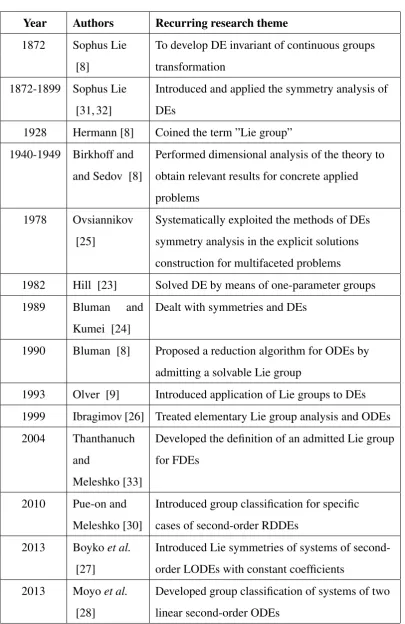
1872 Sophus Lie To develop DE invariant of continuous groups
[8] transformation
1872-1899 Sophus Lie Introduced and applied the symmetry analysis of
[31, 32] DEs
1928 Hermann [8] Coined the term ”Lie group”
1940-1949 Birkhoff and Performed dimensional analysis of the theory to and Sedov [8] obtain relevant results for concrete applied
problems
1978 Ovsiannikov Systematically exploited the methods of DEs [25] symmetry analysis in the explicit solutions
construction for multifaceted problems
1982 Hill [23] Solved DE by means of one-parameter groups
1989 Bluman and
Kumei [24]
Dealt with symmetries and DEs
1990 Bluman [8] Proposed a reduction algorithm for ODEs by admitting a solvable Lie group
1993 Olver [9] Introduced application of Lie groups to DEs 1999 Ibragimov [26] Treated elementary Lie group analysis and ODEs 2004 Thanthanuch Developed the definition of an admitted Lie group
and
Meleshko [33]
for FDEs
2010 Pue-on and Introduced group classification for specific Meleshko [30] cases of second-order RDDEs
2013 Boykoet al. Introduced Lie symmetries of systems of second-[27] order LODEs with constant coefficients
1.3 Problem Statement
Delay differential equations play significant roles in every facet of real life applications. Recently, more researchers turn to these equations since they can be used to describe various natural phenomena accurately. Unfortunately, DDEs are not easy to analyse or solve. Although there are some methods can solved first-order DDEs but they cannot solve higher-order DDEs. So, the researchers just study the stability of these equations. This is particularly true for the higher-order DDEs. So any applications modeled by these equations become insurmountable. Consequently, a direct method for solving DDEs is still lacking. The following research questions must be answered to fill this gap:
(i) How to classify second-order RDDEs to solvable Lie algebra?
(ii) Is it possible to achieve the family of transformation solutions for DDEs? (iii) Can one generalize the classification to second-order NDDEs using solvable Lie
algebra?
(iv) How to prove the validity of the classification method of RDDE and NDDE in real application?
(v) How to extend the classification technique for nth-order RDDEs and NDDEs to
solvable Lie algebra?
1.4 Research Objectives
The goal of this thesis is to develop the Lie symmetry analysis, especially Lie group analysis method to classify higher-order DDEs to solvable Lie algebra. The objectives of this thesis are the following:
(iv) To demonstrate the validity and feasibility of the classification method in precise examination of NDDEs and RDDEs on HPB model.
(v) To generalize the classification method from second-order DDEs to nth-order RDDEs and NDDEs.
1.5 Scope of the Study
The present thesis aims to develop a new approach to study DDEs with retarded and neutral delay of various order. So the scope of this work includes classification of second and nth-order delay differential equations of retarded and
neutral types with constant coefficients as solvable Lie algebras to achieve the family of the transformation solutions. Constant and positive time delay (τ) will be used. The effectiveness of the classification technique has been verified by classifying Human Postural Balance model in second-order DDEs, leading to the properties of the solutions of this model by obtaining the transformation solutions.
1.6 Research Significance
delay to solvable Lie algebra. The present method is able to achieve the family of transformation solutions for such equations.
By this classification technique it becomes simple to determine the properties of the solutions (retarded and neutral) DDEs of any order. It is believed that the results and successful implementation of the classifier provides a new basis for easily classifying DDEs as solvable Lie algebras to arrive at transformation solutions for these equations.
1.7 Research Methodology
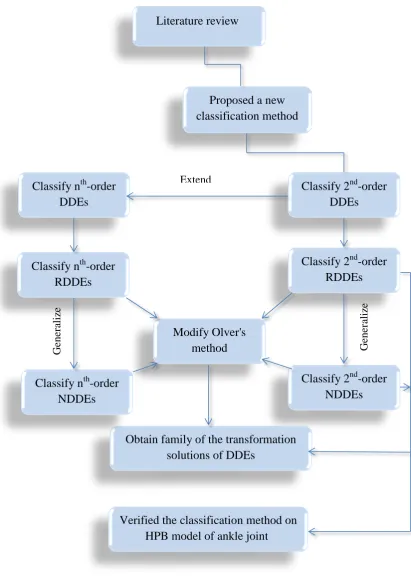
the invariance of such equations without change the space variables. The classification determines the associated symmetry group by the general infinitesimal generator which was prolonged to 6-dimensional spaces of variables. Then, the resulting equations are solved, and the solvable Lie algebras spanned by these parameters are arrived at by satisfying the inclusion property. This research further generalizes the classification to second-order NDDEs. In addition, the present work extends the classification method to nth-order DDEs with retarded and neutral delay by extending some procedures of
such classification. On the result space, modifying Oliver’s method yield the family of the transformation solutions for various order of DDEs. The classification technique has been verified by applying them to modeling of HPB of ankle joint. The research methodology is summarized in Figure 1.2.
1.8 Thesis Outline
This thesis consists of seven chapters together with reference list and appendices. Each chapter commences with a brief introduction and ends with a short summary. The present chapter provides a brief background, develops the rationale of the thesis, and tries to argue why intensive research in the cited topic is necessary. In addition, the problem statement in the form of research questions, proposed objectives, the research scope, and its significance with research methodology are underscored.
Literature review
Proposed a new classification method
Classify 2nd-order DDEs
Classify 2nd-order NDDEs Classify nth-order
DDEs
Obtain family of the transformation solutions of DDEs
Modify Olver's method
Classify nth-order NDDEs
Verified the classification method on HPB model of ankle joint
Figure 1.2 Summarized research methodology
G
ener
al
iz
e
Classify nth-order RDDEs
G
ene
ra
li
ze
Classify 2nd-order RDDEs
In addition, Chapter 2 provides an overview on Lie symmetries and Lie group analysis. It explains most researchers’ work that dealt with Lie group analysis on DE by changing the space variables. However DDEs do not possess equivalent transformations related to the change of the dependent and independent variables. Also it shows that earlier researchers did not succeed in classifying DDE to Lie algebra. Moreover, some basic definitions and theorems regarding Lie group, Lie algebra, Lie-B¨acklund representation are provided. Finally, the formulation of a new approach to study the solution properties of DDEs to overcome the existing shortcomings is emphasized.
The major contributions of the study are documented in the next four chapters. Chapter 3 introduces the results of the proposed new approach for the classification of second-order linear and non-linear retarded DDEs with constant coefficients as solvable Lie algebra. This leads to the transformation solutions by the one-parameter Lie groups which is achieved by the result’s space.
Chapter 4 extends the classification method in Chapter 3 to neutral delay differential equations. This chapter focuses on linear and non-linear NDDEs.
Chapter 5 provides the application of second-order DDEs with retarded and neutral types to solvable Lie algebra classification in modeling human Postural balance of ankle joint. It explained the way that allows us to solve such a model after the classification.
Chapter 6 generalizes the proposed novel classification method to nth
-order (linear and non-linear) DDEs with retarded and neutral delay with constant coefficients. This classification allows us to obtain the solutions ofnth-order DDEs.
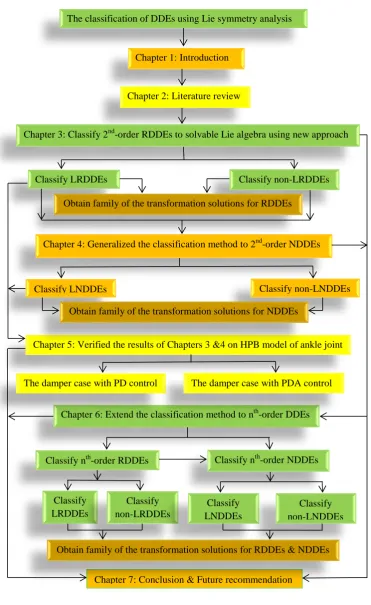
The classification of DDEs using Lie symmetry analysis
Chapter 1: Introduction
Chapter 2: Literature review
Chapter 3: Classify 2nd-order RDDEs to solvable Lie algebra using new approach
Classify LRDDEs Classify non-LRDDEs
Chapter 5: Verified the results of Chapters 3 &4 on HPB model of ankle joint
Chapter 6: Extend the classification method to nth-order DDEs
Classify LRDDEs
Classify non-LRDDEs
Classify LNDDEs
Classify non-LNDDEs
Chapter 7: Conclusion & Future recommendation
Classify nth-order RDDEs Classify nth-order NDDEs
Figure 1.3 Thesis organization
The damper case with PD control The damper case with PDA control
Chapter 4: Generalized the classification method to 2nd-order NDDEs
Classify LNDDEs Classify non-LNDDEs
Obtain family of the transformation solutions for RDDEs
Obtain family of the transformation solutions for NDDEs
to solvable Lie algebra. To begin with, one can focus on linear and non-linear DDEs.
1. Campbell, S. A. Introduction to Delay Differential Equations. Ph.D. Thesis. Canada: University of Waterloo; 2007.
2. Driver, R. D. Ordinary and Delay Differential Equations. New York: Springer-Verlag. 1977.
3. Forde, J. E. Delay Differential Equation Models in Mathematical Biology. Ph.D. Thesis. USA: University of Michigan; 2005.
4. Schmitt, K. Delay and Functional Differential Equations and Their Applications. New York and London. 1972.
5. Smith, H. An Introduction to Delay Differential Equations with Applications to The Life Sciences. Vol. 57. New York: Springer Science & Business Media. 2010. 6. Yang, J., Liang, S. and Zhang, Y. Travelling Waves of A Delayed SIR Epidemic Model with Nonlinear Incidence Rate and Spatial Diffusion. Plos one journal. 2011. 6(6): e21128.
7. Crawley, M. J. Natural Enemies: The Population Biology of Predators, Parasites and Disease. Oxford: Blackwell Scientific Publications. 1992.
8. Oliveri, F. Lie Symmetries of Differential Equations: Classical Results and Recent Contributions. Symmetry J. 2010. 2(2): 658–706.
9. Olver, P. J. Application of Lie Groups to Differential Equations. New York NY, USA: Springer. 1986.
10. Maan, N., Barzinji, K. and Aris, N. Fuzzy Delay Differential Equation In Predator-Prey Interaction: Analysis On Stability Of Steady State. Proceedings of the 2013 The World Congress on Engineering, International Association of Engineer. July 3–5, 2013. London. 2013.
T-Equations Using Coupling Variational Iteration With Taylor Series and Small Term. Bulletin of Mathematics. 2012. 4(1): 1–15.
13. Wang, Q. and Fu, F. Solving Delay Differential Equations with Homotopy Analysis Method. In: Li, K., Li, X., Ma, S. and Irwin, G. W. ed. In Life System Modeling and Intelligent Computing. Berlin Heidelberg: Springer. 97:144–153; 2010.
14. Li, X., Ruan, S. and Wei, J. Stability and Bifurcation in Delay Differential Equations with Two Delays. Journal of Mathematical Analysis and Applications. 1999. 236(2): 254–280.
15. Sun, L. Stability Analysis for Linear Delay Differential Equations and Numerical Examples. Applied Mathematics-A Journal of Chinese Universities. 2003. 18(4): 390–402.
16. Asl, F. M. and Ulsoy, A. G. Analysis of a System of Linear Delay Differential Equations.Journal of Dynamic Systems, Measurement, and Control. 2003. 125(2): 215–223.
17. Gu, K., Niculescu, S. I. and Chen, J. On Stability Crossing Curves for General Systems with Two Delays. Journal of Mathematical Analysis and Applications. 2005. 311(1): 231–253.
18. Berezansky, L. and Braverman, E. On Stability of Some Linear and Nonlinear Delay Differential Equations.Journal of Mathematical Analysis and Applications. 2006. 314(2): 391–411.
19. Kalm´ar-Nagy, T. Stability Analysis of Delay-Differential Equations by The Method of Steps and Inverse Laplace Transform. Differential Equations and Dynamical Systems. 2009. 17(1-2): 185–200.
21. Fan, G., Min-oo, M. and Wolkowicz, G. S. Hopf Bifurcation of Delay Differential Equations with Delay Dependent Parameters. Canadian Applied Mathematics Quarterly. 2009. 17(1): 37–60.
22. Vyasarayani, C. P., Subhash, S. and Kalm´ar-Nagy, T. Spectral Approximations for Characteristic Roots of Delay Differential Equations. International Journal of Dynamics and Control. 2014. 2(2): 126–132.
23. Hill, J. M. Solution of Differential Equation by Means of One-Parameter Groups. London. 1982.
24. Bluman, G. W. and Kumei, S. Symmetries and Differential Equations. New York: Sprinder. 1989.
25. Ovsiannikov, L. V. Group Analysis of Differential Equations. Russian, Nauka, Moscow. 1978. English translation by Ames, W. F. New York: Academic Press. 1982.
26. Ibragimov, N. H. Elementary Lie Group Analysis and Ordinary Differential Equations(1-3). London: Wiley. 1999.
27. Boyko, V. M., Popovych, R. O. and Shapoval, N. M. Lie Symmetries of Systems of Second-Order Linear Ordinary Differential Equations with Constant Coefficients. Journal of Mathematical Analysis and Applications. 2013. 397(1): 434–440. 28. Moyo, S., Meleshko, S. V. and Oguis, G. F. Complete Group Classification
of Systems of Two Linear Second-Order Ordinary Differential Equations. Communications in nonlinear science and numerical simulation. 2013. 18(11): 2972–2983.
29. Thanthanuch, J. and Meleshko, S. V. On Definition of An Admitted Lie Group for Functional Differential Equations. Communications in nonlinear science and numerical simulation. 2004. 9(1): 117–125.
30. Pue-on, P. and Meleshko, S. V. Group Classification of Second-Order Delay Ordinary Differential Equations. Communications in nonlinear science and numerical simulation. 2010. 15(6): 1444–1453.
Differential Equations. Proceedings of ISNA-16 Nonlinear Acoustics at the Beginning of the 21st Century. August 19–23, 2002. Moscow: Russia. 2002. 607–610.
34. Driver, R. D. A Mixed Neutral System. Nonlinear Analysis: Theory, Methods & Applications. 1984. 8(2): 155–158.
35. Gyo′′ri, I. and Ladas, G. Oscillation Theory of Delay Differential Equations with Applications. USA: Oxford University Press. 1991.
36. Hale, J.Theory of Functional Differential Equations. Berlin Heidelberg: Springer. 1971.
37. Krisztin, T. and Wu, J. Asymptotic Behaviors of Solutions of Scalar Neutral Functional Differential Equations.Differential Equations and Dynamical Systems. 1996. 4(3/4): 351–366.
38. Kuang, Y. Delay Differential Equation with Application in Population Dynamics. London: Academic Press. 1996.
39. Hashemi, M. S. Nucci, M. C. and Abbasbandy, S. Group Analysis of The Modified Generalized Vakhnenko Equation. Communications in Nonlinear Science and Numerical Simulation. 2013. 18(4): 867–877.
40. Lie, S. On Integration of a Class of Linear Partial Differential Equations by Means of Definite Integrals. Arch Math. 1881. (3): 328-368.
41. Na, L. and Xi-Qiang, L. Similarity Reductions and Similarity Solutions of the (3+1)-Dimensional KadomtsevPetviashvili Equation. Chinese Physics Letters. 2008. 25(10): 3527-3530.
42. Yan, Z. L. and Liu, X. Q. Symmetry and Similarity Solutions of Variable Coefficients Generalized ZakharovKuznetsov Equation.Applied Mathematics and Computation. 2006. 180(1): 288-294.
44. Vaneeva, O., Popovych, R. O. and Sophocleous, C. Group Analysis of BenjaminBonaMahony Equations With Time Dependent Coefficients. Journal of Physics: Conference Series. IOP Publishing. 621(1): 012016.
45. Yi, S. Time-Delay Systems: Analysis and Control Using The Lambert W Function. PhD. Thesis. USA: University of Michigan; 2009.
46. Bellen, A. and Zennaro, M. Numerical Methods for Delay Differential Equations. Numerical Mathematics and Scientific Computation. New York: Oxford Science Publication, Oxford University Press. 2003.
47. Kalm´ar-Nagy, T., St´ep´an, G. and Moon, F. C. Subcritical Hopf Bifurcation in The Delay Equation Model for Machine Tool Vibrations. Nonlinear Dynamics. 2001. 26(2): 121-142.
48. Batzel, J. J. and Tran, H. T. Stability of The Human Respiratory Control System I. Analysis of a Two-Dimensional Delay State-Space Model. Journal of mathematical biology. 2000. 41(1): 45-79.
49. Pue-on, P. Group Classification of Second-Order Delay Ordinary Differential Equations. Ph.D. Thesis. Thailand: University of Technology; 2007.
50. Roose, D. and Szalai, R. Continuation and Bifurcation Analysis of Delay Differential Equations. In: Krauskopf, B., Osinga, H. M. and Gal´an-Vioque, J. ed. Numerical Continuation Methods for Dynamical Systems. Netherlands: Springer. 359–399; 2007.
51. Lakshmanan, M. and Senthilkumar, D. V. Dynamics of Nonlinear Time-Delay Systems. Berlin Heidelberg: Springer-Verlag. 2010.
52. Kumar, D. and Kadalbajoo, M. K. Numerical Treatment of Singularly Perturbed Delay Differential Equations Using B-Spline Collocation Method on Shishkin Mesh. Journal of Numerical Analysis, Industrial and Applied Mathematics (JNAIAM). 2012. 7(3-4): 73–90.
53. P´eics, H. and Karsai, J. Positive Solutions of Neutral Delay Differential Equation. Novi Sad J. Math. 2002. 32(2): 95–108.
2006. 5-6: 79–84.
56. Heffernan, J. M. and Corless, R. M. Solving Some Delay Differential Equations with Computer Algebra. Mathematical Scientist. 2006. 31(1):21–34.
57. Tang, X. and Shen, J. New Oscillation Criteria for First Order Nonlinear Delay Differential Equations. Colloquium Mathematicum. 2000. 83(1): 21–41.
58. Li, B. and Kuang, Y. Sharp Conditions for Oscillations in Some Nonlinear Nonautonomous Delay Differential Equations. Nonlinear Analysis: Theory, Methods & Applications. 1997. 29(11): 1265-1276.
59. Li, X. Oscillation Properties of Higher Order Impulsive Delay Differential Equations. International Journal of Difference Equations (IJDE). 2007. 2(2): 209–219.
60. Lisle, I. Equivalence Transformations for Class of Differential Equations. Ph.D Thesis. Canada (British Columbia): University of British Columbia; 1992. 61. Starrett, J. Solving Differential Equations by Symmetry Groups. The American
Mathematical Monthly. 2007. 114(9): 778–792.
62. Gazizov, R. K. and Ibragimov, N. H. Lie Symmetry Analysis of Differential Equations in Finance. Nonlinear Dynamics Journal. 1998. 17(4): 387–407. 63. Gonzalez-Lopez, A., Kamran, N. and Olver, P. J. Lie Algebra of Differential
Operators in Two Complex Variables. American Journal of Mathematics. 1992. 114(6): 1163–1185.
64. Gonzalez-Lopez, A., Kamran, N. and Olver, P. J. Lie Algebra of Vector Fields in The Real Plane. In Proc. London Math. Soc. 1992. 64(3): 339–368.
65. Thanthanuch, J. Application of Group Analysis to Functional Differential Equations. Ph.D. Thesis. Thailand, Suranaree: Univirsity of Technology; 2003. 66. Borel, A. Essays in The History of Lie Groups and Algebraic Groups. (No. 21).
Springer Science & Business. 2001.
68. Kirillov, A. An Introduction to Lie Groups and Lie Algebras. Vol. 113. England, Cambridge: Cambridge University Press. 2008.
69. Piscoran, L. I. Noncommutative Differential Direct Lie Derivative and The Algebra of Special Euclidean Group SE(2)Creative Mathematics and informatics. 2008. 17(3): 493–498.
70. Venturi, N. Groups, Lie Groups, Lie Algebras: Introduction. Ph.D. Thesis. Switzerland: LHEP, University of Bern; 2007.
71. Kyrychko, Y. N. and Hogan, S. J. On The Using of Delay Equations in Engineering Applications. Journal of Vibration and Control. 2010. 16(7-8): 943–960.
72. Milton, J. G., Cabrera, J. L. and Ohira, T. Unstable Dynamical Systems: Delays, Noise and Control. EPL (Europhysics Letters). 2008. 83(4): 48001.
73. Milton, J. G. The Delayed and Noisy Nervous System: Implications For Neural Control. Journal of neural engineering. 2011. 8(6): 065005.
74. Piiroinen, P. T. and Dankowicz, H. Low-Cost Control of Repetitive Gait in Passive Bipedal Walkers. International Journal of Bifurcation and Chaos. 2005. 15(06): 1959–1973.
75. Mehta, B. and Schall, S. Forward Models in Visuomotor Control. Journal of Neurophysiology. 2002. 88(2): 942–953.
76. Cabrera, J. L. and Milton, J. G. On-Off Intermittency in A Human Balancing Task. Physical Review Letters. 2002. 89(15): 158702.
77. Loram, I. D., Maganaris, C. N. and Lakie, M. Human Postural Sway Results From Frequent, Ballistic Bias Impulses by Soleus and Gastrocnemius. The Journal of physiology. 2005. 564(1): 295–311.
78. Asai, Y., Tasaka, Y., Nomura, K., Nomura, T., Casidio, M. and Morasso, P. A Model of Postural Control in Quiet Standing: Robust Compensation of Delayinduced Instability Using Intermittent Activation of Feedback Control.PLoS One. 2009. 4(7): e6169.
81. Bingham, J. T., Choi, J. T. and Ting, L. H. Stability in A Frontal Plane Model of Balance Requires Coupled Changes to Postural Configuration and Neural Feedback Control. Journal of neurophysiology. 2011. 106(1): 437–448.
82. Kowalczyk, P., Glendinning, P., Brown, M., Medrano-Cerda, G., Dallali, H. and Shapiro, J. Modelling Human Balance Using Switched Systems with Linear Feedback Control. Journal of The Royal Society Interface. 2012. 9(67): 234– 245.
83. Paoletti, P. and Mahadevan, L. Balancing on Tightropes and Slacklines. Journal of The Royal Society Interface. 2012. 9(74): 2097–2108.
84. Insperger, T., Milton, J. and St´ep´an, G. Acceleration Feedback Improves Balancing Against Reflex Delay. Journal of The Royal Society Interface. 2013. 10(79): 1–32.
85. Bottaro, A., Yasutake, Y., Nomura, T., Casadio, M. and Morasso, P. Bounded Stability of The Quiet Standing Posture: An Intermittent Control Model. Human movement science. 2008. 27(3): 473–495.
86. Gomi, H. and Kawato, M. Adaptive Feedback Control Models of The Vestibulocerebellum and Spinocerebellum. Biological cybernetics. 1992. 68(2): 105–114.
87. Peterka, R. J. Simplifying The Complexities of Maintaining Balance.Engineering in Medicine and Biology Magazine, IEEE. 2003. 22(2): 63–68.
88. Sieber, J. and Krauskopf, B. Extending The Permissible Control Loop Latency for The Controlled Inverted Pendulum. Dynamical Systems. 2005. 20(2): 189–199. 89. Welch, T. D. J. and Ting, L. H. A Feedback Model Reproduces Muscle
Activity During Human Postural Responses to Support-Surface Translations. J. Neurophysiol 2008. 99(2): 1032–1038.
91. Kolmanovskii, V. B. and Nosov, V. R. Stability of Functional Differential Equations. Vol.(180) UK, London: Academic Press. 1986.
92. St´ep´an, G. Retarded Dynamical Systems. UK, Harlow: Longman Scientific & Technecal. 1989.
93. Hale, J. K. and Lunel, S. M. V. Introduction to Functional Differential Equations. Vol.(99) New York: Springer Science & Business Media. 1993.
94. Malakhovski, E. and Mirkin, L. On Stability of Second-Order Quasi-Polynomials with A Single Delay. Automatica. 2006. 42(6): 1041–1047.
95. Lafortune, M. A. and Lake, M. J. Human Pendulum Approach to Simulate and Quantify Locomotor Impact Loading. Journal of biomechanics. 1995. 28(9): 1111–1114.
96. Coveney, V. A., Hunter, G. D. and Spriggs, J. Is The Behaviour of The Leg During Oscillation Linear?. Journal of biomechanics. 2001. 34(6): 827–830.
97. Kyrychko, Y. N., Blyuss, K. B., Gonzalez-Buelga, A., Hogan, S. J. and Wagg, D. J. Real-Time Dynamic Substructuring in A Coupled Oscillator-Pendulum System. The Royal Society. 2006. 462(2068): 1271–1294.
98. Loram, I. D. and Lakie, M. Direct Measurement of Human Ankle Stiffness During Quiet Standing: The Intrinsic Mechanical Stiffness is Insufficient for Stability.The journal of physiology. 2002. 545(3): 1041–1053.
99. Eurich, C. W. and Milton, J. G. Noise-Induced Transitions in Human Postural Sway. Physical Review E. 1996. 54(6): 6681-6684.
100. Deligniˆeres, D., Torre, K. and Bernard, P. L. Transition From Persistent to Anti-Persistent Correlations in Postural Sway Indicates Velocitybased Control. PloS Computational Biology. 2011. 7(2): e1001089.
101. Haller, G. and Stepan, G. Micro-Chaos in Digital Control. Journal of Nonlinear Science. 1996. 6(5): 415-448.
![Figure 1.1 Sophus Lie (Nordfjordeid, 17 December 1842 - Christiania, 18 February1899) [8]](https://thumb-us.123doks.com/thumbv2/123dok_us/1273290.1159887/20.595.255.398.72.245/figure-sophus-lie-nordfjordeid-december-christiania-february.webp)