
COSTAR-COncrete STructures Aging Reference Manual
A Structures Condition Assessment Tool
Gregor, Frank E. 1) and Carey, John J. 2)
1) LCM Technology, LC, Tarpon Springs, Florida, USA 2) EPRI, Palo Alto, California, USA
A B S T R A C T
In the past there has been a common belief that concrete structures are capable of fimctioning well beyond the normal life of a power plant. Initial life extension studies carried out by EPRI and others identified a number of concrete and embedment degradation mechanisms which, under certain exposure conditions, could lead to degradation of concrete structures. Effective aging management and early detection and mitigative action, ff necessary, assures that the structures continue to be capable of performing their functions. The COSTAR project focussed on identifying, evaluating and recording the applicable research references, studies and plant experiences with concrete structures and developing a software tool for application to plant specific assessments.
COSTAR uses the Microsoft ACCESS database as a platform and consists of two distinct modules: A degradation susceptibility evaluation and a condition assessment process. Both modules rely on the aging degradation database, the functional grouping of the structures and a ranking logic (green, yellow, red) to determine the significance of degradation susceptibility and in-situ observed degraded conditions. COSTAR also contains a library of effective detection/investigation methods and effective mitigative actions down to the procedure level.
An expert review panel was utilized to evaluate the acceptance criteria and logic used in the program. Extensive field testing has been completed to validate the software. Enhancements have been identified to make the program more user friendly and efficient. A Beta version of COSTAR is available for use now and improvements are planned for the future.
I N T R O D U C T I O N
The COSTAR (Concrete Structures Aging Reference manual) project was initiated to provide a tool to the utility engineers for the development or enhancement of aging management programs for the nuclear power plant concrete structures. This is accomplished by providing a comprehensive electronic reference manual of current concrete aging and degradation
knowledge and applying this information in a quasi expert format to perform initial ranking of the plant structures with respect to degradation susceptibility and functional importance of the structures. A second module contains a condition assessment option to accomplish evaluation of existing (in-situ) or postulated degraded concrete structure conditions, selecting supplemental investigations techniques and aging management options.
P R O G R A M D E S C R I P T I O N
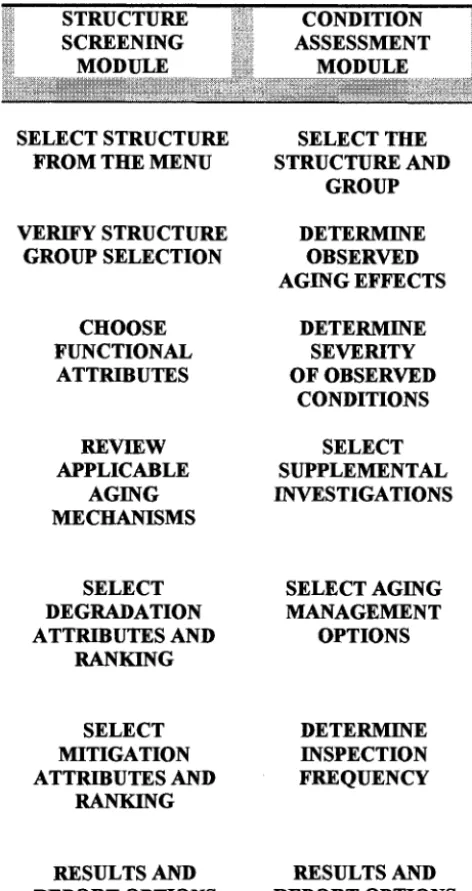
Because of its universal use and flexibility, the Microsoft ACCESS data base, Windows 95 version, was chosen as the principal platform for this program. COSTAR consists of two modules, the Structures Screening Module and the Condition Assessment Module. Both modules utilize the same data and structure selection process. The individual steps for each of the modules are as shown on Figure 1.
Screening Module
The main menu of the program lets the user select the applicable plant type (PWR or BWR) and the type of assessment to be performed. The screening module can be used to create an inventory of plant concrete structures, to perform an initial ranking of functional importance and to evaluate the potential susceptibility to concrete aging and degradation, using plant specific information. This module also lends itself to assessment of concrete structures for the purpose of license renewal with respect to susceptibility to degradation using plant specific conditions.
F I G . 1 C O S T A R
Program Flow
C h a r tii'/~ii ' STRUCTURE ~iili CONDITION i~i
~ii SCREENING ~ii; ASSESSMENT
i~
~i
MODULE ~!i MODULE ~SELECT STRUCTURE
FROM
THE MENUSELECT THE STRUCTURE AND
GROUP VERIFY STRUCTURE
GROUP SELECTION
DETERMINE
OBSERVED
AGING EFFECTS
CHOOSE FUNCTIONAL ATTRIBUTES DETERMINE SEVERITYOF
OBSERVEDCONDITIONS REVIEW APPLICABLE AGING MECHANISMS SELECT SUPPLEMENTAL INVESTIGATIONS SELECT DEGRADATION ATTRIBUTES AND
RANKING SELECT AGING MANAGEMENT OPTIONS SELECT MITIGATION ATTRIBUTES AND
RANKING
DETERMINE
INSPECTION
FREQUENCY
RESULTS AND RESULTS AND
REPORT OPTIONS REPORT OPTIONS
i i i i i i i i i i ii
.Structures Menu
The Structures Menu consists of a
comprehensive listing of common concrete structures found in nuclear power plants, representing BWR and PWR plants. Reinforced, unreinforced and precast concrete, reinforced and prestressed containment structures, as well as masonry block structures are included, together with the embedded rebar and steel embedments. Steel structures are not included in the scope of this program. A specific objective was to include all applicable concrete structures, whether safety related or not, underground, underwater, inaccessible or simple slabs or footings. In all 141 structures are listed in the menu, many of them in duplicate due to differing names, functions or configuration.
Structure
Groups
Each of the individual concrete structures are categorized into one of twelve Structure Groups with similar function, environmental conditions and exposure. While the structure groups have been predetermined by an expert panel, a different group can be designated based on plant unique conditions. Detailed Structure Group descriptions are provided to assure that the most fitting group is matched with the plant conditions. A specific structure, such as the Reactor Building in a BWR or the Auxiliary Building in a PWR, can be represented by a number of different elements. Each element, exhibiting its own unique condition, fimction or exposure and
belonging to a specific structure group, for instance the Building-Exterior, Buildings-Interior, Below Grade Structures and Equipment Foundations could be evaluated separately for these buildings.
The structure groups are linked to the functional attributes and the aging mechanisms, predetermined by an expert panel.
Functional Attributes
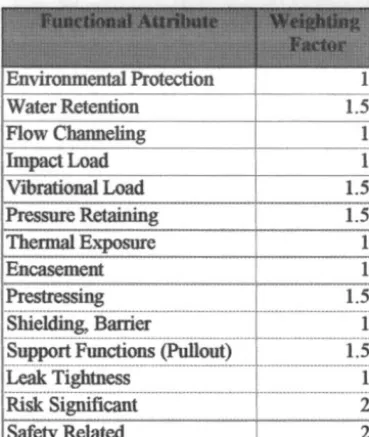
In order to establish the relative importance of the structures, the various functions must be considered. A total of 14 functions have been identified, as shown on Table 1. Detailed descriptions were generated for each function to assure that the user selects the appropriate and applicable functions. To compensate for the fact that not all functions are of equal importance, weighting factors were applied, as indicated on Table 1. Passive functional attributes (i.e., water retention) were assigned a base factor of 1.0, active fimctional attributes (i.e., vibration, impact) and pressure retaining functions are given a factor of 1.5 and the safety related and risk significant attributes are assigned an importance factor of 2.0.
The functional importance of the structure is based on the cumulative value of these functions and assigning a range to each of three functional importance categories as follows:
A range of 0 to <3.0 is referred to as a "Standard Structure".
A range of 3.0 to 6.0 is referred to as a °'Important Structure".
TABLE 1
COSTAR Functional Attribute Listing
Environmental Protection .... ! 1
Water Retention I 1.5 ~
Flow Channeling ] 1-
Impact Load i 1i
Vibrational Load [ 1.5
Pressure Retaining [ . .
Thermal Exposure 1
Eh-ca~asement [ 11
o ,
i Si e!ia #il}i riiiiiiiiiiiiiiiiiiiiiiiiiiiliiiiiiiiiiiiiiiiiiiiiiiiiil!il
Support Functions (Pullout) i 1.5i
Aging Mechanisms
A comprehensive review of the available and applicable literature on concrete aging and degradation identified many diverse aging mechanisms, which were eventually grouped into 16 common aging mechanisms. For each of the mechanisms a detailed standard description was generated to assure consistency in the definition of the terms used in this program. Each aging mechanism has been linked to the structure groups to indicate the potential susceptibility and eliminating combinations that are not feasible. The feasible mechanisms for the structure group under consideration are displayed in the program and the user selects those applicable to the structure under consideration and representative of the plant conditions. Other mechanisms can be chosen, however, this would reflect a highly unusual condition.
The aging mechanisms have also been linked to the aging effects (discussed later) and the Degradation and Mitigation Attributes associated with the respective aging mechanism.
Degradation Attributes
Degradation Attributes are those plant specific conditions and features which determine the rate of degradation, the susceptibility of the structure and the long term performance expectations. From the available literature, 14 pertinent degradation attributes were identified as applicable to the nuclear plant concrete
TABLE 2
COSTAR Aging Mechanisms Listing
Abrasion, Erosion And Cavitation Bio-Fouling
Chemical Attack - Aggressive Corrosion Of Embedded Steel Cracking of Masonry
Creep
Current - Cathodic Protection Elevated Temperature Environmental Degradation Fatigue, Vibration
. . .
Freeze-Thaw
~ Irradiation Of Concrete
[Leaching of Calcium
Hydroxide
struOures, as shown on Table 3. Each degradation attribute has a detailed description, discussing the degradation effects, the manifestations, materials affected or susceptible locations. The plausible degradation attributes associated with the aging mechanism have been predetermined, however, the user may choose others or simply select only those which are truly representative of his plant conditions and features. The objective can also be to postulate certain conditions to determine the potential consequences.
Mitigation Attributes
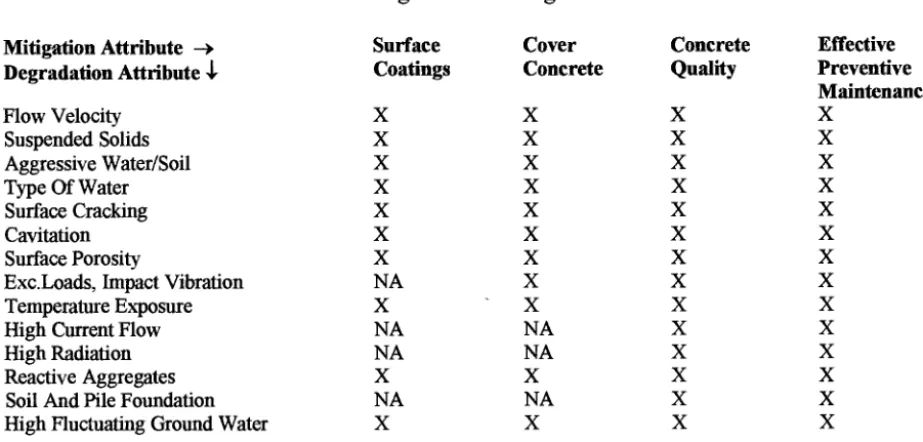
Mitigation Attributes are those plant conditions and features which offset or mitigate the effects of the degradation, prolong the life of the concrete structure and protect the structure against unexpected degradation of its functions. An assessment matrix was constructed to link the mitigation attributes with the degradation attributes to verify that each mitigation attribute is capable of offsetting a degradation attribute, as shown on Table 3. The unacceptable combinations were blocked within the program (i.e., surface coatings cannot mitigate radiation effects).
As with the degradation attributes, detailed descriptions are provided for the mitigation attributes and the Low, Medium and High rank criteria were established on the basis of available information, no new data or research was conceived under this program. The criteria bases are described and referenced, to permit additional review or interpretation by the user.
T A B L E 3 Matrix of Mitigation and Degradation Attribute Combinations
Mitigation Attribute -~
Surface
Cover
Concrete
Effective
Degradation Attribute ~,
Coatings
Concrete
Q u a l i t y
Preventive
Maintenance
Flow Velocity X X X X
Suspended Solids X X X X
Aggressive Water/Soil X X X X
Type Of Water X X X X
Surface Cracking X X X X
Cavitation X X X X
Surface Porosity X X X X
Exc.Loads, Impact Vibration NA X X X
Temperature Exposure X ~ X X X
High Otrrent Flow NA NA X X
High Radiation NA NA X X
Reactive Aggregates X X X X
Soil And Pile Foundation NA NA X X
High Fluctuating Ground Water X X X X
Summation Logic
A numerical logic needed to be developed to take into account the functional importance of the structure, the number of aging mechanisms, the degradation susceptibility and the degradation and mitigation attributes. The logic chosen for use in COSTAR consists of a "Traffic Light" color code linked to the Low, Medium and High criteria scores for the mitigation and degradation attributes as follows:
• A Low Criteria Rank is designated Green with a numerical value of 1.0 or 4.0 for the Degradation and Mitigation Attribute respectively.
• A Medium Criteria Rank is designated Yellow with a numerical value of 2.0
• A High Criteria Rank is designated Red with a numerical value of 4.0 or 1.0 for the Degradation and Mitigation Attribute respectively.
• The sum averages are computed for each aging mechanism
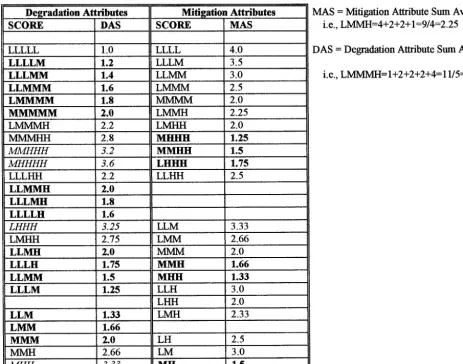
• The individual aging mechanism is determined to be red, yellow or green, using the logic shown on Table 4. • For structures with several Aging Mechanisms, the results are combined, using the logic shown on Table 5. The final result of the screening process is to assign the structure into one of three categories:
Green - The structure is not exposed to unusual conditions requiring specific attention or targeted preventive maintenance.
Yellow - The structure is susceptible to degradation and mitigative or preventive actions should be contemplated. The structure deserves closer attention and periodic condition review. Red - The structure could be subject to degradation which would impair its function over time and
within the current life cycle. Preventive or mitigative actions should be considered in the near term and additional investigations should be considered.
Table 4
S c o r i n g L o g i c F o r C o m b i n i n g D e g r a d a t i o n A n d M i t i g a t i o n A t t r i b u t e sD e g r a d a t i o n A t t r i b u t e s S C O R E
LLLLL L L L L M ,
L L L M M
L L M M M 1.6
L M M M M i . 8
M M M M M 2.O
L M M M H 212
2.8
MMHHH 3 . 2
MHHHH
LLLHH ' '
L L M M H 2 . 0
L L L M H 1.8
L L L L H 1.6
LHHH 3.25
. . . . i
LMHH 2.75
L L M H '' 2.0
' L L L H " 1.75 L L M M " 1 . 5
L L L M 1.25
L L M
L I ~
M M M MMHM H H "
D A S
1.0 1.2 1.4
M i t i g a t i o n A t t r i b u t e s ' S C O R E
LLLL LLLM LLMM
L ~
MMMM'
L ~
L M H H . . . M H l t H
M ~
bIAS 4.0 3.5 3.02.5
2.0
2.25 2.0 1 . 2 5 , ,1.5
3.6
2.2
i.33 1 . 6 6 2 . 0 2166
. . . .
3.33
/
L H H H 1 . 7 5 LLHH
LLM LMM M I V I I V I
M M ~ ' M l q ~ LLH
LHH
LH L M M H2.5
3.33 2.66 . . . . 2.0 1 . 6 6 1.33 3.0 2.0 2.33 2.5 3 . 0 1.5MAS = Mitigation Attribute Stun Average i.e., LMMH=4+2+2+1=9/4=2.25
DAS = Degradation Attribute Sum Average i.e., LMMMH= 1+2+2+2+4 = 11/5=2.2
IF DAS>3.19 THEN SUM=4 (RED), IF DAS<2.19 AND MAS<l.76 THEN SUM=I (GREEN), ELSE SUM=2 (YELLOW)
BOLD=GREEN COMBINATIONS ITALIC=RED COMBINATIONS, ALL OTHER COMBINATIONS ARE YELLOW GREEN=LOW (L)=I FOR DEGRADATION AND 4 FOR MITIGATION, YELLOW = MEDIUM (M)=2 FOR BOTH RED = HIGH (H)=4 FOR DEGRADATION AND 1 FOR MITIGATION
TABLE 5 COSTAR Ranking Logic For Multiple Aging Mechanisms (AM)
AM#1
A M # 2
....
A M # 3
L M n L M H L M HX - - X - - X - -
- X - X - - X - -
- X - - X - X - -
- X - - X = - X -
_ - X X - - X - -
. . . .
A M # 4
L M H
X - -
X - -
X - -
X - -
X - -
,
S T R U C T U R E
L
X M X X H X XIn conclusion, the scoring criteria can be summarized as follows:
All the AM's are" L " Then the Structure is ranked" L " (Green) One AM is " M " Then the Structure is ranked " M " (Yellow) Two AM's are" M " Then the Structure is ranked" M " (Yellow) More than two AM's are "M" Then the Structure is ranked" H " (RED) Any AM is" H " Then the Structure is ranked " H " (RED)
Screening Results and Report
After successful entry of all the required data, the results are computed and displayed on a Screening Assessment Form. The form will show the Structure Functional Category (Standard, Important, Critical) and the Structure Rank (Green, Yellow, Red), as explained above. Two report options are provided, a Detailed Structure Report for the individual structure displaying the input data and the results and a Summary Report for all the evaluated structures in a tabular form, sorted by Structure Rank (Red, Yellow, Green).
C O N D I T I O N A S S E S S M E N T M O D U L E
The Condition Assessment Module can be chosen to start the evaluation of plant specific conditions observed as a result of inspections, walkdowns or ongoing investigations. Of particular importance are conditions identified under the Structural Monitoring Program, such as observed degradation, impaired functions (leaking roof, broken concrete pads) or abnormal conditions. These conditions need to be evaluated quickly for corrective action or disposition and could be appropriate candidates for this COSTAR condition assessment module.
Structure and Structure Group Selection
The selection process for the structure to be evaluated and the applicable structure group selection uses the same data base and methodology described for the Screening Module above. Because the Condition Assessment is plant specific, it is important to select the most applicable structure and associated structure group for the case. Review of the descriptions will help focusing in on the correct choice.
Aging Effects and Aging Mechanisms
Aging Effects are the conditions or manifestations of degraded concrete structures as observed in the field and they are the observable consequences of active aging mechanisms. Based on available industry literature [1 through 19], 10 relevant aging effects have been identified and cross linked to the applicable aging mechanisms capable of causing these effects. Each aging effect is also linked to those supplemental investigations and aging management options which may be applicable to the observed conditions. Using the actual field conditions, the user selects one or more of the Aging Effects and reviews the detailed descriptions for the aging effect and the three evaluation criteria, to determine which most closely matches the in-situ conditions. The criteria values are viewed as ranges of severity and are a guidance to the evaluating utility engineer. Where possible, references have been provided for the technical bases of the criteria.
Aging Effects Ranking Logic
The structure is ranked in accordance with the determined severity of the aging effects. If there were more than one aging effect observed and scored for the structure, the combined ranking is based on the same logic as the one applied to the combination of aging mechanisms, shown on Table 5.
Supplemental Investigations
Aging Management Options
Similar to the supplemental investigations, the Aging Management Options available to monitor, prevent, mitigate, repair or replace the degraded structure have been identified from the key references. Detailed descriptions, taken from the literature or modified for this application, have been included in COSTAR for 25 different options. Each option has been categorized in accordance with standard industry convention as Preventive, Mitigative or Corrective maintenance and the potential applicability to the observed aging effects has been established. The user may select from the menu the most fitting and effective aging management option in case the structure being evaluated ranks in the Red or Yellow regime.
Inspection Periods
Consistent with the Codes and Standards for concrete (AC1349.3R and ASME XI), recommended Inspection Intervals and frequencies for re-inspection or condition monitoring of degraded concrete structures have been included in COSTAR as follows:
: : : : : : : : : : : : : : : : : : : : : : : : : : : : : : : : : : : : : : : :
!M (YELLOW)
I
(' LLOW)
. . . _- . . . '_ . . . . . . '_ . . . ! _ _ _ 2 . . . ~_ .. . . ~ _ _ 2 . . . 2 . . . = . . . l _ : . = . ~
Without Corrective Action ] 36 Months
With Corrective Action I 60 Months
~~iii~i~~iiiiiii~ii!i~iiiiiiiii!iiiitii [ii iitliiiii~i!i!iiiii~ii~!iii!iiiiiiii!iiii!ii~i!i
The user may select the appropriate frequency, consistent with the plant conditions and the selected corrective actions (Aging Management Options).
Key References
The principal objective of COSTAR was to provide in a single source document a comprehensive manual of technical data and information regarding aging management of concrete structures and to present this data in a logical and organized fashion for ready access and application. The data contained in the COSTAR data base represents the most applicable data from the references cited below.
1. American Concrete Institute, ACI-201.1R-92, "Guide for Making a Condition Survey of Concrete in Service", Detroit, Michigan.
2. American Concrete Institute, ACI-349.3R-96, "Evaluation of Existing Nuclear Safety Related Concrete Structures", Detroit, Michigan.
3. US Nuclear Regulatory Commission, NUREG-1522, March 1995, "Assessment of Inservice Conditions of Safety .
Related Nuclear Plant Structures".
4. Oak Ridge National Laboratory, ORNL/NRC/LTR-90/17, March 1991, "Structural Aging Assessment Methodology for Concrete Structures in Nuclear Power Plants".
5. Oak Ridge National Laboratory, ORNL/NRC/LTR-90/29, September 1991, "Inservice Inspection and Structural Integrity Assessment Methods for Nuclear Power Plant Concrete Structures".
6. Oak Ridge National Laboratory, NUREG/CR-4652 (ORNL/TM-10059), Sept. 1986, "Concrete Component Aging and its Significance Relative to Life Extension of Nuclear Power Plants".
7. Oak Ridge National Laboratory, NUREG/CR-6424 (ORNL/TM-13148), March 1996, "Report on Aging of Nuclear Power Plant Reinforced Concrete Structures".
8. International Atomic Energy Agency, IAEA-TECDOC-1025, June 1998, "Assessment and Management of Ageing of Major Nuclear Power Plant Components Important to Safety: Concrete Containment Buildings".
9. Electric Power Research Institute, EPRI-TR-103835, July 1994, "PWR Containment Structures, License Renewal Industry Report, Rev. 1".
10. Electric Power Research Institute, EPRI-TR-103840, July 1994, "BWR Containments, License Renewal Industry Report, Rev. 1".
11. Electric Power Research Institute, EPRI-TR-103 842, July 1994, "Class I Structures, License Renewal Industry Report, Rev. 1".
12. US Nuclear Regulatory Commission, NUREG-CP-00120, July 1992, "Proceedings of The Fit~ Workshop on Containment Integrity".
14. Nuclear Energy Institute, NE196-03, Revision D, July 1996, "Industry Guideline For Monitoring The Condition Of Structures At Nuclear Power Plants".
15. US Nuclear Regulatory Commission, Reg. Guide 1.160, Revision 2, March 1997, "Monitoring The Effectiveness Of Maintenance At Nuclear Power Plants".
16. US NRC, NRC Inspection Manual, Inspection Procedure IP-62002, 12/31/96, Inspection Of Structures, Passive Components And Civil Engineering Features At uclear Power Plants".
17. US NRC, NRC Inspection Manual, Inspection Procedure IP-62003, 06/11/97, "Inspection Of Steel And Concrete Containment Structures At Nuclear Power Plants".
18. US NRC, NRC Inspection Manual, Inspection Procedure IP-62706, 08/31/95, "Maintenance Rule".
![CRIMINAL AND JUVENILE JUSTICE PLANNING DIVISION[428]](data:image/gif;base64,R0lGODlhAQABAIAAAP///wAAACH5BAEAAAAALAAAAAABAAEAAAICRAEAOw==)