Knowledge management (KM) framework for
representing lessons learned system for
Communities of practice...
Article · January 2004
CITATIONS
5
READS
171
5 authors, including:
Some of the authors of this publication are also working on these related projects:
ENABLING KNOWLEDGE SHARING BEHAVIOUR THROUGH SOCIAL MEDIA ANALYSISView project
Mobile Forensic Triage For Damaged Phones Using M_TriageView project Kamaruddin MALIK Mohamad
Universiti Tun Hussein Onn Malaysia 16PUBLICATIONS 39CITATIONS
SEE PROFILE
Rose Alinda Alias
Universiti Teknologi Malaysia 95PUBLICATIONS 196CITATIONS
SEE PROFILE
Shamsul Sahibuddin
Universiti Teknologi Malaysia 87PUBLICATIONS 291CITATIONS
SEE PROFILE
Nor Nor Hidayati
Universitas Palangka Raya 4PUBLICATIONS 10CITATIONS
KNOWLEDGE MANAGEMENT (KM) FRAMEWORK FOR REPRESENTING LESSONS LEARNED SYSTEM FOR COMMUNITIES OF PRACTICE IN INSTITUTIONS OF HIGHER LEARNING
Mohd Nazir Ahmad Sharif
Faculty of Computer Science & Information Systems Universiti Teknologi Malaysia
81310 Skudai Negeri Johor Darul Takzim
Malaysia
email: [email protected]
Kamaruddin Malik Mohamad
Faculty of Computer Science & Information Systems Universiti Teknologi Malaysia
81310 Skudai Negeri Johor Darul Takzim
Malaysia email: [email protected]
Rose Alinda Alias
Faculty of Computer Science & Information Systems Universiti Teknologi Malaysia
81310 Skudai Negeri Johor Darul Takzim
Malaysia
email: [email protected]
Shamsul Shahibudin
Faculty of Computer Science & Information Systems Universiti Teknologi Malaysia
81310 Skudai Negeri Johor Darul Takzim
Malaysia
email: [email protected]
Nor Hidayati Zakaria
Faculty of Computer Science & Information Systems Universiti Teknologi Malaysia
81310 Skudai Negeri Johor Darul Takzim
Malaysia
email: [email protected]
ABSTRACT
Organisations worldwide are using techniques and technologies to better manage their knowledge. Their objective is to improve the quality of knowledge sharing by exploiting tacit and explicit knowledge of successes and failures. The requirement to record, reference and access lessons learned to support teaching operations and exercises is mainly important to lecturers in Institutes of Higher Learning. Lessons learned are typically short descriptions of specific experiences that may have future applicability in similar situations. In general, this paper proposes a KM adapted model for representing Lessons Learned System (LLS) Framework. The model was derived by mapping the Nonaka’s KM model [1] with the Lessons Learned processes that are adapted from Weber [2]. Finally, based on this model, the main features of LLS were defined and a prototype of LLS was developed. The prototype of LLS is used to illustrate the features of LLS and to demonstrate how it can be used to access Lessons Learned in order to support Communities of Practices (CoP) in Institutions of Higher Learning. LLS is a web-based application developed using WAMP which is an open source software suite comprising of Apache server, MySQL database and PHP programming for Windows operating system.
Keywords: Knowledge Management, Communities of Practice, Lessons Learned Process, Lessons Learned
System
1.0 INTRODUCTION
knowledge media, organisation studies, epistemology, other aspects of classification and definition informed by artificial intelligence human resource issues etc.
There are a broad range of KM applications and their relationships to the KM enabling technologies. KM enabling technologies continue to evolve rapidly especially in the areas of collaboration and search engines [7]. Binney [7] introduces a KM spectrum as a framework for understanding the KM landscape by providing a checklist of KM applications and the enabling technologies that mapped onto the KM applications which they enable.
This paper is structured as follows: Section 2.0 highlights the KM definitions and selects a particular KM model for discussion. Section 3.0 gives an overview on Communities of Practices (CoP) by providing a simple scenario in an Institute of Higher Learning context that represents the need for KM support. In Section 4.0, KM applications are discussed through the KM spectrum framework and an overview of the overall KM applications that are mapped to the defined elements of the framework is given. Section 5.0 discusses how the derivation process is done in order to propose an adapted model for representing Lessons Learned System (LLS) using KM approach, while Section 6.0 shows how the approach is exemplified by developing a simple application. Section 7.0 presents some discussion and future work that can be done, and finally Section 8.0 concludes this paper.
2.0 KNOWLEDGE MANAGEMENT (KM)
There are many definitions of KM in the literature, thus comparisons must be made to know the focus by each author. Some of the focuses are highlighted below.
McAdam and McCreedy [6] assert that KM relates to both theory and practice, where its central issues are people and learning. They also highlight that the role of IT is mainly as a useful enabler rather than a central tenet of KM. Furthermore, KM is a multi-discipline which originates from other disciplines such as psychology, management science, sociology, strategy, and production engineering (refer to Nonaka and Takeuchi [1]). De Jarnett [8] defines knowledge management in terms of processes of knowledge creation, followed by interpretation, knowledge dissemination and use, and knowledge retention and refinement.
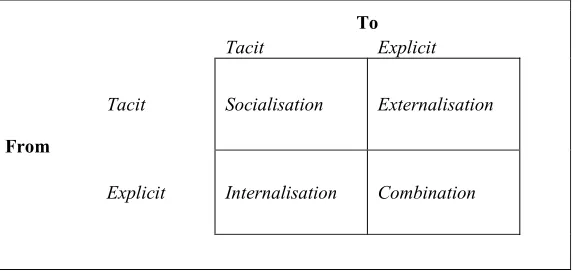
Although many KM models are found in the literature, the Nonaka and Takeuchi model (refer to Fig. 1) is used as the framework of this study because of its simple high level conceptual representation of KM. It is also very popular and has been widely used as a KM foundation framework by many KM researchers (refer to Alavi and Leidner [9]; Barclay and Murray [10]; Davenport and Prusak [11]; McAdam and McCreedy [6]; and Meso and Smith [12]). The model implies a mechanistic approach to knowledge categorisation which is more consistent and focuses on a process perspective. Nonaka and Takeuchi defined KM process as a knowledge creation process. It models knowledge transfer as a spiral process where each type of knowledge can be converted in a clockwise spiral. The knowledge transformation process is defined as socialisation, externalisation, internalisation and combination.
To
Tacit Explicit
Tacit Socialisation Externalisation
From
Explicit Internalisation Combination
Socialisation is the process that transfers tacit knowledge in one person to tacit knowledge in another person. Willingness to share from one individual to another facilitates knowledge sharing. Although traditionally, socialisation is perceived as mainly being an activity constructed in physical reality, technology has facilitated the activity to be conducted virtually. Internet technology has facilitated virtual socialisation through tools such as email, collaboration, and groupware.
Externalisation is the process of making tacit knowledge explicit. It requires the expression of tacit knowledge and
its translation into comprehensible forms that can be understood by others. Techniques such as knowledge elicitation in artificial intelligence also play an important role in this process.
Combination relies on three processes to transfer explicit knowledge once it has been made explicit. The initial
process focuses on capturing and integrating new explicit knowledge that might involve collecting externalised knowledge (e.g. public data) from inside or outside the company and the combination of such data. Second, the dissemination of explicit knowledge is based on the process of transferring this form of knowledge directly by using presentations or meeting. Here new knowledge is spread among the organisational members. Third, the editing or processing of explicit knowledge makes it more usable (e.g. documents such as plans, report, market data).
Internalisation is the process of understanding and absorbing explicit knowledge into tacit knowledge by the
individual. Knowledge in the tacit form is actionable by the owner.
3.0 COMMUNITIES OF PRACTICE
Communities of Practice(CoP) is defined as groups of people who share a concern, a set of problems, or a passion about a topic and who deepen their knowledge and expertise in this area by interacting on an ongoing basis. The focus of this study is on the development of a Lecturer CoP in an Institute of Higher Learning that shares the same interest and work practices in the creation, dissemination and application of knowledge.
The following are two simple scenarios that depict the motivations for this study. These scenarios commonly occur among lecturers who are teaching the same subject.
Scenario 1
“Ahmad and Abu are senior lecturers with more than ten years of teaching experience and have been teaching the same subject for many years. However, they seldom discuss on ways to improve their teaching of the subject. Almost every semester, the students’ examination results show that Ahmad’s students have a higher failure rate as compared to Abu’s students. Although both lecturers are given the same exam papers with the same marking schemes, a big gap exists in the marks assigned by them. They also often give contradicting explanations of the same concept. Furthermore, the majority of Abu’s students are satisfied with his lecture, assignments and evaluation.”
Scenario 2
“In general, students are not confident to register for the subjects taught by new lecturers as the lectures are often difficult to understand. Students feel that new lecturers tend to struggle in order to find the right method to prepare for their classes, to conduct the lectures and to evaluate their students.”
Based on these two scenarios, a few of the problems or issues discussed can be solved through effective sharing of experiences of good and bad practices in teaching among the lecturers. There are recurring issues and problems that have been solved in the past but are kept inertly in individuals as tacit knowledge and are not shared with other lecturers.
4.0 KM APPLICATIONS
Table 1 shows KM applications mapped to the elements of the KM spectrum. It is a framework which covers all of the KM applications reviewed. There are six elements, labeled as transactional, analytical, asset management, process, developmental and innovation and creation. In transactional KM, the use of knowledge is embedded in the application. Analytical KM provides interpretations of, or creates new knowledge from vast amounts or disparate sources of material. Asset management KM focuses on processes associated with the management of knowledge assets. Process-based KM covers the codification and improvement of processes, also referred to as work-practices, procedures or methodology. Developmental KM applications focus on increasing the competencies or capabilities of an organisation’s knowledge workers. Finally, innovation and creation KM applications provide an environment in which knowledge workers can come together in teams to collaborate in the creation of new knowledge.
Table 1: KM Spectrum [7]
Transactional Analytical
Asset
Management Process Developmental
Innovation and Creation KM Applications Case Based Reasoning (CBR), Help Desk Applications, Customer Service Applications, Order Entry Applications, Service Agent Support Applications Data Warehousing Data Mining Business Intelligence Management Information Systems Decision Support Systems Customer Relationship Management (CRM) Competitive Intelligence Intellectual Property Document Management Knowledge Valuation Knowledge Repositories Content Management TQM Benchmarking Best Practices Quality Management Business Process (Re) Engineering Process Improvement Process Automation Lessons Learned Methodology SEIICMM, ISO9XXXX, Six Sigma Skill Development Staff Competencies Learning Teaching Training Communities Collaboration Discussion Forums Networking Virtual Teams Research And Development Multi-Disciplined Teams
According to Secchi et al. [14], Lessons Learned is a knowledge or understanding gained by experience. The experience may be positive, as in a successful test or mission, or negative, as in a mishap or failure. Success is also considered as a source of Lessons Learned. A lesson must be significant in that it has a real or assumed impact on operations; valid in that it is factually and technically correct; and applicable in that it identifies a specific design, process, or decision that reduces or eliminates the potential for failures and mishaps, or reinforces a positive result.
Lessons Learned process refers to an organisation’s efforts for managing Lessons Learned. It may enhance job safety, reduce costs, improve quality, and/or increase problem-solving speed (Weber, et al [15]). The results obtained from a survey on organisations show that Lessons Learned typically addresses five processes: collect, verify, store, disseminate, and reuse (Weber et al., [16]). The result of the survey is depicted in Fig. 2.
Lessons Learned Process Decision Process
Fig. 2: Typical LL process adapted from Weber, R. et al. (2001)
5.0 KM ADAPTED MODEL
As was mentioned in Section 4.0, this paper identifies Lessons Learned as KM applications and derives the LLS as KM enabling technologies which maps onto the KM spectrum. To discuss further on LLS, the system to be developed is categorised from the viewpoint of the types of corporate memories as shown in Table 2. According to Borghoff [17], the simplest form of corporate memory (in this paper, we refer as KM enabling technology, in particular, on Lessons Learned System) is a knowledge attic. This type of corporate memory has passive distribution and collection, where the knowledge is provided and is accessed without any mechanism to facilitate and automate the match between requested knowledge and produced knowledge (Borghoff and Pareschi [17]). Thus, this paper focuses on a passive approach to LLS.
Table 2: Types of corporate memories (Borghoff and Pareschi, 1998) COLLECT
Experiences
Lesson (raw)
Lessons Elicitation Experts
VERIFY
Editing
STORE Lesson
DISSEMINATE
Lessons
Database
QueriesLesson
Relevant Lessons
REUSE Decision Makers
Action Objects, state
Choice
Updates Analyse
Passive Collection Active Collection
Passive Distribution
Active Distribution
The knowledge attic The knowledge sponge
The proposed KM application model is based upon the understanding of Nonaka’s SECI model, LLS and Lessons Learned process. A model (refer to Fig. 3) adapted from the mapping of Nonaka and TakeuchiKM model(Nonaka and Takeuchi [1])and the Lessons Learned process (Weber et al. [15]) is used as the framework of the study. Through the mapping, we have defined the socialisation process that transfers tacit knowledge in one person into tacit knowledge in another person as Collect. To support this process, LLS can virtually facilitate the activities involved through the use of tools such as chatting, email or e-forum. The externalisation process is the process of making tacit knowledge explicit. Meaning, it represents the expression of tacit knowledge into comprehensible forms that can be understood by others. In facilitating this process, LLS passively provides facilities for members to share their knowledge as defined in “collect”, and submit a raw lesson that must be verified and then stored as verified Lessons Learned by experts. The expert’s expression of submitted Lessons explicitly translates the tacit knowledge into verified or comprehensible forms. Thus, in translating tacit knowledge explicitly, we have further defined the externalisation process as Verify and Store. In the combination process, the explicit knowledge is transferred to explicit knowledge in others. As stated before, this process relies on three other sub-processes (i.e. capturing and integrating new explicit knowledge, direct transferring form, and processing of knowledge to be more usable). In supporting these processes, the paper defines the combination process as Disseminate. LLS provides newsflash and web-hosting features to make sharing of all lessons learned possible among the members (refer Table 3). Finally, to represent the internalisation process as Lessons Learned process, we have defined the process as Reuse. In order to understand or absorb the explicit lessons learned into tacit lessons learned, LLS serves the individual member with downloadable form of lessons learned and searching of key features. The downloadable lessons learned is associated with relevant explicit form (e.g. pictures, report, and other media), which helps individual members to absorb the lessons learned and represents it in “actionable form”.
To
Tacit Explicit
Tacit Socialisation “Collect” Externalisation “Verify & Store”
From
Explicit Internalisation “Reuse” Combination “Disseminate”
Fig. 3: Mapping of Nonaka KM Model and the LL generic process [15] for representing generic LL System Framework
The main features of LLS are further defined based on this adapted model as shown in Table 3. “Add lessons learned” and “online discussion” features are defined for Collect; the “verify”, “save” and “delete” are defined for Verify and Store; the “search”, “print” and “download” are features defined for Reuse; while “newsflash” and “website hosting” features supports Disseminate. The LLS is able to aid lecturers through sharing of experiences among its community.
6.0 APPLICATION EXAMPLE
Table 3: Adapted KM Model for Representing LLS Features
Tacit Explicit Socialisation
“Collect”
Externalisation
“Verify & Store”
Tacit
Features
1. Add lessons learned
2. Online Discussion
New lessons can be added by any member of the group
Group members can interact online before adding new lessons
Features
1. Verify
2. Save
3. Delete
Verification is done on each added lessons by “expert”
These 3 features are only accessible to “experts”
Translate tacit knowledge into “comprehensible” form Internalisation “Reuse” Combination “Dissemination” Explicit Features
1. Search by category
2. Search by keyword
3. Print
4. Download
Lessons can be searched by members only
Can be transformed into other media through print and download feature (to absorb tacit
knowledge into “actionable” form
Features
1. Host on website with user authentication
2. Newsflash on latest verified lessons
Done by
moderator/ADMIN (a member of the group) with advise from “experts”
As an overview, the LLS is used as a central depository for knowledge. Each member need to login into the system. The members can add new knowledge into the system that will be verified by experts. Any new addition of verified knowledge will be notified through newsflash to all the other members. The system is further enhanced with searching capabilities through keywords and categories.
7.0 DISCUSSION AND FURTHER WORK
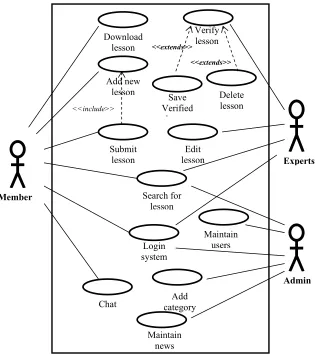
Fig. 4: Use cases for actor; Admin, Members and Experts in LLS
Fig. 5: The LLS interface for members
Admin <<extends>>
<<extends>>
<<include>> Download
lesson
Verify lesson
Member
Add new
lesson Save
Verified l
Delete lesson
Login system
Chat
Maintain users
Maintain news Search for
lesson
Experts Submit
lesson lessonEdit
Further study could be made on other selected KM applications based on the KM spectrum (refer to [7]) by selecting applications from other KM spectrum elements e.g. transactional, analytical, asset management, developmental or innovation and creation. The same study can also be done on other CoP groups such as the administrators in Institutions of Higher Learning or even teachers or administrators in primary or secondary schools. Further work can also be done to refine the LLS application in terms of categorisation of knowledge. Currently keywords and categories are defined by the users and then audited by experts. Better categorisation method could enhance greatly on knowledge retrieval. Another improvement that can be done on the system is in implementing a more secure user authentication mechanism. Data security should also be given ample emphasis by using encryption or other security measures to hinder hackers from getting invaluable information from the data repository. Finally, future work can also concentrate on refining the proposed framework that was presented in this paper.
8.0 CONCLUSION
This study has looked at various KM definitions, has compared available KM models, and has developed a KM application for supporting lecturers’ activities in an Institute of Higher Learning. De Jarnett’s [8] definition of KM– “Knowledge management is knowledge creation followed by interpretation, knowledge dissemination and use, and knowledge retention and refinement”, was adopted for this study because it combines both the theory and practices of KM. The KM model by Nonaka and Takeuchi [1] was chosen as the framework of this study because not only does it show the simplest high-level conceptual representation of KM but it is also very popular and is widely used as a KM foundation framework by KM researchers. The model implies a more mechanistic approach to knowledge categorisation and focuses on a process perspective. Based on the KM spectrum, LLS is identified and proposed as a KM application to support lecturers in sharing their knowledge in an Institute of Higher Learning. From the understanding of the chosen KM model, Lessons Learned definition and Lessons Learned processes, we have created a new adapted model. This adapted model was then used to define the LLS main features for the web-based application to be developed. According to Secchi et al. [14], a lesson learned is a knowledge or understanding gained by experience.
REFERENCES
[1] I. Nonaka and H. Takeuchi, “The Knowledge Creating Company: How Japanese Companies Create the Dynamics of Innovation”. New York: Oxford Univ Press. 1995.
[2] R. Weber, D. W. Aha, H. Munoz-Avila, and L. A. Breslow, “Active Delivery for Lessons Learned System”. Advances in Case-Based Reasoning, 5th European Workshop, EWCBR2K, Trento, Italy: Springer-Verlag, 1997, pp. 322-334
[3] P. Secchi, R. Ciaschi and D.Spence, (1999a). “The ESA Alert System.”
[4] T. H. Davenport, and P. Klahr, “Managing Customer Support Knowledge”. California Management Review, Vol. 40 No. 3, 1998, pp. 195-208.
[5] P. Quintas, P. Lefrere, and G. Jones, “Knowledge Management: A Strategic Agenda”. Journal of Long Range Planning, Vol. 30 No. 3, 1997, pp. 385-91.
[6] R. McAdam and S. McCreedy, (1999). “A Critical Review of Knowledge Management Models”. The Learning Organisation, MCB University Press, Vol. 6 No. 3, 1999, pp. 91-100.
[7] Binney, Derek, “The Knowledge Management Spectrum – Understanding the KM Landscape”. Journal of Knowledge Management, Vol. 5 No. 1, 2001, pp. 33-42.
[8] L. De Jarnett, “Knowledge the Latest Thing”. Information Strategy, The Executives Journal, Vol. 12, pt 2, 1996, pp. 3-5.
[10] R. O. Barclay and P. C. Murray, “What is Knowledge Management?” Knowledge Praxis, www.media-access.com/whatis.html. 1999.
[11] T. H. Davenport, L. Prusak and H. J. Wilson, What’s the Big Idea? Creating and Capitalizing on the Best New Management Thinking. Boston, MA: Harvard Business School Press, 2003.
[12] P. Meso and R. Smith, “A Resource-Based View of Organisational Knowledge Management Systems”. Journal of Knowledge Management, MCB University Press, Vol. 4 No. 3, 2000, pp. 224-234.
[13] D. M. Braun, and M. C. Macal, “Development of a System for Accessing Lessons Learned”. Argonne National Laboratory Report, Argonne, IL 60439, 1995.
[14] P. Secchi, “Proceeding Of Alerts And Lessons Learned: An Effect Way to Prevent Failures and Problems”. Technical Report WPP-167, Noordwijk, The Netherlands : ESTEC. 1999.
[15] R. Weber, D. W. Aha, H. Munoz-Avila and L. A. Breslow, “Active Delivery for Lessons Learned System.” 5th European Workshop, EWCBR2K, Trento, Italy:Springer-Verlag, 2001, pp. 322-334.
[16] R. Weber, D. W. Aha, Becerra and I. Fernandez, “Artificial Intelligence and Knowledge Management”. International Journal of Expert System Research & Applications, 2000a.
[17] M. U. Borghoff, and R. Pareschi, Information Technology for Knowledge Management. Springer-Verlag, Berlin Heidelberg New York, 1998.
ADDITIONAL REFERENCES
[1] T. Beckman, “A Methodology for Knowledge Management”, in Proceeding of the IASTED International Conference On AI And Soft Computing.
[2] M. Boisot, Information and Organisations: The Managers as Anthropologists. London, Fontana/Collins, 1987.
[3] T. Bourner, “Teaching Methods for Learning Outcomes”. Education + Training, MCB University Press, Vol. 39 No. 9, 1997, pp. 344-348.
[4] A. Brooking, “The Management Of Intellectual Capital”. Journal of Long Range Planning, Vol. 30 No. 3, 1997, pp. 364-5.
[5] S. Clegg, M. Barret, T. Clarke, L. Dwyer, J. Gray, S. Kemp and J. Marceau, “Management Knowledge for the Future: Innovation, Embryos and New Paradigms”. The Politics of Management Knowledge, Sage, London, 1996.
[6] J. Conallen, Building Web Applications with UML. Addison-Wesley, 2000.
[7] T. H. Davenport and L. Prusak, Working Knowledge: How Organisations Manage What They Know. Boston, MA: Harvard Business School Press, 1998.
[8] P. Drucker, “The Information Executives Truly Need”. Harvard Business Review, Jan-Feb 1995, pp. 54-62. [9] L. Edvinsson, and M. S. Malone, Intellectual Capital: Realizing Your Company’s True Value by Finding Its
Hidden Brainpower. 1st ed., New York, HarperBusiness, 1997.
[10] S. Elliot, (1999a). “APQC Benchmarking Best-Practise Report on Competitive Intelligence.” APQC, www.store.apqc.org
[12] L. Fuld, The New Competitor Intelligence: The Complete Resource For Finding, Analyzing and Using Information About Your Competitors. New York, John Wiley and Sons, 1994.
[13] J. Guthrie and R. Petty, “Knowledge Management: The Information Revolution Has Created the Need for a Codified System of Gathering and Controlling Knowledge”. Company Secretary, Vol. 9 No. 1, 1999, pp. 38-41
[14] G. Hedlund, “A Model of Knowledge Management and the N-Form Corporation”. Strategic Management Journal, Vol. 15 No. 73-90, 1994.
[15] Hill, C. (1999). “APQC Benchmarking Report – Benchmarking Benchmarking: Shared Learning for Excellence”, www.store.apqc.org
[16] C. W. Hosapple and K. D. Joshi, “Description and Analysis of Existing Knowledge Management Frameworks”, in Proceedings Of The 32nd Hawaii International Conference On System Sciences, 1999. [17] T. Kuhn, The Structure of Scientific Revolution. University Of Chicago Press, Chicago, IL, 1970.
[18] T. Kuhn, “Second Thoughts on Paradigms”. The Search for Philosophical Scientific Theories, University of Illinois, Chicago, IL, 1974.
[19] M. McGrath, “PHP: For Windows And Linux”. Computer Step, www.ineasysteps.com. 2002.
[20] F. Nickols, (2000). “Community of Practice, Overview”.
[21] Nickols, F. (2000). “Community of Practice, Roles and Responsibilities”.
[22] Nickols, F. (2000). “Community of Practice, Start Up Kit”.
[23] F. Nickols, (2000). “Community of Practice, What It’s Like Inside”.
[24] C. O’Dell and C. J. Grayson, “If Only We Knew What We Know: Identification And Transfer Of Internal Best Practices”. California Management Review, Vol. 40 No. 3, 1999, pp. 154-174.
[25] T. Peters, Liberation Management. New York, Pan Books, 1992.
[26] M. Polanyi, “Personal Knowledge: Towards A Post Critical Philosophy”. New York, Harper, Torchbooks, 1962.
[27] V. J. Powers, “Sprint Corporation: Blending in Benchmarking With Quality”. Continuous Journey, January, 1995.
[28] J. Richardson, M. Ensenck and D. Piper, Student Learning: Student Leaning: Research in Education and Cognitive Psychology. London, Open University Press, 1987.
[29] D. J. Skyrme, “Knowledge Networking - Creating the Collaboration Enterprise”. Butterworth-Heinemann, 1999.
[30] Taylor et al. International Journal of Technology Management, Vol. 11 No. 3, 1997, pp. 385-391 [31] R. Taylor, Unisys Decision Support Systems Programme. City Gate London, 1996.
[32] D. J. Teece, “Capturing Value From Knowledge Assets”. California Management Review, Vol. 40 No. 3, 1998, pp. 55-79.
12 BIOGRAPHY
Mohd Nazir Ahmad Sharif is a lecturer at the Universiti Teknologi Malaysia. His research interests include
Knowledge Management Applications, Web Applications, Software Modelling and System Development.
Kamaruddin Malik Mohamad is a Systems Analyst with Universiti Teknologi Malaysia. His research interest is
in system development.
Rose Alinda Alias is an Associate Professor at the Universiti Teknologi Malaysia. Her research interests include
knowledge management, information systems planning and mobile knowledge management.
Shamsul Shahibudin is also an Associate Professor at the Universiti Teknologi Malaysia. His reseach interests
include CSCW, GDSS and knowledge management.
Nor Hidayati Zakaria is a lecturer at the Universiti Teknologi Malaysia. Her research interests include
![Table 1: KM Spectrum [7]](https://thumb-us.123doks.com/thumbv2/123dok_us/1254041.1158018/5.612.82.522.229.599/table-km-spectrum.webp)

![Fig. 3: Mapping of Nonaka KM Model and the LL generic process [15] for representing generic LL System Framework](https://thumb-us.123doks.com/thumbv2/123dok_us/1254041.1158018/7.612.159.446.318.454/mapping-nonaka-model-generic-process-representing-generic-framework.webp)