for a New Public Administration of K-12 Educational Processes? (Under the direction of Dr. Richard M. Clerkin).
by
Johnnie Chamaine Larrie
A dissertation submitted to the Graduate Faculty of North Carolina State University
in partial fulfillment of the requirements for the degree of
Doctor of Philosophy
Public Administration
Raleigh, North Carolina 2017
APPROVED BY:
_______________________________ _______________________________
Dr. Richard M. Clerkin Dr. Jerrell D. Coggburn
Committee Chair
_______________________________ _______________________________
DEDICATION
BIOGRAPHY
ACKNOWLEDGMENTS
Although I do not have enough space here to thank all of those persons who touch this dissertation process in a positive way, I am taking the time to thank the following persons who deserve special acknowledgement.
I thank Dr. Richard M. Clerkin, my Advisor and the chair of my dissertation committee (and my friend), for staying with me through and encouraging me to stay the path and complete this journey. Aside from his unending intellectual counsel, he made sure I was given grace and had space to get this done. For that, I owe him a debt of gratitude
I thank my dissertation committee members, Dr. Craig C. Brookins, Dr. Jerrell D. Coggburn, and Dr. Brand L. Nowell, now my colleagues, but throughout this process, my professors, my mentors, and my intellectual heavy weights. A wise person surrounds herself with wise counsel to wade courageously through this dissertation process. My committee members were that collective of wise counsel, and for that counsel they have my sincere appreciation.
I thank my second mom, Jeanette H. Garr, for her simple belief in me that extends way back to days gone by -- because she held on and knew I would reach this point. I thank God for bringing her into my life.
I thank Lesley Riley for putting that PhD program application on my desk those many years ago, and telling me to “just do it;” I thank my “MFP” colleagues for quiet support and giving me space without judgment to “do my thing;” I thank my Executive Director, George Hausen for support expressed in the simple words of “what can I do to help you cross the PhD threshold.” They gave me support in starting, working through, and completing the process. I appreciate them for all of their meaningful words and thoughtful actions.
I thank my sister Linda V. Ragland …..it simply cannot be told in full on this page. I love her for being my sister.
I thank Reggie, Uhlan, and Micah – my husband and my children – for the immeasurable patience displayed, and for helping me believe I would succeed as long I kept moving. I thank them for oodles of coffee and for many late nights and weekends spent keeping me company at D.H. Hill Library – when they could have been elsewhere. They were that light at the end of the tunnel and I love them for being there to help me see my way through it all …
TABLE OF CONTENTS
I. List of Tables ... ix
II. List of Figures ... xi
Chapter One ... 1
III.Problem Statement ... 1
A. Introduction: ... 1
B. Competing Views of K-12 Public Education... 3
C. Charter Schools in Public Education Reform Debates ... 5
D. The Role of Teaching Autonomy in Shaping the Debate Over K -12 Public Education Reform ... 8
E. Looking Beyond Autonomy to the Organizational Form of Charter Schooling ... 11
F. Conclusion: Research Purpose and Questions ... 15
Chapter Two ... 18
IV.Literature Review ... 18
A. Introduction: Providing a Contextual Framework for Understanding Charter School Research ... 18
B. Charter School Research in the Political Shadow of School Choice Debates ... 20
C. Providing a Theoretically Contextual Framework for Exploring The Concept of Teacher Autonomy ... 24
1. Institutional Theory: As a Framework for Examining Charter School Behavior .. 26
2. Exploring the Institutional Setting of Charter Schooling... 27
D. Outlining Key Areas of Research Addressing Charter School Autonomy ... 37
1. A View of Autonomy in General Education Research... 39
3. A View of Autonomy in Organizational Theory Research ... 44
E. Conceptualizing and Assessing the Practical Dimensions of Teacher Autonomy as a Relational Concept... 45
F. Conclusions: Next Steps ... 52
Chapter Three... 53
V. Methodology ... 53
A. Introduction: Purpose Overview ... 53
B. Research Objectives ... 53
C. Research Design ... 58
1. Data Collection and Instrumentation ... 62
2. Research Population ... 64
3. Summary ... 67
Chapter Four ... 68
VI.Data Analyses ... 68
A. Introduction: ... 68
B. Summary Review ... 68
C. Data Collection ... 71
D. Data Analyses and Findings ... 74
1. Recoding and Providing Descriptive Analyses for the Dependent Variables ... 75
2. Recoding and Providing Descriptive Analyses for the Additional Independent Variables ... 77
3. Exploring the Hypotheses ... 79
a. Hypothesis1 – Charter school teachers in s tates with strong charter school policies are more likely to perceive higher levels of teacher autonomy than are charter school teachers in states with weak charter school policies. ... 80
c. Hypothesis1b
– Charter school teachers in states with strong charter school policies are more likely to perceive higher levels of curricular autonomy tha n
are charter school teachers in states with weak charter school policies ... 88
d. Hypothesis1c – Charter school teachers in states with strong charter school policies are more likely to perceive higher levels of satisfactory teaching conditions than are charter school teachers in states with weak charter school policies ... 90
E. Conclusion: ... 94
Chapter Five ... 96
V. Research Implications and Recommendations ... 96
A. Research Question and Problem [Re]Statement ... 96
B. Proposed Hypotheses and Research Design ... 97
C. Summary of Findings: ... 99
1. Descriptive Statistics ... 99
2. Results of Hypotheses Testing ... 100
D. Research Limitations ... 104
1. Data Collection and Generalizability of the Research Findings Given Small N -Responses ... 104
2. Under-Capturing Teaching Autonomy as a “Fluid Concept” in Quantitative Research... 106
E. Research Implications and Recommendations ... 107
1. The Process and Practice of Charter Schooling Should be Reflected in Nonprofit Research... 108
2. Charter School Policy Research Should Consider Demographic Concerns That May Mediate Teacher Perception of Teaching Autonomy ... 110
References ... 114
LIST OF TABLES
Table 3.1_Curriculum Autonomy Sub-Scale Items ... 63
Table 3.2 _ General Teaching Autonomy Sub-Scale Items ... 63
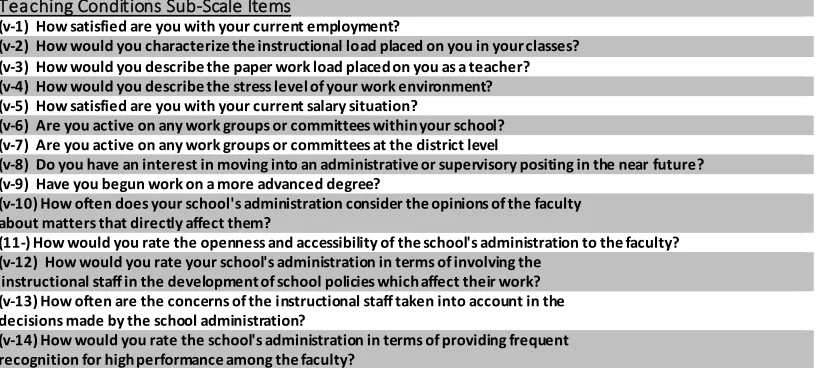
Table 3.3 _ Teaching Conditions Sub-Scale Items ... 63
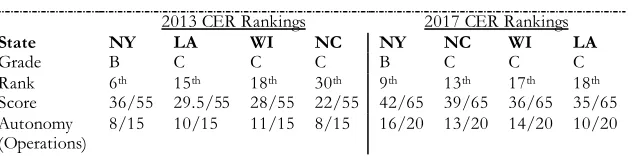
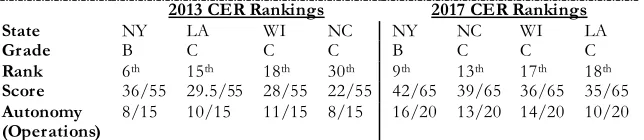
Table 3.4_ Center for Education Reform (CER) Comparative Scorecard Rankings ... 66
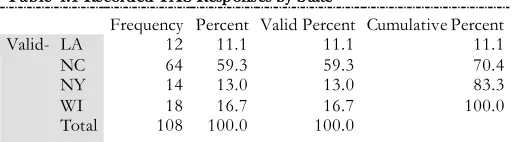
Table 4.1 _ Recorded TAS Responses by State ... 74
Table 4.2 _Mean Scores for Recoded Autonomy Sub-Scales ... 75
Table 4.3 _ Autonomy Sub-scale Mean_Score by State ... 76
Table 4.4 _ Recoded Mean Score for General Teaching Autonomy_Mean_GTA_R... 76
Table 4.5 _ Recoded Mean Score for Curriculum Autonomy Mean_CA_R ... 76
Table 4.6 _ Recoded Mean Score for Teaching Conditions_ Mean_TC_R ... 77
Table 4.7 _Description of Recoded Demographic Variables ... 77
Table 4.8 _ Frequency Table (Gender) ... 78
Table 4.9 _ Frequency Table (Ethnicity) ... 78
Table 4.10 _ Frequency Table (Age) ... 78
Table 4.11 _ Frequency Table (Teaching Level) ... 79
Table 4.12 _ Frequency Table (TeachExp) ... 79
Table 4.13 _ Frequency Table (Teach_Trad)... 79
Table 4.14 _ Frequency Table (Teach_Private) ... 79
Table 4.15 _ Frequency Table (Dem_Years SchoolExist)... 79
Table 4.16(b) _ Tukey Post-hoc Test (State Comparison x 3 Mean Teaching Autonomy
Sub-scales) ... 82
Table 4.16(c) _ One-Way ANOVA_Descriptives ... 82
Table 4.17(a) _ Cross Tabulation (State v Mean_GTA) ... 85
Table 4.17(b) _ Chi-Square Tests (State v Mean_GTA) ... 86
Table 4.17(c) _ Phi & Cramer's V (State v Mean_GTA)... 86
Table 4.18(a) _ Regression (Mean_GTA) One-Way ANOVA ... 86
Table 4.18(b) _ Regression Model Summaryb Mean_GTA) ... 86
Table 4.18(c) _ Regression Model Coefficientsa _(Mean_GTA) ... 87
Table 4.19a) _ Cross Tabulation (State v Mean_CA) ... 89
Table 4.19(b) _ Chi-Square Tests (State v Mean_CA) ... 89
Table 4.19(c) _ Phi & Cramer's V (State v Mean_CA) ... 89
Table 4.20(a) _ Regression (Mean_CA) One-Way ANOVA ... 90
Table 4.20(b) _ Regression Model Summaryb (Mean_CA) ... 90
Table 4.20(c) _ Regression Model Coefficientsa _(Mean_CA) ... 90
Table 4.21(a) _ Cross Tabulation (State v Mean_TC) ... 91
Table 4.21(b) _ Chi-Square Tests (State v Mean_TC) ... 91
Table 4.21(c) _ Phi & Cramer's V (State v Mean_TC) ... 91
Table 4.22(a) _ Regression (Mean_TC) One-Way ANOVA ... 92
Table 4.22(b) _ Regression Model Summaryb (Mean_TC) ... 92
LIST OF FIGURES
Figure 2.1 _ Environmental Contingencies Model ... 24
Figure 2.2 _ Charter School State Policy Model ... 34
Figure 2.3 _ Relational Concept of Autonomy ... 46
Figure 2.4 _ Multi-Dimensional Autonomy Model ... 49
Chapter One I. Problem Statement
A. Introduction
Over the last several decades, school choice policy has broadened political debate over the role private markets should secure in the process and delivery of public education in American society. Whether private market mechanisms – like autonomy, choice, and competition – can heighten the quality of educational processes and improve student performance and
achievement outcomes has become a cornerstone question of this political debate. Those advocating for the infusion of autonomy, choice, and competition, into public education processes suggest a theoretical link between such mechanisms and the quality of public education and overall student outcomes.
Various research literatures make theoretical links between organizational and teaching autonomy, and classroom innovations and student outcomes (Bennet et al., 1998; Chubb & Moe, 1988; Finn et al., 2000; Finn & Gau, 1998). Given theoretical implications, charter schools have become critical testing grounds for assessing, (1) whether traditional bureaucratic schooling might account largely for entrenched and nonresponsive teaching practices
associated with poor student outcomes, and (2) whether nonprofit schooling structures could and should represent alternative venues for alleviating these issues. Thus, one critical test of charter schools’ relevance to the broader educational landscape is whether the policy grant of organizational and teacher autonomy translates into actual autonomy, and whether such autonomy gives these schools systemic ability to display the types and levels of classroom innovation unparalleled in traditional public school settings. Yet whether charter schools exhibit organizational and teaching autonomy, and whether such autonomy fosters uniquely innovative practices that influence the quality of student outcomes, has little empirical support in charter school research.
This dissertation focuses on the former question, by exploring and addressing the broad question of whether the policy grant of autonomy influences the scope and manner of teaching autonomy in charter school classroom settings. In providing a research framework for
addressing this question, the remaining sections of this chapter explore specifically (1)
B. Competing Views of K-12 Public Education
For decades public education has remained at the forefront of local, state, and national policy efforts, as key political stakeholders advocate for educational reforms that meet widely diverse and often contentious schooling demands and preferences. In light of this push, states have weighed-in specifically on the issue of public education via legislative activities -- resulting in incremental movement towards particular types of public education reform. While broad consensus exists regarding the need for public education reform, ideological and politically charged debates about the purpose(s) of public education and how to [re]form public education to those purpose(s) seem to flow from two ideologically disparate camps.
Historically, public education has remained fundamental to the preservation and
particular views of educational equality. Those public education advocates who espouse this view suggest further that this current system of school service delivery must remain within the control of larger governments so that public education can remain available to all students in a manner that is both equitable and capable of retaining overall educational substance (Bridges & McLaughlin, 1994; McDermott, 1999).
Over the last forty years, this particular view has met with growing challenge from members of both policy and education arenas who perceive critical failings within the current
bureaucratic framework of public education service delivery and outcomes. Key educational research provides some level of empirical support for the contested proposition that the democratic goal of public schooling and the bureaucratic framework that supports this goal remain responsible largely for perceived failings in K-12 public education (Chubb & Moe, 1988; Coleman, 1982). This proposition has become the impetus for growing policy
discussions on the attractiveness of infusing private market mechanisms into public education selection processes. Some of the most vocal critics of the bureaucratic framework charge that traditional K-12 public schooling supports unnecessary administration, remains largely nonresponsive to the expressed needs of key stakeholders, and dampens the quality of
educational service delivery and overall student outcomes (Good & Braden, 2000; Coleman, et al., 1982).
Among these critics are those school choice reform advocates calling for a more private market approach to K-12 public educational service delivery. Many of these reform advocates assert that the process of education represents a private good subject to individual
students as the primary consumers of that good (Bridges & McLaughlin, 1994; Chubb & Moe, 1988). One of the theoretical assumptions underlying this aspect of school choice reform suggests schools that operate free of traditional bureaucratic controls innovate and heighten and thereby differentiate the quality of their core educational practices (Hassel, 2012) in response to relevant demands and expressed needs. In turn, this differentiation allows schools to compete for parents and students -- who themselves are free to choose among an array of schools based upon their personal needs and preferences (Oplatka, 2004). Thus, proponents of school choice suggest that school autonomy remains an essential mechanism for securing efficiency and responsiveness in educational processes and quality in educational practices and student outcomes (Chubb & Moe, 1988; Dewey, 2004; Hursh, 2005; McDermott, 1999).
C. Charter Schools in Public Education Reform Debates
The theoretical assumption regarding the relationship between autonomy and the quality of K-12 public school practices and outcomes has dominated recent efforts at substantive
specific and substantive context for recent policy-based reforms around K-12 public education. More specifically, charter schools represent one a recent and more extensively implemented state government-level policy approach to market-based K-12 public education reform.
Charter schools are publicly-funded independent schools of choice under contract with their respective authorizing agency for a specified period of time to educate K-12 school-aged children in accordance with expressed charter goals and general governmental requirements for student performance and achievement. In 1991, Minnesota implemented the first state policy supporting charter schools as alternative K-12 public educational settings. Since that time, forty-four states and the District of Columbia have implemented charter school policies resulting in over 7,000 charter schools across the country that remain accountable for educating over 3 million school-aged children.1
Generally, most charter schools operate as nonprofit schools of choice that may be created by anyone or any group that meets the requirements of charter school authorizers. By policy, they are exempted largely from various state and local regulations. This exempt status provides charter schools with wide latitude to engage
governance and instructional practices that comport with expressed goals and resources (Brouillette, 2002; Finn, Manno, & Vanourek, 2000). Charter schools reflect four interrelated concepts deemed critical to school choice reform efforts: (1) autonomy, (2) governance and classroom innovation, (3) parental choice and competition, and (4) student outcome
accountability (Murphy, 2002).
The first concept represents a cornerstone of charter school policy in that, charter schools are said to operate relatively free from bureaucratic constraints found in more traditional
1
public school settings. State charter school policies contain specific granting language that provides charter schools with varying degrees of autonomy over curricula design and instructional implementation, personnel hiring and training decisions, student selection and retention processes, resource acquisition and management practices, and governance structure (Good & Braden, 2000; Brouillette, 2002; Wells, 2002). State charter school policies vary in the degree and scope of autonomy granted. Despite this variation, relative to traditional K-12 public school settings, the policy language emphasizes less administrative and regulatory oversight, and more localized forms of political control over these various areas of schooling. The basic policy design serves to encourage experimentation with new instructional strategies in response to expressed student needs and general stakeholder preferences.
ways not experienced in traditional public school settings (Good & Braden, 2000; Finn, Manno, & Vanourek, 2000). As such, charter schools represent localized educational laboratories (Finn, et al, 2000) with relatively untested but broad opportunities to determine the necessary parameters of market-like mechanisms in K-12 public educational policy reform. Thus, charter schools have figured prominently into on-going debates over the substance of public educational processes, and over the appropriate organizational mechanisms for directing public educational practices. Just as importantly, they bring to the surface evident tensions in promoting alternative educational practices in place of entrenched schooling practices associated with compromised educational quality in traditional public school settings. These debates maintain critical import within educational and policy research circles concerned with the political contours of public education reform [efforts]. Yet given the brief history of charter schooling in this country relative to traditional K-2 public schools settings, the substance of these tensions and debates remains largely untested in charter school research.
D. The Role of Teaching Autonomy in Shaping the D ebate Over K-12 Public Education Reform
Teacher autonomy over classroom instructional practices represents a key expected but intermediary outcome of charter school policy. As such, charter school classrooms have become proving grounds for testing the relevance and acceptable scope of private market mechanisms in [re]shaping the parameters of K-12 public education. More specifically, since the scope and substance of teaching practices sit at the heart of educational quality, the
grant of teacher autonomy provides professional space for teachers to engage educational practices that meet the demands of their classroom settings relative to their task envirohments (Dorros, 1971; Pearson & Moomaw, 2005; White, 1992). This assumption remains counter to educational research that suggests that institutional tradition holds teachers on a continuum that moves from most to least dependent – with the level of dependency becoming defined further by the system of schooling in which teachers sit (Koehler, 1990; Leiter, 1981). Thus, the extent to which teacher autonomy influences the quality of student performance and student
achievement represents a more specific and central policy discussion regarding the relevance of charter school setting to influencing the quality of K-12 educational processes and practices. In this respect, how teachers behave in charter school classroom environments represents an important area of charter school research. Yet, empirical studies regarding how autonomy gets perceived and and becomes negotiated by teachers in classroom environments in particular (Bulkley & Fisler, 2002, 2003; Bulkley & Wohlstetter, 2004; Lubienski, 2003; Wohlstetter et al, 1995), and the extent to which such autonomy influences the quality of charter school classroom practices, (Crawford, 2001; Gawlik, 2007; Lubienski, 2003; Whitty, 1996) are policy concerns that have received little attention in K-12 public education research. Moreover, the concept of teacher autonomy remains largely unaddressed and somewhat ambiguous in general charter school research, and wide disagreement exists regarding the actual workings of
autonomy within charter school classroom settings (Crawford, 2001; Finnigan, 2007; Lubienski, 2003; Wohlstetter & Griffin, 1998).
teaching autonomy (Wohlstetter & Griffin, 1998). Other studies suggested that any number of organizational contingencies could impede whether and to what extent teachers exercised autonomy in their respective classroom settings (Crawford, 2001; Finnigan, 2 007). Still, other studies highlighted the need to explore a variety of institutional constraints that may influence the dynamics of charter school organizational environment, and whether and how teachers perceive of their ability to negotiate instructional and pedagogical practices in their own classroom settings (Lubienski, 2003; Wohlstetter, et al., 1995).
Charter schools remain embedded in a larger institutional environment that has defined over time both organziational behavior and organizational structure (DiMaggio & Powell, 1983; Lubienski, 2003; Lubienski, 2005). This institutional environment reflects well established formal and informal norms, rules, and cultural expectations born out of legal and regulatory requirments, and historically acceptable schooling behaviors. Overtime, these expectations have shaped and provided levels of legitimacy to K-12 public educational processes and practices (Meyer & Rowan, 2006; 2008). Notwithstanding key policy expectations, charter school acceptance depends in part on whether they can achieve and sustain teaching processes and practices that provide them with organizational legitimcacy and allow them to meet
environments (Coburn, 2004; Meyer & Rowan, 2008; Oliver, 1991). More partiuclarly, variations in the perceived degree of teacher awareness and agency, pro-activeness, influence, and self-interest, represent key considerations in assessing the extent to which teachers exercise autonomy over classroom practices. Therefore, a more particularized understanding of
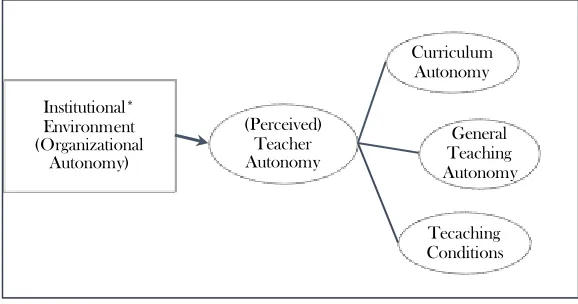
whether and how teacher autonomy influences charter school educational practices requires in part, an explicit acknowledgement of the institutional enviroment in which charter schools teachers operate and how they behave given their perceptions of that environment. Within the context of institutional environment, this dissertation asks specifically, “How do teachers perceive autonomy in their respective classroom settings.” Relatedly, it asks, whether the question of autonomy remains central to charter school viability in K-12 public education service delivery within the context of these environmental concerns.”
E. Looking Beyond Autonomy to the Organizational Form of Charter Schooling Although charter schools have assumed some level of legitimacy in policy reform efforts, they have maintained a somewhat tenuous status as a practical complement to the long-standing institutional design of K-12 public schooling. Most charter schools represent nonprofit
schooling organizations that in theory sit at the crossroads of private, public, and nonprofit expectations regarding educational service delivery. Private expectations encompass autonomy, parental choice, inter-school competition, and process and practice innovations. Public
additional tensions, charter schools have figured prominently in education literatures that explore, challenge and justify public policy initiatives that promote them as quasi-private market venues for engaging innovative educational practices and influencing student outcomes (Good & Braden, 2000; Bulkley & Fisler, 2003; Finn et al, 2000; Lubienski, 2003). Yet, they represent part of a broader theoretical discussion regarding the appropriate relationship between nonprofit, private, and government sectors in distributing broad based resources and mediating various types of on-going social issues (Belfield & Levin, 2005; Good & Braden, 2000; Hassel, 2012; Henig, 2008).
Historically, nonprofit organizations have shouldered the burden of engaging in various forms of political advocacy to advance social causes and alleviate social problems (Byrce 2005) that government(s) cannot and private markets will not confront (Ferris, 1998; Salamon, 1987). Particularly over the last several decades, nonprofit organizations have become central to the protection, advancement, and process of public education as a deliverable social good. They have made strategic use of public policy and more direct governmental engagement to achieve those ends. These considerations have given way to discussions regarding the practical
position(s) nonprofits have assumed in influencing important policy development and implementation processes. Therefore, it is not unusual to find nonprofits in the midst of experimental policy efforts designed to address whether and how private market mechanisms can and should influence the scope and substance of K-12 public educational processes, practices and outcomes.
equitable, and by those who have criticized their insistence on rigid bureaucratic processes that impede more fluid and more responsive quality-level educational outcomes. Some school reform advocates view charter schools as nonprofit organizational structures capable of alleviating these tensions, and these schools have proliferated as an importantly collective and collaborative response to what has been termed a crisis in public educational governance (Chubb & Moe, 1988; Ferris, 1998; Smith, 2003). Yet, very little research exists that highlights the tensions involved in using the nonprofit sector to facilitate the delivery of public
educational services left traditionally to local, state, and federal g overnments. Moreover, one of the aspects of the charter school movement glossed over in the literature is whether this
nonprofit context can facilitate unique educational service delivery, and at the same time, maintain a level of engagement with respective government bodies that does not result in unnecessary bureaucratic entanglement (Hassel, 2012).
from the policy perspective, these schools are positioned organizationally to avoid some of the traditional bureaucratic inertia common to K-12 public educational processes, and thereby respond better to institutional, technical, and organizational contingencies that influence the quality of their processes and practices (Hassel, 2012; Oliver, 1991). At the same time, they remain constrained from implementing private market processes that place certain educational choices, opportunities, and services beyond the reach of less affluent communities, parents and students (Bulkley & Fisler, 2003; Finn, Manno, & Vanourek, 2000). Therefore, in theory they may be suited uniquely to complement the K-12 public educational landscape in the
development and implementation of educational practices that meet the goals of a variety of key stakeholders.
This complementary role that charter schools have assumed in the delivery of K-12 educational services remains in keeping with nonprofit literatures that note the reality of government-nonprofit sector relations in the delivery of increasingly complex social services in general (Young, 2006). The extent to which charter schools succeed at these efforts can help highlight the essential role that nonprofits play in facilitating effective governmental
responsiveness to a heterogeneous citizenry in a self-governing society (Berger & Neuhaus, 2000; Chubb & Moe, 1988; Ferris, 1998). Further, to the extent that public policy itself is concerned with “why, how, when and for whom” nonprofit organizations engage to influence the distribution of resources (Bryce, 2006), theories of public policy processes should include space in which to empirically analyze these questions. Therefore, whether or not this
particular non-profit organizational structure remains important to public educational
dissertation devotes some time to exploring nonprofit organizational influences as they relate to public educational processes and asks whether charter schools – as a nonprofit organizational form – remain both equipped and appropriate for addressing a number of issues raised in public policy debates over school choice [reform] efforts.
F. Conclusion: Research Purpose and Questions
Governments have come under increasing pressure to engage K-12 public educational service delivery in more efficient and effective ways. Most states have implemented charter school policies in an effort to address this pressure. These policies reflect the legislative promise of providing charter schools with a level of autonomy over various educational practices not found in traditional K-12 public school settings. Aside from operating as schools of choice, this grant of autonomy represents the most prominent private market characteristic of charter schools. Many school choice advocates assert that this autonomy remains essential to providing teachers with the professional space they need to conceptualize, organize, and deliver innovative classroom practices in ways that both respond to educational needs and heighten the quality of educational outcome. In this respect, charter schools have received increasing
instructional and pedagogical practices in this setting. Additionally, given their assumed
complementary role in educational service delivery, charter schools have become the subject of broader policy debates regarding whether the dominant institutional design of charter
schooling represents a legitimate venue for heightening the quality of public educational outcomes.
Gaining this clarity represents a needed step in informing policy debates about whether charter schools represent promising educational conduits for facilitating appropriate
educational aims outside of highly bureacuratized educational settings, and whether charter schools represent necessary organizational conduits for achieving incremental reform in
educational service delivery. In summary, the broad questions explored in this dissertation are: “Given the broader institutional environment in which charter schools operate, how do charter school teachers perceive of autonomy in their respective classroom settings?” and “Whether charter schools operate as important nonprofit schooling venues for fostering important educational processes?”
Chapter Two II. Literature Review
A. Introduction: Providing a Contextual Framework for Understanding Charter School Research
Chapter one explores the concept of K-12 public schooling under state charter school policies – as these policies reflect the most recent and most expansive educational policy reform initiatives to promote the use of private market mechanisms in facilitating K-12 public educational service delivery. These policies reflect the legislative promise of providing charter schools with levels of governance and classroom autonomy not found in traditional K-12 public school settings. The theoretical assumption(s) underlying this aspect of charter school policy suggest that organizational autonomy remains essential to providing classroom teachers with professional space to conceptualize, organize, and deliver innovative teaching practices that enhance classroom learning environments and heighten the quality of K-12 public educational outcomes (Finn et al., 2000; Henig, 2008; Lubienski, 2003; Lubienski, 2004; Pearson & Moomaw, 2005). Many education reform advocates suggest that teacher autonomy over the classroom sphere can usher in educational practices capable of replacing compromised and entrenched educational practices associated with poor student
achievement and performance outcomes in traditional K-12 public school settings. Various education research literatures advance this theoretical connection between teacher
both organizational and classroom practices, but little consensus exists regarding
contingencies that may influence autonomous schooling practices. As nonprofit schooling venues, charter schools sit uniquely at the crossroads of private, public, and nonprofit expectations regarding educational service delivery. Yet charter schools have had a very limited history on the K-12 public education landscape. Moreover, this history has become contextualized by over-simplified and often politically driven debates about whether school choice policies alter the landscape of public educational opportunity and how such policies influence key public educational outcomes (Bifulco & Ladd, 2006; Carnoy, et al., 2006; Christensen & Rainey, 2009; Hill, et al., 2006; Imberman, 2010; Zhang & Yang, 2008). These debates, and the resulting political context in which charter schools operate have influenced the general direction of charter school research. Thus general charter school research has shed limited light on some of the more intermediary concerns regarding charter school processes – like whether or how the policy grant of autonomy may influence actual charter school classroom practices. More specifically, whether charter school teachers perceive autonomy in their respective classroom settings, how this perception becomes mediated within the broader institutional setting in which charter schools operate, and whether these types of nonprofit school settings are necessrary to facilitate educational reforms that influence classroom practices and student outcomes (Bryce, 2006; Ferris, 1998), represent critical questions that remain under-addressed in charter school research.
requires that charter school research address the concept of teacher autonomy within the broader institutional setting in which charter schools operate. Answering these questions in this fashion may help inform the broader policy debates regarding incremental reform in educational service delivery (Henig, 2008), and whether charter schools represent promising educational conduits for facilitating this reform The next section of this dissertation
highlights the political context in which charter school research has unfolded.
B. Charter School Research in the Political Shadow of School Choice Debates Ideologically driven debates about the role of private markets in social processes secured traditionally by local, state, and federal governments, and the way these debates have become reflected in general school choice research, have shaped the current state of charter sc hool research in particular. (Bifulco & Ladd, 2006; Carnoy, et al, 2006; Hill et al., 2006; Christensen & Rainey, 2009; Imberman, 2010; Zhang & Yang, 2008). Perceived failings in K-12 public education have resulted in a growing call for school choice reform. The reform advocated is understood commonly as blending the protections of public educational service delivery (universal accessibility of educational opportunities) with the efficiencies of popular private market mechanisms (autonomy, choice, and competition) (Moranto, et al., 1999; Miron & Nelson, 2000; Belfield & Levin, 2005). School choice theory suggests that open access to public educational opportunities via key private market mechanisms will increase school process efficiencies, particularize and diversify educational practices, heighten student performance and outcomes, enable responsiveness to a diverse array of stakeholder
schooling fits uniquely in this effort to blend the protections of public education with the efficiencies of private market mechanisms to achieve said outcomes. Perceived outcomes and goals from such blending have resulted in broad-based support for school choice reform. Thus, charter school policy has achieved a level of exposure, recognition, and acceptance well beyond those experienced with past school choice reform initiatives.
Those who hold a dimmer view of the role of private markets in public educational service delivery have acknowledged failings in K-12 public education processes; but, they have
questioned the diversion of public resources towards reform efforts that remain under -tested and therefore largely unproven (Good & Braden, 2000). Pressures resulting from the
reallocation of funding between charter schools and traditional public schools, and the flow of resources away from traditional public schools at the expense of needed instructional reform, have raised particular concerns in political and research circles regarding whether charter school outcomes differ in substantively measurable ways from those exhibited in traditional public school settings (Belfield & Levin, 2005).
In light of stated promises and concerns over challenges to traditional K-12 public
which has placed primary emphases on the politics of public school privatization and expected student-based outcomes (Carnoy, et al., 2006; Cooley, 2006; Garcia, 2008); Hoxby, 2004; May, 2006; Okpala, 2007). These emphases have come at the expense of placing needed focus on charter school processes critical to these same outcomes (Bulkley & Fisler, 2003; Lubienski, 2003). Moreover, political debates have overshadowed empirically-based evidence that might offer stronger support for general claims voiced regarding charter school influcnece, efficacy, and relevancy (Henig, 2008).
(Lubienski 2003; Oplatka 2004).
Still, other research support the view that the policy grant of autonomy has served instrumentally in providing administrators and teachers with the space to differentiate educational practices in quite meaningful ways (Finn et al., 1996; Finn et al., 2000). Even where education research has documented charter school success with various expected outcomes, a lack of conceptual clarity regarding what autonomy should look like in charter school settings and noted research variations regarding whether and how autonomy influences these outcomes overshadow some of these stated research claims. The lack of research focus on intermediary concerns that link charter school policy to classroom outcomes has left unanswered questions regarding the substantive relevance of school policies aimed at promoting autonomous schooling (Bulkley & Wohlstetter, 2004; Geske 1997; Lubienski 2003; Oplatka 2004).
contextual framework to highlight and discuss more fully the various literatures relevant to exploring the concept of teacher autonomy in charter school settings.
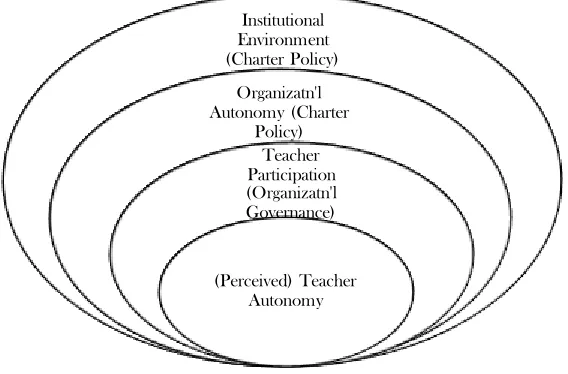
C. Providing a Theoretically Contextual Framework for Exploring Teacher Autonomy Education research acknowledges a variety of potential constraints placed upon teachers given both the institutional and organizational environments in which they operate (Lubienski, 2003; Meyer & Rowan, 2006; Meyer & Rowan, 2008). Figure 2.1 depicts the embedded nature of teachers’ work environment. The depiction suggests that teachers’ perceptions -- and behaviors given those perceptions -- become shaped within the context of key environmental contingencies. More specifically, charter schools teachers operate within an institutional
environment shaped by a long history of public K-12 schooling bound by layers of political and bureaucratic control. The nature of these controls reinforces continually the dominance of
both formal and informal norms, rules, and educational behaviors and practices (Meyer & Rowan, 1977, 2006) that define this larger institutional setting. Given the historical dominance
Institutional Environment (Charter Policy)
Organizatn'l Autonomy (Charter
Policy) Teacher Participation (Organizatn'l Governance)
(Perceived) Teacher Autonomy
of this institutional setting, charter schools would tend to reflect organizational conditions, and adapt further to the educational behaviors and practices established by their older and more dominant traditional public school counterparts (DiMaggio & Powell, 1983; Lubienski, 2003; Meyer & Rowan, 2006; Meyer & Rowan, 2008). Thus, despite presumed organizational autonomy, the institutional setting itself would tend to influence the degree of autonomy exhibited by charter schools.
that address the institutional setting of public schooling and charter schooling in particular, and provides further a theoretical context for addressing the institutional environment(s) in which charter school teachers operate.
1. Institutional Theory: As a Framework for Examining Charter School Behavior Earlier K-12 education research placed major emphasis on how traits within the public school setting influenced school practices, outcomes, and overall effectiveness, at the expense of exploring how key attributes of the institutional environment itself influenced such
dynamics, (Chubb & Moe, 1988; Chubb & Moe, 1990; McDermott, 1999; Smith & Meier, 1994). Some critics of this aspect of education research noted that given the singular dominance of the American institution of public schooling, educational research suffered largely from its reluctance to address how this complex environment mediated intermediary school traits, as well as mediated traits specific to actors within particular school settings. Thus, limited research began addressing questions regarding the extent to which the bureaucratic institution of public schooling – and the hierarchical controls associated with this schooling -- influenced key educational governance processes and teaching practices. Much of this research made research assessments based on state level aggregated data to highlight the influence of institutional setting on K-12 public schooling processes,. This effort served largely as an attempt to place some empirical focus on both process and outcome differences between K-12 private and public school settings -- particularly given key differences in organizational control mechanisms (Chubb & Moe, 1988; Chubb & Moe, 1990; Coleman et al., 1982).
contingencies and intermediary indicators within institutional settings that could account more fully for important educational practices and outcomes across these institutional settings (Lubienski, 2003). Just as importantly, other key aspects of this research used aggregated data based on individual survey analyses to make broad inferences about differences in institutional school settings and resulting outcomes – compromising the extent to which true comparisons could be drawn regarding these phenomena (Smith & Meier, 1994). Thus, subsequent education research highlighted the limits of these earlier comparative studies. Particular
criticisms noted early research had not provided a clear conceptual framework for assessing the practical dimensions of organizational agency or control by key actors – particularly given variations in organizational dynamics and given the broader institutional environment (Bohte, 2001; Chubb & Moe, 1988, 1990; Lubienski, 2003, 2004; Coburn, 2004; Meyer & Rowan, 2006; Smith & Meier, 1994). These same concerns represent considerations within the context of this dissertation research, as charter school research has only hinted at the role of
institutional environment in influencing the behavior of charter schools and specific actors within charter school settings (Lubienski, 2003). Given these concerns, institutional theory offers a promising theoretical context in which to explore the interplay between
institutionalizing processes and organizational self-agency in general and the influence of charter school policy on the behaviors of charter schools within their larger institutional setting in particular. The next section of this dissertation addresses the movement of charter school actors within this larger institutional setting.
2. Exploring the Institutional Setting of Charter Schooling
generally in environments that remain characteristic of two interrelated institutional processes: powerful organizational structures (1) force those within their relational networ k to mimic norms, rules, cultural expectations and resulting practices that define the institutional structure in which they operate, and thus, (2) reinforce continually the dominance of these same norms, rules, expectations, and practices (Meyer & Rowan, 1977; Meyer, et al., 2008). Further, these constraining forces cause newer or less well-adapted organizations to mimic and adapt to behaviors and structural characteristics of older and more dominant organizations within their institutional environment in accordance with these same contingencies that define that
environment (DiMaggio & Powell, 1983). Theoretical implications suggest such adaptations remain necessary for organizational survival and legitimacy -- particularly given the
characteristics of organizational newness or organizational instability relative to other organizational actors operating in the same institutional environment (DiMaggio & Powell, 1983; Meyer & Rowan, 1977). Thus, notwithstanding the policy grant of autonomy, given both relative organizational newness and instability, charter schools may tend towards educational practices common to their traditional and more established K-12 public school counterparts (Lubienski, 2004; Oplatka, 2004; Meyer & Rowan, 2006; Meyer, et al., 2008).
its relationship to various school practices (Miron & Nelson, 2002; Murphy, 2002; Wohlstetter, et al., 1995). Yet OT research and more recent aspects of education research highlight the role of interest driven behavior in mitigating environmental contingencies and influencing organizational practices (Beckert, 1999; Coburn, 2004; Lubienski, 2003; Lubienski, 2004; Meyer & Rowan, 2008; Oplatka, 2004; Oliver, 1991). Thus, notwithstanding stated policy expectations, whether and how charter school teachers perceive of and engage classroom autonomy hinge on key environmental contingencies and the behaviors charter school actors engage in light of those contingencies.
Given stated policy promises, charter schools represent schooling organizations that in theory sit at the crossroads of private, public, and nonprofit expectations regarding educational service delivery. Notwithstanding these expectations, as pictured in Figure 2.1, they are
practices and expected outcomes, and (5) parents, students, and community-level stakeholders, who provide more locally-based influence on educational processes and practices (Bennett & Hansel, 2008; Fields & Feinberg, 2001). These various actors operate within an even broader authority structure, born of federal legislative, judicial, and executive policies. These policy authorities impose more standardized and uniform educational requirements on public schools in general, and shape the outer parameters of school funding, student access, and key student outcomes -- like student testing, student graduation, and pedagogical and curricula requirements (Fusarelli, 2002; McCarthy, 2008; McDermott, 1999; Wong, 2008). Over time, these various actors and authorities have defined, influenced, and legitimated appropriate organizational processes, and acceptable educational norms, values, and principles.
The dynamics of this institutional setting have given rise to a bureaucratization and professionalization of schooling – such that concerns over school accreditation, teaching qualifications, student outcomes, and educational resource distribution have led to
entrenched and correspondingly responsive teaching practices (Ballantine & Spade, 2008). Although charter schools operate directly under chartering policies that allow them to define their respective vision, mission, goals, and operational conditions, they exercise power and make internal decisions within the context of these various institutional parameters. The tug -and-pull of these parameters provides at least minimal influence over decision(s) that charter schools make regarding educational practices (Miron & Nelson, 2002; Wohlstetter et al, 1995 quoting Caldwell & Spinks 1992). Moreover, organizational survival depends in part on whether charter schools can achieve and sustain organizational legitimacy, and meet
environment. So for example, charter school policies allow some degree of autonomy over the structure and substance of charter school classroom practices; yet, these schools are not exempt from federal and state mandated student outcomes that should flow from those practices – like standardized testing, grade performance, and graduation requirements. Nor are they insensitive to the informal pressures and expectations imposed on them – by students, parents, and various other stakeholder communities – to reflect accepted educational processes and practices to preserve organizational legitimacy.
Given these various stakeholder concerns, some education research literatures refer to the structural context in which charter schools operate as power-sharing arrangements, existing within an institutional environment that shapes further the extent to which they are able to self-determine educational processes and practices (Wohlstetter, et al, 1995). More specifically, the organization of charter schooling – including how teachers might perceive autonomy and further engage autonomy in their classroom settings – remains endogenous to these key institutional controls (Chubb & Moe, 1988; Coburn, 2004; Meyer & Rowan, 2008). Subject to these outer control parameters, charter school policies offer a break from other key aspects of institutional control, and provide charter schools with operational context to exercise varying degrees of autonomy to shape their respective vision, mission, goals, and classroom practices, and to engage internal processes that align with and help them achieve these various concerns.
Lubienski, 2003). Thus, a more substantive understanding of whether and how teachers exercise autonomy in their respective classroom school settings requires an explicit acknowledgement of the institutional environment in which charter schools operate; and, it requires a contextual assessment of the extent to which institutional arrangements influence charter school behavior in general and teacher behavior in particular. Further,
acknowledging these institutional concerns provides a needed starting point in this dissertation for exploring the extent to which the policy grant of autonomy fosters
autonomous practices in charter school settings. Yet, this dissertation research acknowledges also the complex nature of institutional environments (DiMaggio & Powell, 1983; Meyer & Rowan, 1977). A fuller understanding of how these environments tend to influence the behaviors of teachers in their classroom settings would require a multi-tiered empirical analysis well beyond the parameters of this dissertation research. As suggested, state law, cultural practices, professional norms, shared political ideologies, and resource
dependencies represent critical environmental determinants of adaptive behaviors in school settings (Coburn, 2004; Pfeffer & Gerald, 1978). While this dissertation research takes into account aspects of some of these determinants, an examination of state charter school policy serves as the appropriate context for assessing the influence of institutional environments on teaching autonomy in charter school classroom settings.
established within their larger environmental settings. These policies differ in terms of the scope and substance of autonomy expressed (and implied) by the policy language (Dart, 2004). These variations exist in part given key differences in the strength or weakness of the deregulatory language in charter school policies across the respective implementing states. To an important extent, these differences parallel the variations in social, political, and ideological support for more market-like organizational forms of educational service delivery (Dart, 2004). States with strong charter school policies tend to reflect aspects of the
institutional environment that favor market-like educational policy reform. In like direction, their charter school policies tend to support greater organizational and teaching autonomy, as they contain provisions that incorporate decreased regulatory controls over charter schooling. Thus they tend to: (1) have high or no ceilings on the number of charter schools permissible regionally or across the state, (2) offer charter schools a broad number of waivers from state (and local) requirements, and (3) provide charter schools expanded control over financing, fiscal and budgetary activities, as well as over, personnel, pedagogy, and curricula activities (Baker & Dickerson, 2006; Green & Mead, 2004; Murphy, 2002). Conversely, states with weak charter school policies tend to reflect aspects of the institutional
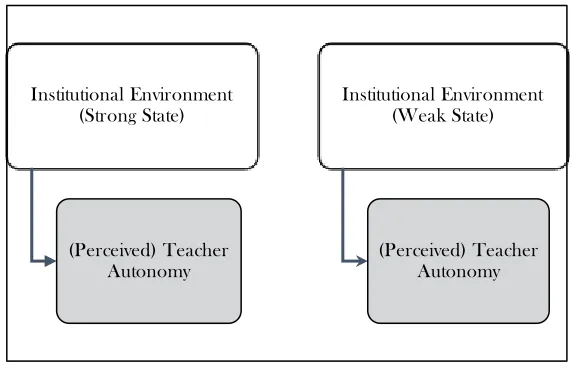
In an effort to assess whether and the extent to which organizational and institutional controls influence teacher [perception of] autonomy, this dissertation incorporates the distinction drawn
between strong and weak charter school policies, and conceptualizes further the institutional environment as one in which a state may be defined as having a strong policy or a weak policy. Figure 2.2 depicts this presumed relationship. The theoretical assumption is that charter school policies will buffer charter schools from an array of state, regional, and local level controls associated with broader institutional pressures. This buffering should allow charter schools to break organizationally with educational patterns established in their larger institutional environment. Further, the relative strength or weakness of charter school policy should influence the actual practice of autonomy in charter school settings, and more particularly, should influence whether and the degree to which teachers engage autonomous practices in their respective classroom settings. This dissertation research suggests additionally that the institutional environment of charter schooling will shape further teachers’ respective
perceptions regarding their individual autonomy, and will influence directly the extent to which
Institutional Environment (Strong State)
(Perceived) Teacher Autonomy
Institutional Environment (Weak State)
(Perceived) Teacher Autonomy
they are able to engage strategically with[in] their classroom settings to affect meaningful classroom practices. Thus, to the extent that the level of buffering built into charter school policies can vary the behaviors of charter school actors, policy differences should influence differently teacher perception of autonomy. Therefore, teachers in states with relatively
stronger charter school policies should experience autonomy differently than teachers in states with relatively weaker charter school policies. This dissertation poses the following hypothesis regarding this particular assumption:
Hypothesis1
– Charter school teachers in states with strong charter school policies are more likely to perceive higher levels of teacher autonomy than are charter school teachers in states with weak charter school policies.
Exploring the influence of charter school policies on charter school practices offers an initial window into assessing the influence of environment(s) on teaching autonomy in charter school classroom settings. This dissertation research suggests further that whether teachers engage autonomy, and whether they do so in a manner that supports policy
engage classroom practices differentiated from those found in traditional K-12 public school settings; however, the circumstances under which they [would] do so given their larger institutional environment remains unclear (Bulkley & Fisler, 2003; Bulkley & Wohlstetter, 2004; Finn, et al., 2000; Lubienski, 2003; Oplatka, 2004; Wohlstetter, et al., 1995).
This particular research is supported by aspects of broader education and organizational theory research that note the importance of other entrepreneurial determinants – like degree of choice and choice awareness, pro-activeness, actor influence, and actor self-interest – in assessing whether and how the policy grant of autonomy influences the educational practices of charter schools within their institutional setting (Coburn, 2004; Meyer & Rowan, 2006; Meyer & Rowan, 2008; 1991). Thus, the degree to which school actors are able to respond
strategically within highly institutionalized and technically complex environments depends in part upon the degree of choice awareness and choice exercised within the organizational setting, the level of pro-activeness engaged to influence the organizational setting, and the extent to which self-interests become substantive factors in influencing behaviors exercised by these same actors. This has become referred to in more recent OT research as the unfolding of entrepreneurial activities (Beckert, 1999; Garud et al., 2007) – where teachers use the operational space they have to shape actively learning environments based upon their perception of educational needs and interests that are balanced further against educational possibilities and constraints.
The extent of such strategic responses to broader institutional considerations remains unaccounted for in extant charter school research (Bulkley & Fisler, 2003; Bulkley &
& Briggs, 1995). Therefore, a more particularized understanding of how autonomy influences charter school educational practices requires an explicit acknowledgement of these additional considerations —as they influence the degree to which teachers use their autonomy to
manipulate resources and meet goals and organizational expectations as defined within their respective charters and their respective task environments. Moreover, it remains important to develop an appropriate conceptual framework for exploring whether and how teachers experience this autonomy in their respective classroom settings (Henig, 2008; Lubienski, 2003). Therefore, the next section of this literature review (1) provides a review of charter school research as well as a review of general education research, and (2) proposes a conceptual framework for exploring teacher autonomy in charter school settings.
charter school policy influences the behavior of teachers in their classroom settings, and how such policy might translate given institutional and organizational contingencies. Moreover, the dominant direction of charter school debates emphasizes the extent to which research has ignored these important intermediary aspects of educational processes.
Several large studies have reviewed empirically based research regarding the effects of charter school on the overall educational landscape (Bulkley & Fisler, 2002, 2003; Bulkley & Wohlstetter, 2004; Gill et al, 2007; Lubienski, 2003; Lubienski, 2004). Collectively these studies note that although charter schools have broad-based political appeal, the most important empirical questions about charter schools and their place in public educational processes have received little focus (Gill et al., 2007). More particularly, charter school research studies have addressed questions regarding the influence of school governance and general organizational characteristics (i.e., choice, access, competition, and educational diversification) on the broader educational landscape. Although these studies explore broad issues relevant to school choice debates, only limited research has addressed how autonomous schooling works in practice – particularly with respect to whether and how the policy grant of autonomy influences teaching practices in classroom settings.
engage autonomy generally in ways that differentiate them from traditional public schools, or (3) whether charter schools show heightened accountability for outcomes stemming from autonomy over governance practices and decision-making (Hill & Lake, 2002; Moranto, et al., 1999). Limited focus on charter school autonomy as a conceptual concern stems in part from conceptual issues reflected in general K-12 education research.
1. A View of Autonomy in General Education Research
Generally, education literatures have used broad conceptual gestures to address the issue of school autonomy. The broadest theoretical view of school autonomy is that it represents the devolution of power over a variety of bureaucratic decision-making processes from state, regional and district authorities to individual schools (Whitty, 1996). Its practical application as discussed in school reform literatures suggests that it entails varying levels of internal control over resource mechanisms that allow a school to determine those educational goals, standards and methods that will enhance its own organizational well-being (Chubb & Moe, 1988;
Wohlstetter et al., 1995). On both theoretical and practical levels, it implies the removal of bureaucratic constraints such that organizations are able to self-manage (Wohlstetter et al, 1995) in order to move dynamically with environmental contingencies. This general focus on the removal of bureaucratic constraints appears to have driven much of the early research on the theoretical and practical dimensions of school autonomy.
McDermott (1999) explored general issues of power and control between states and local school districts, and how those issues influenced the quality and distribution of educational resources. Fields and Feinberg (2001) examined the concept of site-based educational decision making as a successful alternative to more centralized and bureaucratic forms of educational management. Their research noted the importance of fracturing school management and decision-making practices to produce a new governance model capable of generating more deliberative-based educational outcomes. Smith (2003) conducted empirical research into whether bureaucratic deregulatory school reform models were capable of producing practical but important student outputs and outcomes. Among other things, Smith’s study noted: (1) the connection between bureaucratic deregulation of schooling and schooling outputs or outcomes remains empirically tenuous, and that (2) this tenuous connection stems in part from a lack of conceptual focus on specified processes that explain what bureaucratic deregulation looks like in practice and how identified practices might touch key educational outputs or outcomes.
2002), and these various areas of organizational control are deemed to influence overall educational quality. Moreover, charter school research reflects some effort to clarify additional school processes critical to school autonomy, and more importantly, critical to teaching
autonomy as it relates to student performance and student achievement. 2. A View of Autonomy in Charter School Research
One of the issues raised consistently in early charter school research regarding the concept of autonomy was, “how should this research approach the question of autonomous schooling, – particularly given variations in charter school policy and the relative organizational newness of charter school settings under these policies” (Bulkley & Wohlstetter, 2004; Lubienski, 2003; Wohlstetter, et. al., 1995). General education research has identified local organizational control as a critical element of autonomous schooling (Chubb & Moe, 1988, 1990; Wohlstetter, et. al., 1995); and charter school research in particular has identified
organizational control as one of three distinct areas critical to the concept of autonomy in charter school settings (Wohlstetter, et al., 1995). Although teacher autonomy represents the focus of this dissertation research, organizational autonomy receives some focus, as it
influences key organizational practices – including how teachers behave in their respective classroom settings (Wohlstetter, et al., 1995).
perceive of this autonomy given these contingencies (Bulkley & Fisler, 2002). Actual freedom to make choices over internal processes reflects first in the structure and administrative scheme of the charter school policy as well as support for its implementation. The policy sets the initial regulatory parameters for charter school existence, general operations, and waivers from traditional federal, state and local laws that govern traditional public school processes (Bulkley & Fisler, 2003). More specifically, the levels and types of freedoms provided via charter sc hool policies depend on specified legislative goals (e.g., parental choice, teacher professionalization, general diversification of public educational processes, less bureaucracy , etc.,), as well as the degree of political support expressed across and within states (Wohlstetter, et. al., 1995). Additionally, any freedoms provided within the framework of charter school policies remain subject still to other regulatory requirements that serve as outside limits on how these freedoms become expressed in particular practices. Substantive differences in the language of charter school policies, as well as varying differences in specified charter policy goals, mean that charter schools will differ necessarily in whether and what aspects of organizational autonomy they engage.
As a threshold goal, charter school policies offer charter school personnel control over any number of organizational processes, subject mostly to the express concerns of various
that may impede key decision-making processes, and are (2) free to engage varying degrees of organizational self-governance in ways uncommon to traditional public school settings
(Wohlstetter, et. al., 1995). Although these policies promote organizational distance from a variety of bureaucratic constraints, (Gawlik, 2007; Murphy, 2002; Wohlstetter, et. al., 1995), from a policy implementation standpoint, the concept of autonomy can hold varying practical meanings and implications for charter school actors as reflected in extant research (Bulkley & Fisler, 2003). Moreover, given these variations, charter school research has struggled somewhat to provide agreed upon insight into how the practical dimensions of organizational autonomy operate in charter school settings (Bulkley & Fisler, 2003; Bulkley & Wohlstetter, 2004; Lubienski, 2003).
provide a more expansive view of organizational autonomy that takes into account
environmental contingencies that may influence the substance of organizational autonomy. 3. A View of Autonomy in Organizational Theory Resear ch
General OT research suggests that the concept of autonomy implies a lack of insularity, in that organizations operate within the realm of organizational and institutional contingences that influence both constraints and opportunities (Bifulco, 2011). Thus, organizational autonomy becomes determined by the extent to which an organization can and does operate successfully within the realm of both “social and institutional [pressures and] resources that mediate [its] power to [self] determine . . . ” (Bifulco, p. 266). Kerr (2002) notes particularly that
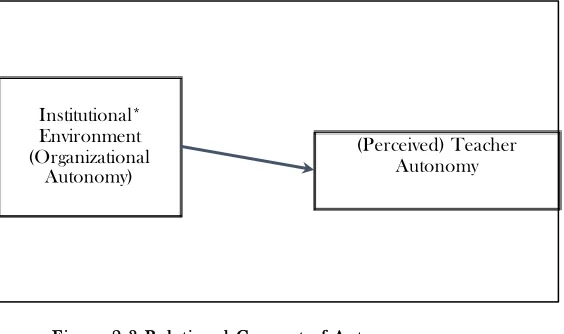
autonomy through an examination of state charter school policy, and uses the charter school policy framework to assess the influence of both organizational and institutional environments on teaching autonomy in charter school classroom settings.
E. Conceptualizing and Assessing the Practical Dimensions of Teacher Autonomy as a Relational Concept
Since the scope and substance of teaching practices sit at the heart of educational quality, the classroom represents a key schooling domain over which charter schools expect to exercise relative autonomy (Chubb & Moe, 1988; Lubienski, 2003). Moreover, what actually happens in charter school classrooms represents one of the core debates regarding charter school relevance to public educational practices; so the extent to which teacher autonomy influences the quality of student performance and student achievement represents an important area of charter school research. Yet, charter school research has placed more emphases on the grant of autonomy, and how it appears in charter school context(s), rather than on how autonomy is perceived and becomes negotiated in classroom settings (Bulkley & Fisler, 2002; Bulkley & Fisler, 2003; Bulkley & Wohlstetter, 2004; Gawlik, 2007; Lubienski, 2003; Whitty, 1996; Wohlstetter, et. al., 1995). Moreover, even the concept of teacher autonomy remains
somewhat ambiguous in charter school literature, fueling wide disagreement over whether and how charter school teachers engage autonomous practices in their respective classroom settings.