Jurnal Teknologi, 43(F) Dis. 2005: 85–94 © Universiti Teknologi Malaysia
A STUDY OF FORMATION DAMAGE CAUSED BY OIL-BASED MUD IN DYNAMIC CONDITION
ISSHAM ISMAIL1 & THANAPALA SINGAM MURUGESU2
Abstract. Well productivity can be significantly affected by damage near to wellbore area caused by drilling. Thus, this technical paper discusses the formation damage caused by oil-based mud on the Berea sandstone cores in simulated vertical and horizontal wells. This study was carried out in a dynamic condition at various differentials pressure. Oil-based mud was prepared in the laboratory and standard equipments were used to determine the mud rheological properties. Berea sandstone cores were saturated with sarapar for 24 hours prior to the tests. The result of this study was based on the measurement of filtrate loss and core permeability measurement before and after exposure to oil-based mud in vertical and horizontal conditions at various differentials pressure. The experimental results revealed that the permeability impairment increased as differential pressure increases. However, at differential pressure of 250 psi (1723.7 kPa), the damage occurred was less severe compared to 200 psi (1379.0 kPa), in both vertical and horizontal conditions. SEM image showed the presence of microfractures in the core when exposed to mud at high pressure and temperature, under dynamic condition. Experimental results also showed that the horizontal condition experienced more severe damage and lower filtrate loss as compared to vertical condition.
Keywords: Damage ratio, dynamic flow, formation damage, oil-based mud, SEM
Abstrak. Daya pengeluaran telaga boleh terjejas dengan teruknya akibat daripada kerosakan yang berlaku berhampiran lubang telaga, berikutan aktiviti penggerudian. Dengan itu, kertas kerja teknikal ini membincangkan tentang kerosakan formasi yang dialami teras batu pasir Berea yang ditempatkan di dalam telaga tegak dan mendatar terselaku, berpunca daripada penggunaan lumpur gerudi. Kajian dilaksanakan dalam keadaan dinamik menggunakan tekanan pembezaan yang berlainan. Lumpur dasar minyak disediakan di makmal, dengan peralatan makmal standard digunakan bagi menentukan sifat reologi lumpur terbabit. Sebelum bermulanya kajian, teras batu pasir Berea ditepukan dengan sarapar selama 24 jam. Keputusan kajian dibuat berdasarkan data kehilangan turasan dan data ketertelapan teras yang diukur sebelum dan selepas sampel teras didedahkan kepada lumpur. Keputusan kajian menunjukkan bahawa kerosakan ketertelapan teras bertambah teruk dengan meningkatnya tekanan pembezaan. Walau bagaimanapun, pada tekanan pembezaan 250 psi (1723.7 kPa), kerosakan yang berlaku lebih rendah berbanding 200 psi (1379.0 kPa) bagi kedua-dua telaga mendatar dan tegak. Imej SEM menunjukkan kewujudan retakan halus pada sampel teras yang didedahkan kepada aliran lumpur dengan tekanan pembezaan dan suhu yang tinggi. Keputusan kajian juga menunjukkan bahawa telaga mendatar mengalami kerosakan yang lebih teruk dan kehilangan turasan yang lebih rendah jika dibandingkan dengan telaga tegak.
Kata kunci: Nisbah kerosakan, aliran dinamik, kerosakan formasi, lumpur dasar minyak, SEM
1
Petroleum Engineering Department, Faculty of Chemical and Natural Resources Engineering, Universiti Teknologi Malaysia, 81310 UTM, Skudai.
2
1.0 INTRODUCTION
From the time a drill bit enters the pay zone until the well is put on production, a formation is exposed to series of operations and fluids that can impair its productive capacity. This reduction in productivity is termed as formation damage. It can be defined as the alteration of producing formation near the wellbore due to the introduction of foreign fluids and the consequent interaction with the fluids and formation [1]. Previous field and laboratory studies showed that the operations during drilling, completion, workover, production, and stimulation works are potential sources of formation damage.
During drilling, formation damage attributes primarily from two sources: filtrate invasion from a drilling fluid and the accompanying invasion and migration of solids. The damaging solids may come directly from fluid system or from the formation itself. The intrusion and deposition of these mobile particles lead to the blockage of pore throats, which include a reduction in permeability of the formation [2].
The major cause of damage during drilling is due to the invasion of mud solids. During drilling, the bridging mud solids, whose range in size varies form larger to slightly smaller than the pore openings of the rock, build up on the wellbore to form a low permeability filter cake. Particles which are smaller than the pore opening flow into the formation along with the mud filtrate. These solids form internal bridges at pore restrictions and cause reduction in permeability of the rock [2].
The numerous mechanisms that result in formation damage may be generally classified as to the manner by which they decrease production [3]:
(1) Reduced absolute permeability of formation due to plugging of pore channels by induced particles.
(2) Reduced relative permeability to oil due to an increase in water saturation or oil-wetting rock.
(3) Increased viscosity of reservoir fluid results from emulsions or high-viscosity treating fluids.
The degree of damage varies with parameters such as differential pressure, mud annular velocity, characteristics of the formation as well as the composition of the mud filtrate and solids that flow with it under dynamic conditions [2]. To minimize damage, a mud should have low fluid loss, low fine solid concentration, should form a thin, impermeable mud cake, and exhibit good rheological properties [1].
is also essential when drilling a reservoir with an oil mud as the loss of whole mud, including the water phase, deep into a reservoir could cause emulsion blocking [4].
2.0 MATERIALS AND EXPERIMENTAL PROCEDURES
The experimental work was set up to study two different variables which were differential pressure and core position angle. The ranges of the two experimental variables tested were:
(1) Differential pressure: 100 – 250 psi (689.5 – 1723.7 kPa).
(2) Angle: 90° (vertical) and 180° (horizontal).
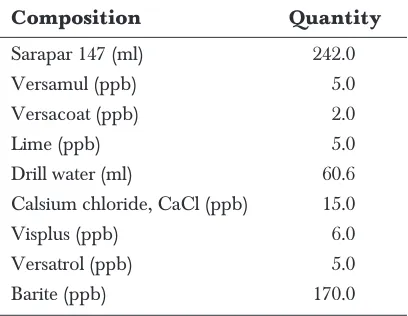
Oil-based mud was prepared in the Drilling Laboratory of Petroleum Engineering Department, Universiti Teknologi Malaysia using conventional equipments. Table 1 shows the composition of the mud system used in this study. After the mud was prepared, mud rheological properties were measured using equipments, namely mud balance, rheometer, and High Pressure High Temperature (HPHT) filter press [5].
Eight Berea sandstone core samples were used in this experiment. The core sampels were cut into 6 inches (15.24 cm) long and 2 inches (5.08 cm) in diameter. Prior to the test, core samples were saturated with sarapar oil for 24 hours [6].
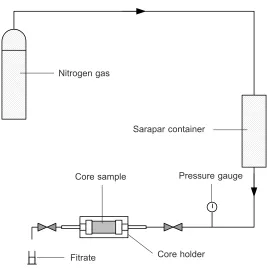
The severity of the core damage was evaluated according to the measurement of initial permeability and damaged permeability of the cores samples after being exposed to the oil-based mud. The experimental apparatus, as shown in Figure 1, was used to measure the initial permeability and damaged permeability of the core sample.
Table 1 The formulation of oil-based mud
Composition Quantity
Sarapar 147 (ml) 242.0
Versamul (ppb) 5.0
Versacoat (ppb) 2.0
Lime (ppb) 5.0
Drill water (ml) 60.6 Calsium chloride, CaCl (ppb) 15.0
Visplus (ppb) 6.0
Versatrol (ppb) 5.0
Nitrogen gas was used to force sarapar from sarapar container to flow through the core, as shown in Figure 1. The volume of sarapar collected as filtrate was used to calculate the flow rate of sarapar using Equation (1):
Q V / t= (1)
The calculated flow rate was substituted into Equation (2) to calculate the initial core sample permeability:
(
)
( )k= Q L A Pµ ∆ (2)
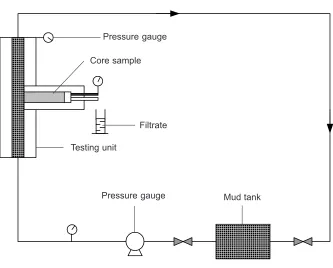
After initial permeability was measured, the core sample was placed in the formation damage rig. Figure 2 shows the formation damage rig that was used in this experiment. It has a testing unit which was mounted on the rotating rig holder and the rotation angle level could be preset to vertical or horizontal conditions by adjusting the angle disk.
The core holder that comprised the core sample was flanged to the testing unit and exposed to the drilling mud at various differential pressures in vertical and horizontal conditions. The core sample was exposed to the mud for 30 minutes and filtrate was collected for the same period of time. After damaging process, the core
Figure 1 Permeability measurement equipment Nitrogen gas
Sarapar container
Fitrate Core holder
sample was removed from the formation damage rig and placed in permeability measurement unit to measure the damaged permeability of the core.
3.0 RESULTS AND DISCUSSION
Generally, the data obtained and discussion can be divided into four main parts:
(1) Influence of differential pressure on formation damage.
(2) Comparison of formation damage in vertical and horizontal conditions. (3) Filtrate loss at various differential pressures.
(4) Filtrate loss in vertical and horizontal conditions.
3.1 Influence of Differential Pressure on Formation Damage Table 2 shows the rheological properties of the mud used in this study. It was found that the rheological properties of the mud were within the ranges recommended by the industry. The mud was used to damage the Berea sandstone core samples.
The damage ratio, DR, was calculated from the ratio of the permeability of the
core after damage, kd, to initial permeability of the core before damage, ki [7]:
(
)
DR = k / kd i ×100% (3)
Figure 2 Formation damage rig Pressure gauge
Core sample
Filtrate
Testing unit
The severity of damage to the core sample by drilling fluid is inversely proportional to the damage ratio.
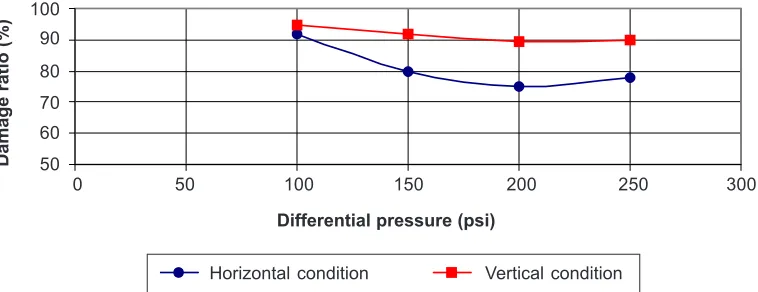
Results show that higher differential pressures caused severe damage. The effect of differential pressure on the damage in horizontal and vertical conditions is shown in Figure 3.
Table 2 Mud properties
Properties Achieved value
Density, ppg 10.3
Plastic viscosity, cp 23.0 Yield point, lb/100ft2 11.0 Gel strength (10 seconds) 7.0 Gel strength (10 minutes) 14.0 Filtrate loss, ml 3.0
Figure 3 Damage ratio for vertical and horizontal conditions 100
0 90
80
70
60
50
50 100 150 200 250 300
Differential pressure (psi)
Horizontal condition Vertical condition
Damage ratio (%)
A core sample exposed to 200 psi (1379.0 kPa) differential pressure showed higher damage compared to 100 (689.5 kPa) and 150 psi (1034.2 kPa), both in horizontal and vertical conditions. At higher differential pressures, the migration of solid particles into core samples increased. Total solid migration into the core sample was proportional to the differential pressure. Generally, greater solid invasion causes severe blockage of pore throats that induces greater reduction in permeability of core sample.
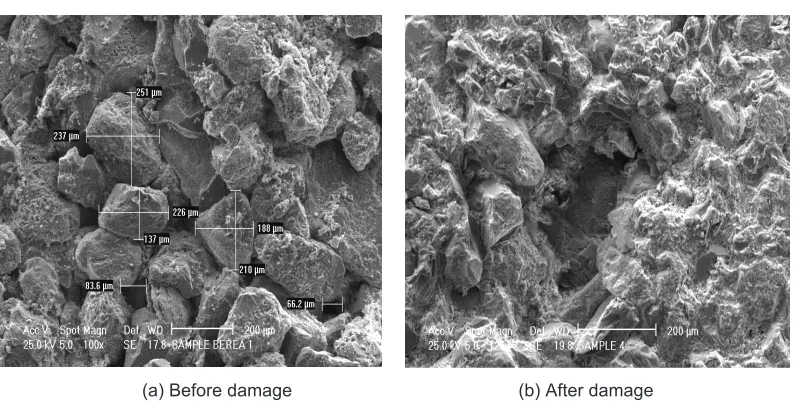
At pressure differential of 250 psi (1723.7 kPa), the damage occurred was less severe compared to 200 psi (1379.0 kPa), in both vertical and horizontal conditions. A SEM image showed the presence of microfractures in the core sample when exposed to a pressure differential of 250 psi (1723.7 kPa), as shown in Figure 4. The presence of microfractures was possibly due to exposure to drilling at high pressure
3.2 Comparison of Formation Damage in Vertical and Horizontal Conditions
The experimental results revealed that horizontal condition experienced more damage compared to vertical condition. In this study, the horizontal and vertical conditions were simulating the horizontal and vertical conditions, respectively. Figure 3 shows at a given differential pressure, vertical condition showed higher damage ratio compared to horizontal.
In the vertical condition, the mud invasion into formation was in a cylindrical pattern. On the other hand, in the horizontal condition, due to the frequent anisotropy condition, the mud invasion pattern was elliptical. Elliptical invasion pattern in horizontal condition forced more particles into the core sample compared to vertical condition [8]. This phenomenon caused horizontal condition to experience more damage compared to vertical condition.
Besides that, in the horizontal condition, due to the gravity effect, mud particles tend to move towards the bottom of the condition. This phenomenon forced more particles into the core sample, which led to severe damage.
3.3 Filtrate Loss at Various Differential Pressures
Figures 5 and 6 show the filtrate loss in vertical and horizontal condition at 100 psi (689.5 kPa), 150 psi (1034.2 kPa), 200 psi (1379.0 kPa), and 250 psi (1723.7 kPa) differential pressure. Both graphs show that at 250 psi (1723.7 kPa) differential pressure, the highest volume of filtrate was collected. This was followed by 200 psi (1379.0
(a) Before damage (b) After damage
kPa), 150 psi (1034.2 kPa), and 100 psi (689.5 kPa) differential pressure. The filtrate loss was found to increase with increment in differential pressure. Generally, higher differential pressures tend to force more fluid from mud into the formation that may cause severe formation damage. Higher differential pressures cause severe formation damage. This is because at higher differential pressures, the migration of solid particles into formation increase.
Figure 5 Filtrate loss in vertical condition 4.5
10 1.5
2 2.5 3 3.5 4
1
0.5
0
5
0 15 20 25 30
Time (minute)
Filtrate loss (ml)
100 psi
150 psi
200 psi
250 psi
Figure 6 Filtrate loss in horizontal condition 10
1.5 2 2.5 3 3.5
1
0.5
0
5
0 15 20 25 30
Time (minute)
Filtrate loss (ml)
100 psi
150 psi
200 psi
3.4 Filtrate Loss in Vertical and Horizontal Conditions
Filtrate loss data showed that higher filtrate was collected in vertical condition compared to horizontal condition, as shown in Figures 5 and 6. For example, at the end of 30 minutes and 250 psi (1723.7 kPa), the filtrate collected in the vertical condition was 3.9 ml as compared to 2.9 ml for horizontal condition. This was due to the presence of thick, impermeable mud cake in horizontal condition that had resulted in lower filtrate loss. Although horizontal condition experienced lower filtrate loss, it encountered severe formation damage due to anisotropic flow and gravity effect – a phenomenon that reduces well productivity significantly. The presence of a thick mud cake can cause problems to drilling operation, such as pipe sticking.
4.0 CONCLUSIONS
The following conclusions were derived from this research study:
(1) Higher differential pressures cause severe formation damage. This is because at higher differential pressures, the migration of solid particles into core samples increase.
(2) Horizontal condition experiences more damage compared to vertical condition due to anisotropic flow and gravity effect in horizontal condition.
(3) Filtrate loss increase with the increment in differential pressure.
(4) Filtrate loss is lower in horizontal condition due to the formation of a thick, impermeable mud cake.
ACKNOWLEDGEMENTS
The authors would like to thank the Malaysian Government for the financial assistance given via the IRPA grant (Vot: 72232).
NOMENCLATURE
A area, in2
cp centipoise
DR damage ratio, dimensionless
k permeability, Darcy
kd damaged permeability, Darcy
ki initial permeability, Darcy
L core length, inches
ml milliliter
ppb pound per barrel
ppg pound per gallon
SEM Scanning Electron Microscope
t time, sec.
V volume, cc
∆P differential pressure, psi
µ viscosity, cP
CONVERSION FACTOR
(oF – 32)/1.8 = °C
bbl × 1.589 873 E – 01 = m3
cP × 1.0 E – 03 = Pa.s
ft × 3.048* E – 01 = m
gal × 3. 785 412 E – 03 = m3
in. × 2.54* E + 00 = cm
lbm × 4.535 924 E – 01 = kg
md × 9.869233 E – 04 = µm2
ppg × 1.198 264 E + 02 = kg/m3
psi × 6.894 757 E + 00 = kPa
* Conversion factor is exact
REFERENCES
[1] McKinney, L. K., and J. J. Azar. 1988. Formation Damage Due to Synthetic Oil Mud Filtrates at Elevated Temperatures and Pressures. SPE 17162.
[2] Tovar, J., J. J. Azar, J. L. Lummus, D. S. Sarma, and P. Ali. 1994. Formation Damage Studies on Reservoir Rocks using Water-Based and Oil-Based Muds. SPE 27349.
[3] Allen, T. O., and A. P. Roberts. 1993. Production Operation: Well Completions, Workover and Stimulation. 4th ed. Oklahoma: Oil & Gas Consultants.
[4] McNaughton, P. J. 1982. Oil Muds in South East Asia. SPE 10435.
[5] American Petroleum Institute. 1990. API Recommended Practice Standard Procedure for Field Testing Oil-based Drilling Fluids. API RP 13B-2. Dallas: American Petroleum Institute.
[6] Marshall, D. S. 1997. Development of a Recommended Practice for Formation Damage Testing. SPE 38154.
[7] Krueger, R. F. 1988. An Overview of Formation Damage and Well Productivity in Oilfield Oprations: An Update. SPE 17459.