How is developmental stability sustained in the face
of genetic variation?
JAMES R. S. WHITTLE*
School of Biological Sciences, University of Sussex, Brighton, United Kingdom
ABSTRACT The number and arrangement of scutellar bristles on the thorax of Drosophila melanogaster is largely invariant in wild-type stocks. This character therefore appears to be buffered against changes in phenotype, and has previously been described as a canalized character. Mutations that do alter this phenotype increase the variability in bristle number and can reveal otherwise cryptic genetic differences at other loci. This phenomenon is examined and possible mechanisms contributing to stability of this developmental event are discussed, but the notion that the character is canalized is found not to be heuristic.
KEY WORDS:
developmental stability, bristle pattern, canalization
0214-6282/98/$10.00
© UBC Press Printed in Spain
*Address for reprints: School of Biological Sciences, University of Sussex, Brighton BN1 9QG, United Kingdom. FAX: 0044-1273-678433. e-mail: [email protected]
Introduction
Like begets like. Fascination with the phenomenon of reproduc-tion drives us to understand the mechanisms underpinning the process of development, including an explanation of the regularity with which a particular animal form develops from each fertilized egg of that same species. I want to look at a particular developmen-tal process, the spatial patterning of scutellar bristles, which are sense organs on the Drosophila melanogaster adult. We know that the properties (and thus the behavior) of cells and groups of cells that compose tissues reflect the abundance and types of different proteins that they contain. Each of those proteins is encoded by a gene and the protein structure derives directly from the translation or ‘expression’ of the gene in that particular cell. When geneticists sample a natural population and examine the DNA sequence of a gene or the amino acid sequence of its product, they find consid-erable variability or heterogeneity within and between individuals. A population contains a large reservoir of genetic variants, yet most of them do not cause detectable phenotypic changes. I want to see whether progress in our understanding of the ‘developmental machinery’ offers any hints regarding the basis of developmental stability. The first point is to explain how geneticists can untangle the complexities of development.
Geneticists have devised successful and effective
meth-ods for ‘dissecting’ a developmental process
Geneticists use perturbation analysis, often calling it ‘muta-tional dissection’, to identify genetic components in a biological process. I will explain how this method brings us to two
conclu-sions; first that all these genes must normally contribute to the reliability or stability of the process, and second, that if many genes are involved in the process this does not seem to make it more ‘fragile’ than if fewer genes were involved. The ‘logic’ of mutational dissection runs as follows. If we mutagenize animals and then breed from them to produce homozygotes in the F2 generation, then any mutation that has altered the integrity, abundance or stability of a gene product involved in development will be recognizable in the F2 segregation because of the upset it creates. If the mutation is recessive in its effect, then it can be described and catalogued, and maintained as a heterozygous stock displaying a wild-type phenotype. Crosses between differ-ent recessive mutations make clear whether any two mutations found are in the same gene or are changes in two quite different genes (the complementation test). Each mutation will have iden-tified a gene that must be essential for the developmental event: otherwise why would any change in it have shown up? Locating the site of each mutation in the chromosomes provides a useful step towards obtaining the DNA sequence for that gene. When a gene has been sequenced, its protein product can be deduced by ‘decoding’ it or can actually be synthesized in vitro. The ‘expres-sion’ of that gene can be documented by searching tissues for the messenger RNA or the protein. Combining the descriptive knowl-edge of what goes wrong when the mutant version of a gene replaces the wild-type one with the molecular information about the protein product usually provides a reasonable account of how
Abbreviations used in this paper: Km, Michaelis constant; RFLP, Restriction
the activity of that gene contributes to the process. It is self-evident that normality depends upon every single one of the genes found by ‘mutational dissection’ being operational.
A long-established empirical finding is that if one induces new mutations in a genotype that already has a mutant gene affecting a particular phenotype, then it generally becomes easier to detect new mutations in other genes affecting the same phenotype. This has been of great benefit in mutational dissection, and there are two stratagems. The first is to start with a stock showing a mutant phenotype and to recover mutations in other genes that act as suppressors or enhancers of that phenotype. There are situations in which a newly induced mutation is only detectable in a genotype that is already mutant for another gene, and many instances where mutations of a subtle kind would have been overlooked except in the ‘mutant background’. For example, we have successfully isolated mutations in other genes which when heterozygous (there-fore they are ‘dominant’ mutations) modify the phenotype of homozygotes for the mutation spade in the wingless gene (Buratovich et al., 1997). A second example also features the wingless gene which is necessary for the appearance of the scutellar bristles (Phillips and Whittle, 1993). Flies that are hetero-zygous for a mutation in wingless , encoding a secreted ‘signal’ protein, and that are also simultaneously heterozygous for a mutation in arrow, which has a role in the response of cells to this ‘signal’, have a low frequency of leg defects. Heterozygous muta-tions at a third locus can enhance the frequency of the leg defect. This enhancement can be used to identify related genes in the same process (Kim A. Caldwell, S. Dougan, E. Matunis, J. Tran, and S. DiNardo, personal communication).
The second stratagem has been to use a heterozygote for a recessive mutation (it therefore has a wild-type phenotype) as a background in which to search for phenotypic change in this heterozygote, either when one of its parents has been subjected to mutagenesis, or when the heterozygote also carries a known deletion or additional copy of genetic material elsewhere in the genome. Antonio García-Bellido pioneered this latter approach in Drosophila, calling it “gene-dose titration analysis”(Botas et al., 1982). A way to interpret the genetic situation underlying this approach is to say that the attenuation or loss of activity of one gene product makes the developmental process more sensitive to small changes in the activity of other gene products. Using mutations in different genes to subtract successively more proteins that are part
of the same ‘developmental machine’ makes the system more labile or error-prone, often in a multiplicative way (each successive mutation having a larger de-stabilising effect than the previous one). This is a familiar experience in relation to failures in compo-nents of designed machinery, like those of a car. This analysis also reminds us that whether the effect of a mutation is recessive or dominant can depend upon the composition of the rest of the genotype and should not be thought of as some absolute molecular property of that DNA sequence.
A case study: the pattern of scutellar bristles
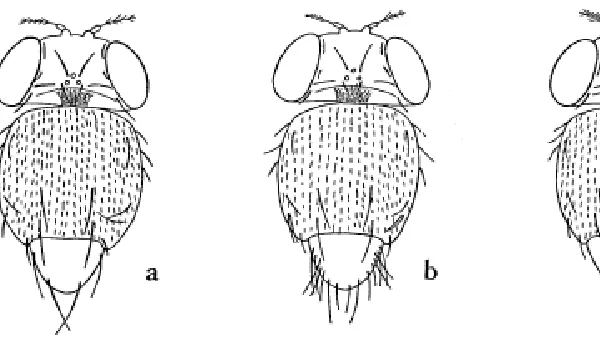
I have chosen to consider the spatial patterning of large bristles (sense organs of the peripheral nervous system) on a part of the dorsal thorax called the scutellum. In wild-type flies, the pattern and number of these bristles (four) is almost invariant (Fig. 1a). The scutellum comes from the fusion during pupation of two separate (and mirror-imaged) groups of cells (called the wing imaginal discs) found within the larva on the left and right sides. I will recount the history of the scutellar bristles in the reverse order to that which occurs during development (see also the paper by Modolell and Campuzano, this issue). Each functioning bristle, including its neuron connecting it to the central nervous system, is the product of the co-ordinated differentiation of a clone of four cells from a ‘sense organ precursor’ cell (called an SOP). The SOPs appear within a ‘proneural cluster’ of cells, a group related by position rather than by cell lineage, and all of which express the gene scute (of the achaete-scute cluster of genes, García-Bellido and Santamaria, 1978; see also the paper by Campos-Ortega in this issue) which is inactive outside each cluster. The borders of the cluster and the scutellar SOPs themselves appear at fixed sites in the disc epithelium so the pattern and number of scutellar bristles must depend upon the precision of the expression of scute.
This is a specific instance of the puzzle about spatial patterning that has tantalized developmental biologists for many years. The presence of active Scute product depends upon the integrity of at least three other genes, wingless, pannier and extramacrochaetae. Of these, the last two must ‘repress’ scute, because loss-of-activity mutations in these genes prompt more bristles to form, while the first one must ‘activate’ scute, for its mutations result in a disappearance of bristles. The Wingless protein is secreted, and therefore has one of the properties of a signal molecule, but originates very locally in the
tissue. There is evidence for the implication of two other secreted ‘signaling’ molecules participating in the process, the products of the genes decapentaplegic and hedgehog. It is known in other systems that the binding of the protein Hedgehog to its receptor protein Patched removes a negative regulatory effect upon the signal transduction in the recipient cell. Because cells homozygous for mutations in the patched gene make more bristles than expected on the scutellum (Roberts, Phillips, Warner and Whittle, unpublished), this suggests that the Hedgehog/Patched signaling system contrib-utes to the determination of the scutellar bristles. In contrast, the inactivation or removal of a kinase enzyme by mutations in the gene zeste-white 3 shaggy causes extra cells to behave as if they have received the Wingless signal and to become SOPs, resulting in the formation of extra bristles. Interestingly, clones of cells defective for the kinase Shaggy respond as if the signal from their wild-type neighbors is propagated through the tissue from its posterior edge (Warner, Phillips and Whittle, unpublished).
The concept of developmental canalization
Waddington (1942) coined the term canalization to describe the ability of some developmental processes to persist in progressing to their normal end-point in the face of genetic or environmental disturbances. In a series of papers from 1959 onwards, J. M. Rendel and A. S. Fraser and their colleagues explored canalization with reference to scutellar bristle number (Rendel 1959,1967; Fraser, 1970). Rendel introduced a recessive X-linked mutation sc1 from the gene scute into a wild population so that it was
segregating. He tracked the mutation in his experiments from one generation to the next by the closely linked recessive mutation white (eyes). White-eyed flies had the scute mutation whilst red-eyed flies had the wild-type copy of scute. Mutant homozygotes had fewer scutellar bristles but there was more variability in number. In this population, the mean scutellar bristle number of sc1
males was 0.92, comprising flies with 0,1,2 or 3 bristles, whereas the wild-type males all had four scutellar bristles. Selection for increased scutellar bristle number on the scute sibs in this popula-tion caused the mean scutellar bristle number to rise towards four (to 2.81 in males, comprising flies with 1,2,3 or 4 bristles) showing that at least some of the variability must have been genetic. In the wild-type sibs, sharing all their genotype in common with these flies except for the region close to scute and white , the bristle number only rose to 4.06 (188 males with four bristles and 12 males with five bristles).
As the mean scutellar bristle number of the scute individuals in the selected population approached four, the variability in bristle number in this genotype fell again. This outcome was described by saying that selection had moved the process back into a ‘buffered zone’ at four bristles, despite the presence now in the genotype of the scute mutation. He concluded that the ‘buffering’ or ‘canaliza-tion’ could not be a function of the scute gene (because that was mutant), but that the introduction of the scute mutation had upset the process sufficiently so that previously cryptic genetic variation was now revealed and could then be seized upon in the selection response. Rendel went on to postulate that there was a normally distributed underlying propensity to form these bristles (which he called ‘make’), and he used a statistical transformation to estimate the ‘distances’ between the 2-3, the 3-4 and the 4-5 bristle thresholds for this hypothetical underlying variable. His analysis
showed that the distance between the 3-4 and the 4-5 thresholds (the ‘4’ class) was larger than that of the other intervals. The canalization concept in relation to scutellar bristle pattern has been defended (Waddington, 1972), and critically reviewed by Scharloo (1991).
Thirty eight years later, and having the benefit of hindsight, I do not consider that Rendel’s proposal of a underlying hypothetical variable with normal distribution, ‘make’, as part of an explanation for scutellar bristle variation, is any longer an heuristic notion, for the following reasons. SOPs for the left and right scutellar bristles are detectable in the two wing discs whilst they are quite separate structures, rather than part of a common ‘unit’ within which the control of SOP number could be exerted. The hypothetical ‘make’ distribution therefore relates poorly to any biologically meaningful single entity. Second, there was debate in the literature at the time as to whether the statistical consideration ought to have been the individual bristle site and the bristle/no bristle threshold (Robertson, 1956) rather than the sum total of scutellar bristles (see also Scharloo, 1991). Simultaneous losses at one site and increases at the other site in the same fly have been seen. The anterior and posterior bristles are determined at different developmental ages (Poodry, 1975). Many authors have shown that flies with five scutellar bristles are most likely to have their extra bristle at an anterior site, which suggests that the developmental events pre-ceding the appearance of the anterior and posterior scutellars cannot be identical. Counting together bristles at anterior and posterior sites therefore sacrifices important spatial information about this developmental event. These objections, together with the accumulating knowledge of molecular events in the history of scutellar bristle formation, seem to leave the concept of canaliza-tion without utility in this example.
How might attributes of genes and gene products
con-fer stability upon a developmental process?
an individual protein involved might not. The system would there-fore be insensitive to (some) variation in the genes encoding the individual components.
A second alternative explanation is that the stability of a devel-opmental process may be an outcome of the kinetic properties of the total assembly of component gene products. The work of H. Kacser and his colleagues (Kacser and Burns, 1973) has clearly shown that ‘through-put’ or flux in a metabolic pathway comprising several coupled enzymes is relatively insensitive to small changes in the catalytic properties of each individual enzyme. Gene prod-ucts that have catalytic properties (rather than structural roles) might give a system a flexibility or tolerance to changes precisely because of their particular properties (for instance, the enzyme parameters Km and Vmax in a cascade of phosphorylation events of the type that mediate signal transduction from some receptors). Such an imagined structure should be relatively insensitive to protein changes affecting these parameters stemming from alleles segregating in the population.
A third explanation for stability is redundancy. Geneticists have long recognized that if a genome carries duplicate copies of genes (as an autopolyploid does), then the species would be relatively refractory to phenotypic change following mutation in one of the several copies of the same coding unit. In common parlance this would be described as ‘safety in numbers’ but it only predicts stability of phenotype in the face of mutation and offers no expla-nation of any dynamic buffering of the developmental process following fluctuations in other ‘inputs’ or parameters. Wilkins (1997), has suggested that canalization may in part reflect the contribu-tions of paralogous genes to a given process. Paralogs are gene products closely related structurally (meaning that their DNA sequences are similar). The effect of removing one paralog by genetic ‘knock-out’ or by disruption may be masked by the contri-bution of paralogs encoding similar proteins, if they are present in the same cells at the same time. In the absence of one particular gene product, the activity of a second and related protein present becomes relevant. The missing protein might have the higher affinity or efficiency in the process but in its absence, even a ‘poor fit’ alternative might protect the developmental process from the consequence of a total loss of a crucial component or molecular activity. Wilkins (1997) cites a number of examples where it is clear that phenotypic change is more severe when both (of two) mem-bers of a paralogous family of genes are mutant than when either is singly mutant.
A fourth explanation for developmental stability is provided by homeostasis at the level of cell behavior. The ‘machinery’ driving cell division within an imaginal disc is an excellent example self-regulating process of a higher level than the previous examples. García-Bellido and his colleagues (García-Bellido et al., 1973) were pioneers in recognizing that, within a group of cells that share the same developmental fate (he called it compartment), the cell lineage history was indeterminate rather than fixed. They showed this by creating genetic mosaics with cell-limited differing growth parameters and observing that heterogeneity in cell cycling time, a central cell process, was without any effect upon the size or the fidelity of the developmental patterns (for instance, the scutellum and its bristles) formed by that compartment of cells. This property confers on the compartment of cells a stability in the face of stochastic cell loss or local growth impairment. More recently, they have documented the fact that despite the indeterminate lineage within a compartment, there is a regular dynamic pattern of cell
division with respect to position within the disc. This implies a high-level and dynamic interaction between the cells of a compartment within a disc so that in successive intervals of developmental time, ‘permission to divide’ is reassigned according to a spatial pattern irrespective of the previous (and possibly unequal) division contri-butions of those cells (Milan et al., 1996a,b).
Conclusions
Scutellar bristle pattern and number in Drosophila show little variability, even in the face of segregating genetic differences. We conclude that the developmental events involved seem to be ‘buffered’ or dampened against changes. Yet there is a low level of genetic variation affecting scutellar bristles in natural populations. Many lines with increased scutellar bristle number have been created by selection in samples from wild-type populations (e.g, Fig. 1b, taken from Payne 1918; Fraser, 1970). Quantitative trait loci affecting bristles in wild populations have been mapped using restriction fragment length polymorphisms (RFLPs), and have identified genetic variants at or in the immediate vicinity of all the following loci known to developmental biologists analyzing bristle formation: achaete-scute, Notch, bobbed, daughterless, scab-rous, extramacrochaetae, hairy, Delta and Enhancer of split (Fal-coner and Mackay, 1996). Many gene products indeed participate during the specification of bristles (see Simpson 1997, for a recent review).
Work towards a complete genetic inventory and detailed de-scriptions of the properties of the gene products is yielding secrets about individual steps in the ‘developmental mechanics’, and this reductionist approach to analysis is still in the ascendancy. We are approaching the point at which there could be a complete descrip-tion of the gene expression events presaging the appearance of each SOP. At that point, it will be valuable to model the process to see if we indeed have sufficient understanding to predict and then test experimentally the stability in behavior of the process, as has been achieved for the behavior of gap genes in segmentation in Drosophila by H. Kitano (Kitano et al., 1998). Provided that the model can subsume all the known information and makes verifiable new predictions, then it would suggest that there are unlikely to be other important attributes contributing to stability that are not rather obvious emergent properties following from the integrated function of the individual genetic components.
In other words, developmental stability of this character is unlikely to be an emergent property beyond the reach of the molecular biology and genetics of contemporary developmental biologists, and is more obvious and less mysterious than the concept of canalization might have suggested.
A personal perspective
copy of his pioneering study on genetic analysis of scutellar bristles (Payne, 1918 and Fig. 1). In 1997 I find myself looking at scutellar bristle formation again with molecular tools. One hopes this is humility in the presence of an intriguing biological problem rather than the recurrence of narrow obsessional behavior flying in the face of reason!
Acknowledgments
I am grateful to Michael Buratovich, Eddy van Daele, Jimmy Sang and Adam Wilkins for comments on various drafts of this manuscript and for the helpful editorial comments of Alain Ghysen, but the responsibility for it remains my own. I thank Steve DiNardo for permission to quote unpub-lished material. My research is supported by the Wellcome Trust and the Biotechnology and Biological Sciences Research Council.
References
BARKAI, N. and LEIBLER, S. (1997). Robustness in simple biochemical networks. Nature 387: 913-917.
BOTAS, J., DEL PRADO, J.M. and GARCÍA-BELLIDO, A. (1982). Gene-dose titration analysis in the search of trans-regulatory genes. EMBO J. 1: 307-310.
BURATOVICH, M., PHILLIPS, R.G. and WHITTLE, J.R.S. (1997). Genetic relation-ships between the mutations spade and Sternopleural and the wingless gene in Drosophila development. Dev.Biol. 185: 244-260.
CAMPOS ORTEGA. J.A. (1998). The genetics of the Drosophila achaete-scute gene complex: a historical appraisal. Int. J. Dev. Biol. 42:
FALCONER, D.S. and MACKAY, T.F.C. (1996). Introduction to quantitative genetics. Longman, Harlow.
FRASER, A.S. (1970). Variation of scutellar bristles in Drosophila XVI. Major and minor genes. Genetics 65: 305-309.
GARCÍA-BELLIDO, A. and SANTAMARIA, P. (1978). Developmental analysis of the achaete-scute system of Drosophila melanogaster. Genetics 88: 469-486.
GARCÍA-BELLIDO, A., RIPOLL, P. and MORATA, G. (1973). Developmental compartmentalisation of the wing disk of Drosophila. Nature New Biol. 245: 251-253.
KACSER, H. and BURNS, J.A. (1973). The control of flux. Symp. Soc. Exp. Biol. 27: 65-104.
KITANO, H., HAMAHASHI, S., KITAZAWA, J., TAKAO, K. and IMAI, S-I. (1998). The virtual laboratories: a new approach of computational biology. (Eds. Husbands, P. and Harvey, I.). M.I.T. Press. Proc. Fourth European Conf. on Artificial life. pp. 274-283. (In press).
MILAN, M., CAMPUZANO, S. and GARCÍA-BELLIDO, A. (1996a). Cell cycling and patterned cell proliferation in the wing primordium of Drosophila. Proc. Natl. Acad. Sci. USA. 93: 640-645.
MILAN, M., CAMPUZANO, S. and GARCÍA-BELLIDO, A. (1996b). Cell cycling and patterned cell proliferation in the wing primordium during metamorphosis. Proc. Natl. Acad. Sci. USA. 93: 11687-11692.
MODOLELL J. and CAMPUZANO, S. (1998). The achaete-scute complex as an integrating device. Int. J. Dev. Biol. 42: 275-282.
PAYNE, F. (1918). An experiment to test the nature of the variation on which selection acts. Indiana U. Stud. 5: 3-45.
PHILLIPS, R.G. and WHITTLE, J.R.S. (1993). wingless expression mediates deter-mination of peripheral nervous system elements in the late stages of Drosophila wing disc development. Development. 118: 427-438.
POODRY, C.A. (1975). A temporal pattern in the development of sensory bristles in Drosophila. Roux Arch. Dev. Biol. 178: 203-213.
RENDEL, J.M. (1959). Canalization of the scute phenotype of Drosophila. Evolution 13: 425-439.
RENDEL, J.M. (1967). Canalization and gene control. Logos Press, London.
ROBERTSON, A. (1956). Variation in scutellar bristle number- an alternative hypoth-esis. Am. Nat. 99: 19.
SCHARLOO, W. (1991). Canalization: genetic and developmental aspects. Annu. Rev. Ecol. Syst. 22: 65-93.
SIMPSON, P. (1997). Notch signaling in development: on equivalence groups and asymmetric developmental potential. Curr. Opin. Genet. Dev. 7: 537-542.
WADDINGTON, C.H. (1942). The canalization of development and the inheritance of acquired characters. Nature 150: 563-565.
WADDINGTON, C.H. (1972). Form and information. In Towards a theoretical biology. 4. Essays. An I.U.B.S. Symposium. (Ed. Waddington, C.H.). Edinburgh University Press. Edinburgh. pp. 109-141.
WHITTLE, J.R.S. (1967). Genetic analysis of the control of number and pattern of scutellar bristles in Drosophila melanogaster. Genetics 63: 167-181.