A lightweight and efficient tool for cleaning Web pages
Stefan Evert
Institute of Cognitive Science, University of Osnabr¨uck 49069 Osnabr¨uck, Germany
Abstract
Originally conceived as a “naive” baseline experiment using traditional n-gram language models as classifiers, theNCLEANERsystem has turned out to be a fast and lightweight tool for cleaning Web pages with state-of-the-art accuracy (based on results from the CLEANEVAL competition held in 2007). Despite its simplicity, the algorithm achieves a significant improvement over the baseline (i.e. plain, uncleaned text dumps), trading off recall for substantially higher precision.NCLEANERis available as an open-source software package. It is pre-configured for English Web pages, but can adapted to other languages with minimal amounts of manually cleaned training data. Since
NCLEANERdoes not make use of HTML structure, it can also be applied to existing Web corpora that are only available in plain text format, with a minor loss in classfication accuracy.
1.
Introduction
The World Wide Web is an amazing, almost inexhaustible and very convenient source of authentic natural language data. Automatically compiled Web corpora have become increasingly popular in recent years and have been used for many different purposes (Kilgarriff and Grefenstette, 2003; Baroni and Bernardini, 2006). In particular, Web corpora offer the NLP community an opportunity to train statis-tical models on, and mine information from, much larger amounts of text than was previously possible. It is easy and inexpensive to collect billions of words of English, Ger-man, French, and many other languages.
NLP researchers sometimes use “large and messy” training corpora in the hope that errors will somehow cancel out in the statistical models (Banko and Brill, 2001). Web pages are even messier than other text sources, though, and inter-esting linguistic regularities may easily be lost among the countless duplicates, index and directory pages, Web spam, open or disguised advertising, and boilerplate. Therefore, thorough preprocessing and cleaning of Web corpora is cru-cial in order to obtain reliable frequency data.
Software tools are readily available for many subtasks, es-pecially those that are also relevant to Web search en-gines: identification of language and encoding, duplicate removal, detection of Web spam and automatically gen-erated pages, HTML-to-text conversion, and possibly also automatic stripping of advertisements.1 When these steps
have been performed, the resulting pages may still contain substantial amounts of linguistically undesirable material, in particular any kind of canned or automatically gener-ated text blocks. Collectively referred to as boilerplate, such canned text includes navigation bars, page headers, link lists, disclaimers and copyright statements, as well as the ubiquitous advertisements. Similar to page duplicates, boilerplate may grossly inflate frequency counts for cer-tain terms and expressions (such asclick here,Contentsor Vi@gr@). Therefore, reliable boilerplate removal is indis-pensable for the compilation of useful Web corpora.
1
In the author’s experience, however, Google search results often seem to be dominated by advertising and pages containing counterfeit category listings or search results.
Commercial search engines (as well as other popular and well-funded application domains such as information re-trieval) are usually not concerned about boilerplate, which will not figure prominently among users’ search results, es-pecially when ranking techniques are applied. Even in the Web as Corpus community, this task has often been trivi-alised or ignored. Before the recent CLEANEVAL com-petition,2boilerplate removal was typically performed with
simple ad-hoc scripts, if at all.
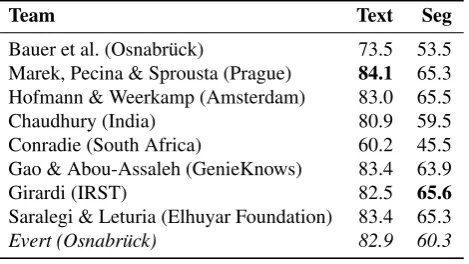
Team Text Seg
Bauer et al. (Osnabr¨uck) 73.5 53.5 Marek, Pecina & Sprousta (Prague) 84.1 65.3 Hofmann & Weerkamp (Amsterdam) 83.0 65.5
Chaudhury (India) 80.9 59.5
Conradie (South Africa) 60.2 45.5
Gao & Abou-Assaleh (GenieKnows) 83.4 63.9
Girardi (IRST) 82.5 65.6
Saralegi & Leturia (Elhuyar Foundation) 83.4 65.3 Evert (Osnabr¨uck) 82.9 60.3
Table 1: CLEANEVAL competition results (Text = text cleaning, Seg = paragraph segmentation and classification).
The page cleaning tool presented in this paper started out as a “naive” baseline experiment to find out whether character-level n-gram models would be able to distinguish between clean body text and boilerplate. In particular, no use was made of HTML tags and structure, in stark contrast to pre-vious approaches that rely heavily on tag density and other heuristic measures.3 The n-gram models worked
surpris-ingly well, achieving a significant improvement over unfil-tered text dumps. In the CLEANEVAL competition held in 2007, its text cleaning accuracy came close to those of the best systems (English track, text only, cf. Table 1). Para-graph segmentation and classification was not an objective of the experiment, and as a result the algorithm performed
2
Seehttp://cleaneval.sigwac.org.uk/ 3
Web page
(HTML) cleanedtext
HTML preprocessing
Lynx text dump
heuristic rules & text segment
identification
n-gram models (segment filter) existing
text dump
Figure 1: Architecture of theNCLEANERsystem
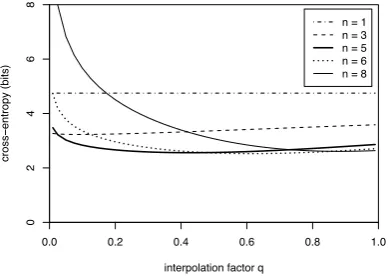
cross-validation.6 Figure 2 plots cross-entropy against the interpolation parameter qfor various values of n. These graphs suggestn= 6andq= 0.6(a fairly strong interpo-lation where unigrams still have a relative weight of0.03) as a good and robust choice, with a cross-entropy of2.53 bits. Note that higher-order models (e.g.n = 8) require extremely strong interpolation, indicating a low degree of robustness.
Evaluation of the full system revealed that lower-order models achieve slightly better accuracy despite higher cross-entropy values, perhaps because of their better gen-eralisation capabilities. The current implementation uses models withn= 3andq= 0.5, but experiments indicate that overall performance is robust across a wide range of parameter values.
0.0 0.2 0.4 0.6 0.8 1.0
0
2
4
6
8 StupidOS parameter tuning (standard model)
interpolation factor q
cross
−
entropy (bits)
n = 1 n = 3 n = 5 n = 6 n = 8
Figure 2: Parameter tuning for the n-gram language models on joint “clean” and “dirty” training data.
A drawback of the n-gram approach is that it is highly language-specific, and separate training data are required for each new language the system is applied to. In order to test whether it might be feasible to build a standard param-eter file that works well for multiple languages,non-lexical versions of the n-gram models have also been implemented, which map all letters toaand all digits to0. These models cannot learn to recognise language-specific keywords and
6
Note that a straightforward minimisation of cross-entropy on the training data without cross-validation would lead to serious overfitting. The raw text dumps were used because they comprise both the clean and the “virtual” boilerplate training corpus.
have to rely on features such as word length and the pres-ence of special characters (such as punctuation) for their classification.
4.
Internal evaluation
An internal evaluation of the NCLEANER algorithm was carried out by cross-validation on the gold standard of Bauer et al. (2007). In the CLEANEVAL competition, minimum edit distance was used as an evaluation criterion. However, there are two important drawbacks to this ap-proach: (i) the resulting scores are not very intuitive and fail to distinguish between false positives and false negatives (which may have different importance in practical applica-tions); (ii) the minimum edit distance algorithm is compu-tationally expensive, and the Perl implementation provided by the CLEANEVAL organisers was far too slow to be used for extensive experiments.
Therefore, the evaluation ofNCLEANERwas carried out in terms of word-level precision (i.e. the percentage of cor-rect words in the automatically cleaned files) and recall (i.e. the percentage of clean words in the gold standard that were preserved by the automatic procedure). As an overall measure,F-score(the harmonic mean of precision and recall) was used. Precision and recall were determined from a word-level sequence alignment of the automatically cleaned pages with the corresponding gold standard ver-sions, using a fast heuristic algorithm implemented in the Pythondifflibpackage.
Table 2 shows precision, recall and F-score for (i) Lynx text dumps as a baseline, (ii) theNCLEANERpre- and post-processing heuristicswithoutthe language models, (iii) the
fullNCLEANERsystem, and (iv) the non-lexical version of
micro-averaged macro-averaged
F-score precision recall F-score precision recall
Baseline 91.23 84.16 99.58 85.32±15.11 79.00±20.14 96.74±02.13 Heuristics only 89.39 85.12 94.11 84.06±18.03 79.16±20.61 94.11±15.02
NCLEANER 91.60 91.95 91.25 87.63±15.50 88.47±14.21 89.74±16.83
Non-lexical model 89.99 90.17 89.82 85.60±16.84 85.35±17.53 89.37±17.37
Table 2: Internal evaluation results of theNCLEANERalgorithm on the gold standard of Bauer et al. (2007), showing both micro-averaged and macro-averaged F-score, precision and recall (as percentages calculated at word level).
It is obvious from Table 2 thatNCLEANERachieves an im-provement over the baseline, and that the n-gram language models are an essential component of the algorithm: using only the heuristic rules, performance drops even below the baseline. The macro-averaged data show that the improve-ment is statistically significant (paired t-test for F-scores of
NCLEANERvs. baseline across texts:t= 1.976, df= 157,
p=.0499).
More importantly, NCLEANER trades off recall for preci-sion, achieving a good balance with both precision and re-call above 91%. Note that the increase in micro-averaged precision from 84.16% to 91.95% corresponds to a 50% reduction of the error rate. Since it is easy to collect large amounts of text from the Web, high recall is usually not im-portant for Web corpora, so the trade-off is well justified. The histogram in Figure 3 shows that precision is almost always increased over the baseline for the individual files in the gold standard, so users ofNCLEANERcan be confi-dent that automatically cleaned Web pages will only rarely be “worse” than their uncleaned counterparts. For a con-siderable number of files, precision was increased by more than 10 percent points.
Of course, the non-lexical model does not perform as well, but still achieves significantly better precision than the baseline (paired t-test for precision across texts: t = 9.0557, df= 157,p= 5.055·10−16).
5.
External evaluation
The standard parameter files included in the NCLEANER
distribution were trained on the full gold standard of Bauer et al. (2007). Further evaluation of these models was car-ried out on an external data set: the official test set of the CLEANEVAL competition, containing 674 manually cleaned files with a total of 1.6 million words of clean text. The micro-averaged results reported in Table 3 give a good indication of the accuracy thatNCLEANERwill achieve in real-world applications. It is also interesting to compare the intuitively meaningful precision and recall values shown there to the official overall score thatNCLEANERachieved on the same test set in the CLEANEVAL competition (Ta-ble 1).
Quite surprisingly, the trade-off between recall and preci-sion works even better on the external data set, where the
NCLEANERsystem achieves a micro-averaged precision of
94.70%, corresponding to a reduction in error rate by al-most 70%. Note that the baseline results are much lower than for the internal evaluation, with a recall of little more than 95%. This can mostly be traced to some issues with
F-score precision recall
Baseline 88.72 83.11 95.15
NCLEANER(HTML) 92.73 94.70 90.83
NCLEANER(text) 90.18 90.30 90.05
Non-lexical (HTML) 92.31 91.65 92.97 Non-lexical (text) 89.86 89.88 89.85
Table 3: Micro-averaged evaluation results of the standard
NCLEANER parameter files on the official CLEANEVAL
test set (percentages calculated at word level).
character encoding, formatting and “hidden” text in the Web pages. Apparently, the text dumps that served as a basis for the manual cleanup of the CLEANEVAL test set were generated by a different tool than Lynx.
When applied to existing text dumps rather than HTML files, NCLEANER achieves considerably lower accuracy (demonstrating the importance of the heuristics, which seemed only to make text quality worse in the cross-validation experiments). It is still a significant improvement over the baseline with well-balanced precision and recall of approximately 90%.
The non-lexical model performs somewhat worse than the standard model on HTML files, especially with respect to precision. On plain text dumps, there is no significant dif-ference between the two models. At least for this purpose, the non-lexical parameter file contained in theNCLEANER
distribution is probably also useful for other European lan-guages than English.
F-score precision recall
Baseline 0.00 0.00 0.00
NCLEANER(HTML) 60.85 69.30 54.24
NCLEANER(text) 34.04 28.98 41.25
Non-lexical (HTML) 55.76 52.76 59.13 Non-lexical (text) 33.21 27.43 42.07
Table 4: Micro-averaged labelled segmentation accu-racy of the standard NCLEANER parameter files (official CLEANEVAL test set, percentages of all segment mark-ers).
StupidOS (standard) vs. baseline
difference in precision
−100 −50 0 50 100
0.00
0.02
0.04
0.06
0.08
0.10
0 0 0 3
4 5
21 45
30
28
20
2
Figure 3: Distribution of precision differences betweenNCLEANERand the baseline for individual files in the gold standard of Bauer et al. (2007).
NCLEANERdoes not achieve satisfactory accuracy in this
task yet, the main focus of future development will remain on text cleaning. Without information from the HTML markup (i.e. on plain text file), labelling performance is ran-dom (almost all segments are identified as standard para-graphs).
0 50000 100000 150000 200000 250000 300000 350000
88
90
92
94
96
NCleaner learning curve
Training size (tokens)
Accuracy
F−score precision recall
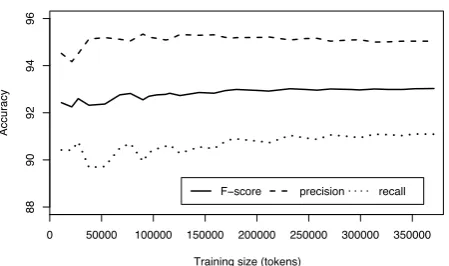
Figure 4: Learning curve ofNCLEANER, using incremental subsets of the gold standard (Bauer et al., 2007) for training and the CLEANEVAL test set for evaluation (all values are micro-averaged).
A crucial issue for any supervised learning approach is the amount of training needed to train a high-quality model. Figure 4 shows thelearning curveofNCLEANERtrained on incremental subsets of the gold standard. The F-score curve quickly levels off, and precision even degrades slightly due to overtraining effects. While there is some random varia-tion for very small training sets, 50,000 to 100,000 words of training data appear to be completely sufficient, cor-responding to less than 50 manually cleaned Web pages. Even with a very small training set consisting of 10 or fewer randomly selected Web pages, precision is consis-tently above 94% and recall around 90%. This suggests
that NCLEANER can be adapted to other languages or
tasks (such as cleaning newsgroup postings) with minimal amounts of manually annotated data.
6.
Availability and practical issues
One advantage of the naive n-gram modelling approach taken by NCLEANERis its low computational complexity. The size of the standard parameter file is only 2.3 MB in a redundant, human-readable format; in compressed form, it shrinks to 600 KB. Even the research prototype imple-mented in fully portable Perl code processes approximately 20 million words per hour on a standard server-class ma-chine and occupies less than 20 MB of working memory while running. The mixed Perl/C implementation processes more than 120 million words per hour, making it suitable even for large Web corpora in the gigaword range.The NCLEANER software is available as an open-source
Perl package (Text-NCleaner), which can be down-loaded from http://webascorpus.sf.net/. The Python script used for evaluation (cleaneval.py) is available from the same Web page.
7.
References
Michele Banko and Eric Brill. 2001. Scaling to very very large corpora for natural language disambiguation. In Proceedings of the 39th Annual Meeting of the As-sociation for Computational Linguistics, pages 26–33, Toulouse, France.
Marco Baroni and Silvia Bernardini, editors. 2006. Wacky! Working papers on the Web as Corpus. GEDIT, Bologna. Online version: http://wackybook. sslmit.unibo.it/.
Daniel Bauer, Judith Degen, Xiaoye Deng, Priska Herger, Jan Gasthaus, Eugenie Giesbrecht, Lina Jansen, Christin Kalina, Thorben Kr¨uger, Robert M¨artin, Martin Schmidt, Simon Scholler, Johannes Steger, Egon Stemle, and Ste-fan Evert. 2007. FIASCO: Filtering the Internet by auto-matic subtree classification, Osnabr¨uck. Inthis volume. Adam Kilgarriff and Gregory Grefenstette. 2003.
Intro-duction to the special issue on the Web as corpus. Com-putational Linguistics, 29(3):333–347.