Figure 1: MultiNet annotation of the sentence “Stephen Akerfeldt, currently vice president finance, will succeed Mr. McAlpine.” Nodes C4 and C8 are re-used from previous sentences.
direction of the directed arc). These are the inter-sentential coreference links necessary to transform the set of localized semantic interactions into a complete semantic network that describes the relationships of concepts presented in a dis-course.
A detailed annotation manual can be found at:
https://wiki.ufal.ms.mff.cuni.cz/projects:content- annotation
Manual annotations are performed using a graphical user interface, allowing the labeler to create nodes and arc and add labels to the nodes and arcs. Recall that our goal is to incorporate these annotations into the Prague Dependency Treebank. In order to facilitate this, the Tectogrammati-cal Representation (deep-syntax) trees of the PCEDT (PDT annotation of the Penn WSJ Treebank) are used to induce a default network. The nodes of the Tectogrammatical trees are directly mapped to MultiNet concepts, which may be further modified by the annotator. This imposes a loose constraint on the networks that are produced by the an-notators: the networks will inherit structure from the Tec-togrammatical trees.
In the following sections, we will examine the positive im-pact these annotation constraints have on the evaluation of networks annotated by multiple people.
3.
Annotation: Data, Methodology, and
Evaluation
The evaluation presented in this paper has been carried out on a subset of The Wall Street Journal articles from the Penn Treebank (Marcus et al., 1993), which have been an-notated at multiple levels of analysis according to the PDT guidelines. The source data was publicly released as the Prague Czech-English Dependency Treebank (Cuˇr´ın et al., 2004), a corpus of parallel English and Czech annotations of the Penn Treebank. In this work, we have only explored the MultiNet annotation on the English component of this corpus.
The different levels of annotation are derived from the Functional Generative Description (FGD) of lguage (Sgall et al., 1986) which is the basis of the PDT an-notation effort. This includes detailed morphological anal-ysis, surface syntactic analanal-ysis, and deep-syntactic analy-sis; the latter is called the Tectogrammatical Representa-tion (TR) as it was referred to in the original FGD work. Tectogrammatical trees are stripped of function words (syn-semantic lexical items), leaving only the content bearing words as first-class nodes in the trees. Information derived from the function words is encoded in the labels and nodes of the TR dependency trees.
As mentioned above, the MultiNet annotation procedure begins with a TR tree, from which the annotator is given a default network that maintains links to the TR tree. The annotator then creates new nodes and arcs as necessary, and labels the nodes and arcs. Any concept, represented as a MultiNet node, which has previously been used in the dis-course is available to the annotators via the annotation tool interface. When an annotator believe a concept in the cur-rent sentence has been previously mentioned, they can add this node to the current network (the node maintains it’s identifier from the previous context). The annotator then creates anEQUlink between the node for the previously used concept and the newly observed concept.
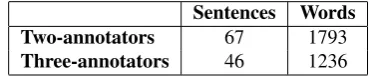
Sentences Words Two-annotators 67 1793
Three-annotators 46 1236
Table 1: Annotated corpus. A subset of sentence from En-glish side of the PCEDT (a PDT-style annotation of the WSJ treebank).
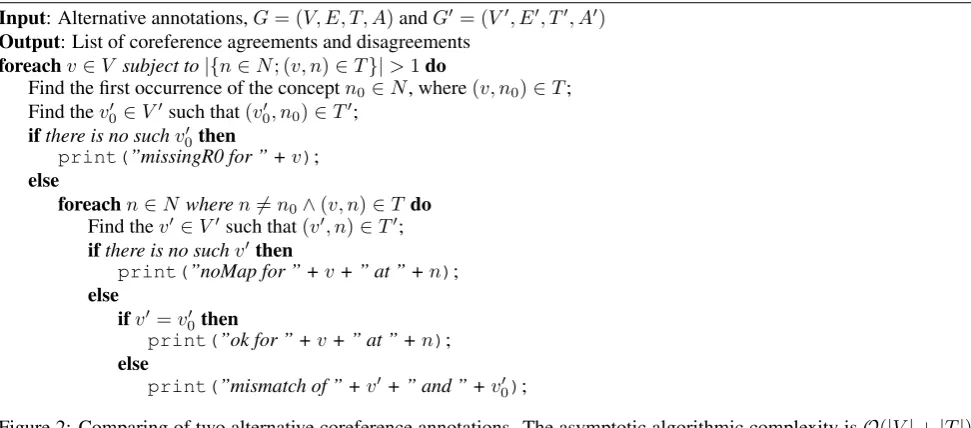
Input: Alternative annotations,G= (V, E, T, A)andG0= (V0, E0, T0, A0)
Output: List of coreference agreements and disagreements
foreachv∈V subject to|{n∈N; (v, n)∈T}|>1do
Find the first occurrence of the conceptn0∈N, where(v, n0)∈T;
Find thev00 ∈V0such that(v00, n0)∈T0; ifthere is no suchv0
0then
print(”missingR0 for ” +v);
else
foreachn∈Nwheren6=n0∧(v, n)∈T do
Find thev0 ∈V0such that(v0, n)∈T0;
ifthere is no suchv0then
print(”noMap for ” +v+ ” at ” +n);
else
ifv0=v00then
print(”ok for ” +v+ ” at ” +n);
else
print(”mismatch of ” +v0+ ” and ” +v00);
Figure 2: Comparing of two alternative coreference annotations. The asymptotic algorithmic complexity isO(|V|+|T|)
because every inner loop iterates over different sets ofn.
Annotator Sentences Unique concepts (non-singleton) Non-singletons per sent (std. dev.)
SM 46 1248 (120) 2.6 (1.86)
CW 67 1713 (248) 3.7 (2.05)
CB 67 1800 (174) 2.6 (1.24)
Table 2: Annotation statistics for coreference evaluation. Non-singleton concepts are those with at least one coreference link.
4.
Empirical Evaluation
We have run the coreference agreement evaluation on our annotated data, for which the relevant statistics are pre-sented in Table 2. we report the raw results of the evalu-ation in Table 3. We have chosen not to report any further statistical evaluation due to 1) the limited amount of data available for analysis, and 2) the subtle dependency on the mapping procedure used as a basis for the analysis. The results in are divided into four categories of corefer-ences:
mismatchOne annotator uses a different canonical con-cept as the coreference target.
missingR0The first mention of the concept in one anno-tator’s graphs does not have a counterpart in the best matching network of the other annotator.
noMapThe concept which is coreferring to a previous sentence in one annotators graph has no mapping to in the other annotators graph.
okThe coreferring concept used in the sentence by one an-notator is mapped to a concept in the other anan-notator’s graph and the canonical concepts from both annotators are mapped.
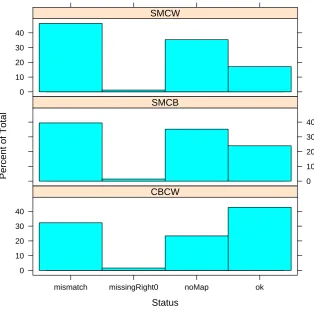
In Figure 3, we present a depiction of the agreement results that shows there is quite a bit of variance under the metric forokagreements. Note that annotator SM appears to have less agreement in general.
5.
Error Analysis
We have manually reviewed the disagreements as found us-ing the above described metric. We have found that there are one of two explanations for many of the errors. One reason for disagreement appears to be an inadequate de-scription of the coreference task in the annotation guide-lines. The other error is related to the automatic mapping technique used in our evaluation.
The annotation guidelines do not indicate which previous concept to use when annotating coref-erence. An example of this was found for net-work annotations for sentences following this sen-tence from section F20 of the Penn WSJ Treebank:
The U.S. trade representative, Carla Hills, . . .
In the subsequent text, Carla Hillsis used to identify the person. One annotator chose to use Carla Hills as the coreferent concept, but another chose to use The U.S. trade representative. The equality of a entities found in appositions of this sort can be resolved either by refining the annotation guideline or automatically preprocessing the data to identify appositive phrases.
Status mismatch missingR0 noMap ok Article Pair
F20 CB-CW 17 1 5 14
SM-CB 15 0 24 11
SM-CW 23 1 22 4
F21 CB-CW 3 0 6 8
SM-CB 6 0 1 3
SM-CW 5 0 2 3
F22 CB-CW 9 1 7 8
SM-CB 7 1 0 3
SM-CW 10 0 5 7
F26 CB-CW 6 0 5 7
F27 CB-CW 5 0 6 16
Table 3: Experimental results of pairwise coreference annotation agreement evaluation. The labels CB, CW, and SM, identify the individual annotators.
Status
Percent of Total
0 10 20 30 40
mismatch missingRight0 noMap ok
CBCW
0 10 20 30 40
SMCB
0 10 20 30 40
SMCW
Figure 3: The agreement for all pairs of annotators, CBCW, SMCB, and SMCW. The data shows high variance w.r.t. the distribution ofokcases.
6.
Conclusion and Future Work
We have presented a technique to evaluate coreference links in a semantic network annoation framework as well as the evaluation results on a small set of data annotated by three independent labalers. Evaluation under the current tech-nique is inconclusive due to the complex nature of the anno-tation scheme and the integrated labeling of both structure an coreference structures.
We intend to use the proposed technique for subsequent coreference tasks in the role of consistency checking. We note that our technique is effective in determining that both the structural and coreference annotations agree.
Acknowledgment
This work was partially supported by Czech Academy of Science grants 1ET201120505 and 1ET101120503; by Czech Ministry of Education, Youth and Sports projects LC536 and MSM0021620838; and by the US National Sci-ence Foundation under grant OISE–0530118. The views expressed are not necessarily endorsed by the sponsors.
7.
References
Jan Cuˇr´ın, Martin ˇCmejrek, Jiˇr´ı Havelka, and Vladislav Kuboˇn. 2004. Building parallel bilingual syntactically annotated corpus. InProceedings of The First Interna-tional Joint Conference on Natural Language Process-ing, pages 141–146, Hainan Island, China.
Jan Hajiˇc, Jarmila Panevov´a, Eva Hajiˇcov´a, Petr Sgall, Petr Pajas, Jan ˇStˇep´anek, Jiˇr´ı Havelka, and Marie Mikulov´a. 2006. Prague Dependency Treebank 2.0. CD-ROM, Linguistic Data Consortium, LDC Catalog No.: LDC2006T01, Philadelphia, Pennsylvania. Hermann Helbig. 2006. Knowledge Representation and
the Semantics of Natural Language. Springer, Berlin, Germany.
Mitchell P. Marcus, Mary Ann Marcinkiewicz, and Beat-rice Santorini. 1993. Building a large annotated corpus of English: the Penn treebank. Computational Linguis-tics, 19(2):313–330.
V´aclav Nov´ak. 2007. Cedit – semantic networks manual annotation tool. In Proceedings of Human Language Technologies: The Annual Conference of the North American Chapter of the Association for Computational Linguistics (NAACL-HLT), pages 11–12, Rochester, New York, April. Association for Computational Lin-guistics.