Post-MT Term Swapper: Supplementing a Statistical Machine Translation
System with a User Dictionary
Masaki Itagaki, Takako Aikawa
MicrosoftOne Microsoft Way, Redmond, WA 98052, U.S.A. ([email protected], [email protected])
Abstract
A statistical machine translation (SMT) system requires homogeneous training data in order to get domain-sensitive (or context-sensitive) terminology translations. If the data consists of various domains, it is difficult for an SMT system to learn context-sensitive terminology mappings probabilistically. Yet, terminology translation accuracy is an important issue for MT users. This paper explores an approach to tackle this terminology translation problem for an SMT system. We propose a way to identify terminology translations from MT output and automatically swap them with user-defined translations. Our approach is simple and can be applied to any type of MT system. We call our prototype “Term Swapper.” Term Swapper allows MT users to draw on their own dictionaries without affecting any parts of the MT output except for the terminology translation(s) in question. Using an SMT system developed at Microsoft Research, called MSR-MT (Quirk, et al., (2005); Menezes & Quirk (2005)), we conducted initial experiments to investigate the coverage rate of Term Swapper and its impact on the overall quality of MT output. The results from our experiments show high coverage and positive impact on the overall MT quality.
1.
Introduction
Terminology translations need to be context-sensitive. For instance, the Japanese translation corresponding to the term “memory resources” in (1a) is appropriate in the IT domain, whereas the one in (1b) would be appropriate in the general domain but would be awkward in the IT domain.
(1) There is a shortage of memory resources.
a. メモリ リソースが不足しています。
“(computer) memory resources” =>OK in the IT domain
b. 記憶資源が不足してます。
“(brain) memory resource” => OK in the general domain
Selecting context-sensitive terminology translations would be challenging for an SMT system, especially when its training data is not homogeneous in terms of domain. Even when the system has homogeneous training data, this is difficult. For instance, at Microsoft, we have been localizing technical documents over the last couple of years, using an SMT system called MSR-MT (Quirk, et al, 2005). The MSR-MT training data comes solely from the IT domain, yet we find terminology translations challenging as many product groups use different terminology translations for the same English terms (Itagaki, et al, 2007).
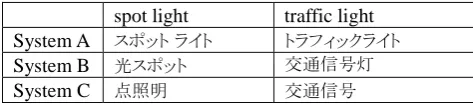
Such domain differences in training data for SMT systems may have led to different term translations by different systems. For instance, using several Web-based translation systems, we translated the simple terms, “spot light” and “traffic light,” into Japanese. As shown in Table 1, all the systems return different translations, which are all correct in isolation.
spot light traffic light
System A スポット ライト トラフィックライト
System B 光スポット 交通信号灯
System C 点照明 交通信号
Table 1: Various terminology translations in Japanese across different systems
As we extend the use of MT across different domains or across different systems, we need a way to make terminology translations context-sensitive. One solution is to allow users to apply their own dictionary to an MT system, so that they can use specific terminology translations. Term Swapper provides a way to achieve this.
2.
Overview of Term Swapper
2.1 Terminology Translation Variations based
on Contexts
One of the difficulties in applying a user-defined dictionary to an SMT system is to identify the locations of specific terminology translations in its output. For instance, using MSR-MT, we tested sentences that contain the term “Family Safety” (a security feature name in Windows Vista). Table 2 lists the Japanese translations from MSR-MT.
Source Target
Family Safety exists. 家族の安全が存在します。
‘The safety of family exists.’
This is Family Safety. これはファミリ安全です。
‘This is Family Safely.’
Click on the Family Safety button.
ファミリ Safety をクリックします。 ‘Click Family Safety.’
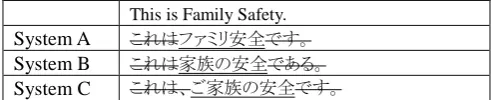
The parts struck out are irrelevant to the term translation in question. Let us walk though how Term Swapper can predict such parts, using example (4) above. Example (4) uses Template C in Table 3 (i.e., “This is X.” ). Given this template, we can assume that potential translation strings from any MT system would be one of the following provided in (5).
(5) これ{は/が/は、/が、}TERM{です/だ/である}。
The variants of the case marker in (5) (i.e., {は/が/は、/
が、}) or those of the predicate „be” (i.e., です/だ/であ
る) are necessary as these parts (as well as terminology translations themselves) vary, depending on a given MT system or even depending on a given term. Table 4 and Table 5 illustrate this point.
This is Family Safety.
System A これはファミリ安全です。
System B これは家族の安全である。
System C これは、ご家族の安全です。
Table4: Translation variations across different systems
This is TERM. The output from MSR-MT
This is Microsoft. これは Microsoft です。
This is NULL. これがNULL です。
This is a Manager Error ID.”
これは、マネージャ エラー IDです。
Table5: Translation variations depending on Terminology
Table 4 lists the translations of the sentence, “This is Family Safety”, from three different systems. Table 5, on the other hand, lists the translations of the same template with three different terms from MSR-MT. The underlined parts are the terminology translations in question and the parts struck out are those that Term Swapper needs to strip off. As shown, the translations of function words or predicate parts vary, depending on a given term (see Table 5) as well as on a given system (see Table 4). In order to achieve the goal of stripping off the parts irrelevant to terminology translations, it is critical for our templates to be as simple as possible.
As explained earlier, we used the training set of 454 sentences to identify simple template codes that could achieve this goal for three language pairs; namely, English -> Japanese, Chinese (Simplified), and Korean. The same templates were used across the three target languages, but different ways of stripping off case markers, predicates, etc. were implemented by each language.
4.
Coverage Experiment
4.1. Design and Results
We conducted an investigation to determine the coverage rate of Term Swapper, using MSR-MT. To this end, we first created a dummy user dictionary that consists of 634 English lexical items (all were nouns), each of which was
translated as “[DUMMY]” to easily identify it as swapped text. We then took 500 sentences from a game product (“Age of Empires”) as the test data. Since the game content is not in our training data, a large part of the terms are unknown to the SMT system. Each of the test sentences contains at least one of the lexical items in our user dictionary. Using MSR-MT, we translated these 500 sentences into the three languages (i.e., Japanese, Chinese, and Korean) with Term Swapper and counted how many sentences contained [DUMMY] string(s) in their MT outputs. Table 6 provides the percentage of the occurrence of the sentences with [DUMMY] for the three languages.
EJ EC EK
90.6% 92% 86%
Table 6: The current coverage rates of EJ, EC, and EK systems.
4.2. Error Analysis
As shown in the previous section, there are terms that were not swapped successfully. To find out why Term Swapper failed to swap the terminology translations in question, we looked at some examples, using MSR-MT. Here, we would like to provide a brief analysis of such cases.
The English terms used for the above experiment are all nouns but some of them involve compound nouns. When such compound nouns are translated non-adjacently in the original raw MT output, Term Swapper is destined to fail. Examine (6), for instance.
(6)
a. [Input] Choose what shader model to use.
b. [Dictionary] shader model : シェーダのモデル
c. [MT Output] どのシェーダを使用してモデルを 選
択します。
The term in the user dictionary is “shader model”. While the raw MT output in (6c) is awkward, the point we want to make is the fact that the translation of „shader‟ (i.e., シ ェーダ) and that of „model‟ (i.e., モデル) do not occur in adjacent positions. In such cases, there is no way for Term Swapper to identify the location of the entire terminology translation of a compound noun such as “shader model.” Note that this is not a problem intrinsic to Term Swapper. Rather it is a problem intrinsic to the analysis of the MT system. If the translations of the two terms occur adjacently as in (7c), Term Swapper can successfully fix the terminology translation as in (7d).
(7)
a. [Input] Choose a shader model.
b. [Dictionary] shader model : シェーダのモデル
c. [MT Output] シェーダ モデルを選択します。
BLEU: A Method for Automatic Evaluation of Machine Translation. In Proceedings of the 40th Annual Meeting of ACL, Philadelphia, PA, pp. 311- 318. Quirk, C, Menezes, A. and Cherry, C. (2005). Dependency treelet translation: Syntactically informed phrasal SMT. In Proceedings of the 43rd ACL, Ann Arbor, Michigan, pp. 271–279.
Appendix I: Templates in Term Swapper
Templates Patterns [X = a term]
Descriptions
AS IS X A term itself
SUBJ+V X exists. A term as the subject of an intransitive verb.
SUBJ+BE X is a word. A term as the subject of a copula.
SUBJ+A_UNK_1 A X damns it. A term as the subject of an unknown verb (with indefinite article)
SUBJ+A_UNK_2 An X damns it. A term as the subject of an unknown verb (with indefinite article)
SUBJ+A_UNK_3 Thg X damns it. A term as the subject of an unknown verb (with definite article)
OBJ_THIS_IS_1 This is X. A term as the predicate of a copula (with a period) OBJ_THIS_IS_2 This is X A term as the predicate of a
copula (without a period)
OBJ_V Select X. A term as an object of a transitive verb.
OBJ_HAVEITS I have its X. A term as an object with a possessive pronoun.
PREP_WITH with X A term following a common preposition, “with” PREP_ONEOF one of X A term following a
preposition, “of”
PREP_RARE onto X A term following a infrequent preposition, “onto”.
PARENTHESIS (X) A term in parenthesises.
ENGLISH A source term A term as in the source text.
Appendix II: Example of Swapped Terms
English A natural formation of rock and ice.
Raw MT 岩と氷の自然なフォーメーションをします。
User Dict. formation =構造物
Fixed MT 岩と氷の自然な構造物をします。
Human Translation
岩や氷でできた自然の構造物です。
English Provides Experience Points and other benefits.
Raw MT エクスペリエンスポイントとその他の利点を提供
します。
User Dict. Experience=経験値, benefits=利益
Fixed MT 経験値ポイントとその他の利益を提供します。
Human Translation
経験値ポイントやその他の利益をもたらします。
English Maurice of Orange, also known as Maurice of Nassau, was born in 1567. Raw MT Maurice の Orange、別名 Maurice の Nassau、1567 で
誕生しました。
User Dict. Maurice = マウリッツ, Orange=オラニエ、
Nassau=ナッサウ
Fixed MT マウリッツのオラニエ、別名マウリッツのナッ
サウ、1567 で誕生しました。
Human Translation
ナッサウ伯マウリッツ (オラニエ公マウリッツ)