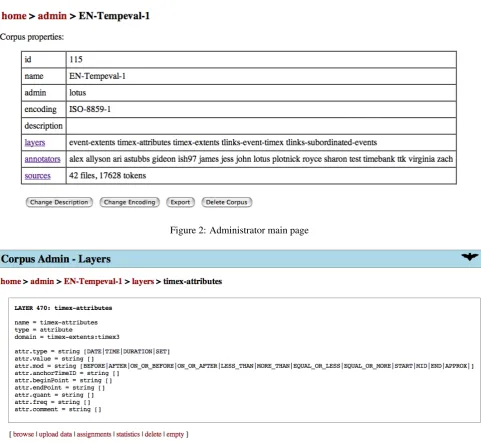
Figure 2: Administrator main page
Figure 3: Layer administration in BAT
<edge id="t2" ref="e2"> <fs type="token">
<f name="lemma" sVal="clock"/> <f name="pos" sVal="NN"/> </fs>
</edge>
GrAF is an XML serialization that instantiates the abstract graph of LAF. It functions as the pivot format to and from which annotations compliant with LAF can be mapped to. It is simple to combine several annotations into one GrAF, as long as stand-off annotation was used for all annotations.
3.
BAT Functionality
Like any self respecting annotation tool, BAT tries to make annotation as intuitive as possible while providing a rich enough set of features. Unlike many tools available, BAT
attempts to do some of the heavy lifting that generally falls into the hands of the corpus administrator.
3.1. Administration
The BAT Administrator pages provide functionality for cre-ating corpora, importing source data, crecre-ating annotator lo-gins, assigning tasks to annotators, defining layers, upload-ing layer data, viewupload-ing inter-annotator agreement statistics, and viewing general progress of annotators. The sources link in Figure 2 allows the administrator to upload the base segmentation as a tab-separated file with filename, token offset and token string columns. One current difference between LAF and BAT is that BAT only allows one base segmentation per corpus.
Figure 4: Extent annotation in BAT
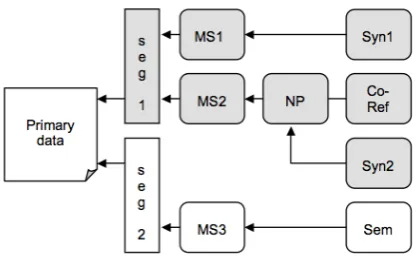
like layer name, layer type and layer domain. The domain of a layer is the set of layers that it annotates over (that is, the arrows in Figure 1). In the case shown in Figure 3, the domain is all nodes labeledtimex3in the timex-extents layer. The default domain is the base segmentation. BAT includes the layer typesextentandattribute, reflecting the LAF difference between nodes and associated features structures. For attribute layers, like the one shown in Fig-ure 3, attribute names and their possible values will need to be defined as well. BAT uses a third layer type named relationeven though under LAF there is no theoretical dif-ference between annotating extents and relations, they are both concerned with adding nodes. BAT departs from LAF conventions here so it can align more with annotation prac-tice, where there is a clear difference between marking ex-tents, even if on top of other exex-tents, and marking relations between extents.
Note that the strict LAF/BAT distinction between nodes (extents or relations) and associated feature structures (at-tributes) may annoyingly split what one considers to be one task into two task, for example when the task involves se-lecting named entities with their types. Therefore, BAT will in the future introduce mixed tasks where both extents and attributes are annotated in one fell swoop.
There are advantages however to separating extent and attribute annotation. One is that in some cases the ex-tents may be created by external tools. For example, for Tempeval2, one of the tasks is to annotate the temporal re-lation between events in subordination rere-lations, as in”The spokesperson said his country was provoked by the enemy.”. In this case, the syntactic relation between the eventssaid andprovokedcould be created by a parser or taken from another annotation like the Penn Treebank. Node pairs like
these can be uploaded as an extent layer and the annotator can then concentrate on defining the attributes to the rela-tion (that is, whether one event is before, during or after the other).3
3.2. Annotation
When annotators log in, they see all the layers in which files have been assigned to them as annotation tasks. Clicking a layer name takes the annotator to a list of files in the layer that were assigned to her. The list also indicates the sta-tus of all these files. Files are either assigned, submitted or frozen. In the second case, an assigned file has been previ-ously annotated and submitted by the annotator; in the third case, a submitted file was frozen and can therefore not be edited anymore (although the annotator can go in and see the annotation).
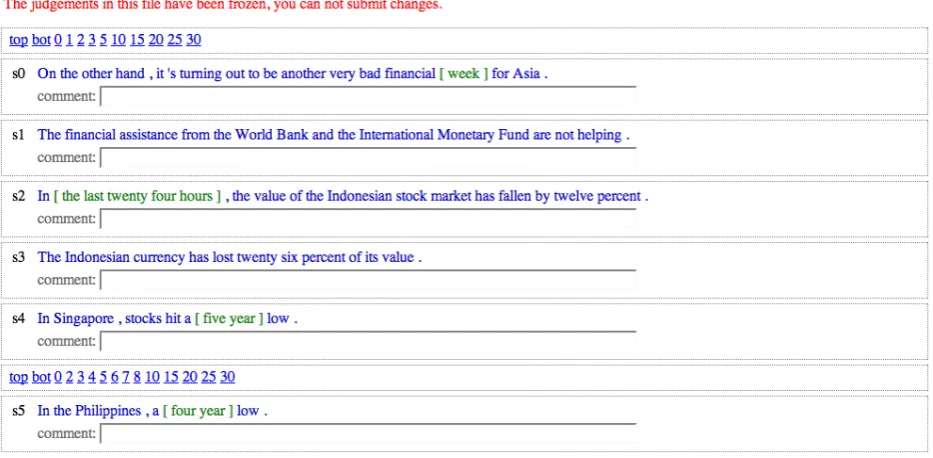
Clicking on a file name in the list of assigned files will lead the annotator to a screen as in Figure 4. Extents are defined by clicking the first and last tokens of the extents.4 Annota-tors can add and delete extents and change the boundaries of extents.
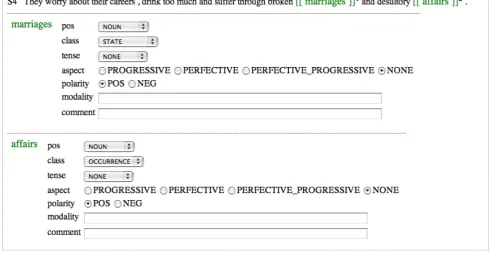
Figure 5 shows a screenshot of event attribute annotation with an example taken from current annotation of events performed at Brandeis University. For any kind of attribute annotation, the extents are highlighted in the sentence and the attributes defined in the layer definition are displayed below the sentence. The tool uses the layer definition to
3
This, by the way, is what motivated the very first version of BAT since it made it feasible to quickly annotate large numbers of temporal links for Tempeval.
4
Figure 5: Attribute annotation in BAT
create the interface. In particular, the list of values listed for each attribute (see Figure 3) determines whether the user is presented with a radio button, pulldown list or a general text input field. Currently, radio buttons are used if there are four or less possible values and pulldown lists if there are more. Text inputs are used if the value of the attribute is not constrained. Finally, defaults spelled out in the layer definition will be preselected.
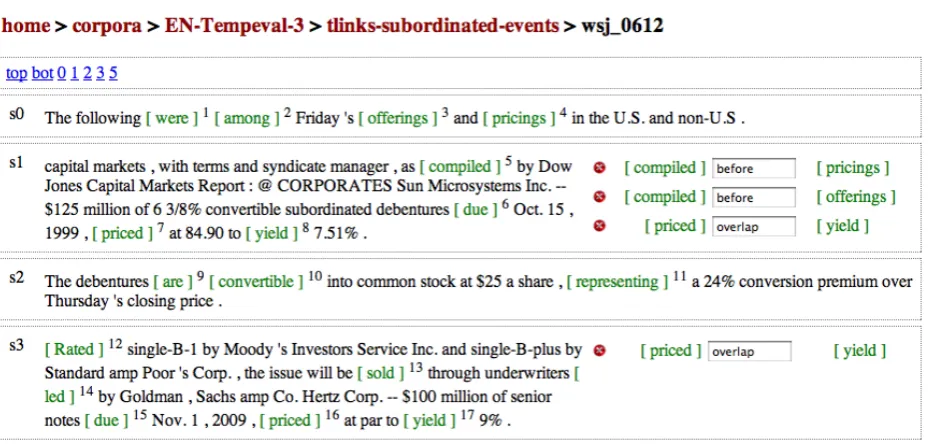
An example of relation annotation is shown in Figure 6. Relation layers are defined on top of one or two extent layers. In the current example, the relation layer tlinks-subordinated-events is defined on top of the event extents layer. The layer definition fortlinks-subordinated-eventsis printed below:
name = tlinks-subordinated-events type = relation
domain = event-extents:event label = tlink
attr.relationType = string []
In addition, the layer definition specifies the label of rela-tion and what attributes are defined for this label. In the case above, the label istlinkwhich has one attribute named relTypewhose possible value is not constrained.
As with attribute layers, the interface will take the layer definition and act accordingly. Initially, all it will show is the document with all events highlighted. The annotator can click an event, after which it will turn red, then click another event. After the second click a little widget will materialize towards the right of the event that occurs first in the text. Now the annotator can fill in a value that de-scribes the relation between the two events. Relations can be removed by clicking the little red button on the left of the relation.
Relation functionality is not complete yet since currently only one attribute can be defined for each label. For ex-ample, for thetlinks-subordinated-eventslayer the only at-tribute defined is the relation type of the temporal link (the name of the attribute is not shown because confusion is not possible). The more general approach though would be to allow a set of attributes and thereby stay in lock step with attribute annotation and the LAF philosophy.
3.3. Adjudication phase
The administrator can assign as many annotators to each file as she desires, typically using one to three annotators. For each file in an annotation layer, the administrator can also assign one judge. Judges will see an interface very similar to the annotators, but with some major differences:
• the judge will see all annotations of the annotators but cannot change them
• attributes submitted by the annotators will be pre-sented in a more compact form
• cases where annotators disagree are highlighted in red so the judge can easily focus on them
• a judge cannot submit results until all annotators have frozen their judgements
When the annotators agree, their judgments will be copied as defaults to the judge’s extents or attributes. Ideally, if the annotators agree on everything, all the judge needs to do is to glance over the results and hit the submit button.
3.4. Technical details and current status
Figure 6: Relation annotation in BAT
or higher and MySQL 4 or higher. The tool has been in-stalled on various Linux servers and on Mac OSX 10.4. User requirements are limited, but an internet connection is required. Most browsers are known to work without prob-lems, with the notable exception of many version of Inter-net Explorer.5
The tool has been used for temporal annotation in five languages for the Tempeval2 task scheduled for Semeval-2010 (VGS+09). For temporal annotation, BAT has now fully supplanted the old Alembic and Tango tools that were used while creating Timebank (DFG+03; VKMP06; DAH+97). The current version of BAT is available at
http://timeml.org/site/bat/. Anyone can get
an administrator account simply by following the instruc-tions in the manual.
4.
Conclusion and Future Work
BAT is a generic annotation tool that can be used with lit-tle overhead for the annotator and that gives ample control to the corpus administrator. Annotation tasks can be de-fined to fit the needs of the annotation and collecting results from annotators is a simple matter of clicking a button in the administrator interface. Likewise, progress can be eas-ily monitored and inter-annotator agreement statistics are readily available.
It should be noted that there are things that are hard, if not impossible, to annotate with BAT. For example, BAT is not set up to be a tool for creating syntactic structure. It is pos-sible, but in a very laborious and roundabout way. This is due to the interface, which focusses on the text, extents se-lected in the text, and attributes associated with the extents. It does not do well when extents overlap or are embedded in each other, as with syntactic structure.
5Although this wasn’t checked thoroughly for the latest
Inter-net Explorer versions.
Another limitation is that any annotation starts with a base-segmentation and that this base-segmentation determines what can be selected in the tool. It is not possible to simply swipe a couple of characters and than create a label. This is prob-lematic for morphology rich languages, where the base-segmentation now has to stipulate that some morphemes are actually tokens.
There is a large list of requested features and wanted im-provements, as well as an even larger list of minor bugs and annoyances. Here are some of the most useful and interest-ing ones:
• introduce a distinction between morphemes and to-kens, allowing annotators to select segments of words
• introduce a new layer type that combines extent anno-tation and attribute annoanno-tation
• allow unlimited attributes for relations
• supply convenience scripts to deal with corpus import and export
• create a task repository with some standard tasks
• optimize code that calculates statistics (this is now one of the major bottlenecks that make it hard to have cor-pora lager than 50,000 tokens)
• add timestamps to judgements so we have a temporal trail of annotations
• allow users more control over the interface
Finally, one potential problem to many administrators could be that all the data and annotations live on a server main-tained by strangers. There is really no reason why BAT should not be installed elsewhere and the source code will be made publicly available under a reasonable license (Cre-ative Commons or GPL) once its level of maturity has been pushed up a bit.
5.
Acknowledgments
The first version of BAT was developed under the ARDA AQUAINT grant NBCHC040027, ”The TARSQI Toolkit: Temporal Awareness and Event-based Chronicles”, and the NSF-CRI grant 0551615, ”Towards a Comprehensive Lin-guistic Annotation of Language”. BAT functionality is now further developed in the context of the NSF-INT-0753069 project ”Sustainable Interoperability for Language Tech-nology (SILT)”, funded by the National Science Founda-tion.
Many people were involved in creating BAT. Thanks to Alex Plotnick for much of the Javascript coding and to Royce Stubbs for implementing the inter-annotator agree-ment statistics. And many thanks to all the people who pro-vided input in the design phase and who actually used BAT in its early stages and who kept harassing me to improve the sub-optimal features known as bugs. Listed in alpha-betical order: Valentina Bartalesi, Tommaso Caselli, Lotus Goldberg, Allyson Ettinger, Nancy Ide, Seohyun Im, Jes-sica Moszkowicz, Alex Plotnick, James Pustejovsky, Roser Saur´ı, Rachele Sprugnoli, Nianwen Xue, and Yuping Zhou. Of course, all bone-headed design decisions remain firmly my responsibility.
6.
References
David Day, John Aberdeen, Lynette Hirschman, Robyn Kozierok, Patricia Robinson, and Marc Vilain. Mixed-Initiative Development of Language Processing Systems. InFifth Conference on Applied Natural Language Pro-cessing Systems, pages 88–95, Washington D.C., U.S.A., 1997.
David Day, Lisa Ferro, Robert Gaizauskas, Patrick Hanks, Marcia Lazo, James Pustejovsky, Roser Saur´ı, Andrew See, Andrea Setzer, and Beth Sundheim. The TimeBank Corpus.Corpus Linguistics, March 2003.
Nancy Ide and Laurent Romary. Representing Linguistic Corpora and Their Annotations. In Proceedings of the Fifth Language Resources and Evaluation Conference (LREC), Genoa, Italy, 2006.
Nancy Ide and Keith Suderman. GrAF: A graph-based for-mat for linguistic annotations. InProceedings of the Lin-guistic Annotation Workshop, pages 1–8, Prague, Czech Republic, June 2007. Association for Computational Linguistics.
Marc Verhagen, Robert Gaizauskas, Frank Schilder, Mark Hepple, Graham Katz, and James Pustejovsky. SemEval-2007 Task 15: TempEval Temporal Relation Identification. In Proceedings of the Fourth Interna-tional Workshop on Semantic Evaluations (SemEval-2007), pages 75–80, Prague, Czech Republic, June 2007. Association for Computational Linguistics.
Marc Verhagen, Robert Gaizauskas, Frank Schilder, Mark Hepple, Jessica Moszkowicz, and James Pustejovsky. The TempEval challenge: identifying temporal relations in text. Language Resources and Evaluation, 43(2), 2009.