An exchange format for multimodal annotations
Thomas Schmidt
1, Susan Duncan
2, Oliver Ehmer
3, Jeffrey Hoyt
4, Michael Kipp
5, Dan Loehr
6,
Magnus Magnusson
7, Travis Rose
8, Han Sloetjes
91
University of Hamburg, 2University of Chicago, 3University of Freiburg, 4,6MITRE Corporation,
5
DFKI Saarbrücken, 7Human Behavior Laboratory, Reykjavik,
8
Virginia Tech, 9MPI for Psycholinguistics, Nijmegen
Corresponding authors: [email protected], [email protected]
Abstract
This paper presents the results of a joint effort of a group of multimodality researchers and tool developers to improve the interop-erability between several tools used for the annotation of multimodality. We propose a multimodal annotation exchange format, based on the annotation graph formalism, which is supported by import and export routines in the respective tools.
1.
Introduction
This paper presents the results of a joint effort of a group of multimodality researchers and tool developers (see [16], [17]) to improve the interoperability between several tools used for the annotation of multimodality. We pro-pose a multimodal annotation exchange format, based on the annotation graph formalism, which is supported by import and export routines in the respective tools. The paper is structured as follows: section 2 gives an overview of the multimodal annotation tools involved. Section 3 discusses the main commonalities and differ-ences in these tools’ data models and formats. Section 4 describes the main characteristics of the exchange format. Section 5 is concerned with the implementation of con-version routines from the tools’ formats to the exchange format and vice versa. Section 6, finally, discusses some possible future improvements or extensions of the ex-change format. The appendix contains an exemplary, commentated annotation file in the multimodal annotation exchange format.
2.
Tools
The following tools were considered in this effort:
ANVIL, a video annotation tool, developed by
Mi-chael Kipp at the DFKI in Saarbrücken (see [1], [11] and [12]).
C-BAS, a tool for coding events on video or audio
tracks, developed by Kevin Moffit at the University of Arizona(see [7]).
ELAN, a tool for multi-level annotation of video and
audio, developed by the Max-Planck-Institute for Psycholinguistics in Nijmegen(see [6], [9] and [25]).
EXMARaLDA Partitur-Editor, a tool for
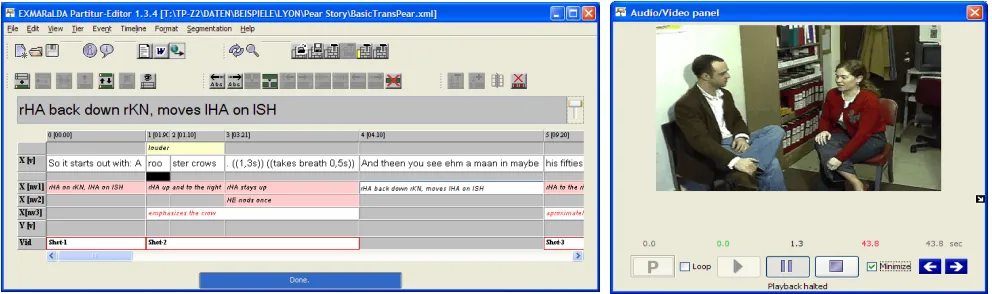
transcrip-tion of audio or video recordings of spoken language, developed by Thomas Schmidt at the University of Hamburg (see [10], [21], [22] and figure 1)
MacVisSTA, a tool for annotation and visualization
of multiple time-synchronized videos, developed by Travis Rose, Francis Queck and Chreston Miller at Virginia Tech (see [19] and [20]).
Theme, a commercial software tool for finding
pat-terns in temporally annotated data, developed by Magnus Magnusson for Noldus (see [23]).
Transformer, a tool for editing and converting
be-tween several formats for linguistic transcription, developed by Oliver Ehmer at the University of Freiburg (see [24]).
These tools differ greatly in their technical details, in their intended target audiences, in the design of their user in-terfaces and in the specific tasks they help to solve. They have in common, however, that they all allow the creation of or the work with analytic textual data which is time-aligned to a video recording. They are therefore all used to carry out multi-modal annotation and analysis. It is not uncommon, though, that a researcher wants to exchange data between two or more of them, because no single tool offers all the functionality required for a given task. For instance, a typical processing pipeline could look like this:
1) EXMARaLDA is used to transcribe verbal behavior
of an interaction,
2) ELAN’s advanced video support is needed to add
detailed annotation of multimodal behavior,
3) Theme is used to carry out an analysis of the
anno-tated data,
4) Transformer is used to generate a visualization of the
annotated data.
3.
Comparison of data formats
As a first step towards this goal, a thorough analysis and comparison of the different tool formats was carried out. All formats have in common that their basic building blocks are annotation tuples consisting of a start and an end point (with, typically, a temporal interpretation) and one or more text labels (with no fixed interpretation). Since this is precisely the principle on which the annota-tion graph formalism (AG, see [4]) is based, it was natural to choose AGs as a general framework for our task. However, there are differences between the formats (1) with respect to the way the basic building blocks are organised into larger structures and (2) with respect to semantic specifications of and structural constraints on the basic and larger structural entities.The following section discusses the differences in the formats which were identified to be relevant in terms of interoperability.
3.1. General organisation of the data structure
3.1.1. Tier-based data formats vs. non-tier-based formats
In ANVIL, ELAN, EXMARaLDA and Transformer, all annotations are partitioned into a number of tiers such that each annotation is part of exactly one tier, and no two annotations within a tier overlap. These tiers are usually used to group annotations which belong to one level of analysis (e.g. verbal vs. non-verbal behaviour, hand movements vs. facial expression) or to one participant (in multi-party interaction). By contrast, C-BAS and Mac-VisSTA do not have the concept of a tier; they keep all annotations in a single list. When converting from a non-tier-based format to a tier-based format, a partition of this list into tiers must be found.
3.1.2. Single vs. multiple labels
Annotations consist of a single label in ELAN, EX-MARaLDA, MacVisSTA and Transformer, while ANVIL and C-BAS can have multiple (typed) labels for one and the same annotation. When converting from the latter formats to one of the former, each multi-label annotation has to be split into a corresponding number of single-label annotations.
3.1.3. Implicit vs. explicit timeline
In ANVIL, C-BAS MacVisSTA and Transformer, the timestamps of annotations refer directly to media times in the recording. By contrast, ELAN and EXMARaLDA define an explicit external timeline, i.e. an ordered set of anchors to which annotations refer. Anchors in this ex-ternal timeline can, but need not, be assigned an absolute timestamp which links them to the media signal.
It is thus possible in ELAN and EXMARaLDA to leave
the media offsets of certain annotations unspecified.1
In terms of interoperability, the difference between im-plicit and exim-plicit timelines poses two problems: First, the former do not permit unspecified media offsets. When going from a format with an explicit to a format with an implicit timeline, missing offsets therefore have to be calculated. The simplest way to achieve this is through (linear) interpolation. Second, in going from an implicit to an explicit timeline, the question arises of how to treat points with identical offsets. If two such points are mapped to different anchors (the EXMARaLDA and ELAN formats allow this), there is no straightforward way of ordering them and contradictory data structures (i.e. annotations whose endpoint precedes their startpoint in the timeline) may result. It therefore seems more prac-tical to map them to a single anchor.
3.2. Semantic specifications and constraints The properties of the multimodal annotation formats discussed so far, just like the AG framework in general, are on a relatively high level of abstraction. That is, they concern very general structural characteristics of annota-tion data, and they do not say very much about their se-mantics. 2 While a high level of abstraction is beneficial to interoperability in many ways, actual applications profit from more concrete semantic specifications. All of the
1
In other words: the annotator can freely determine the degree of precision of the alignment between annotations and re-cordings. By the same logic, it becomes possible to have a completely non-temporal interpretation of start and end points – for instance, when the annotated object is not a recording, but a written text.
2
It is in this sense that Bird/Liberman (2001:55) call their AG framework “ontologically parsimonious (if not positively mis-erly!)”
Appendix: Commented example of an instance of the multimodal annotation exchange format
This example was generated by the EXMARaLDA export mechanism. It corresponds to the annotation file illustrated in the screenshot in figure 1.
<?xml version="1.0" encoding="UTF-8"?>
<AGSet xmlns="http://www.ldc.upenn.edu/atlas/ag/" xmlns:xlink="http://www.w3.org/1999/xlink" version="1.0" id="exmaralda">
<Metadata>
<!-- Each tier is defined in a MetaDataElement with name 'Tier' -->
<MetadataElement name="Tier">
<!-- A child MetadataElement with name 'TierIdentifier' spcifies a unique ID for this tier -->
<!-- This element is obligatory -->
<MetadataElement name="TierIdentifier">TIE0</MetadataElement>
<!-- Further child MetadataElements with name 'TierAttribute' define further properties of the respective tier -->
<!-- These elements are optional -->
<!-- this tier property says that the tier is assigned to the speaker with the (unique) ID 'SPK0' -->
<MetadataElement name="TierAttribute">
<!-- This MetadataElement specifies the tool which defined the property - in this case EXMARaLDA -->
<MetadataElement name="Source">EXMARaLDA</MetadataElement>
<!-- This MetadataElement specifies the name of the property in the tool's format -->
<MetadataElement name="Name">speaker</MetadataElement> <!-- This MetadataElement specifies the value of the property -->
<MetadataElement name="Value">SPK0</MetadataElement> </MetadataElement>
<!-- Another tier property defined by EXMARaLDA: the tier is of category 'sup' (for 'suprasegmental') -->
<MetadataElement name="TierAttribute">
<MetadataElement name="Source">EXMARaLDA</MetadataElement> <MetadataElement name="Name">category</MetadataElement> <MetadataElement name="Value">sup</MetadataElement> </MetadataElement>
<!-- Another tier property defined by EXMARaLDA: the tier is of type 'a' (for 'annotation') -->
<MetadataElement name="TierAttribute">
<MetadataElement name="Source">EXMARaLDA</MetadataElement> <MetadataElement name="Name">type</MetadataElement>
<MetadataElement name="Value">a</MetadataElement> </MetadataElement>
</MetadataElement>
<!-- another tier definition -->
<MetadataElement name="Tier">
<MetadataElement name="TierIdentifier">TIE1</MetadataElement> <!-- follows another set of EXMARaLDA-specific tier attributes -->
</MetadataElement>
<!-- yet another tier definition --> <MetadataElement name="Tier">
<MetadataElement name="TierIdentifier">TIE2</MetadataElement> <!-- follows another set of EXMARaLDA-specific tier attributes -->
</MetadataElement>
<!-- follow more tier definitions -->
</Metadata>
<!-- The Timeline to which Anchors refer -->
<Timeline id="exmaralda_Timeline1">
<!-- The Signal element specifies the media file for this annotation -->
<Signal id="exmaralda_Timeline1_Signal1" unit="miliseconds" mimeClass="" mimeType="video/quicktime" encoding=""
xlink:href="pear.mov"/> </Timeline>
<!-- one AG element holds the actual Annotations and their Anchors -->
<!-- it refers to the Timeline defined above -->
<AG timeline="exmaralda_Timeline1" id="exmaralda_AG1"> <!-- each Anchor gets a unique ID -->
<!-- offsets are given in milliseconds -->
<!-- Anchors should be ordered by offset -->
<!-- each Annotation gets a unique ID -->
<!-- the value of the 'type' attribute refers to the PCDATA value of a MetadataElement with name 'TierIdentifier' -->
<!-- the values of the 'start' and 'end' attribute refer to the 'id' attributes of Anchor elements -->
<!-- this Annotation element describes an annotation in tier 'TIE0', starting at anchor 'T1', ending at anchor 'T3' labelled 'louder' -->
<Annotation id="TIE0_T1" type="TIE0" start="T1" end="T3"> <!-- the Feature element(s) contain the actual annotation label(s)-->
<!-- the value of the 'name' attribute can be freely chosen -->
<Feature name="description">louder </Feature> </Annotation>
<!-- [...] -->
<!-- Three annotation elements from tier 'TIE1', describing verbal behaviour -->
<Annotation id="TIE1_T0" type="TIE1" start="T0" end="T1"> <Feature name="description">So it starts out with: A </Feature> </Annotation>
<Annotation id="TIE1_T1" type="TIE1" start="T1" end="T2"> <Feature name="description">roo</Feature>
</Annotation>
<Annotation id="TIE1_T2" type="TIE1" start="T2" end="T3"> <Feature name="description">ster crows</Feature> </Annotation>
<!-- [...] -->
<!-- Three annotation elements from tier 'TIE2', describing non-verbal behaviour --> <Annotation id="TIE2_T0" type="TIE2" start="T0" end="T1">
<Feature name="description">rHA on rKN, lHA on lSH</Feature> </Annotation>
<Annotation id="TIE2_T1" type="TIE2" start="T1" end="T3"> <Feature name="description">rHA up and to the right </Feature> </Annotation>
<Annotation id="TIE2_T3" type="TIE2" start="T3" end="T4"> <Feature name="description">rHA stays up</Feature> </Annotation>
<!-- more annotations follow -->