CSEIT184527 | Published - 14 April 2018 | March-April-2018 [ (4 ) 5 : 220-228] 220
Flexible compartments IoT driven smart pill-box
Lipsa Dash1,Arun R2, Bhavani R2, RethnaJennifer S2
1Professor, Department of Electronics and Communication, New Horizon College of Engineering,
Outer Ring Road Marthahalli, Bengaluru, Karnataka, India
2Student Department of Electronics and Communication, New Horizon College of Engineering,
Outer Ring Road Marthahalli, Bengaluru, Karnataka, India
ABSTRACT
The scenario today in taking care of elderlypeople and other groups of people who need continuous medical attention involves assisting them with the right medication at the right moment of time. To enable these set of people to take medication on their own without the assistance of another individual is the main aim of this proposed paper. The proposed system is said to have inculcated Assistive technology which provides means of assistance by use of rehabilitative devices to people with varies disabilities. Assistive technology(AT) aims at promoting independence of the people by actually enabling them to perform varies tasks with ease which they were unable to perform otherwise. Assistive technology provides means of enhancing the lifestyle of people by providing assistance. On a reality check today not everyone is able to access AT catering to reasons like high costs, less awareness and less availability of the varies assistive devices. But it has been estimated that by 2050, a major portion of the society will be running on AT devices. In this paper we have proposed an approach advancing towards using AT devices. There has been usage of open source technologies and gives a new organised manner of taking medication dosages."Flexible compartment smart pillbox" basically allows the organization of several medication schedules that health disorders presented in elderly people and other groups of people require. The proposed system includes a buzzer along with an automatic pill dispensing system, user-friendly display interface and a notification system that uses a WIFI module. ARM-7 is taken as the principal controller. The development of this device is mainly focused on supporting elderly people and other groups of people who may have the needfor an assisted care.
Keywords: Assistive technology, IoT, ARM7, smart pill box
I. INTRODUCTION
CSEIT184527 | Published - 14 April 2018 | March-April-2018 [ (4 ) 5 : 220-228] 222
II. EXISTING SYSTEM
A combination between electronic and mechanical pill boxes or dispensers is presented. It’s been included that certain traditional pills organizers, which represent the first step in these developments and have enabled us to obtain the ideas required for the designing of useful patterns in development of this solution.
In [9] is presented a pill dispenser which has different prescribed administration schedules. It includes a plurality of pill storage compartments, each of them capable of holding more than one pill. This device has a pill detector and generates a signal to alert patients to take the prescribed medicine. There are twelve storage compartments, arranged in a ring about a vertically rotating wheel. However, the limitation to this solution was that this pill dispenser could only hold doses for 24- hours
A current design presented in Cheyene[10], presents a device that enables the storing and dispensing of pills and various other supplements (i.e., food, drug, supplements, liquids, powders or pills). This device is said to work as an alarm clock and may work with blisterpacked pills or alternatively use an encapsulated compartment to hold and dispense loose pills. Also, it can be connected by wireless means to external environments (cellphones, computers). But, this device does not allow the basic management of several dosages and different kind of pills.
In providinganother solution was the e-pill [11]. It had in its stock various alternatives to organize and dispense pills, which can be mentioned especiallyin two ways: i) A device mainlydesigned to dispense pills composed by 2 medication trays, and 3 day-dosage discs. It hada circumference shape and it had turning compartments for each of the scheduled dosage time. The scheduled dosages are dispensed when an alarm is activated, this device does not use referential diseases, just use dosages per days, and is also not programmable for any particular schedule; ii) it is a reminder medication product mainly focused on patients, caregivers or medical health professionals. This device locks automatically and includes 2 keys. For patients trying to get medications prior it’s time there is tamper resistant provided. This device considers supplying pills for one week, four times per day. Also it has alarm and text message reminders.Disadvantages perceived are to close device by interaction of keeper and is not independent. As far as we know, more than it has been described before, there are many solutions which offers advantages as dispensing or alerting system however they do not provide an automatic reminder system, different alert forms or a study in loT field, besides devices are economically difficult to access.
CSEIT184527 | Published - 14 April 2018 | March-April-2018 [ (4 ) 5 : 220-228] 223 The next module uses the WEDUINO module installedin Smart PillBox to achieve 2way messaging with remote relatives via IoT.The module first reads the sensing signals in the kit and uses WI-FI to transmit the signals to the WI-FI router and then sends the medication information to the remote webpage or cell phone for monitoring.It’s a 4 compartment PillBox. Also the cell phone can send a remind message back to the LCD screen on Smart PillBox by means of internet.
The last one is based on Arduino Mega 2560 taken as the principal controller[12]. This prototype contains; a programmable alarm system with an automatic opening and closing system, an interactive user interface and a notification system through GSM network.In this work, it proposes a solution that solves these problems.
III. PROTOTYPE CONSTITUENTS
The components are chosen based on their functionality and precision. They are very cost efficient and easily available.
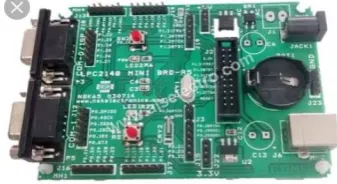
3.1 ARM-7 [LPC 2148]
It is a 32-bit controller with 64 pin configuration. It has 2 ADC,2 UART (hardware serial ports) and real time clock present in it. 45 pins are used for accessing. It also has a 20MHZ crystal oscillator,16 interrupts and 512kb RAM. It also has a USB port that helps us easily connect to the computer. Associated compatible products and capabilities in ARM 7 lets user manage different modules including dc motor, stepper motor controllers.sensors or touch screens which are part in materials chosen and which will have a specific task in the pillbox.
Figure 1. the arm-7 controller 3.2 LCD display
It is a 16x2 display used to show the values of the sensors used, the timing of the pill to be dispensed, the pill that is being dispensed and the patient details. It takes in hexadecimal commands to display data.
CSEIT184527 | Published - 14 April 2018 | March-April-2018 [ (4 ) 5 : 220-228] 224 Figure 2. LCD display
3.3 RFID reader and RFID tag
It works on the principle of radio frequency based electromagnetic field to transfer data from tag to reader. It is distance limited. The tag has to be close to the reader for it to read it. The tag had unique code for authentication of only that particular patient. We use passive reader were a battery is present internally. It works on UART protocol.
Figure 3. RFID reader module 3.4 WIFI module
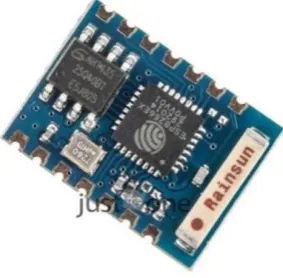
In this project we use ESP8266 WIFI module to connect to the customised app on the mobile of the doctor or care taker. It uses a standard set of instructions to send and receive data from the cloud. It directly interfaces with arm-7. It works on the principle of IoT.
Figure 4. WIFI module 3.5 Sensors
CSEIT184527 | Published - 14 April 2018 | March-April-2018 [ (4 ) 5 : 220-228] 225 The pulse sensor reads the heart rate of the patient. The LED present in it absorbs the blood flow and the IC processes the data.
The blood pressure sensor works on UART protocol. It reads the blood pressure of the patient. The blood pressure reading has to done manually
Figure 5. Temp sensor
Figure 6. pulse sensor
3.6 Stepper and DC motors
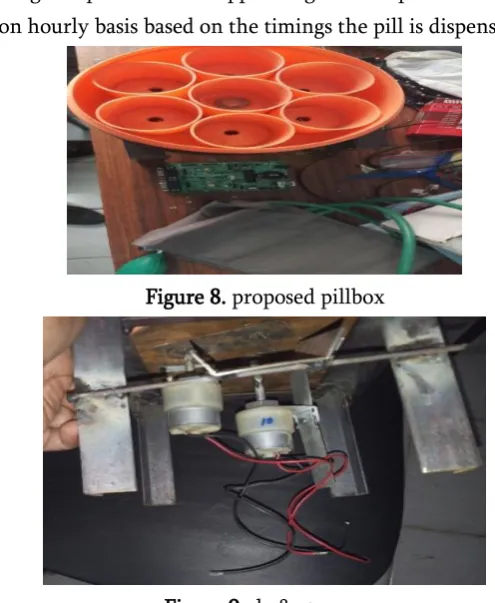
They are both used for the opening and closing mechanism of the dispenser. They have driver circuit for the interfacing with the controller.
We use Kiel-u vision software for writing the controller code in embedded C. Flashmagic is used to dump the code the controller. The app code is written in JAVA for its object oriented and platform independent qualities.
IV. WORKING
The device aims to dispense the pills to the elderly patients and also patients with disorders such as amnesia, dementia etc at the programmed time.
The device is designed such that only one authorised patient can use it thus avoiding any wrong medication reaching the wrong patient.
The dispenser automatically dispenses the medicine thereby reducing the problem of opening and closing the compartments by the patient.
CSEIT184527 | Published - 14 April 2018 | March-April-2018 [ (4 ) 5 : 220-228] 226
The doctors/caretakers who will have the customised app on their phones can monitor the patient from any place.
The blood pressure, temperature and heart rate values are being recorded and send to the doctor each time the patient takes the medicine thus helping the doctor update the medication on his/her visit. The entire proposed system is automated except for the blood pressure measuring means
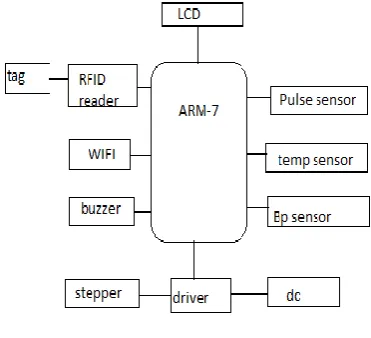
Figure 7. basic block
V. PROTOTYPE BUILDING/RESULTS
The main objective of this analysis is all about using free hardware and software in order to develop a valid and effective device to assist people in taking correct doses of prescribed medicine along with the basic temperature, blood pressure and heart rate readings. ARM-7 was taken as the principal controller. "The Flexible compartment IoT PillBox" is used as a pills storage device, which contains a programmable alarm system, an automatic opening and closing system, an interactive and friendly user interface and a notification system through WIFImodule.
5.1 RFID reader and sensor functions
The RFID tag assigned to each patient will have a unique code. This code is transmitted to the reader giving the patient access to the pill dispenser. Only one patient has access to the dispenser. Once the authorisation is done the sensors read the patient’s temperature, heart rate and blood pressure. These values are sent to the doctor/ caretakers informing them the patient’s health condition.
5.2 Notification system
CSEIT184527 | Published - 14 April 2018 | March-April-2018 [ (4 ) 5 : 220-228] 227 5.3 Buzzer and pill dispensing
Once the confirmation message is obtained the buzzer rings indicating the patient that the particular pill is going to be dispensed. The stepper motor rotates in step angle and DC motor rotates in circular motion stopping at the particular compartment from where the specified pill is being dispensed. The pill falls into a container and the patient has to just consume it. Once this is done the, a message is again updated on the app telling that the patient has consumed the pill. The process repeats on hourly basis based on the timings the pill is dispensed.
Figure 8. proposed pillbox
Figure 9. dc & stepper
VI. FUTURE WORK
Thermometer: A thermometer can be included in order to analyse the internal temperature of the device for the correct conservation of the pills. An alarm will be activated if the temperature exceeds the previous set limit.
Security: After the design is selected, a lock system could be added. The device will be used only by; doctors, keepers, and patients without significant disorders. They would only program the device with a personal password.
Touch Screen: Another module marked as inconclusive is the TFT LCD Touch Screen. In this process the touch function is not available, but the goal is to use this interface to configure the medication scheme.
CSEIT184527 | Published - 14 April 2018 | March-April-2018 [ (4 ) 5 : 220-228] 228 Biometric Blood pressure: This can be inculcated to combat the odds of manually taking the blood pressure readings.
VII. CONCLUSION
Elderly constitute 30% of the population and people with a need of an assistive aid are high in number. The disabled patients and people who cannot afford for a caretaker also require aid. This device aims at dispensing pills according to the patient’s health requirements at the right time and dosage.The system also sends notifications regularly to the doctor/caretaker helping them keep a check on their condition. It is cost efficient and easily accessible for patients of all sectors.
As mentioned in the future works a touch screen LCD could be added and also a thermometer to conserve the pills could be implemented. Further research is being done.
VIII. REFERNCES
1. W. H. Organization, "Assistive Technology," Assistive Technology, 2016. [Online]. Available: http://www. who. intlmed iacentre/factsheets/assistivetechnology/en/.
2. Ministerio Salud Publica, "MAIS (Manual del Modelo de Atenci6n Integral de Salud)," Ministerio de Salud Publica del Ecuador. p. 210, 2012.
3. L. Garyon et al., "Medical and Assistive Health Technology: Meeting the Needs of Aging Populations," vol. 56, pp. 293-302, 2016.
4. C. Mollaret, A. A. Mekonnen, F. Lerasle, I. Ferram\ 1. Pinquier, and B. Boudet, "A multi-modal perception based assistive robotic system for the elderly," vol. 0, pp. 1-20,2016. P. Casanova-Sotolongo,
5. P. Casanova-Carrillo, and C. Casanova-Carrillo, "Deterioro cognitivo en la tercera edad," Rev. Cuba. Med. Gen. Integr., vol. 20, no. 5-6, pp. 0-0, 2004.
6. C. Canet, La Tercera Edad, 1st ed. Victoria, Canada, 2005.
7. J. H. Brown, P. E. N. Knowles, F. Booth, and H. C. Post, "United States Patent [[ 19 ]," 909628, 1980.
8. C. Elena and C. Octavian, "Internet of Things as Key Enabler for Sustainable Healthcare Delivery," Procedia - Soc. Behav. Sci., vol. 73, pp. 2S1-2S6, 2013.
9. K. E. Lewis and A. Roberts Jr, "United States Patent [19] [54]," 4,573,606, 1984. 10. Shaahin Cheyene, "(19) United States (12)," vol. 1, no. 19,2011.
11. e-pil1 medication Reminders, "E-pil1 Medication Reminders. " [Online]. Available: www.epill.com.