Large-Scale Noun Compound Interpretation
Using Bootstrapping and the Web as a Corpus
Su Nam Kim
Computer Science & Software Engineering University of Melbourne
Melbourne, VIC 3010 Australia
Preslav Nakov
Department of Computer Science National University of Singapore
13 Computing Drive Singapore 117417 [email protected]
Abstract
Responding to the need for semantic lexical resources in natural language processing ap-plications, we examine methods to acquire noun compounds (NCs), e.g.,orange juice, to-gether with suitable fine-grained semantic in-terpretations, e.g., squeezed from, which are directly usable as paraphrases. We employ bootstrapping and web statistics, and utilize the relationship between NCs and paraphras-ing patterns to jointly extract NCs and such patterns in multiple alternating iterations. In evaluation, we found that having one com-pound noun fixed yields both a higher number of semantically interpreted NCs and improved accuracy due to stronger semantic restrictions.
1 Introduction
Noun compounds (NCs) such as malaria mosquito
andcolon cancer tumor suppressor proteinare
chal-lenging for text processing since the relationship between the nouns they are composed of is im-plicit. NCs are abundant in English and understand-ing their semantics is important in many natural lan-guage processing (NLP) applications. For example, a question answering system might need to know whether protein acting as a tumor suppressor is a good paraphrase fortumor suppressor protein. Sim-ilarly, a machine translation system facing the un-known noun compoundGeneva headquartersmight translate it better if it could first paraphrase it as
Geneva headquarters of the WTO. Given a query
for “migraine treatment”, an information retrieval
system could use paraphrasing verbs likerelieveand
preventfor query expansion and result ranking.
Most work on noun compound interpretation has focused on two-word NCs. There have been two general lines of research: the first one derives the NC semantics from the semantics of the nouns it is made of (Rosario and Hearst, 2002; Moldovan et al., 2004; Kim and Baldwin, 2005; Girju, 2007; S´eaghdha, 2009; Tratz and Hovy, 2010), while the second one models the relationship between the nouns directly (Vanderwende, 1994; Lapata, 2002; Kim and Bald-win, 2006; Nakov and Hearst, 2006; Nakov and Hearst, 2008; Butnariu and Veale, 2008).
In either case, the semantics of an NC is typi-cally expressed by an abstract relation like CAUSE (e.g., malaria mosquito), SOURCE(e.g., olive oil), or PURPOSE (e.g., migraine drug), coming from a small fixed inventory. Some researchers however, have argued for a more fine-grained, even infinite, inventory (Finin, 1980). Verbs are particularly use-ful in this respect and can capture elements of the semantics that the abstract relations cannot. For ex-ample, while most NCs expressing MAKE, can be paraphrased by common patterns like be made of
andbe composed of, some NCs allow more specific
patterns, e.g.,be squeezed fromfororange juice, and
be topped withforbacon pizza.
Recently, the idea of using fine-grained para-phrasing verbs for NC semantics has been gain-ing popularity (Butnariu and Veale, 2008; Nakov, 2008b); there has also been a related shared task at SemEval-2010 (Butnariu et al., 2010). This interest is partly driven by practicality: verbs are directly us-able as paraphrases. Still, abstract relations remain dominant since they offer a more natural generaliza-tion, which is useful for many NLP applications.
One good contribution to this debate would be a direct study of the relationship between fine-grained and coarse-grained relations for NC interpretation. Unfortunately, the existing datasets do not allow this since they are tied to one particular granular-ity; moreover, they only contain a few hundred NCs. Thus, our objective is to build a large-scale dataset of hundreds of thousands of NCs, each interpreted (1) by an abstract semantic relation and (2) by a set of paraphrasing verbs. Having such a large dataset would also help the overall advancement of the field. Since there is no universally accepted abstract re-lation inventory in NLP, and since we are interested in NC semantics from both a theoretical and a prac-tical viewpoint, we chose the set of abstract relations proposed in the theory of Levi (1978), which is dom-inant in theoretical linguistics and has been also used in NLP (Nakov and Hearst, 2008).
We use a two-step algorithm to jointly harvest NCs and patterns (verbs and prepositions) that in-terpret them for a given abstract relation. First, we extract NCs using a small number of seed pat-terns from a given abstract relation. Then, using the extracted NCs, we harvest more patterns. This is repeated until no new NCs and patterns can be extracted or for a pre-specified number of itera-tions. Our approach combines pattern-based extrac-tion and bootstrapping, which is novel for NC in-terpretation; however, such combinations have been used in other areas, e.g., named entity recognition (Riloff and Jones, 1999; Thelen and Riloff, 2002; Curran et al., 2007; McIntosh and Curran, 2009).
The remainder of the paper is organized as fol-lows: Section 2 gives an overview of related work, Section 3 motivates our semantic representation, Sections 4, 5, and 6 explain our method, dataset and experiments, respectively, Section 7 discusses the results, Section 8 provides error analysis, and Sec-tion 9 concludes with suggesSec-tions for future work.
2 Related Work
As we mentioned above, the implicit relation be-tween the two nouns forming a noun compound can often be expressed overtly using verbal and prepo-sitional paraphrases. For example, student loan is “loan given to a student”, whilemorning teacan be paraphrased as “tea in the morning”.
Thus, many NLP approaches to NC semantics have used verbs and prepositions as a fine-grained semantic representation or as features when pre-dicting coarse-grained abstract relations. For ample, Vanderwende (1994) associated verbs ex-tracted from definitions in an online dictionary with abstract relations. Lauer (1995) expressed NC se-mantics using eight prepositions. Kim and Baldwin (2006) predicted abstract relations using verbs as features. Nakov and Hearst (2008) proposed a fine-grained NC interpretation using a distribution over Web-derived verbs, prepositions and coordinating conjunctions; they also used this distribution to pre-dict coarse-grained abstract relations. Butnariu and Veale (2008) adopted a similar fine-grained verb-centered approach to NC semantics. Using a dis-tribution over verbs as a semantic interpretation was also carried out in a recent challenge: SemEval-2010 Task 9 (Butnariu et al., 2009; Butnariu et al., 2010). In noun compound interpretation, verbs and prepositions can be seen as patterns connecting the two nouns in a paraphrase. Similar pattern-based ap-proaches have been popular in information extrac-tion and ontology learning. For example, Hearst (1992) extracted hyponyms using patterns such as
X, Y, and/or other Zs, where Z is a hypernym of
X and Y. Berland and Charniak (1999) used sim-ilar patterns to extract meronymy (part-whole) re-lations, e.g.,parts/NNS of/IN wholes/NNS matches
basements of buildings. Unfortunately, matches are
rare, which makes it difficult to build large semantic inventories. In order to overcome data sparseness, pattern-based approaches are often combined with bootstrapping. For example, Riloff and Jones (1999) used a multi-level bootstrapping algorithm to learn both a semantic lexicon and extraction patterns, e.g.,
owned by X extracts COMPANY andfacilities in X
Bootstrapping has been applied to noun com-pound extraction as well. For example, Kim and Baldwin (2007) used it to produce a large number of semantically interpreted noun compounds from a small number of seeds. In each iteration, the method replaced one component of an NC with its synonyms, hypernyms and hyponyms to generate a new NC. These new NCs were further filtered based on their semantic similarity with the original NC. While the method acquired a large number of noun compounds without significant semantic drifting, its accuracy degraded rapidly after each iteration. More importantly, the variation of the sense pairs was lim-ited since new NCs had to be semantically similar to the original NCs.
Recently, Kozareva and Hovy (2010) combined patterns and bootstrapping to learn the selectional restrictions for various semantic relations. They used patterns involving the coordinating conjunction
and, e.g., “* and John fly to *”, and learned argu-ments such asMary/TomandFrance/New York. Un-like in NC interpretation, it is not necessary for their arguments to form an NC, e.g., Mary France and
France Mary are not NCs. Rather, they were
in-terested in building a semantic ontology with a pre-defined set of semantic relations, similar to YAGO (Suchanek et al., 2007), where the patternwork for
would have arguments likea company/UNICEF.
3 Semantic Representation
Inspired by (Finin, 1980), Nakov and Hearst (2006) and (Nakov, 2008b) proposed that NC semantics is best expressible using paraphrases involving verbs and/or prepositions. For example, bronze statueis a statue thatis made of, is composed of, consists of, contains, is of, is, is handcrafted from, is dipped in,
looks like bronze. They further proposed that
se-lecting one such paraphrase is not enough and that multiple paraphrases are needed for a fine-grained representation. Finally, they observed that not all paraphrases are equally good (e.g., is made of is arguably better than looks like or is dipped in for MAKE), and thus proposed that the semantics of a noun compound should be expressed as a distribu-tionover multiple possible paraphrases. This line of research was later adopted by SemEval-2010 Task 9 (Butnariu et al., 2010).
It easily follows that the semantics of abstract re-lations such as MAKE that can hold between the nouns in an NC can be represented in the same way: as a distribution over paraphrasing verbs and prepo-sitions. Note, however, that some NCs are para-phrasable by more specific verbs that do not nec-essarily support the target abstract relation. For ex-ample,malaria mosquito, which expresses CAUSE, can be paraphrased using verbs likecarry, which do not imply direct causation. Thus, while we will be focusing on extracting NCs for a particular abstract relation, we are interested in building semantic rep-resentations that are specific for these NCs and do not necessarily apply toallinstances of that relation. Traditionally, the semantics of a noun compound have been represented as an abstract relation drawn from a small closed set. Unfortunately, no such set is universally accepted, and mapping between sets has proven challenging (Girju et al., 2005). Moreover, being both abstract and limited, such sets capture only part of the semantics; often multiple meanings are possible, and sometimes none of the pre-defined ones suits a given example. Finally, it is unclear how useful these sets are since researchers have of-ten fallen short of demonstrating practical uses.
Arguably, verbs have more expressive power and are more suitable for semantic representation: there is an infinite number of them (Downing, 1977), and they can capture fine-grained aspects of the mean-ing. For example, while bothwrinkle treatmentand
migraine treatment express the same abstract
rela-tion TREATMENT-FOR-DISEASE, fine-grained dif-ferences can be revealed using verbs, e.g., smooth
can paraphrase the former, but not the latter.
In many theories, verbs play an important role in NC derivation (Levi, 1978). Moreover, speakers of-ten use verbs to make the hidden relation between the noun in a noun compound overt. This allows for simple extraction and for straightforward use in NLP tasks like textual entailment (Tatu and Moldovan, 2005) and machine translation (Nakov, 2008a).
Finally, a single verb is often not enough, and the meaning is better approximated by a collection of verbs. For example, whilemalaria mosquito ex-presses CAUSE (and is paraphrasable usingcause), further aspects of the meaning can be captured with more verbs, e.g.,carry, spread, be responsible for,
4 Method
We harvest noun compounds expressing some target abstract semantic relation (in the experiments below, this is Levi’s MAKE2), starting from a small number
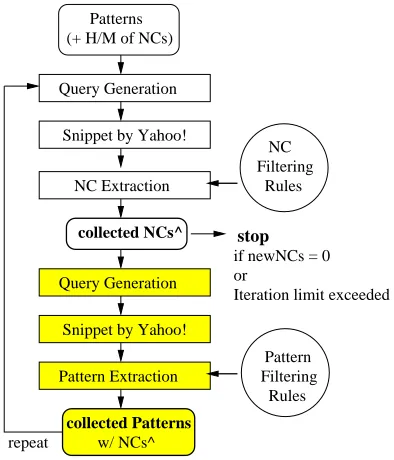
of initial seed patterns: paraphrasing verbs and/or prepositions. Optionally, we might also be given a small number of noun compounds that instanti-ate the target abstract relation. We then learn more noun compounds and patterns for the relation by al-ternating between the following two bootstrapping steps, using the Web as a corpus. First, we extract more noun compounds that are paraphrasable with the available patterns (see Section 4.1). We then look for new patterns that can paraphrase the newly-extracted noun compounds (see Section 4.2). These two steps are repeated until no new noun compounds can be extracted or until a pre-determined number of iterations has been reached. A schematic description of the algorithm is shown in Figure 1.
(+ H/M of NCs) Patterns
Query Generation
NC Extraction
Pattern Filtering
Rules Filtering
NC
Rules
repeat
collected NCs^
Query Generation
w/ NCs^
collected Patterns
stop
if newNCs = 0 or
Iteration limit exceeded Snippet by Yahoo!
Pattern Extraction Snippet by Yahoo!
Figure 1: Our bootstrapping algorithm.
4.1 Bootstrapping Step 1: Noun Compound Extraction
Given a list of patterns (verbs and/or prepositions), we mine the Web to extract noun compounds that match these patterns. We experiment with the fol-lowing three bootstrapping strategies for this step:
• Loose bootstrapping uses the available pat-terns and imposes no further restrictions.
• Strict bootstrappingrequires that, in addition to the patterns themselves, some noun com-pounds matching each pattern be made avail-able as well. A pattern is only instantiated in the context of either the head or the modifier of a noun compound that is known to match it.
• NC-only strict bootstrappingis a stricter ver-sion of strict bootstrapping, where the list of patterns is limited to the initial seeds.
Below we describe each of the sub-steps of the NC extraction process: query generation, snippet har-vesting, and noun compound acquisition & filtering. 4.1.1 Query Generation
We generate generalized exact-phrase queries to be used in a Web search engine (we useYahoo!):
"* that PATTERN *" (loose) "HEAD that PATTERN *" (strict) "* that PATTERN MOD" (strict) wherePATTERNis an inflected form of a verb,MOD andHEAD are inflected forms the modifier and the head of a noun compound that is paraphrasable by the pattern, that is the word that, and * is the search engine’s star operator.
We use the first pattern for loose bootstrapping
and the other two for bothstrict bootstrappingand
NC-only strict bootstrapping.
Note that the above queries are generalizations of the actual queries we use against the search engine. In order to instantiate these generalizations, we fur-ther generate the possible inflections for the verbs and the nouns involved. For nouns, we produce sin-gular and plural forms, while for verbs, we vary not only the number (singular and plural), but also the tense (we allow present, past, and present perfect). When inflecting verbs, we distinguish between ac-tive verb forms likeconsist of and passive ones like
be made fromand we treat them accordingly.
Over-all, in the case ofloose bootstrapping, we generate about 14 and 20 queries per pattern for active and passive patterns, respectively, while forstrict
boot-strappingandNC-only strict bootstrapping, the
For example, given the seedbe made of, we could generate "* that were made of *". If we are further given the NCorange juice, we could also produce"juice that was made of *"and "* that is made of oranges".
4.1.2 Snippet Extraction
We execute the above-described instantiations of the generalized queries against a search engine as exact phrase queries, and, for each one, we collect the snippets for the top 1,000 returned results. 4.1.3 NC Extraction and Filtering
Next, we process the snippets returned by the search engine and we acquire potential noun com-pounds from them. Then, in each snippet, we look for an instantiation of the pattern used in the query and we try to extract suitable noun(s) that occupy the position(s) of the*.
For loose bootstrapping, we extract two nouns,
one from each end of the matched pattern, while
forstrict bootstrappingand forNC-only strict
boot-strapping, we only extract one noun, either
preced-ing or followpreced-ing the pattern, since the other noun is already fixed. We then lemmatize the extracted noun(s) and we form NC candidates from the two arguments of the instantiated pattern, taking into ac-count whether the pattern is active or passive.
Due to the vast number of snippets we have to process, we decided not to use a syntactic parser or a part-of-speech (POS) tagger1; thus, we use heuristic
rules instead. We extract “phrases” using simple in-dicators such as punctuation (e.g., comma, period), coordinating conjunctions2 (e.g.,and, or),
preposi-tions (e.g.,at, of, from), subordinating conjunctions (e.g., because, since, although), and relative pro-nouns (e.g., that, which, who). We then extract the nouns from these phrases, we lemmatize them using WordNet, and we form a list of NC candidates.
While the above heuristics work reasonably well in practice, we perform some further filtering, re-moving all NC candidates for which one or more of the following conditions are met:
1In fact, POS taggers and parsers are unreliable for
Web-derived snippets, which often represent parts of sentences and contain errors in spelling, capitalization and punctuation.
2Note that filtering the arguments using such indicators
indi-rectly subsumes the pattern"X PATTERN Y and"proposed in (Kozareva and Hovy, 2010).
1. the candidate NC is one of the seed examples or has been extracted on a previous iteration;
2. the head and the modifier are the same;
3. the head or the modifier are not both listed as nouns in WordNet (Fellbaum, 1998);
4. the candidate NC occurs less than 100 times in
theGoogle Web 1T 5-gram corpus3;
5. the NC is extracted less thanN times (we tried 5 and 10) in the context of the pattern for all instantiations of the pattern.
4.2 Bootstrapping Step 2: Pattern Extraction This is the second step of our bootstrapping algo-rithm as shown on Figure 1. Given a list of noun compounds, we mine the Web to extract patterns: verbs and/or prepositions that can paraphrase each NC. The idea is to turn the NC’s pre-modifier into a post-modifying relative clause and to collect the verbs and prepositions that are used in such clauses. Below we describe each of the sub-steps of the NC extraction process: query generation, snippet har-vesting, and NC extraction & filtering.
4.2.1 Query Generation
The process of extraction starts with exact-phrase queries issued against a Web search engine (again
Yahoo!) using the following generalized pattern:
"HEAD THAT? * MOD"
where MOD andHEAD are inflected forms of NC’s modifier and head, respectively, THAT? stands for
that, which, who or the empty string, and*stands
for 1-6 instances of search engine’s star operator. For example, given orange juice, we could gen-erate queries like"juice that * oranges", "juices which * * * * * * oranges", and"juices * * * orange".
4.2.2 Snippet Extraction
The same as in Section 4.1.2 above.
3http://www.ldc.upenn.edu/Catalog/CatalogEntry.jsp?
4.2.3 Pattern Extraction and Filtering
We split the extracted snippets into sentences, and filter out all incomplete ones and those that do not contain (a possibly inflected version of) the target nouns. We further make sure that the word sequence following the second mentioned target noun is non-empty and contains at least one non-noun, thus en-suring the snippet includes the entire noun phrase. We then perform shallow parsing, and we extract all verb forms, and the following preposition, between the target nouns. We allow for adjectives and partici-ples to fall between the verb and the preposition but not nouns; we further ignore modal verbs and aux-iliaries, but we retain the passivebe, and we make sure there is exactly one verb phrase between the tar-get nouns. Finally, we lemmatize the verbs to form the patterns candidates, and we apply the following pattern selection rules:
1. we filter out all patterns that were provided as initial seeds or were extracted previously; 2. we select the top 20 most frequent patterns;
3. we filter out all patterns that were extracted less thanN times (we tried 5 and 10) and with less thanM NCs per pattern (we tried 20 and 50).
5 Target Relation and Seed Examples
As we mentioned above, we use the inventory of abstract relations proposed in the popular theoreti-cal linguistics theory of Levi (1978). In this theory, noun compounds are derived from underlying rel-ative clauses or noun phrase complement construc-tions by means of two general processes: predicate deletion and predicate nominalization. Given a two-argument predicate,predicate deletionremoves that predicate, but retains its arguments to form an NC, e.g., pie made of apples→ apple pie. In contrast,
predicate nominalizationcreates an NC whose head
is a nominalization of the underlying predicate and whose modifier is either the subject or the object of that predicate, e.g., The President refused General
MacArthur’s request.→presidential refusal.
According to Levi, predicate deletion can be ap-plied to abstract predicates, whose semantics can be roughly approximated using five paraphrasing verbs (CAUSE, HAVE, MAKE, USE, and BE) and four prepositions (IN, FOR, FROM, and ABOUT).
Typically, in predicate deletion, the modifier is derived from the object of the underlying relative clause; however, the first three verbs also allow for it to be derived from the subject. Levi expresses the distinction using indexes. For example,music boxis MAKE1 (object-derived), i.e., thebox makes music,
while chocolate bar is MAKE2 (subject-derived),
i.e.,the bar is made of chocolate(note the passive). Due to time constraints, we focused on one re-lation of Levi’s, MAKE2, which is among the most
frequent relations an NC can express and is present in some form in many relation inventories (Warren, 1978; Barker and Szpakowicz, 1998; Rosario and Hearst, 2001; Nastase and Szpakowicz, 2003; Girju et al., 2005; Girju et al., 2007; Girju et al., 2009; Hendrickx et al., 2010; Tratz and Hovy, 2010).
In Levi’s theory, MAKE2 means that the head of
the noun compound is made up of or is a product of its modifier. There are three subtypes of this relation (we do not attempt to distinguish between them):
(a) the modifier is a unit and the head is a configu-ration, e.g.,root system;
(b) the modifier represents a material and the head is a mass or an artefact, e.g.,chocolate bar;
(c) the head represents human collectives and the modifier specifies their membership, e.g.,
worker teams.
There are 20 instances of MAKE2in the appendix
of (Levi, 1978), and we use them all asseed NCs.
As seed patterns, we use a subset of the
human-proposed paraphrasing verbs and prepositions cor-responding to these 20 NCs in the dataset in (Nakov, 2008b), where each NC is paraphrased by 25-30 an-notators. For example, for chocolate bar, we find the following list of verbs (the number of annotators who proposed each verb is shown in parentheses):
Seed NCs: bronze statue, cable network, candy cigarette, chocolate bar, concrete desert, copper coin, daisy chain, glass eye, immigrant minority, mountain range, paper money, plastic toy, sand dune, steel helmet, stone tool, student committee, sugar cube, warrior castle, water drop, worker team
Seed patterns: be composed of, be comprised of, be inhabited by, be lived in by, be made from, be made of, be made up of, be manufactured from, be printed on, consist of, contain, have, house, include, involve, look like, resemble, taste like
Table 1: Our seed examples: 20 noun compounds and 18 verb patterns.
As we can see, the most frequent patterns are of highest quality, e.g.,be made of (16), while the less frequent ones can be wrong, e.g.,serve (1). There-fore, we filtered out all verbs that were proposed less than five times with the 20 seed NCs. We further re-moved the verbbe, which is too general, thus ending up with 18 seed patterns. Note that some patterns can paraphrase multiple NCs: the total number of seed NC-pattern pairs is 84.
The seed NCs and patterns are shown in Table 1. While some patterns, e.g.,taste likedo not express the target relation MAKE2, we kept them anyway
since they were proposed by several human anno-tators and since they do express the fine-grained se-mantics of some particular instances of that relation; thus, we thought they might be useful, even for the general relation. For example, taste likehas been proposed 8 times for candy cigarette, 7 times for
chocolate bar, and 2 times forsugar cube, and thus
it clearly correlates well with some seed examples, even if it does not express MAKE2 in general.
6 Experiments and Evaluation
Using the NCs and patterns in Table 1 as initial seeds, we ran our algorithm for three iterations of
loose bootstrapping and strict bootstrapping, and
for two iterations of NC-only strict bootstrapping. We only performed up to three iterations because of the huge number of noun compounds extracted
forNC-only strict bootstrapping(which we only ran
for two iterations) and because of the low number of new NCs extracted byloose bootstrappingon itera-tion 3. While we could have runstrict bootstrapping
for more iterations, we opted for a comparable num-ber of iterations for all three methods.
Examples of noun compounds that we have ex-tracted arebronze bell (be made of, be made from)
andchild team (be composed of, include).
Exam-ple patterns arebe filled with(cotton bag, water cup) anduse(water sculpture, wood statue).
Limits Extracted & Retained
(see 4.2.3) NCs Patterns Patt.+NC Loose Bootstrapping
N=5,M=50 1,662 / 61.67 12 / 65.83 1,337 N=10,M=20 590 / 61.52 9 / 65.56 316 Strict Bootstrapping
N=5,M=50 25,375 / 67.42 16 / 71.43 9,760
N=10,M=20 16,090 / 68.27 16 / 78.98 5,026 NC-only Strict Bootstrapping
N=5 205,459 / 69.59 – –
N=10 100,550 / 70.43 – –
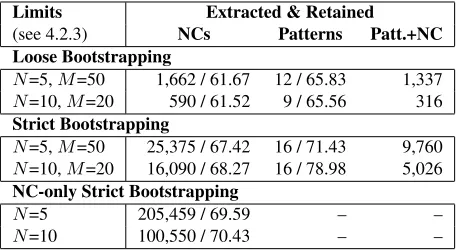
Table 2: Total number and accuracy in % for NCs, pat-terns and NC-pattern pairs extracted and retained for each of the three methods over all iterations.
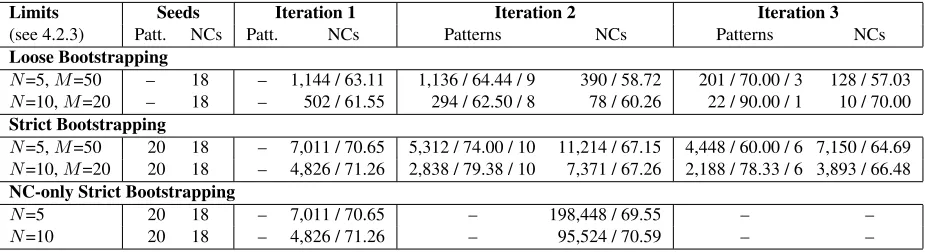
Tables 2 and 3 show the overall results. As we mentioned in section 4.2.3, at each iteration, we fil-tered out all patterns that were extracted less thanN times or with less thanM NCs. Note that we only used the 10 most frequent NCs per pattern as NC seeds for NC extraction in the next iteration ofstrict
bootstrappingandNC-only strict bootstrapping.
Ta-ble 3 shows the results for two value combinations of (N;M): (5;50) and (10;20). Note also that if some NC was extracted by several different patterns, it was only counted once. Patterns are subject to particular NCs, and thus we show (1) the number of patterns extracted with all NCs, i.e., unique NC-pattern pairs, (2) the accuracy of these pairs,4 and
(3) the number of unique patterns retained after fil-tering, which will be used to extract new noun com-pounds on the second step of the current iteration.
4One of the reviewers suggested that evaluating the accuracy
of NC-pattern pairs could potentially conceal some of the drift of our algorithm. For example, whilewater cup/be filled with is a correct NC-pattern pair,water cupis incorrect for MAKE2; it is probably an instance of Levi’s FOR. Thus, the same
Limits Seeds Iteration 1 Iteration 2 Iteration 3
(see 4.2.3) Patt. NCs Patt. NCs Patterns NCs Patterns NCs
Loose Bootstrapping
N=5,M=50 – 18 – 1,144 / 63.11 1,136 / 64.44 / 9 390 / 58.72 201 / 70.00 / 3 128 / 57.03
N=10,M=20 – 18 – 502 / 61.55 294 / 62.50 / 8 78 / 60.26 22 / 90.00 / 1 10 / 70.00 Strict Bootstrapping
N=5,M=50 20 18 – 7,011 / 70.65 5,312 / 74.00 / 10 11,214 / 67.15 4,448 / 60.00 / 6 7,150 / 64.69 N=10,M=20 20 18 – 4,826 / 71.26 2,838 / 79.38 / 10 7,371 / 67.26 2,188 / 78.33 / 6 3,893 / 66.48 NC-only Strict Bootstrapping
N=5 20 18 – 7,011 / 70.65 – 198,448 / 69.55 – –
N=10 20 18 – 4,826 / 71.26 – 95,524 / 70.59 – –
Table 3: Evaluation results for up to three iterations. For NCs, we show the number of unique NCs extracted and their accuracy in %. For patterns, we show the number of unique NC-pattern pairs extracted, their accuracy in %, and the number of unique patterns retained and used to extract NCs on the second step of the current iteration. The first column shows the pattern filtering thresholds used (see Section 4.2.3 for details).
The above accuracies were calculated based on human judgments by an experienced, well-trained annotator. We also hired a second annotator for a small subset of the examples.
For NCs, the first annotator judged whether each NC is an instance of MAKE2. All NCs were judged,
except for iteration 2 of NC-only strict bootstrap-ping, where their number was prohibitively high and only the most frequent noun compounds extracted for each modifier and for each head were checked: 9,004 NCs forN=5 and 4,262 NCs forN=10.
For patterns, our first annotator judged the cor-rectness of the unique NC-pattern pairs, i.e., whether the NC is paraphrasable with the target pattern. Given the large number of NC-pattern pairs, the an-notator only judged patterns with their top 10 most frequent NCs. For example, if there were 5 patterns extracted, then the NC-pattern pairs to be judged would be no more than 5×10 = 50.
Our second annotator judged 340 random exam-ples: 100 NCs and 20 patterns with their top 10 NCs for each iteration. The Cohen’s kappa (Cohen, 1960) between the two annotators is .66 (85% initial agree-ment), which corresponds to substantial agreement (Landis and Koch, 1977).
7 Discussion
Tables 2 and 3 show that fixing one of the two nouns in the pattern, as instrict bootstrappingandNC-only
strict bootstrapping, yields significantly higher
ac-curacy (χ2 test) for both NC and NC-pattern pair extraction compared toloose bootstrapping.
The accuracy forNC-only strict bootstrappingis a bit higher than forstrict bootstrapping, but the ac-tual differences are probably smaller since the eval-uation of the former on iteration 2 was done for the most frequent NCs, which are more accurate.
Note that the number of extracted NCs is much higher with the strict methods because of the higher number of possible instantiations of the generalized query patterns. For NC-only strict bootstrapping, the number of extracted NCs grows exponentially since the number of patterns does not diminish as in the other two methods. The number of extracted patterns is similar for the different methods since we select no more than 20 of them per iteration.
Overall, the accuracy for all methods decreases from one iteration to the next since errors accumu-late; still, the degradation is slow. Note also the ex-ception ofloose bootstrappingon iteration 3.
Comparing the results for N=5 and N=10, we can see that, for all three methods, using the latter yields a sizable drop in the number of extracted NCs and NC-pattern pairs; it also tends to yield a slightly improved accuracy. Note, however, the exception
of loose bootstrapping for the first two iterations,
Acknowledgments
This research is partially supported (for the sec-ond author) by the SmartBook project, funded by the Bulgarian National Science Fund under Grant D002-111/15.12.2008.
We would like to thank the anonymous reviewers for their detailed and constructive comments, which have helped us improve the paper.
References
Ken Barker and Stan Szpakowicz. 1998. Semi-automatic recognition of noun modifier relationships. In Pro-ceedings of the 17th International Conference on Computational Linguistics, pages 96–102.
Matthew Berland and Eugene Charniak. 1999. Finding parts in very large corpora. InProceedings of the 37th Annual Meeting of the Association for Computational Linguistics, ACL ’99, pages 57–64.
Cristina Butnariu and Tony Veale. 2008. A concept-centered approach to noun-compound interpretation. In Proceedings of the 22nd International Conference on Computational Linguistics, COLING ’08, pages 81–88.
Cristina Butnariu, Su Nam Kim, Preslav Nakov, Diar-muid ´O S´eaghdha, Stan Szpakowicz, and Tony Veale. 2009. Semeval-2010 task 9: The interpretation of noun compounds using paraphrasing verbs and prepo-sitions. InProceedings of the Workshop on Semantic Evaluations: Recent Achievements and Future Direc-tions, SEW ’09, pages 100–105.
Cristina Butnariu, Su Nam Kim, Preslav Nakov, Diar-muid ´O S´eaghdha, Stan Szpakowicz, and Tony Veale. 2010. SemEval-2010 task 9: The interpretation of noun compounds using paraphrasing verbs and prepo-sitions. InProceedings of the 5th International Work-shop on Semantic Evaluation, SemEval-2, pages 39– 44.
Jacob Cohen. 1960. A coefficient of agreement for nom-inal scales. Educational and Psychological Measure-ment, 1(20):37–46.
James R. Curran, Tara Murphy, and Bernhard Scholz. 2007. Minimising semantic drift with mutual exclu-sion bootstrapping. InProceedings of the Conference of the Pacific Association for Computational Linguis-tics, PACLING ’07, pages 172–180.
Pamela Downing. 1977. On the creation and use of En-glish compound nouns. Language, 53:810–842. Christiane Fellbaum, editor. 1998. WordNet, An
Elec-tronic Lexical Database. MIT Press, Cambridge, Mas-sachusetts, USA.
Charles J. Fillmore, Collin F. Baker, and Hiroaki Sato. 2002. Seeing arguments through transparent struc-tures. InProceedings of the Third International Con-ference on Language Resources and Evaluation, vol-ume III ofLREC ’02, pages 787–791.
Timothy Wilking Finin. 1980. The semantic interpre-tation of compound nominals. Ph.D. thesis, Univer-sity of Illinois at Urbana-Champaign, Champaign, IL, USA. AAI8026491.
Thierry Fontenelle. 1999. Semantic resources for word sense disambiguation: a sine qua non. Linguistica e Filologia, 9:25–41.
Roxana Girju, Dan Moldovan, Marta Tatu, and Daniel Antohe. 2005. On the semantics of noun compounds.
Computer Speech and Language, 19(44):479–496. Roxana Girju, Preslav Nakov, Vivi Nastase, Stan
Sz-pakowicz, Peter Turney, and Deniz Yuret. 2007. Semeval-2007 task 04: Classification of semantic rela-tions between nominals. InProceedings of the 4th Se-mantic Evaluation Workshop, SemEval-1, pages 13– 18.
Roxana Girju, Preslav Nakov, Vivi Nastase, Stan Sz-pakowicz, Peter Turney, and Deniz Yuret. 2009. Classification of semantic relations between nominals.
Language Resources and Evaluation, 43(2):105–121. Roxana Girju. 2007. Improving the interpretation of
noun phrases with cross-linguistic information. In
Proceedings of the 45th Annual Meeting of the Asso-ciation of Computational Linguistics, ACL ’07, pages 568–575.
Marti Hearst. 1992. Automatic acquisition of hy-ponyms from large text corpora. In Proceedings of the Fourteenth International Conference on Computa-tional Linguistics, COLING ’92, pages 539–545. Iris Hendrickx, Su Nam Kim, Zornitsa Kozareva, Preslav
Nakov, Diarmuid ´O S´eaghdha, Sebastian Pad´o, Marco Pennacchiotti, Lorenza Romano, and Stan Szpakow-icz. 2010. SemEval-2010 task 8: Multi-way classifi-cation of semantic relations between pairs of nominals. In Proceedings of the 5th International Workshop on Semantic Evaluation, SemEval-2, pages 33–38. Su Nam Kim and Timothy Baldwin. 2005. Automatic
interpretation of compound nouns using WordNet sim-ilarity. InProceedings of 2nd International Joint Con-ference on Natural Language Processing, IJCNLP ’05, pages 945–956.