Collaborative Annotation and Visualization of Functional and
Discourse Structures
Hengbin Yan
Halliday Centre for Intelligent Applications of Language Studies, Department of Chinese, Translation and Linguistics, City University of Hong Kong
Jonathan Webster
Halliday Centre for Intelligent Applications of Language Studies, Department of Chinese, Translation and Linguistics, City University of Hong Kong
Abstract
Linguistic annotation is the process of adding additional notations to raw linguistic data for descriptive or analytical purposes. In the tagging of complex Chinese and multilingual linguistic data with a sophisticated linguistic framework, immediate visualization of the complex multi-layered functional and discourse structures is crucial for both speeding up the tagging process and reducing errors. The need for large-scale linguistically annotated corpora has made collaborative annotation increasingly essential, and existing annotation tools are inadequate to the task of providing assistance to annotators when dealing with complex linguistic structural information. In this paper we describe the design and development of a collaborative tool to extend existing annotation tools. The tool improves annotation efficiency and addresses certain difficulties in representing complex linguistic relations. Here, we adopt annotation based on Systemic Functional Linguistics and Rhetorical Structure Theory to demonstrate the effectiveness of the interface built on such infrastructure.
Keywords: Linguistic Annotation, Linguistic Visualization, Cross-domain References
1. Introduction
Recent years have witnessed an increasing need for large-scale high-quality annotated corpora on complex Chinese linguistic information where no automated annotators are available. Annotation on multi-level data complex structural relationships in such linguistic frameworks as Systemic Functional Grammar (SFG) [1] and Rhetorical Structure Theory [2] is a difficult task.
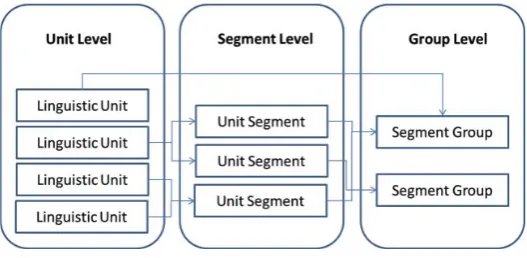
2) Segment Level: continuous range of linguistic elements (phrases, clauses, sentences, and paragraphs)
3) Group Level: groups of ranges of linguistic Elements (non-continuous grammatical units, i.e., clausal relations, hierarchical discourse trees in RST)
Figure 1: Three primary levels of linguistic relations.
Figure 1 illustrates a simplified abstract view of the three-level structure. At the Unit Level, the basic linguistic elements (e.g. words, morphemes) are either broken up into several separate linguistic segments, or joined together by an unlimited number of continuous units into a common segment. For example, the word uncovered can be made up of several morphemes (i.e., un + cover + ed), each represented by a single segment, or it can be joined together by another word (e.g. cases) to form a new segment (uncovered cases). At the Segment Level, segments (e.g. morphemes, words) can be part of a larger segment (e.g. clauses, paragraphs) in an indefinitely recursive and hierarchical manner. The Group Level is a generic structure that deals with relations among linguistic units and segments. For example, in RST there are different discourse relations (e.g. Antithesis, Condition) and roles (e.g. Nucleus, Satellite). Such relations in the data model are defined as groups, with one textual segment pointing to another and attaching a relation (function, tag, or role) to the pointed segment. Similar to segments, the number of segments in each group is unlimited and the group as a whole can in turn be pointed to by another group with an arbitrary depth of recursion and hierarchy, but unlike units in segments, the segments in each group can be non-continuous and overlapping, thus enabling any complex relations to be aptly defined. In our application scenarios, we focus on annotating hierarchical discourse structures in RST and the three layers of metafunctions in SFG. These layers of linguistic units and the complex relations among them are represented using the proposed common structure.
In one-to-many and many-to-many relations, a sequence of ordered linguistic objects may be linked across different layers. Such interrelationships can form complex linguistic networks representing intricate linguistic meanings. Due to their inherent complexity, understanding such relationships can pose challenges to annotators, especially when such relationships are constantly added or removed in a collaborative annotating environment. The platform introduces real-time visualization of the structural relations as the annotation progresses, allowing the annotator to keep track of and make changes to annotations accordingly.
In annotating such structural relations, each unit is given a unique identifying number which we use for easy grouping of the units and to define the complex, often embedded interrelations between the units (e.g., in SFG these include logico-semantic relations such as
Parataxis and Hypotaxis, Elaboration and Extension etc.).
2.3 Visualized Cross-domain Reference
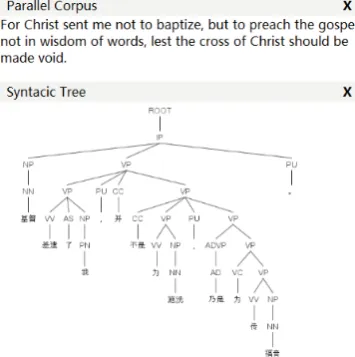
functional structures, the automatic annotation of semantic and discourse information has been largely ignored. One difficulty has been the lack of high-quality corpora to bootstrap the automation, a time and cost extensive task that has to be done manually. In a collaborative environment, leveraging the resources of non-expert annotators can significantly boost the annotation efficiency, as has been demonstrated by recent experiments [11]. The lack of sufficient linguistic expertise, however, restrains non-expert linguistic annotators from engaging in more complex annotations. The annotation process can be significantly accelerated using assistance and reference tools such as a tag dictionary [12]. Different annotators may form different opinions on particular annotations based on their own reference to acquired linguistic knowledge. By unifying the source of such knowledge, we may be able to boost inter-annotator agreement on issues where they otherwise differ. Our annotation tool is built on a generic infrastructure compatible with various formats of linguistic information such as Treebanks, multilingual corpora, part-of-speech (POS) annotation and output from statistical syntactic parsers such as the Stanford parser. These additional corpora and annotations not only serve to enrich textual data with additional layers of linguistic information but can be potentially used to assist in annotation. In our current application scenarios, when annotating a corpus the annotator is often faced with the following tasks:
1) Divide the text into meaningful segments
2) Analyze the segmented texts for the internal structure, such as functional structure of a clause or sentence
3) Analyze the functions of each functional/semantic unit, such as the part-of-speech of each word
4) Refer to a previously annotated section similar to the one being annotated 5) Consult a thesaurus for entries to the words whose meaning is unclear
6) Consult a multilingual corpus parallel to or aligned with the corpus (when annotating a corpus in another language).
Figure 2: Automatically generated Reference Channels for annotation.
Figure 3: The web-based annotation interface.
3. APPLICATION
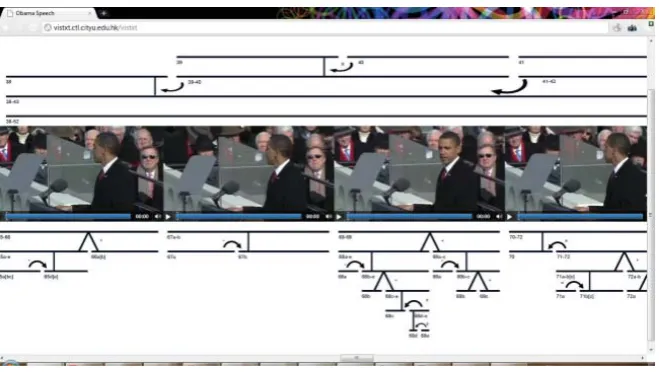
The tagger built on the proposed infrastructure can be used for visualizing various types of analysis. Rhetorical Structure Theory, for example, has been adopted for the tagger to help visualize the analysis of US President Obama’s speeches.
Rhetorical Structure Theory (RST) is “an abstract set of convention” which “provides a general way to describe the relations among clauses in a text” [2]. This theory is widely used for text analysis for complex multilayer sentence and paragraph relations.
These sentence/paragraph relations are tagged using the proposed tagger, visualized and presented with the help of the “RST generator” which generates the RST figures, visualizing sentence/paragraph interpretation pictures.
Figure 4: Visualized textual structures based on RST tagger outputs.
constructed (Figure 4).
4. CONCLUSION
In this paper, we present a collaborative tool for Chinese and multilingual linguistic structure annotation with visualized cross-domain references. We begin by a discussion on current trends in annotating corpora and the requirements for developing a new annotation tool. A review of existing linguistics analysis tool is presented in our introduction.
We demonstrate with example applications that 1) a large collaborative annotation platform is necessary for speeding up large-scale manual or semi-automated Chinese linguistic annotation; 2) annotating complex linguistic information is a difficult and error-prone process; 3) visualized annotation references for language structures can help facilitate the annotation process, especially in a collaborative environment; and 4) cross-domain references can further assist annotators in making the right decisions.
Our tool is designed with collaborative tasking and cross-domain analysis in mind. All linguistic signals are converted into interoperable database structures in real time when users submit their input. Data obtained from different domains can be stored in the database structure and used to serve as the basis for cross-domain references. The use of our tools for handling these relationships requires a minimal learning curve. The same system may also be used for educational purposes like annotation training and examination marking for students. Usage examples may include exercises on identifying SFL constituents, translation alignment and other language analysis.
REFERENCES
[1] M. A. Halliday and C. M. Matthiessen, “An introduction to functional grammar,” London: Edward Arnold, 2004.
[2] W. C. Mann and S. A. Thompson, “Rhetorical structure theory: Toward a functional theory of text organization,” Text, vol. 8, no. 3, pp. 243–281, 1988.
[3] M. Honnibal and J. R. Curran, “Creating a systemic functional grammar corpus from the Penn treebank,” Proceedings of the Workshop on Deep Linguistic Processing -
DeepLP ’07, no. June 2005, p. 89, 2007.
[4] C. Müller and M. Strube, “Multi-level annotation of linguistic data with MMAX2,” Corpus Technology and Language Pedagogy: New, pp. 197–214, 2006.
[5] A. Burchardt, K. Erk, A. Frank, A. Kowalski, S. Pado, and M. Pinkal, “SALTO–a versatile multi-level annotation tool,” in Proceedings of LREC 2006, 2006, pp. 517–520.
[6] M. O’Donnell, “Demonstration of the UAM CorpusTool for text and image annotation,” Proceedings of the 46th Annual Meeting of the Association for Computational
Linguistics on Human Language Technologies Demo Session - HLT ’08, no. June, pp. 13–16, 2008.
[7] X. Ma, H. Lee, S. Bird, and K. Maeda, “Models and tools for collaborative annotation,” Arxiv preprint cs/0204004, 2002.
[8] S. Dipper, “XML-based Stand-off Representation and Exploitation of Multi-Level Linguistic Annotation,” German Research, no. 03.
XML-based Representation and Flexible Visualization,” Computational Linguistics, 2004.
[10] M. Stührenberg, D. Goecke, N. Diewald, A. Mehler, and I. Cramer, “Web-based annotation of anaphoric relations and lexical chains,” in Proceedings of the Linguistic Annotation Workshop on - LAW ’07, 2007, no. June, pp. 140–147.
[11] J. Chamberlain, U. Kruschwitz, and M. Poesio, “Constructing an anaphorically annotated corpus with non-experts,” Proceedings of the 2009 Workshop on The People’s Web Meets NLP Collaboratively Constructed Semantic Resources - People's Web '09. Association for Computational Linguistics, Morristown, NJ, USA, pp. 57–62, 2009.
[12] M. Carmen, P. Felt, R. Haertel, D. Lonsdale, O. Merkling, E. Ringger, and K. Seppi, “Tag Dictionaries Accelerate Manual Annotation,” Interface, pp. 1660–1664, 2006.