Transformed Subcategorization Frames in Chunk Parsing
Leonardo Lesmo & Vincenzo Lombardo
Dipartimento di Informatica and Centro di Scienza CognitivaUniversità di Torino C.so Svizzera, 185 - I-10149 Italy
{lesmo, vincenzo}@di.unito.it
Abstract
This pa per describes an approach to treebank development which relies on the manual development of annotation tools. The overall process of tree annotation is described, and a special emphasis is put on the description of the last tool which has been built, i.e. a dependency-based robust chunk parser. The modularization of the parser and the central role of verbal subcategorization is presented. The first experimental results, carried out on a corpus of 645 sentences are reported and discussed.
1. Introduction
It is well known that the amount of linguistic resources available for different languages vary considerably in extent (see, e.g., (ATALA, 1999) for report of treebanks for German, Spanish, Chinese, Polish). Currently, Italian, despite its historical and cultural value, stands rather low in the scale. Although some wide-scale projects are under way (e.g. CLIPS: Lessico Computazionale dell’Italiano Parlato e Scritto, Computational Lexicon of Spoken and Written Italian), there is a shortage of POS annotated corpora. The situation of procedural resources, as POS taggers and wide-coverage robust parsers is even worse.
The construction of annotated corpora is a particularly labor-intensive and time-consuming task usually performed by human annotators with the help of software tools. Usually the annotation process occurs in two phases: a fully automated Part Of Speech (POS) tagging and a syntactic annotation that can be performed in different ways. For example, in the Penn Treebank (Marcus et al., 1993) syntactic bracketing consists of the manual correction of an automated parsing output where the annotator possibly "glues" together disconnected syntactic chunks. In the NEGRA treebank (Brants et al., 1999) the annotation is an interactive process that the annotator can stop at any point to correct or alter the structure automatically generated. In general, syntactic annotation schemata of existing treebanks try to achieve a trade-off between representation accuracy and corpus data coverage satisfying some requirements of theory-independence (Skut et al., 1997) (XTAG Project: www.cis.upenn.edu/~xtag) and annotation consistency between the analyses of different phenomena (Marcus et al., 1994). Data coverage requires a formalism that is able to represent all the types of specific linguistic phenomena occurring in the corpus, catching most of the peculiarities of the represented natural language.
Recent work in corpus-based linguistic analysis has pointed out the necessity of including predicate-argument structures in treebank annotation schemata (Marcus et al., 1994) (Skut et al., 1997). This permits the collection of
large data bases of subcategorization frames and their relative statistics, that are of valuable help for the accuracy of parsing models (Collins, 1997), and in the implementation of IE systems (Vilain, 1999).
In the last five years, the Turin University NLP working group has engaged in a first effort in building NL resources for Italian. The research proceeded in steps, and has a threefold goal:
- to develop annotated corpora - to develop tools for annotation - to develop linguistic knowledge bases
While the first two objectives are clear enough, the third one requires some words of explanation. We believe (in agreement with, e.g. (Skut et al., 1997)) that the parsing task could be made easier by exploiting pieces of well-founded linguistic knowledge. In particular, we have paid considerable attention to the use of subcategorization information, especially for verbs, but also for nouns and some adjectives. Of course, subcategorization data, as other pieces of linguistic knowledge, is not readily available for Italian; but our mostly manual approach to parser development enabled (or forced) us to build also a depository of subcategorization information. So, as a temporary result of the work, which is under way, we have today available not only 1200 parsed sentences, but also a set of about 360 verbs for which accurate subcategorization data are available.
In short, the current process of treebank development is based on the following steps:
1. A text (without any form of preprocessing) is submitted to a tokenizer. The tokenizer keeps apart standard words from punctuation marks, special symbols (e.g. @), and numbers. The tokenizer will not be discussed in the present paper.
Fig.1 – The Dependency Parse Tree of the sentence “E’ italiano, come progetto e realizzazione, il primo porto turistico dell’Albania”
iguating among those tags. Rules are organized in packets, each of which contains the rules that handle a given ambiguity. So, there exists a packet for NOUN-VERB ambiguity, another packet for ADJ-ADV-NOUN, and so on. Each packet also include a default tag, which is chosen in case no rule applies. Most packets aim at disambiguating among categories (e.g. NOUN and VERB), but a few packets apply to subcategories or features (e.g. for PERSON ambiguity of verbs).
Each rule has the simple form
IF condition THEN tag CF certainty-factor
where certainty-factor can assume the values C(ertain), A(lmost certain), U(ncertain), and is used to state the priority of application of the rules. The condition tests the neighborhood of the ambiguous word, which consists in the two preceding and the two following words. Notice that the previous words have already been disambiguated, but the next two words can still be possibly ambiguous. This makes the checks on the following context less reliable than the ones on the preceding context.
Currently, we use 136 rules, 127 of which handle inter-category ambiguities, while 9 of them apply to intra-category ambiguities.
The original tests, carried out on an eterogeneous corpus including newspaper articles, chapters of novels and of technical books, amounting to 48.000 lexical items gave a result of 3.42% wrong tags. However, we have recently started the analysis of some parts of the Italian Civil Code. Unexpectedly, the tagging errors on the sentences analyzed (13491 items, including punctuation) were 260 (1.93%). This is probably due to the more regular structure of the legal language, with respect to
other texts, but it can be argued (although the new data are limited in size) that the tagging rules implicitly encode some principles of well-written Italian; this is presumably due to their having been written manually, trying to face the problems found in the corpus from a "general knowledge of language" perspective: the encoder of the rules, in fact, tried to write tagging rules reasonably general, i.e. to avoid rules applying just to peculiar cases casually occurring in the corpus. The tagger disambiguates about 800 words per second, in compiled LISP code on a Pentium III processor (including the writing of the output file).
4. Syntactic knowledge: Subcategorization
In order to describe the chunk parser, we need to introduce the approach to verbal subcategorization we have adopted. Each verbal subcategory is associated with a Subcategorization Class (SC); SC's are arranged in a taxonomy. The root of the taxonomy is the class VERBS, while other nodes are, for instance, TRANS(itive), INTRANS(itive). Other nodes refer to less standard subcategories; for instance, INTRANS-INDOBJ-PRED refers to verbs as "sembrare" (to seem), which admit a subject (which can be a subordinate), an indirect object, and a predicative complement:
Ex 1. La casa gli sembra bella (The house to-him seems nice)
Ex 2. Correre nei prati mi sembra splendido (To-run in-the fields to-me seems beautiful)
Ex 3. Mario ha perso di vista il suo obiettivo (Mario has lost sight of [the] his goal)
Each SC is associated with a subcategorization frame (SF), which includes the definition of one or more complements, given by the complement name (i.e. the label of arcs that will appear in the resulting DPT to connect a verb with that complement), and a description of the syntactic structure licensed for that complement.
Actually, the true definition of the set of complements defined for a class is obtained via an inheritance mechanism. For instance, the SC of SUBJ-VERBS includes the definition of standard 'subjects', and the class TRANS (transitives) is a daughter of SUBJ-VERBS. So, for TRANS, the syntactic structure of subjects need not be defined, since it is inherited from SUBJ-VERBS. Currently, the hierarchy includes 150 classes, 37 of which refer to verbal locutions (as "aver bisogno", to need). 361 verbs have been classified according to the classes. On the average, each verb belongs to 2.3 different classes.
Of course, the definition of the classes regards a 'base' form: the verb is active and finite, pro-drop has not been applied, no cliticization and no movement has occurred. But the ve rb can appear in a sentence in other forms, for which the surface realization defined in the class cannot match the input pattern. So, the base class definitions undergo a process of transformation, where all possible (according to the current set of 11 defined transformations) surface realizations are generated. The final outcome of this process is that the original (base) hierarchy (of 150 nodes) is translated into a surface hierarchy including 3507 transformed classes.
For instance, the base class TRANS gives rise to 28 derived class (among which TRANS+INFINITIVIZATION, TRANS+PASSIVIZATION, TRANS+INFINITIVIZATION+ OBJECT-RAISING+IMPERSONALIZATION, etc.). In some cases, the complement label is affected by a transformation; although our approach is strictly mono-stratal, we have adopted the convention that a transformed complement name can keep trace of the transformation: so, arc labels as SUBJ/AGTCOMPL can be found in the parse trees.
5. A chunk parser
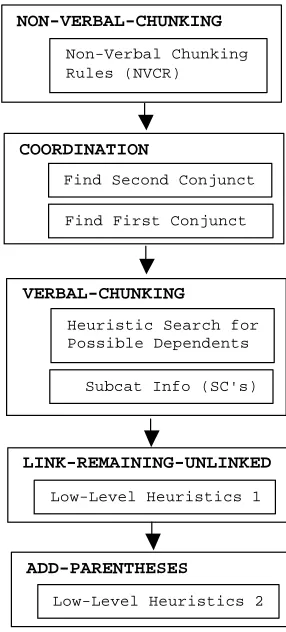
As stated in the introduction, the parser operates on the POS-tagged sentences, after they have been manually corrected. It works according to the steps shown in Fig.1.
5.1 Non-Verbal Chunking
Non-verbal chunking rules (NVCR) work in a rather standard way, starting from smaller chunks, and then trying to include them in larger chunks. It must be observed that sentential dependents (subordinates and relative clauses) are not linked to their governor in this step, but they are left unattached until the Verbal-chunking step is applied.
Each NVCR is associated with a given category, and aims at finding links from a word to that category (the governor) to a depending word. The format of a NCVR is:
(<categ> <subcateg> <direction> <condition> <label>)
where:
Figure 1 - The Chunk-Parser
?? <categ> is the category of the head word ?? <subcateg> is the subcategory of the head word ?? <direction> specifies where the dependent can
appear (see below)
?? <condition> specifies the features of the dependent ?? <label> is the label that must be assigned to the
dependency arc connecting the head with the dependent
A NCVR is applied when a word (the potential 'head') of the given <category> and <subcategory> is found in the text, and aims at looking for surrounding words that can act as dependents for the head. Such a dependent must be found in a position specified by <direction>, and must have the features specified in <condition>. If such a word is found, then it is linked to the head, via an arc labelled as <label>. The major power of the NVCR comes from the flexibility of the <direction> specification. The simplest cases are 'before' and 'after', which require that the dependent comes immediately before or after (i.e. it is adjacent to) the head (as for adverbs with respect to a governing adjective). A bit more complex are 'precedes <skip-word>*' and 'follows <skip-word>*', which
NON-VERBAL-CHUNKING
Non-Verbal Chunking Rules (NVCR)
COORDINATION
Find Second Conjunct
Find First Conjunct
VERBAL-CHUNKING
Heuristic Search for Possible Dependents
Subcat Info (SC's)
LINK-REMAINING-UNLINKED
Low-Level Heuristics 1
ADD-PARENTHESES
Italian allows for the subject to follow the verb, so that the assignment of Subject and Direct Object can only be made on the basis of semantic knowledge. So we introduced some heuristics to choose the best assignment (heuristics that would fail, for instance, in the example above). In sum, there are three possible sources of errors: lack of information about the subcategorization frame of a given verb, failure in determining the right set of dependents, and failures in case assignment (section 6).
5.4 Unlinked elements and parentheses
After the Verbal Chunking step, some elements still remain unlinked to any parent. In particular, the root of the tree, the verbal heads of relative clauses, verbs governed by subordinating conjunctions, punctuation. Moreover, we approached the problem of parenthesized material by analyzing the contents of each parenthesis as a single sentence, so the parenthesis as a whole has still to be inserted in the whole tree. The last two steps of the parser aims at completing the construction of the parse tree. The unattached verbs are inspected to find the most promising attachment point (a noun preceding a relative pronoun or a subordinating conjunction); punctuation is attached to the lowest common ancestor of the surrounding words. For parentheses, the situation is a bit more complex, since the choice of the attachment point depends on the head word inside the parenthesis (which could be a conjunction, a preposition, a noun, etc.). The results reported in section 6 show that in the attachment of these elements is much more domain dependent than for the elements handled in the previous steps. In other words, it is hard to devise heuristics of wide application.
6.
Experimental results
The experiments have been carried out on 645 sentences, for a total of 17.397 items. The sentences are divided in four groups: 437 sentences from the Italian Civil Code, used to refine the parse rules (LEARN); 100 sentences from the same corpus (TEST1), 58 sentences from a corpus semantically related to the learn set (legal sentencing: TEST2), and 50 sentences from an heterogeneous corpus extracted from newspaper articles (TEST3).
It has been considered as an error: - The wrong choice of the parent - The wrong arc label
The first type of errors are Attachment Errors, while the second type concerns mainly the selection of arguments for the verbs.
The errors have been subdivided according to the step of the parser where the error has been made, so there are errors in the application of Non-verbal Chunking Rules (NVCR), errors in the treatment of coordination (COORD), errors in matching the case frames of verbs (Verbal Rules: VR), errors in the attachment of the final unlinked items and in the placement of parentheses (UNL+PAR). The total figures are reported in Table 1. The first step takes care of 50.5% of all arcs appearing in the DPT’s (8786 applications of NVCR rules), and is the most reliable. Although there is a remarkable difference between the three sets of sentences, the heuristics adopted (see Footnote 1) gives good results. The difference between LEARN and TEST2-TEST3 is due to the introduction of some specific rules (e.g. for interpreting dates in the form 27-2-1998) which are useful in the Civil code, but do not apply commonly outside it. The better result of LEARN with respect to TEST1 is due to rules which, although they represent structurally valid principles, are applied to instances appearing just in LEARN. Finally, the residual errors in LEARN depend on the impossibility (or inability of the human rule writer) to devise disambiguating principles in cases where the correct choice seems to be possible just on the basis of semantic preferences.
The COORD step seems to work rather well, but it must be observed that the errors reported in the table concern only the choice of the two conjuncts, while they do not cover unrecognized coordination. This happens in sequences as “John, two girls, and an old man”, where the first comma acts as a coordination, but it is not recognized as such by the parser. If we include these cases, in the analyzed corpus, we find 777 coordinating conjunctions (i.e. 1554 items that should be linked by the COORD rules, instead of the reported 1210); so, the actual figure should be 538 (194 detected + 344 undetected) errors in 1454 items (i.e. 37.00%). The 344 errors not appearing in this column occur in the table mainly as UNL+PAR errors.
The VR step shows very large differences in the corpus. Although they cover just 21.58% of the links, the presence of subcategorization data enables the parser to perform somewhat better. In the LEARN set, we have all verbs correctly classified, and the 16.84% of errors is due to wrong matches between subcategorization pattern and input pattern (e.g. Direct Object and Subject exchanged; see Ex.5 above), and to errors in the initial hypothesis of attachment of a dependent to the verb (Heuristic Search for Possible Dependents in Fig.1). In TEST1, some of the verbs appear also in LEARN, but some unseen verbs appear, so there is a limited decrease in performances. In
NVCR COORD VR UNL + PAR TOTAL
Items Tot Err % Tot Err % Tot Err % Tot Err % Tot Err %
TEST1 2901 1494 51 3.41 179 27 15.08 630 171 27.14 598 183 30.60 2901 432 14.89 TEST2 2166 1169 48 4.11 93 33 35.48 493 182 36.92 411 184 44.77 2166 447 20.64 TEST3 1854 866 36 4.16 94 25 26.60 490 185 37.76 404 204 50.50 1854 450 24.27
Total 17397 8786 204 2.32 1210 194 16.03 3755 944 25.27 3646 953 26.14 17397 2295 13.19
Table 1. Errors made by the parser in its different steps
TEST3, where most of the verbs lack accurate subcategorization infos, the performance drops to a 37.76% of errors. However, the results on TEST2 are somewhat contradictory, since the semantic domain is the same as TEST1 (and LEARN). On a closer inspection, however, we see that the average sentence length of TEST2 (37.3) is greater than in the other sets, with the exception of TEST3 (one sentence in TEST2 included 188 items, the longest sentence we ever found in our corpora), so, in this case, the low performance of the VR rules are probably due to the difficulties encountered by the heuristcs which determine the possible dependents (but a more in-depth analysis is required here).
Finally, in the last two steps, it is apparent that the small size of the LEARN group has strongly affected the generality of the heuristics written by the human expert, so that the uniformity of TEST1 with respect to LEARN still preserves some reasonable figures, but on the other data they affect very negatively the overall performances. It can be argued that the rules used in the first three steps arose as a combination of data inspection and human writer intuitions about language, while in these last two steps, the ‘intuition’ component is largely absent (in particular because of the rather irregular use of punctuation, and of the unconstrained application of parentheses).
With respect to time, the parser, which, as we said above, takes as input a POS-disambiguated file, produces the resulting parse tree at a rate of about 700 words per second (compiled Lisp code on a Pentium III PC, under Linux).
7. Conclusions
This paper has presented an approach to treebank development supported by manually developed annotation tools. In particular, the focus of the paper has been on a robust chunk parser, and on its exploitation of knowledge about verbal subcategorization frames. The experimental results have shown that the parser performs much better in case such knowledge is available.
One of the sources of efficiency in the time performances mentioned above is that the parser is strictly deterministic: no label assigned in one of the steps appearing in Fig.1 is changed by a following step. However, the lack of interaction among the different module is also a primary source of errors. In particular, for PP attachment, it seems that the only way to choose
the best solution is to make preferences contrast different possibilities. However, the NVCR have to take a decision before the VR enter into play. We are currently investigating the effect of interleaving in some steps of the parser.
In a similar way, inside the Verbal Chunking phase, the possible dependents of a verb are hypothesized before the knowledge about subcategorization is applied. Again, the possibility of accepting or rejecting a dependent seem to be useful to improve the correctness of the resulting structure, but this has a non-trivial impact on the strategy for matching the subcategorization frames against the input.
8. References
ATALA (1999). Proceedings of Treebanks workshop – Journées ATALA sur les corpus annotés pour la syntaxe, 18-19 juin 1999, Paris, http://talana.linguist.jussieu.fr/treebanks99/.
Boella G., Lesmo L. (1998): Automatic refinement of Linguistic rules for tagging, Proc. 1st Int. Conf. on Language Resources and Evaluation, LREC 1998, Granada, 923-929
Bosco C. (2000): A richer annotation schema for an Italian treebank. In C. Pilière, editor, P roc. of ESSLLI-2000 Student Session, Birmingham, 22-33.
Bosco C., Lombardo V., Vassallo D., and Lesmo L. (2000): Building a treebank for Italian: a data-driven annotation schema. In Proc. 2nd Int. Conf. on Language Resources and Evaluation, LREC 2000, Athens, 99-105.
Brants T., Skut W., Uszkoreit H. (1999): Syntactic annotation of a German newspaper corpus. In Proc. of Treebanks workshop – Journées ATALA sur les corpus annotés pour la syntaxe, Paris, 69-76.
Buchholz S., Veenstra J., Daelemans W. (1999): Cascaded grammatical relation assignment. EMNLP/VLC-99, University of Maryland, USA. CL/9906004.
Collins M. (1997): Three generative, lexicalized models for statistical parsing. In Proc. of the 35th Meeting of the ACL , 16-23.
Hajic J. (1998): Building a syntactically annotated corpus: the Prague Dependency Treebank In Issues of Valency and Meaning, Karolinum, Praha, 106-132.
Lesmo L., Lombardo V. (2000): Automatic assignment of grammatical relations. In Proc. 2nd Int. Conf. on Language Resources and Evaluation, LREC 2000, Athens, 475-482.
Mel’cuk I. (1988): Dependency syntax: theory and practice, SUNY University Press.
Marcus M.P., Santorini B., Marcinkiewicz M.A. (1993): Building a large annotated corpus of English: The Penn Treebank, Computational Linguistics 19, 313-330.
Marcus M.P., Kim G., Marcinkiewicz M.A., et al. (1994): The Penn Treebank: Annotating predicate argument structure. In Proc. of The Human Language Technology Workshop, San Francisco, Morgan-Kaufmann.
Skut W., Krenn B., Brants T., Uszkoreit H. (1997): An annotation scheme for free word order languages. In Proc. of the Fifth Conference on Applied Natural Language Processing (ANLP), Washington, D.C. Vilain M., (1999). Inferential Information Extraction, in