CSEIT1833297 | Received : 20 March 2018 | Accepted : 31 March 2018 | March-April-2018 [ (3 ) 3 : 262-269 ]
© 2018 IJSRCSEIT | Volume 3 | Issue 3 | ISSN : 2456-3307
306
Travelling Route System Using Data Mining
C. Thyagarajan , R. Balajiganesan, R. AravindDepartment of Computer Science Engineering, Panimalar engineering college, Chennai ,Tamil Nadu, India
ABSTRACT
Communitarian Filtering (CF) is a standout amongst the most successful admonishment ways to deal with adapt to measurements bounty in reality. CF strategies are proportionate to each client and thing. It's patter to separate the other of client's interests crosswise over non-indistinguishable region. The real welfare of this CF is to urge the first ware in an organization .The society clients may show and they may recommends the outline for that society, by this composition we may got pre-prominent movement, for that we are capable procurement the item hopefully. An Alternate admonish skill particularly Swam Friends, it describes inspecting procedure, By method for outline the individual who is in a gathering preparation a gathering in eatery or motel, one of his amigo is found close-by a lodging or hotel, we may meet the tip-off from those supporters. In this paper we dissect diverse framework based KNN calculations. We investigate distinctive strategies for figuring thing similitudes and diverse systems for acquiring proposal from them. At last we tentatively assess our outcomes and contrast them with the K closest neighbor approach and furthermore a novel Domain-touchy Recommendation (DsRec) calculation to make the rating forecast by investigating the client thing subgroup examination at the same time this calculation proposed two parts, for example, a lattice factorization demonstrate ,bi-grouping model.
I.
INTRODUCTION
The fundamental target of this Project is to be forecast of the client conduct and gathers the best organization remarks from the companions gathering. We are executing two methods (i.e) a novel Domain Sensitive Recommendation (DsRec) and Bi-Clustering model. We need to purchase an item in online through site implies, we know the item or thing's suggest by unknown companion's remark and appraisals. In this procedure we didn't foresee our thing with full fulfillment and didn't have the suggestion for the thing set. In this kind of item doesn't have an easy to understand thing to the consumer.The real drawback of this approach isnot effective to purchase an item. It doesn't have the suggestion about the product.In this approach needs to set aside greater opportunity to look through the
best item as a result of outsider remarks and ratings.So we could overcome from past approach. In our venture we are proposing shared filtering&previous proposing two techniques[6], there are a novel Domain Sensitive Recommendation and investigating strategy (overwhelm friends).Systematic tests directed on three certifiable datasets show the adequacy of our strategies. We utilize genuine client thing rating information to experimentally approvethe adequacy of our proposed demonstrate for rating forecast.
recommendation about the item too. By this we may get a best outcome [5].The preferred standpoint of this approach is to conquer the issue of versatility brought by numerous memory-based CF systems where the substantial computational weight is brought by the likeness figurings. The proposed approach is for the new client in a specific gathering, may get a recommendation from their companions. Our companions survey will be sure and in addition right. Our constant work is solid additionally; by this we may foresee the required outcome. Expectation is the best answer for stay away from some awful occasions happening at the same time.In this section we briefly represent some of the research literature related to collaborative filtering, recommender systems, data mining and personalization. Tapestry is one of the earliest implementations of collaborative filtering-based recommender systems. This system relies on the explicit options of people from a close-knit community, such as an office workgroup [6]. For this recommender system is to depend on the person. In Cheng and Church's theorem, a bi-cluster is defined as a subset of rows and columns with almost the same score.
Matrix factorization methods have been shown to be a useful decomposition for multivariate data as low dimensional data representations are crucial to numerous applications in statistics, signal processing and machine learning, an incomplete list of applications of matrix factorization methods includes:
2.1 Bio informatics
Environ metrics and chemo metrics
Text analysis
Miscellaneous, such as extracting speech features, transcription of polyphonic music passages, object.
Example using synthetic data set is intended as demonstration of the MF library since all currently.
BioinformaticText analysis
2.2 Collaborative filtering (CF) Techniques
In the newer, narrower sense, collaborative filtering is a method of making automatic predictions (filtering) about the interests of a user by collecting preferences or taste information from many users (collaborating).
2.2 a) Representative Algorithm a) Memory- Based Collaborative
User-Based CF
Item-Based CF
b) Model- Based Collaborative Filtering
Slope-One CF Dimensionality Reduction (Matrix Factorization) Eg.SVD,PCA
c) Hybrid CollaborativeFiltering
Combination of Memory-Based and Model- Based CF
II.
ALGORITHM DESCRIPTION
In our project wedescribe the use two algorithms, they are:-
1. Collaborative Filtering 2. KNN algorithm
1. COLLABORATIVE FILTERING:
Figure 1. Difference Between Collabartive and Content Based Filter
2.KNN ALGORITHM
K nearest neighbors is a simple algorithm that stores all obtainable cases and classifies new cases based on aanalogymeasure. The model representation for KNN is the entire training dataset. It is as modest as that.KNN has no model other than storing the entire dataset, so there is no learning entail. Efficient implementations can store the data using tangled data structures like k-d trees to make look-up and matching of new patterns during prediction well-organized. Because the entire grounding dataset is stored, you may want to think carefully about the consistency of your training data. It might be a good idea to curate it, update it often as new data becomes available and remove erroneous and outlier data. By using KNN algorithm we have to find the best product and get the product in a group of items with the help of our friend’s recommendation.
Figure 2. KNN ALGORITHM
III.
SYSTEM ARCHITECTURE
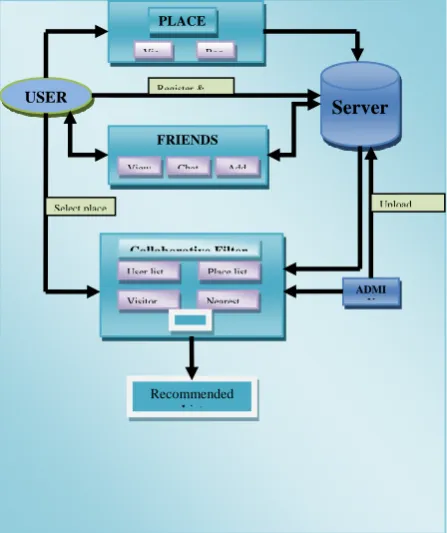
In this section, we will introduce the architecture diagram.
Figure3. Architecture Diagram
IV.
PROPOSED WORK
4.1. IDENTITY MANAGEMENT:
Thesecurity discipline that legalize the right individuals to ingress the right resources at the right times for the right reasons. It also includes the management of descriptive information about the user and how and by whom that information can be accessed and modified [1]. Managed entities typically include users, hardware and network resources and even applications.
The above technique’s used to identify the friend in domain sensitive recommendation. In user side user have to register their details, also user give the request place to the admin who upload the place details and also give the suggestion to the user about his friend in friend’s group. So the user has to identify the friend and give him/her to friend request in this side.
4.2. DATAMINING:
Currently, data in digital form are availableeverywhere, like on the Internet. It can be used to predict the future. Usually the statistical approach is used [8]. Data mining covers the entire
Server Vie Boo
PLACE
USER
FRIENDS View Chat Add
User list Place list
Nearest Visitor
Collaborative Filter
Recommended List
ADMI N Register &
Upload Select place
process of data analysis, including data cleaning and preparation and visualization of the results, and how to produce predictions in real-time so that specific goals are met.
To accompany, imagine a restaurant wants to use data mining to regulate when they should offer certain individuals. It looks at the information it has collected and creates classes based on when customers visit and what they order.
4.3. RELATIONSHIP:
In our project we have two relationship i.e. User to User and User to Place relationship. In user to user relations which defines the new user has a planned to go to a restaurant but he does not know about the restaurant so the new user has to search the existing user from the user list of the particular hotel or restaurant[7]. After searching the new user find one person or his/her friends and easily know about the hotel or restaurant. The above details are stored in server, by data mining process we have to mine the particular or required data from the recommendation of the other people or another user these data’s are maintained by the admin. In user to Place relationship which defines the user need to know the place location of restaurant or hotel. Suppose one of the party halls which will be nearby anyone of his/her friend’s house. The user has to identify and choose place which will be more applicable the user to know about the place as well as the restaurant information also.
4.4. COLLABORATIVE FILTERING:
Collaborative filtering also referred to as social filtering, filters information by using the recommendations of other people. A person who wants to see a movie for example, might ask for recommendations from friends. The recommendations of some friends who have similar interests are trusted more than recommendations from others [4].The user list and place list are stored in collaborative filtering server.Now the user has lot of suggestion, user has to choose Collaborative filtering technique to filter the information by using
the recommendation of our friends and also our friend of friend.
4.5. TEXT MINING WITH MAP NAVIGATION: After getting the recommendation from the another user,the user have to test the item and choose the item with the help of mining .also the user have to choose the place by Google map navigation by the most recommended place[10]. If the place will be nearbyof their neighbors or friend means the user has to send the queries about the place which will be suitable or not and get the suggestion rating. Text mining usually involves the process of structuring the input text (usually parsing, along with the addition of some derived linguistic features and the removal of others, and subsequent insertion into a database), deriving patterns within the structured, and finally evaluation and interpretation of the output.
4.6. RECOMMENDATION:
In the algorithm, the similarities between different items in the dataset are calculated by using one of a number of similarity measures, and then these similarity values are used to predict ratings for user-item pairs not present in the dataset [9]by using this algorithm we have to predict the ratings of the item with the help another user’s recommendation and suggestion about the item and place which is suitable or not for the particular person [7]. The above algorithm that used to calculate the highest rating about the item set and able to choose which location to take a decision by the user[6]. The user details and item details are maintained by admin also he has the responsibilities in collaborative filtering storage.
V.
CONCLUSION
scalability brought by many memory-based CF techniques where the heavy computational burden is brought by the similarity calculations.The proposed approach is for the new user in a particular group, may get a suggestion from their friends. Our friends review will be positive as well as right. Our real timework is solid additionally; by this we may anticipate the required outcome. Forecast is the best answer for maintain a strategic distance from some awful occasions occurringsimultaneously.
In this paper we exhibited and tentatively assessed another calculation for CF-based recommender frameworks and in the meantime deliver top quality.
VI.
REFERENCES
[1]. M. Kantarcioglu and C. Clifton, "Privacy-preserving distributed mining of association rules on horizontally partitioned data," IEEE Trans. Knowl. Data Eng., vol. 16, no. 9, pp. 1026–1037, Sep. 2004.
[2]. B. Rozenberg and E. Gudes, "Association rules mining in vertically partitioned databases," Data Knowl. Eng., vol. 59, no. 2, pp. 378–396, 2006
[3]. S. Han, S. Chee, J. Han, and K. Wang, "Rectree: An efficient collaborative filtering method," in Proceedings of the 3rd International Conference onDataWarehousing and Knowledge Discovery. Springer Verlag, 2001, pp. 141–151.
[4]. G.-R. Xue, C. Lin, Q. Yang, W. Xi, H.-J.Zeng, Y. Yu, and Z. Chen, "Scalable collaborative filtering using clusterbased smoothing," in Research and Development in Information Retrieval, 2005, pp. 114–121.
[5]. A. Bellogin and J. Parapar, "Using graph partitioning techniques for neighbour selection in user-based collaborative filtering," in Proceedings of the 6th ACM conference on Recommender systems, 2012, pp. 213–216 [6]. M. Ye, P. Yin, W.-C. Lee, and D.-L. Lee,
"Exploiting geographical influence for
collaborative point-of-interest recommendation," in Proc. 34th Int. ACM SIGIR Conf. Res. Develop. Inf. Retrieval, 2011, pp. 325–334.
[7]. M. Ye, X. Liu, and W.-C. Lee, "Exploring social influence for recommendation: A generative model approach," in Proc. 35th Int. ACM SIGIR Conf. Res. Develop. Inf. Retrieval, 2012, pp. 671-680.
[8]. Q. Yuan, G. Cong, Z. Ma, A. Sun, and N. M. Thalmann, "Who, where, when and what: Discover spatio-temporal topics for twitter users," in Proc. 19th ACM SIGKDD Int. Conf. Knowl. Discovery Data Mining, 2013, pp. 605– 613.
[9]. W. Wang, H. Yin, L. Chen, Y. Sun, S. Sadiq, and X. Zhou, "Geo-SAGE: A geographical sparse additive generative model for spatial item recommendation," in Proc. 21th ACM SIGKDD Int. Conf. Knowl. Discovery Data Mining, 2015, pp. 1255–1264.
[10]. H. Gao, J. Tang, and H. Liu, "Exploring