© 2018 IJSRCSEIT | Volume 3 | Issue 3 | ISSN : 2456-3307
Evaluation of EHR Attribute-Based Access Control (ABAC) in
Fog Computing
K. JayaKrishna1, K. Naresh2
1Associate professor Department of MCA, Qiscollge of engineering & Technology, Ongole, Andra Pradesh, India
2Student Department of MCA, Qiscollge of engineering & Technology, Ongole, Andra Pradesh, India
ABSTRACT
Cisco as of late proposed another computing condition called fog registering to help inactivity touchy and constant applications. It is an association of billions of gadgets closest to the system edge. This registering will be proper for Electronic Medical Record (EMR) frameworks that are inertness touchy in nature. In this paper, we mean to accomplish two objectives:
(1) Managing and sharing Electronic Health Records (EHRs) between numerous fognodes and cloud
(2) Focusing on security of EHR, which contains exceedingly private data. In this way, we will secure access into EHR on Fog computing without affecting the performance of fognodes.
We will cook distinctive clients in light of their properties and therefore giving Attribute Based Access Control ABAC into the EHR in fog to anticipate unapproved get to. We center around decreasing the putting away and forms in fognodes to help low capacities of capacity and processing of fognodes and enhance its performance Keywords: Fog computing, Electronic Medical Record (EMR), Electronic Health Record (EHR)
I.
INTRODUCTION
The hazardous increment in the utilization of sensors and detecting data prompts the extent of creating a lot of future applications. The most essential necessity in these applications is low-idleness preparing and as known incorporating of administrations at the center of the Internet in the distributed computing may prompt high dormancy which is rejected. While there are various monetary favorable circumstances of cloud, there is an issue for inertness delicate applications because of successive developments of colossal information from the source to the server/cloud [1]. The dormancy delicate and ongoing applications require nodes in the region to give quick reactions. Another stage is expected to accomplish these necessities; [2] Cisco as of late proposed another processing condition called
idleness and versatility prerequisite for new applications [3]. In this examination, the Fog condition is thought to be a fitting stage to actualize Electronic Health Records (EHR). These days, in present day human services conditions, social insurance suppliers are moving their electronic restorative record frameworks to fogs [5]. However, as the cloud isn't great decision for ongoing and idleness touchy applications, we suggest that the Fog processing is proper for EHR. EHR contains private and touchy patient health data which are should have been secured and the protection of the patient must be guaranteed. Security in Fog Computing Environment will in the end turn into an issue; with security installed into the Fog Computing condition, we imagine, in this exploration, to give suitable security arrangements without affecting on performance. With the proposition of Attribute Based Access Control which is an adaptable and consistent system [6], we will provide food diverse clients in light of their properties, protest (data and resources) characteristics and condition conditions (time and location). In this way, giving secure access system into the EHR fog to counteract unapproved access to fog and furthermore forestall breaks of data; user based credits may be identified with a focused on application. In this paper, we present an inventive ABAC engineering for EHR in fogcomputing condition as an elective that gives characteristic preferences that will enhance the safety efforts identified with EHR. Notwithstanding that, we show that the presentation of fog registering will beat the cloud based choices.
II.
LITERATURE REVIEW
Rather than tearing apart Cloud Computing, Fog Computing permits another kind of uses and benefits, and that there is a rich transaction between the Cloud and the Fog, predominantly with regards to information administration and examination. This audit is for the most part identified with work and manages the potential dangers of protection
association. In this way, the entrance ought to be confined and given just amid the performance of a particular assignment. In [5] and [9], the creators chiefly centres around get to control issues when EHRs are imparted to different human services suppliers in distributed computing situations. In [5], they proposed a brought together access control plot which underpins understanding driven specific sharing of virtual composite EHRs utilizing distinctive levels of granularity, pleasing information blend and different security resistance prerequisites. Nonetheless, this approach accepts that all medicinal services suppliers receive a bound together EHR pattern, which isn't relevant in cloud conditions. In [9], the creators endeavour to defeat this impediment by supporting EHRs conglomeration from different medicinal services suppliers considering diverse EHR information patterns in cloud situations. They propose an efficient access control component to help particular sharing of composite electronic health records accumulated from different human services suppliers in the cloud. They show algorithms for EHRs information pattern organization and cross-location EHR total. In [10], the writers clarify that Attribute-Based Encryption ABE (information must be perused by a client with specific traits [10] reasonable for electronic health records framework in the cloud, in which numerous clients can recover the same EHR while every client can just decode the parts that they are permitted to peruse. The creators here attempt to deal with a few issues, for example, when a client with various parts may cause data spillage and computational overhead on EHR proprietors. Thus, they embrace both ABE and Identity Based Encryption IBE (a sort of open key encryption in which general society key of a client is special client character) and incorporate them into their various levelled structure. ABE is utilized to elements. This structure tends to just the instance of read get to. This arrangement was reasonable for a situation which has huge number of clients (subject) since it relies upon their properties which require not be predefined for every client. Numerous examinations works proposed imperative and helpful ideas of the EHR security [5, 7, 8, 9, and 10]. Be that as it may, there are a few unverifiable issues. One of those issues is the way to oversee data of PHR and convey it close to the client to help brisk access of these data in opportune way. Hence, permitting a healing center staff to get to tolerant data (EHRs) in brief period is basic. Data put away in the patient's EHR may help a medicinal staff to settle on better choices. In some crisis social insurance circumstances, quick trade of patient's EHRs is urgent to spare lives. In our exploration, we endeavour to deal with the EHR close to the restorative staff and give fast reaction to persistent requirements. We will bolster that by actualizing some portion of EHR in appropriate and closest fognodes and we recommend that Attribute Based Access Control (ABAC) that relies upon properties of subject (who need to get to), question (administrations or data), activity traits (see or erase understanding data) and condition conditions (time and location). This approach is adaptable and it diminishes the managerial overhead [6].
III.
FOG COMPUTING APPLICATION IN
HEALTHCARE
time arrangement investigation procedures, (2) they composed and utilized a real– time fall location framework utilizing fog processing worldview, which disperses the examination through the system by part the identification assignments between the edge nodes (e.g., cell phones appended to the client) and the server (e.g., cloud), (3) they look at the exceptional needs and limitations of stroke patients and they proposed tolerant focused outline that is negligible meddling to patients and (4) their tests with certifiable information showed that their
proposed framework accomplishes the high
specificity (low false caution rate) while it likewise accomplishes high affectability. Rely upon specialists learning, their proposed framework is the main vast scale, certifiable unavoidable health observing framework that utilizes the fog processing worldview and circulated investigation. Ultraviolet (UV) radiation greatly affects human health. Since sensors in cell phone cameras are exceptionally touchy to UV, cell phones can possibly be a perfect hardware to quantify UV brilliance. The examination [12] explored hypothetical establishments that control cell phone cameras with no extra to quantify sun powered UV in open condition. Hypothetical establishments achieved to a system that can be sent to any cell phone with a camera. What's more, by using fogcomputing, results can be gathered and altered locally through fog server to give exact UV estimation. Besides, an Android application called UV Meter was built up in view of the methodology that can be executed in cell phones. Confirmation was led under not at all like climate conditions and their outcomes demonstrated that the system is legitimate and can be actualized onto cell phones for regular UV estimation. In another investigation [13],
proficient IoT-empowered medicinal services
framework design which profits by the idea of fogcomputing is exhibited. The viability of fog
registering in IoT-based medicinal services
frameworks as far as transmission capacity use and crisis warning is illustrated. Furthermore, they used ECG include extraction at the edge of the system in
their usage as a contextual analysis. They recommended that to perform functionalities of entryways, the shrewd passage ought to be able to offer an abnormal state of cutting edge benefits in the fog registering stage. The keen portal engineering including physical and operational structures is extravagantly outlined and depicted.
IV.
ABAC IN FOG COMPUTING ENVIRONMENT
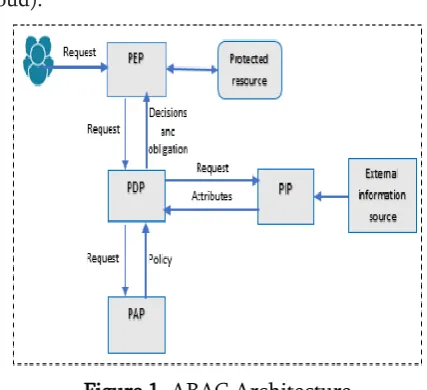
Our approach framework receives property based security system where in all clients are validated and recognized in view of an arrangement of credits which are related to each demand. In our proposed structure, the ABAC is executed and implemented at fognode which gets client get to ask. Each fognode which got asked for activity will break down the qualities that are related with the demand. At that point, in view of these recovered traits and approaches diagram, the consent will be allowed to client. Our proposed arrangement utilized the suggested design of ABAC [14] as appeared in Figure 1. As specified over, this design actualized in the edge of system (fognodes). For that, confirmed and approved access into EHR is connected on ask for at the closest fog rather than at the center of the system (cloud).
Figure 1. ABAC Architecture
The PEP or Policy Enforcement Point looks at the
demand and delivers an approval demand and sends to the PDP.
The PDP or Policy Decision Point assesses approaching solicitations against arrangements that has been developed. The PDP restores a Permit/Deny choice.
The PAP or Policy Administration Point
maintains the approaches and scaffolds PDP to arrangements explanations.
The head of host (fognodes/cloud) is dependable to characterizes pollicises of its host. The multi-inhabitant nature of the fog processing model raises the prerequisite for a manager to characterize strategies that predicament a client to human services framework and execute arrangement outline. Each fognode has particular polices which are connected just to its clients. The PIP or Policy Information Point keeps up engaging properties and scaffolds the PDP to outer wellsprings of traits e.g. databases. The manager of host (fognodes/cloud) is dependable to characterize PIP of its host. He gets ready information construction that determines an arrangement of characterized traits related with a physical or virtual segment. Each fog has information pattern of its clients just to keep away from unused put away database. The traits considered in our proposed ABAC are:
Subject traits (office, part and occupation title)
Activity properties (see or erase persistent data)
Protest qualities (question write, affectability of
information)
Condition properties (time and location)
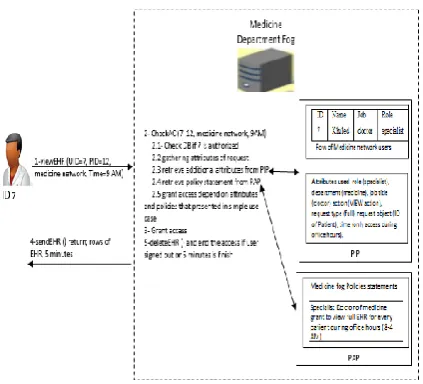
Basic utilize instance of asked for activity (client 7 see understanding 12 record) from Dr Khaled to pharmaceutical office fog is introduced in Figure 2 underneath.
Figure 2. Simple use case of ABAC
Location Based ABAC Fog Computing Architecture Depending upon location of fog gadget, the overseeing and sharing of EHRs between numerous fognodes and cloud is kept up. The imperative issue that we considered in our answer is the low capacities of capacity and processing of fognodes. We center around diminishing the putting away and forms in fognodes to serve the accessibility of fog, to enhance its performance and effectiveness. To accomplish these objectives we suggested that:
All clinic data and necessities are kept up in Cloud (server farm)
Full form of Electronic Medical System (EMR) which contain EHRs of all patients in doctor's facility are executed in cloud (server farm).
It serves all the doctor's facility office's clients.
There is a fog gadget for each and every clinic office Part of EMR is executed in fog, which give just administrations that are required by division's clients to carry out their activity.
Contains data and properties of division organize client and predefined get to arrangements.
Fog applies ABAC into approaching solicitation for each endeavoured get to.
Fog keeps up impermanent and opportune capacity of EHR.
Movement timetable of going to tolerant in healing center is assessed first. This estimation is relegated once quiet visits gathering office and gathering client tries to access to understanding data in cloud.
After first access of the patient record in cloud by the secretary, planning of EHR sharing amongst cloud and particular fog in particular location happened relies upon proposed estimation. For instance, quiet Khaled will be coordinated to research center division after gathering office inside 5 minutes. Along these lines, contingent on proposed estimation, the cloud will send duplicate of going by understanding EHR into particular location of fog inside 5 minutes.
Timing of patient administrations in particular office is evaluated. When understanding arrives and client in this location (office) begins to serve him/her, the clock is begun and after the clock closes, the EHR is erased from the brief stockpiling of fog.
Simple situation is displayed in Figure 3 to clarify straightforward patient work process from gathering to lab and time of EHR sharing amongst cloud and particular fog in particular location (research facility). It is evaluated that patient following 6 minutes (360 s) will go to lab division. Prior to the patients' entry to research center office, the cloud will send duplicate of going by quiet EHR to particular location (lab division).
Figure 3. EHR sharing between cloud and fog
V.
CONCLUSION
We gave ABAC into the EHR in fog to avert unapproved get to. Additionally, we considered in our answer the low capacities of capacity and registering of fognodes by concentrating on decreasing the putting away and forms in fognodes to serve the accessibility of fog, to enhance its performance and proficiency. In our future work, we will mimic our answer by utilizing iFogSim device and we will assess the aftereffects of our answer.
VI.
REFERENCES
[1]. Narayanan HAJ, Güneş MH, editors. Ensuring access control in cloud provisioned healthcaresystems. 2011 IEEE Consumer Communications and Networking Conference (CCNC); 2011: IEEE.
[2]. Jin J, Ahn G-J, Hu H, Covington MJ, Zhang X. Patient-centric authorization framework for electronichealthcare services. computers& security. 2011s;30(2):116-27.
[3]. Huang J, Sharaf M, Huang C-T, editors. A hierarchical framework for secure and scalable ehrsharingand access control in multi-cloud. 2012 41st International Conference on Parallel ProcessingWorkshops; 2012: IEEE.
[4]. Cao Y, Chen S, Hou P, Brown D, editors. FAST: A fog computing assisted distributed analyticssystem to monitor fall for stroke mitigation. Networking, Architecture and Storage (NAS), 2015 IEEEInternational Conference on; 2015: IEEE.
[5]. Mei B, Cheng W, Cheng X, editors. Fog Computing Based Ultraviolet Radiation Measurement viaSmartphones. Hot Topics in Web Systems and Technologies (HotWeb), 2015 Third IEEE Workshopon; 2015: IEEE. [6]. Gia TN, Jiang M, Rahmani A-M, Westerlund T,
Liljeberg P, Tenhunen H, editors. Fog Computing inHealthcare Internet of Things: A Case Study on ECG Feature Extraction.
Ubiquitous Computing and Communications;
Dependable, Autonomic and
SecureComputing; Pervasive Intelligence and Computing (CIT/IUCC/DASC/PICOM), 2015 IEEEInternational Conference on; 2015: IEEE. [7]. Coyne E, Weil TR. ABAC and RBAC: scalable,
flexible, and auditable access management. ITProfessional. 2013;15(3):0014-16.
[8]. Hong K, Lillethun D, Ramachandran U, Ottenwalder B, Koldehofe B, editors. Opportunistic spatiotemporalevent processing for mobile situation awareness. Proceedings of the 7th ACM internationalconference on Distributed event-based systems; 2013: ACM. [9]. Zhu J, Chan DS, Prabhu MS, Natarajan P, Hu
H, Bonomi F, editors. Improving web sites performance using edge servers in fog computing architecture. Service Oriented System Engineering(SOSE), 2013 IEEE 7th International Symposium on; 2013: IEEE. [10]. Hong K, Lillethun D, Ramachandran U,
Ottenwalder B, Koldehofe B, editors. Mobile fog: Aprogramming model for large-scale applications on the internet of things. Proceedings of the secondACM SIGCOMM workshop on Mobile cloud computing; 2013: ACM.
[11]. Bonomi F, Milito R, Zhu J, Addepalli S, editors. Fog computing and its role in the internet of things.Proceedings of the first edition of the MCC workshop on Mobile cloud computing; 2012: ACM.
[12]. Wu R, Ahn G-J, Hu H, editors. Secure sharing of electronic health records in clouds.
CollaborativeComputing: Networking,
Applications and Worksharing
(CollaborateCom), 2012 8th
InternationalConference on; 2012: IEEE. [13]. NIST GS, Goguen A, Fringa A. Risk
Management Guide for Information
Technology Systems.Recommendations of the National Institute of Standards and Technology. 2002.
[14]. Boyd C, Mathuria A. Protocols for
authentication and key establishment: Springer Science &Business Media; 2013.
ABOUT AUTHORS:
K.Naresh is currently pursuing Master of Computer Applications in QIS College of Engineering & Technology, Ongole.AP. He is area of interest in MCA meanDepartment of Master of Computer Applications from QIS College of Engineering & Technology, Ongole.AP.