© 2018 IJSRCSEIT | Volume 3 | Issue 3 | ISSN : 2456-3307
Secured Framework Facilitator with Essential Tool Sets
Dr. V Ilango, Abhishek Kumar
Department of MCA, New Horizon College of Engineering, Bengaluru, Karnataka, India
ABSTRACT
In current scenario various company uses a group of people to manage and analyze the work and the workflow. The main parts of them are to manage, monitor, analyze and provide various security layers to the company processes. The proposed model will be able to do the mentioned works from a single place with minimum amount of effort required to be done. It helps to monitor and analyze the business for the company by generating the customizable report accordingly for each and different branch of company. For organizational mobility of an integrated working on a large scale, the tunneling topology fulfill the requirements which need to be matched up according to the company’s distribution requirements. In this, different prospectus of arrangements has to be considered. A set of multiple structural grids will be required with different functional accessibility irrespective of operational environment from various offices. Service based rule mechanism will be set from the proposed work which incorporates design that will help the companies and provide a substantial work processing provided by a central console that minimizes the related complexity which currently institutions are facing. Due to major technical perception, an outlying establishment is required that will be administrated for various framework identity to reduce the potential risk of security and performance. An isolated accessibility platform would be provided to help and identify the technical challenges on a cross platform alliance with various tunneling information. To curtail the economic perception on any organization, the significant commercial use will be needed when the companies are based in multiple constituents.
Keywords: Tunneling Topology, Monitor, Manage, Analyze, Workflow, Model, Customizable, Framework, Risk, Cross Platform, Performance, Economy, Structural Grid.
I.
INTRODUCTION
We require a team of skilled professionals with high experience to manage the work done in various branches of the company. Similarly other set of people are also required to do the other jobs. It costs a high amount to the company. By providing such framework it helps to reduce the company cost for each and every project required by its client. The proposed framework will consists of features essentially like:
a) Manage the workflow
b) Monitor the work done in past c) Analyze the generated report d) Provide Security layers
The analysis part requires expertize view with respect to the domain knowledge. The provided set of tools will generate a customizable report for each and every work to better understand it.
accessed from anywhere on the globe and can provide login credentials to do the same.
The distribution requirement of a company is the basis which need to be cope with tunneling topology. It considers various prospectus of arrangements which have to be conceived for grids. The large scale integrated working cope with the organizational mobility. All various sets of structural grid will be organized by the system. These grids are associated with different functional accessibility with respect to distinct operational environment from multiple offices. A set of service based rule mechanism will be designed for providing a substantial work processing through centralized control. For routing of information in a bigger organization requires a sense of security due to a bigger distribution working base. Tunneling topology will be used to handle various number of companies all at a same place. It will be able to deal with them at the real time.
There will be a central navigated processing which helps to define different functional aspects for bigger organizations. A set of distinct destination computations will be provided by substantial work processing at a centralized place. For the incorporation of data identity and navigational aspect, bridges and gateways are required. These gateways will help to provide cross platform compatibility. A guided format will be used to provide protocol definitions. This will elaborate the work style and help to define required structural definition. This definition will represent the monitoring facility which can be rendered to users. For the optimization of processes, the administrator will be provided with the required navigational information.
The information can be transferred either in in-series or in out-series which can be managed by guided integration. To track every minute detail regarding different considerations, the information criteria would be elaborated. These information can be detailed resource information, processes tracking
information, application information, services over hold etc. These information can be converted into visual formats for process optimization. In the defined controller interface multiple clients can be managed and organized. This will enhance productivity that is required.
There will be a centralized repository provisioning to have a well-defined data show which would be required for monitoring and analysis and it can be easily organized with the required set of standard security provisioning. To manage the suspicious considerations the system includes defined network resilience with end to end encryption.
II.
LITERATURE SURVEY
Currently we need to do all the management, monitoring, analysis and security work manually. There are no real time set of tools to do all the works at the same place. It costs a huge amount to the company to keep track of all these works and keep different set of expertise people. In the proposed system, a set of tools with a framework will be provided to manage and monitor the work at the real time. It provides various security layers to make it un-penetrable by any exterior person. Tunneling topology will help to keep the various number of companies and can be handled by a few number of people all at the same place.In the existing system the process of doing the previous mentioned work is costly and time consuming. The proposed work will reduce the cost of the company for each and every project as well as saves the time. The requirement gathering process will take time to analyze all the expectations of the client.
detailed understanding of terminology the layered working will be quite difficult. The environmental technology of one office will differ from another ones in relation to bigger companies. In the existing system layout designs of components are static and cannot be customized as per the requirements which imposes a negative impact on flexibility provision. A prebuilt format is used for information routing which cannot be altered as per the requirement. The existing system does not support the bridging which is required for structuring of multi environmental setup. Various vendors are facing the problem of network resilience that are required for maintaining stages of monitoring and tracking. Due to the difficulty of reflective tracking for the source reach, the congestion tracking is a major concern but it’s too important with reference of counter management to have the impact on overall working.
A framework is proposed by Peter R.J. Trim [1] for providing security to business, government and society from cyber-attacks. It describes how a manager can use the framework in a place to reduce organizational vulnerability by undermining cyber threats. J. Thelin and P.J. Murray [6] proposed a web service based security framework in which the security implementations of the web services are discussed and proposes a framework to handle them. It helps to achieve an end to end security for all web services provided in the pre-existing environment. In the presented work, the model was selected is as such for which there would be more features to be added on in each development cycle. The iterative model suits best for this. In this, there would be high end analysis in the first phase ad user acceptance test at the end of each development cycle.
After the analysis and requirement gathering phase there would be study for the feasibility of the proposed model. In this, it would be decided whether the requested framework is practically feasible or not with respect to the other companies and workspace area. The geographic scaling is the basis of the
proposed system design as the corporate intricately works on numerous offices based on various environmental technology as the requirement is to optimize related services and performance navigation from a single system base. In the existing system it is difficult to operate in terms of flexibility for all relative network resilience and even on scale of economics. All required working will be incorporated with the proposed system in reference to different grid system from a single point which can be utilized as a base of multiple client management to individual company networks. Referential integrity is required in the proposed system for the purpose of security based surveillance as the security measure of the incorporated data. In a single screen window, multiple visual references can be designed to support an elaborative structured extension. Configuration of multiple layers and security protocols can be done without vendor software and its services. This cut shorts the cost and removes the complexity in the infrastructure that persist in the existing system. Easy to configurable transmission medium is incorporated on the system with the provided setup revision and the work proposition which need to be managed does not demand extensive knowledge. The working will be enhanced by providing detailed reporting system with a selective output structure that helps to insure the details in real time. The proposed system supports multiple conceptions working at real time. Resource organization can be done with the system reference because of incorporation of all system from a single system. In table 1 the features are described which the main highlights of the proposed system are.
Table 1. Features of the Proposed Framework Feature Description
Resource Organization
Management For management of large organization numerous topologically integrated collections are supported from a central console. Security The system will be provided
with security based surveillance.
Compatibilit y
It will support numerous network technology with compatibility amongst them. Tracking Elaborated reports will be
provided on the real time tracking of information. Command
Interpreter
It is provided with integrated resource support and the provision of clubbing with the command based operation.
III.
PROBLEM IDENTIFICATION
A set of people requires for various operations to do the same work. It is a tedious task to monitor the real time process of each and individual person.
The required report for each team of software development differs in structure and the flow of the layout. So generating same report for various people is a time consuming operation.
To manage a group of people we need a real time software which incorporates various other features to track them also. The analysis part cannot be done automatically to generate different set of reports. A thorough understanding is required of the proposed venture to ascertain all the threats and opportunities. In this all the needed proposal will be outlined before we begin the design and development.Feasibility study is very much important for the decision making and for the understanding of related consideration to achieve the objectives.
According to Gael I. Orsmond and Ellen S. Cohn [13], the features of feasibility study is to identify the main objectives and illustrate the use of these objectives. According to them assessment of recruitment capability and acceptability of the intervention are the main objectives of feasibility.
IV.
MODULES OF SECURED FRAMEWORK
FACILITATOR
Framework
It would assist the companies to incorporate all unlike infrastructure portions to an isolated console system so the all the various formulations of the procedure can be coordinated and supervised properly. For the process of validation and accessing the components a profound system is required to be established with the gateways to process the existent distributed constituent distant infrastructure. A compatible version of various technology is used by the associate is expected to be integrated and incorporated. Authenticated users will be provided with the revision page which will be used to incorporate all cross platforms for an associated working of single company on with respect to multiple clients at real time. In different tunneling session, the incorporation of various security layers will be used and incorporated to achieve a more prominent security layer.
The authenticated infrastructure will be promised with all tracking for integrated transfer and control.For the sniffing considerations automation channels to be set up for a detailed monitoring. To have a pinpoint acknowledgement of various reports required Effective end point consideration will be taken.
Interpret
The selective range of infrastructure includes the notification system for evaluations and consideration. The administrator will be provided by all the component information into multiple sections as it will be generated by a pre-programmed structural reference design. The system will track the multiple coinciding services and other considerations of the potential concern and will be supplied in an understandable elaborated report. Different algorithms will provide sniffing for security perception and to build appropriate cracking to build understanding. With multiple variants of work assistant direct process understanding on the remote infrastructure will be supported.
Figure 1. Block Diagram of Framework for providing various Facilities
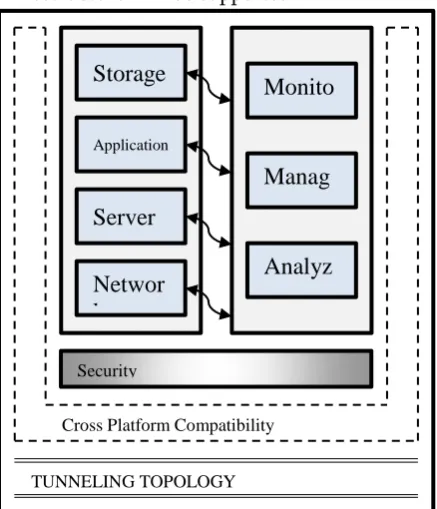
The block diagram of the proposed framework for various facilities is provided in the fig. 1, in which the security will be provided to all the activities and process which are to be handled by a set of people. It protects the framework from various cyber-attacks. The cross platform compatibility is the must to be present at the central control unit to cope up with different architecture of the systems situated in distinct locations of one or many companies.
The tunneling topology will work on parallel work place with many number of systems in real time and would be able to handle clients according to the request by providing a secure connection for each and every session of login in the system. The monitoring facility will be a continuous process for each and every task to be done with the activities performed by employees to manage the work flow and analyze the performance of both.
The analysis part for the work done will be performed by a set of expertise people with the help of reports generated by the framework. Those reports will be customizable to be provided in various formats. It helps to gather the required information needed to generate the report on the demanded activity. The report generated too can be customized for different branch of the company.
The central control will be provided by a command line interpreter to do console work on a distinct system. It can be used to grant and revoke permission to a file. Software installation and maintenance is the main part of the console which would be provided with the administrative authentication.
Figure 2. Operational Design of Proposed Infrastructure
In the figure 2 the operational design of the infrastructure is shown. In this all the different categories of management work are provided which will be organized through a central console for ex. Operations, applications, security rules, protocols etc.
Storage
Application
Server
Networ
k
Monito
r
Manag
e
Analyz
e
Cross Platform Compatibility Security
TUNNELING TOPOLOGY
Central
Consol
e
Network Management
Server Management
Security Management Application
Management
V.
CONCLUSION
The proposed system is built for various infrastructure identity enhancement and it can be controlled from one single control system. It can be clubbed and integrated with multiple users to provide different liabilities which help to manage multiple activities at real time with high precision and understanding. The configuration setups provided by administrator can be used to setup multiple environments. After that the permission grant level gives access to process the information required accordingly. A one place information will be provided in a very simple structure by the proposed system where different categorical selection can be made by the users. By this the information base will be generated for analysis. The export of information can be done in numerous options like convergence requirements.This application can be used by any type of company even if they are associated with cross platform technology and multiple offices. In these cases, it can also be configured through a central located office. It can be used for giving support for multiple clients and environment.A more stable multiple optional workspace will be provided by the system which can be configured by the users according to their requirements which changes over time. A well security system is incorporated so that all needed standard security features will be fulfilled. A direct control to the administrator work will be granted through the command system to work on the client side directly.
There would be great scope of such type of developed system which integrates the previously mentioned features. It will help in each and every aspect to remotely control a group of various system with a single group of people and reduce the company cost to the designed organization. It will help other small organization to evolve with the market and competing companies by providing more number of work opportunity.
VI.
AUTHOR’S BIOGRAPHY
1. Dr. V Ilango is working as HOD in the Department of Computer Applications, New Horizon College of Engineering, Marathalli, Bangalore , Karnataka , INDIA.
2.Abhishek Kumar is doing his MCA Course in the Department of Computer Applications, New Horizon College of Engineering, Marathalli, Bangalore , Karnataka , INDIA. His research interest includes Algorithms, Data Structures, Networks, Software Engineering, Cryptography and Software Reliability.
VII.
REFERENCES
[1]. Peter R.J. Trim, Yang-Im Lee, "A security framework for protecting business, government and society from cyber attacks", System of Systems Engineering (SoSE), 2010 5th International Conference, 22-24 June 2010. [2]. Hamza Djigal, Feng Jun, Jiamin Lu, "Smart
Framework for future Smart City", Cyber Security and Cloud Computing (CSCloud), 2017 IEEE 4th International Conference, 26-28 June 2017.
[3]. D. Kelaidonis, "Cloud Internet of Things Framework for Enabling Services in Smart Cities", Designing Developing and Facilitating Smart Cities 2017.
[4]. L. Lopez, F. J. Nieto, T.-H. Velivassaki, S. Kosta, C.-H. Hong, R. Montella et al., "Heterogeneous Secure Multi-level Remote Acceleration Service for Low-power Integrated Systems and Devices", Procedia Computer Science.
[5]. Mohammad Irshad, "A Systematic Review of Information Security Frameworks in the Internet of Things (IoT)", High Performance Computing and Communications, 12-14 Dec 2016.
Computing, Las Vegas, Nevada, USA, June 23-27, 2002.
[7]. Subhamoy Chakraborti, D. P. Acharjya, Sugata Sanyal, "Application Security framework for Mobile App Development in Enterprise setup". [8]. Machigar Ongtang, Stephen McLaughlin,
William Enck and Patrick McDaniel, "Semantically rich application-centric security in Android", Security and Communication Networks, Volume 5, Issue 6, 2012.
[9]. William Enck, Machigar Ongtang, and Patrick McDaniel, "Mitigating Android Software Misuse Before It Happens", Networking and Security Research Center Technical Report, NAS-TR-0094-2008.
[10]. G. Delac, M. Silic and J. Krolo, "Emerging Security Threats for Mobile Platforms", MIPRO, 2011 Proceedings of the 34th International Convention, pp 1468 – 1473, Print ISBN: 978-14577-0996-8, 2011.
[11]. K. Munir and S. Palaniappan, "Security Threats\Attacks present in Cloud Environment", International Journal of Computer Science and Network Security (IJCSNS) vol 12, No.12,December 2012, pp. 107-114, ISSN : 1738-7906.
[12]. Kashif Munir, Prof Dr. Sellapan Palaniappan, "FRAMEWORK FORSECURECLOUD COMPUTING", International Journal on Cloud Computing: Services and Architecture (IJCCSA),2013.
[13]. Gael I. Orsmond and Ellen S. Cohn, "The Distinctive Features of a Feasibility Study: Objectives and Guiding Questions", OTJR: Occupation, Participation and Health 2015. [14]. Bowen, D. J., Kreuter, M., Spring, B.,
Cofta-Woerpel, L., Linnan, L., Weiner, Fernandez, M, "How we design feasibility studies", American Journal of Preventive Medicine 2009.
[15]. Anurag Kumar Jain, and Shanbhag Devendra, "Addressing Security and Privacy Risks in
Mobile Applications", IT Professional 14.5 (2012): 28-33.
[16]. M.Jensen ,N.Gruschka et al., "The impact of flooding Attacks on network based services", Proceedings of the IEEE International conference on Availiabilty,Reliability and Security (ARES) 2008.
[17]. R. Sravan Kumar and A. Saxena, "Data integrity proofs in cloud storage", Third International Conference on Communication Systems and Networks (COMSNETS), 2011.
[18]. James Joshi, Rafae Bhatti, Elisa Bertino, Arif Ghafoor, "Access-Control Language for Multi domain Environments," IEEE Internet Computing, 2004.
[19]. Dongwan Shin and Gail-J. Ahn, "Role-based Privilege and Trust Management," Computer Systems Science and Engineering Journal, Vol. 20, No. 6, CRL Publishing, 2005.