Towards the Automatic Merging of Lexical Resources:
Automatic Mapping
Muntsa Padró Núria Bel Silvia Necsulescu
IULA
Universitat Pompeu Fabra Barcelona, Spain
IULA
Universitat Pompeu Fabra Barcelona, Spain
IULA
Universitat Pompeu Fabra Barcelona, Spain
[email protected] [email protected] [email protected]
Abstract
Lexical Resources are a critical component for Natural Language Processing applications. However, the high cost of comparing and merg-ing different resources has been a bottleneck to have richer resources with a broad range of po-tential uses for a significant number of lan-guages. With the objective of reducing cost by eliminating human intervention, we present a new method for automating the merging of re-sources, with special emphasis in what we call the mapping step. This mapping step, which converts the resources into a common format that allows latter the merging, is usually per-formed with huge manual effort and thus makes the whole process very costly. Thus, we pro-pose a method to perform this mapping fully automatically. To test our method, we have ad-dressed the merging of two verb subcategoriza-tion frame lexica for Spanish, The results achieved, that almost replicate human work, demonstrate the feasibility of the approach.
1 Introduction
The production, updating, tuning and maintenance of Language Resources for Natural Language Processing is currently being considered as one of the most promising areas of advances for the full deployment of Language Technologies. The reason is that these resources that describe, in one way or another, the characteristics of a particular language are necessary for Language Technologies to work.
Although the re-use of existing resources such as WordNet (Fellbaum, 1998) in different
applica-tions has been a well known and successful case, it is not very frequent. The different technology or application requirements, or even the ignorance about the existence of other resources, has pro-voked the proliferation of different, unrelated re-sources that, if merged, could constitute a richer repository of information augmenting the number of potential uses. This is especially important for under-resourced languages, which normally suffer from the lack of broad coverage resources. The research reported in this paper was done in the context of the creation of a gold-standard for sub-categorization frames of Spanish verbs to be used in lexical acquisition (Korhonen, 2002). We wanted to merge two hand-written, large scale Spanish lexica to obtain a new one that is richer and validated. Because subcategorization frames contain highly structured information, it was con-sidered a good scenario for testing new lexical resource merging methods.
Several attempts at resource merging have been addressed and reported in the literature. Teufel (1995) and Chan & Wu (1999) were concerned with the merging of several source lexica for PoS tagging. The merging of more complex lexica has been addressed by Crouch and King (2005) who produced a Unified Lexicon with lexical entries for verbs based on their syntactic subcategorization in combination with their meaning, as described by WordNet, Cyc (Lenat, 1995) and VerbNet (Kipper et al., 2000).
2. It splits the SRG graphs following the feature-value attributes and builds a binary vector with the verbs that contain each element.
3. For each Incyta SCF minimal unit, it assesses the similarity with each SRG unit comparing the two binary vectors using the Jaccard dis-tance measure, especially suited for binary vec-tors and as in (Chan and Wu, 1999).
4. It chooses as the corresponding elements those that maximize similarity.
Once the corresponding elements have been ex-tracted, a new feature structure is constructed subs-tituting Incyta units with those from SRG and the actual merging with the SRG lexicon is done. Since the SCFs have a graph structure, we used a unification mechanism (NLTK, Bird 2006) to merge both lexica, lemma by lemma, as in Necsu-lescu et al. (2011). Thus, we obtained, totally au-tomatically, a new lexicon that contains SCF information from both lexica.
3 Evaluation and Results
To evaluate the results of our automatic mapping algorithm, we used the resulting lexicon of Necsu-lescu et al (2011) work as our gold-standard. To create this lexicon, Necsulescu et al (2011) devel-oped a manually built set of extraction rules that converted Incyta list-based SCF’s into SRG-like feature structures. Once both dictionaries were reliably converted into the same format, they were merged by using unification, thus obtaining a rich-er lexicon that we have used as the gold-standard for the automatic mapping exercise.
In order to evaluate the quality of the automatic mapping step, we compared the lexicon resulting from the merging of the SRG and the automatically mapped Incyta lexicon with the gold-standard. This comparison was first carried out by looking for identical SCFs in the entries of every particular verb. However, the results of the automatic map-ping are in some cases parts of SCFs, because of the piece splitting process. As said, merging adds the lacking information in numerous cases, but the Incyta SCFs that do not unify with any SRG SCF remain incomplete. Also, there are cases in which the manually converted frame has more informa-tion than the automatic one, but the SCFs resulting from the automating mapping subsumes the one in the gold-standard, so they may be considered cor-rect, although incomplete. Thus, in a second
meas-ure, we also count these pieces that are compatible with SCFs in the gold-standard as a positive result. The evaluation is done using traditional preci-sion, recall and F1 measures for each verb and then we compute the mean of these measures over all the verbs. The results, shown in table 1, are near 88% of F1 even in the strict case of identical SCFs. If we compare SCFs that unify, the results are even more satisfactory.
P R F1 A-identical 87,35% 88,02% 87,69% B-compatible 92,35% 93,08% 92,72%
Table 1: Average results of the mapping exercise
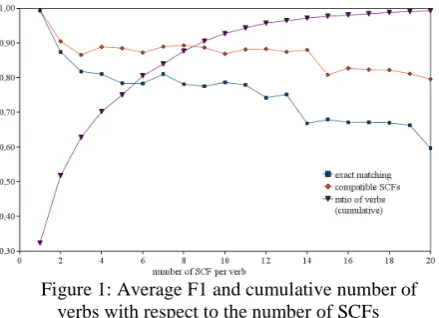
In Figure 1 we can see the performance in terms of number of SCFs under a lemma that are the same in the gold-standard and in the merged lexicon. We also plot the ratio of verbs that have a particular number of SCFs or less. The verbs that have one or two SCFs (about 50% of the verbs) obtain high values, as it may be expected. Nevertheless, 95% of verbs (those with 11 or less SCFs per lemma) obtain at least F1=80% when counting strictly equal SCFs and F1 over 90% when counting unify-ing SCFs. Note that these figures are the lower threshold, since verbs with less SCFs have better results, as it can be seen in Figure 1. To summar-ize, we consider that the obtained precision and recall of all verbs, even those with more than two SCFs, are very satisfactory.
Figure 1: Average F1 and cumulative number of verbs with respect to the number of SCFs
of the original information. Nevertheless, our algo-rithm correctly adds information when there are gaps in one of the dictionaries. It is able to learn correspondences such as “INT” (Incyta for inter-rogative clause) to “q” in SRG and to add this in-formation when it is missed in a particular entry of the SRG lexicon but available in the Incyta entry.
4 Conclusions and Future Work
We have proposed a method to reduce human in-tervention in the merging of lexical resources. In order to unify different lexica, the resources need to be mapped into a comparable format. To reduce the cost of extracting and comparing the contents, we proposed a method to make the mapping auto-matically. We consider the results obtained very satisfactory. Our method rids the manual informa-tion extracinforma-tion phase, which is the big bottleneck for the re-use and merging of language resources.
The strongest point of our method is that it can be applied without the need of knowing the struc-ture nor the semantics of the lexica to be com-pared. This allows us to think our method can be extended to other types of Lexical Resources. The only requirement is that all resources to be merged contain some common data. Although further work is needed for assessing how much common data guarantees the same results, the current work is indicative of the feasibility of our approach.
It is important to note that the results presented here are obtained without using what Crouch and King (2005) call patch files. Automatic merging produces consistent errors that can be objects of further refinement. Thus, it is possible to devise specific patches that correct or add information in particular cases where either wrong or incomplete information is produced. It is future work to study the use of patch files to improve our method.
Acknowledgments
This project has been funded by the PANACEA project (EU-7FP-ITC-248064) and the CLARA project (EU-7FP-ITN-238405).
References
Juan Alberto Alonso, András Bocsák. 2005. Machine Translation for Catalan-Spanish. The Real Case for Productive MT; In Proceedings of the tenth
Confe-rence on European Association of Machine Transla-tion (EAMT 2005), Budapest, Hungary.
Steven Bird. 2006. NLTK: the natural language toolkit. In Proceedings of the COLING/ACL on Interactive presentation sessions. Association for Computational Linguistics, Morristown, NJ, USA.
Ignacio Bosque and Violeta Demonte, Eds. (1999): Gramática descriptiva de la lengua española, R.A.E. - Espasa Calpe, Madrid.
Daniel K. Chan and Dekai Wu. 1999. Automatically Merging Lexicons that have Incompatible Part-of-Speech Categories. Joint SIGDAT Conference on Empirical Methods in Natural Language Processing and Very Large Corpora (EMNLP/VLC-99). Mary-land.
Ann Copestake. 2002. Implementing Typed Feature Structure Grammars. CSLI Publications, CSLI lec-ture notes, number 110, Chicago.
Dick Crouch and Tracy H. King. 2005. Unifying lexical resources. Proceedings of Interdisciplinary Workshop on the Identification and Representation of Verb Fea-tures and Verb Classes. Saarbruecken; Germany.
Christiane Fellbaum. 1998. WordNet: An Electronic Lexical Database. MIT Press.
Gil Francopoulo, Núria Bel, Monte George, Nicoletta Calzolari, Mandy Pet, and Claudia Soria. 2008. Mul-tilingual resources for NLP in the lexical markup framework (LMF). Journal of Language Resources and Evaluation, 43 (1).
John Hughes, Clive Souter, and E. Atwell. 1995. Auto-matic Extraction of Tagset Mappings from Parallel-Annotated Corpora. Computation and Language.
Nancy Ide and Harry Bunt. 2010. Anatomy of Annota-tion Schemes: Mapping to GrAF. Proceedings of the Fourth Linguistic Annotation Workshop, ACL 2010
Daniel Jurafsky and James H. Martin. 2009. Speech and Language Processing: An Introduction to Natural Language Processing, Speech Recognition, and Computational Linguistics. 2nd edition. Prentice-Hall.
Karin Kipper, Hoa Trang Dang, and Martha Palmer. 2000. Class-based construction of a verb lexicon. In Proceedings of AAAI/IAAI.
Anna Korhonen. 2002. Subcategorization Acquisition. PhD thesis published as Technical Report UCAM-CL-TR-530. Computer Laboratory, University of Cambridge
Christopher D. Manning and Hinrich Schütze. 1999. Foundations of Statistical Natural Language Processing. MIT Press, Cambridge, MA, USA.
Montserrat Marimon. 2010. The Spanish Resource Grammar. Proceedings of the Seventh Conference on International Language Resources and Evaluation (LREC'10). Paris, France: European Language Re-sources Association (ELRA).
Miguel A. Molinero, Benoît Sagot and Nicolas Lionel. 2009. Building a morphological and syntactic lexicon by merging various linguistic resources. In Proceed-ing of 17th Nordic Conference on Computational Linguistics (NODALIDA-09), Odense, Danemar.
Monica Monachini, Nicoletta Calzolari, Khalid Chou-kri, Jochen Friedrich,Giulio Maltese, Michele Mam-mini, Jan Odijk & Marisa Ulivieri. 2006. Unified Lexicon and Unified Morphosyntactic Specifications for Written and Spoken Italian. In Calzolari et al. (eds.), LREC2006: 5th International Conference on Language Resources and Evaluation: Proceedings, pp. 1852-1857, Genoa, Italy.C.J.
Silvia Necsulescu, Núria Bel, Muntsa Padró, Montserrat Marimon and Eva Revilla: Towards the Automatic Merging of Language Resources. In Proceedings of WoLeR 2011. Ljubljana, Slovenia.
Pollard and I.A. Sag. 1994. Head-driven PhraseStruc-ture Grammar. The University of Chicago Press, Chicago.